XII- CHEMISTRY
Disorders or irregularities in the arrangement of
constituent particles of a solid crystal are called defects
or imperfections.
Crystal Defect
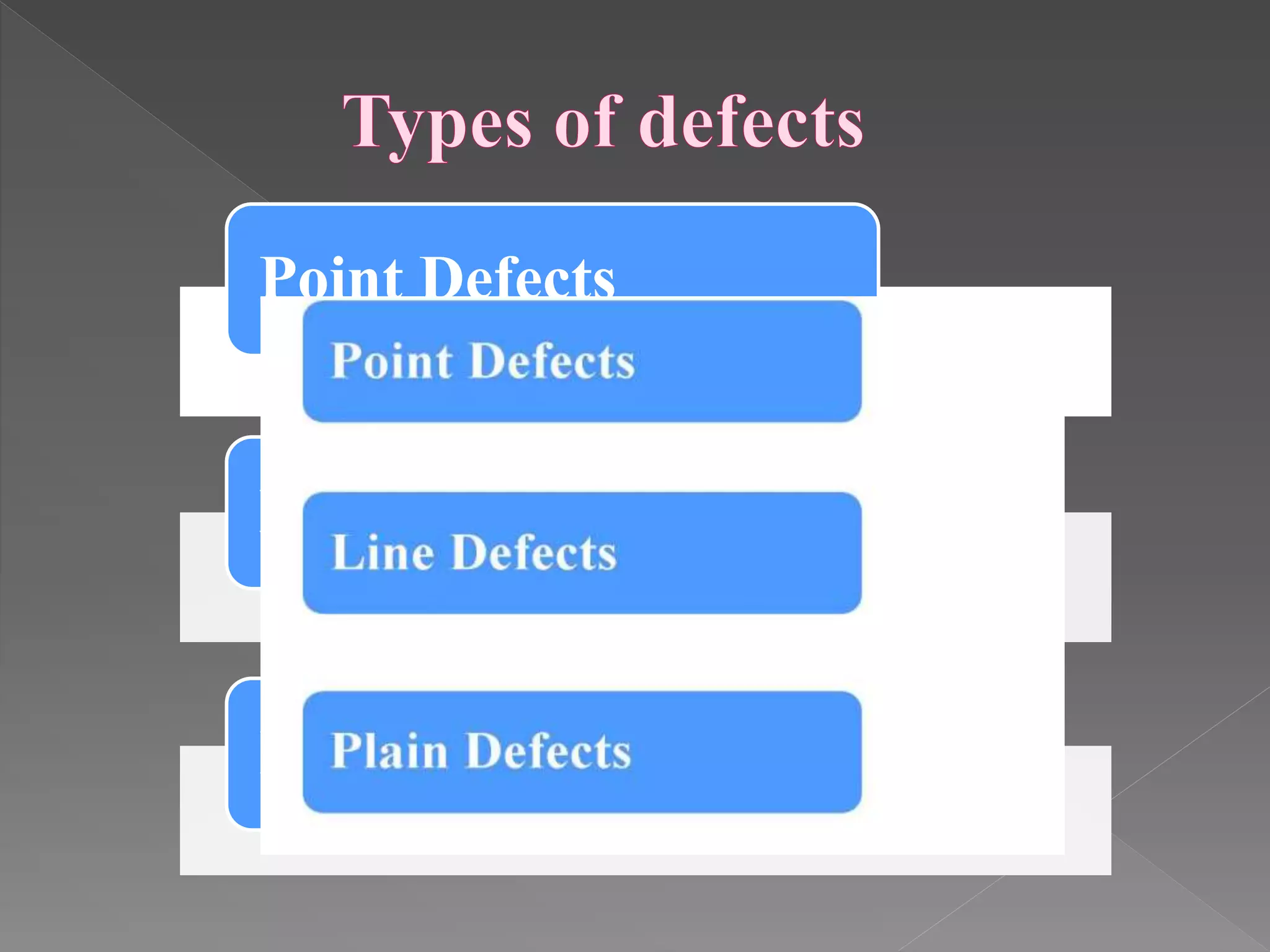
Point Defects
Line Defects
Plain Defects
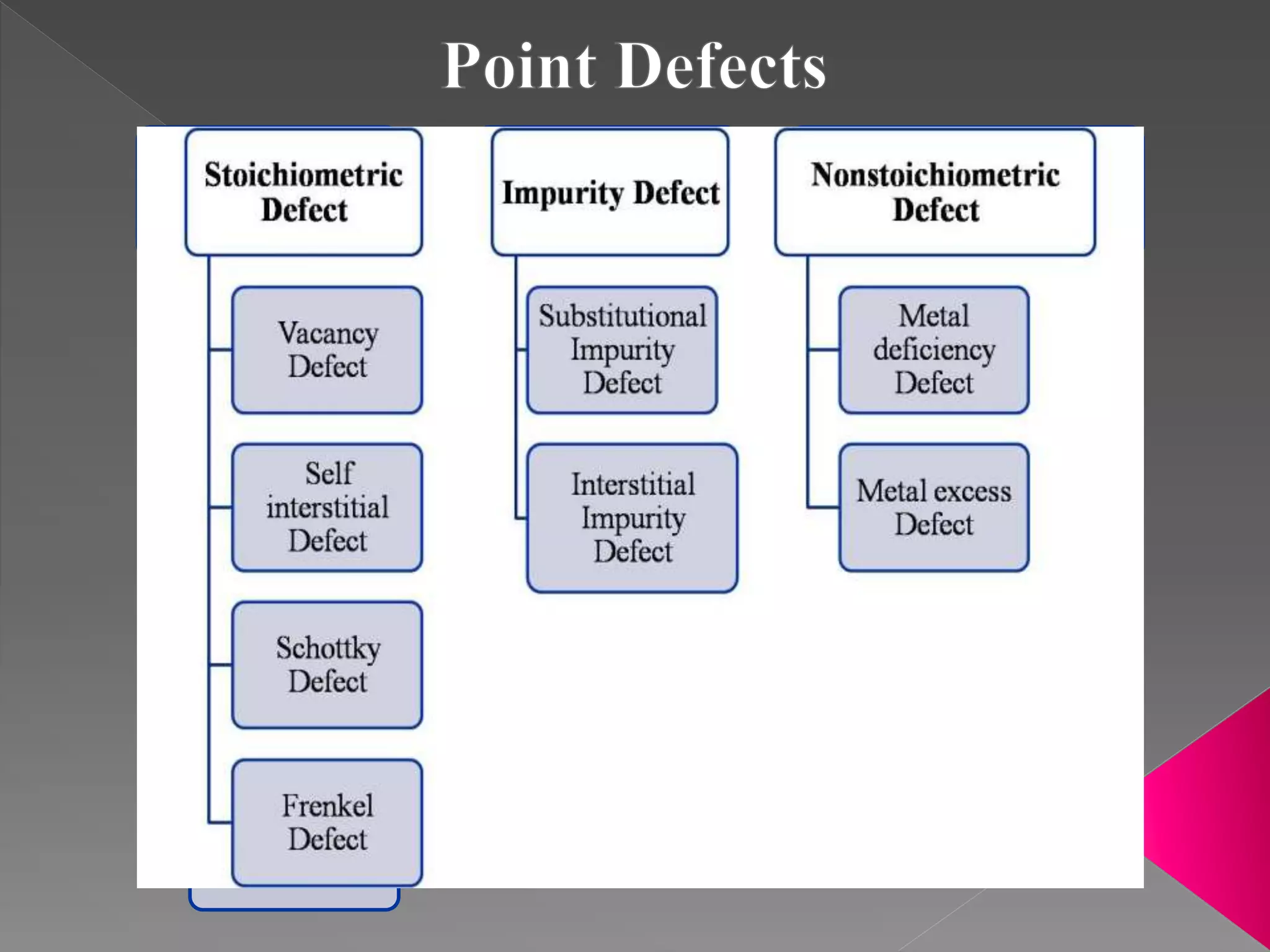
Stoichiometric
Defect
Vacancy Defect
Self interstitial Defect
SchottkyDefect
Frenkel Defect
Impurity Defect
SubstitutionalImpurity
Defect
Interstitial Impurity
Defect
Nonstoichiometric
Defect
Metal deficiency
Defect
Metal excess Defect
The ratio of number of atoms or number of cations and
anions of compounds remains the same as represented by its
chemical formula
i) Vacancy Defect :
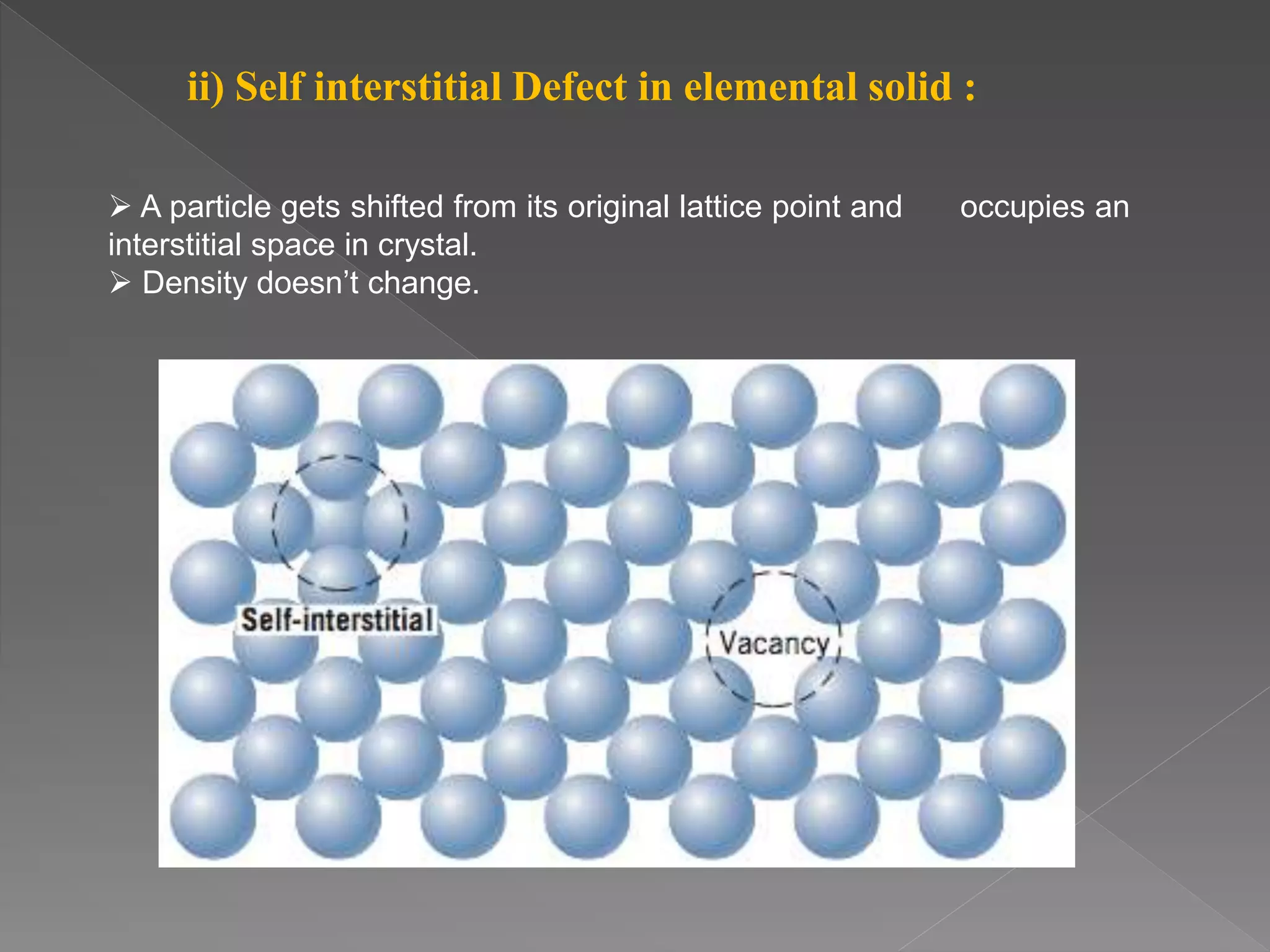
ii) Self interstitial Defect in elemental solid :
Density increases
Extra particle occupies an empty space in crystal lattice
 A particle gets shifted from its original lattice point and occupies an
interstitial space in crystal.
 Density doesn’t change.
ii) Self interstitial Defect in elemental solid :
iii) Schottky Defect :
iv) Frenkel Defect :
Difference between Schottky and frenkel defect
Schottky defect frenkel defect
Occurs in those ionic crystals where
difference in size between cation and anion
is small.
Occurs in those ionic crystals where size of
anion is quite large as compared to that of
the cation.
Ions have high coordination number Ions have low coordination number
Both cation and anion leave the solid
crystal.
Only the smaller ion (cation) leaves its
original lattice site; whereas, the anion
remains in original lattice sites.
Two atoms reduce from the crystal for
each hence schottky defect reduces density
of the solid.
The number of atoms present in the crystal
before and after defect remains same,
hence density of the solid remains same
e.g. NaCl, KCl, AgBr e.g. ZnS, AgCl
 Foreign atoms are present in the crystal lattice.
i) Substitutional Impurity Defect
Solid solutions of metals Vacancy thruogh aliovalent impurity
ii) Interstitial Impurity Defect
The ratio of number of atoms or number of cations and anions of
compounds become different from that indicated by its chemical
formula
i) Metal deficiency Defect
ii) Metal excess Defect
Defect due to extra positive charge occupying interstitial position
Defect due to anion vaccancies
F - Center
THANK YOU

point defect.pptx

  • 1.
  • 2.
    Disorders or irregularitiesin the arrangement of constituent particles of a solid crystal are called defects or imperfections. Crystal Defect
  • 3.
  • 4.
    Stoichiometric Defect Vacancy Defect Self interstitialDefect SchottkyDefect Frenkel Defect Impurity Defect SubstitutionalImpurity Defect Interstitial Impurity Defect Nonstoichiometric Defect Metal deficiency Defect Metal excess Defect
  • 5.
    The ratio ofnumber of atoms or number of cations and anions of compounds remains the same as represented by its chemical formula i) Vacancy Defect :
  • 6.
    ii) Self interstitialDefect in elemental solid : Density increases Extra particle occupies an empty space in crystal lattice
  • 7.
     A particlegets shifted from its original lattice point and occupies an interstitial space in crystal.  Density doesn’t change. ii) Self interstitial Defect in elemental solid :
  • 8.
  • 9.
  • 10.
    Difference between Schottkyand frenkel defect Schottky defect frenkel defect Occurs in those ionic crystals where difference in size between cation and anion is small. Occurs in those ionic crystals where size of anion is quite large as compared to that of the cation. Ions have high coordination number Ions have low coordination number Both cation and anion leave the solid crystal. Only the smaller ion (cation) leaves its original lattice site; whereas, the anion remains in original lattice sites. Two atoms reduce from the crystal for each hence schottky defect reduces density of the solid. The number of atoms present in the crystal before and after defect remains same, hence density of the solid remains same e.g. NaCl, KCl, AgBr e.g. ZnS, AgCl
  • 11.
     Foreign atomsare present in the crystal lattice. i) Substitutional Impurity Defect Solid solutions of metals Vacancy thruogh aliovalent impurity
  • 12.
  • 13.
    The ratio ofnumber of atoms or number of cations and anions of compounds become different from that indicated by its chemical formula i) Metal deficiency Defect
  • 15.
    ii) Metal excessDefect Defect due to extra positive charge occupying interstitial position
  • 16.
    Defect due toanion vaccancies F - Center
  • 17.