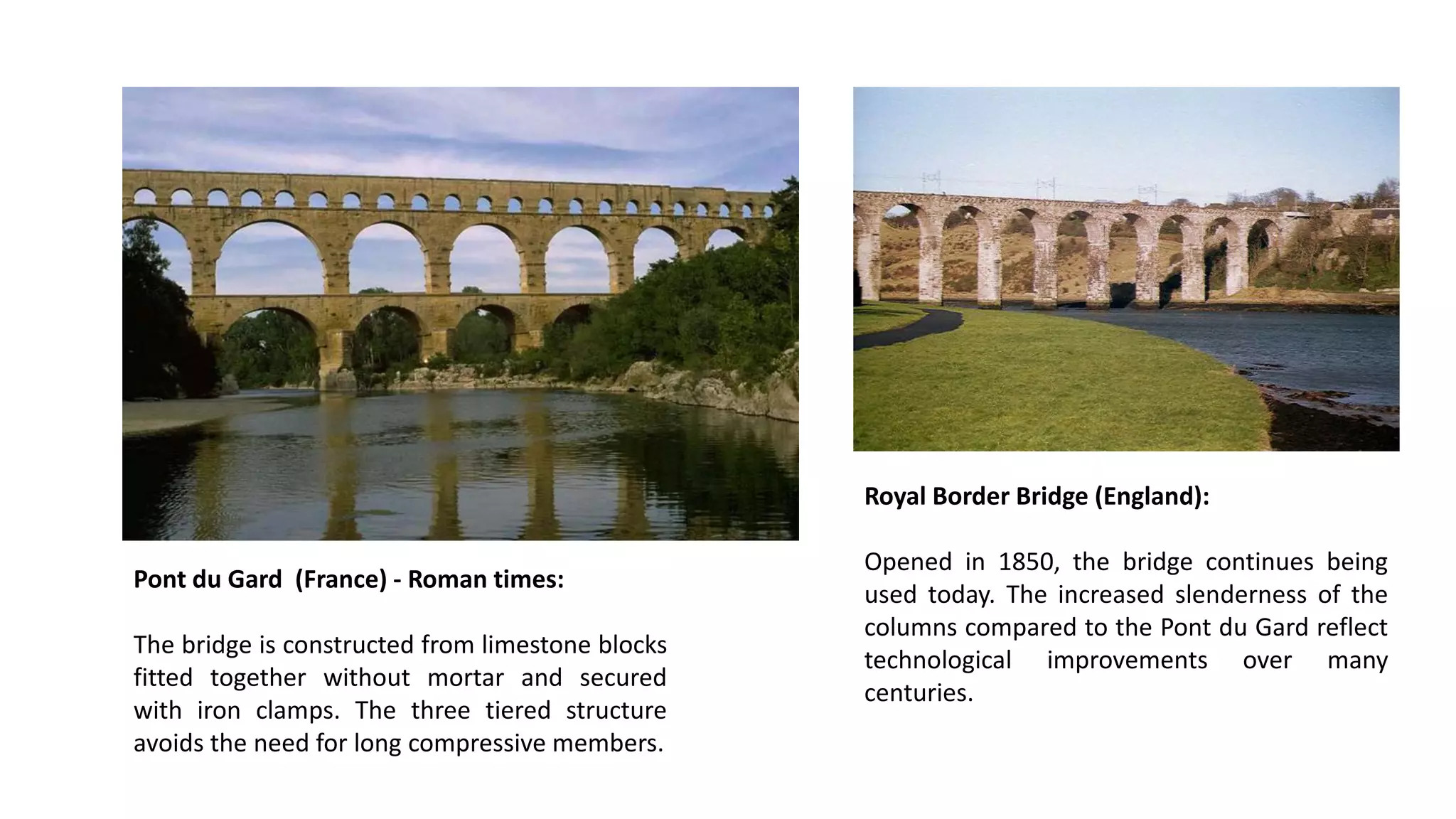
Pont du Gard (France) - Roman times:
The bridge is constructed from limestone blocks
fitted together without mortar and secured
with iron clamps. The three tiered structure
avoids the need for long compressive members.
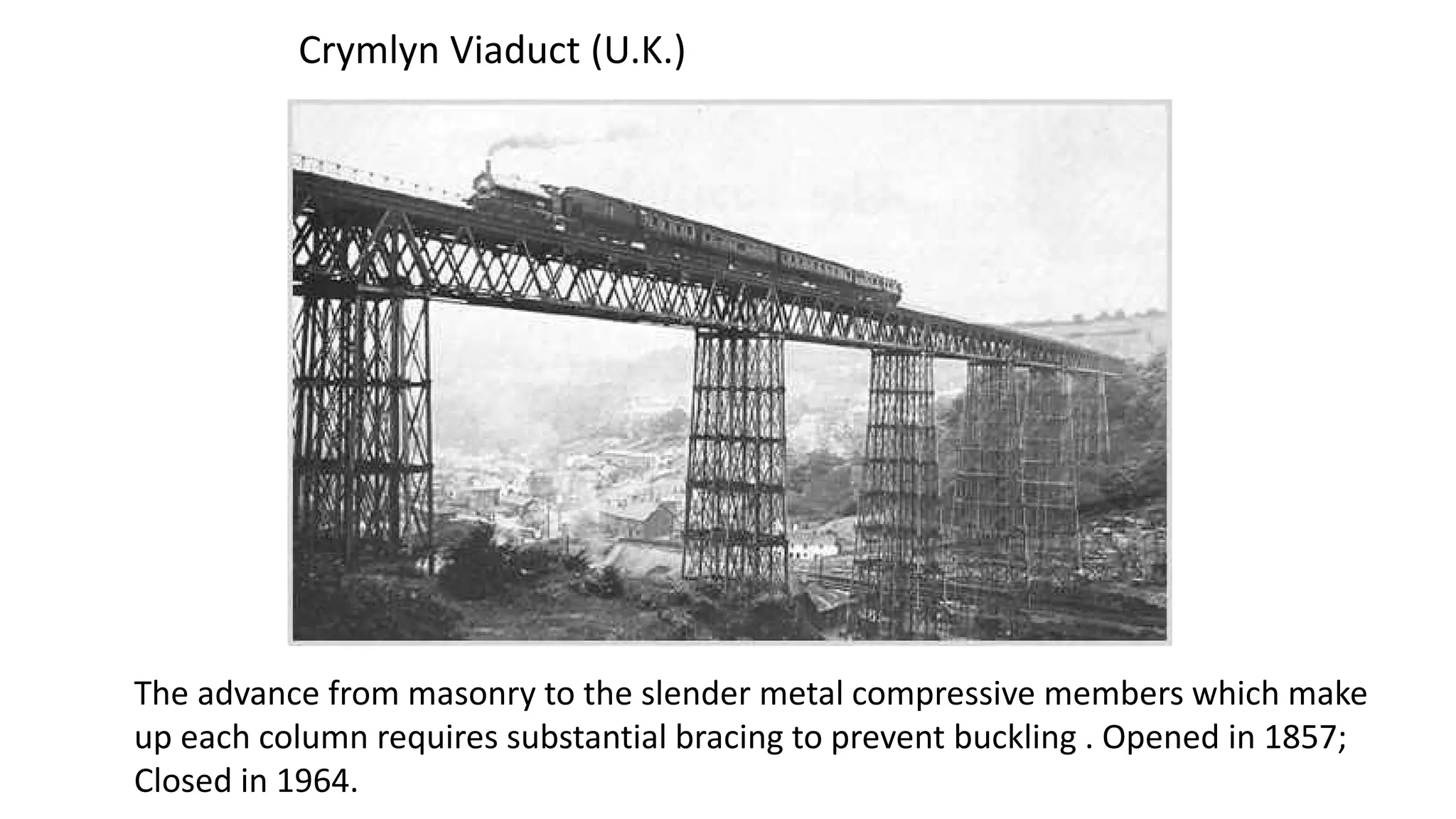
Royal Border Bridge (England):
Opened in 1850, the bridge continues being
used today. The increased slenderness of the
columns compared to the Pont du Gard reflect
technological improvements over many
centuries.
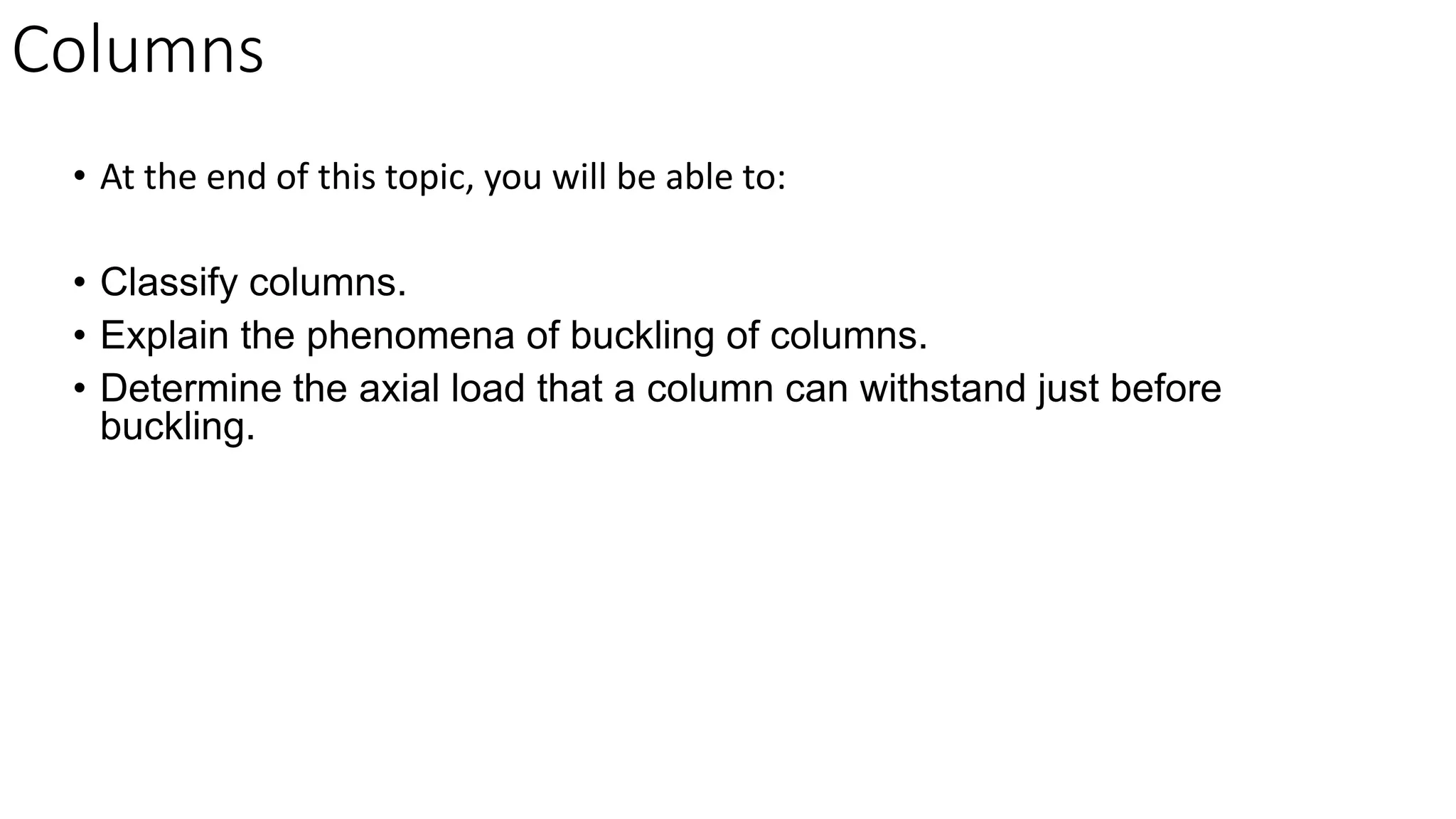
The advance from masonry to the slender metal compressive members which make
up each column requires substantial bracing to prevent buckling . Opened in 1857;
Closed in 1964.
Crymlyn Viaduct (U.K.)
The steering rod (behind the steering
wheel) is designed to fail. That is, the rod
buckles during a car crash to prevent
impaling the driver.
The columns of a building are
designed so that they do not buckle
under the weight of a building.
Columns
• At the end of this topic, you will be able to:
• Classify columns.
• Explain the phenomena of buckling of columns.
• Determine the axial load that a column can withstand just before
buckling.
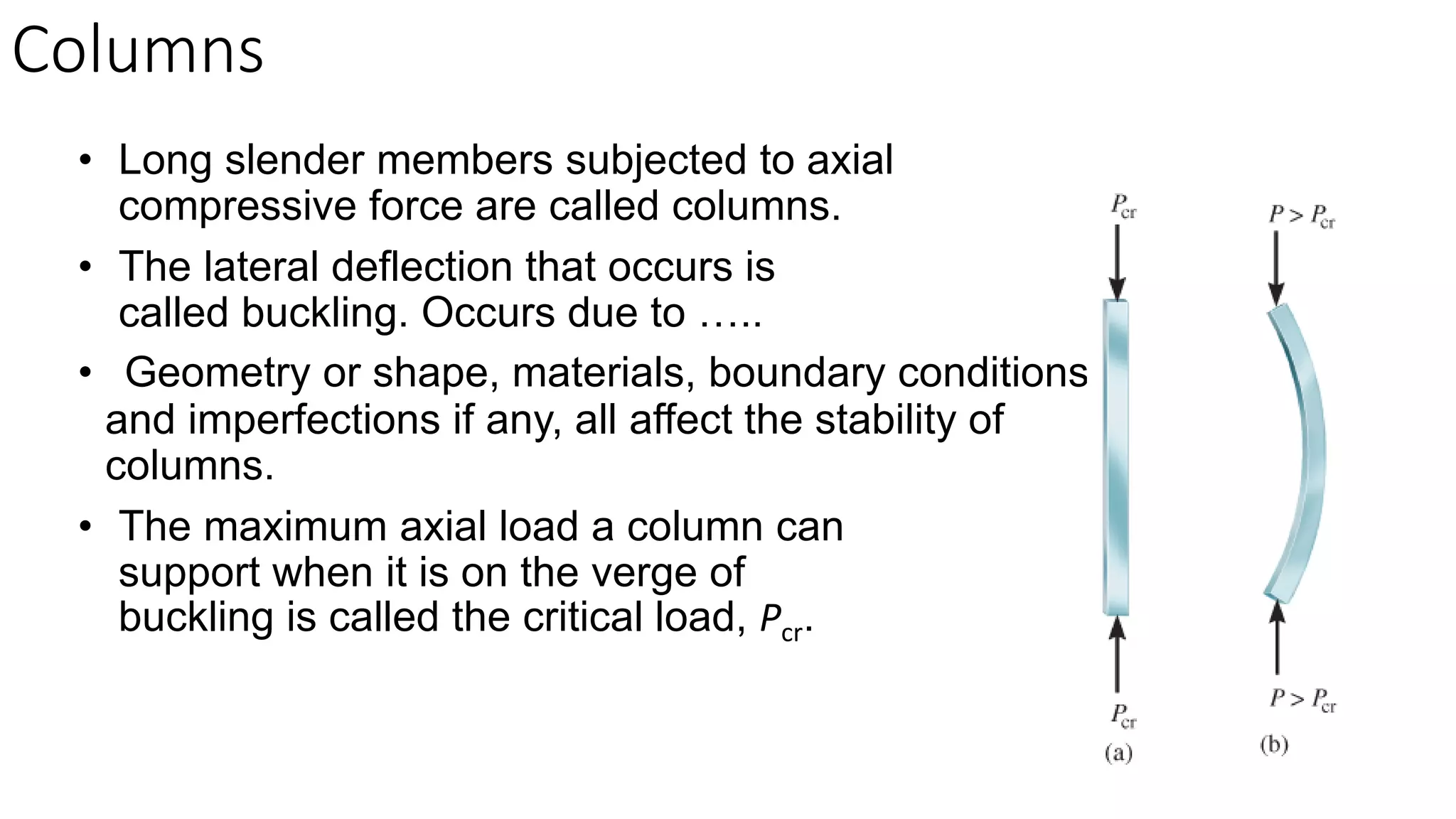
• Long slender members subjected to axial
compressive force are called columns.
• The lateral deflection that occurs is
called buckling. Occurs due to …..
• Geometry or shape, materials, boundary conditions,
and imperfections if any, all affect the stability of
columns.
• The maximum axial load a column can
support when it is on the verge of
buckling is called the critical load, Pcr.
Columns
Columns
• Columns are generally subdivided into the following three types according
to how they fail:
• Short columns fail by crushing (e.g., yielding). Even if loaded eccentrically,
a short column undergoes negligible lateral deflection, so that it can be
analyzed as a member subjected to combined axial loading and bending.
• Long columns fail by buckling. If the axial load is increased to a critical
value, the initially straight shape of a slender column becomes unstable,
causing the column to deflect laterally and eventually collapse.
• Intermediate columns fail by a combination of crushing and buckling.
Determining the Critical Load
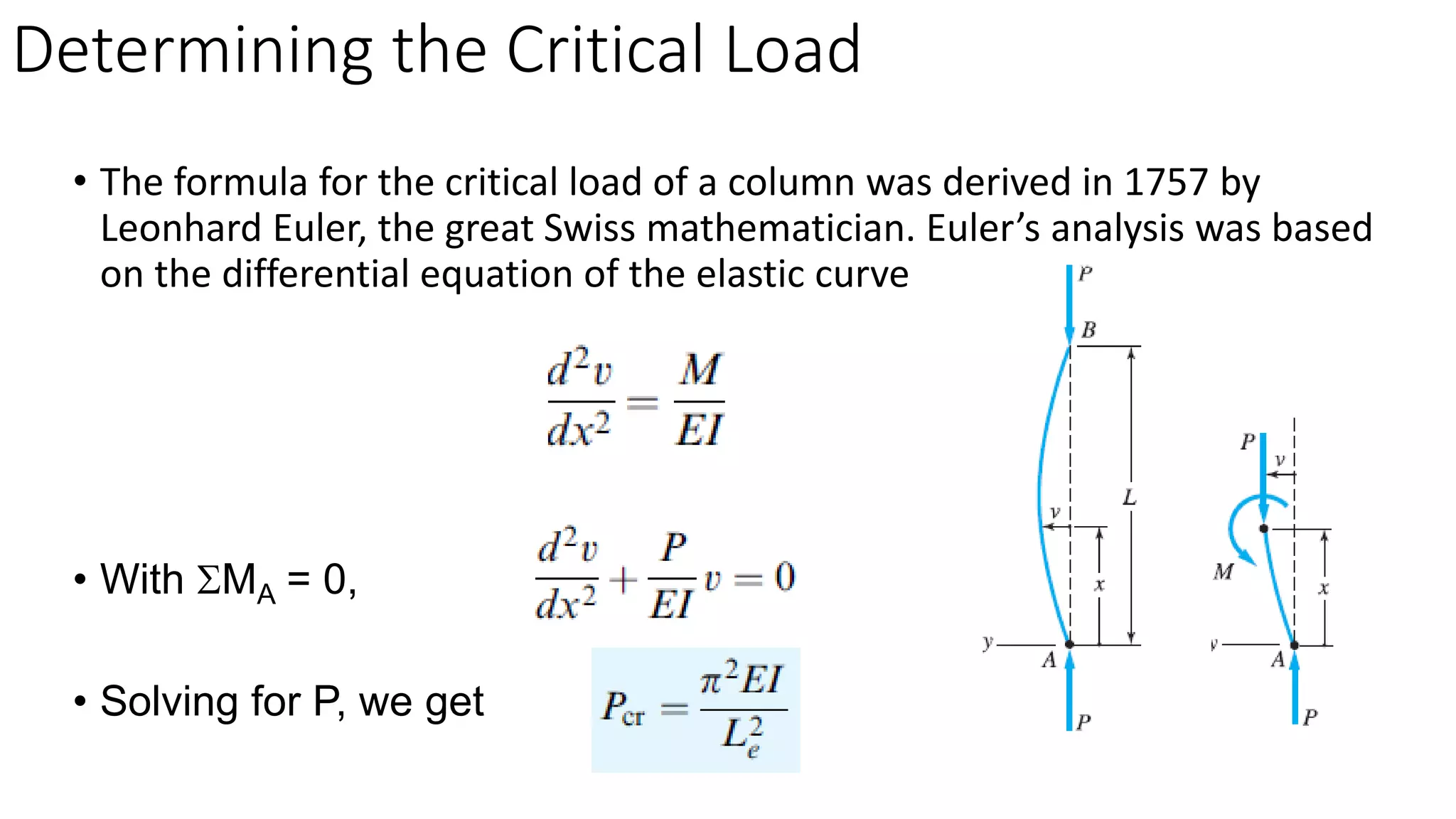
• The formula for the critical load of a column was derived in 1757 by
Leonhard Euler, the great Swiss mathematician. Euler’s analysis was based
on the differential equation of the elastic curve
• With ΣMA = 0,
• Solving for P, we get
Determining the Critical Load
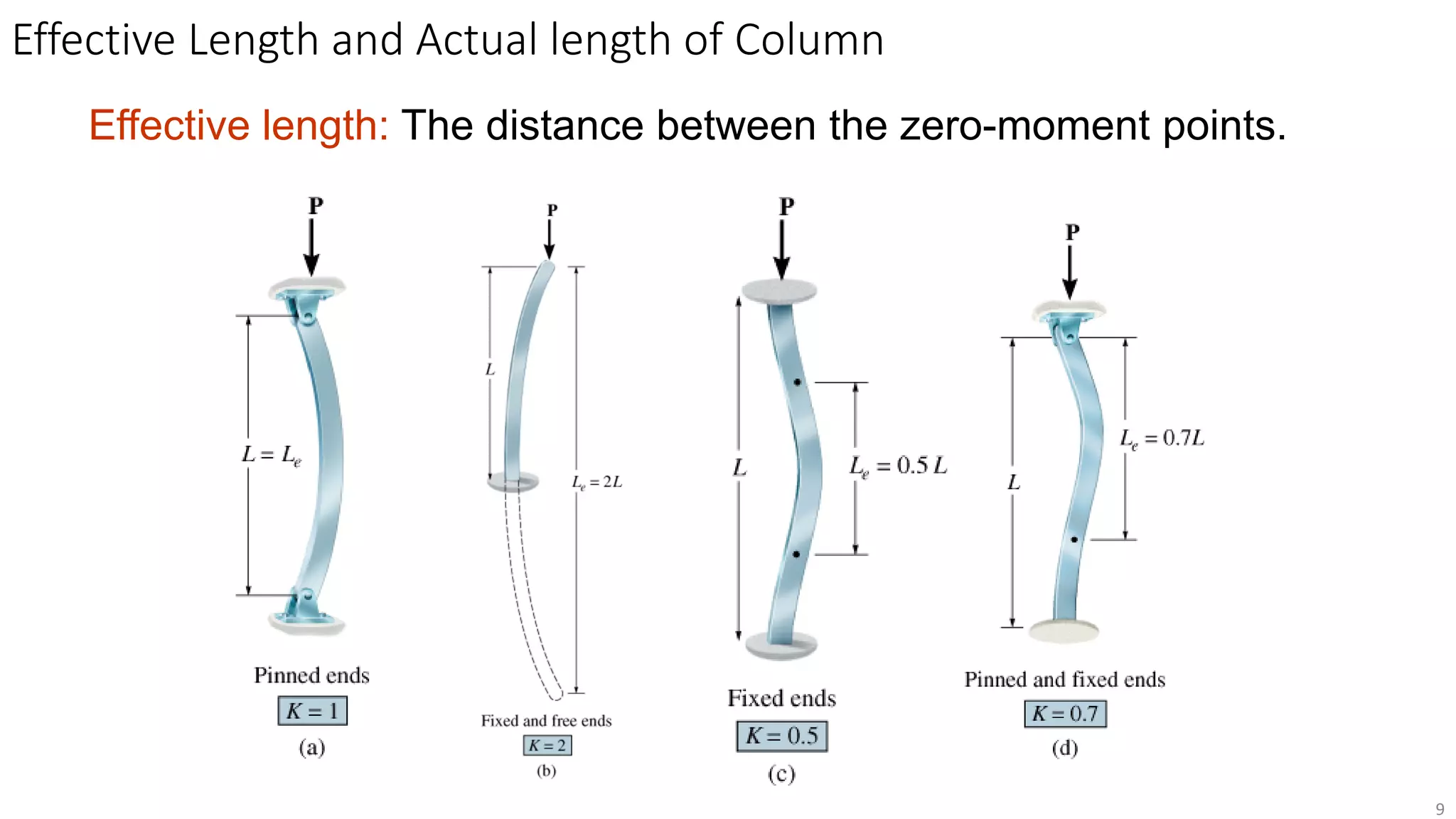
• Where, the effective length Le of the column is determined by the types of
end supports.
Effective
length, Le = L 2L 0.7L 0.5L
Pcr =
9
Effective Length and Actual length of Column
Effective length: The distance between the zero-moment points.
P P
L
One End Pinned
& One End Fixed
P P
L
One End Free
& One End Fixed
P P
L
Fixed Ends
End Constraints:
L/2
2L
( )
2
2
L
EI
P z
Cr
π
=
( )
2
2
4
L
EI
P z
Cr
π
=
( )
2
2
4L
EI
P z
Cr
π
=
( )
2
2
2
L
EI
P z
Cr
π
=
L2≈
P P
L
Free or Pinned Ends
• The stress in the column just before it buckles may be found by substituting
I = A r2
• Where, A is the cross-sectional area and r is the least radius of gyration of the
cross section. Thus,
• Where, σcr is called the critical stress and the ratio Le/r is known as the
slenderness ratio of the column.
• Thus, Pcr should be interpreted as the maximum sustainable load only if σcr < σpl;
where σpl is the proportional limit of the material.
• A column always tends to buckle in the direction that offers the least resistance to
bending. For this reason, buckling occurs about the axis that yields the largest
slenderness ratio Le/r, which is usually the axis of least moment of inertia of the
cross section.
Determining the Critical Load
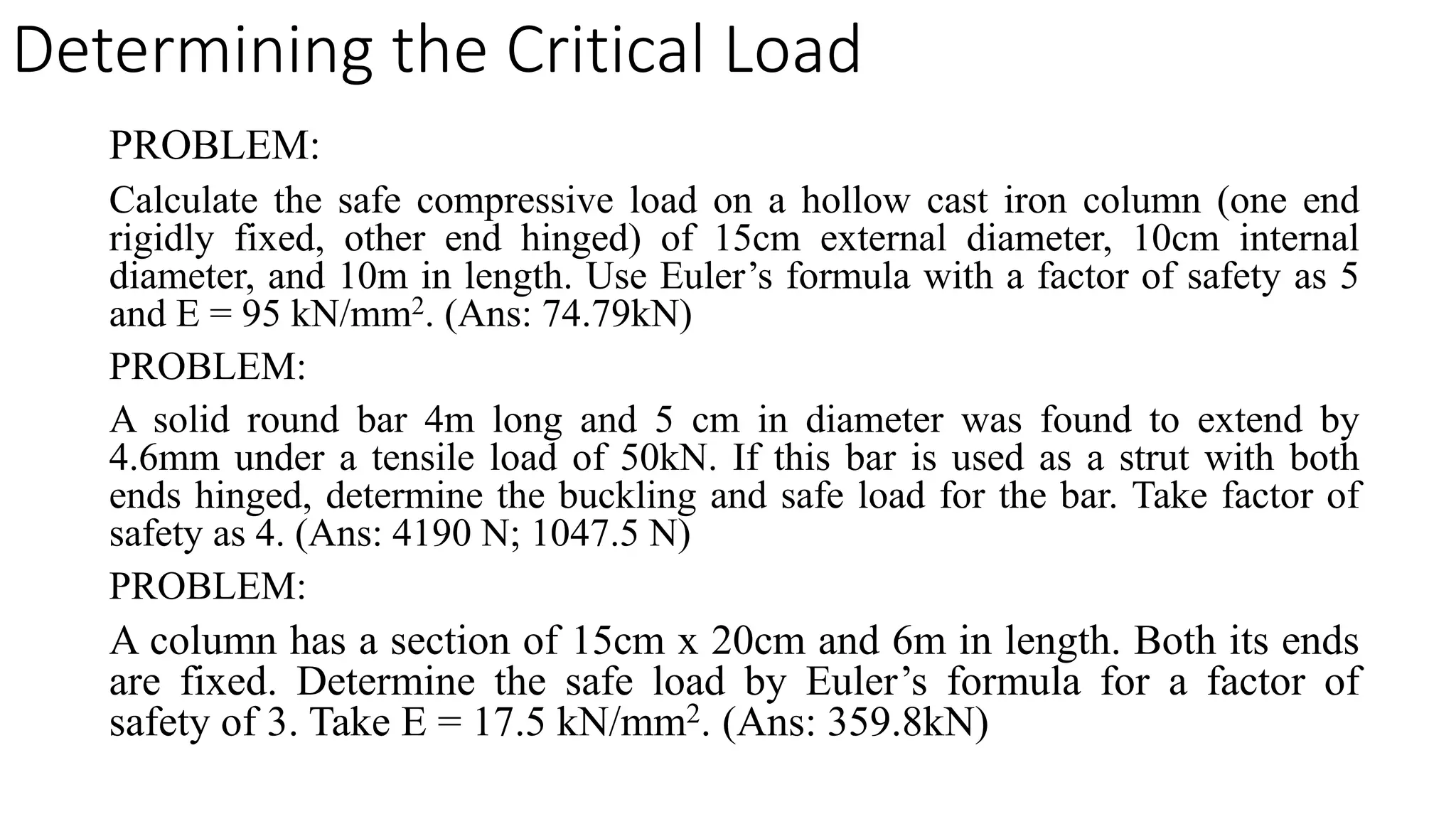
PROBLEM:
Calculate the safe compressive load on a hollow cast iron column (one end
rigidly fixed, other end hinged) of 15cm external diameter, 10cm internal
diameter, and 10m in length. Use Euler’s formula with a factor of safety as 5
and E = 95 kN/mm2. (Ans: 74.79kN)
PROBLEM:
A solid round bar 4m long and 5 cm in diameter was found to extend by
4.6mm under a tensile load of 50kN. If this bar is used as a strut with both
ends hinged, determine the buckling and safe load for the bar. Take factor of
safety as 4. (Ans: 4190 N; 1047.5 N)
PROBLEM:
A column has a section of 15cm x 20cm and 6m in length. Both its ends
are fixed. Determine the safe load by Euler’s formula for a factor of
safety of 3. Take E = 17.5 kN/mm2. (Ans: 359.8kN)
Determining the Critical Load
• Limitations in Euler’s Formula:
• In practice, the ideal conditions are never [ i.e. the strut is initially straight and the end load being applied axially
through centroid] reached. There is always some eccentricity and initial curvature present.
• The column will suffer a deflection which increases with load and consequently a bending moment
is introduced which causes failure before the Euler's load is reached.
• Rankine’s (or Rankin Gordon ) formula:
• It is an empirical formula used for the calculation of ultimate load both for short and long
columns. It gives the ultimate load that column can bear before failure. If column is
short, calculated load will be known as crushing load. And, load will be buckling or
critical (or crippling) load, in case of long column.
Crippling or Critical load, 𝑷𝑷 =
σ𝒄𝒄∗𝑨𝑨
𝟏𝟏+𝜶𝜶
𝑳𝑳𝒆𝒆
𝒓𝒓
𝟐𝟐
where,
σc = critical (crippling) stress;
α = Rankine’s constant =
σ𝒄𝒄
𝝅𝝅𝟐𝟐 𝑬𝑬
,
A = c/s area of the column,
Le/r = slenderness ratio; Le = effective length of the column, r = radius of gyration.
Determining the Critical Load – Rankine’s formula
Rankine’s Constant for various materials
A hollow cast iron column 4.5 m long with both ends fixed , is to carry an axial load of 250 kN under working
conditions. The internal diameter is 0.8 times the outer diameter of the column. Using Rankine –Gordon’s
formula, determine the diameters of the column adopting a factor of safety of 4. Assume σc , the compressive
strength to be 550 N/mm2 and Rankine’s constant α = 1/1600.
Solution:
PROBLEM:
Find the Euler’s crippling load for a hollow cylindrical steel column of 38mm
external diameter & 2.5mm thick. The length of the column is 2.3m and it is
hinged at its both ends. Take E = 205 GPa. Also determine the crippling load by
Rankine’s formula using σc = 335 N/mm2 and α= 1/7500. (Ans: 16882.3 N;
17116.3 N)
PROBLEM:
A hollow column of cast iron whose O.D is 200mm has a thickness of 20mm. It
is 4.5m long and is fixed at both its ends. Calculate the safe load by Rankine’s
formula with a factor of safety of 4. Calculate also the slenderness ratio and the
ratio of Euler’s and Rankine’s critical loads. Take σc = 550 N/mm2, α= 1/1600,
and E = 80 GPa. (Ans: 877356.4 N; 35.15; 2.0607)
Determining the Critical Load – Rankine’s formula
PROBLEM:
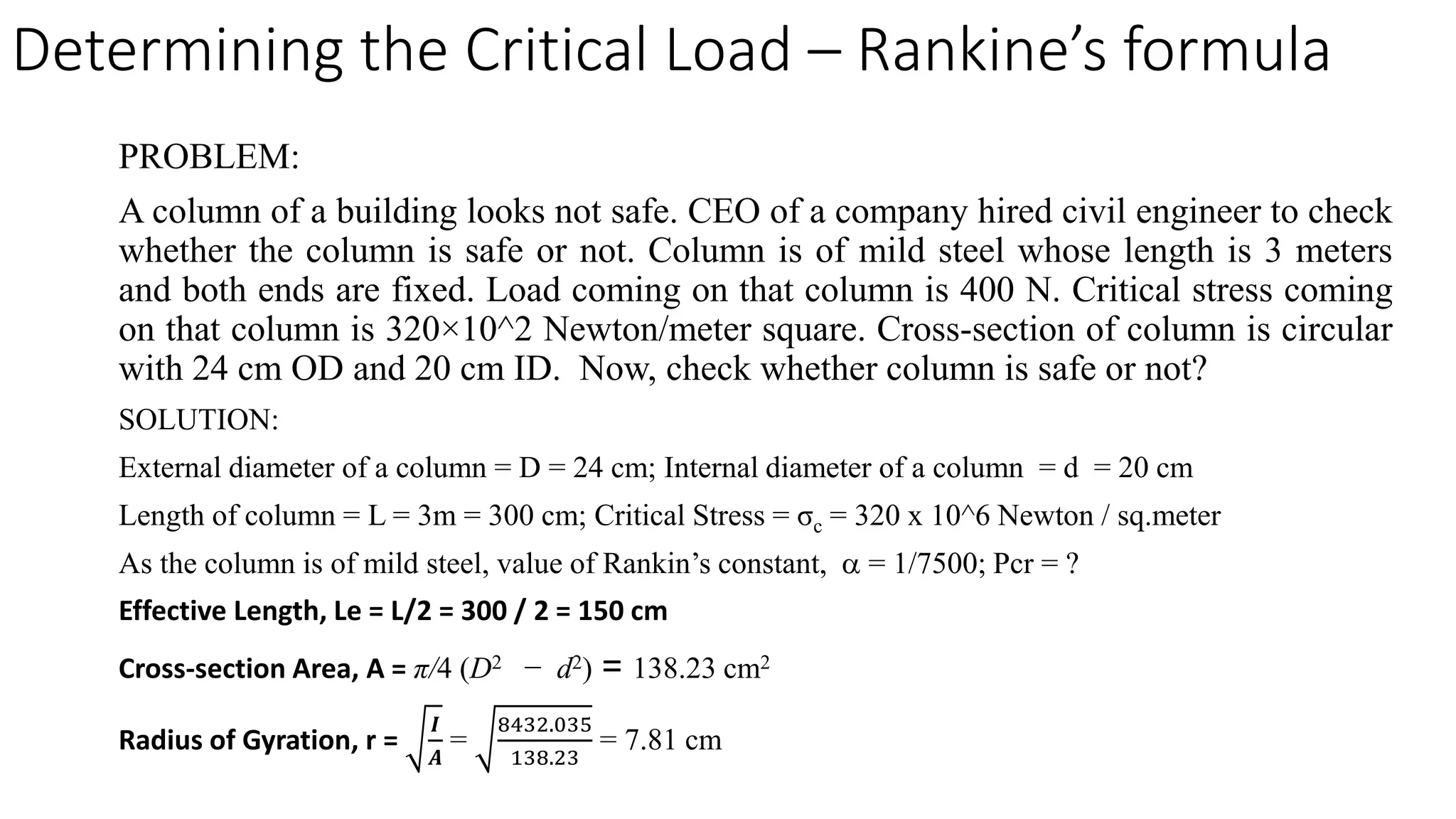
A column of a building looks not safe. CEO of a company hired civil engineer to check
whether the column is safe or not. Column is of mild steel whose length is 3 meters
and both ends are fixed. Load coming on that column is 400 N. Critical stress coming
on that column is 320×10^2 Newton/meter square. Cross-section of column is circular
with 24 cm OD and 20 cm ID. Now, check whether column is safe or not?
SOLUTION:
External diameter of a column = D = 24 cm; Internal diameter of a column = d = 20 cm
Length of column = L = 3m = 300 cm; Critical Stress = σc = 320 x 10^6 Newton / sq.meter
As the column is of mild steel, value of Rankin’s constant, α = 1/7500; Pcr = ?
Effective Length, Le = L/2 = 300 / 2 = 150 cm
Cross-section Area, A = π/4 (D2 − d2) = 138.23 cm2
Radius of Gyration, r =
𝑰𝑰
𝑨𝑨
=
8432.035
138.23
= 7.81 cm
Determining the Critical Load – Rankine’s formula
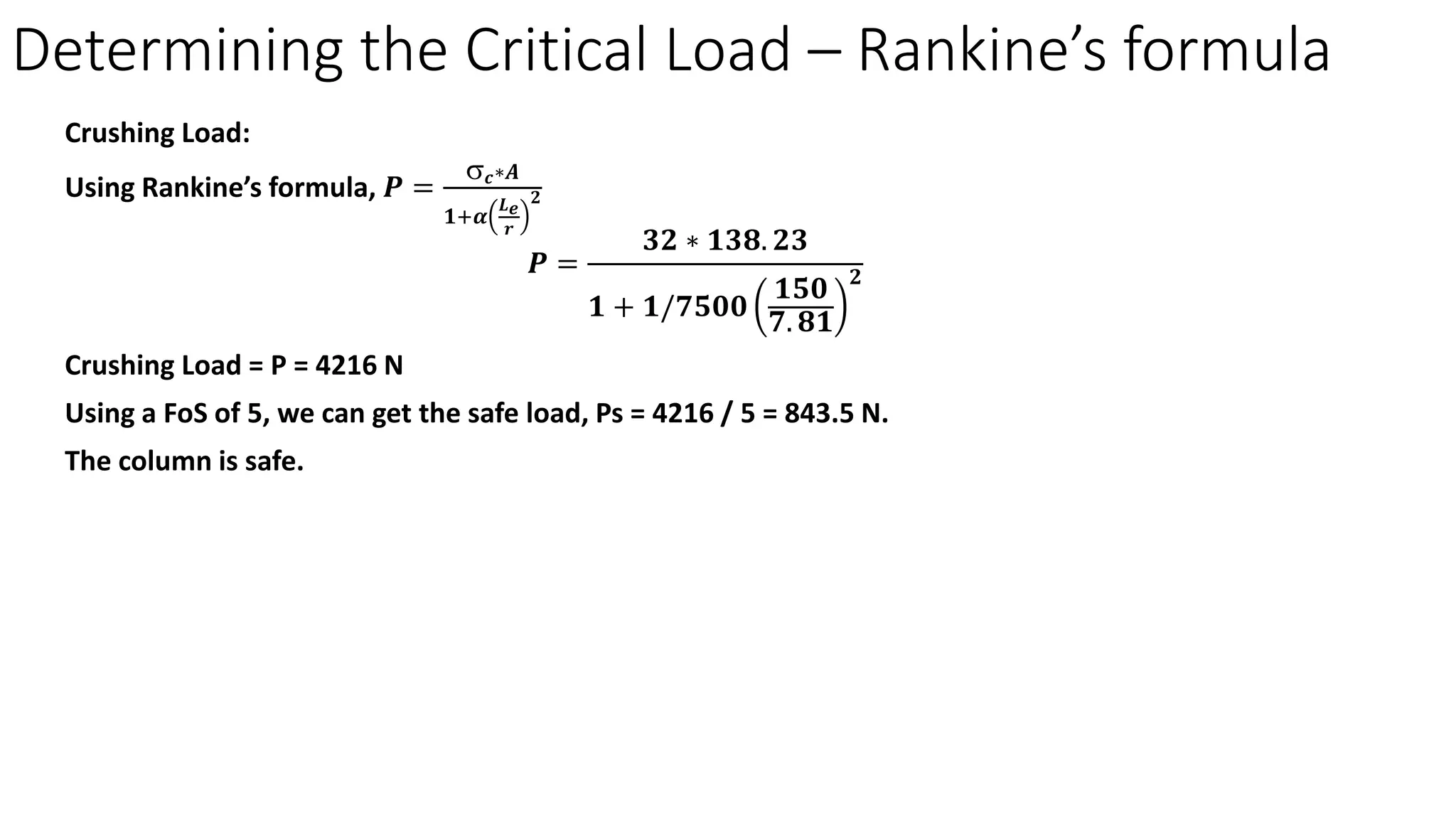
Crushing Load:
Using Rankine’s formula, 𝑷𝑷 =
σ𝒄𝒄∗𝑨𝑨
𝟏𝟏+𝜶𝜶
𝑳𝑳𝒆𝒆
𝒓𝒓
𝟐𝟐
𝑷𝑷 =
𝟑𝟑𝟑𝟑 ∗ 𝟏𝟏𝟏𝟏𝟏𝟏. 𝟐𝟐𝟐𝟐
𝟏𝟏 + 𝟏𝟏/𝟕𝟕𝟕𝟕𝟕𝟕𝟕𝟕
𝟏𝟏𝟏𝟏𝟏𝟏
𝟕𝟕. 𝟖𝟖𝟖𝟖
𝟐𝟐
Crushing Load = P = 4216 N
Using a FoS of 5, we can get the safe load, Ps = 4216 / 5 = 843.5 N.
The column is safe.
Determining the Critical Load – Rankine’s formula

Buckling of Columns

  • 1.
    Pont du Gard(France) - Roman times: The bridge is constructed from limestone blocks fitted together without mortar and secured with iron clamps. The three tiered structure avoids the need for long compressive members. Royal Border Bridge (England): Opened in 1850, the bridge continues being used today. The increased slenderness of the columns compared to the Pont du Gard reflect technological improvements over many centuries.
  • 2.
    The advance frommasonry to the slender metal compressive members which make up each column requires substantial bracing to prevent buckling . Opened in 1857; Closed in 1964. Crymlyn Viaduct (U.K.)
  • 3.
    The steering rod(behind the steering wheel) is designed to fail. That is, the rod buckles during a car crash to prevent impaling the driver. The columns of a building are designed so that they do not buckle under the weight of a building.
  • 4.
    Columns • At theend of this topic, you will be able to: • Classify columns. • Explain the phenomena of buckling of columns. • Determine the axial load that a column can withstand just before buckling.
  • 5.
    • Long slendermembers subjected to axial compressive force are called columns. • The lateral deflection that occurs is called buckling. Occurs due to ….. • Geometry or shape, materials, boundary conditions, and imperfections if any, all affect the stability of columns. • The maximum axial load a column can support when it is on the verge of buckling is called the critical load, Pcr. Columns
  • 6.
    Columns • Columns aregenerally subdivided into the following three types according to how they fail: • Short columns fail by crushing (e.g., yielding). Even if loaded eccentrically, a short column undergoes negligible lateral deflection, so that it can be analyzed as a member subjected to combined axial loading and bending. • Long columns fail by buckling. If the axial load is increased to a critical value, the initially straight shape of a slender column becomes unstable, causing the column to deflect laterally and eventually collapse. • Intermediate columns fail by a combination of crushing and buckling.
  • 7.
    Determining the CriticalLoad • The formula for the critical load of a column was derived in 1757 by Leonhard Euler, the great Swiss mathematician. Euler’s analysis was based on the differential equation of the elastic curve • With ΣMA = 0, • Solving for P, we get
  • 8.
    Determining the CriticalLoad • Where, the effective length Le of the column is determined by the types of end supports. Effective length, Le = L 2L 0.7L 0.5L Pcr =
  • 9.
    9 Effective Length andActual length of Column Effective length: The distance between the zero-moment points.
  • 10.
    P P L One EndPinned & One End Fixed P P L One End Free & One End Fixed P P L Fixed Ends End Constraints: L/2 2L ( ) 2 2 L EI P z Cr π = ( ) 2 2 4 L EI P z Cr π = ( ) 2 2 4L EI P z Cr π = ( ) 2 2 2 L EI P z Cr π = L2≈ P P L Free or Pinned Ends
  • 11.
    • The stressin the column just before it buckles may be found by substituting I = A r2 • Where, A is the cross-sectional area and r is the least radius of gyration of the cross section. Thus, • Where, σcr is called the critical stress and the ratio Le/r is known as the slenderness ratio of the column. • Thus, Pcr should be interpreted as the maximum sustainable load only if σcr < σpl; where σpl is the proportional limit of the material. • A column always tends to buckle in the direction that offers the least resistance to bending. For this reason, buckling occurs about the axis that yields the largest slenderness ratio Le/r, which is usually the axis of least moment of inertia of the cross section. Determining the Critical Load
  • 12.
    PROBLEM: Calculate the safecompressive load on a hollow cast iron column (one end rigidly fixed, other end hinged) of 15cm external diameter, 10cm internal diameter, and 10m in length. Use Euler’s formula with a factor of safety as 5 and E = 95 kN/mm2. (Ans: 74.79kN) PROBLEM: A solid round bar 4m long and 5 cm in diameter was found to extend by 4.6mm under a tensile load of 50kN. If this bar is used as a strut with both ends hinged, determine the buckling and safe load for the bar. Take factor of safety as 4. (Ans: 4190 N; 1047.5 N) PROBLEM: A column has a section of 15cm x 20cm and 6m in length. Both its ends are fixed. Determine the safe load by Euler’s formula for a factor of safety of 3. Take E = 17.5 kN/mm2. (Ans: 359.8kN) Determining the Critical Load
  • 13.
    • Limitations inEuler’s Formula: • In practice, the ideal conditions are never [ i.e. the strut is initially straight and the end load being applied axially through centroid] reached. There is always some eccentricity and initial curvature present. • The column will suffer a deflection which increases with load and consequently a bending moment is introduced which causes failure before the Euler's load is reached. • Rankine’s (or Rankin Gordon ) formula: • It is an empirical formula used for the calculation of ultimate load both for short and long columns. It gives the ultimate load that column can bear before failure. If column is short, calculated load will be known as crushing load. And, load will be buckling or critical (or crippling) load, in case of long column. Crippling or Critical load, 𝑷𝑷 = σ𝒄𝒄∗𝑨𝑨 𝟏𝟏+𝜶𝜶 𝑳𝑳𝒆𝒆 𝒓𝒓 𝟐𝟐 where, σc = critical (crippling) stress; α = Rankine’s constant = σ𝒄𝒄 𝝅𝝅𝟐𝟐 𝑬𝑬 , A = c/s area of the column, Le/r = slenderness ratio; Le = effective length of the column, r = radius of gyration. Determining the Critical Load – Rankine’s formula
  • 14.
    Rankine’s Constant forvarious materials
  • 15.
    A hollow castiron column 4.5 m long with both ends fixed , is to carry an axial load of 250 kN under working conditions. The internal diameter is 0.8 times the outer diameter of the column. Using Rankine –Gordon’s formula, determine the diameters of the column adopting a factor of safety of 4. Assume σc , the compressive strength to be 550 N/mm2 and Rankine’s constant α = 1/1600. Solution:
  • 16.
    PROBLEM: Find the Euler’scrippling load for a hollow cylindrical steel column of 38mm external diameter & 2.5mm thick. The length of the column is 2.3m and it is hinged at its both ends. Take E = 205 GPa. Also determine the crippling load by Rankine’s formula using σc = 335 N/mm2 and α= 1/7500. (Ans: 16882.3 N; 17116.3 N) PROBLEM: A hollow column of cast iron whose O.D is 200mm has a thickness of 20mm. It is 4.5m long and is fixed at both its ends. Calculate the safe load by Rankine’s formula with a factor of safety of 4. Calculate also the slenderness ratio and the ratio of Euler’s and Rankine’s critical loads. Take σc = 550 N/mm2, α= 1/1600, and E = 80 GPa. (Ans: 877356.4 N; 35.15; 2.0607) Determining the Critical Load – Rankine’s formula
  • 17.
    PROBLEM: A column ofa building looks not safe. CEO of a company hired civil engineer to check whether the column is safe or not. Column is of mild steel whose length is 3 meters and both ends are fixed. Load coming on that column is 400 N. Critical stress coming on that column is 320×10^2 Newton/meter square. Cross-section of column is circular with 24 cm OD and 20 cm ID. Now, check whether column is safe or not? SOLUTION: External diameter of a column = D = 24 cm; Internal diameter of a column = d = 20 cm Length of column = L = 3m = 300 cm; Critical Stress = σc = 320 x 10^6 Newton / sq.meter As the column is of mild steel, value of Rankin’s constant, α = 1/7500; Pcr = ? Effective Length, Le = L/2 = 300 / 2 = 150 cm Cross-section Area, A = π/4 (D2 − d2) = 138.23 cm2 Radius of Gyration, r = 𝑰𝑰 𝑨𝑨 = 8432.035 138.23 = 7.81 cm Determining the Critical Load – Rankine’s formula
  • 18.
    Crushing Load: Using Rankine’sformula, 𝑷𝑷 = σ𝒄𝒄∗𝑨𝑨 𝟏𝟏+𝜶𝜶 𝑳𝑳𝒆𝒆 𝒓𝒓 𝟐𝟐 𝑷𝑷 = 𝟑𝟑𝟑𝟑 ∗ 𝟏𝟏𝟏𝟏𝟏𝟏. 𝟐𝟐𝟐𝟐 𝟏𝟏 + 𝟏𝟏/𝟕𝟕𝟕𝟕𝟕𝟕𝟕𝟕 𝟏𝟏𝟏𝟏𝟏𝟏 𝟕𝟕. 𝟖𝟖𝟖𝟖 𝟐𝟐 Crushing Load = P = 4216 N Using a FoS of 5, we can get the safe load, Ps = 4216 / 5 = 843.5 N. The column is safe. Determining the Critical Load – Rankine’s formula