INDIAN INSTITUTE OF TECHNOLOGY ROORKEE
Machine Foundations
IQBAL
17512008
Alternate Hydro Energy Systems
AHN 512
2
Introduction
Type of Loads
• Static load – due to weight of machine and weight of foundation itself
• Dynamic load – nature of dynamic load depends on type of machine
Type of machines
1. Reciprocating machines
Produce periodic unbalanced force
Engines, Compressors etc.
Less than 600 rpm
Sinusoidal unbalanced force
2. Impact machines
High impact load for small duration
Forge hammers etc.
60 to 150 blows per minute
3. Rotary machines
Medium and high speed machines e.g. turbo-generators, rotary compressors
Generally 1500 to 10000 rpm
3
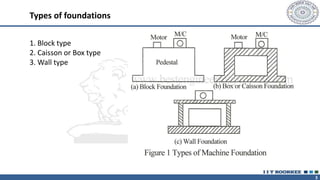
Types of foundations
1. Block type
2. Caisson or Box type
3. Wall type
4
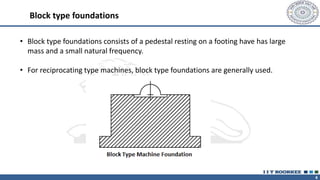
Block type foundations
• Block type foundations consists of a pedestal resting on a footing have has large
mass and a small natural frequency.
• For reciprocating type machines, block type foundations are generally used.
5
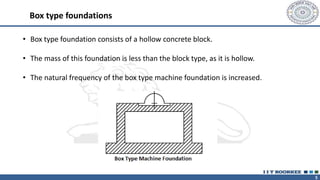
• Box type foundation consists of a hollow concrete block.
• The mass of this foundation is less than the block type, as it is hollow.
• The natural frequency of the box type machine foundation is increased.
Box type foundations
6
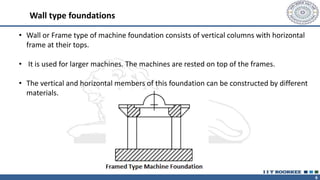
• Wall or Frame type of machine foundation consists of vertical columns with horizontal
frame at their tops.
• It is used for larger machines. The machines are rested on top of the frames.
• The vertical and horizontal members of this foundation can be constructed by different
materials.
Wall type foundations
7
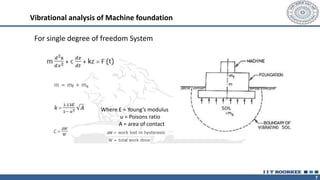
Vibrational analysis of Machine foundation
For single degree of freedom System
Where E = Young’s modulus
u = Poisons ratio
A = area of contact
8
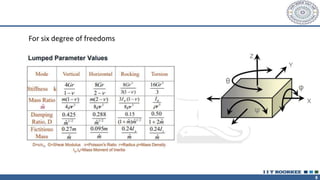
For six degree of freedoms
9
•Cross Hole Test (CHT)
•Down hole test (DHT)
•Spectral Analysis of Shear wave ( SASW)
•Block Vibration Tests
Laboratory tests:
•Resonant Column test
•Cyclical Tri axial Test
The above test are conducted usually by a Geotechnical Contractor and appropriate
values are recommended by him in the Geotechnical report
How to determine the Soil Parameters?
10
Indian Standard on design and construction of foundation
for rotary machines
IS: 2974 (part 3) 1992 code of practice is for foundation designing of rotary machine.
Salient features of Code of practice
• Necessary Data
• Design Criteria
• Concrete foundation design
11
Necessary Data
Data provided by machine manufacturer
• General description about the machine, outline dimensions, driving and driven
machine, rated output
• Detailed loading diagram showing details of transfer of loads and their point of
application
• Details of dynamic loads and couples- their location, magnitude and direction
• Operating speed, critical speed
• Mass moment of Inertia of driving and driven machine about principal axes
• Allowable displacements at machine bearing points during normal operation
Data on ground and site conditions
• Soil profile and soil characteristics up to the depth of three times the expected plan
dimension of foundation
• Dynamic properties of soil
• The relative position of water table below ground level at different times of the year
12
Design Criteria
• The machine foundation should be isolated from other foundations
• It should be able to carry the superimposed loads without causing shear or crushing failure
• No resonance should occur between the natural frequency of the foundation–soil system
and pulsating load
• The amplitude of vibrations does not exceed the safe value
• Limitations of amplitude of vibration 1. to avoid damage to machinery
2. to avoid damage to neighbouring structures
3. to avoid discomfort to person
4. to avoid soil settlement
13
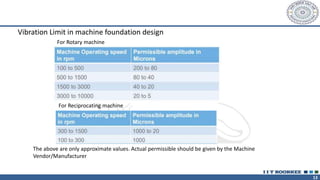
The above are only approximate values. Actual permissible should be given by the Machine
Vendor/Manufacturer
Vibration Limit in machine foundation design
For Rotary machine
For Reciprocating machine
14
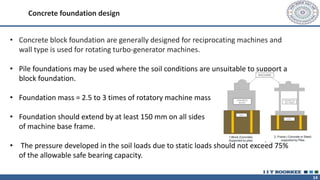
• Concrete block foundation are generally designed for reciprocating machines and
wall type is used for rotating turbo-generator machines.
• Pile foundations may be used where the soil conditions are unsuitable to support a
block foundation.
• Foundation mass = 2.5 to 3 times of rotatory machine mass
• Foundation should extend by at least 150 mm on all sides
of machine base frame.
• The pressure developed in the soil loads due to static loads should not exceed 75%
of the allowable safe bearing capacity.
Concrete foundation design
15
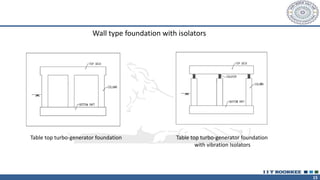
Table top turbo-generator foundation Table top turbo-generator foundation
with vibration Isolators
Wall type foundation with isolators
16
IS Codes
IS 2974 – 5 parts, of which part 1, 3 and 4 are for reciprocating and rotating machines
IS 5294 – Method of test for determination of soil dynamics properties
IS 7207 – Design of generator foundation for hydroelectric power station
17
References
• Varanasi Rama Rao, Machine Foundations in oil and gas industry, Chennai Office
• www.theconstructor.org/geotechnical/general-requirements-of-machine-foundations/7244
• www.theconstructor.org/structural-engg/machine-foundation-vibration-analysis/14777
• BIS (1992). “IS 2974 (Part 3): 1992—Indian Standard Design and Construction of Machine Foundations—Code of
Practice, Part 3: Foundations for Rotary Type Machines (Medium and High Frequency) (Second Revision)”, Bureau
of Indian Standards, New Delhi
• Dr Priti Maheshwari, Machine Foundations, Module - 02 Lecture – 4, Department Of Civil Engineering, IITR
• Sukanta Adhikar, Turbo-generator foundation

Machine foundations

  • 1.
    INDIAN INSTITUTE OFTECHNOLOGY ROORKEE Machine Foundations IQBAL 17512008 Alternate Hydro Energy Systems AHN 512
  • 2.
    2 Introduction Type of Loads •Static load – due to weight of machine and weight of foundation itself • Dynamic load – nature of dynamic load depends on type of machine Type of machines 1. Reciprocating machines Produce periodic unbalanced force Engines, Compressors etc. Less than 600 rpm Sinusoidal unbalanced force 2. Impact machines High impact load for small duration Forge hammers etc. 60 to 150 blows per minute 3. Rotary machines Medium and high speed machines e.g. turbo-generators, rotary compressors Generally 1500 to 10000 rpm
  • 3.
    3 Types of foundations 1.Block type 2. Caisson or Box type 3. Wall type
  • 4.
    4 Block type foundations •Block type foundations consists of a pedestal resting on a footing have has large mass and a small natural frequency. • For reciprocating type machines, block type foundations are generally used.
  • 5.
    5 • Box typefoundation consists of a hollow concrete block. • The mass of this foundation is less than the block type, as it is hollow. • The natural frequency of the box type machine foundation is increased. Box type foundations
  • 6.
    6 • Wall orFrame type of machine foundation consists of vertical columns with horizontal frame at their tops. • It is used for larger machines. The machines are rested on top of the frames. • The vertical and horizontal members of this foundation can be constructed by different materials. Wall type foundations
  • 7.
    7 Vibrational analysis ofMachine foundation For single degree of freedom System Where E = Young’s modulus u = Poisons ratio A = area of contact
  • 8.
    8 For six degreeof freedoms
  • 9.
    9 •Cross Hole Test(CHT) •Down hole test (DHT) •Spectral Analysis of Shear wave ( SASW) •Block Vibration Tests Laboratory tests: •Resonant Column test •Cyclical Tri axial Test The above test are conducted usually by a Geotechnical Contractor and appropriate values are recommended by him in the Geotechnical report How to determine the Soil Parameters?
  • 10.
    10 Indian Standard ondesign and construction of foundation for rotary machines IS: 2974 (part 3) 1992 code of practice is for foundation designing of rotary machine. Salient features of Code of practice • Necessary Data • Design Criteria • Concrete foundation design
  • 11.
    11 Necessary Data Data providedby machine manufacturer • General description about the machine, outline dimensions, driving and driven machine, rated output • Detailed loading diagram showing details of transfer of loads and their point of application • Details of dynamic loads and couples- their location, magnitude and direction • Operating speed, critical speed • Mass moment of Inertia of driving and driven machine about principal axes • Allowable displacements at machine bearing points during normal operation Data on ground and site conditions • Soil profile and soil characteristics up to the depth of three times the expected plan dimension of foundation • Dynamic properties of soil • The relative position of water table below ground level at different times of the year
  • 12.
    12 Design Criteria • Themachine foundation should be isolated from other foundations • It should be able to carry the superimposed loads without causing shear or crushing failure • No resonance should occur between the natural frequency of the foundation–soil system and pulsating load • The amplitude of vibrations does not exceed the safe value • Limitations of amplitude of vibration 1. to avoid damage to machinery 2. to avoid damage to neighbouring structures 3. to avoid discomfort to person 4. to avoid soil settlement
  • 13.
    13 The above areonly approximate values. Actual permissible should be given by the Machine Vendor/Manufacturer Vibration Limit in machine foundation design For Rotary machine For Reciprocating machine
  • 14.
    14 • Concrete blockfoundation are generally designed for reciprocating machines and wall type is used for rotating turbo-generator machines. • Pile foundations may be used where the soil conditions are unsuitable to support a block foundation. • Foundation mass = 2.5 to 3 times of rotatory machine mass • Foundation should extend by at least 150 mm on all sides of machine base frame. • The pressure developed in the soil loads due to static loads should not exceed 75% of the allowable safe bearing capacity. Concrete foundation design
  • 15.
    15 Table top turbo-generatorfoundation Table top turbo-generator foundation with vibration Isolators Wall type foundation with isolators
  • 16.
    16 IS Codes IS 2974– 5 parts, of which part 1, 3 and 4 are for reciprocating and rotating machines IS 5294 – Method of test for determination of soil dynamics properties IS 7207 – Design of generator foundation for hydroelectric power station
  • 17.
    17 References • Varanasi RamaRao, Machine Foundations in oil and gas industry, Chennai Office • www.theconstructor.org/geotechnical/general-requirements-of-machine-foundations/7244 • www.theconstructor.org/structural-engg/machine-foundation-vibration-analysis/14777 • BIS (1992). “IS 2974 (Part 3): 1992—Indian Standard Design and Construction of Machine Foundations—Code of Practice, Part 3: Foundations for Rotary Type Machines (Medium and High Frequency) (Second Revision)”, Bureau of Indian Standards, New Delhi • Dr Priti Maheshwari, Machine Foundations, Module - 02 Lecture – 4, Department Of Civil Engineering, IITR • Sukanta Adhikar, Turbo-generator foundation