
Department of Civil Engineering
Machine foundation
Presented By- Rakesh Ahirwar
S.N. 202111105
Branch- Geotechnical Engineering
INDEX
 Introduction
 Literature review
 Types of machine
foundation
 Foundation design
criteria
 Soil Exploration
 Depth of site exploration
 Conclusion
 Reference
Introduction
 With the advancement of technology and literature
available in the field of industry, high speed
machinery has been developed. As the speed of
machinery has increased, vibrations also increased.
Machines transmit vibrations to the structure
supporting them. Hence, it is important to design
and develop such structure which sustains the
vibrations of machinery. e.g. Foundation of
Pulverizing mills, HP Ash water pumps, Ash water
recovery pumps, Foundation of Raw water pumps,
etc.
LITERATURE REVIEW
 Gazetas G. (1983) [1], Prakash S. et al.[2], Wang ZY et
al.[3] and Srinivasulu P. et al.[15] found that with the
advancement of technology and literature available in
the field of industry, high speed machinery has been
developed. As the speed of machinery have increased,
vibrations effect increased adversely affecting the
condition of equipment.
 Various machine foundations, applications and
their design aspects are discussed forward.
Block foundation
 Application- It is used for machines of large mass and a
small natural frequency
 Design aspects - The ability
to use block foundation
primarily depends on the
quality of near surface soils
and designed as rigid
structures.
The dynamic response of a rigid block foundation
depends only on the dynamic load, foundation‘s mass,
dimensions, and soil characteristics observed by
Pradhan P.K. et al. [5]
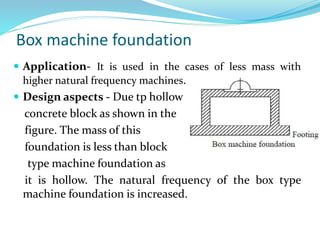
Box machine foundation
 Application- It is used in the cases of less mass with
higher natural frequency machines.
 Design aspects - Due tp hollow
concrete block as shown in the
figure. The mass of this
foundation is less than block
type machine foundation as
it is hollow. The natural frequency of the box type
machine foundation is increased.
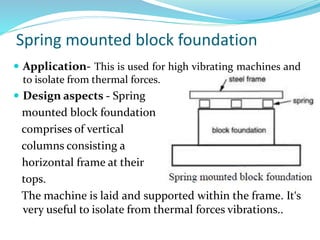
Spring mounted block foundation
 Application- This is used for high vibrating machines and
to isolate from thermal forces.
 Design aspects - Spring
mounted block foundation
comprises of vertical
columns consisting a
horizontal frame at their
tops.
The machine is laid and supported within the frame. It‘s
very useful to isolate from thermal forces vibrations..
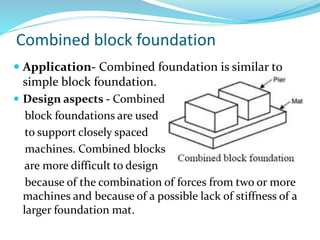
Combined block foundation
 Application- Combined foundation is similar to
simple block foundation.
 Design aspects - Combined
block foundations are used
to support closely spaced
machines. Combined blocks
are more difficult to design
because of the combination of forces from two or more
machines and because of a possible lack of stiffness of a
larger foundation mat.
Tabletop foundation
 Application- It allows for ducts, piping, and ancillary items
to be located below the equipment.
 Design aspects - Elevated
support is common for
large turbine-driven
equipment such as electric
generators. Tabletop
structures are considered to be flexible, hence their
response to dynamic loads can be quite complex.
Tabletop with isolator foundation
 Application- It is used for high vibrating machines like
pumps, blowers, fans, etc
 Design aspects - Springs and
dampers located at the top of
supporting columns are
sometimes used to minimize
the response to dynamic loading.
The effectiveness of isolators depends on the machine
speed and frequency by Richart Jr. et al. [17].
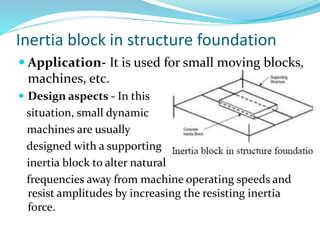
Inertia block in structure foundation
 Application- It is used for small moving blocks,
machines, etc.
 Design aspects - In this
situation, small dynamic
machines are usually
designed with a supporting
inertia block to alter natural
frequencies away from machine operating speeds and
resist amplitudes by increasing the resisting inertia
force.
Pile supported foundation
 Application- It is used in soft ground conditions and
excessive Settlement e.g. drilled piers, auger cast piles,
and driven piles.
 Design aspects - Any of the
previously mentioned
foundation types may be
supported directly on soil
or on piles. Piles use end
bearing, frictional side adhesion, or a combination of
both to transfer axial loads into the underlying soil
noted by Kaynia A.M. et al. [6].
FOUNDATION DESIGN CRITERIA
 The basic goal in the design of a machine foundation is
to limit its motion to amplitudes that neither endanger
the satisfactory operation of the machine nor disturb
people working in the immediate vicinity. Allowable
amplitudes depend on the speed, location and
criticality or function of the machine. Other limiting
dynamic criteria affecting the design may include
avoiding resonance and excessive transmissibility to
the supporting soil or structure.
Soil Exploration
 A key ingredient to a successful design is the careful
engineering analysis of the soil foundation response to
dynamic.
 The object of site investigation of industries like
thermal power plant, etc. is to obtain reliable, specific
and detailed information about the soil/rock and
groundwater conditions at a site for enabling engineers
in the safe and economic design and execution of
engineering works. To meet this objective investigation
should be carried out to the required depth and
horizontal extent in the region likely to be affected by
the proposed constructions. loads from the machine
operation.
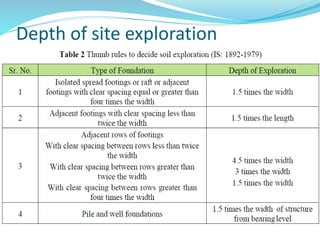
Depth of site exploration
Conclusion
 Thermal power plants have wide range of heavy
machineries and structures in which there is a need of
extensive studies with existing data base and history.
Machine-foundation design has been associated with
the civil engineering discipline with specialization in
soil technology and structural engineering.
 The significant number of equipments affected due to
foundation related problems. Study shows about 19% of
overall equipments partially or fully affected due to
foundation related issues in a year. Out of which
approximately 70% of issues solved by rework (partial
foundation work) and about 30% of equipments
required to make new foundations in the power plant.
Reference
 MACHINE FOUNDATIONS FOR POWER PLANT: SOME DESIGN
ISSUES WITH REAL TIME EXAMPLES, Nidhi R. Somkuwar, Post
Graduate Student, Civil Engineering Department, Guru Nanak Institute
of Engineering and Technology, Nagpur, India , International Journal of
Civil Engineering and Technology (IJCIET).
 Gazetas G., "Analysis of Machine Foundation Vibrations: State of the
Art", Journal of Soil Dynamics and Earthquake Engineering, 1983, Vol. 2,
No. 1, pp. 2-42.
 Wang ZY, Liu JB, Pei YX et al. ―Theoretical and experimental study on
micro-vibration reduction of large dynamic machine foundation‖
Chinese J Geo tech Eng 2002, pp. 363–366.
 Bhatia, K.G., ―Machine Foundation Design—A State of the Art‖, Journal
of Structural Engineering, SERC 2006, Vol. 33, No. 1, pp. 69–80.
THANK
YOU

Machine foundation

  • 1.
    Department of CivilEngineering Machine foundation Presented By- Rakesh Ahirwar S.N. 202111105 Branch- Geotechnical Engineering
  • 2.
    INDEX  Introduction  Literaturereview  Types of machine foundation  Foundation design criteria  Soil Exploration  Depth of site exploration  Conclusion  Reference
  • 3.
    Introduction  With theadvancement of technology and literature available in the field of industry, high speed machinery has been developed. As the speed of machinery has increased, vibrations also increased. Machines transmit vibrations to the structure supporting them. Hence, it is important to design and develop such structure which sustains the vibrations of machinery. e.g. Foundation of Pulverizing mills, HP Ash water pumps, Ash water recovery pumps, Foundation of Raw water pumps, etc.
  • 4.
    LITERATURE REVIEW  GazetasG. (1983) [1], Prakash S. et al.[2], Wang ZY et al.[3] and Srinivasulu P. et al.[15] found that with the advancement of technology and literature available in the field of industry, high speed machinery has been developed. As the speed of machinery have increased, vibrations effect increased adversely affecting the condition of equipment.  Various machine foundations, applications and their design aspects are discussed forward.
  • 5.
    Block foundation  Application-It is used for machines of large mass and a small natural frequency  Design aspects - The ability to use block foundation primarily depends on the quality of near surface soils and designed as rigid structures. The dynamic response of a rigid block foundation depends only on the dynamic load, foundation‘s mass, dimensions, and soil characteristics observed by Pradhan P.K. et al. [5]
  • 6.
    Box machine foundation Application- It is used in the cases of less mass with higher natural frequency machines.  Design aspects - Due tp hollow concrete block as shown in the figure. The mass of this foundation is less than block type machine foundation as it is hollow. The natural frequency of the box type machine foundation is increased.
  • 7.
    Spring mounted blockfoundation  Application- This is used for high vibrating machines and to isolate from thermal forces.  Design aspects - Spring mounted block foundation comprises of vertical columns consisting a horizontal frame at their tops. The machine is laid and supported within the frame. It‘s very useful to isolate from thermal forces vibrations..
  • 8.
    Combined block foundation Application- Combined foundation is similar to simple block foundation.  Design aspects - Combined block foundations are used to support closely spaced machines. Combined blocks are more difficult to design because of the combination of forces from two or more machines and because of a possible lack of stiffness of a larger foundation mat.
  • 9.
    Tabletop foundation  Application-It allows for ducts, piping, and ancillary items to be located below the equipment.  Design aspects - Elevated support is common for large turbine-driven equipment such as electric generators. Tabletop structures are considered to be flexible, hence their response to dynamic loads can be quite complex.
  • 10.
    Tabletop with isolatorfoundation  Application- It is used for high vibrating machines like pumps, blowers, fans, etc  Design aspects - Springs and dampers located at the top of supporting columns are sometimes used to minimize the response to dynamic loading. The effectiveness of isolators depends on the machine speed and frequency by Richart Jr. et al. [17].
  • 11.
    Inertia block instructure foundation  Application- It is used for small moving blocks, machines, etc.  Design aspects - In this situation, small dynamic machines are usually designed with a supporting inertia block to alter natural frequencies away from machine operating speeds and resist amplitudes by increasing the resisting inertia force.
  • 12.
    Pile supported foundation Application- It is used in soft ground conditions and excessive Settlement e.g. drilled piers, auger cast piles, and driven piles.  Design aspects - Any of the previously mentioned foundation types may be supported directly on soil or on piles. Piles use end bearing, frictional side adhesion, or a combination of both to transfer axial loads into the underlying soil noted by Kaynia A.M. et al. [6].
  • 13.
    FOUNDATION DESIGN CRITERIA The basic goal in the design of a machine foundation is to limit its motion to amplitudes that neither endanger the satisfactory operation of the machine nor disturb people working in the immediate vicinity. Allowable amplitudes depend on the speed, location and criticality or function of the machine. Other limiting dynamic criteria affecting the design may include avoiding resonance and excessive transmissibility to the supporting soil or structure.
  • 14.
    Soil Exploration  Akey ingredient to a successful design is the careful engineering analysis of the soil foundation response to dynamic.  The object of site investigation of industries like thermal power plant, etc. is to obtain reliable, specific and detailed information about the soil/rock and groundwater conditions at a site for enabling engineers in the safe and economic design and execution of engineering works. To meet this objective investigation should be carried out to the required depth and horizontal extent in the region likely to be affected by the proposed constructions. loads from the machine operation.
  • 15.
    Depth of siteexploration
  • 16.
    Conclusion  Thermal powerplants have wide range of heavy machineries and structures in which there is a need of extensive studies with existing data base and history. Machine-foundation design has been associated with the civil engineering discipline with specialization in soil technology and structural engineering.  The significant number of equipments affected due to foundation related problems. Study shows about 19% of overall equipments partially or fully affected due to foundation related issues in a year. Out of which approximately 70% of issues solved by rework (partial foundation work) and about 30% of equipments required to make new foundations in the power plant.
  • 17.
    Reference  MACHINE FOUNDATIONSFOR POWER PLANT: SOME DESIGN ISSUES WITH REAL TIME EXAMPLES, Nidhi R. Somkuwar, Post Graduate Student, Civil Engineering Department, Guru Nanak Institute of Engineering and Technology, Nagpur, India , International Journal of Civil Engineering and Technology (IJCIET).  Gazetas G., "Analysis of Machine Foundation Vibrations: State of the Art", Journal of Soil Dynamics and Earthquake Engineering, 1983, Vol. 2, No. 1, pp. 2-42.  Wang ZY, Liu JB, Pei YX et al. ―Theoretical and experimental study on micro-vibration reduction of large dynamic machine foundation‖ Chinese J Geo tech Eng 2002, pp. 363–366.  Bhatia, K.G., ―Machine Foundation Design—A State of the Art‖, Journal of Structural Engineering, SERC 2006, Vol. 33, No. 1, pp. 69–80.
  • 18.