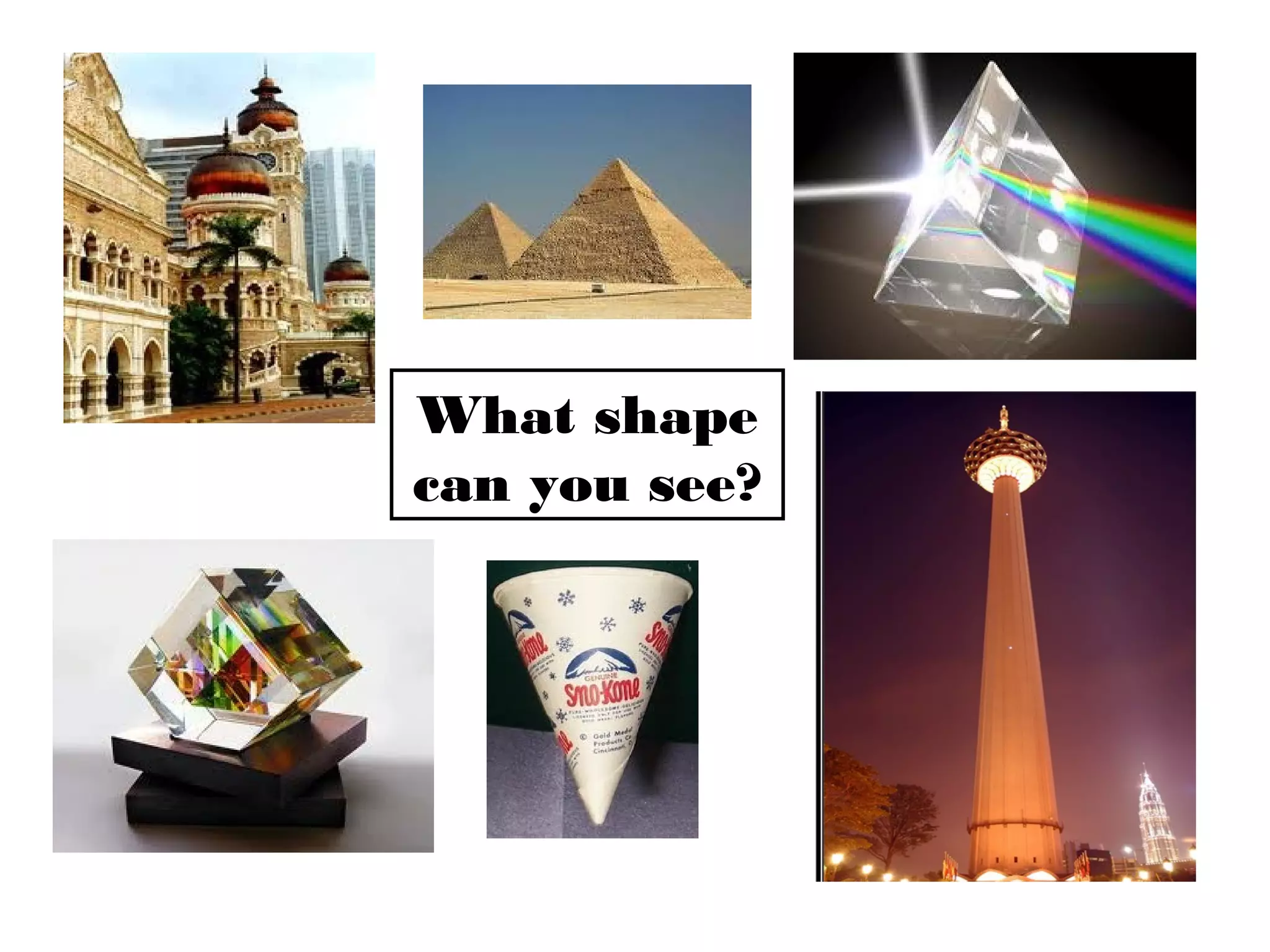
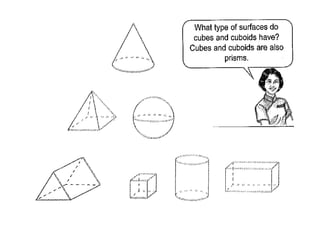
What shape
can you see?
SOLID
GEOMETRY II
LEARNING OUTCOMES


State the geometric properties of prisms,
pyramids, cylinders, cones and spheres.
Draw nets for prisms, pyramids,
cylinders and cones.
State and find surface areas of prisms,
pyramids, cylinders, cones and spheres.
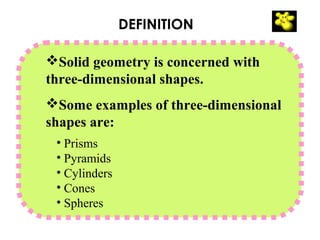
DEFINITION

Solid geometry is concerned with
three-dimensional shapes.
Some examples of three-dimensional
shapes are:
 • Prisms
 • Pyramids
 • Cylinders
 • Cones
 • Spheres
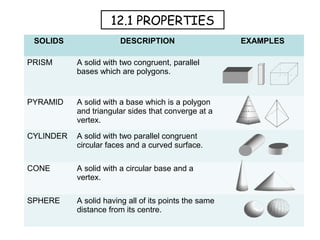
12.1 PROPERTIES
 SOLIDS                DESCRIPTION                     EXAMPLES

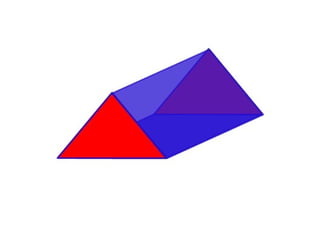
PRISM      A solid with two congruent, parallel
           bases which are polygons.


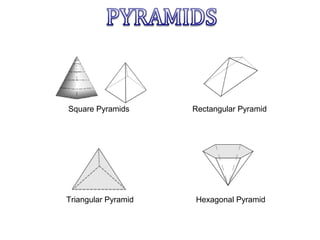
PYRAMID    A solid with a base which is a polygon
           and triangular sides that converge at a
           vertex.

CYLINDER   A solid with two parallel congruent
           circular faces and a curved surface.

CONE       A solid with a circular base and a
           vertex.

SPHERE     A solid having all of its points the same
           distance from its centre.
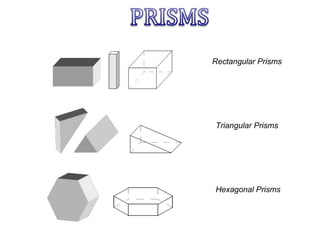
Rectangular Prisms


Triangular Prisms


Hexagonal Prisms
Square Pyramids      Rectangular Pyramid


Triangular Pyramid   Hexagonal Pyramid
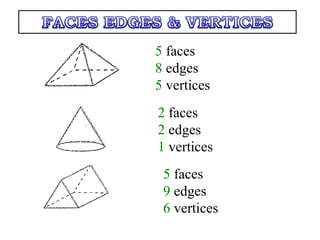
5 faces
8 edges
5 vertices
2 faces
2 edges
1 vertices
 5 faces
 9 edges
 6 vertices
12.2 NETS OF GEOMETRIC
 12.2 NETS OF GEOMETRIC
         SOLIDS
         SOLIDS


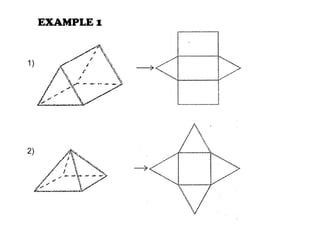
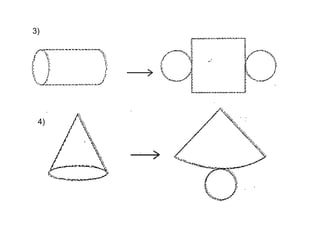
A net is a two-dimensional
figure that can be folded
into a three-dimensional
solid.
EXAMPLE 1


1)


2)
3)


 4)
WORKSHEET
12.3 SURFACE AREA


The surface area of a solid is the
total area of all the faces of the
solid.

• It is measured using squares
• Units include mm²,cm²,m²,km².
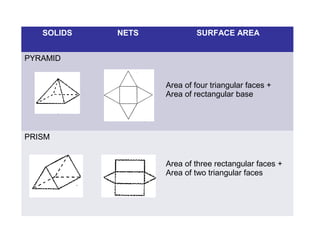
SOLIDS   NETS            SURFACE AREA


PYRAMID


                   Area of four triangular faces +
                   Area of rectangular base


PRISM


                   Area of three rectangular faces +
                   Area of two triangular faces
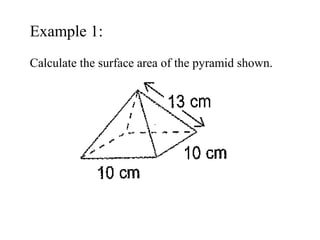
Example 1:
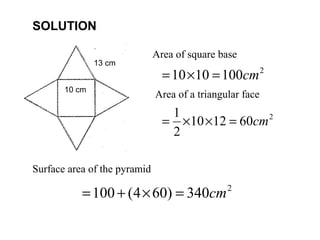
Calculate the surface area of the pyramid shown.
SOLUTION

                              Area of square base
               13 cm
                                = 10 × 10 = 100cm 2
       10 cm
                              Area of a triangular face
                                 1
                                = ×10 ×12 = 60cm 2
                                 2

Surface area of the pyramid

           = 100 + (4 × 60) = 340cm            2
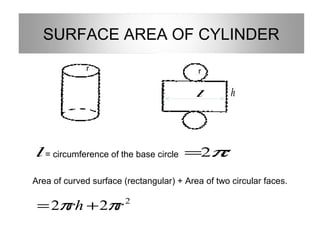
SURFACE AREA OF CYLINDER
             r                            r

                                          l        h


l = circumference of the base circle =2πr
Area of curved surface (rectangular) + Area of two circular faces.

 = 2πrh + 2πr           2
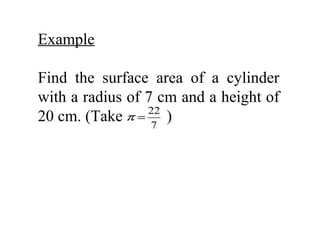
Example

Find the surface area of a cylinder
with a radius of 7 cm and a height of
                 22
20 cm. (Take  π=
                  7
                    )
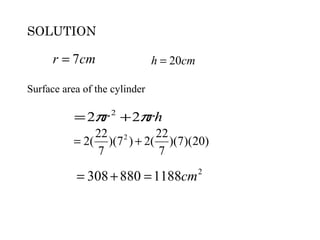
SOLUTION

      r = 7cm                  h = 20cm

Surface area of the cylinder

           = 2πr + 2πrh
                   2

               22 2       22
           = 2( )(7 ) + 2( )(7)(20)
               7          7

           = 308 + 880 = 1188cm 2
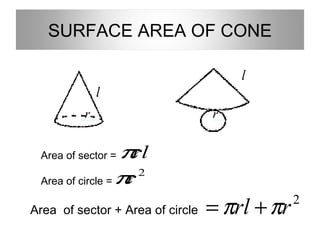
SURFACE AREA OF CONE

                                      l
              l
          r                       r


 Area of sector = π rl
 Area of circle = π
                     2
                   r
Area of sector + Area of circle   = πrl + πr   2
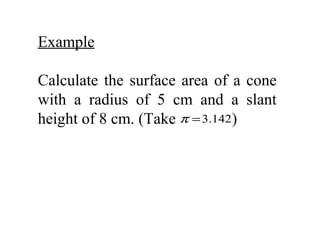
Example

Calculate the surface area of a cone
with a radius of 5 cm and a slant
height of 8 cm. (Take π = 3.142)
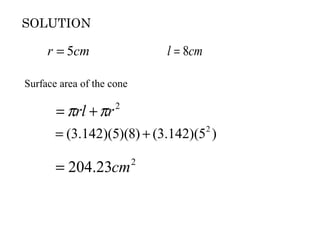
SOLUTION

     r = 5cm                   l = 8cm

Surface area of the cone

       = πrl + πr    2


       = (3.142)(5)(8) + (3.142)(52 )

       = 204.23cm          2
SURFACE AREA OF SPHERE


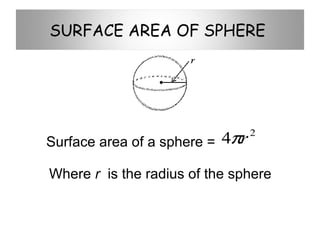
Surface area of a sphere = 4πr
                                 2


Where r is the radius of the sphere
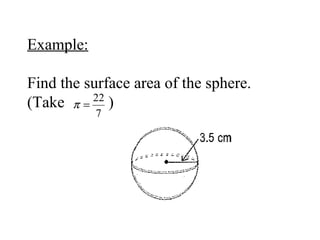
Example:

Find the surface area of the sphere.
          22
(Take π = )
           7
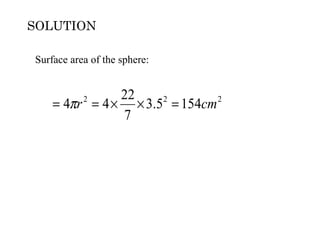
SOLUTION

Surface area of the sphere:


               22
    = 4πr = 4 × × 3.52 = 154cm 2
           2

               7
POP QUIZ
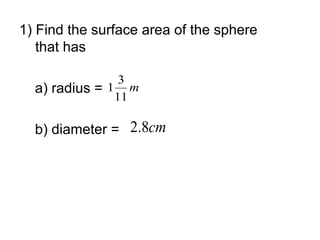
1) Find the surface area of the sphere
   that has

                3
  a) radius = 1 m
               11

  b) diameter = 2.8cm
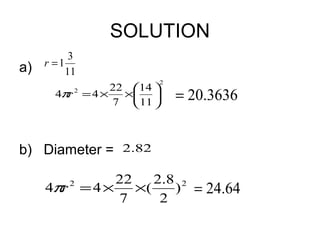
SOLUTION
           3
a)   r =1
          11
                            2
                     22 14 
       4πr 2 = 4 ×     × 
                     7  11 
                                = 20.3636


b) Diameter = 2.82

               22    2.8 2
     4πr = 4 ×
          2
                  ×(    ) = 24.64
               7      2
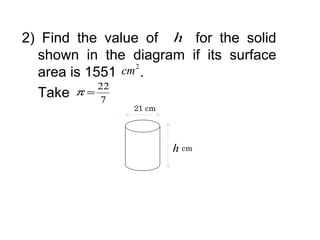
2) Find the value of h for the solid
  shown in the diagram if its surface
  area is 1551 cm 2 .
            22
  Take  π=
            7
                21 cm


                        h cm
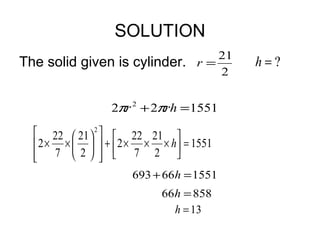
SOLUTION
                                     21
The solid given is cylinder.      r=      h=?
                                     2


                 2πr 2 + 2πrh = 1551

   22  21  2   22 21 
   2 × ×    +  2 × × × h = 1551
   7 2   7 2 
               
                     693 + 66h = 1551
                           66h = 858
                             h = 13
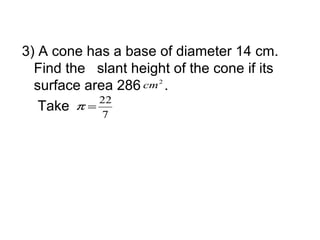
3) A cone has a base of diameter 14 cm.
  Find the slant height of the cone if its
  surface area 286 cm 2 .
            22
   Take  π=
             7
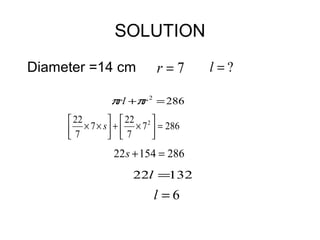
SOLUTION
Diameter =14 cm               r=7       l =?

                 πrl +πr 2 = 286
      22           22      
     7   × 7 × s  +  × 7 2  = 286
                  7        
                  22 s + 154 = 286
                       22l =132
                             l =6
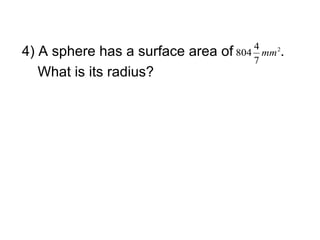
4
4) A sphere has a surface area   of 804 mm 2.
                                       7
   What is its radius?
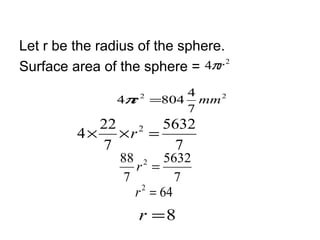
Let r be the radius of the sphere.
Surface area of the sphere =   4πr 2

                       4
                4π =804 mm 2
                  r 2

                       7
            22    5632
         4 × ×r =
               2

            7       7
                 88 2 5632
                    r =
                  7          7
                    r 2 = 64
                    r =8
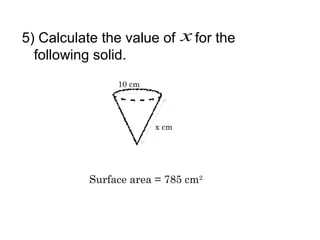
5) Calculate the value of     x for the
  following solid.
               10 cm


                       x cm


          Surface area = 785 cm2
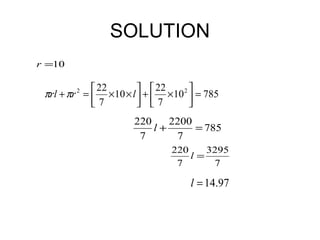
SOLUTION
r =10

               22        22      
 πrl + πr 2 =  ×10 × l  +  ×10 2  = 785
              7         7        
                      220    2200
                          l+      = 785
                       7      7
                               220    3295
                                   l=
                                7      7

                                    l = 14.97
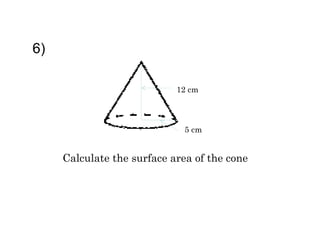
6)

                            12 cm


                              5 cm


     Calculate the surface area of the cone
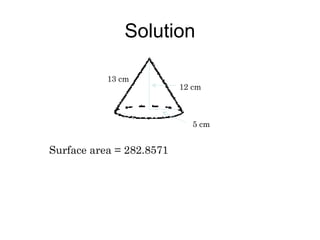
Solution

           13 cm
                          12 cm


                             5 cm


Surface area = 282.8571
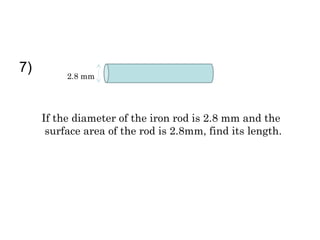
7)        2.8 mm


     If the diameter of the iron rod is 2.8 mm and the
      surface area of the rod is 2.8mm, find its length.
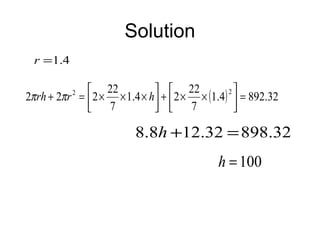
Solution
 r =1.4

                22             22           2
2π rh + 2π r =  2 × × 1.4 × h +  2 × × (1.4)  = 892.32
          2

                7              7             

                         8.8h +12.32 = 898.32
                                            h = 100
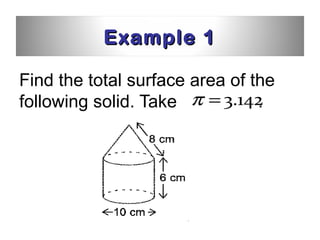
Example 1

Find the total surface area of the
following solid. Take π = 3.142 .
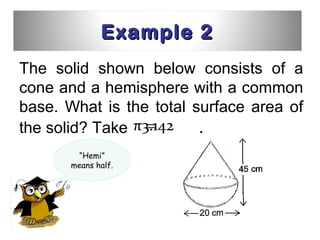
Example 2
The solid shown below consists of a
cone and a hemisphere with a common
base. What is the total surface area of
                  =
the solid? Take π3.142   .
         “Hemi”
       means half.
HOMEWORK

• Ex12.3A, Ex12.3B, Ex12.3C


NEXT LESSON Chapter 13 - Statistics


http://www.harcourtschool.com/jingles/jingles_all/1what_am_i.html

Solid geometry ii slide

  • 1.
  • 2.
  • 3.
    LEARNING OUTCOMES State thegeometric properties of prisms, pyramids, cylinders, cones and spheres. Draw nets for prisms, pyramids, cylinders and cones. State and find surface areas of prisms, pyramids, cylinders, cones and spheres.
  • 5.
    DEFINITION Solid geometry isconcerned with three-dimensional shapes. Some examples of three-dimensional shapes are: • Prisms • Pyramids • Cylinders • Cones • Spheres
  • 6.
    12.1 PROPERTIES SOLIDS DESCRIPTION EXAMPLES PRISM A solid with two congruent, parallel bases which are polygons. PYRAMID A solid with a base which is a polygon and triangular sides that converge at a vertex. CYLINDER A solid with two parallel congruent circular faces and a curved surface. CONE A solid with a circular base and a vertex. SPHERE A solid having all of its points the same distance from its centre.
  • 7.
  • 8.
    Square Pyramids Rectangular Pyramid Triangular Pyramid Hexagonal Pyramid
  • 9.
    5 faces 8 edges 5vertices 2 faces 2 edges 1 vertices 5 faces 9 edges 6 vertices
  • 10.
    12.2 NETS OFGEOMETRIC 12.2 NETS OF GEOMETRIC SOLIDS SOLIDS A net is a two-dimensional figure that can be folded into a three-dimensional solid.
  • 11.
  • 12.
  • 13.
  • 14.
    12.3 SURFACE AREA Thesurface area of a solid is the total area of all the faces of the solid. • It is measured using squares • Units include mm²,cm²,m²,km².
  • 15.
    SOLIDS NETS SURFACE AREA PYRAMID Area of four triangular faces + Area of rectangular base PRISM Area of three rectangular faces + Area of two triangular faces
  • 16.
    Example 1: Calculate thesurface area of the pyramid shown.
  • 17.
    SOLUTION Area of square base 13 cm = 10 × 10 = 100cm 2 10 cm Area of a triangular face 1 = ×10 ×12 = 60cm 2 2 Surface area of the pyramid = 100 + (4 × 60) = 340cm 2
  • 19.
    SURFACE AREA OFCYLINDER r r l h l = circumference of the base circle =2πr Area of curved surface (rectangular) + Area of two circular faces. = 2πrh + 2πr 2
  • 20.
    Example Find the surfacearea of a cylinder with a radius of 7 cm and a height of 22 20 cm. (Take π= 7 )
  • 21.
    SOLUTION r = 7cm h = 20cm Surface area of the cylinder = 2πr + 2πrh 2 22 2 22 = 2( )(7 ) + 2( )(7)(20) 7 7 = 308 + 880 = 1188cm 2
  • 22.
    SURFACE AREA OFCONE l l r r Area of sector = π rl Area of circle = π 2 r Area of sector + Area of circle = πrl + πr 2
  • 23.
    Example Calculate the surfacearea of a cone with a radius of 5 cm and a slant height of 8 cm. (Take π = 3.142)
  • 24.
    SOLUTION r = 5cm l = 8cm Surface area of the cone = πrl + πr 2 = (3.142)(5)(8) + (3.142)(52 ) = 204.23cm 2
  • 25.
    SURFACE AREA OFSPHERE Surface area of a sphere = 4πr 2 Where r is the radius of the sphere
  • 26.
    Example: Find the surfacearea of the sphere. 22 (Take π = ) 7
  • 27.
    SOLUTION Surface area ofthe sphere: 22 = 4πr = 4 × × 3.52 = 154cm 2 2 7
  • 28.
  • 29.
    1) Find thesurface area of the sphere that has 3 a) radius = 1 m 11 b) diameter = 2.8cm
  • 30.
    SOLUTION 3 a) r =1 11 2 22 14  4πr 2 = 4 × ×  7  11  = 20.3636 b) Diameter = 2.82 22 2.8 2 4πr = 4 × 2 ×( ) = 24.64 7 2
  • 31.
    2) Find thevalue of h for the solid shown in the diagram if its surface area is 1551 cm 2 . 22 Take π= 7 21 cm h cm
  • 32.
    SOLUTION 21 The solid given is cylinder. r= h=? 2 2πr 2 + 2πrh = 1551  22  21  2   22 21   2 × ×    +  2 × × × h = 1551  7 2   7 2    693 + 66h = 1551 66h = 858 h = 13
  • 33.
    3) A conehas a base of diameter 14 cm. Find the slant height of the cone if its surface area 286 cm 2 . 22 Take π= 7
  • 34.
    SOLUTION Diameter =14 cm r=7 l =? πrl +πr 2 = 286  22   22  7 × 7 × s  +  × 7 2  = 286   7  22 s + 154 = 286 22l =132 l =6
  • 35.
    4 4) A spherehas a surface area of 804 mm 2. 7 What is its radius?
  • 36.
    Let r bethe radius of the sphere. Surface area of the sphere = 4πr 2 4 4π =804 mm 2 r 2 7 22 5632 4 × ×r = 2 7 7 88 2 5632 r = 7 7 r 2 = 64 r =8
  • 37.
    5) Calculate thevalue of x for the following solid. 10 cm x cm Surface area = 785 cm2
  • 38.
    SOLUTION r =10  22   22  πrl + πr 2 =  ×10 × l  +  ×10 2  = 785 7  7  220 2200 l+ = 785 7 7 220 3295 l= 7 7 l = 14.97
  • 39.
    6) 12 cm 5 cm Calculate the surface area of the cone
  • 40.
    Solution 13 cm 12 cm 5 cm Surface area = 282.8571
  • 41.
    7) 2.8 mm If the diameter of the iron rod is 2.8 mm and the surface area of the rod is 2.8mm, find its length.
  • 42.
    Solution r =1.4  22   22 2 2π rh + 2π r =  2 × × 1.4 × h +  2 × × (1.4)  = 892.32 2  7   7  8.8h +12.32 = 898.32 h = 100
  • 44.
    Example 1 Find thetotal surface area of the following solid. Take π = 3.142 .
  • 45.
    Example 2 The solidshown below consists of a cone and a hemisphere with a common base. What is the total surface area of = the solid? Take π3.142 . “Hemi” means half.
  • 48.
    HOMEWORK • Ex12.3A, Ex12.3B,Ex12.3C NEXT LESSON Chapter 13 - Statistics http://www.harcourtschool.com/jingles/jingles_all/1what_am_i.html