Solid Geometry
The student is able to (I can):
• Classify three-dimensional figures according to their
properties
• Associate two-dimensional nets with their three-
dimensional shapes
• Analyze the cross-sections of three-dimensional shapes
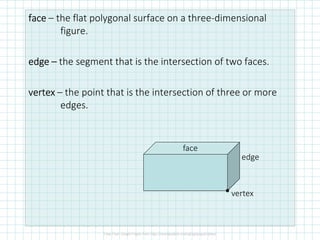
facefacefaceface – the flat polygonal surface on a three-dimensional
figure.
edgeedgeedgeedge –––– the segment that is the intersection of two faces.
vertexvertexvertexvertex – the point that is the intersection of three or more
edges.
face
edge
vertex•
polyhedronpolyhedronpolyhedronpolyhedron – a three-dimensional figure composed of
polygons. (plural polyhedrapolyhedrapolyhedrapolyhedra)
prismprismprismprism – two parallel congruent polygon bases connected by
faces that are parallelograms.
cylindercylindercylindercylinder – two parallel congruent circular bases and a curved
surface that connects the bases.
pyramidpyramidpyramidpyramid – a polygonal base with triangular faces that meet at
a common vertex.
coneconeconecone – a circular base and a curved surface that connects the
base to a vertex.
rightrightrightright prismprismprismprism – a prism whose faces are all rectangles. (Assume
a prism is a right prism unless noted otherwise.)
obliqueobliqueobliqueoblique prismprismprismprism – a prism whose faces are not rectangles.
altitudealtitudealtitudealtitude – a perpendicular segment joining the planes of the
bases (the height).
crosscrosscrosscross sectionsectionsectionsection – the intersection of a three-dimensional figure
and a plane.
Examples Describe the cross sections:
1.
2.
Examples Describe the cross sections:
1.
2.
A hexagon
A triangle
A cubecubecubecube is a prism with six square faces. Other prisms and
pyramids are named for the shape of their bases:
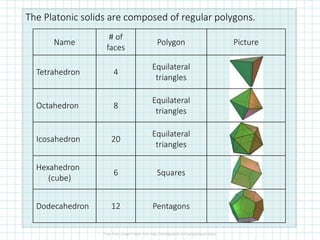
The Platonic solids are composed of regular polygons.
Name
# of
faces
Polygon Picture
Tetrahedron 4
Equilateral
triangles
Octahedron 8
Equilateral
triangles
Icosahedron 20
Equilateral
triangles
Hexahedron
(cube)
6 Squares
Dodecahedron 12 Pentagons
Euler’s Formula
For any polyhedron with V vertices, E edges, and F faces:
V − E + F = 2.
Example: If a given polyhedron has 12 vertices and 18 edges,
how many faces does it have?
− + =
− + =
=
2
12 18 2
8
V E F
F
F
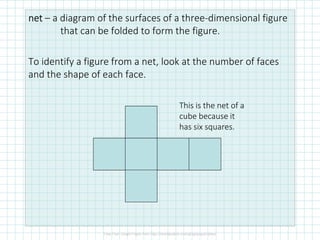
netnetnetnet – a diagram of the surfaces of a three-dimensional figure
that can be folded to form the figure.
To identify a figure from a net, look at the number of faces
and the shape of each face.
This is the net of a
cube because it
has six squares.
Examples Describe the three-dimensional figure from
the net.
1.
2.
Triangular
Pyramid
Cylinder
The surface areasurface areasurface areasurface area is the total area of all faces and curved
surfaces of a three-dimensional figure. The lateral arealateral arealateral arealateral area of a
prism is the sum of the areas of the lateral faces.
Let’s look at a net for a hexagonal prism:
If each side of the hexagon is 10 in., what is the area of the
hexagon?
What is the area of each rectanglular face if the height of the
prism is 16 in?
What is the total surface area?
If each side of the hexagon is 10 in., what is the area of the
hexagon?
What is the area of each rectanglular face if the height of the
prism is 16 in?
What is the total surface area?
( )
2
210 3
6 6 25 3 150 3 in
4
 
= = 
 
2
150 3 in
2
150 3 in
( )( ) 2
10 16 160 in=
160in2
( ) ( ) 2
2 150 3 6 160 1479.6 in+ ≈
If we take the shape below and rotate it about the indicated
axis, we will generate a three-dimensional figure. The type of
figure generated depends on the initial shape andandandand the axis
around which it is rotated.
Thus, rotating the rectangle about the axis has created a
cylinder.

12.1 Solid Geometry

  • 1.
    Solid Geometry The studentis able to (I can): • Classify three-dimensional figures according to their properties • Associate two-dimensional nets with their three- dimensional shapes • Analyze the cross-sections of three-dimensional shapes
  • 2.
    facefacefaceface – theflat polygonal surface on a three-dimensional figure. edgeedgeedgeedge –––– the segment that is the intersection of two faces. vertexvertexvertexvertex – the point that is the intersection of three or more edges. face edge vertex•
  • 3.
    polyhedronpolyhedronpolyhedronpolyhedron – athree-dimensional figure composed of polygons. (plural polyhedrapolyhedrapolyhedrapolyhedra) prismprismprismprism – two parallel congruent polygon bases connected by faces that are parallelograms. cylindercylindercylindercylinder – two parallel congruent circular bases and a curved surface that connects the bases.
  • 4.
    pyramidpyramidpyramidpyramid – apolygonal base with triangular faces that meet at a common vertex. coneconeconecone – a circular base and a curved surface that connects the base to a vertex.
  • 5.
    rightrightrightright prismprismprismprism –a prism whose faces are all rectangles. (Assume a prism is a right prism unless noted otherwise.) obliqueobliqueobliqueoblique prismprismprismprism – a prism whose faces are not rectangles. altitudealtitudealtitudealtitude – a perpendicular segment joining the planes of the bases (the height).
  • 6.
    crosscrosscrosscross sectionsectionsectionsection –the intersection of a three-dimensional figure and a plane.
  • 7.
    Examples Describe thecross sections: 1. 2.
  • 8.
    Examples Describe thecross sections: 1. 2. A hexagon A triangle
  • 9.
    A cubecubecubecube isa prism with six square faces. Other prisms and pyramids are named for the shape of their bases:
  • 10.
    The Platonic solidsare composed of regular polygons. Name # of faces Polygon Picture Tetrahedron 4 Equilateral triangles Octahedron 8 Equilateral triangles Icosahedron 20 Equilateral triangles Hexahedron (cube) 6 Squares Dodecahedron 12 Pentagons
  • 11.
    Euler’s Formula For anypolyhedron with V vertices, E edges, and F faces: V − E + F = 2. Example: If a given polyhedron has 12 vertices and 18 edges, how many faces does it have? − + = − + = = 2 12 18 2 8 V E F F F
  • 12.
    netnetnetnet – adiagram of the surfaces of a three-dimensional figure that can be folded to form the figure. To identify a figure from a net, look at the number of faces and the shape of each face. This is the net of a cube because it has six squares.
  • 13.
    Examples Describe thethree-dimensional figure from the net. 1. 2. Triangular Pyramid Cylinder
  • 14.
    The surface areasurfaceareasurface areasurface area is the total area of all faces and curved surfaces of a three-dimensional figure. The lateral arealateral arealateral arealateral area of a prism is the sum of the areas of the lateral faces. Let’s look at a net for a hexagonal prism:
  • 15.
    If each sideof the hexagon is 10 in., what is the area of the hexagon? What is the area of each rectanglular face if the height of the prism is 16 in? What is the total surface area?
  • 16.
    If each sideof the hexagon is 10 in., what is the area of the hexagon? What is the area of each rectanglular face if the height of the prism is 16 in? What is the total surface area? ( ) 2 210 3 6 6 25 3 150 3 in 4   = =    2 150 3 in 2 150 3 in ( )( ) 2 10 16 160 in= 160in2 ( ) ( ) 2 2 150 3 6 160 1479.6 in+ ≈
  • 17.
    If we takethe shape below and rotate it about the indicated axis, we will generate a three-dimensional figure. The type of figure generated depends on the initial shape andandandand the axis around which it is rotated. Thus, rotating the rectangle about the axis has created a cylinder.