K.V
    Faridkot
Harkamalpreet
Singh Brar
   9 -B
     th
Topic
Objectives
 At the end of the lesson the students
  should be able;
      To find the surface area of a
  cylinder ..
What is a cylinder?
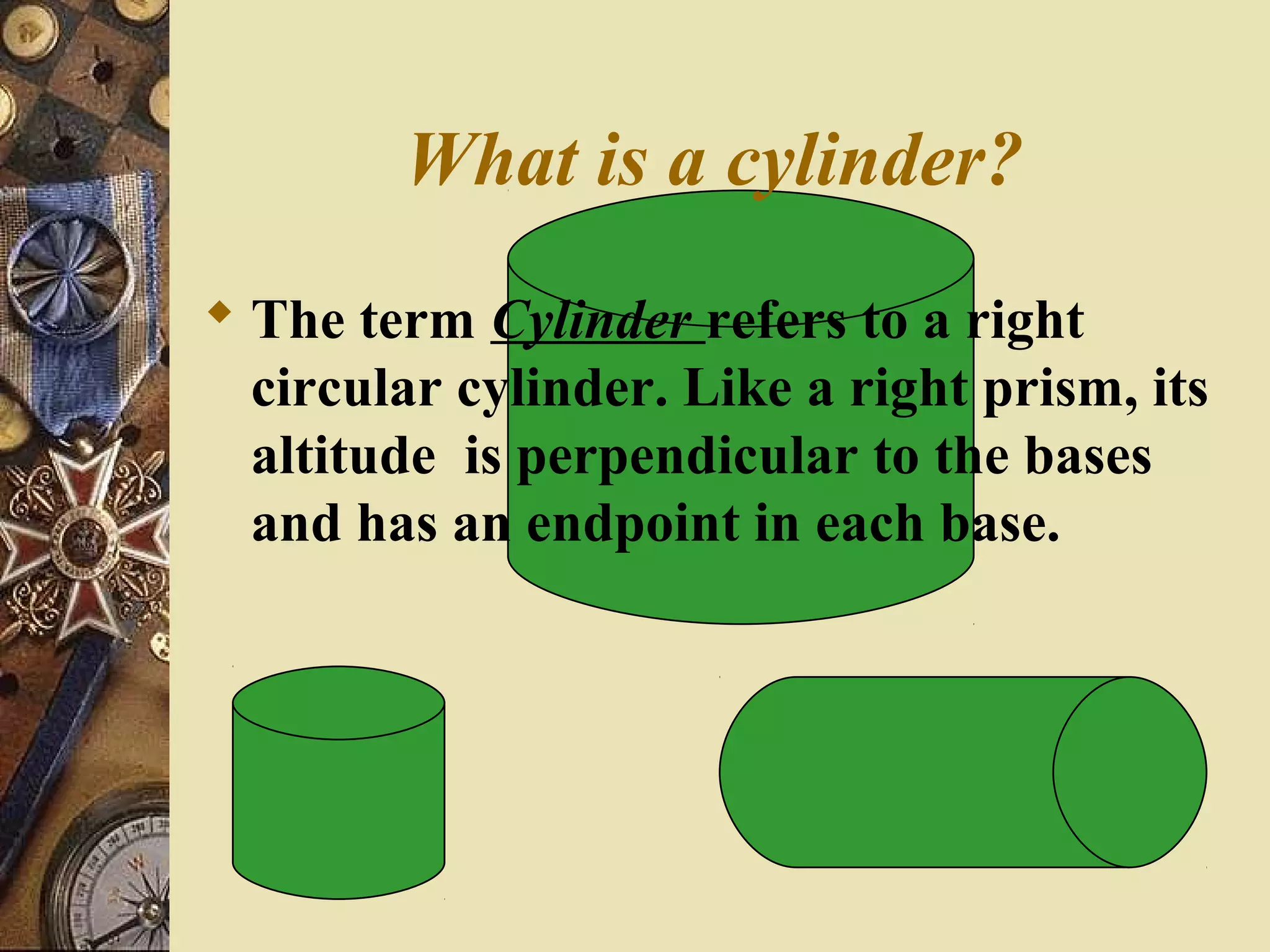
 The term Cylinder refers to a right
  circular cylinder. Like a right prism, its
  altitude is perpendicular to the bases
  and has an endpoint in each base.
PRESENTATION

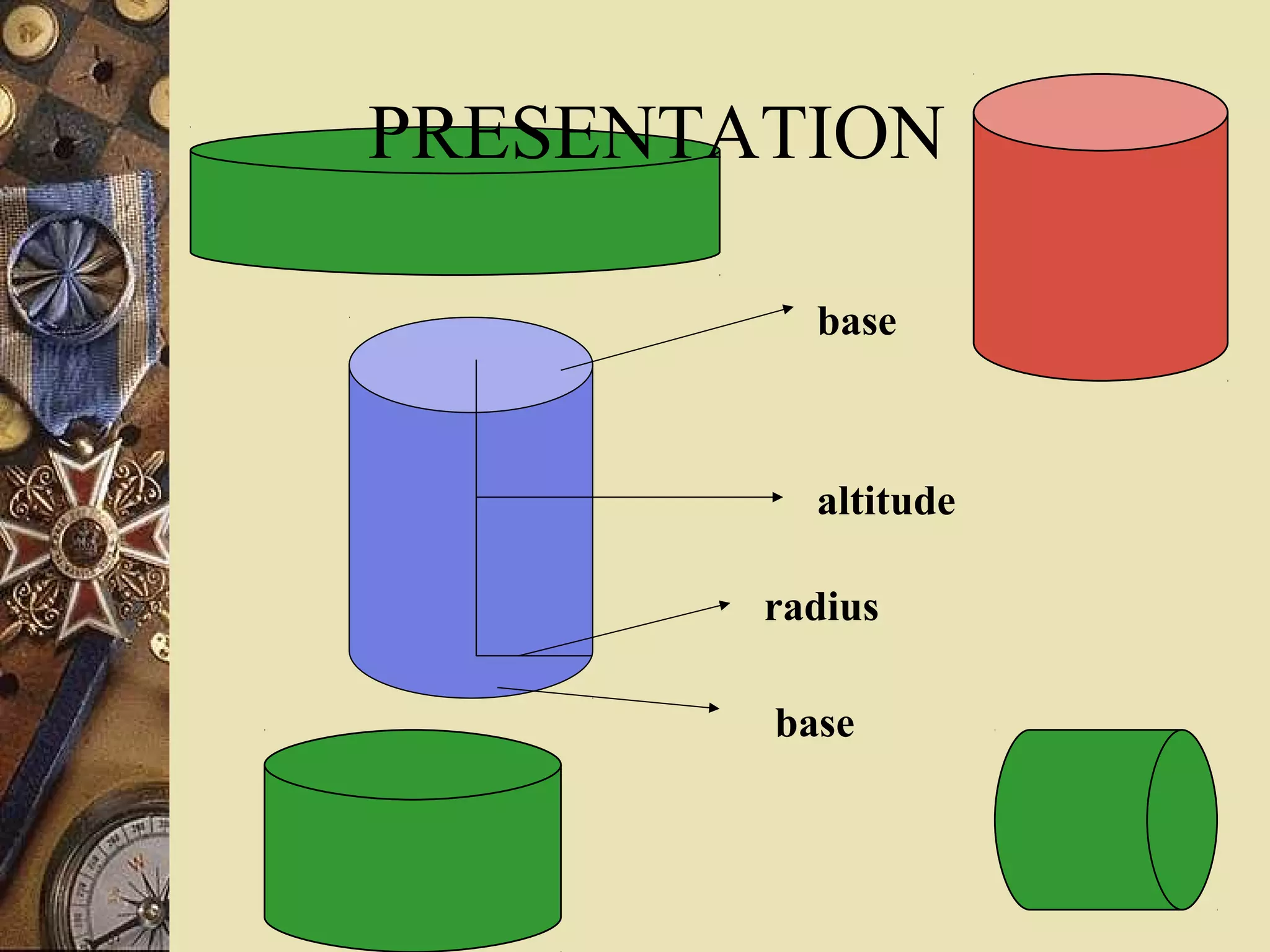
          base


          altitude

        radius

        base
What will happen if we
 removed the end of the
cylinder and unrolled the
          body?

  Lets find out
 !!!!
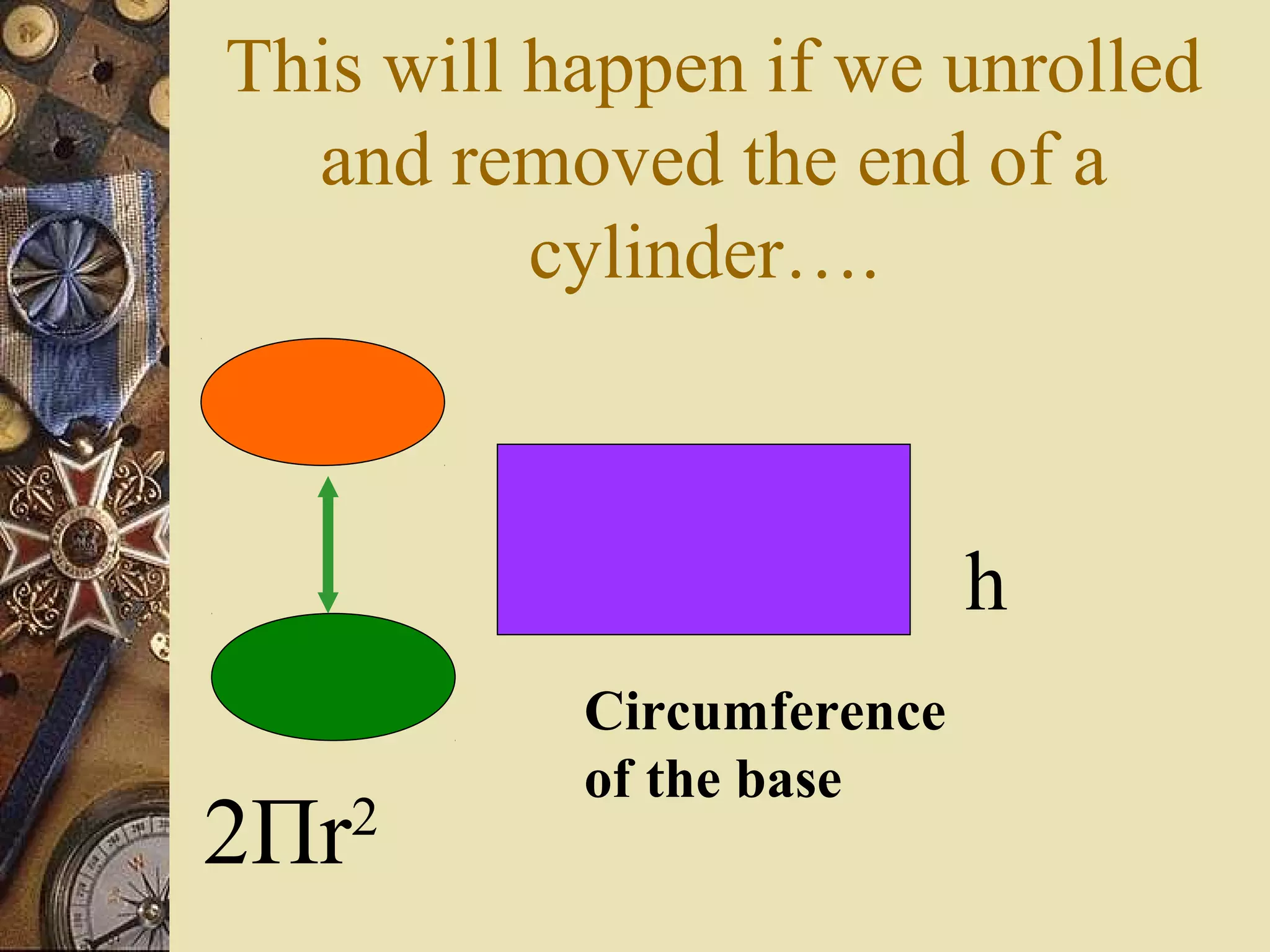
This will happen if we unrolled
  and removed the end of a
          cylinder….


                           h
           Circumference
           of the base
2Πr   2
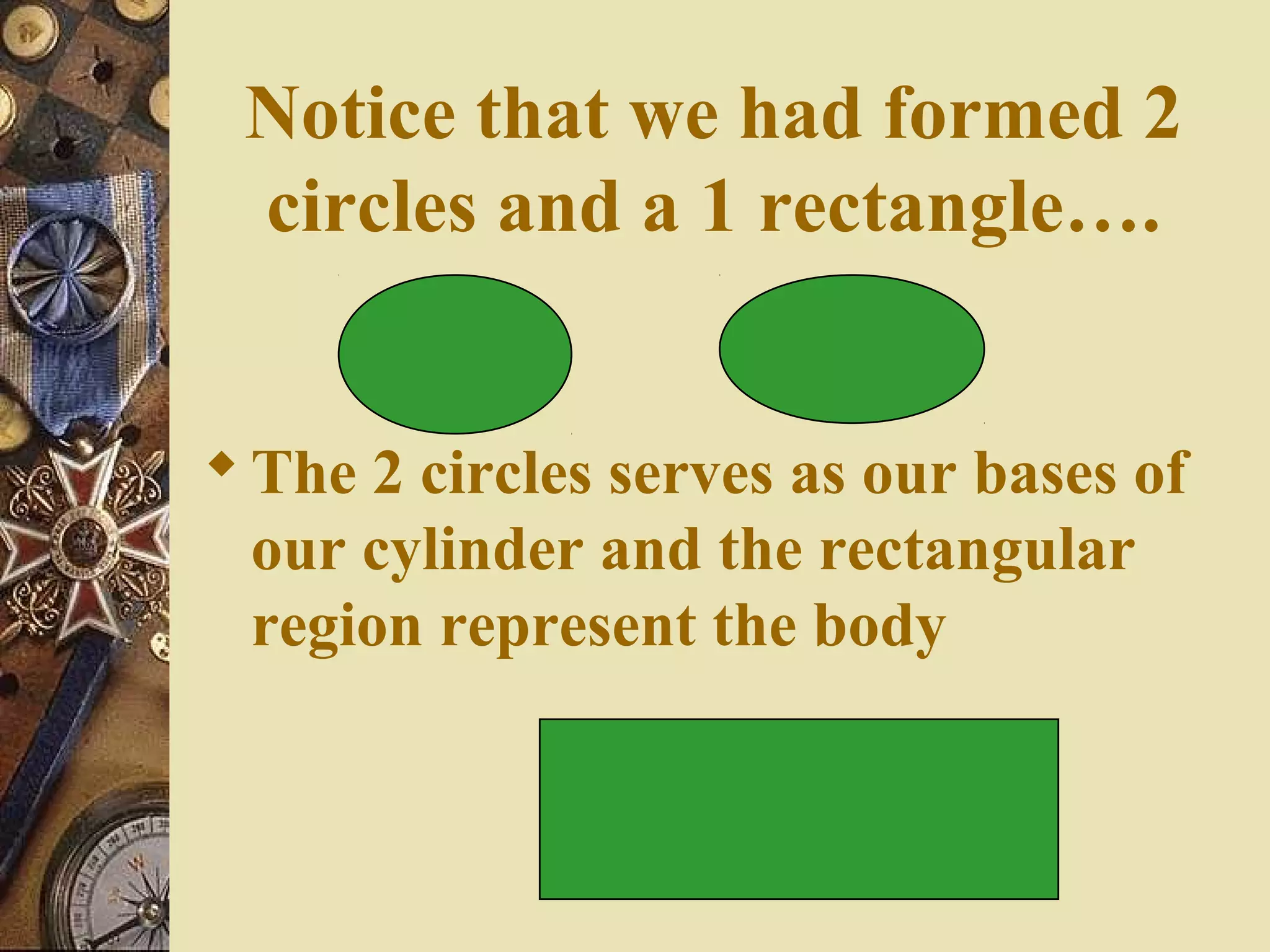
Notice that we had formed 2
 circles and a 1 rectangle….


 The 2 circles serves as our bases of
  our cylinder and the rectangular
  region represent the body
How can we solved the surface
    area of a Cylinder?

 To solve the surface area of a
  cylinder, add the areas of the
  circular bases and the area of
  the rectangular region which is
  the body of the cylinder.
This is the formula in order to
 solved the surface are of a
           cylinder.

 SA= area of 2 circular bases
  + are of a rectangle


              oR
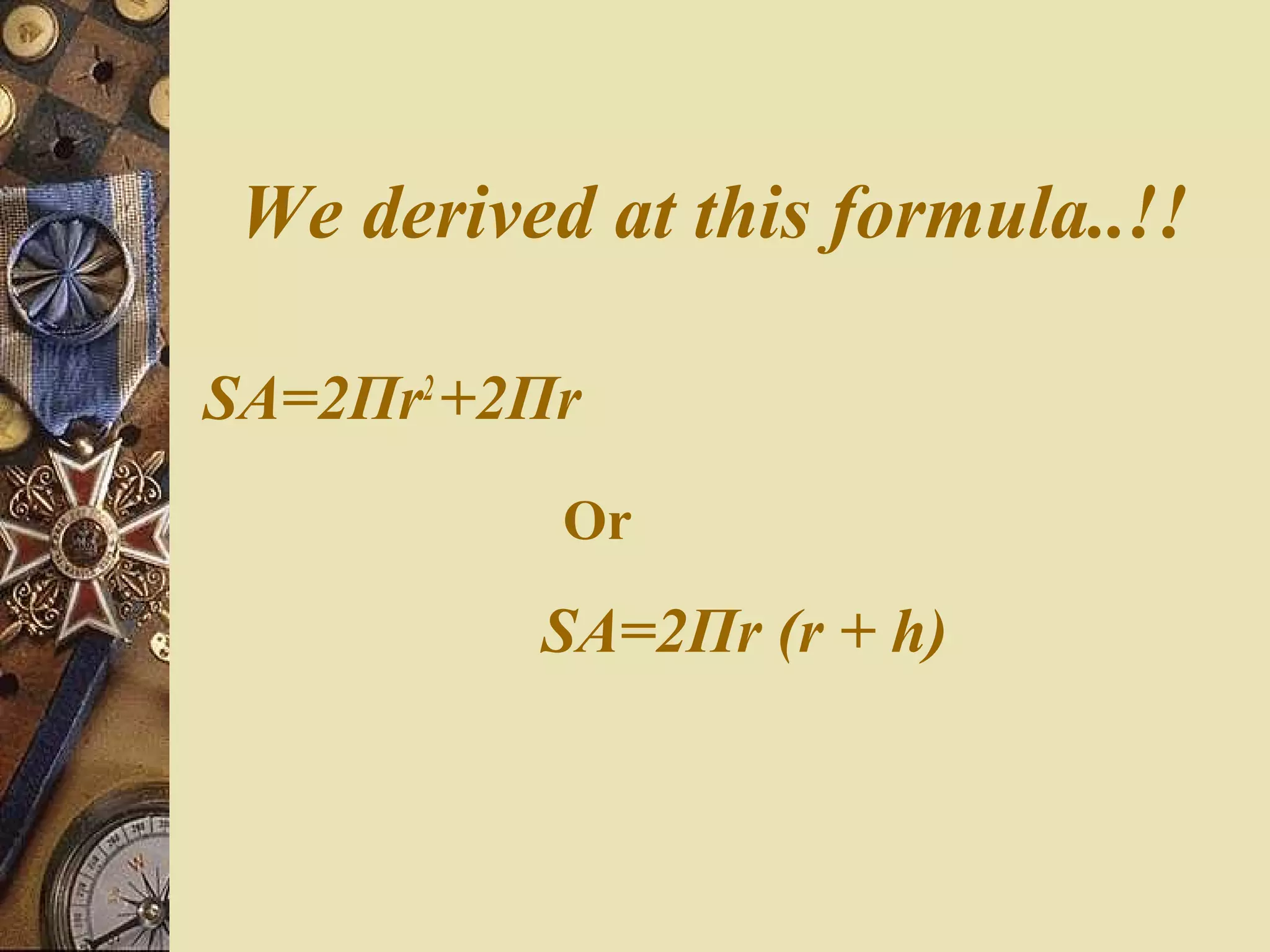
We derived at this formula..!!

SA=2Πr2 +2Πr
           Or

          SA=2Πr (r + h)
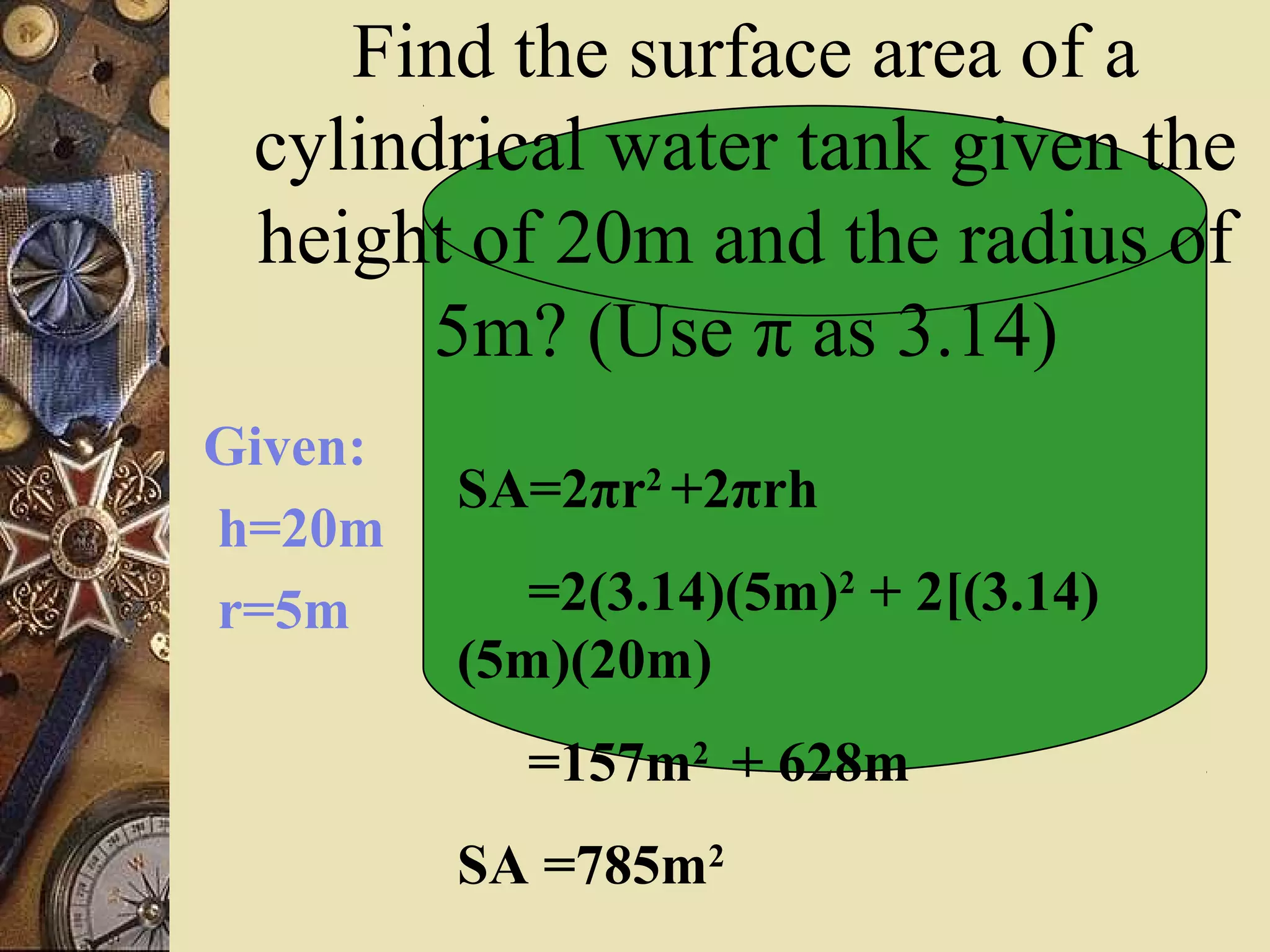
Find the surface area of a
 cylindrical water tank given the
 height of 20m and the radius of
       5m? (Use π as 3.14)
Given:
         SA=2πr2 +2πrh
h=20m
r=5m        =2(3.14)(5m)2 + 2[(3.14)
         (5m)(20m)
           =157m2 + 628m
         SA =785m2
2-Surface Area of a Prism
    Cubes and Cuboids
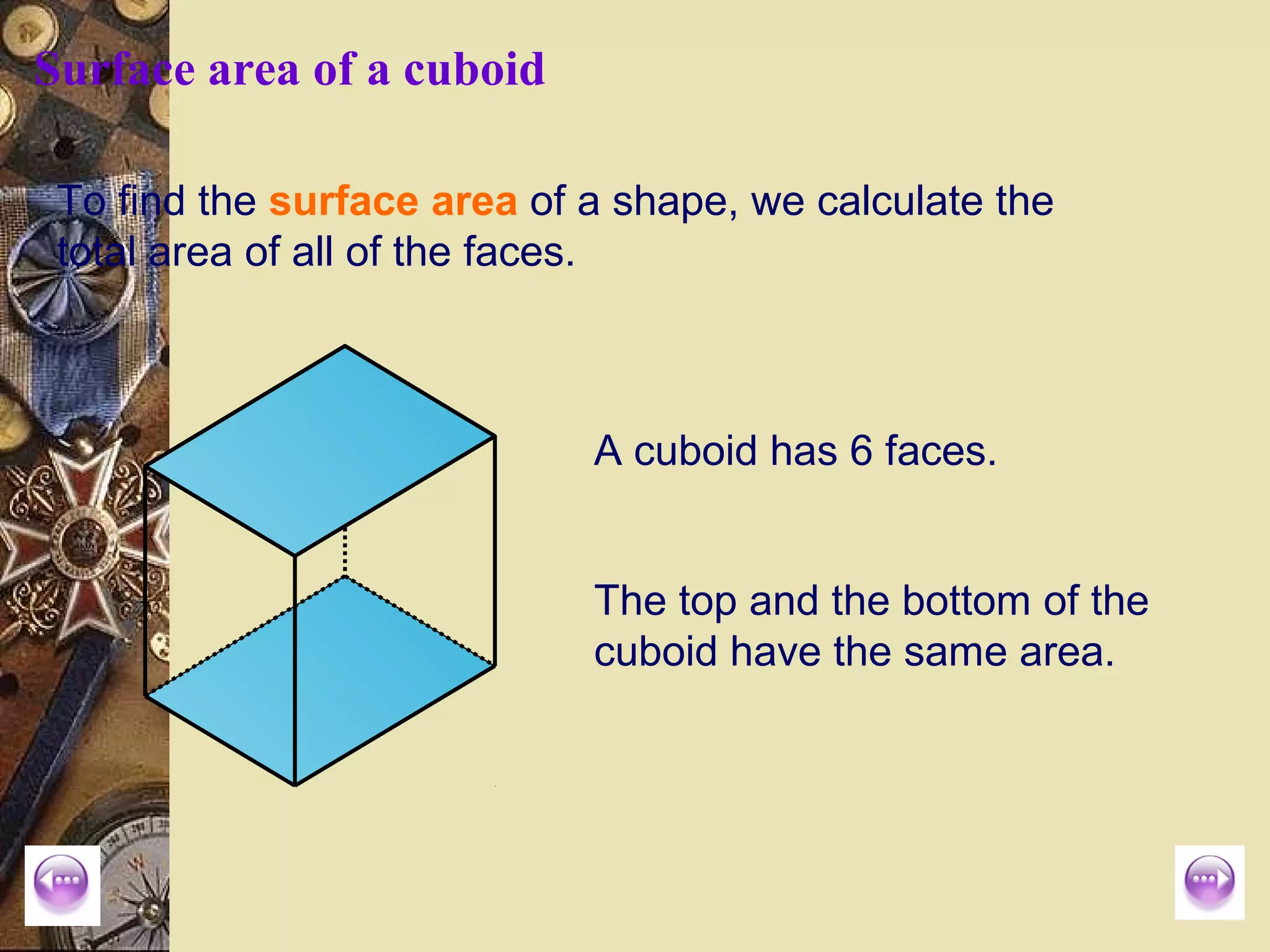
Surface area of a cuboid

 To find the surface area of a shape, we calculate the
 total area of all of the faces.


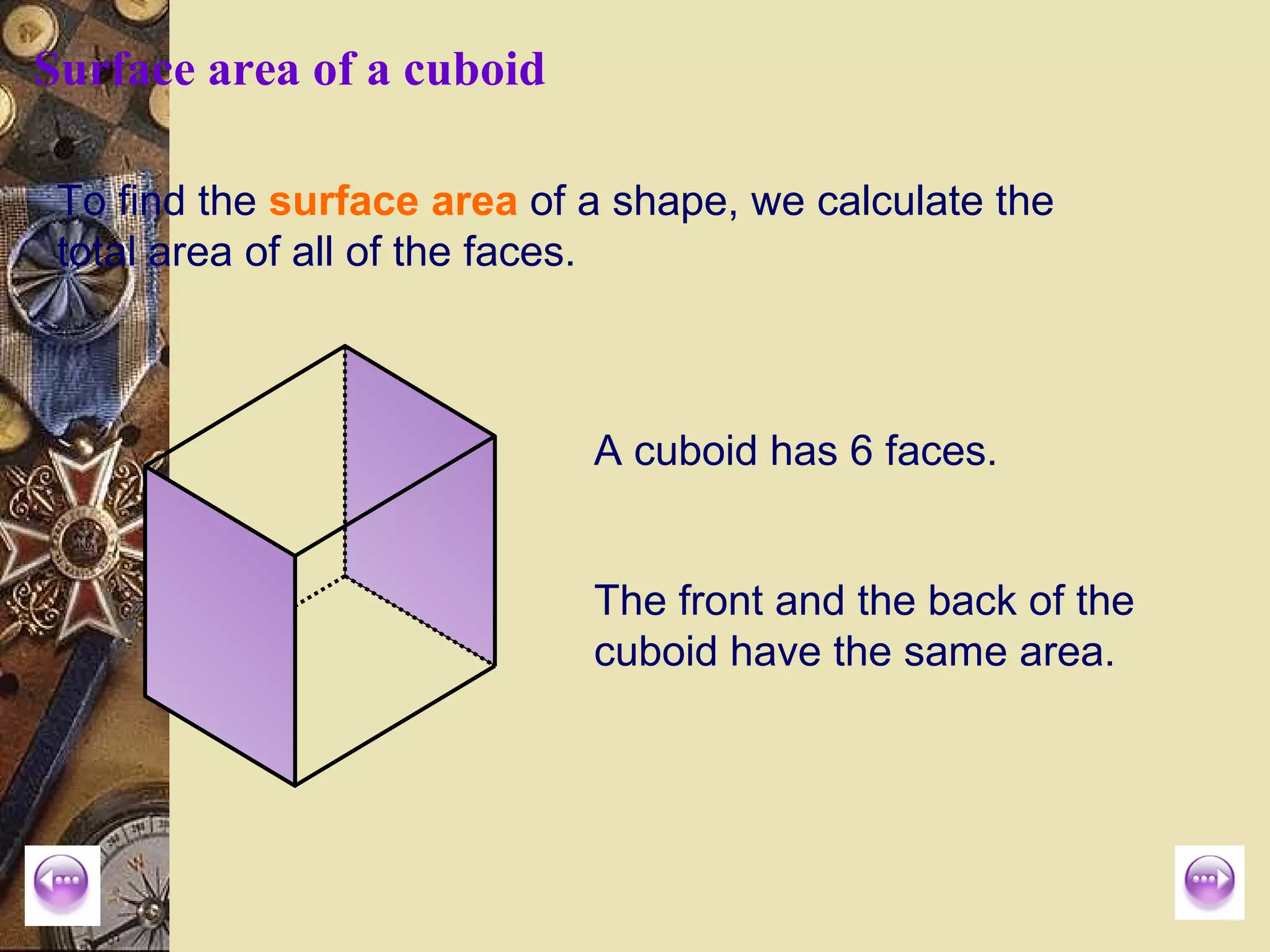
                             A cuboid has 6 faces.


                             The top and the bottom of the
                             cuboid have the same area.
Surface area of a cuboid

 To find the surface area of a shape, we calculate the
 total area of all of the faces.


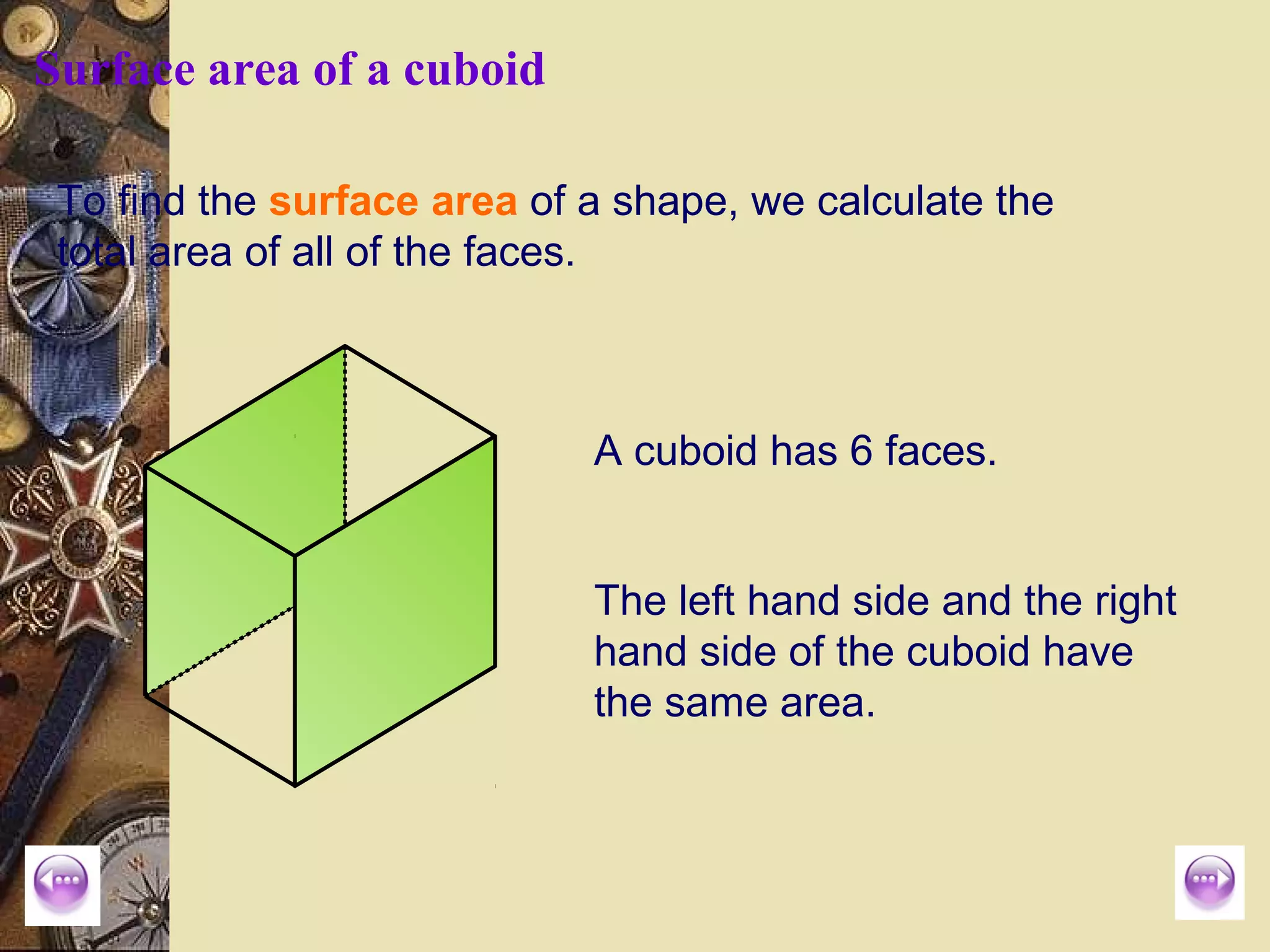
                             A cuboid has 6 faces.


                             The front and the back of the
                             cuboid have the same area.
Surface area of a cuboid

 To find the surface area of a shape, we calculate the
 total area of all of the faces.


                             A cuboid has 6 faces.


                             The left hand side and the right
                             hand side of the cuboid have
                             the same area.
Surface area of a cuboid

 To find the surface area of a shape, we calculate the
 total area of all of the faces.
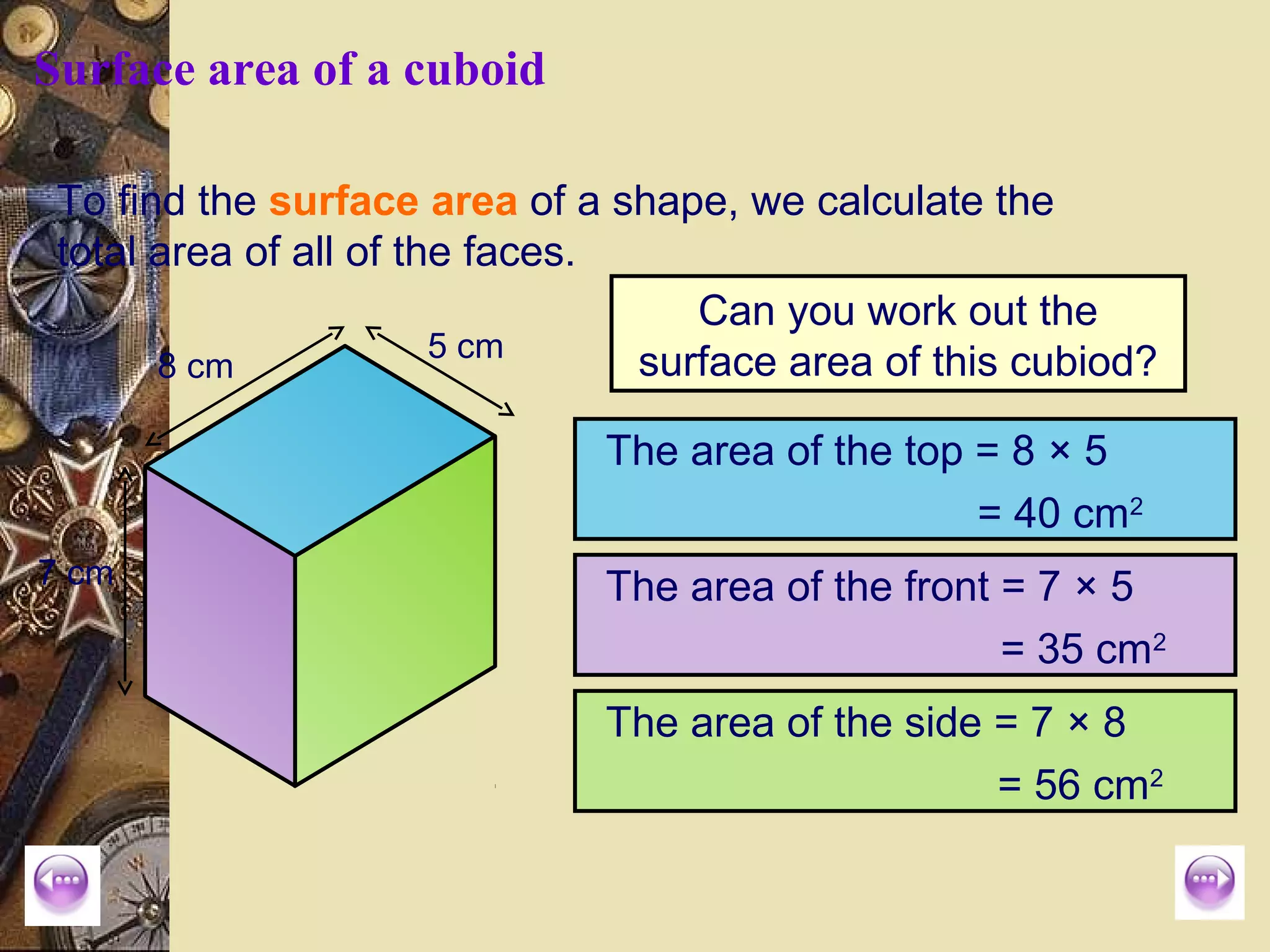
                                    Can you work out the
                        5 cm
       8 cm                      surface area of this cubiod?

                              The area of the top = 8 × 5
                                                  = 40 cm2
7 cm                          The area of the front = 7 × 5
                                                    = 35 cm2
                              The area of the side = 7 × 8
                                                   = 56 cm2
Surface area of a cuboid

 To find the surface area of a shape, we calculate the
 total area of all of the faces.

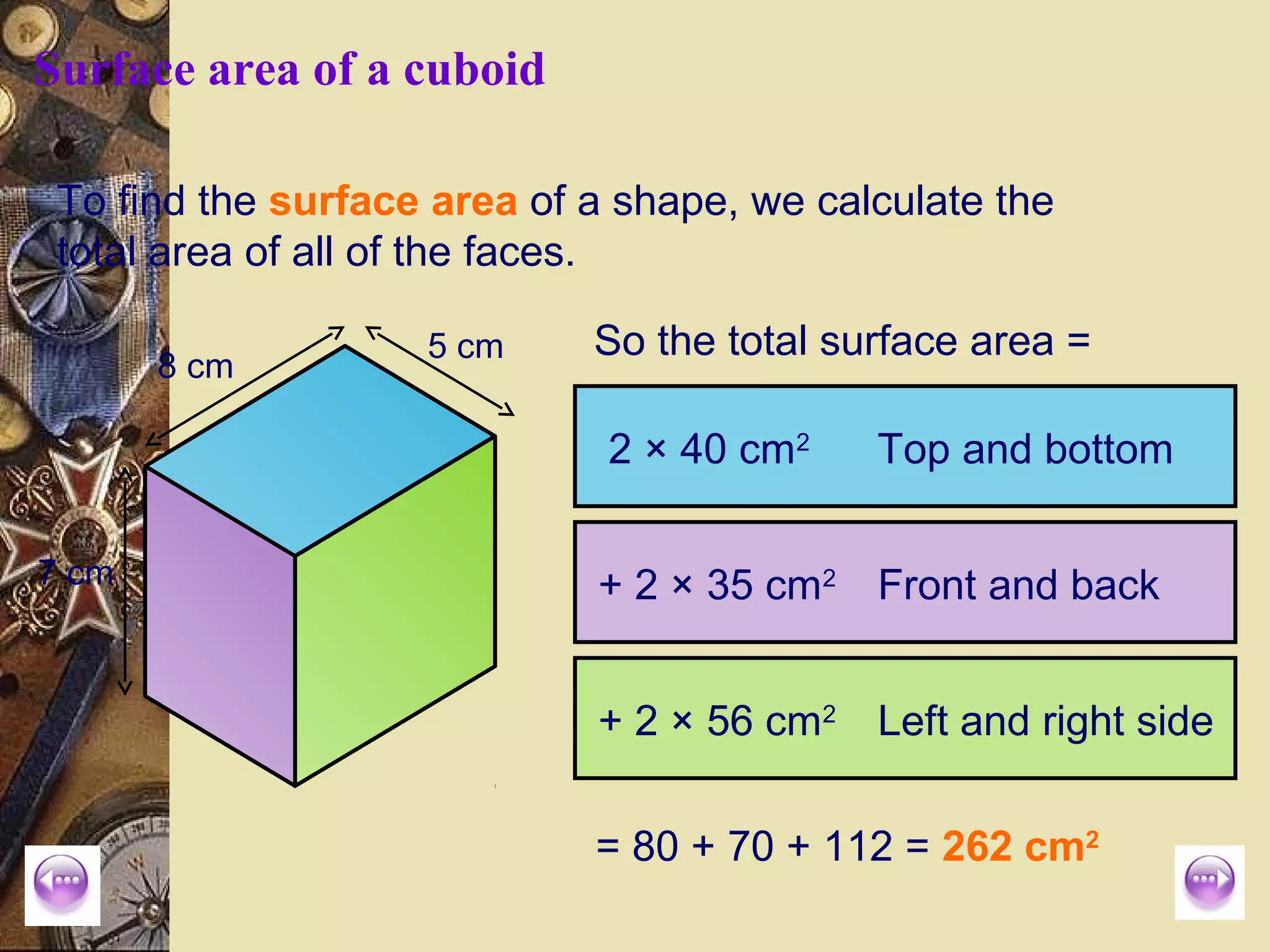
                    5 cm     So the total surface area =
       8 cm

                              2 × 40 cm2    Top and bottom

7 cm                         + 2 × 35 cm2 Front and back


                             + 2 × 56 cm2 Left and right side

                             = 80 + 70 + 112 = 262 cm2
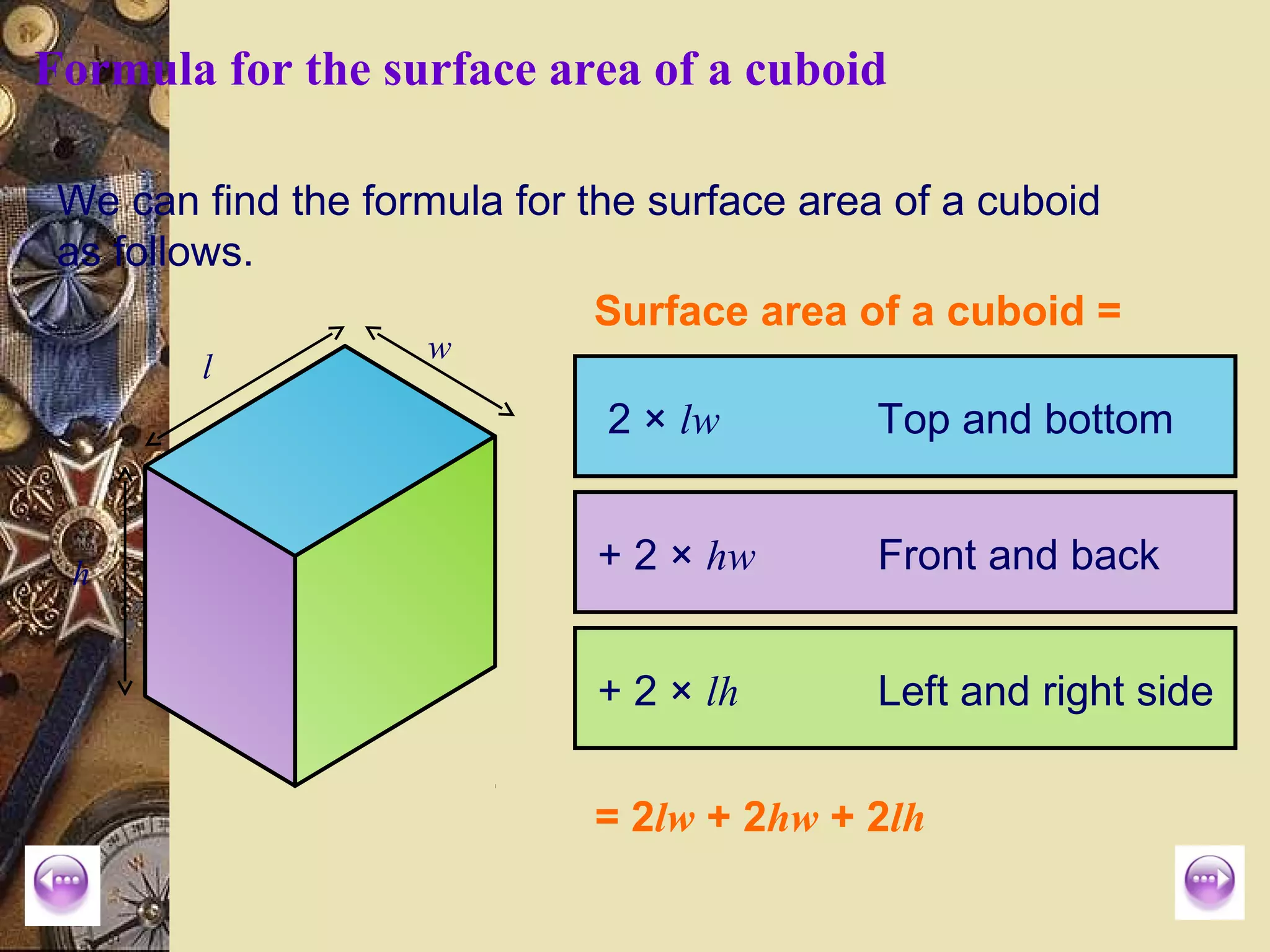
Formula for the surface area of a cuboid

 We can find the formula for the surface area of a cuboid
 as follows.
                              Surface area of a cuboid =
                    w
        l
                             2 × lw         Top and bottom


 h                           + 2 × hw       Front and back


                             + 2 × lh       Left and right side

                             = 2lw + 2hw + 2lh
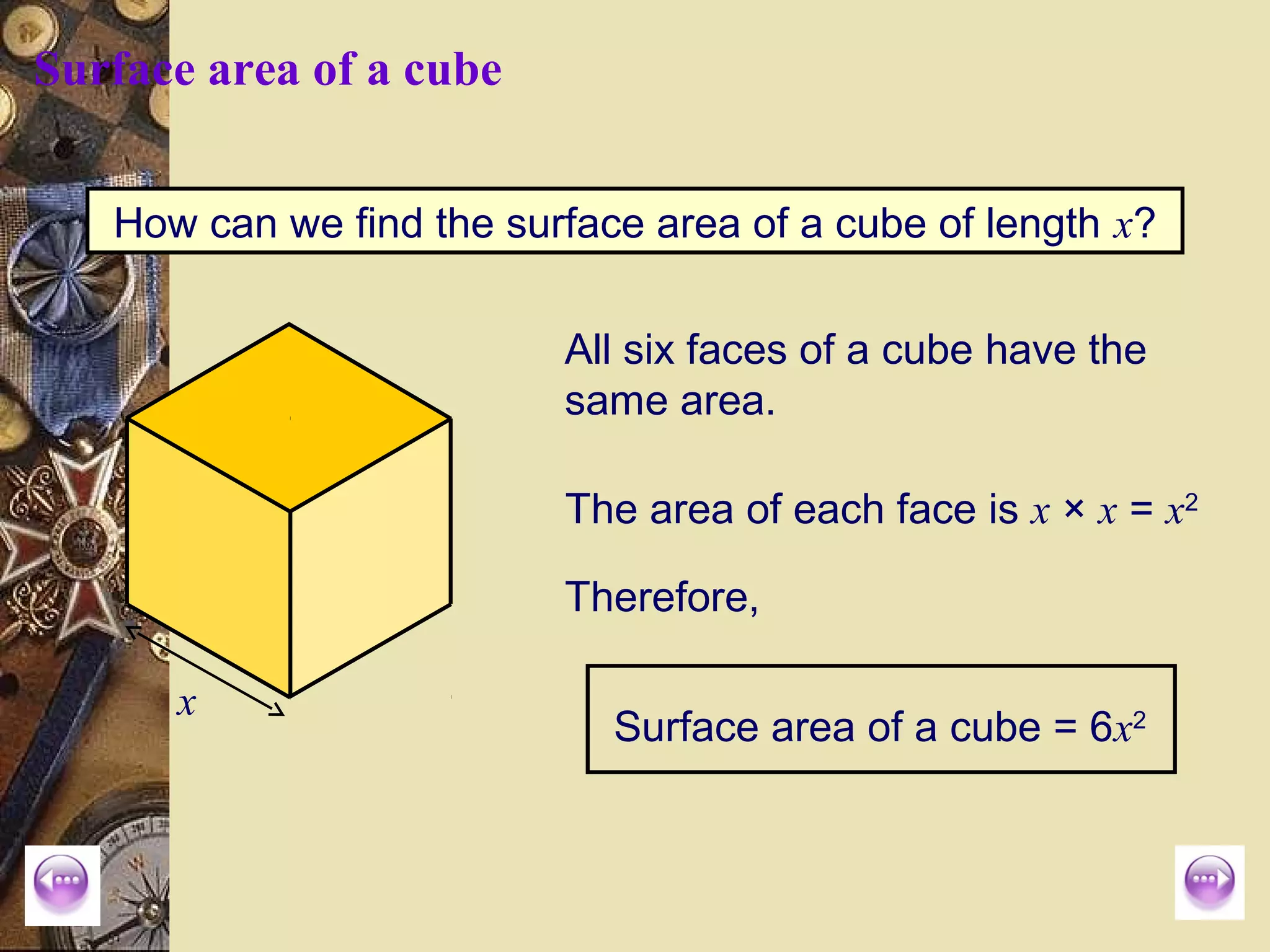
Surface area of a cube


   How can we find the surface area of a cube of length x?

                          All six faces of a cube have the
                          same area.

                          The area of each face is x × x = x2

                          Therefore,

      x
                             Surface area of a cube = 6x2
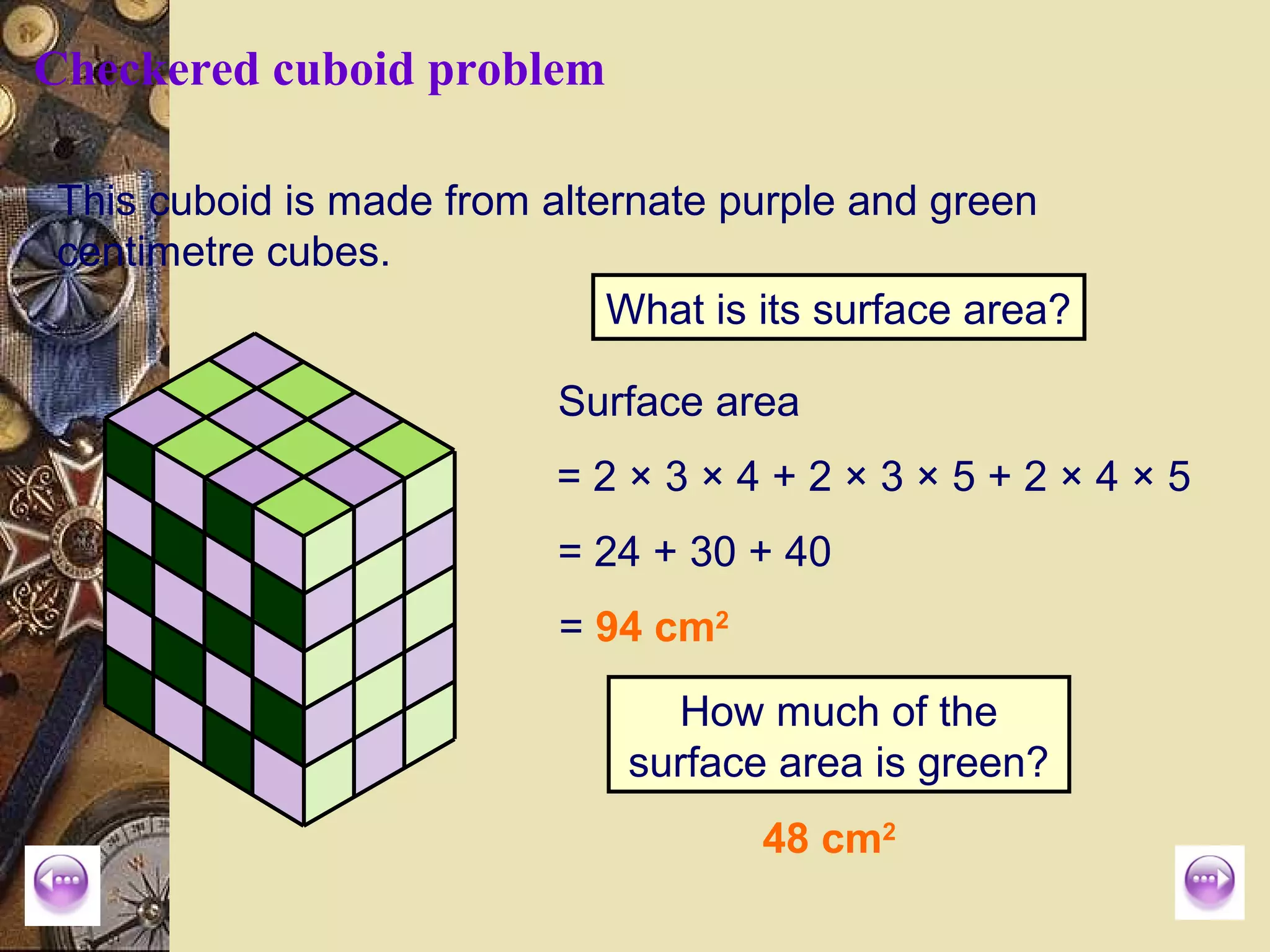
Checkered cuboid problem

This cuboid is made from alternate purple and green
centimetre cubes.
                             What is its surface area?

                          Surface area
                          =2×3×4+2×3×5+2×4×5
                          = 24 + 30 + 40
                          = 94 cm2

                                How much of the
                              surface area is green?
                                     48 cm2
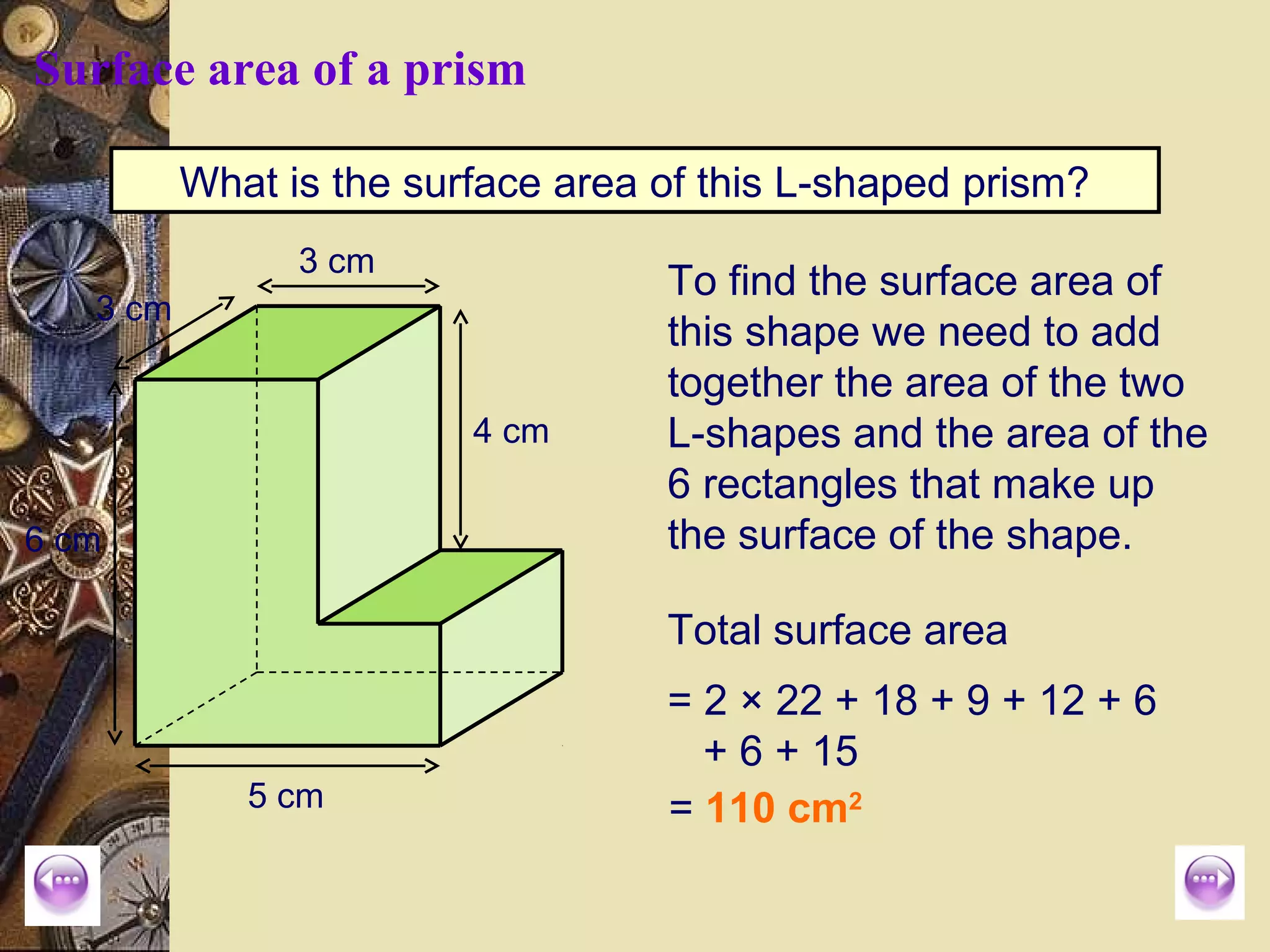
Surface area of a prism

          What is the surface area of this L-shaped prism?
                3 cm
                                   To find the surface area of
   3 cm
                                   this shape we need to add
                                   together the area of the two
                         4 cm      L-shapes and the area of the
                                   6 rectangles that make up
6 cm                               the surface of the shape.

                                   Total surface area
                                   = 2 × 22 + 18 + 9 + 12 + 6
                                     + 6 + 15
             5 cm                  = 110 cm2
Using nets to find surface area

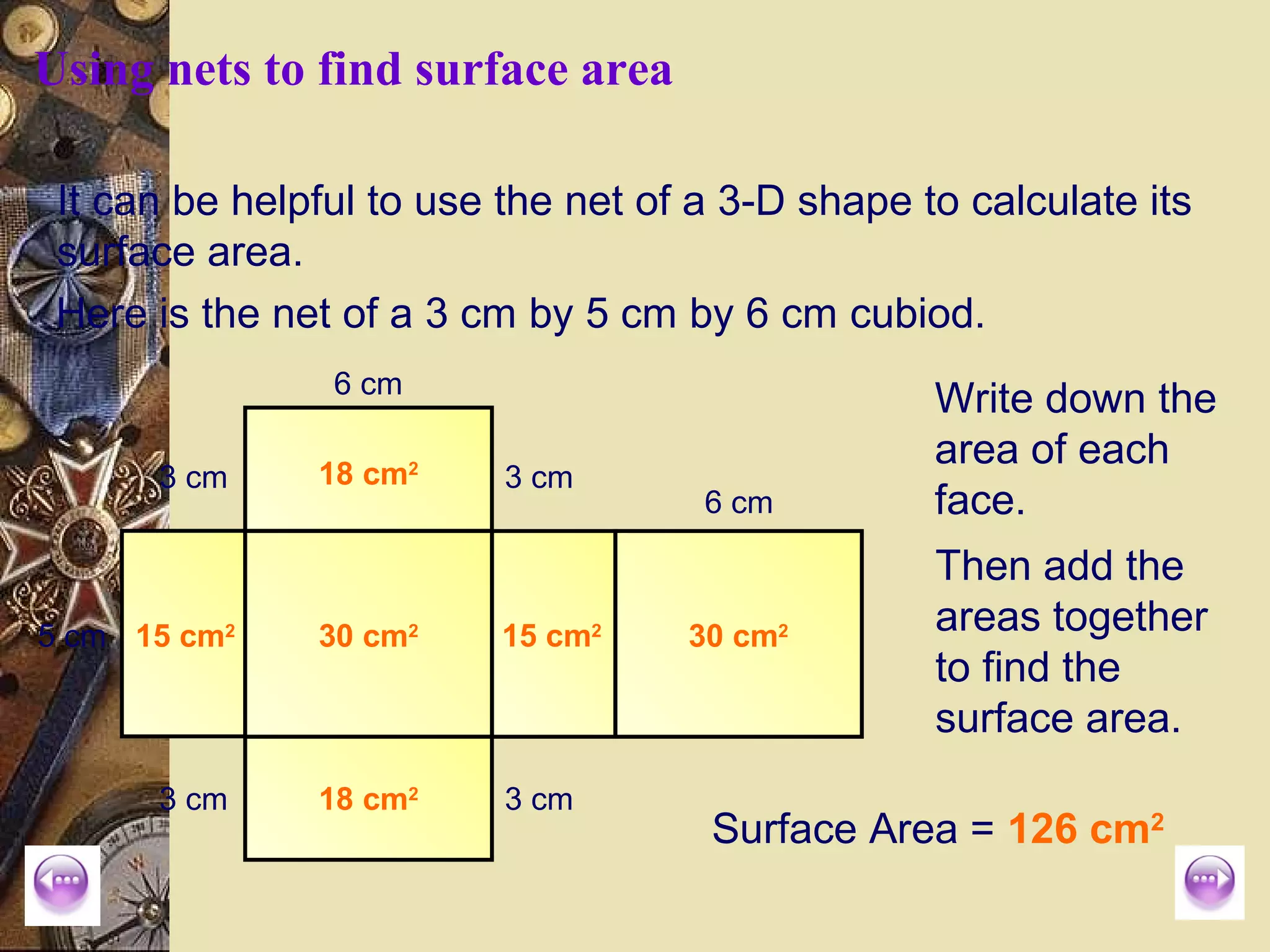
 It can be helpful to use the net of a 3-D shape to calculate its
 surface area.
 Here is the net of a 3 cm by 5 cm by 6 cm cubiod.
                6 cm
                                                  Write down the
                                                  area of each
      3 cm     18 cm2     3 cm
                                     6 cm         face.
                                                  Then add the
5 cm 15 cm2    30 cm2     15 cm2    30 cm2
                                                  areas together
                                                  to find the
                                                  surface area.
      3 cm     18 cm2     3 cm
                                     Surface Area = 126 cm2
Using nets to find surface area

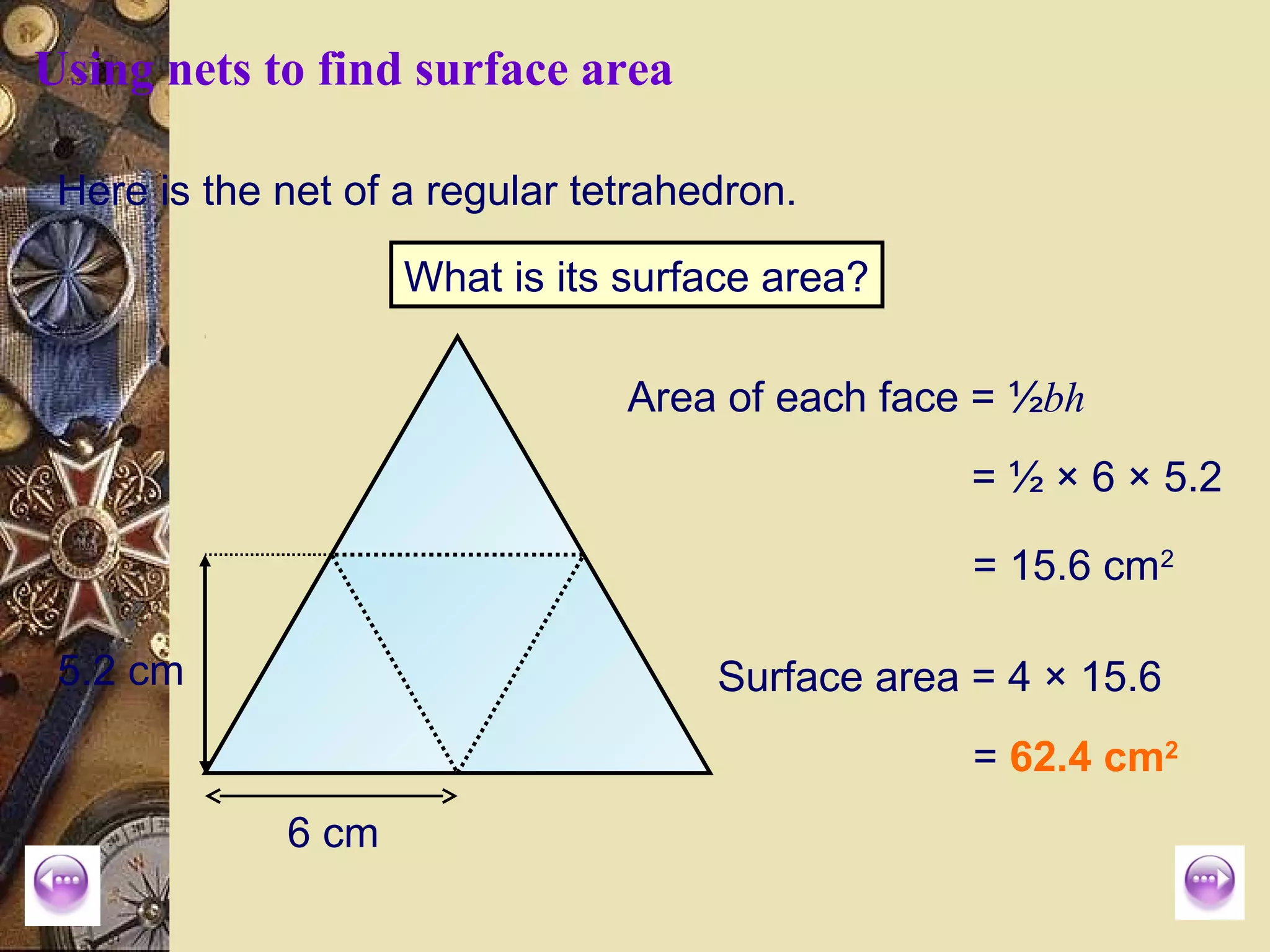
 Here is the net of a regular tetrahedron.

                    What is its surface area?

                                Area of each face = ½bh
                                                  = ½ × 6 × 5.2

                                                  = 15.6 cm2

 5.2 cm                              Surface area = 4 × 15.6
                                                  = 62.4 cm2
             6 cm
3-Warm up: Finding the Area of a
Lateral Face
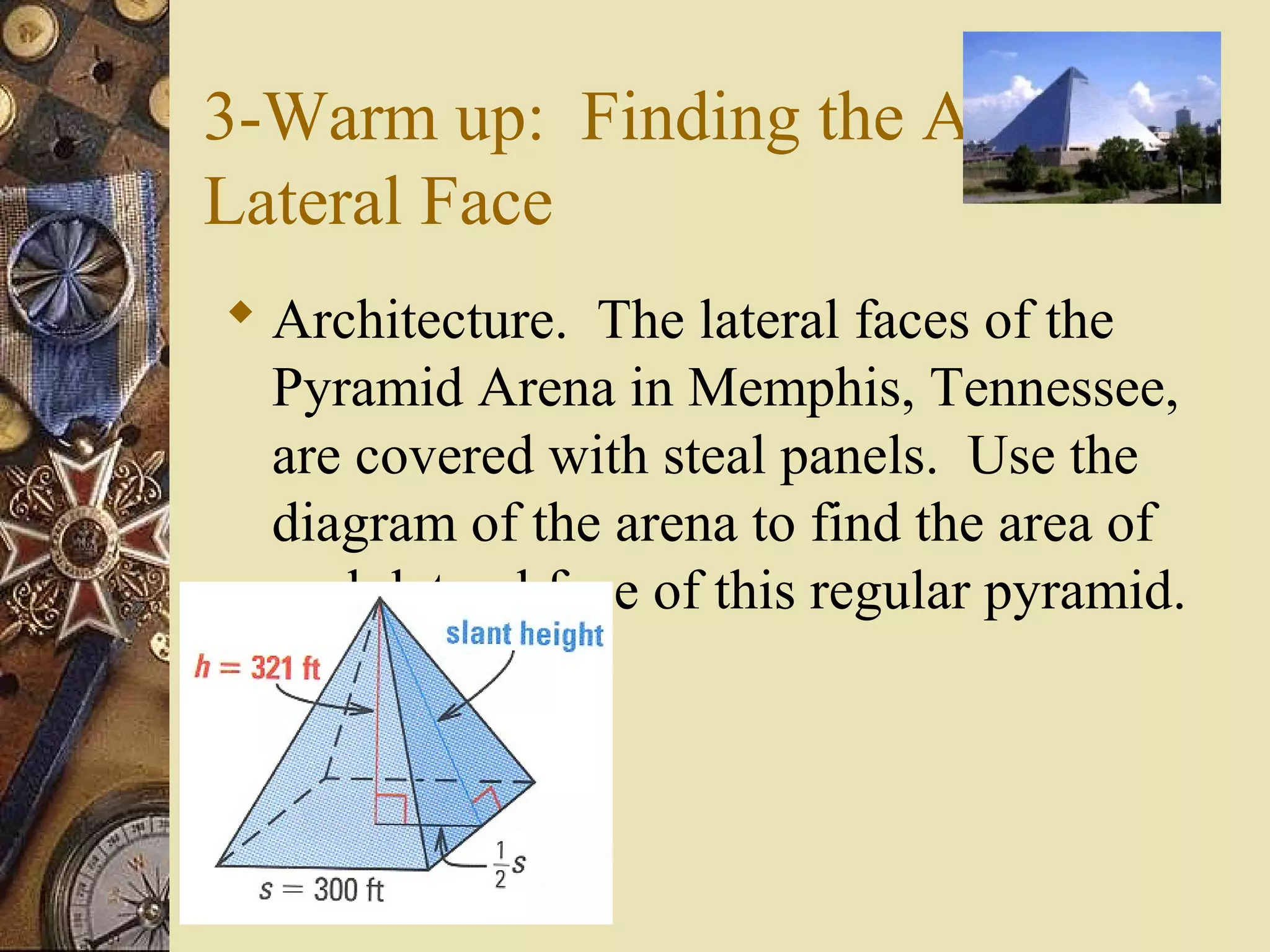
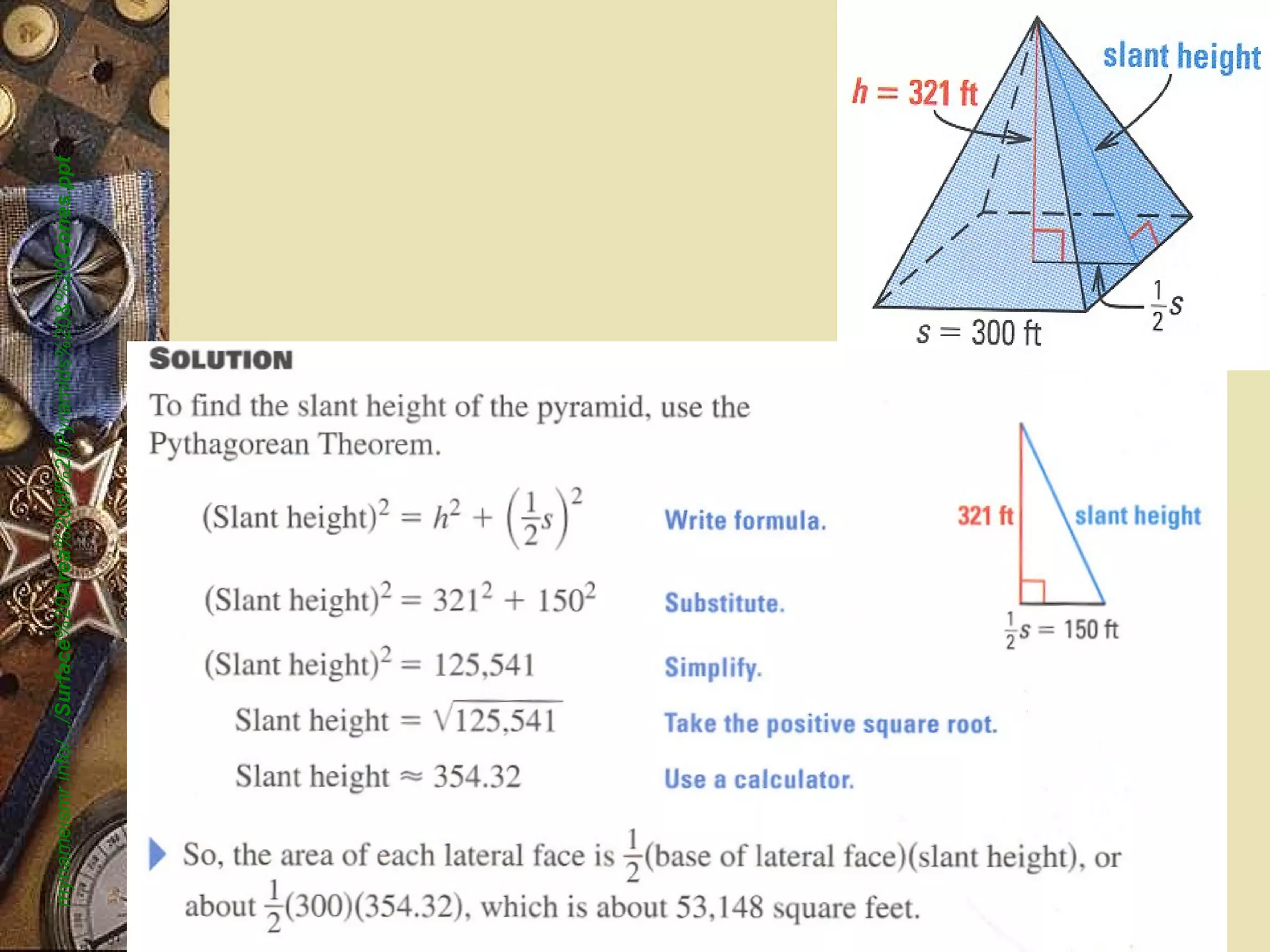
 Architecture. The lateral faces of the
  Pyramid Arena in Memphis, Tennessee,
  are covered with steal panels. Use the
  diagram of the arena to find the area of
  each lateral face of this regular pyramid.
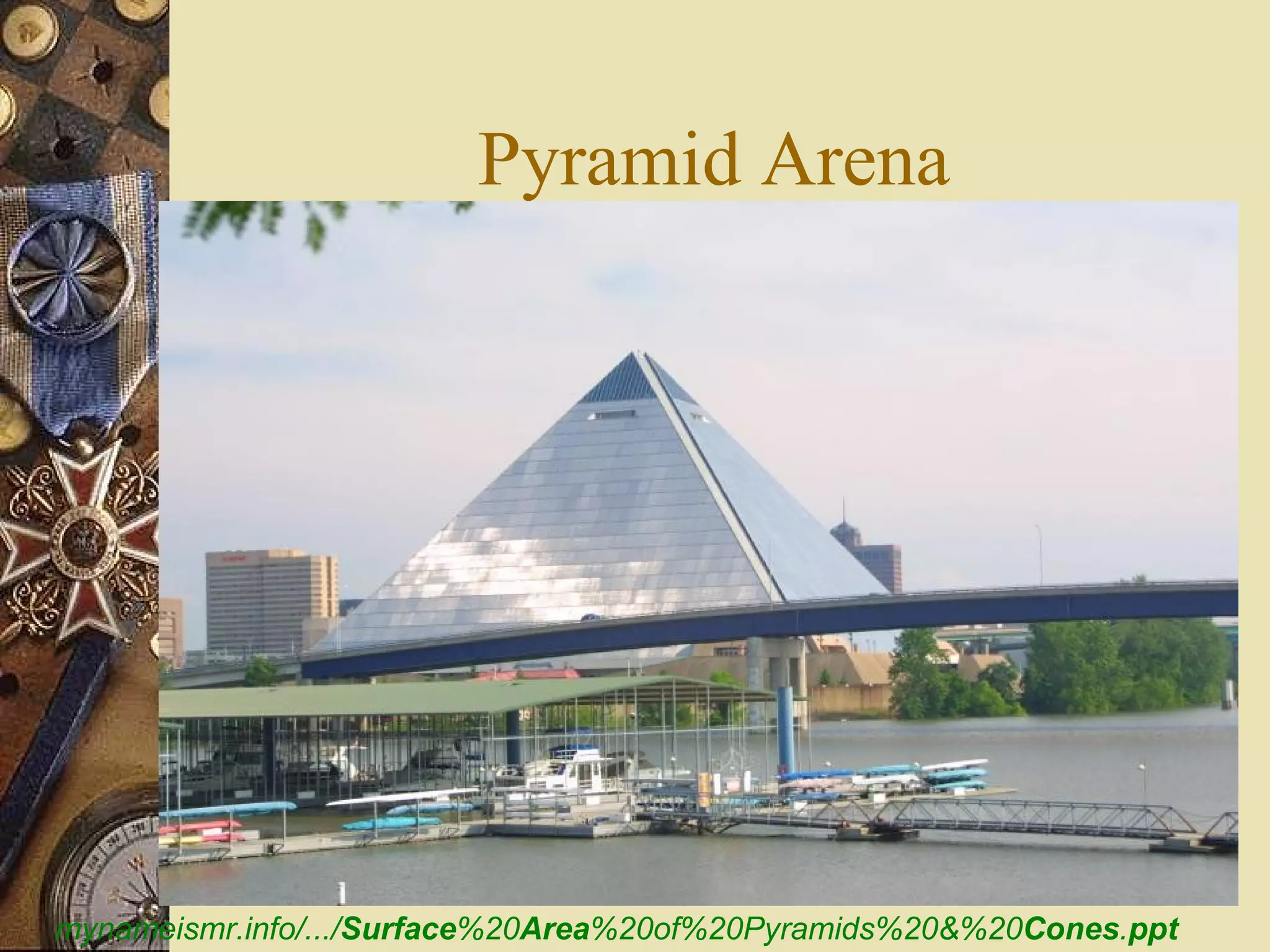
Pyramid Arena


mynameismr.info/.../Surface%20Area%20of%20Pyramids%20&%20Cones.ppt
Surface Area of a Cone


                                           Unit 6, Day 4
                                            Ms. Reed
With slides from www.cohs.com/.../229_9.3%20Surface%20Area%20of
   %20Pyramids%20and%20Cones%20C...
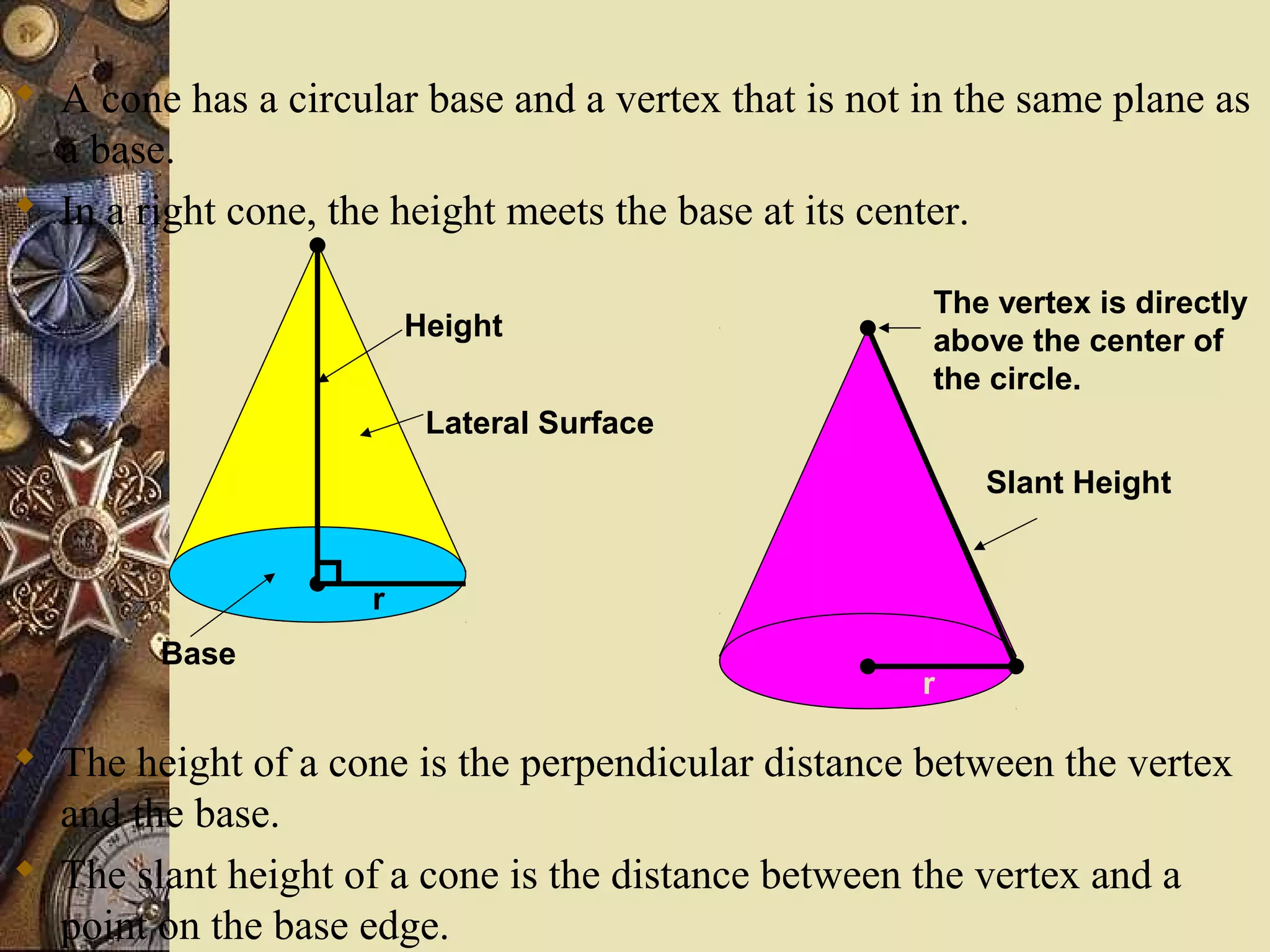
 A cone has a circular base and a vertex that is not in the same plane as
  a base.
 In a right cone, the height meets the base at its center.

                                                       The vertex is directly
                         Height                        above the center of
                                                       the circle.
                          Lateral Surface
                                                          Slant Height


                     r
        Base
                                                      r

 The height of a cone is the perpendicular distance between the vertex
  and the base.
 The slant height of a cone is the distance between the vertex and a
  point on the base edge.
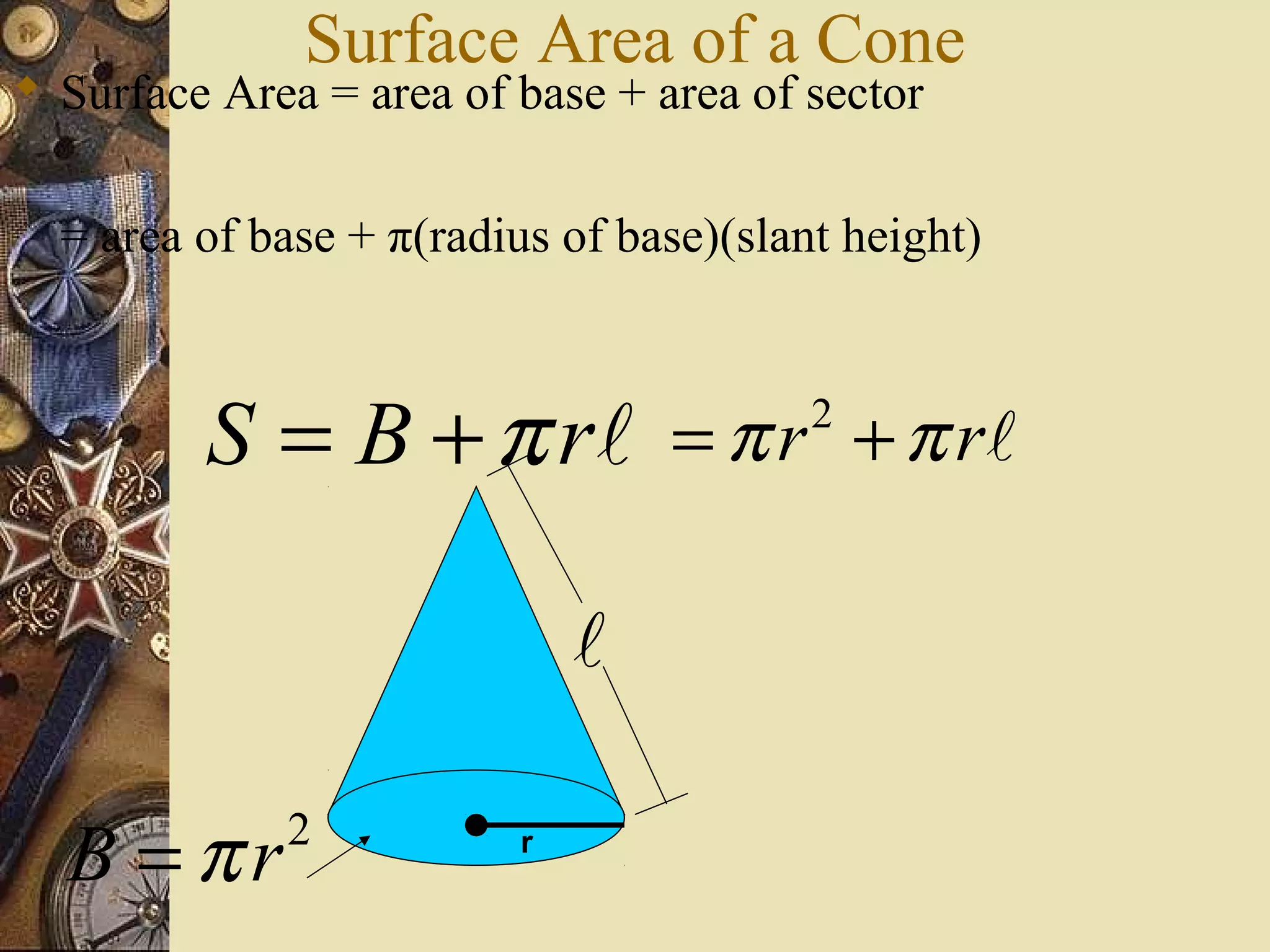
Surface Area of a Cone
 Surface Area = area of base + area of sector


  = area of base + π(radius of base)(slant height)


         S = B + π r l = π r + π rl      2


                             l

  B =πr      2           r
Lateral Area of a Cone
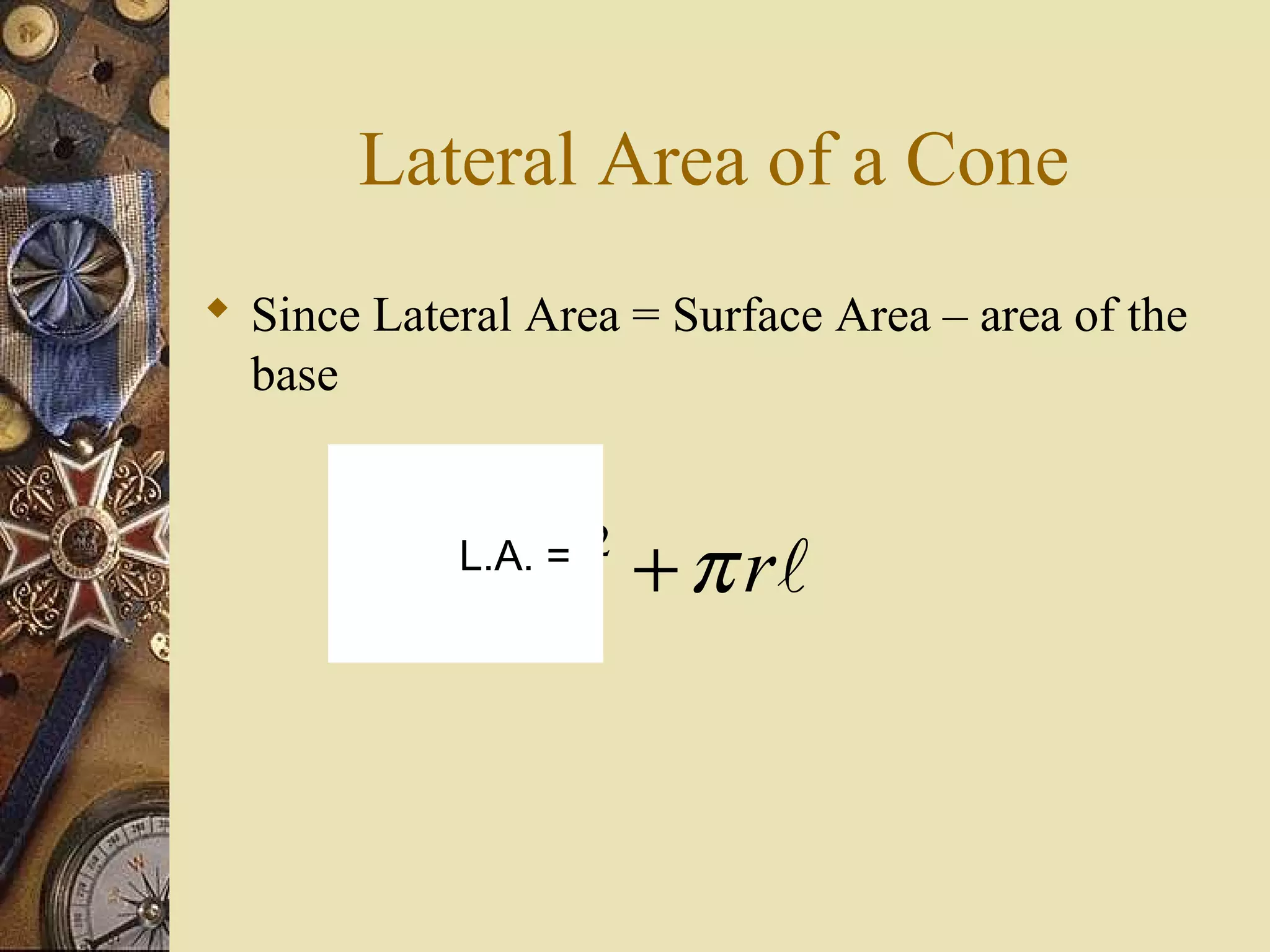
 Since Lateral Area = Surface Area – area of the
  base


           = π r + π rl
            L.A. = 2
Example 1:
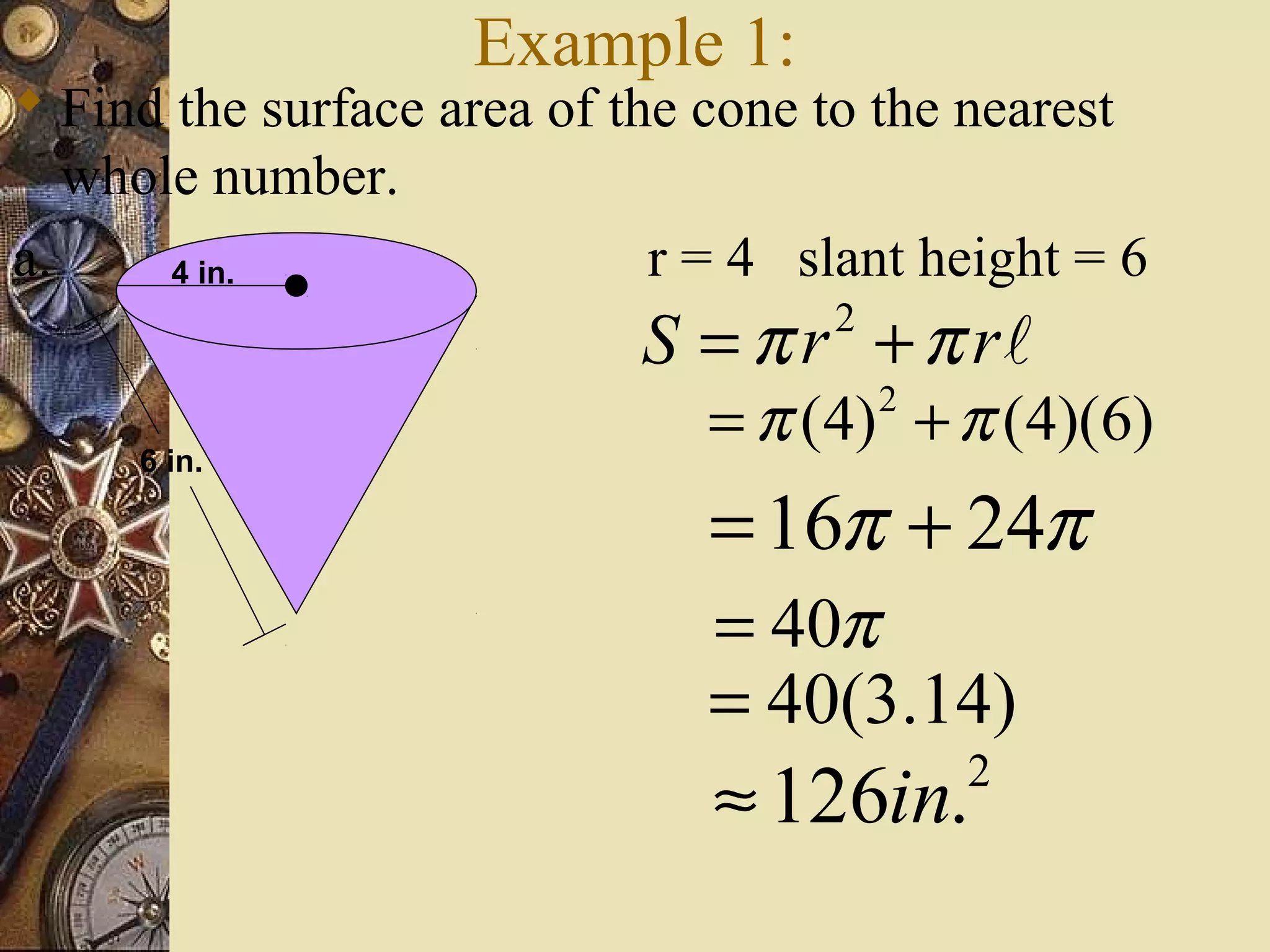
 Find the surface area of the cone to the nearest
   whole number.
a.     4 in.                 r = 4 slant height = 6
                            S = π r + π rl
                                    2

                               = π (4) + π (4)(6)
                                        2
     6 in.

                               = 16π + 24π
                               = 40π
                               = 40(3.14)
                               ≈ 126in.     2
Example 2:
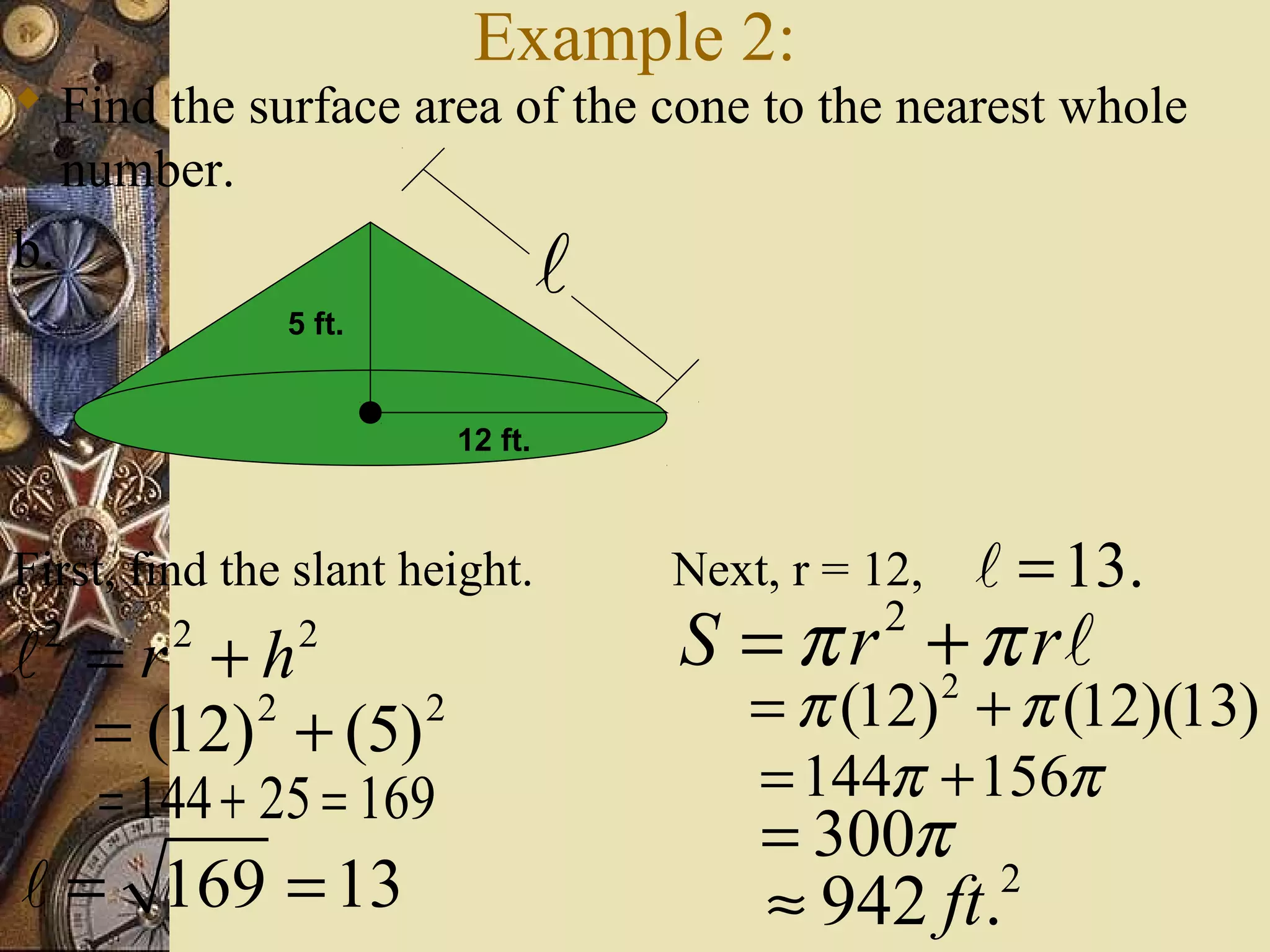
 Find the surface area of the cone to the nearest whole
  number.
b.                               l
               5 ft.


                        12 ft.


First, find the slant height.        Next, r = 12,   l = 13.
l =r +h
 2      2      2                     S = π r + π rl
                                                2

  = (12) + (5)
        2      2                         = π (12) + π (12)(13)
                                             2


     = 144 + 25 = 169                    = 144π + 156π
                                         = 300π
l = 169 = 13                             ≈ 942 ft.    2
On your own #1
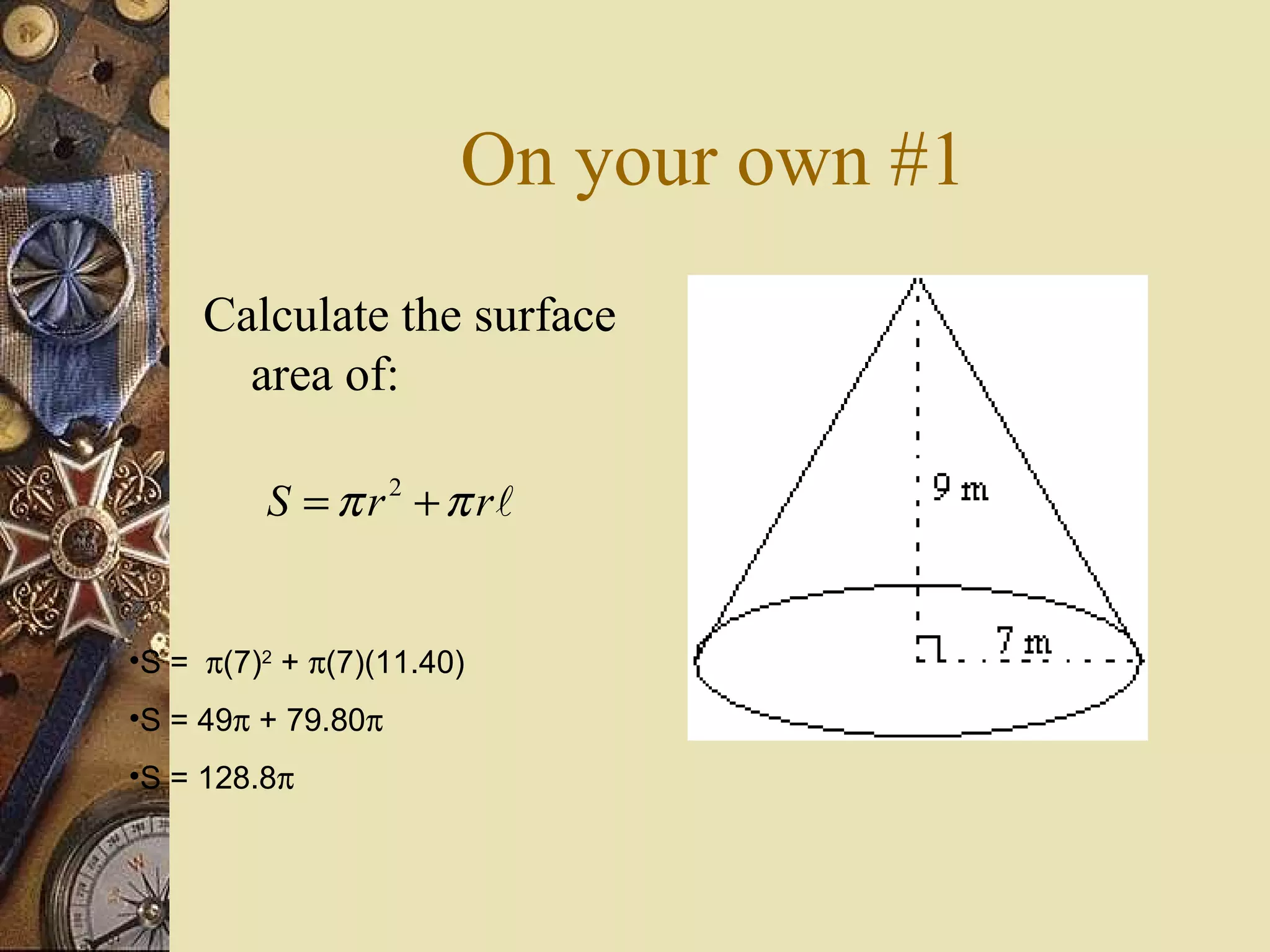
     Calculate the surface
       area of:

         S = π r 2 + π rl


•S = π(7)2 + π(7)(11.40)
•S = 49π + 79.80π
•S = 128.8π
On your own #2
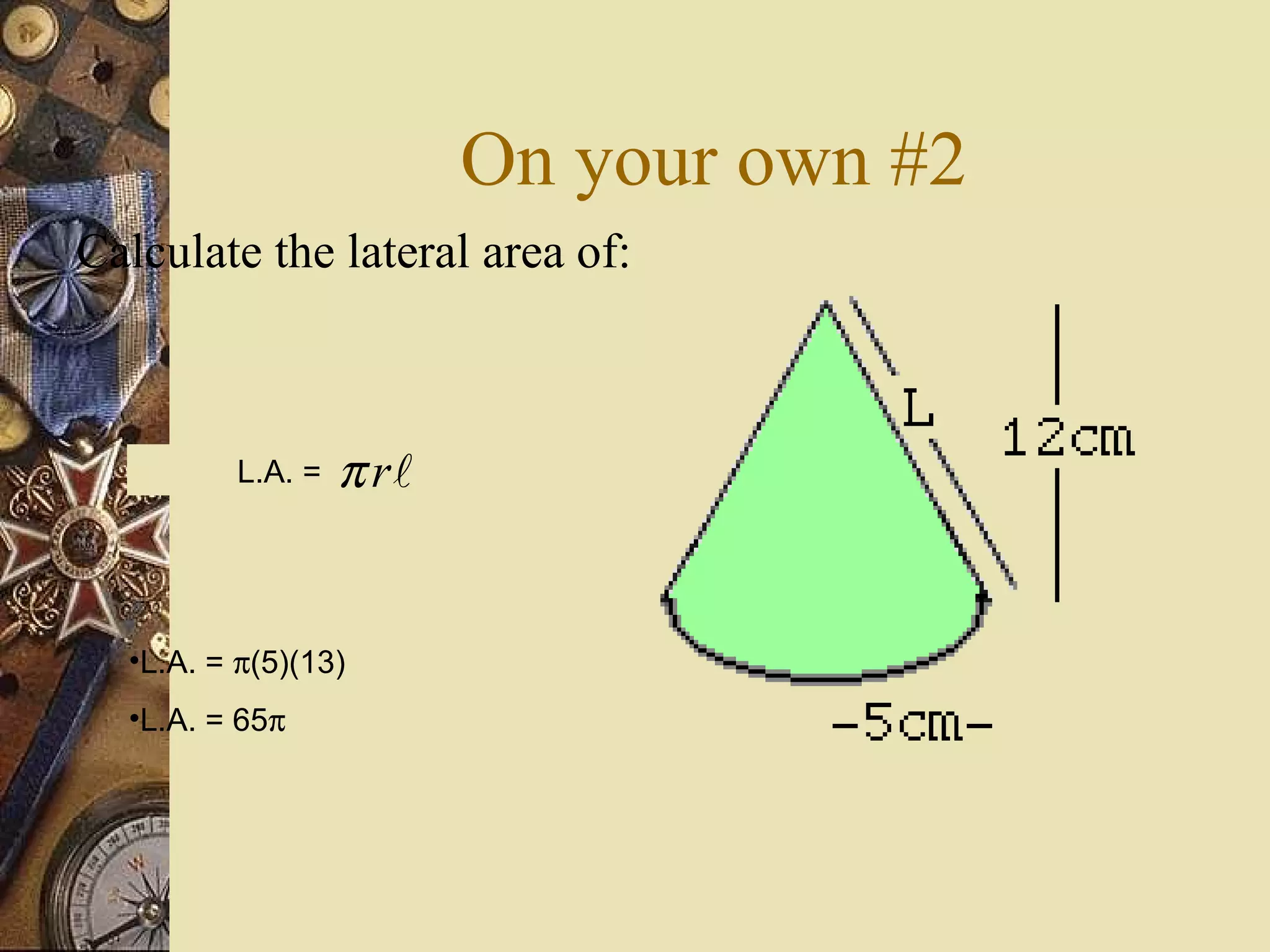
Calculate the lateral area of:


   S   = π r = π rl
          L.A. +
             2


  •L.A. = π(5)(13)
  •L.A. = 65π
Homework
Work Packet:
Surface Area of Cones
4-Surface Area of a
      Sphere
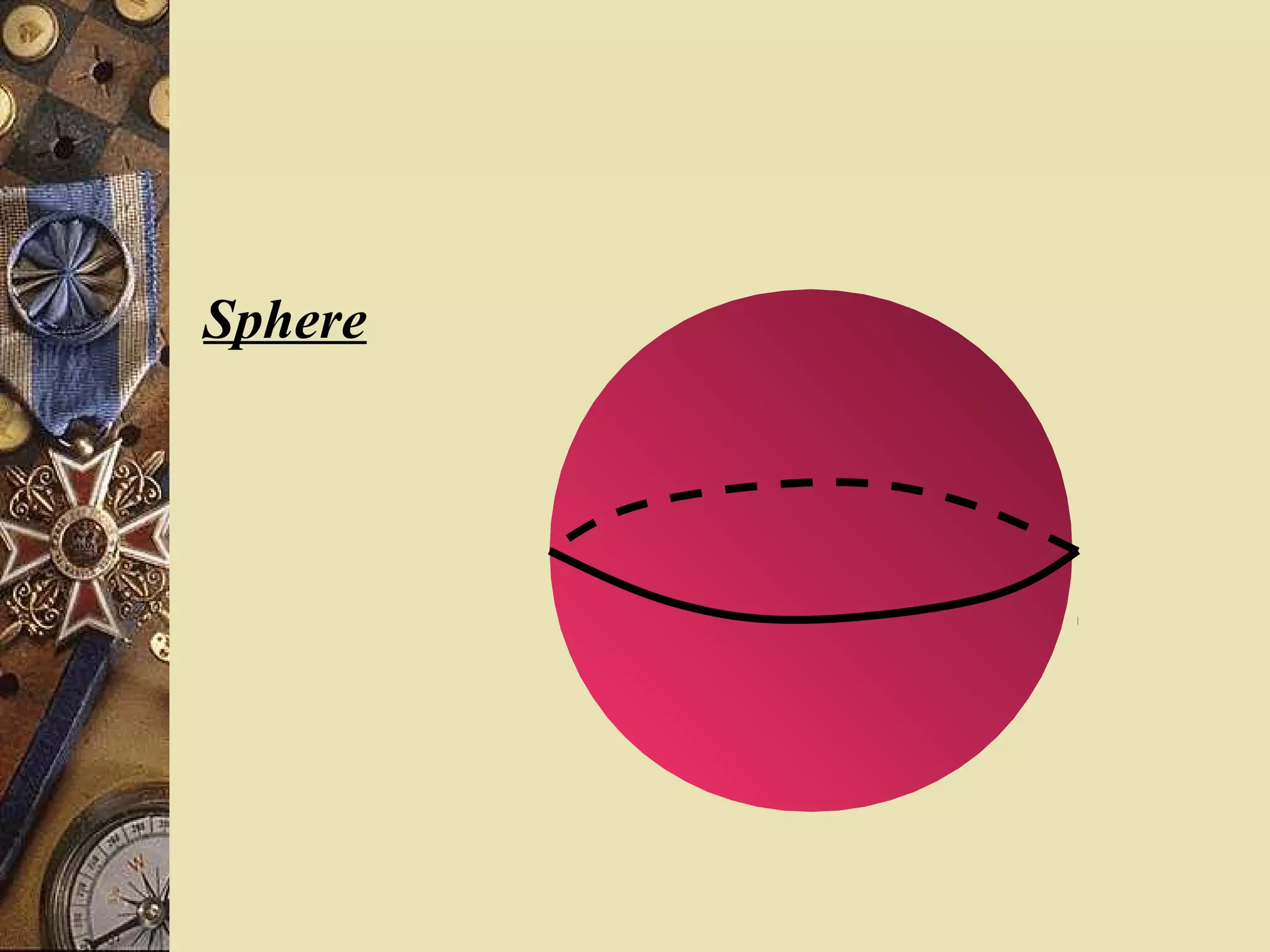
Sphere
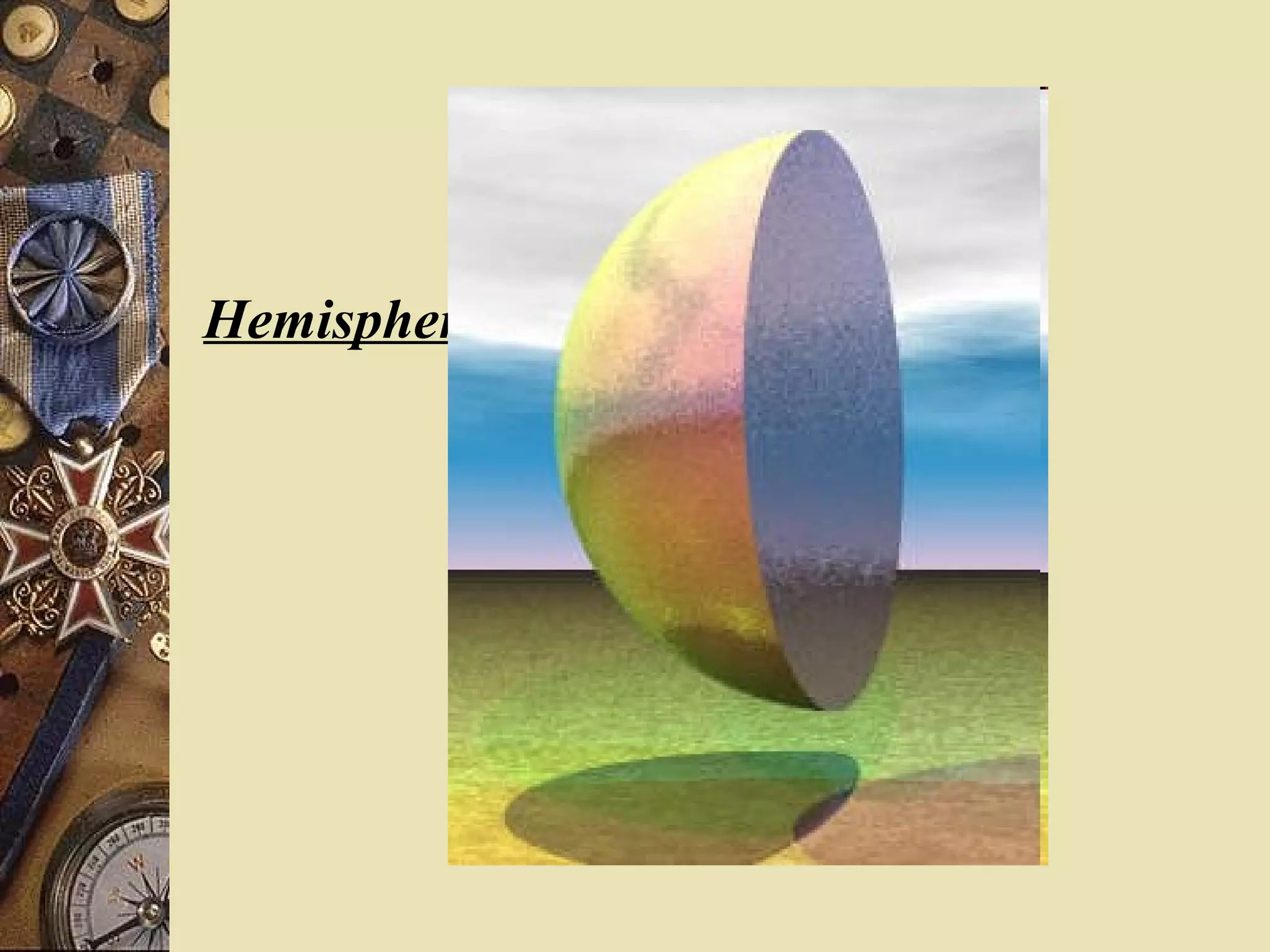
Hemisphere
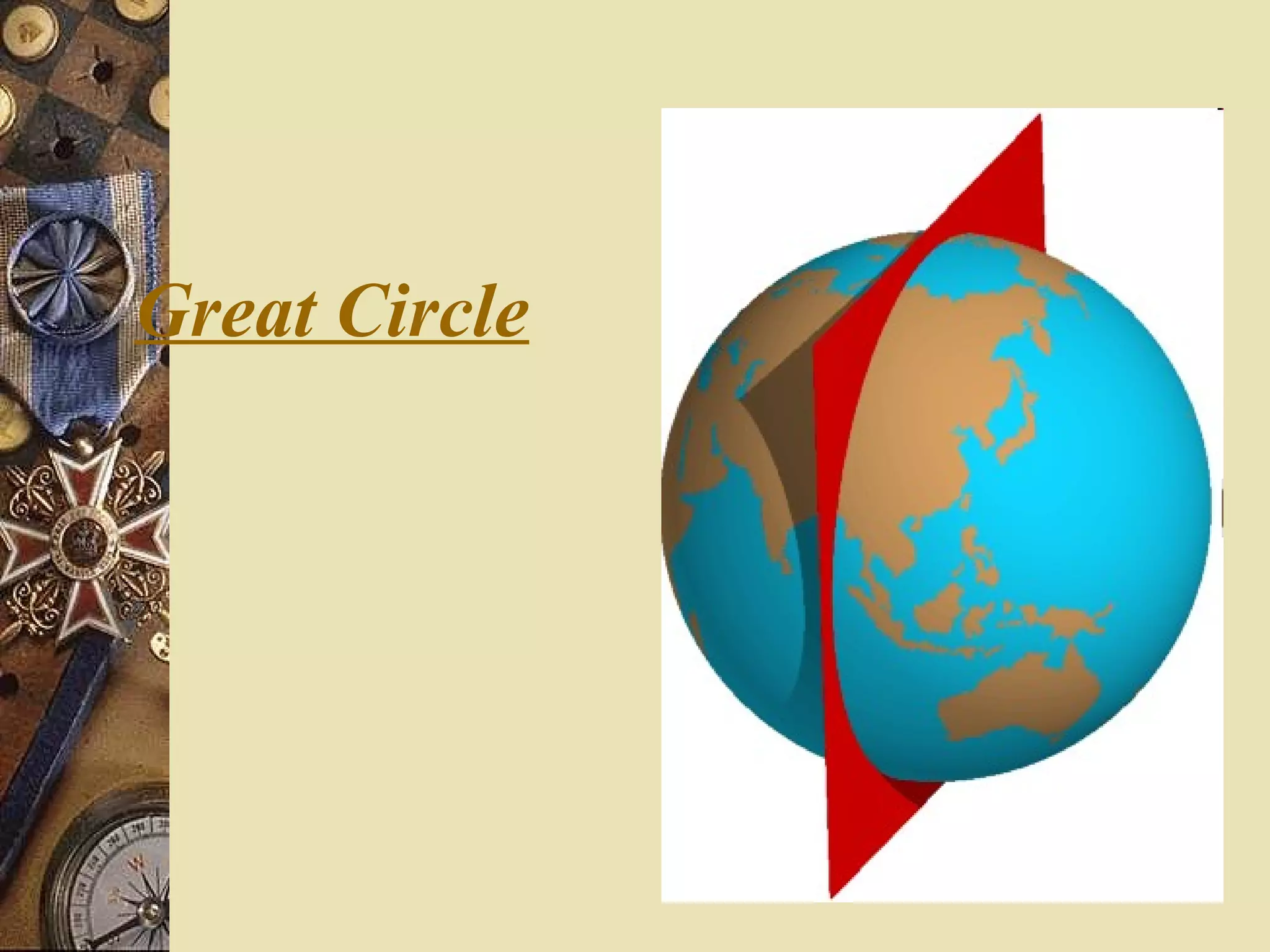
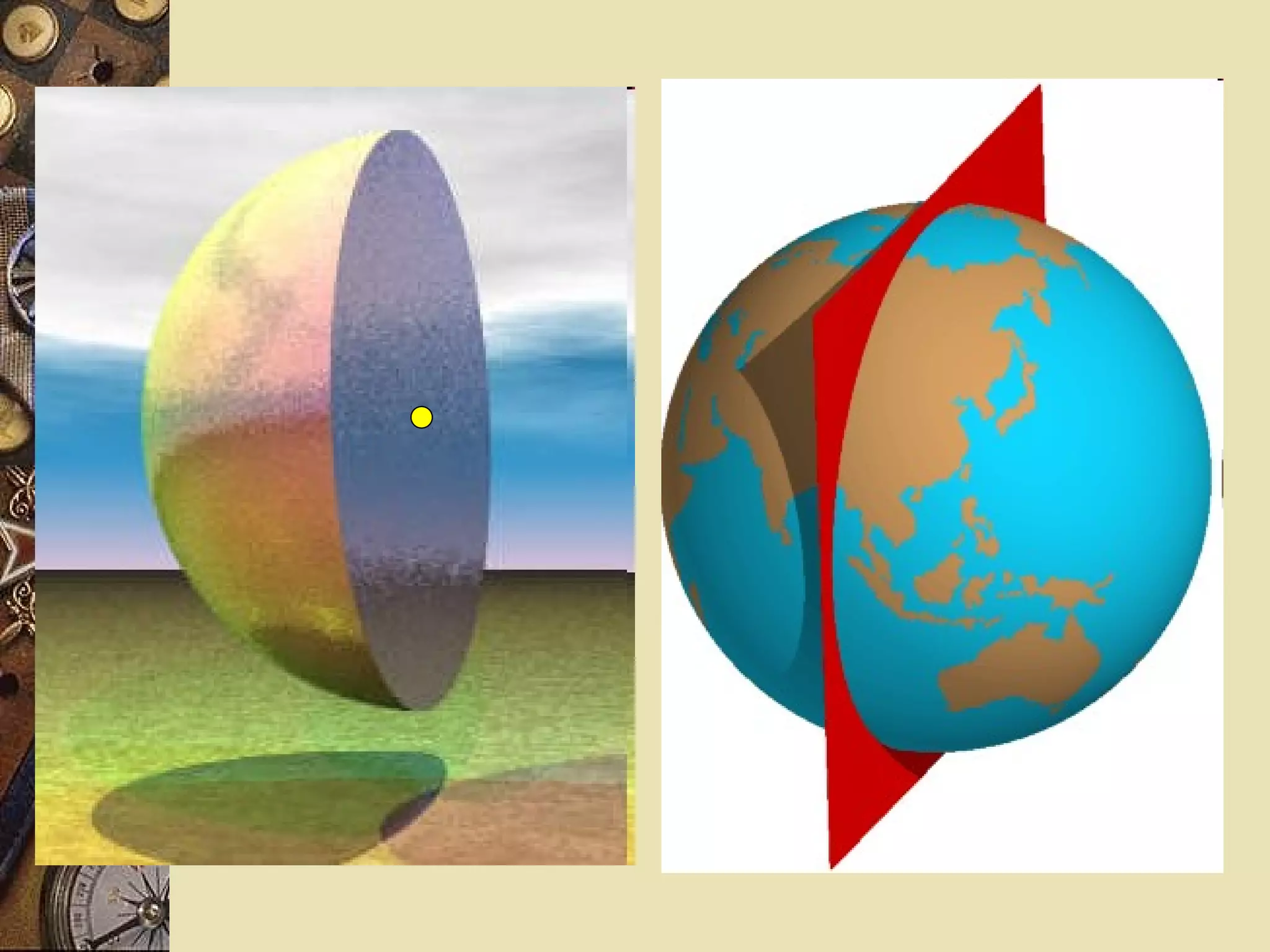
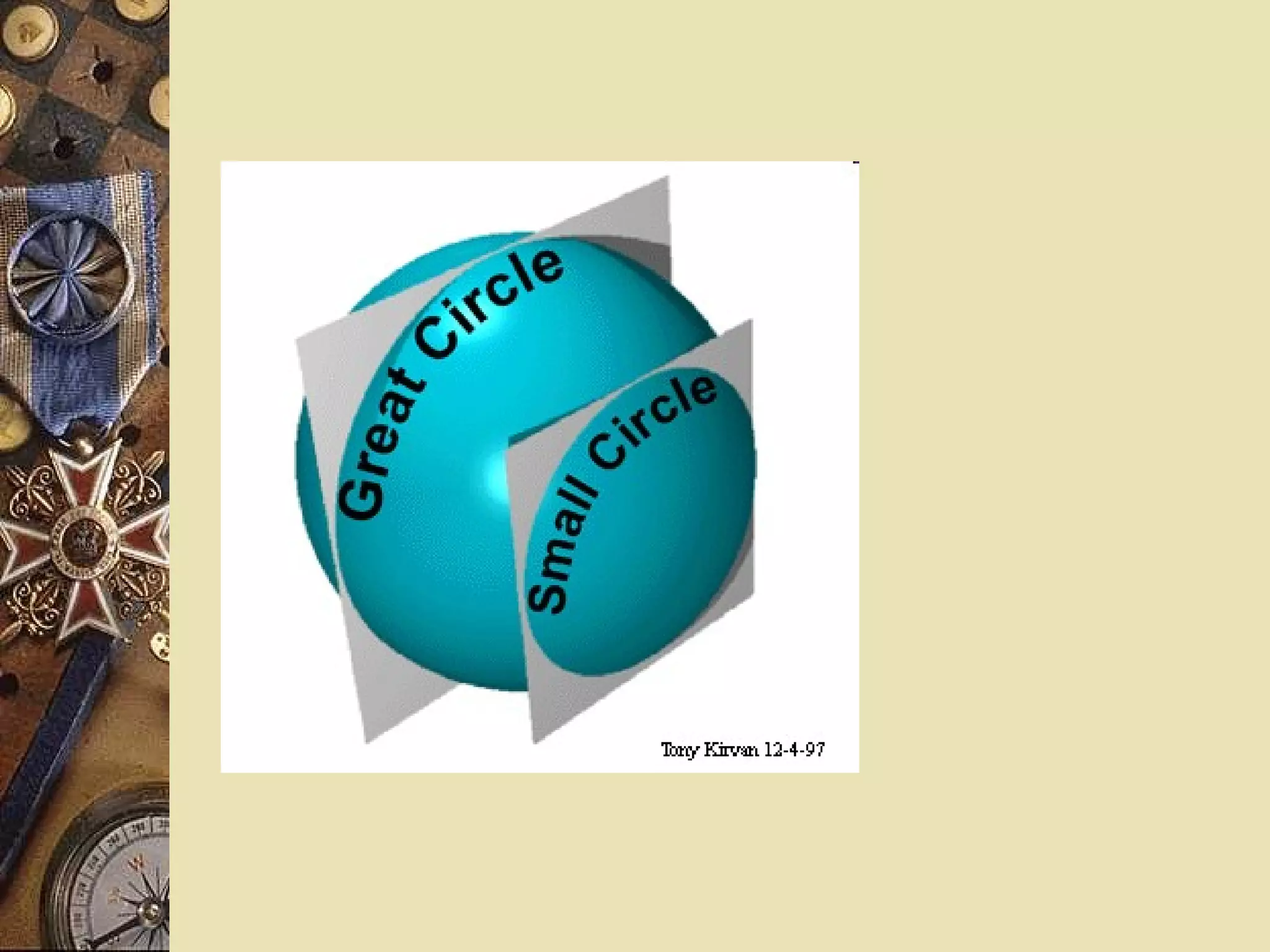
Great Circle
(Surface Area of a Sphere) = 4πr2
5-Basic Geometric
   Properties


      Volume of a
        cuboid
In this lesson you will learn
to calculate the volume of a
           cuboid
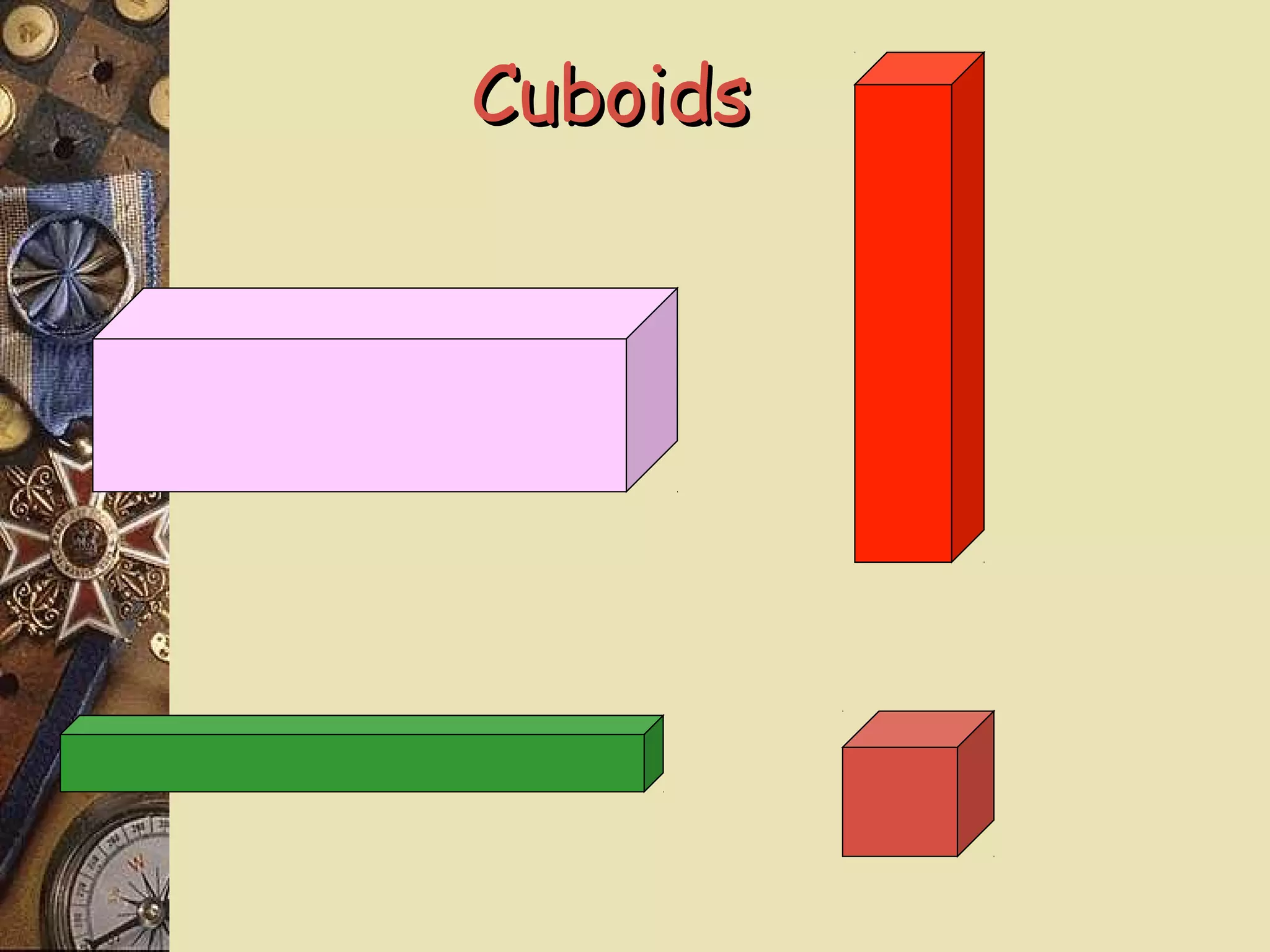
Cuboids
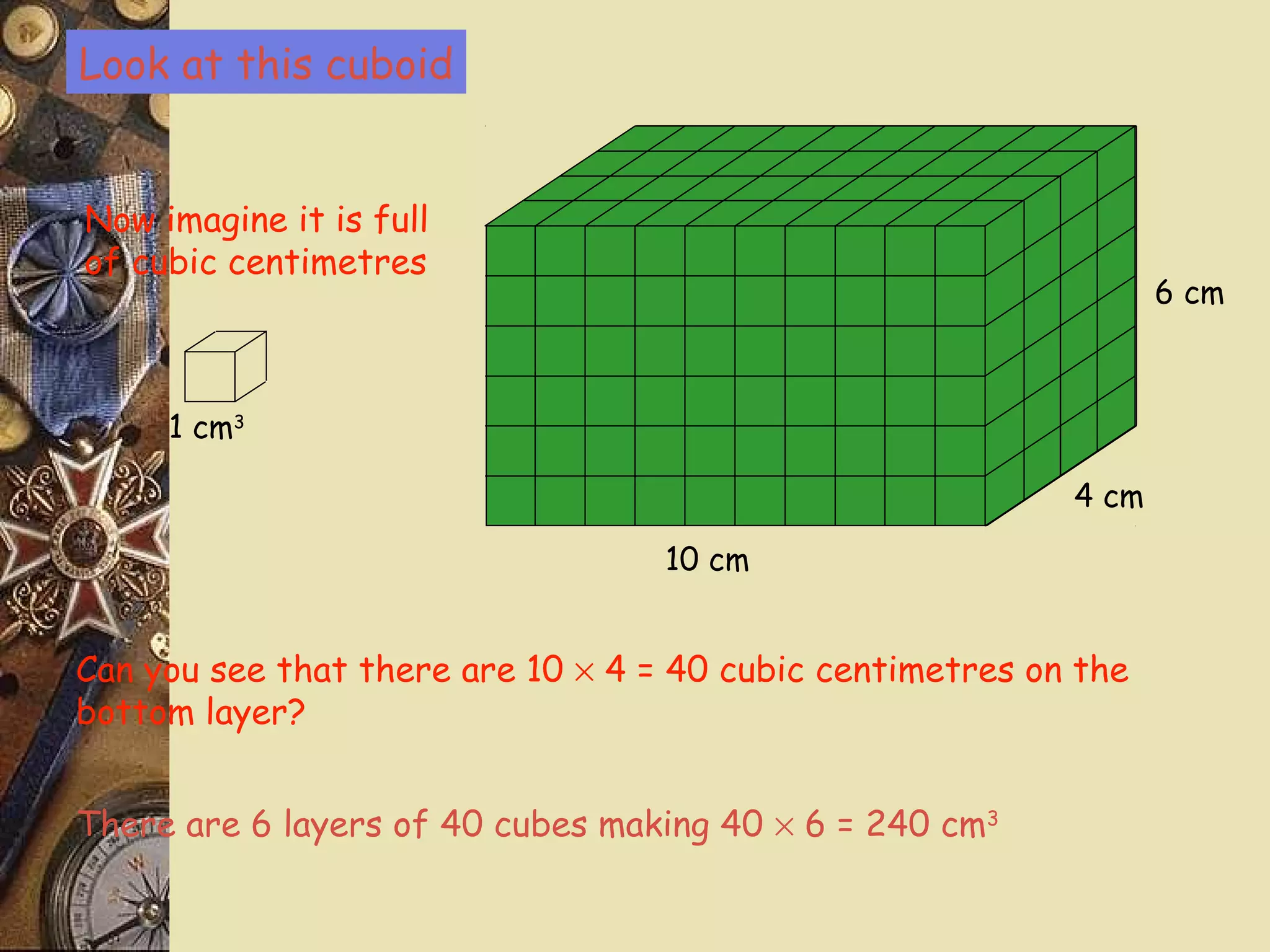
Look at this cuboid


Now imagine it is full
of cubic centimetres
                                                                  6 cm


     1 cm3

                                                           4 cm

                                   10 cm


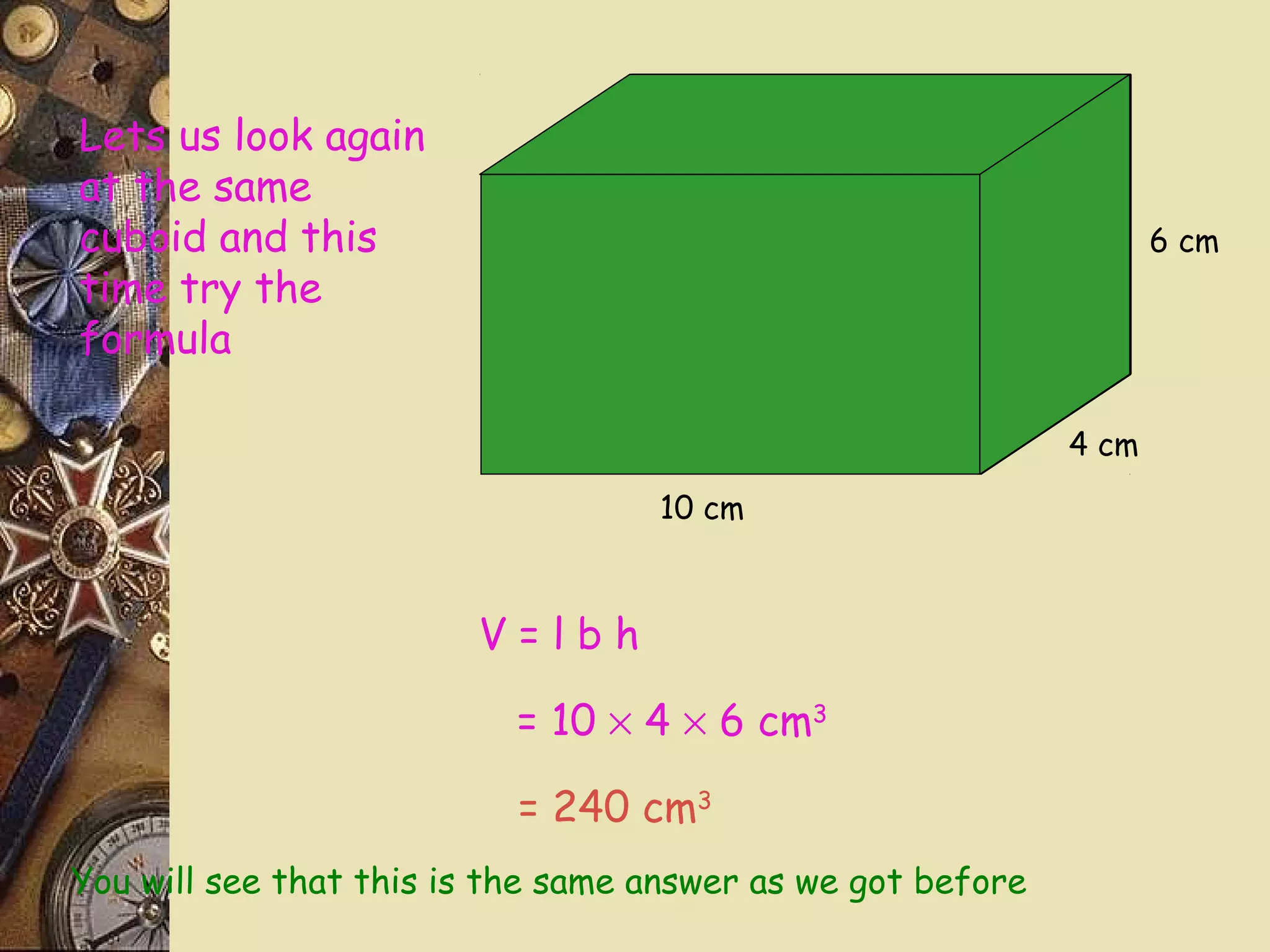
Can you see that there are 10 × 4 = 40 cubic centimetres on the
bottom layer?


There are 6 layers of 40 cubes making 40 × 6 = 240 cm3
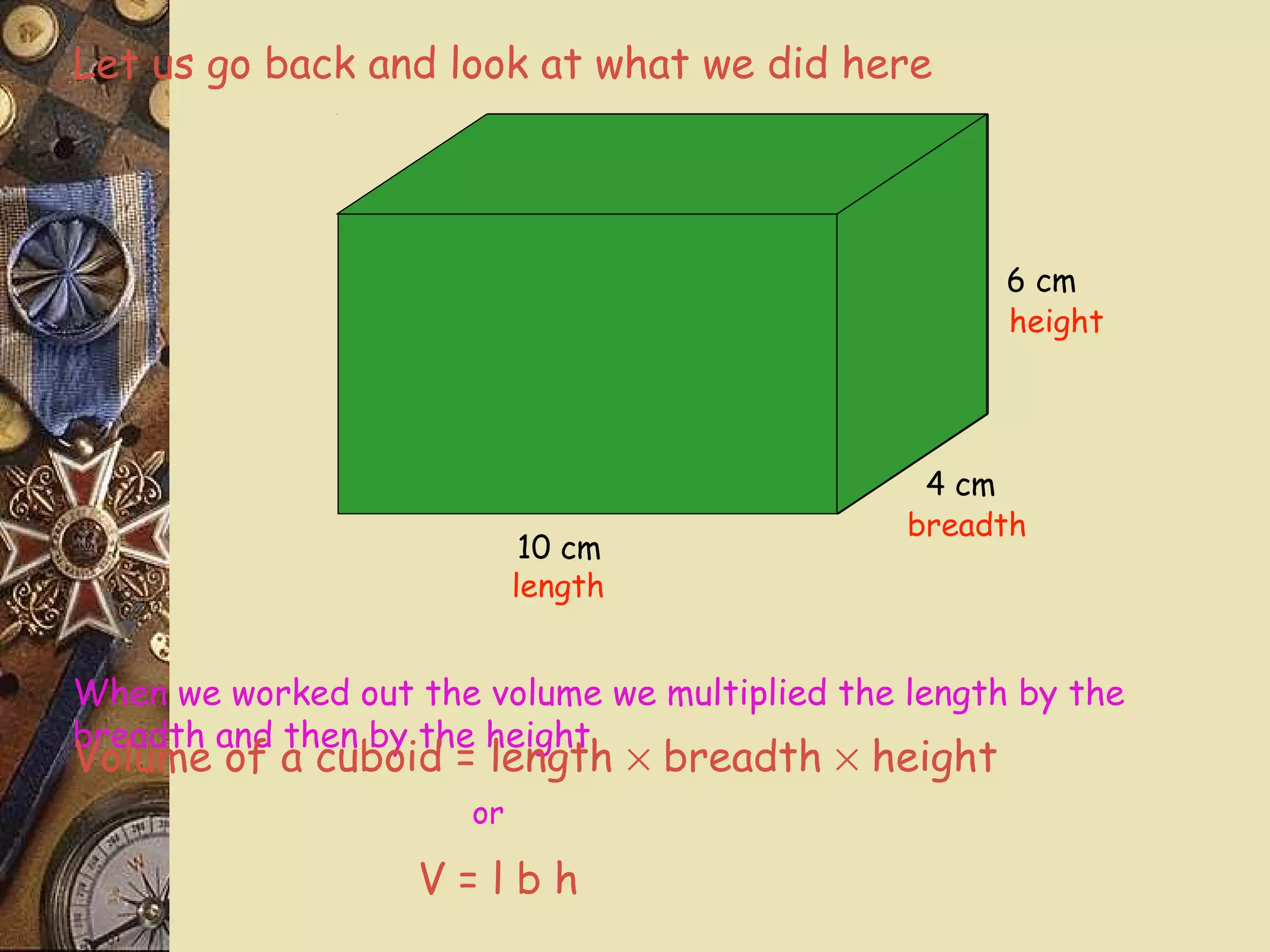
Let us go back and look at what we did here


                                                      6 cm
                                                      height


                                                 4 cm
                                                breadth
                             10 cm
                            length


When we worked out the volume we multiplied the length by the
breadth and then by the height
Volume of a cuboid = length × breadth × height
                       or

                    V=lbh
Lets us look again
at the same
cuboid and this                                                     6 cm
time try the
formula

                                                             4 cm

                                   10 cm


                        V=lbh

                           = 10 × 4 × 6 cm3

                           = 240 cm3
You will see that this is the same answer as we got before
6-Volume of a Cylinder
What is Volume?

 The volume of a three-dimensional figure
  is the amount of space within it.

 Measured in Units Cubed (e.g. cm3)
Volume of a Prism
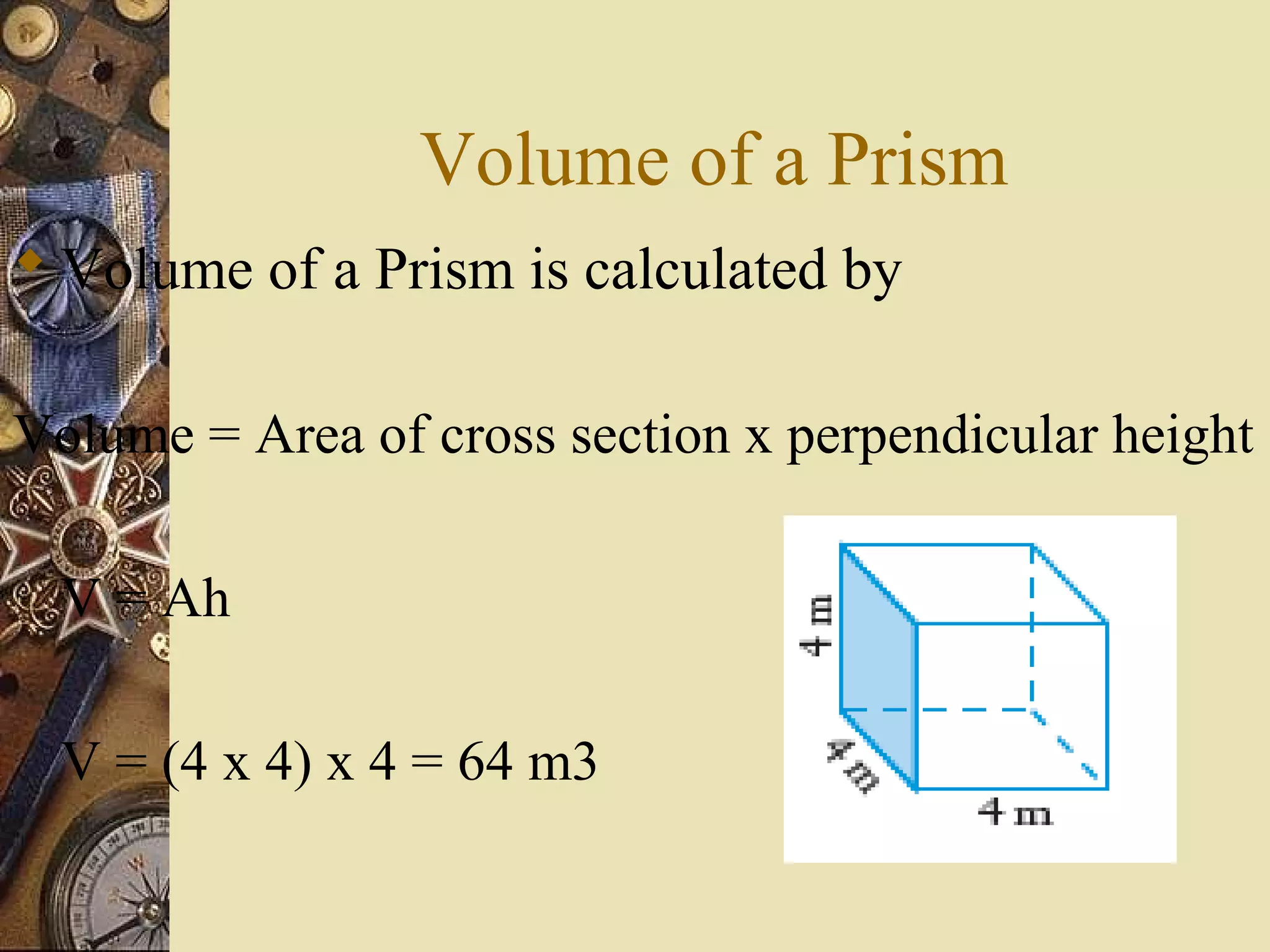
 Volume of a Prism is calculated by

Volume = Area of cross section x perpendicular height

  V = Ah

  V = (4 x 4) x 4 = 64 m3
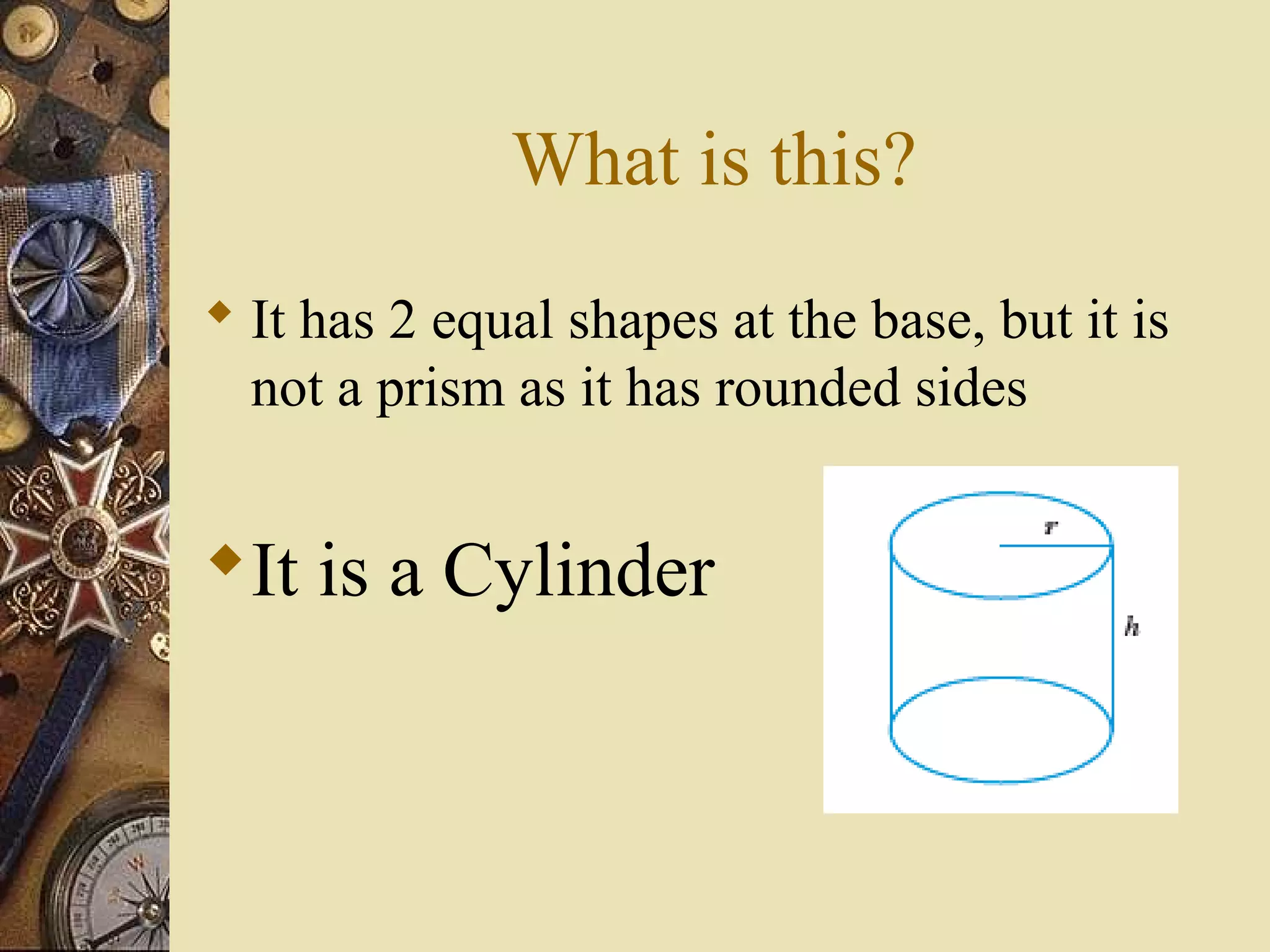
What is this?
 It has 2 equal shapes at the base, but it is
  not a prism as it has rounded sides


It is a Cylinder
Volume of a Cylinder
 How might we find the Volume of a
  Cylinder?
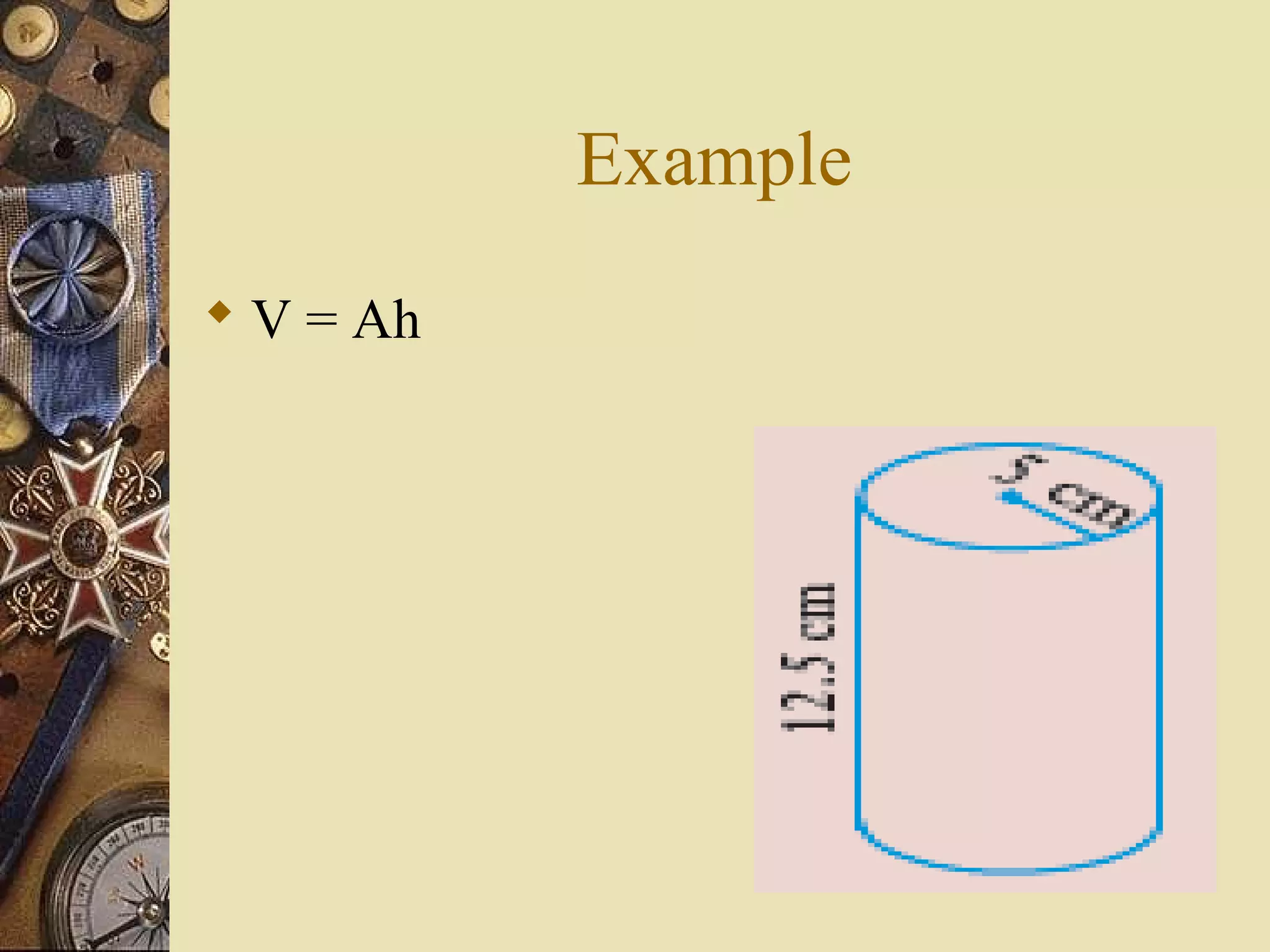
Example
 V = Ah
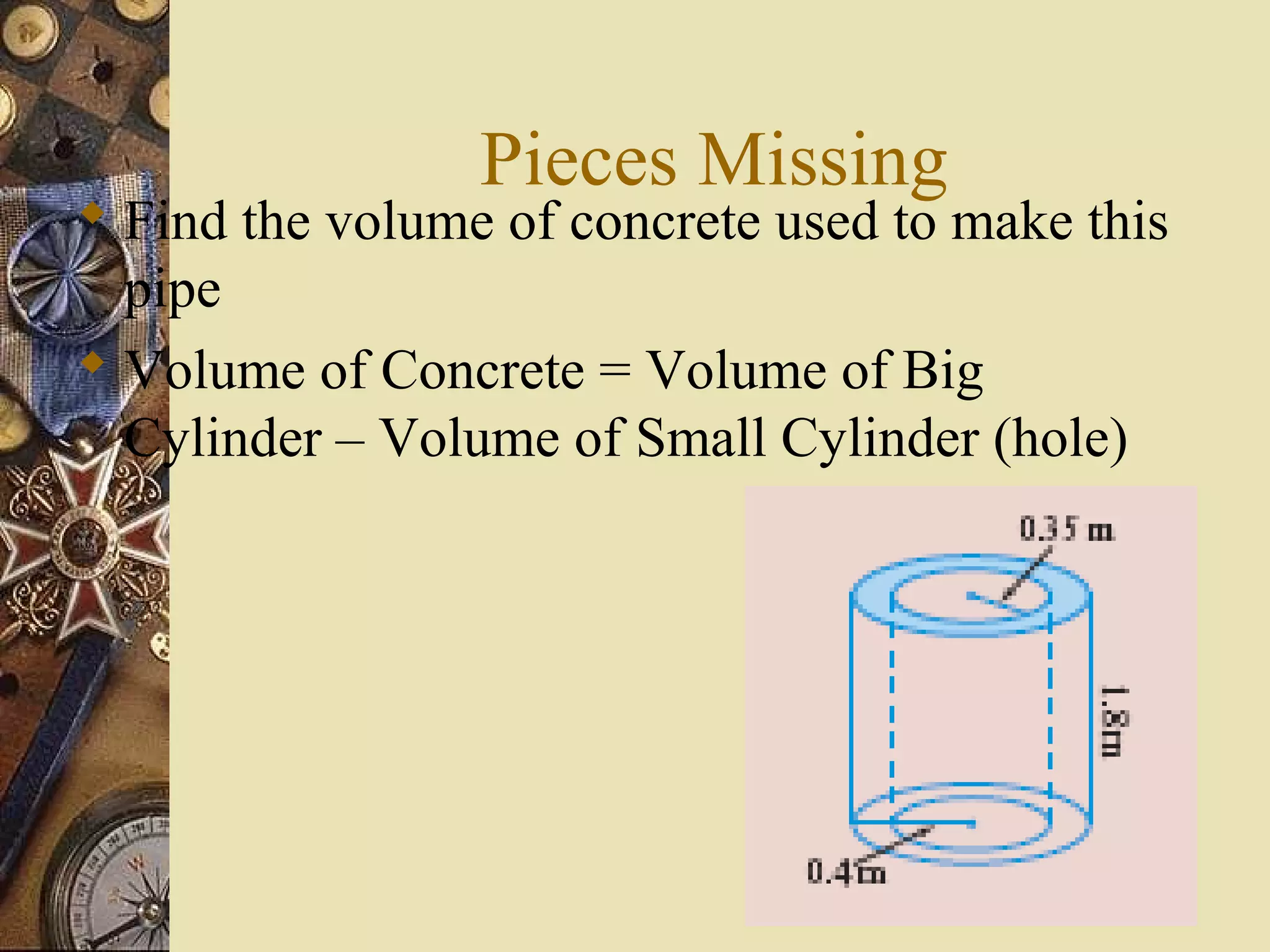
Pieces Missing
 Find the volume of concrete used to make this
  pipe
 Volume of Concrete = Volume of Big
  Cylinder – Volume of Small Cylinder (hole)
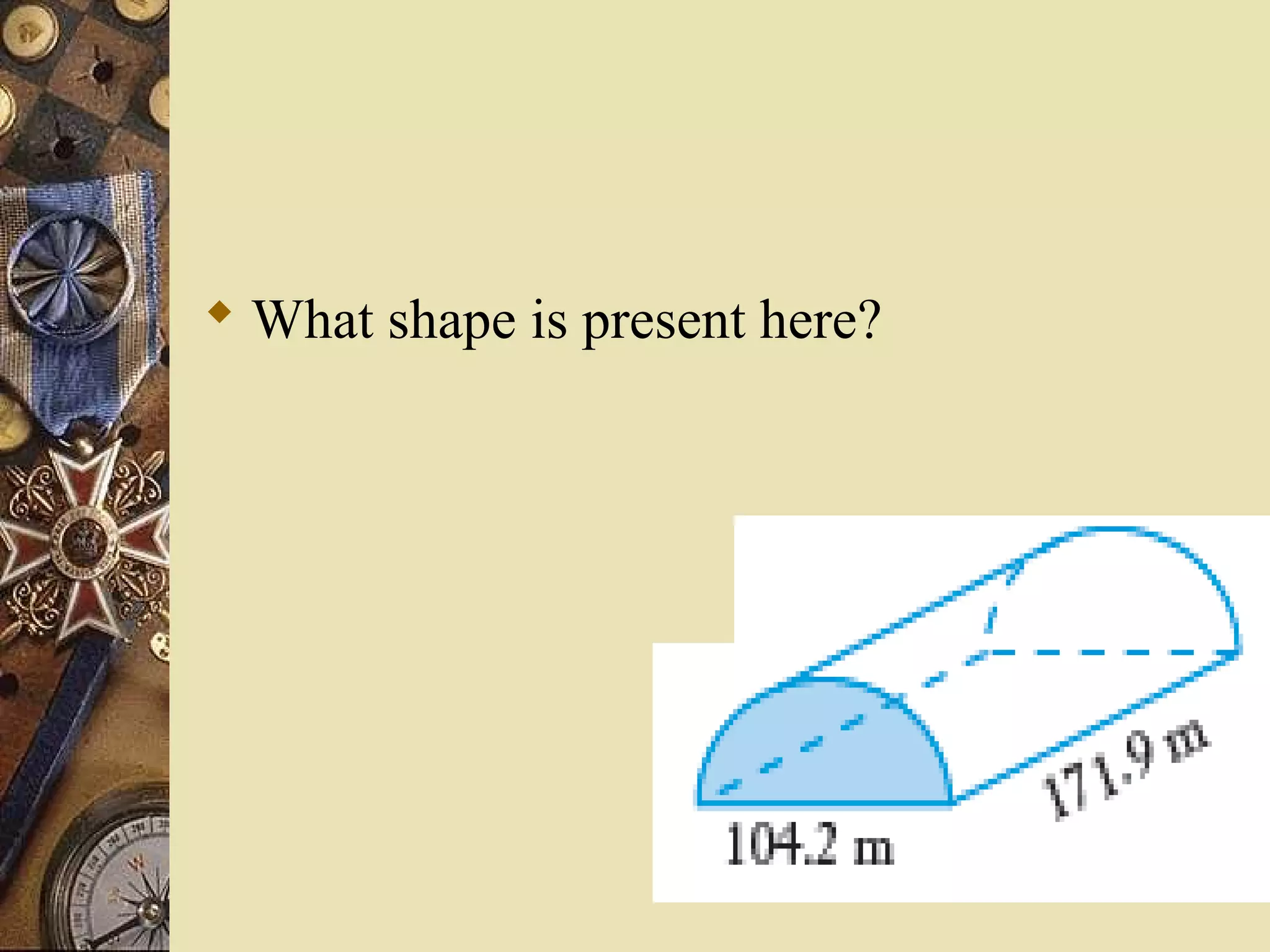
 What shape is present here?
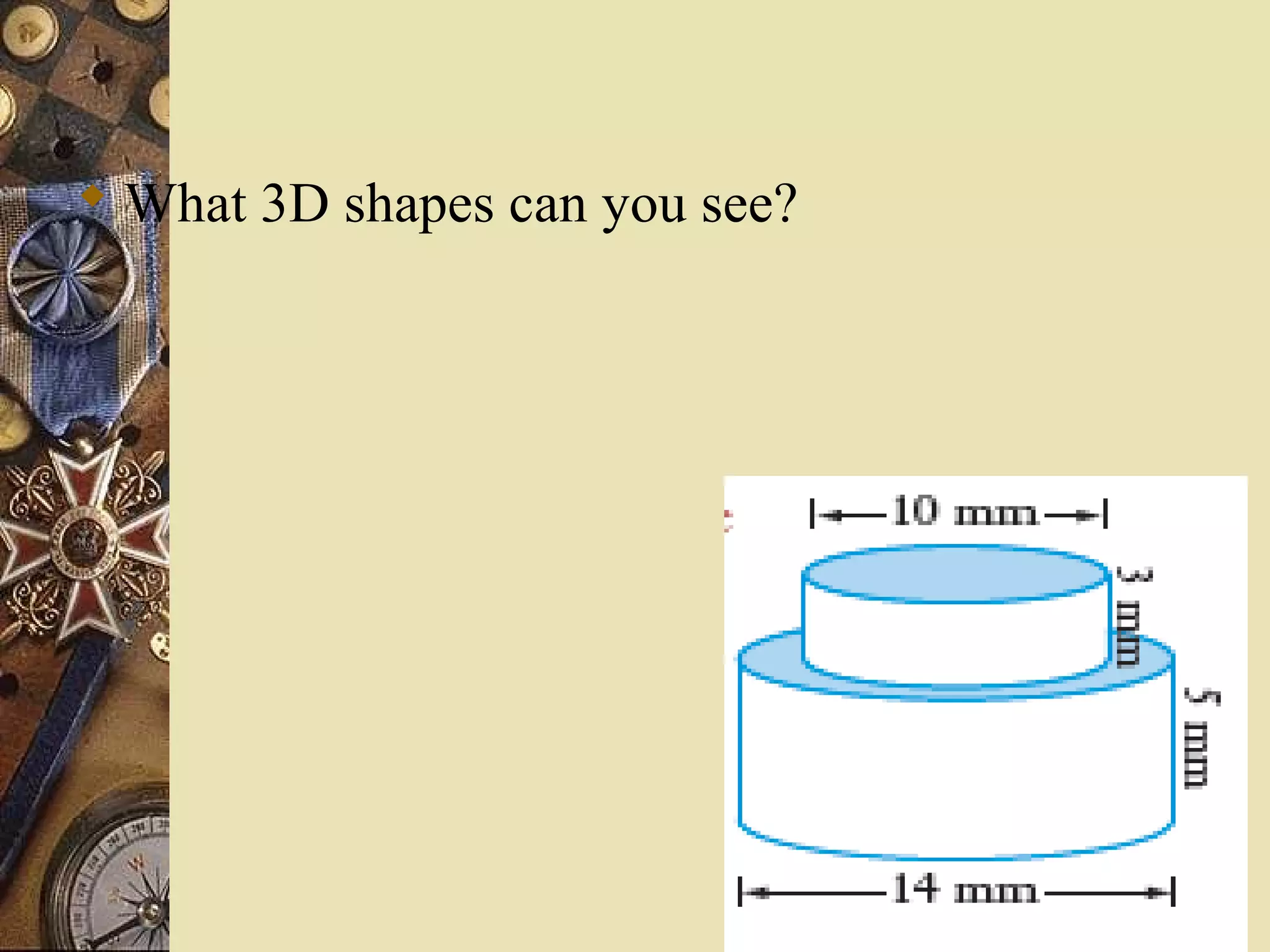
 What 3D shapes can you see?
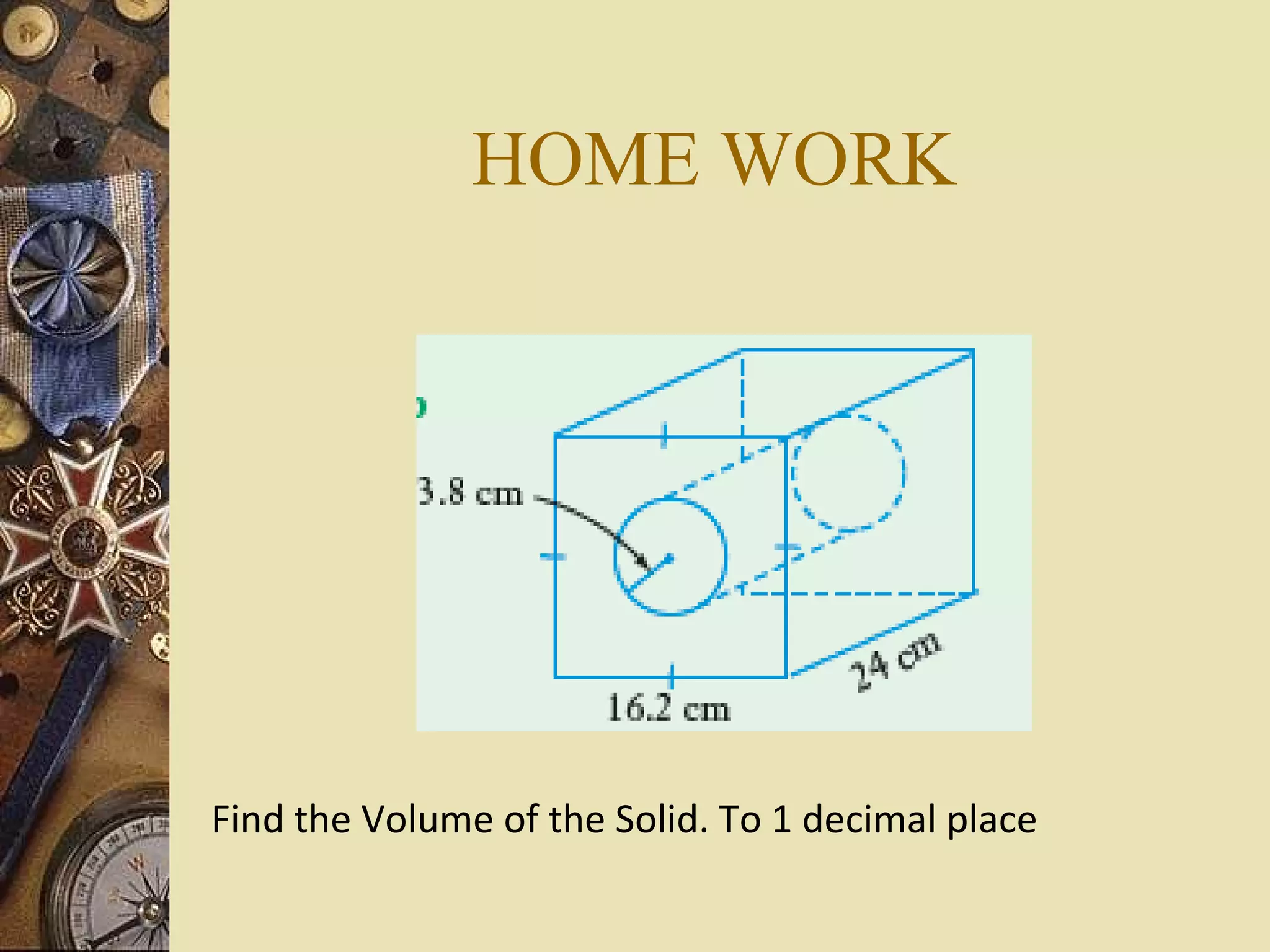
HOME WORK


Find the Volume of the Solid. To 1 decimal place
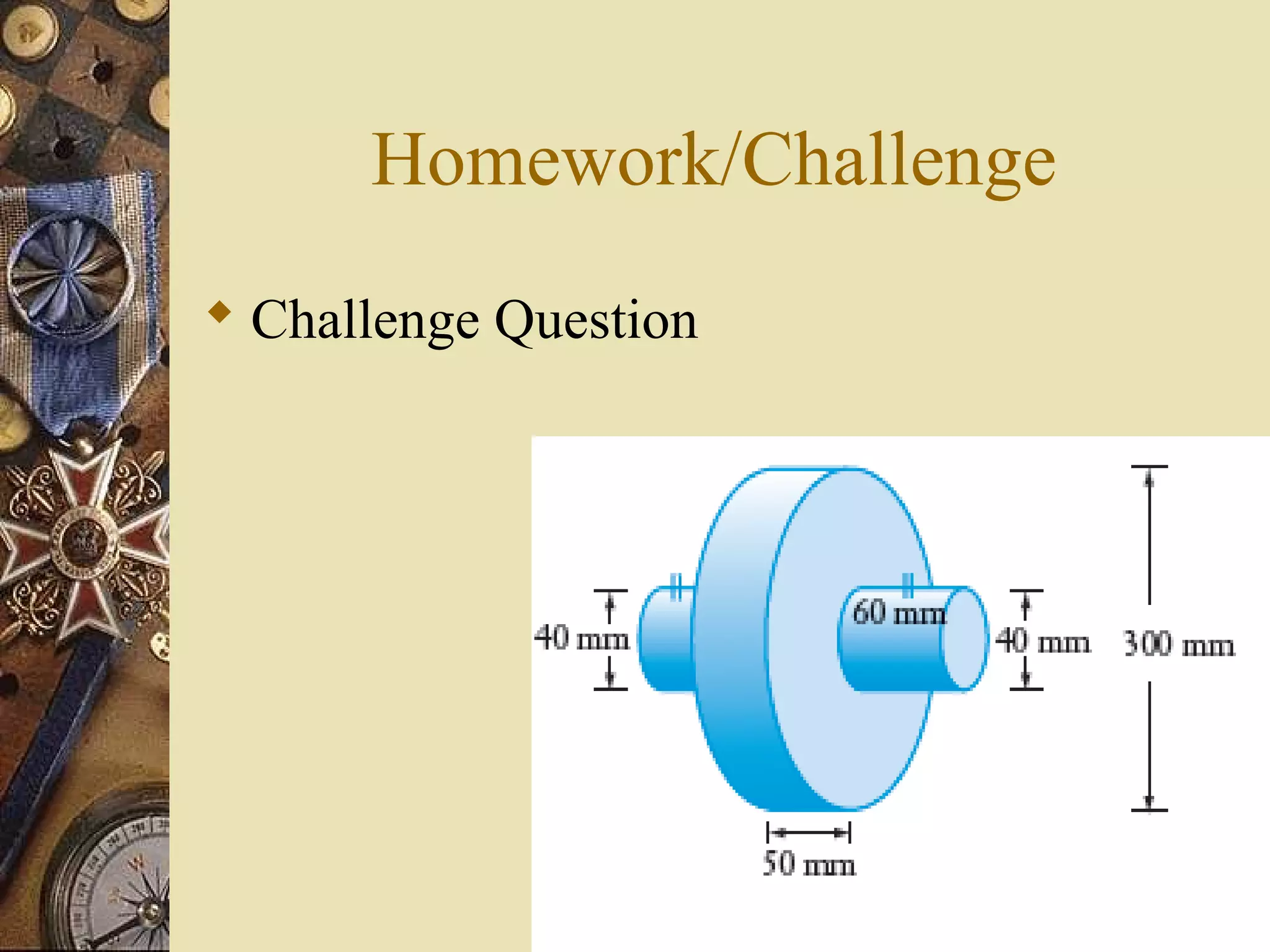
Homework/Challenge
 Challenge Question
Volume of a Cylinder
 How might we find the Volume of a
  Cylinder?
 V = Ah
  –=
Conversion of units
 1cm – 10mm
 1m – 100cm
 1km – 1000m
Conversions of Units
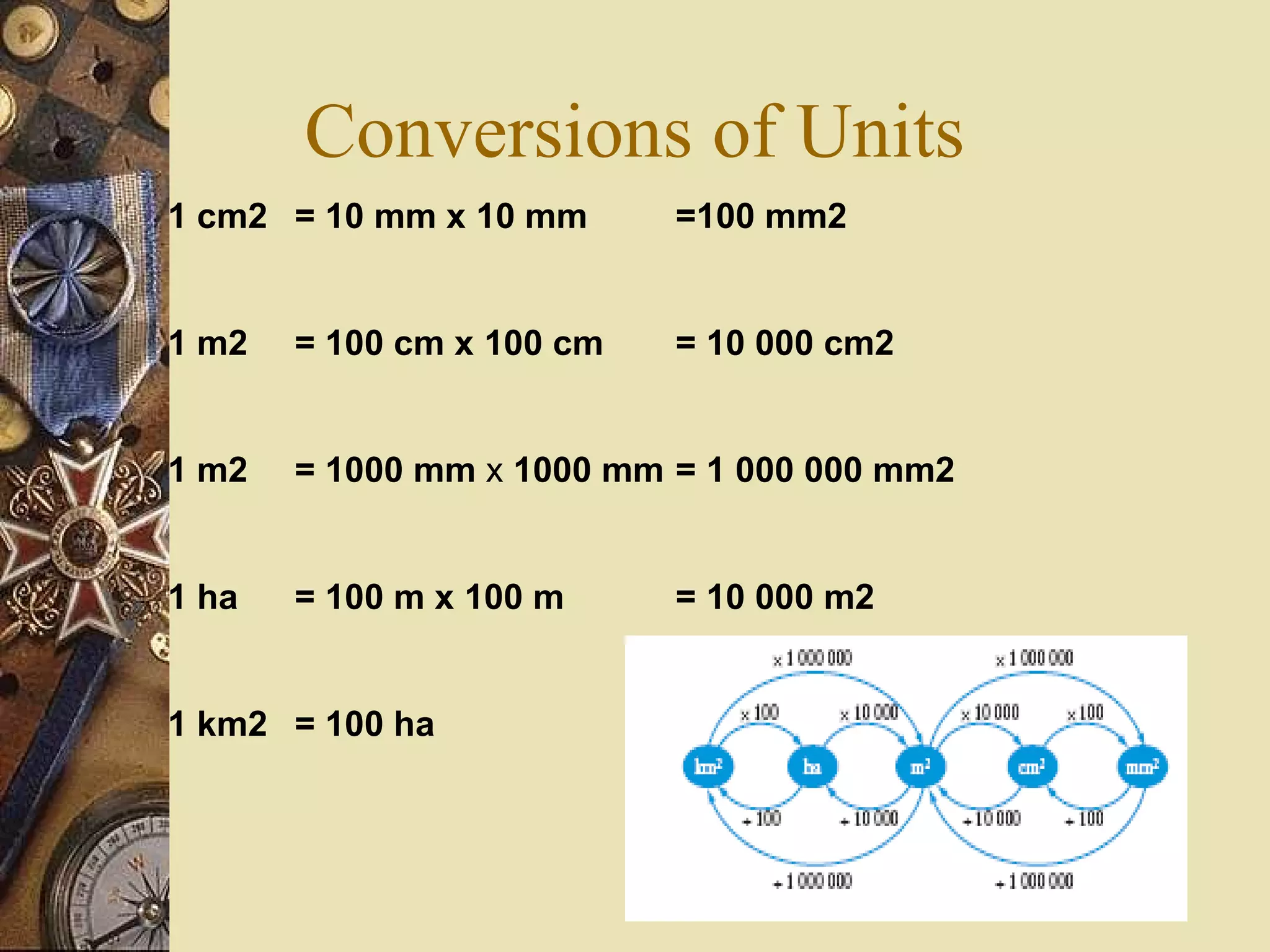
1 cm2 = 10 mm x 10 mm      =100 mm2


1 m2   = 100 cm x 100 cm   = 10 000 cm2


1 m2   = 1000 mm x 1000 mm = 1 000 000 mm2


1 ha   = 100 m x 100 m     = 10 000 m2


1 km2 = 100 ha
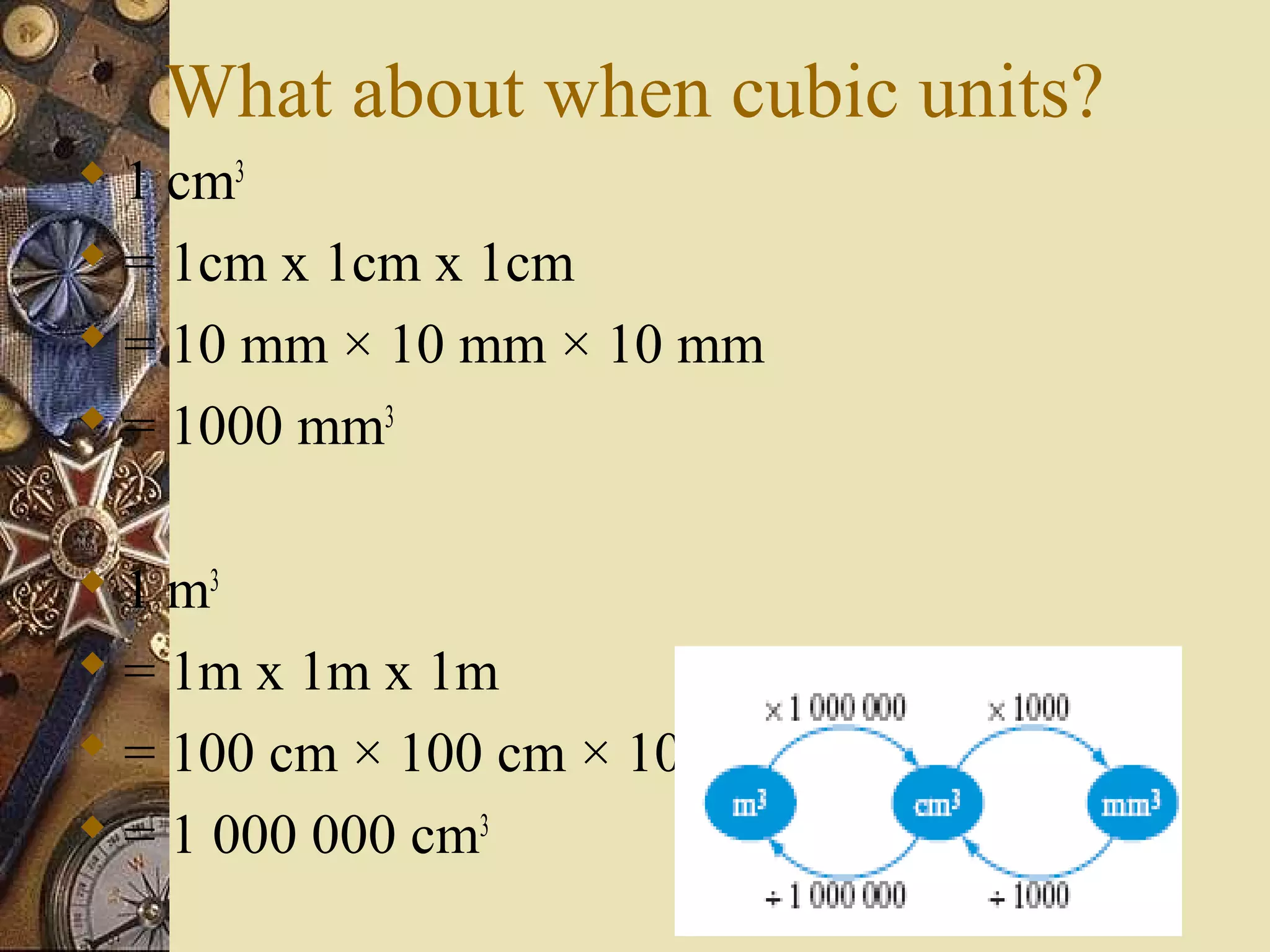
What about when cubic units?
 1 cm3
 = 1cm x 1cm x 1cm
 = 10 mm × 10 mm × 10 mm
 = 1000 mm3

 1 m3
 = 1m x 1m x 1m
 = 100 cm × 100 cm × 100 cm
 = 1 000 000 cm3
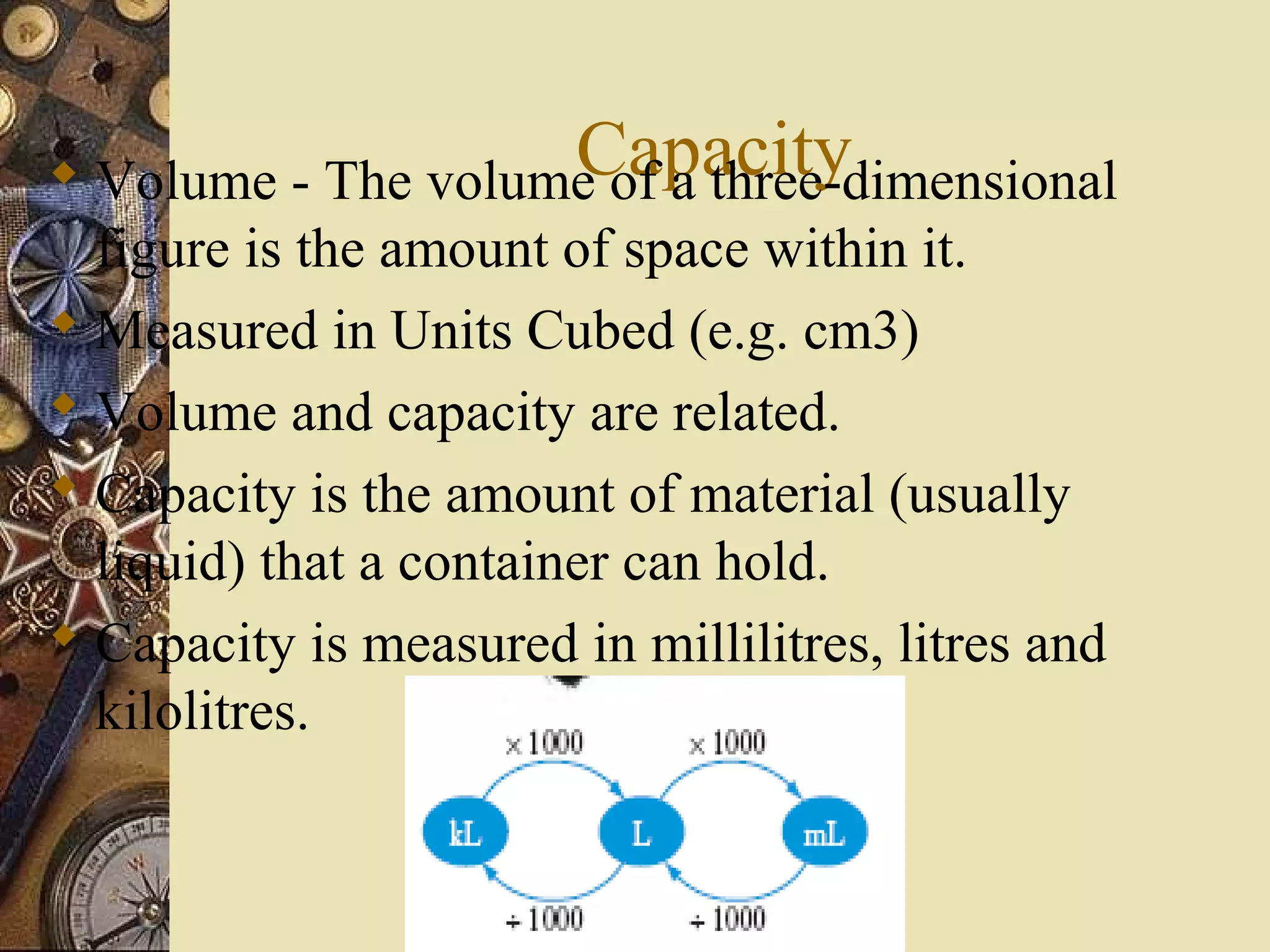
Capacity
 Volume - The volume of a three-dimensional
  figure is the amount of space within it.
 Measured in Units Cubed (e.g. cm3)
 Volume and capacity are related.
 Capacity is the amount of material (usually
  liquid) that a container can hold.
 Capacity is measured in millilitres, litres and
  kilolitres.
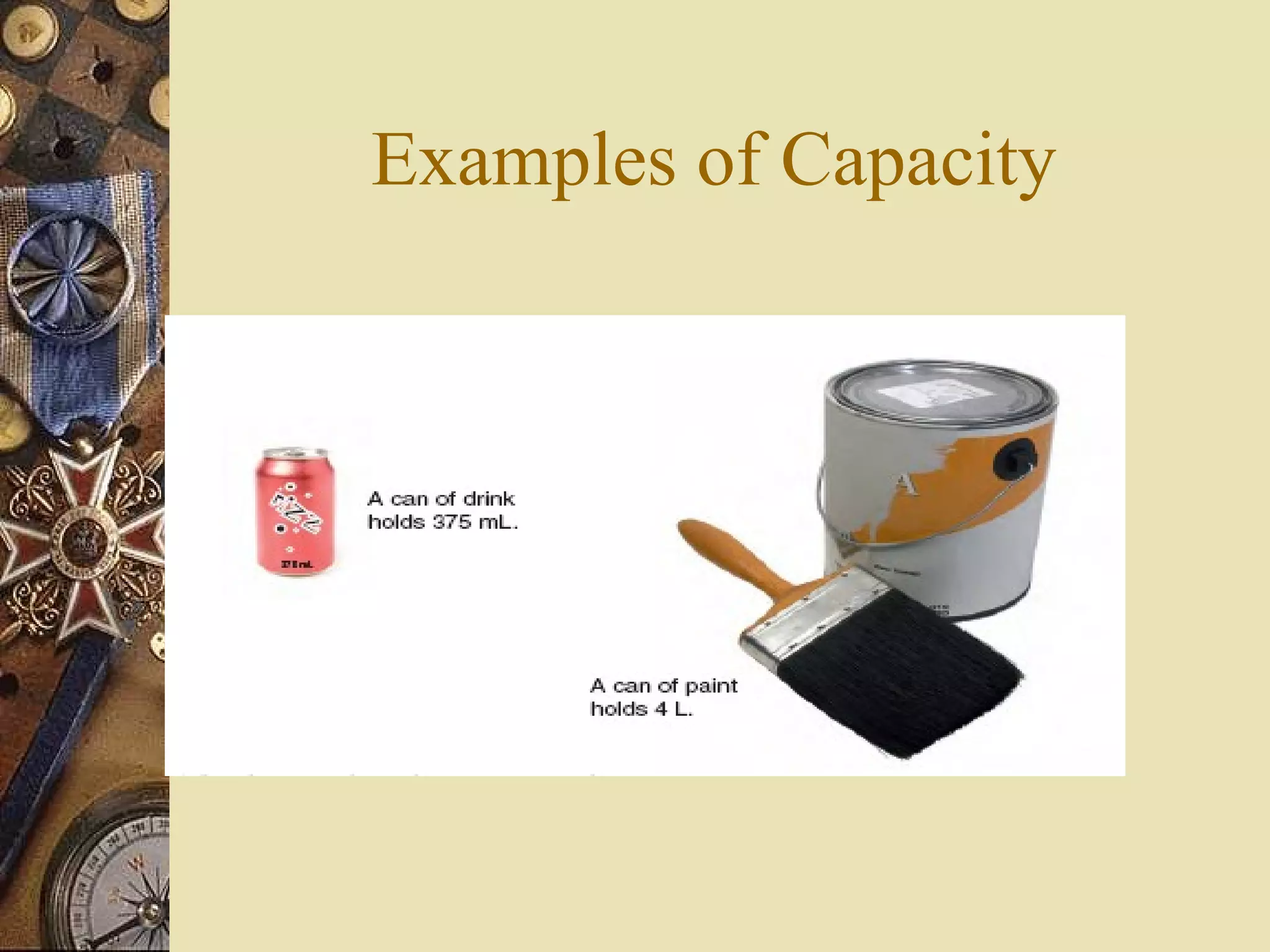
Examples of Capacity
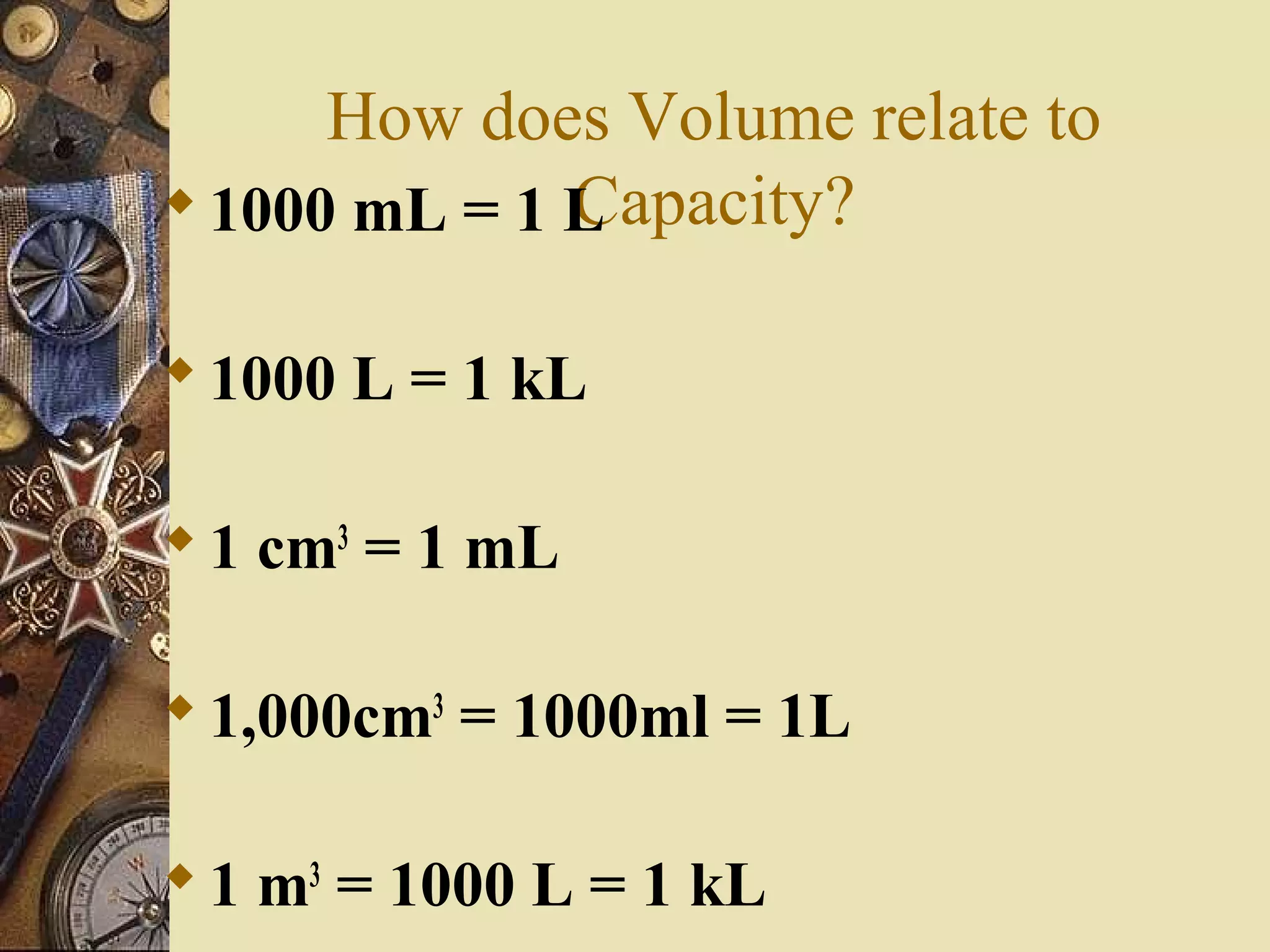
How does Volume relate to
              Capacity?
 1000 mL = 1 L

 1000 L = 1 kL

 1 cm3 = 1 mL

 1,000cm3 = 1000ml = 1L

 1 m3 = 1000 L = 1 kL
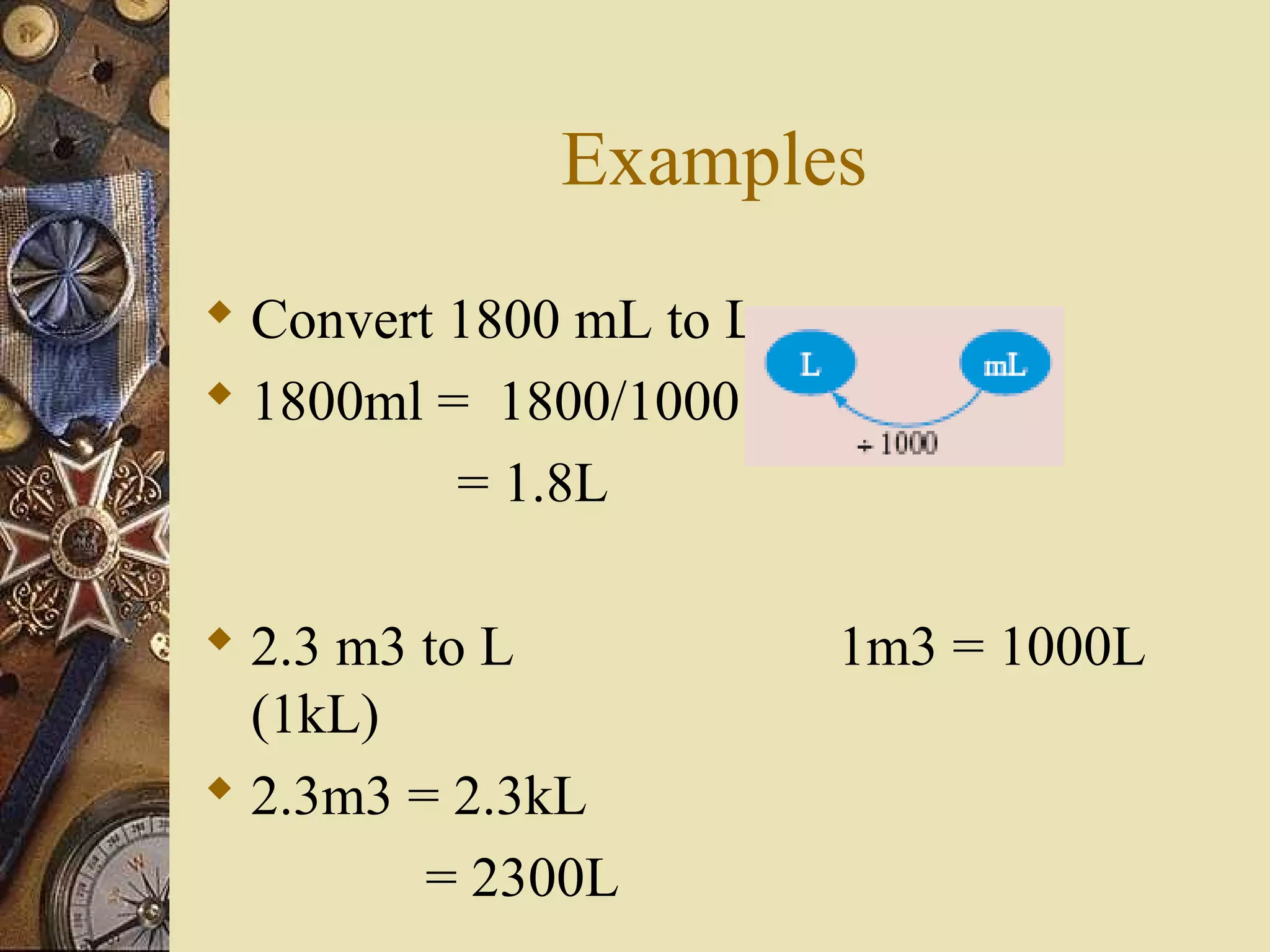
Examples
 Convert 1800 mL to L
 1800ml = 1800/1000
          = 1.8L

 2.3 m3 to L            1m3 = 1000L
  (1kL)
 2.3m3 = 2.3kL
         = 2300L
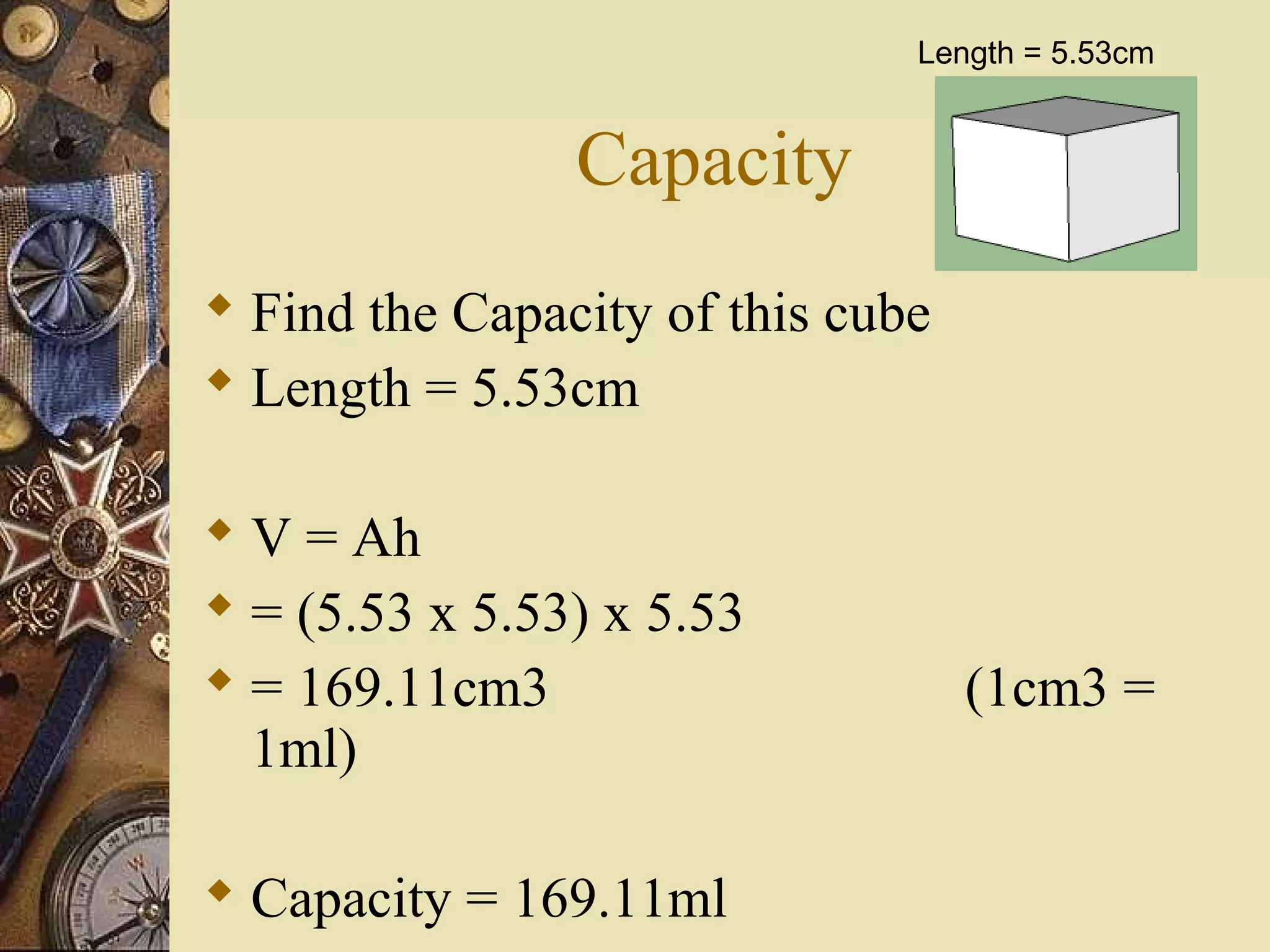
Length = 5.53cm


                Capacity
 Find the Capacity of this cube
 Length = 5.53cm

 V = Ah
 = (5.53 x 5.53) x 5.53
 = 169.11cm3                      (1cm3 =
  1ml)

 Capacity = 169.11ml
Example
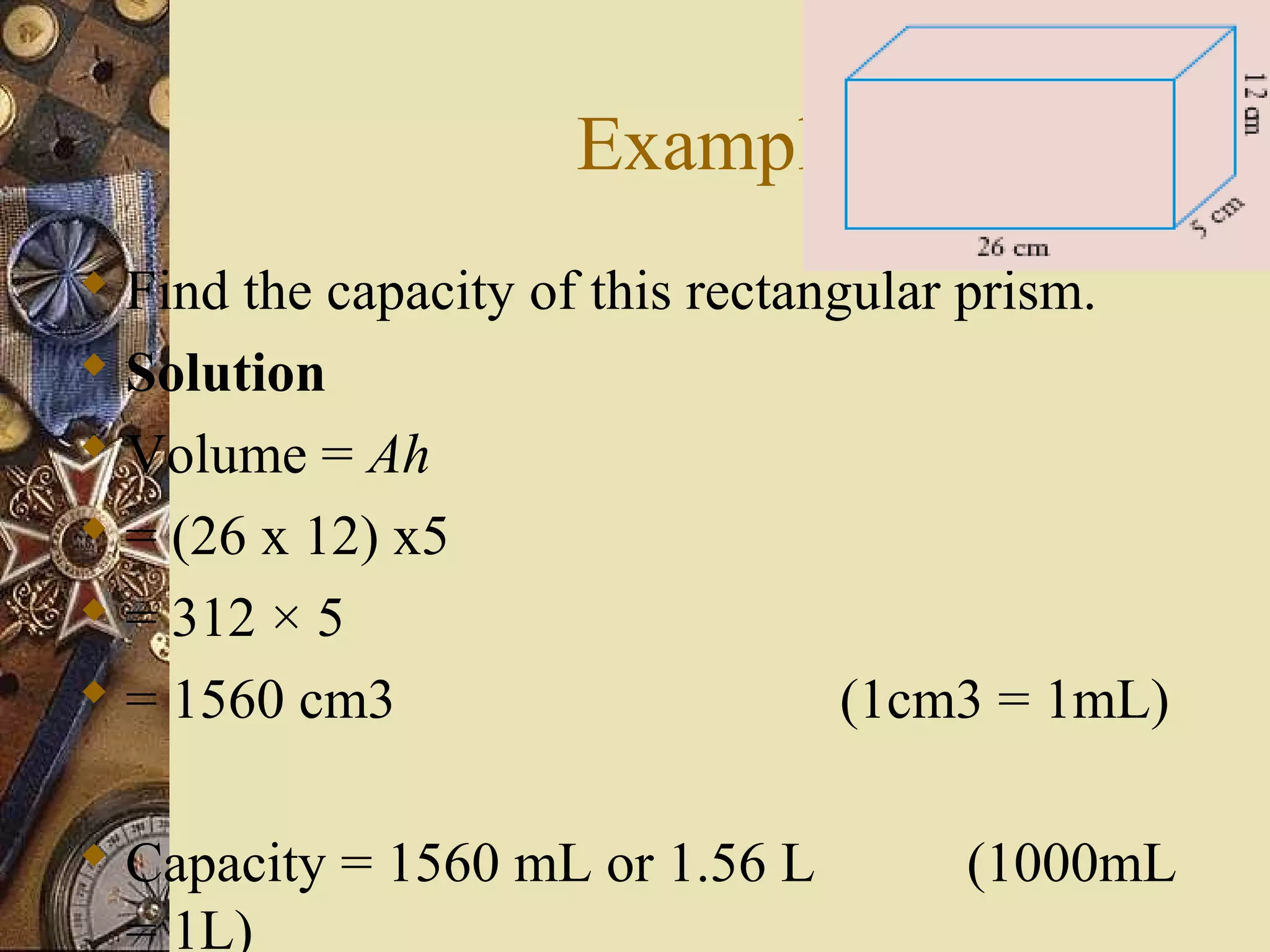
 Find the capacity of this rectangular prism.
 Solution
 Volume = Ah
 = (26 x 12) x5
 = 312 × 5
 = 1560 cm3                       (1cm3 = 1mL)

 Capacity = 1560 mL or 1.56 L        (1000mL
  = 1L)
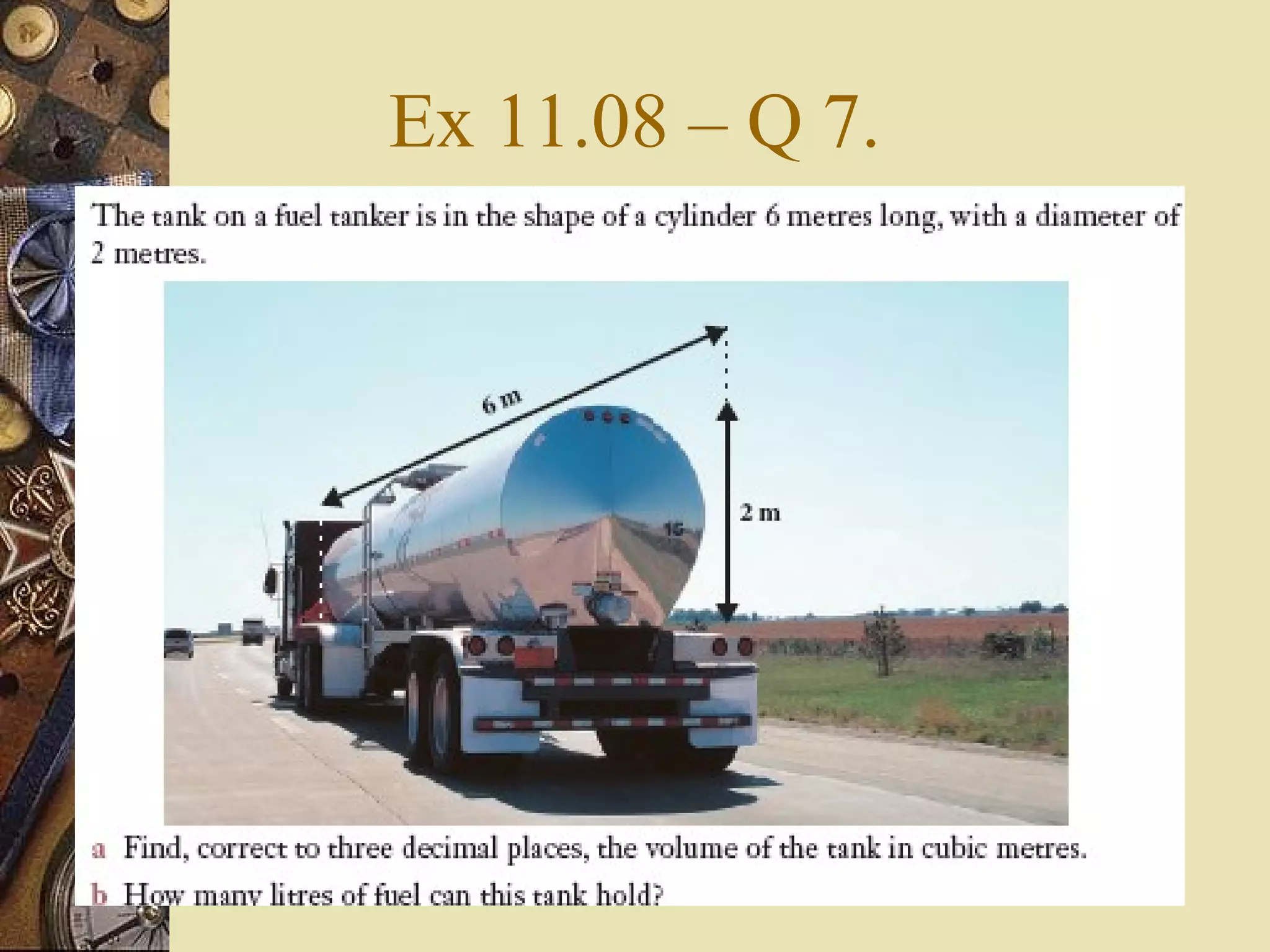
Ex 11.08 – Q 7.
 What size rainwater tank would be needed to
  hold the run-off when 40 mm of rain falls on a
  roof 12 m long and 3.6 m wide? (Answer in
  litres.)
7-Volume of Cones
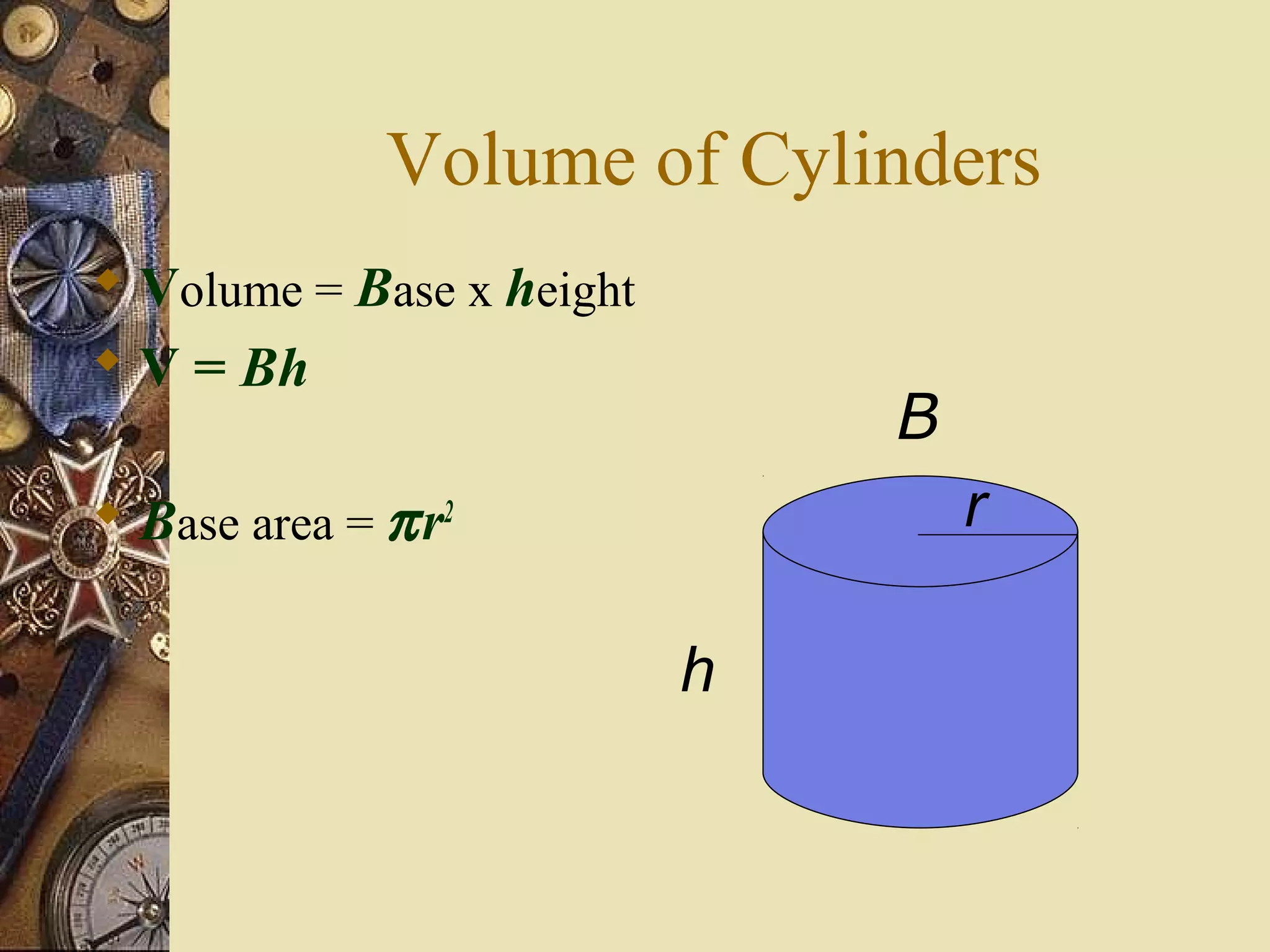
Volume of Cylinders
 Volume = Base x height
 V = Bh
                               B
 Base area = π r2                 r

                           h
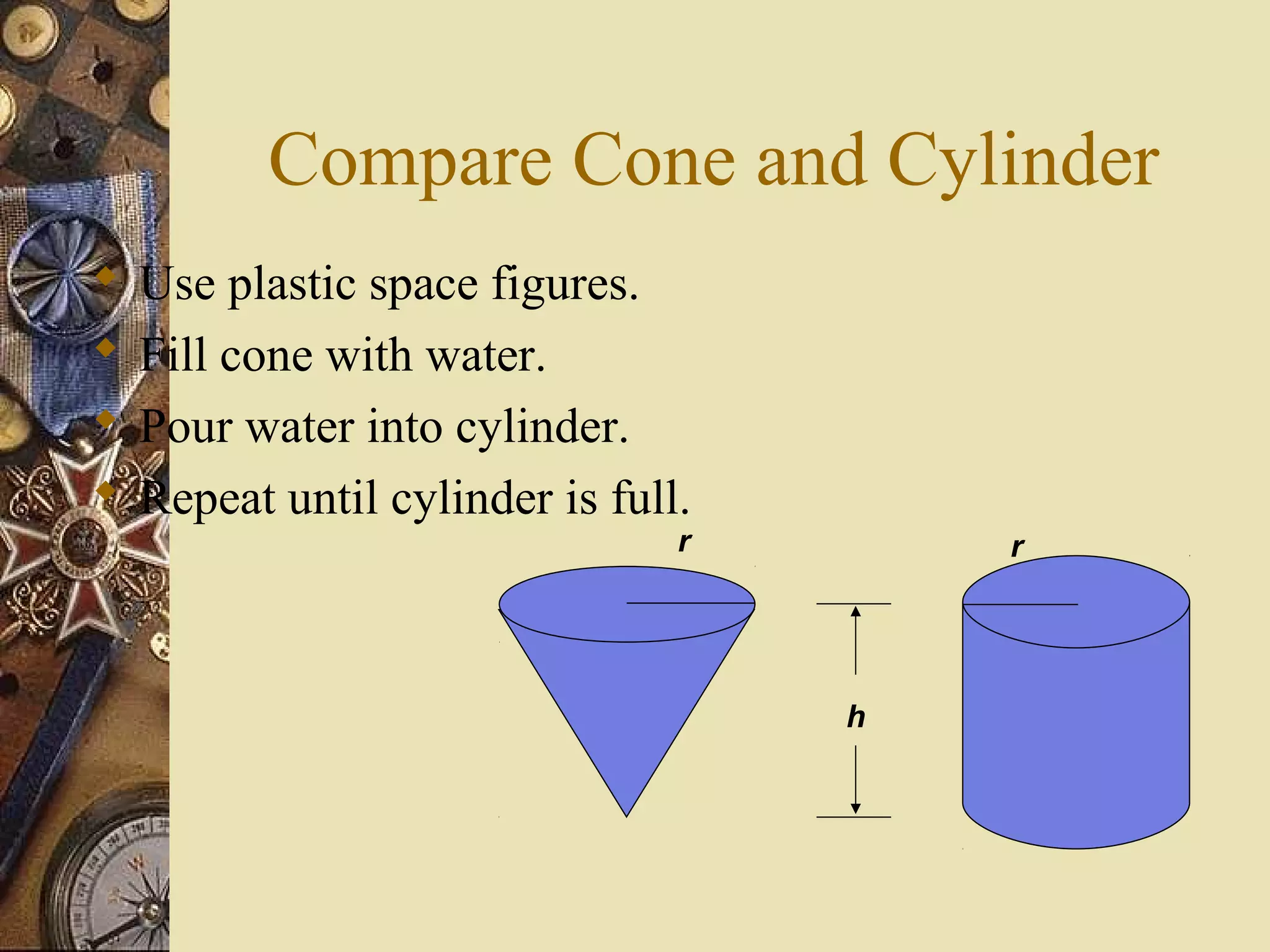
Compare Cone and Cylinder
   Use plastic space figures.
   Fill cone with water.
   Pour water into cylinder.
   Repeat until cylinder is full.
                                 r       r


                                     h
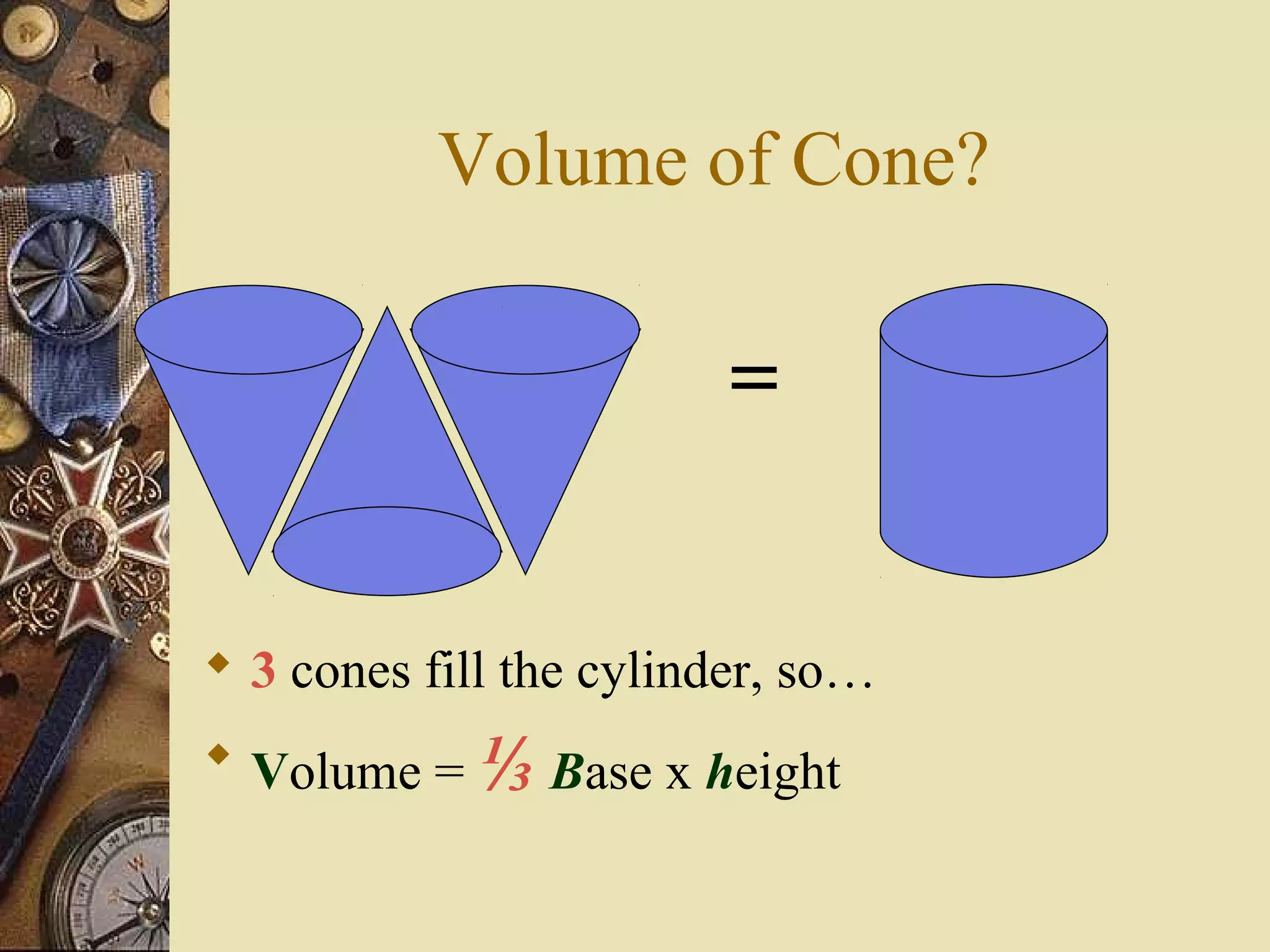
Volume of Cone?

                        =


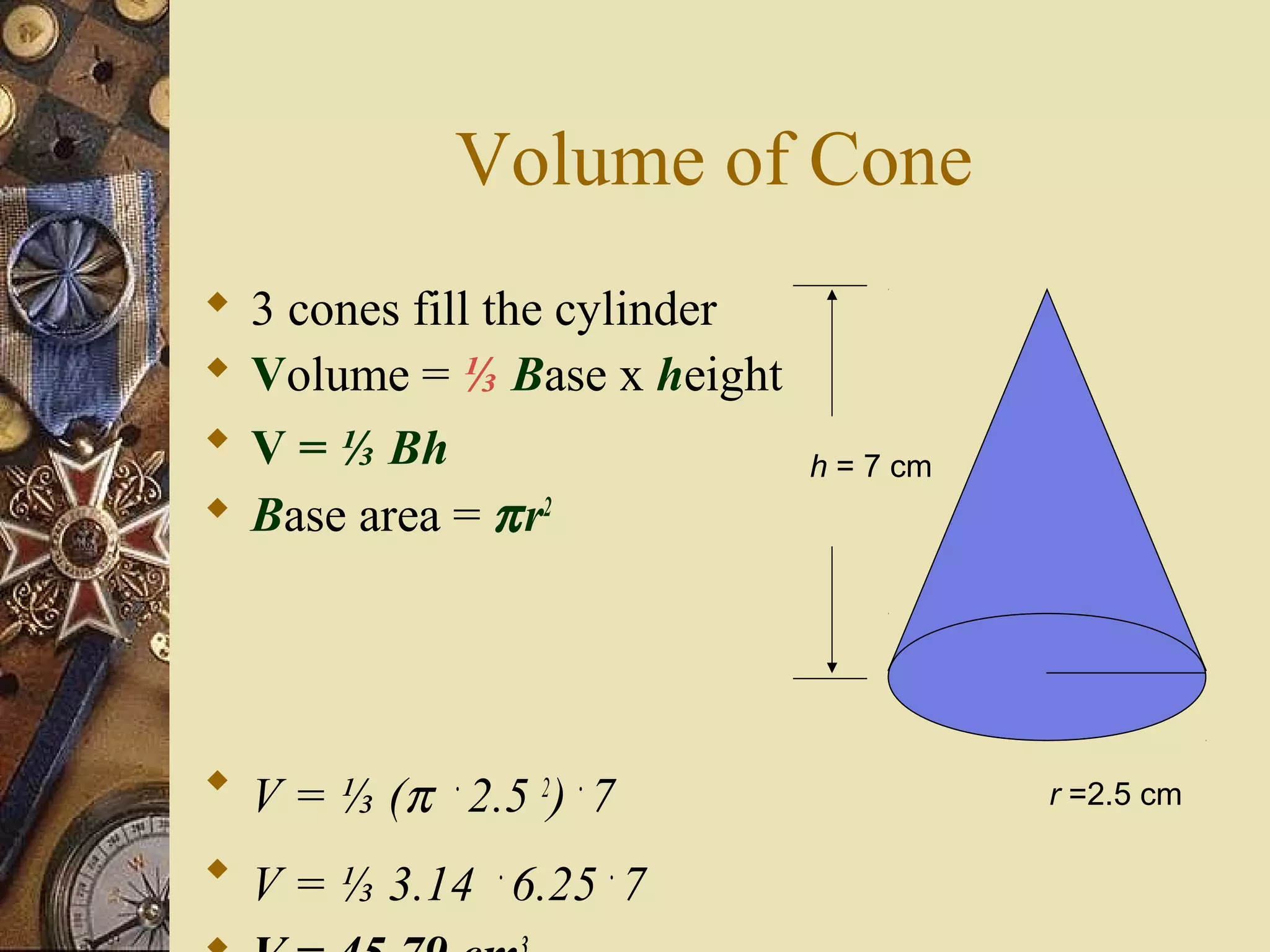
 3 cones fill the cylinder, so…
 Volume = ⅓ Base x height
Volume of Cone
   3 cones fill the cylinder
   Volume = ⅓ Base x height
   V = ⅓ Bh                    h = 7 cm
   Base area = π r2


 V = ⅓ (π . 2.5 2) . 7                    r =2.5 cm

 V = ⅓ 3.14 . 6.25 . 7
8-Developing the Formula for the
      Volume of a Sphere
Volume of a Sphere


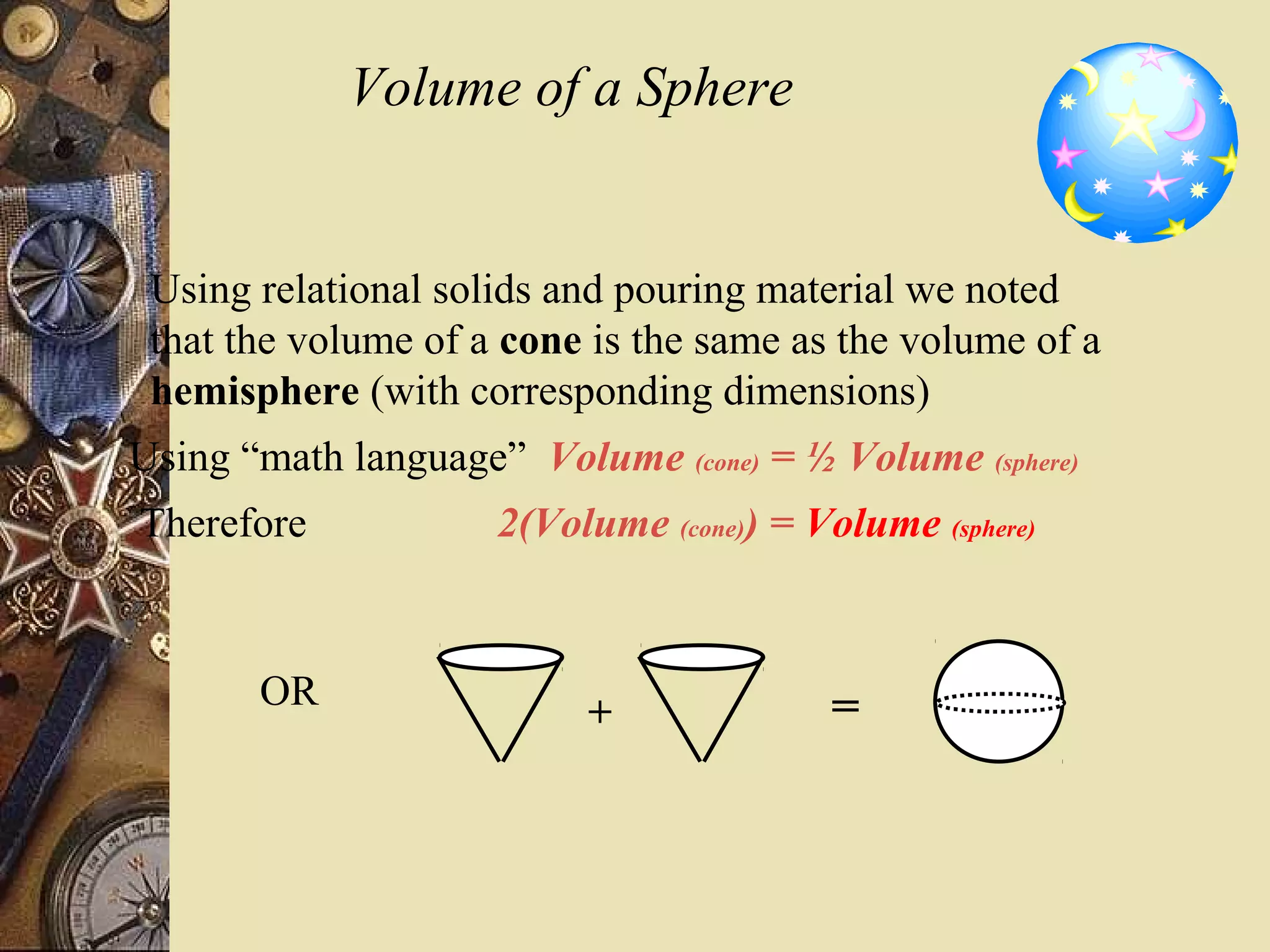
 Using relational solids and pouring material we noted
 that the volume of a cone is the same as the volume of a
 hemisphere (with corresponding dimensions)
Using “math language” Volume (cone) = ½ Volume (sphere)
Therefore            2(Volume (cone)) = Volume (sphere)


       OR                                 =
                          +
Volume of a Sphere


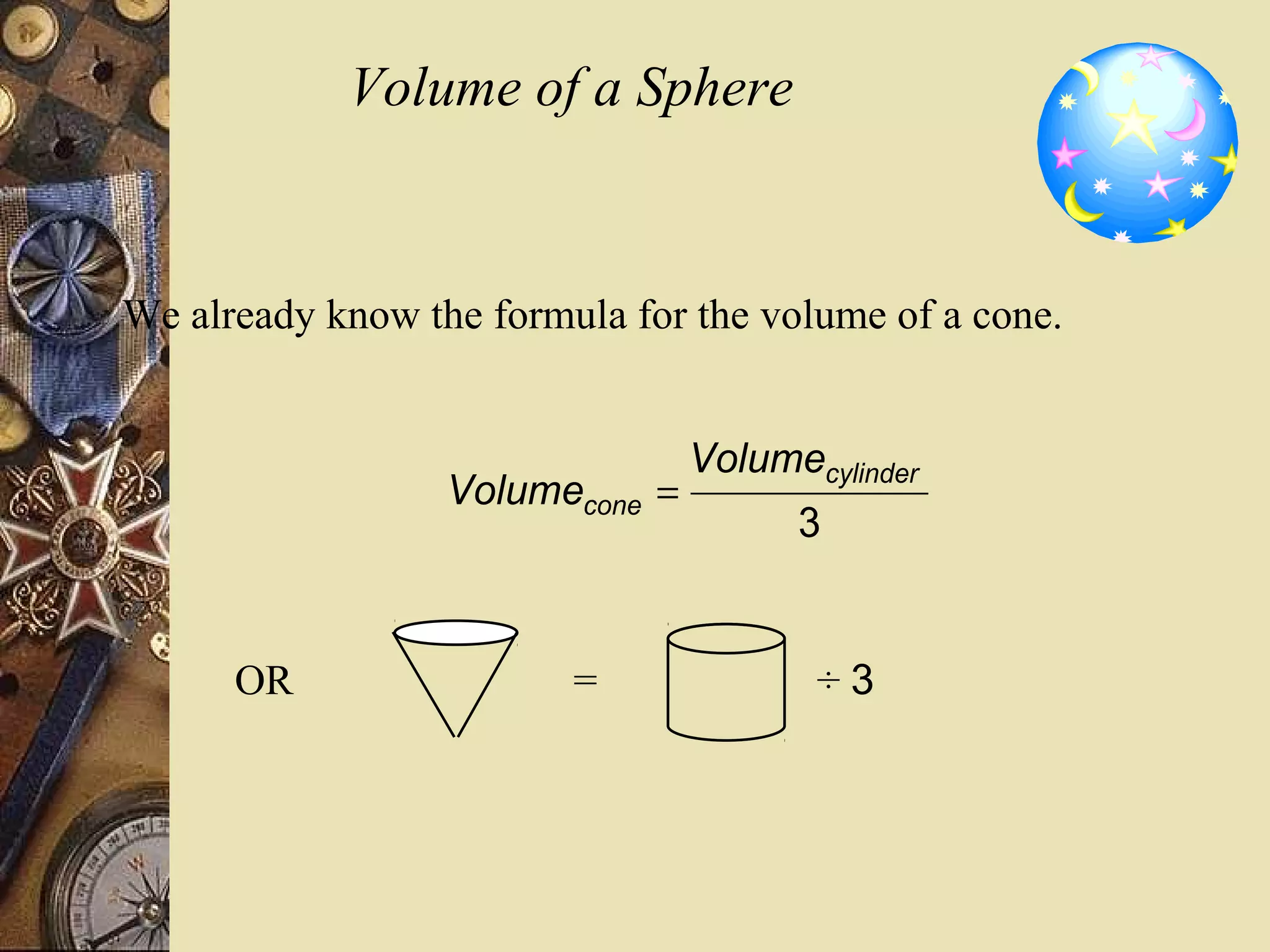
We already know the formula for the volume of a cone.


                                 Volumecylinder
                  Volumecone =
                                       3


      OR                 =              ÷3
Volume of a Sphere
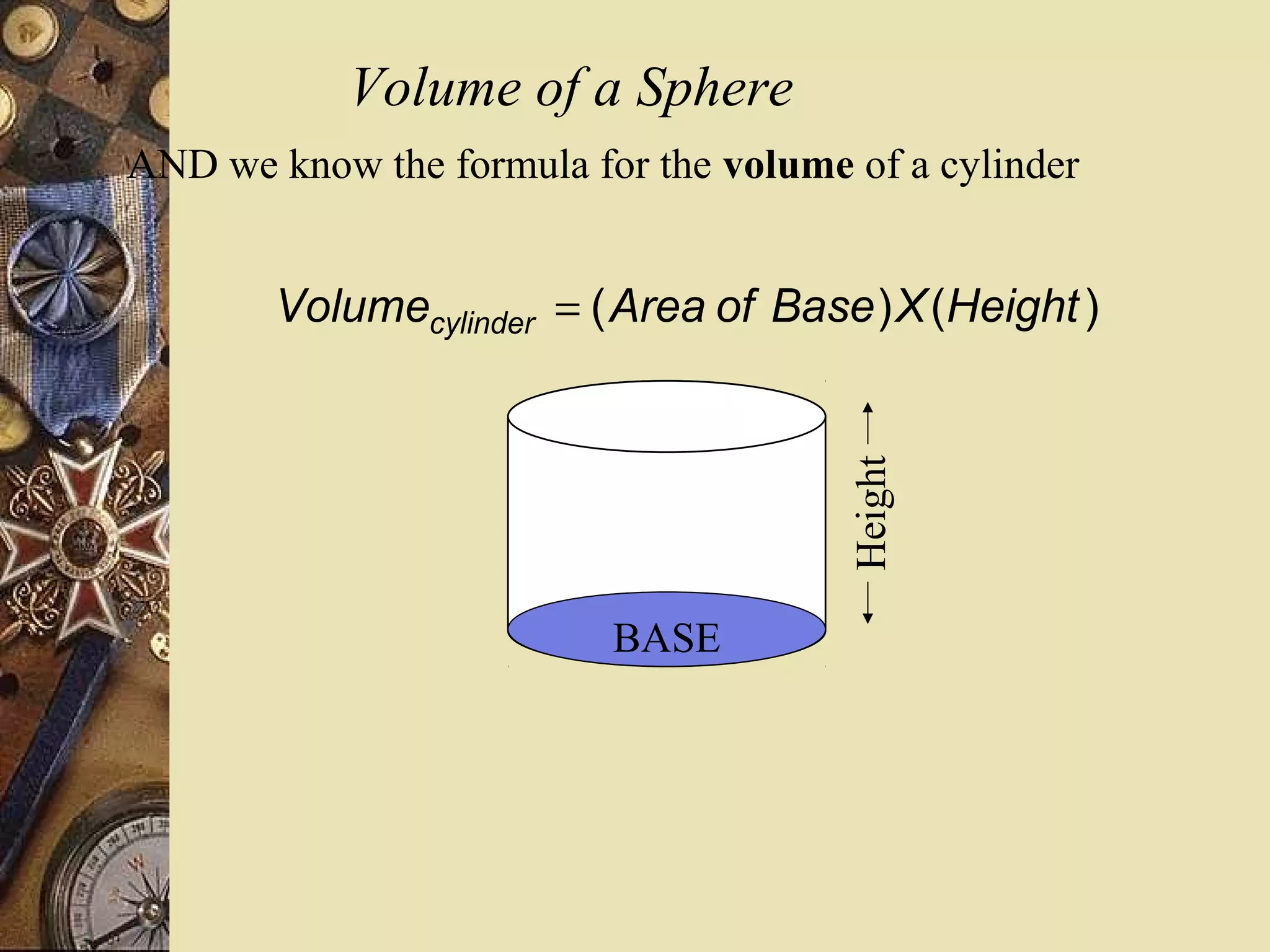
AND we know the formula for the volume of a cylinder


        Volumecylinder = ( Area of Base ) X (Height )


                                       Height
                          BASE
Volume of a Sphere

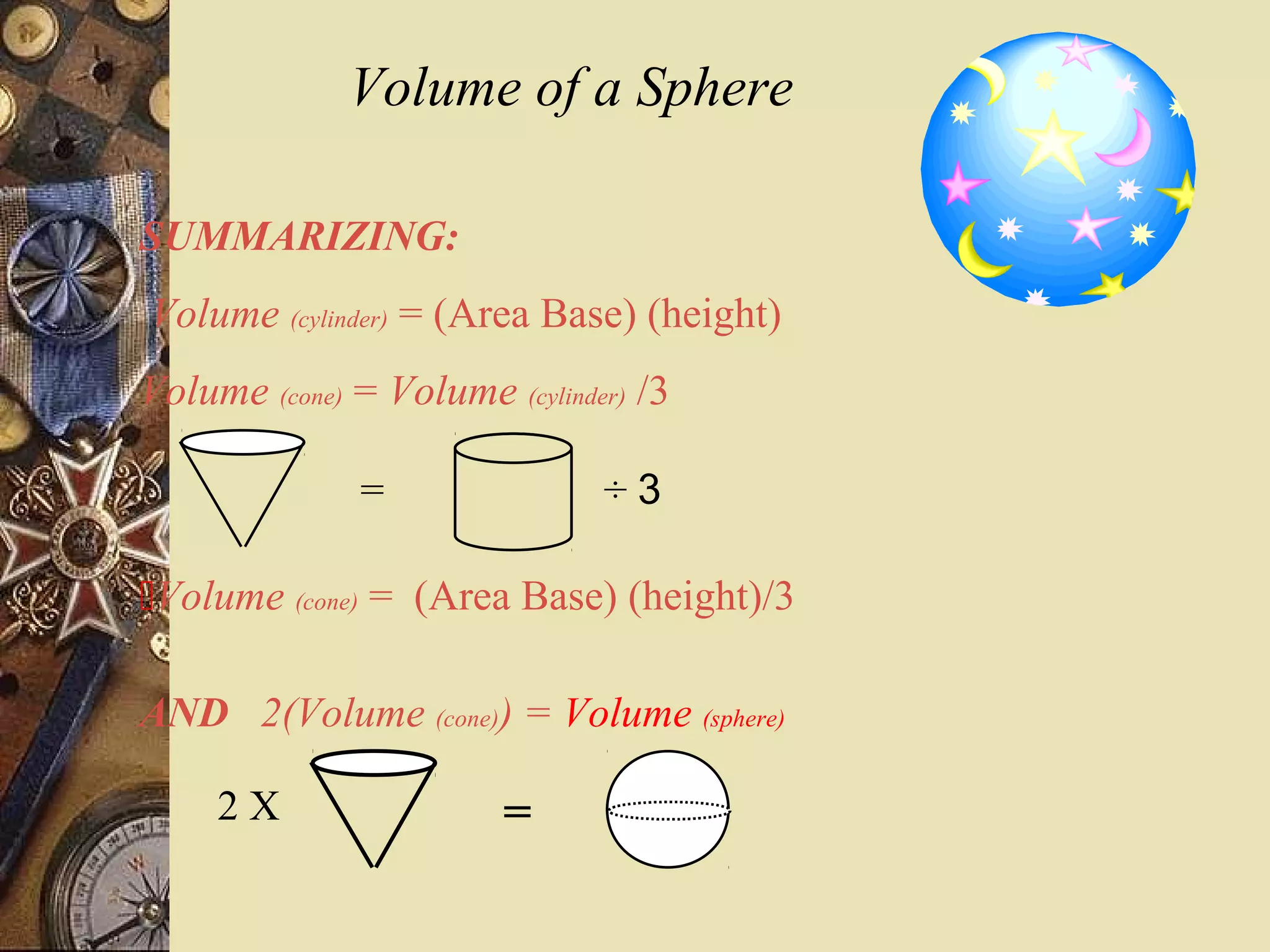
SUMMARIZING:
Volume (cylinder) = (Area Base) (height)
Volume (cone) = Volume (cylinder) /3

              =                ÷3

Volume (cone) = (Area Base) (height)/3

AND 2(Volume (cone)) = Volume (sphere)

     2X                 =
Volume of a Sphere
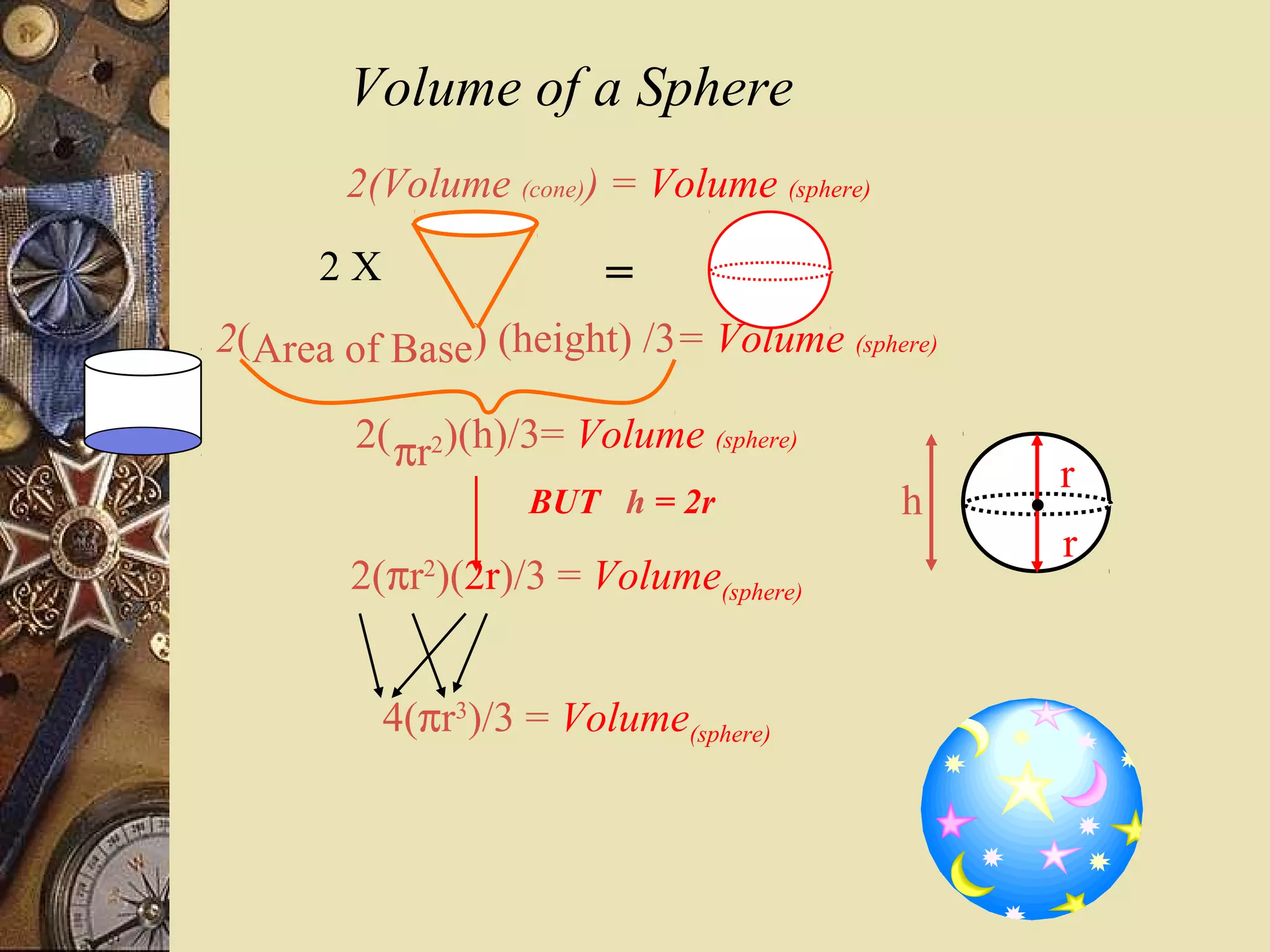
       2(Volume (cone)) = Volume (sphere)
      2X                 =
2(Area of Base) (height) /3= Volume (sphere)

        2( πr2)(h)/3= Volume (sphere)
                                                r
                    BUT h = 2r              h
                                                r
        2(πr )(2r)/3 = Volume(sphere)
             2


           4(πr3)/3 = Volume(sphere)
3
4π r 
            Volume of a Sphere       4 π r 3
  3                                     3


                                 3
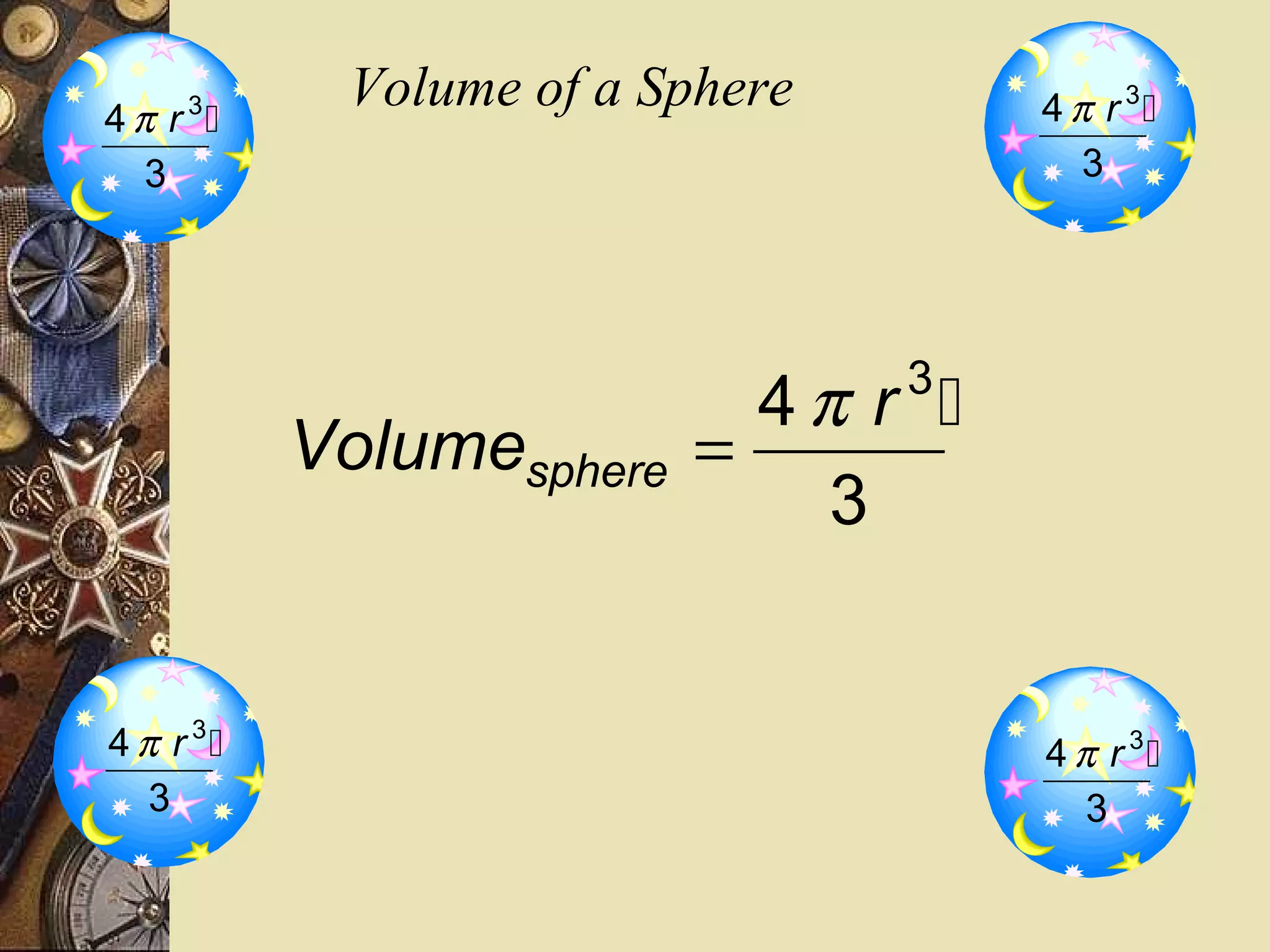
                            4π r 
           Volumesphere   =
                              3


4 π r 3                             4 π r 3
   3                                    3
Surface area of a cuboid and a cube,cylinder,cone,sphere,volume of cuboid,cylinder,cone and sphere.ppt

Surface area of a cuboid and a cube,cylinder,cone,sphere,volume of cuboid,cylinder,cone and sphere.ppt

  • 1.
    K.V Faridkot Harkamalpreet Singh Brar 9 -B th
  • 2.
  • 3.
    Objectives  At theend of the lesson the students should be able; To find the surface area of a cylinder ..
  • 4.
    What is acylinder?  The term Cylinder refers to a right circular cylinder. Like a right prism, its altitude is perpendicular to the bases and has an endpoint in each base.
  • 5.
    PRESENTATION base altitude radius base
  • 6.
    What will happenif we removed the end of the cylinder and unrolled the body? Lets find out !!!!
  • 7.
    This will happenif we unrolled and removed the end of a cylinder…. h Circumference of the base 2Πr 2
  • 8.
    Notice that wehad formed 2 circles and a 1 rectangle….  The 2 circles serves as our bases of our cylinder and the rectangular region represent the body
  • 9.
    How can wesolved the surface area of a Cylinder?  To solve the surface area of a cylinder, add the areas of the circular bases and the area of the rectangular region which is the body of the cylinder.
  • 10.
    This is theformula in order to solved the surface are of a cylinder.  SA= area of 2 circular bases + are of a rectangle oR
  • 11.
    We derived atthis formula..!! SA=2Πr2 +2Πr Or SA=2Πr (r + h)
  • 12.
    Find the surfacearea of a cylindrical water tank given the height of 20m and the radius of 5m? (Use π as 3.14) Given: SA=2πr2 +2πrh h=20m r=5m =2(3.14)(5m)2 + 2[(3.14) (5m)(20m) =157m2 + 628m SA =785m2
  • 13.
    2-Surface Area ofa Prism Cubes and Cuboids
  • 14.
    Surface area ofa cuboid To find the surface area of a shape, we calculate the total area of all of the faces. A cuboid has 6 faces. The top and the bottom of the cuboid have the same area.
  • 15.
    Surface area ofa cuboid To find the surface area of a shape, we calculate the total area of all of the faces. A cuboid has 6 faces. The front and the back of the cuboid have the same area.
  • 16.
    Surface area ofa cuboid To find the surface area of a shape, we calculate the total area of all of the faces. A cuboid has 6 faces. The left hand side and the right hand side of the cuboid have the same area.
  • 17.
    Surface area ofa cuboid To find the surface area of a shape, we calculate the total area of all of the faces. Can you work out the 5 cm 8 cm surface area of this cubiod? The area of the top = 8 × 5 = 40 cm2 7 cm The area of the front = 7 × 5 = 35 cm2 The area of the side = 7 × 8 = 56 cm2
  • 18.
    Surface area ofa cuboid To find the surface area of a shape, we calculate the total area of all of the faces. 5 cm So the total surface area = 8 cm 2 × 40 cm2 Top and bottom 7 cm + 2 × 35 cm2 Front and back + 2 × 56 cm2 Left and right side = 80 + 70 + 112 = 262 cm2
  • 19.
    Formula for thesurface area of a cuboid We can find the formula for the surface area of a cuboid as follows. Surface area of a cuboid = w l 2 × lw Top and bottom h + 2 × hw Front and back + 2 × lh Left and right side = 2lw + 2hw + 2lh
  • 20.
    Surface area ofa cube How can we find the surface area of a cube of length x? All six faces of a cube have the same area. The area of each face is x × x = x2 Therefore, x Surface area of a cube = 6x2
  • 21.
    Checkered cuboid problem Thiscuboid is made from alternate purple and green centimetre cubes. What is its surface area? Surface area =2×3×4+2×3×5+2×4×5 = 24 + 30 + 40 = 94 cm2 How much of the surface area is green? 48 cm2
  • 22.
    Surface area ofa prism What is the surface area of this L-shaped prism? 3 cm To find the surface area of 3 cm this shape we need to add together the area of the two 4 cm L-shapes and the area of the 6 rectangles that make up 6 cm the surface of the shape. Total surface area = 2 × 22 + 18 + 9 + 12 + 6 + 6 + 15 5 cm = 110 cm2
  • 23.
    Using nets tofind surface area It can be helpful to use the net of a 3-D shape to calculate its surface area. Here is the net of a 3 cm by 5 cm by 6 cm cubiod. 6 cm Write down the area of each 3 cm 18 cm2 3 cm 6 cm face. Then add the 5 cm 15 cm2 30 cm2 15 cm2 30 cm2 areas together to find the surface area. 3 cm 18 cm2 3 cm Surface Area = 126 cm2
  • 24.
    Using nets tofind surface area Here is the net of a regular tetrahedron. What is its surface area? Area of each face = ½bh = ½ × 6 × 5.2 = 15.6 cm2 5.2 cm Surface area = 4 × 15.6 = 62.4 cm2 6 cm
  • 25.
    3-Warm up: Findingthe Area of a Lateral Face  Architecture. The lateral faces of the Pyramid Arena in Memphis, Tennessee, are covered with steal panels. Use the diagram of the arena to find the area of each lateral face of this regular pyramid.
  • 26.
  • 27.
  • 28.
    Surface Area ofa Cone Unit 6, Day 4 Ms. Reed With slides from www.cohs.com/.../229_9.3%20Surface%20Area%20of %20Pyramids%20and%20Cones%20C...
  • 29.
     A conehas a circular base and a vertex that is not in the same plane as a base.  In a right cone, the height meets the base at its center. The vertex is directly Height above the center of the circle. Lateral Surface Slant Height r Base r  The height of a cone is the perpendicular distance between the vertex and the base.  The slant height of a cone is the distance between the vertex and a point on the base edge.
  • 30.
    Surface Area ofa Cone  Surface Area = area of base + area of sector = area of base + π(radius of base)(slant height) S = B + π r l = π r + π rl 2 l B =πr 2 r
  • 31.
    Lateral Area ofa Cone  Since Lateral Area = Surface Area – area of the base = π r + π rl L.A. = 2
  • 32.
    Example 1:  Findthe surface area of the cone to the nearest whole number. a. 4 in. r = 4 slant height = 6 S = π r + π rl 2 = π (4) + π (4)(6) 2 6 in. = 16π + 24π = 40π = 40(3.14) ≈ 126in. 2
  • 33.
    Example 2:  Findthe surface area of the cone to the nearest whole number. b. l 5 ft. 12 ft. First, find the slant height. Next, r = 12, l = 13. l =r +h 2 2 2 S = π r + π rl 2 = (12) + (5) 2 2 = π (12) + π (12)(13) 2 = 144 + 25 = 169 = 144π + 156π = 300π l = 169 = 13 ≈ 942 ft. 2
  • 34.
    On your own#1 Calculate the surface area of: S = π r 2 + π rl •S = π(7)2 + π(7)(11.40) •S = 49π + 79.80π •S = 128.8π
  • 35.
    On your own#2 Calculate the lateral area of: S = π r = π rl L.A. + 2 •L.A. = π(5)(13) •L.A. = 65π
  • 36.
  • 37.
  • 38.
  • 39.
  • 40.
  • 43.
    (Surface Area ofa Sphere) = 4πr2
  • 44.
    5-Basic Geometric Properties Volume of a cuboid
  • 45.
    In this lessonyou will learn to calculate the volume of a cuboid
  • 46.
  • 47.
    Look at thiscuboid Now imagine it is full of cubic centimetres 6 cm 1 cm3 4 cm 10 cm Can you see that there are 10 × 4 = 40 cubic centimetres on the bottom layer? There are 6 layers of 40 cubes making 40 × 6 = 240 cm3
  • 48.
    Let us goback and look at what we did here 6 cm height 4 cm breadth 10 cm length When we worked out the volume we multiplied the length by the breadth and then by the height Volume of a cuboid = length × breadth × height or V=lbh
  • 49.
    Lets us lookagain at the same cuboid and this 6 cm time try the formula 4 cm 10 cm V=lbh = 10 × 4 × 6 cm3 = 240 cm3 You will see that this is the same answer as we got before
  • 50.
    6-Volume of aCylinder
  • 51.
    What is Volume? The volume of a three-dimensional figure is the amount of space within it.  Measured in Units Cubed (e.g. cm3)
  • 52.
    Volume of aPrism  Volume of a Prism is calculated by Volume = Area of cross section x perpendicular height V = Ah V = (4 x 4) x 4 = 64 m3
  • 53.
    What is this? It has 2 equal shapes at the base, but it is not a prism as it has rounded sides It is a Cylinder
  • 54.
    Volume of aCylinder  How might we find the Volume of a Cylinder?
  • 55.
  • 56.
    Pieces Missing  Findthe volume of concrete used to make this pipe  Volume of Concrete = Volume of Big Cylinder – Volume of Small Cylinder (hole)
  • 57.
     What shapeis present here?
  • 58.
     What 3Dshapes can you see?
  • 59.
    HOME WORK Find theVolume of the Solid. To 1 decimal place
  • 60.
  • 61.
    Volume of aCylinder  How might we find the Volume of a Cylinder?  V = Ah –=
  • 62.
    Conversion of units 1cm – 10mm  1m – 100cm  1km – 1000m
  • 63.
    Conversions of Units 1cm2 = 10 mm x 10 mm =100 mm2 1 m2 = 100 cm x 100 cm = 10 000 cm2 1 m2 = 1000 mm x 1000 mm = 1 000 000 mm2 1 ha = 100 m x 100 m = 10 000 m2 1 km2 = 100 ha
  • 64.
    What about whencubic units?  1 cm3  = 1cm x 1cm x 1cm  = 10 mm × 10 mm × 10 mm  = 1000 mm3  1 m3  = 1m x 1m x 1m  = 100 cm × 100 cm × 100 cm  = 1 000 000 cm3
  • 65.
    Capacity  Volume -The volume of a three-dimensional figure is the amount of space within it.  Measured in Units Cubed (e.g. cm3)  Volume and capacity are related.  Capacity is the amount of material (usually liquid) that a container can hold.  Capacity is measured in millilitres, litres and kilolitres.
  • 66.
  • 67.
    How does Volumerelate to Capacity?  1000 mL = 1 L  1000 L = 1 kL  1 cm3 = 1 mL  1,000cm3 = 1000ml = 1L  1 m3 = 1000 L = 1 kL
  • 68.
    Examples  Convert 1800mL to L  1800ml = 1800/1000 = 1.8L  2.3 m3 to L 1m3 = 1000L (1kL)  2.3m3 = 2.3kL = 2300L
  • 69.
    Length = 5.53cm Capacity  Find the Capacity of this cube  Length = 5.53cm  V = Ah  = (5.53 x 5.53) x 5.53  = 169.11cm3 (1cm3 = 1ml)  Capacity = 169.11ml
  • 70.
    Example  Find thecapacity of this rectangular prism.  Solution  Volume = Ah  = (26 x 12) x5  = 312 × 5  = 1560 cm3 (1cm3 = 1mL)  Capacity = 1560 mL or 1.56 L (1000mL = 1L)
  • 71.
  • 72.
     What sizerainwater tank would be needed to hold the run-off when 40 mm of rain falls on a roof 12 m long and 3.6 m wide? (Answer in litres.)
  • 73.
  • 74.
    Volume of Cylinders Volume = Base x height  V = Bh B  Base area = π r2 r h
  • 75.
    Compare Cone andCylinder  Use plastic space figures.  Fill cone with water.  Pour water into cylinder.  Repeat until cylinder is full. r r h
  • 76.
    Volume of Cone? =  3 cones fill the cylinder, so…  Volume = ⅓ Base x height
  • 77.
    Volume of Cone  3 cones fill the cylinder  Volume = ⅓ Base x height  V = ⅓ Bh h = 7 cm  Base area = π r2  V = ⅓ (π . 2.5 2) . 7 r =2.5 cm  V = ⅓ 3.14 . 6.25 . 7
  • 78.
    8-Developing the Formulafor the Volume of a Sphere
  • 79.
    Volume of aSphere Using relational solids and pouring material we noted that the volume of a cone is the same as the volume of a hemisphere (with corresponding dimensions) Using “math language” Volume (cone) = ½ Volume (sphere) Therefore 2(Volume (cone)) = Volume (sphere) OR = +
  • 80.
    Volume of aSphere We already know the formula for the volume of a cone. Volumecylinder Volumecone = 3 OR = ÷3
  • 81.
    Volume of aSphere AND we know the formula for the volume of a cylinder Volumecylinder = ( Area of Base ) X (Height ) Height BASE
  • 82.
    Volume of aSphere SUMMARIZING: Volume (cylinder) = (Area Base) (height) Volume (cone) = Volume (cylinder) /3 = ÷3 Volume (cone) = (Area Base) (height)/3 AND 2(Volume (cone)) = Volume (sphere) 2X =
  • 83.
    Volume of aSphere 2(Volume (cone)) = Volume (sphere) 2X = 2(Area of Base) (height) /3= Volume (sphere) 2( πr2)(h)/3= Volume (sphere) r BUT h = 2r h r 2(πr )(2r)/3 = Volume(sphere) 2 4(πr3)/3 = Volume(sphere)
  • 84.
    3 4π r  Volume of a Sphere 4 π r 3 3 3 3 4π r  Volumesphere = 3 4 π r 3 4 π r 3 3 3

Editor's Notes

  • #15 Discuss the meaning of surface area. The important thing to remember is that although surface area is found for three-dimensional shapes, surface area only has two dimensions. It is therefore measured in square units.
  • #19 Stress the importance to work systematically when finding the surface area to ensure that no faces have been left out. We can also work out the surface area of a cuboid by drawing its net ( see slide 51 ). This may be easier for some pupils because they would be able to see every face rather than visualizing it.
  • #20 Pupils should write this formula down.
  • #21 As pupils to use this formula to find the surface area of a cube of side length 5 cm. 6 × 5 2 = 6 × 25 = 150 cm 2 . Repeat for other numbers. As a more challenging question tell pupils that a cube has a surface area of 96 cm 2 . Ask them how we could work out its side length using inverse operations.
  • #22 Discuss how to work out the surface area that is green. Ask pupils how we could write the proportion of the surface area that is green as a fraction, as a decimal and as a percentage.
  • #23 Discuss ways to find the surface area of this solid. We could use a net of this prism to help find the area of each face.
  • #24 Links: S3 3-D shapes – nets S6 Construction and Loci – constructing nets