NAME ______________________________________________ DATE                                 ____________ PERIOD _____


    11-5 Surface Area: Pyramids and
                   Cones              (Pages 578–582)
A pyramid is a solid figure that has a polygon for a base and triangles for sides,
or lateral faces. Pyramids have just one base. The lateral faces intersect at a
point called the vertex. Pyramids are named for the shapes of their bases. For
example, a triangular pyramid has a triangle for a base. A square pyramid
has a square for a base. The slant height of a pyramid is the altitude of any of
the lateral faces of the pyramid. To find the surface area of a pyramid, you must
find the area of the base and the area of each lateral face. The area of the
lateral surface of a pyramid is the area of the lateral faces (not including the
base). A circular cone is another solid figure and is shaped like some ice cream
cones. Circular cones have a circle for their base.

                           The surface area of a cone is equal to the area of the base, plus the lateral area of the cone.
 Surface Area of
                           The surface area of the base is equal to ␲r 2. The lateral area is equal to ␲rᐉ, where ᐉ is the
 a Circular Cone
                           slant height of the cone. So, the surface area of the cone, SA, is equal to ␲r 2 ϩ ␲rᐉ.


    Examples               Find the surface area of the given geometric solids.
a. a square pyramid with a base that                                            b. a cone with a radius of 4 cm and a
   is 20 m on each side and a slant                                                slant height of 12 cm
   height of 40 m                                                                  Use the formula.
      Find the surface area of the base and the lateral faces.                     SA ϭ ␲r2 ϩ ␲rᐉ
      Base:                   Each triangular side:                                SA Ϸ ␲(4)2 ϩ ␲(4)(12)
                                      1       1                                    SA Ϸ 50.3 ϩ 150.8
      A ϭ s2 or (20)2            A ϭ ᎏ bh or ᎏ (20)(40)
                                      2       2                                    SA Ϸ 201.1 cm2
      A ϭ 400                    A ϭ 400
      SA ϭ 400 ϩ 4(400)          Area of the base plus area
      SA ϭ 2000 m2               of the four lateral sides.


    Practice
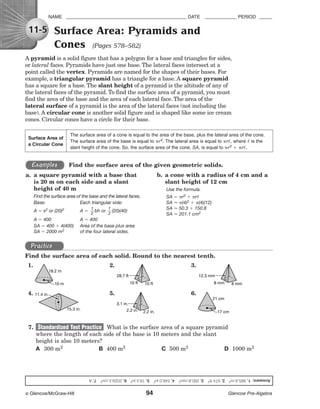
Find the surface area of each solid. Round to the nearest tenth.
 1.                                            2.                                             3.
                 18.2 m
                                                    28.7 ft                                        12.3 mm
                   10 m                                       10 ft   10 ft                                8 mm      8 mm

 4.   11.4 in.                                 5.                                             6.
                                                                                                           21 cm
                                                    3.1 in.
                          15.3 in.                        2.2 in.     2.2 in.                                17 cm


 7. Standardized Test Practice What is the surface area of a square pyramid
    where the length of each side of the base is 10 meters and the slant
    height is also 10 meters?
    A 300 m2                 B 400 m2               C 500 m2              D 1000 m2


                                     Answers: 1. 885.9 m2 2. 674 ft2 3. 260.8 mm2 4. 548.0 in2 5. 18.5 in2 6. 2029.5 cm2 7. A


©   Glencoe/McGraw-Hill                                                94                                          Glencoe Pre-Algebra

Prealg pssg g094

  • 1.
    NAME ______________________________________________ DATE ____________ PERIOD _____ 11-5 Surface Area: Pyramids and Cones (Pages 578–582) A pyramid is a solid figure that has a polygon for a base and triangles for sides, or lateral faces. Pyramids have just one base. The lateral faces intersect at a point called the vertex. Pyramids are named for the shapes of their bases. For example, a triangular pyramid has a triangle for a base. A square pyramid has a square for a base. The slant height of a pyramid is the altitude of any of the lateral faces of the pyramid. To find the surface area of a pyramid, you must find the area of the base and the area of each lateral face. The area of the lateral surface of a pyramid is the area of the lateral faces (not including the base). A circular cone is another solid figure and is shaped like some ice cream cones. Circular cones have a circle for their base. The surface area of a cone is equal to the area of the base, plus the lateral area of the cone. Surface Area of The surface area of the base is equal to ␲r 2. The lateral area is equal to ␲rᐉ, where ᐉ is the a Circular Cone slant height of the cone. So, the surface area of the cone, SA, is equal to ␲r 2 ϩ ␲rᐉ. Examples Find the surface area of the given geometric solids. a. a square pyramid with a base that b. a cone with a radius of 4 cm and a is 20 m on each side and a slant slant height of 12 cm height of 40 m Use the formula. Find the surface area of the base and the lateral faces. SA ϭ ␲r2 ϩ ␲rᐉ Base: Each triangular side: SA Ϸ ␲(4)2 ϩ ␲(4)(12) 1 1 SA Ϸ 50.3 ϩ 150.8 A ϭ s2 or (20)2 A ϭ ᎏ bh or ᎏ (20)(40) 2 2 SA Ϸ 201.1 cm2 A ϭ 400 A ϭ 400 SA ϭ 400 ϩ 4(400) Area of the base plus area SA ϭ 2000 m2 of the four lateral sides. Practice Find the surface area of each solid. Round to the nearest tenth. 1. 2. 3. 18.2 m 28.7 ft 12.3 mm 10 m 10 ft 10 ft 8 mm 8 mm 4. 11.4 in. 5. 6. 21 cm 3.1 in. 15.3 in. 2.2 in. 2.2 in. 17 cm 7. Standardized Test Practice What is the surface area of a square pyramid where the length of each side of the base is 10 meters and the slant height is also 10 meters? A 300 m2 B 400 m2 C 500 m2 D 1000 m2 Answers: 1. 885.9 m2 2. 674 ft2 3. 260.8 mm2 4. 548.0 in2 5. 18.5 in2 6. 2029.5 cm2 7. A © Glencoe/McGraw-Hill 94 Glencoe Pre-Algebra