Visual impairments
      8.11.2012
    Nina Kaijasilta
     Petri Myllys
    Maiju Tompuri
Visual Impairments

• Visual impairments – a matter of
  definition
 – Visually impaired, vision impairment, partially
   sighted, low vision, legally blind, totally blind,
   functional loss of vision, eye disorder, retinal
   degeneration, albinism, cataracts, glaucoma,
   muscular problems, corneal disorders,
   diabetic retinopathy, congenital disorders,
   infection, cortical visual impairment
Visual Impairments


  • Visually impaired – categorization between1:
    – Low vision / partially sighted2
    – Blind
  • Based on WHO definition
       – Visual acuity & visual field defect


    1
      http://www.nkl.fi/fi/etusivu/tietoa/maarittely
    2
      http://www.nkl.fi/fi/etusivu/tietoa/sanastoengl
Visual Impairments


    • 285.389M visually impaired people (2010 estimate)1
         – Enough reason to visualization for visually impaired


    1
        http://www.who.int/blindness/en/
Why to consider?
“A well-designed visualization facilitates the
understanding of the key messages, speeds
the process and reduces strain.

Great visualizations take into consideration,
how people receive and utilize information.”

                                    Näsänen, 2007


         Accessible design
Why to consider?


    “The power of the web is in its universality. Access
    by everyone regardless of disability is an essential
    aspect.”

                            Tim Berners-Lee, creator of WWW
BLINDNESS
Blindness


   • The WHO definition from 19721
    – Case for revision:
         • Interesting issue – definition of blindness:
         • No distinction when it comes to perception of light


     1
         http://www.who.int/blindness/Change%20the%20Definition%20of%20Blindness.pdf
Blindness


     • Another angle:
           – International Council of Ophthalmology
             recommends1
               • Blindness: only total vision loss
               • Low vision: lesser degrees of vision loss
               • Visual impairment: loss of visual functions at the
                 organ level


     1
         Colenbrander 2002, 17
Blindness


   • Complete blindness is rare1,2
   • So what exactly is visualization and to
     whom can we visualize?


     1
       http://www.nkl.fi/fi/etusivu/tietoa/maarittely
     2
       Nelson 2003, 29
LOW VISION
What’s low vision?
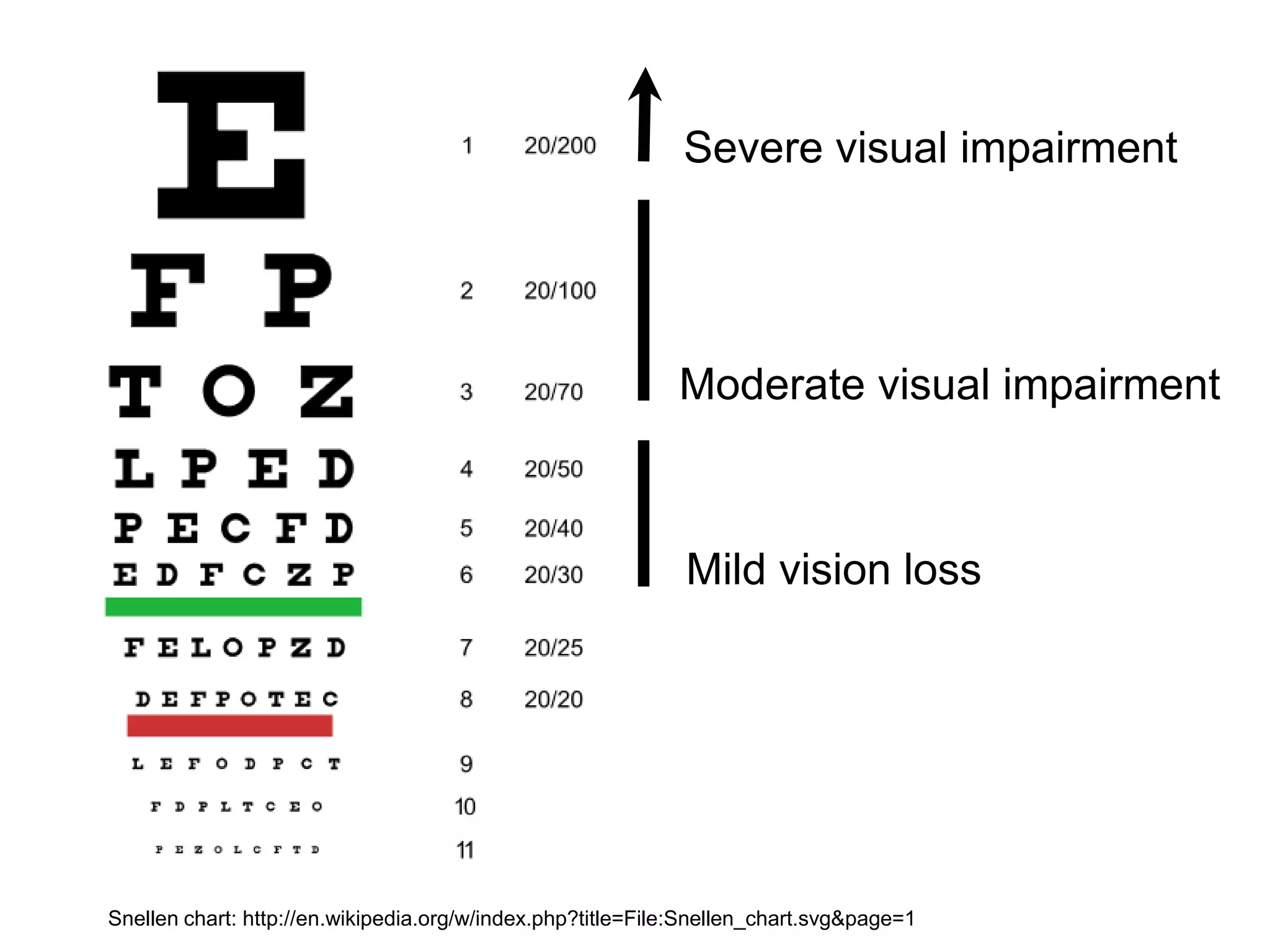
Low vision in the World Health Organization
classifications1:

•Moderate visual impairment
•Severe visual impairment
•visual field loss (loss of peripheral vision).

1http://www.who.int/mediacentre/factsheets/fs282/en/index.html
Severe visual impairment


                                                            Moderate visual impairment


                                                             Mild vision loss


Snellen chart: http://en.wikipedia.org/w/index.php?title=File:Snellen_chart.svg&page=1
Low vision


                          Why does it occur?
   • Uncorrected refractive errors
     (myopia, hyperopia or astigmatism), 43 %
   • Cataract, 33%
   • Glaucoma, 2%
                                                                    World Health Organization1


   1http://www.who.int/mediacentre/factsheets/fs282/en/index.html
COLOR BLINDNESS
Color blindness


      • The colorblind have a narrowed color
        perception
      • There is no treatment or cure for color
        blindness


Pic: http://understandinggraphics.com/wp-content/uploads/2009/10/color-blind-chart.png
Color vision
     • Red cones – L cones
     • Green cones – M cones
     • Blue cones – S cones


                          Normal Vision                         Color Blindness (Protanopia)

Pic: http://www.cis.rit.edu/fairchild/WhyIsColor/Questions/3-
Normal vision                    Red-Blind/ ProtanopiaGreen-Blind/               Blue-Blind/Tritanopia
                                                        Deuteranopia


  Monochromacy/                    Red-Weak/                       Green-Weak/     Blue-Weak/
  Achromatopsia                    Protanomaly                     Deuteranomaly   Tritanomaly
Simulator: http://www.colblindor.com/coblis-color-blindness-simulator/
Color blindness


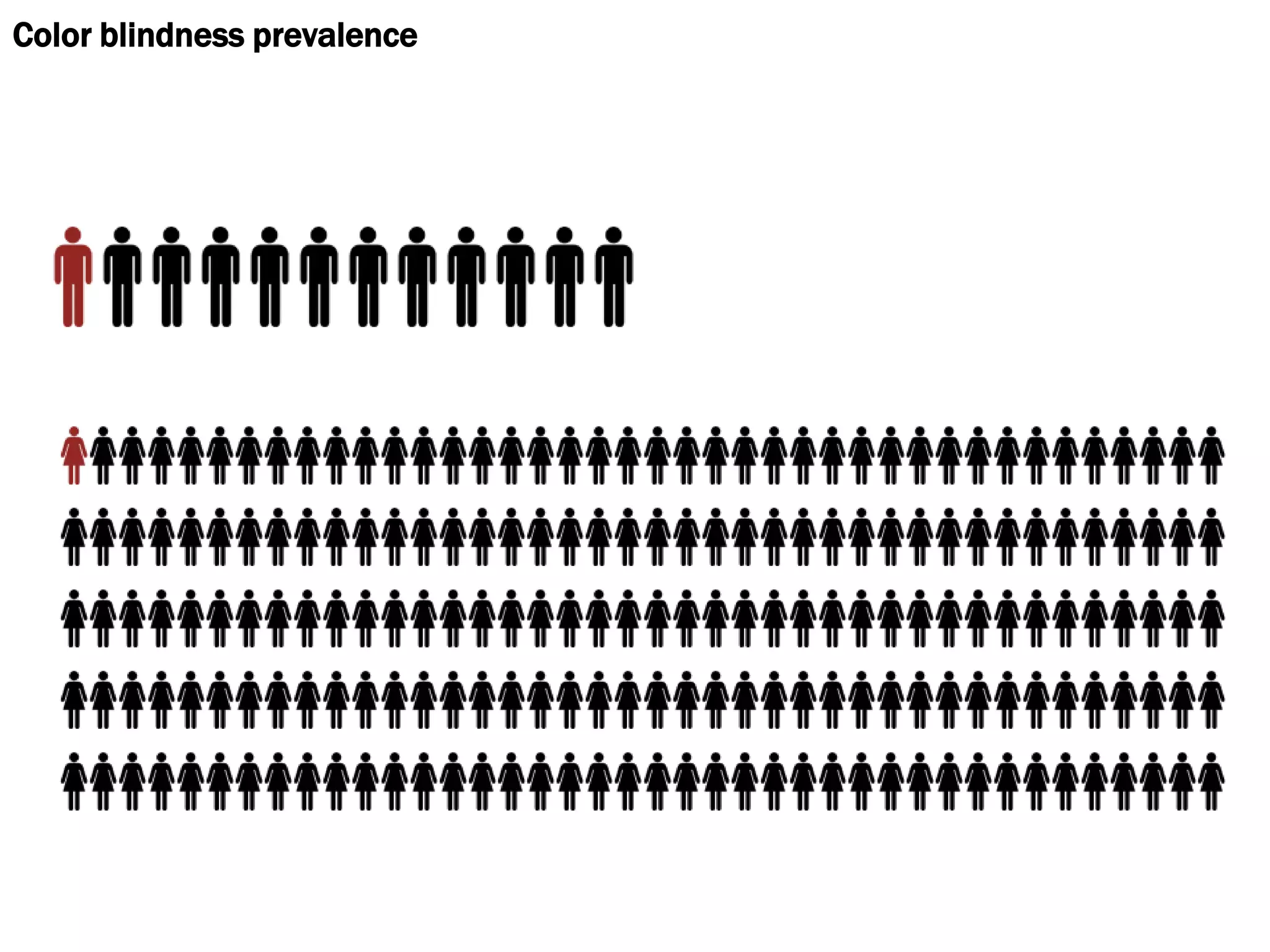
                     Prevalence (Caucasian)

              Type                                            Men          Women
             Cone absent                                      2.4%         0.03%
             L-cone absent (Protanopia)                       1-1.3%       0.02%

             M-cone absent (Deuteranopia)                     1-1.3%       0.01%

             S-cone absent (Tritanopia)                       0.001%       0.03%
             Cone defect                                      6.3%         0.37%
             L-cone defect (Protanomaly)                      1-1.3%       0.02%
             M-cone defect (Deuteranomaly)                    4.5-5.0%     0.35%
             S-cone defect (Tritanomaly)                      0.01-0.02%   0.01%
             Total                                            8 - 10%      0.3 – 0.5%


Source: http://www.colour-blindness.com/general/prevalence/
Color blindness prevalence
Color blindness


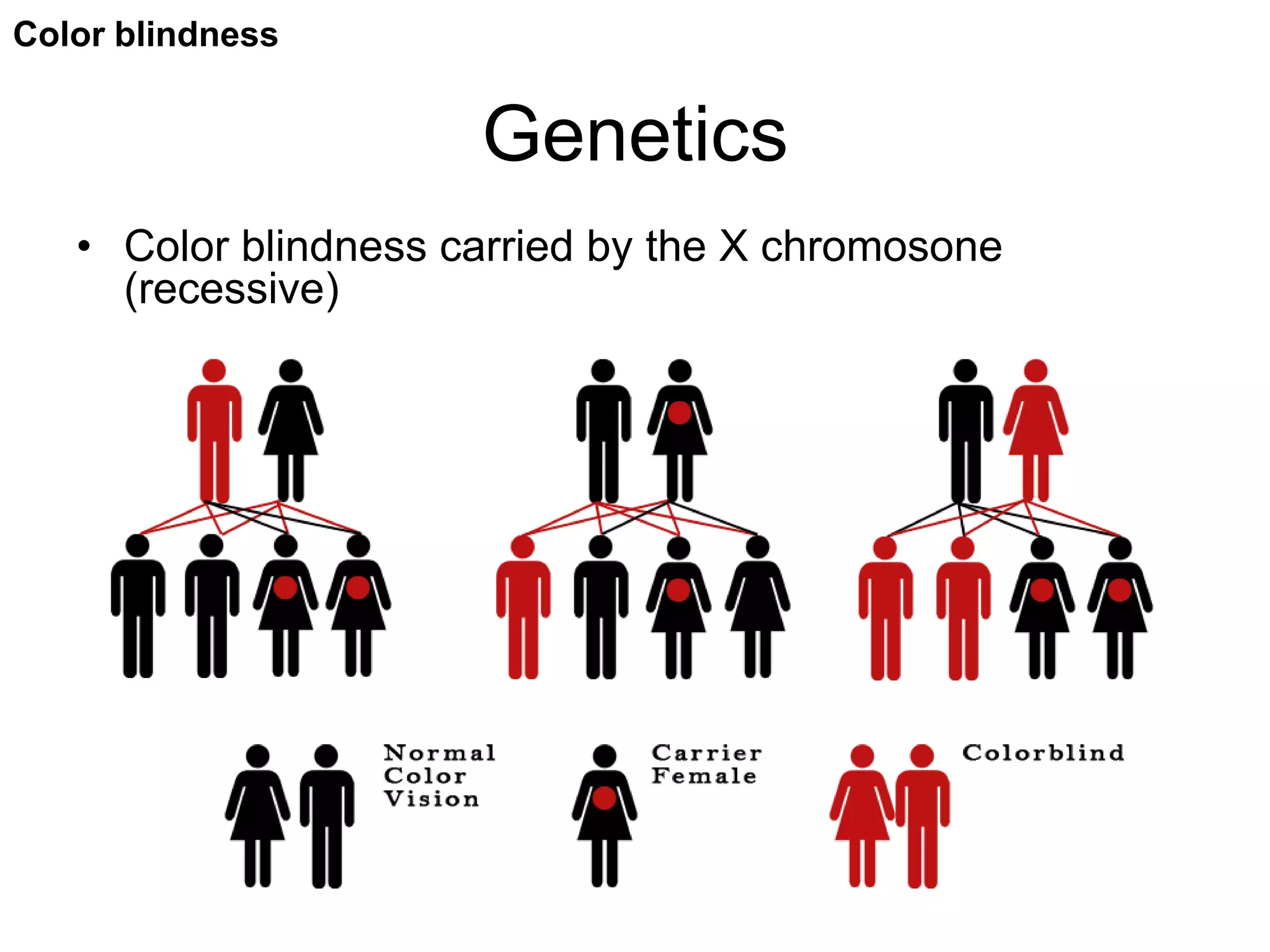
                      Genetics
   • Color blindness carried by the X chromosone
     (recessive)
Color blindness

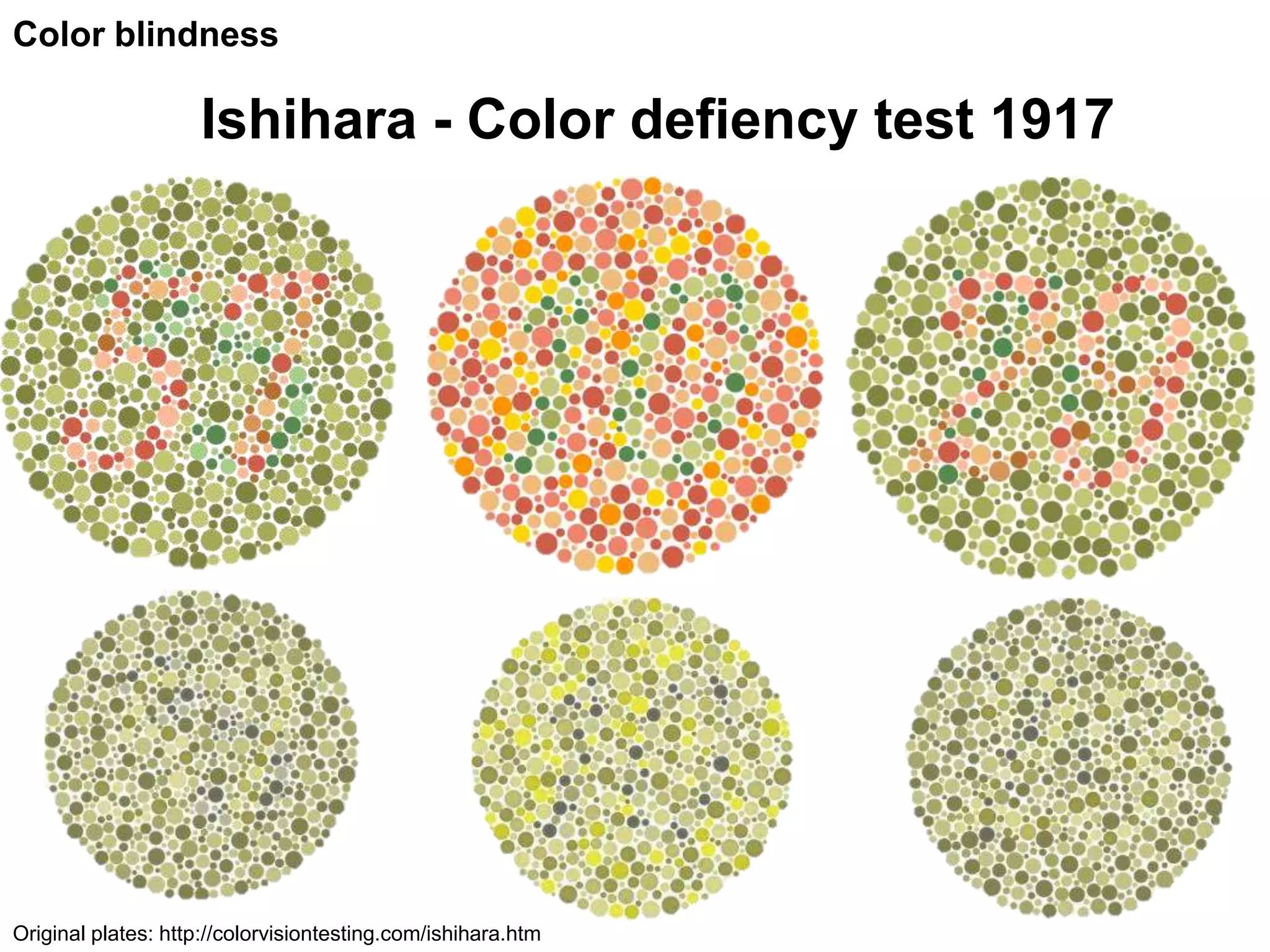
                    Ishihara - Color defiency test 1917


Original plates: http://colorvisiontesting.com/ishihara.htm
Color blindness

                                      Hue Color Vision 1949
                                                                                         1


                                           Color arrangement test 1947
                                                                                     2


1 Screenshot:   http://www.colblindor.com/farnsworth-munsell-100-hue-color-vision-
2 Screenshot: http://www.colblindor.com/color-arrangement-test/
test/#prettyPhoto
Color blindness


                                RGB Anomaloscope 1907
                                                                                     1


                                                    2


1 Screenshots:    http://www.colblindor.com/rgb-anomaloscope-color-blindness-test/
2 Pic:   https://www.good-lite.com/Details.cfm?ProdID=570
HOW TO DESIGN?
Visualizing for blind?

• What exactly is seeing?
 – Seeing could be thought as a mental
   interpretation of some input
Visualization methods for
persons blind or partially sighted
How to design for the blind


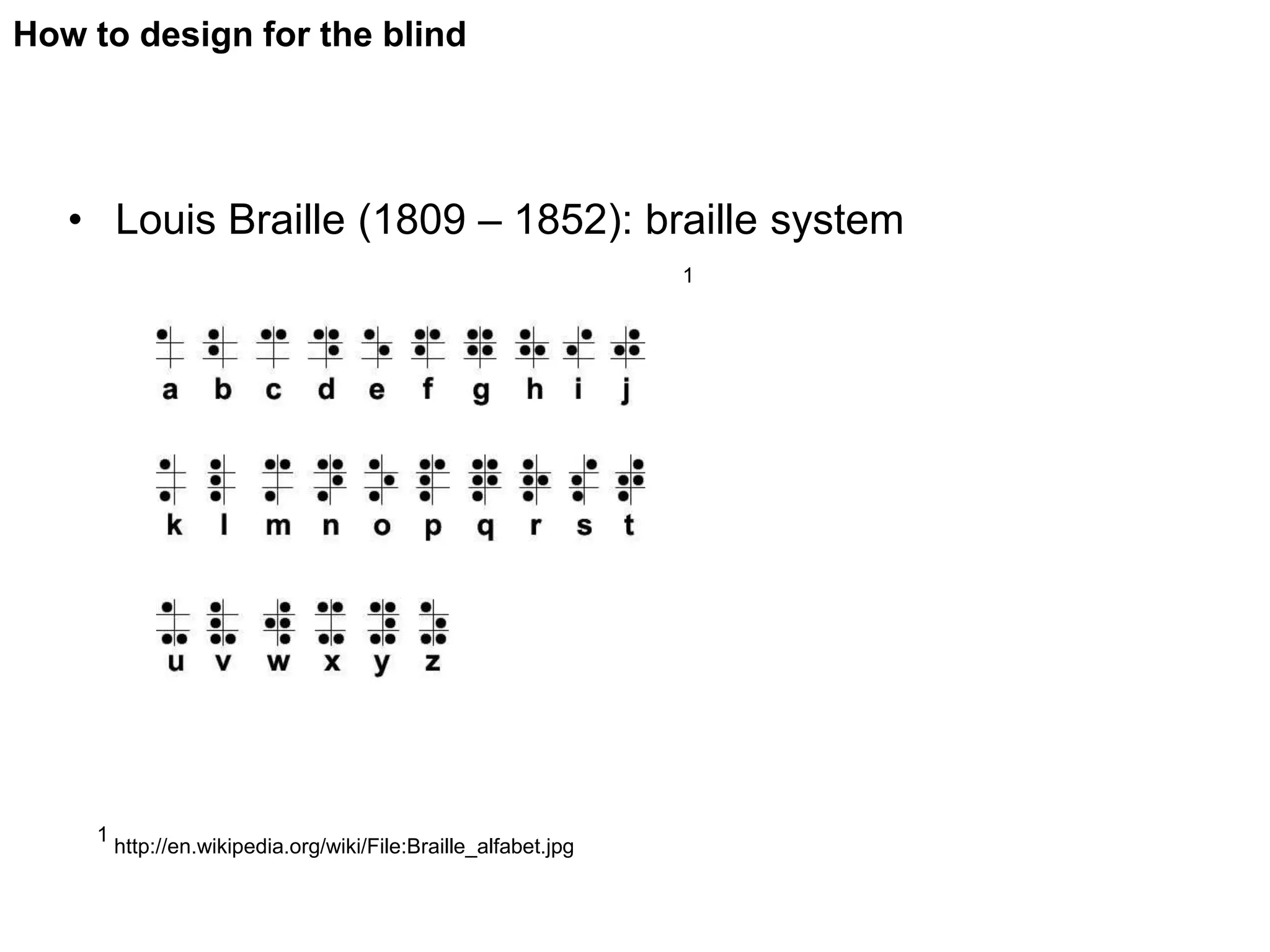
   • Louis Braille (1809 – 1852): braille system
                                                                1


    1
        http://en.wikipedia.org/wiki/File:Braille_alfabet.jpg
How to design for the blind


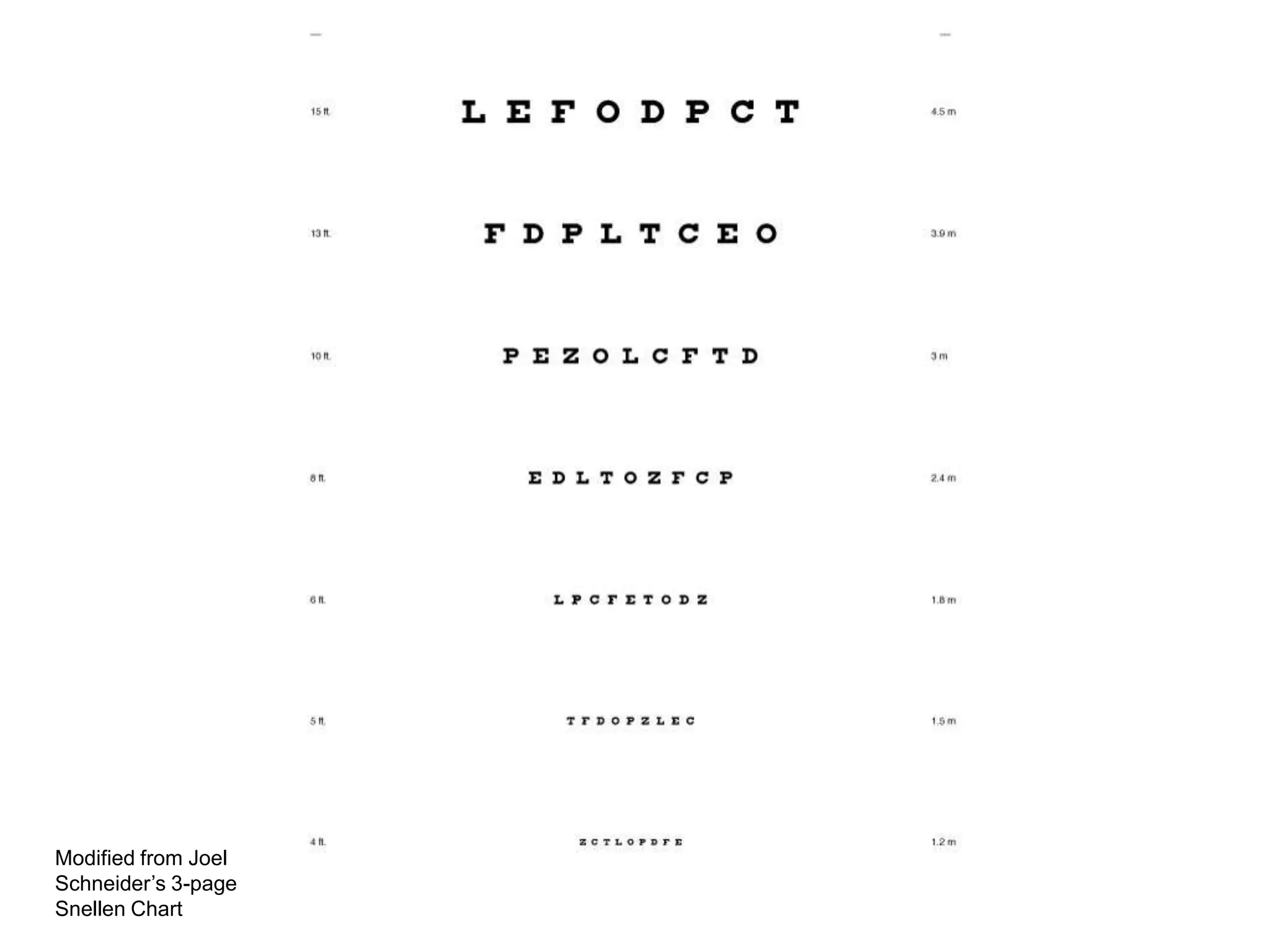
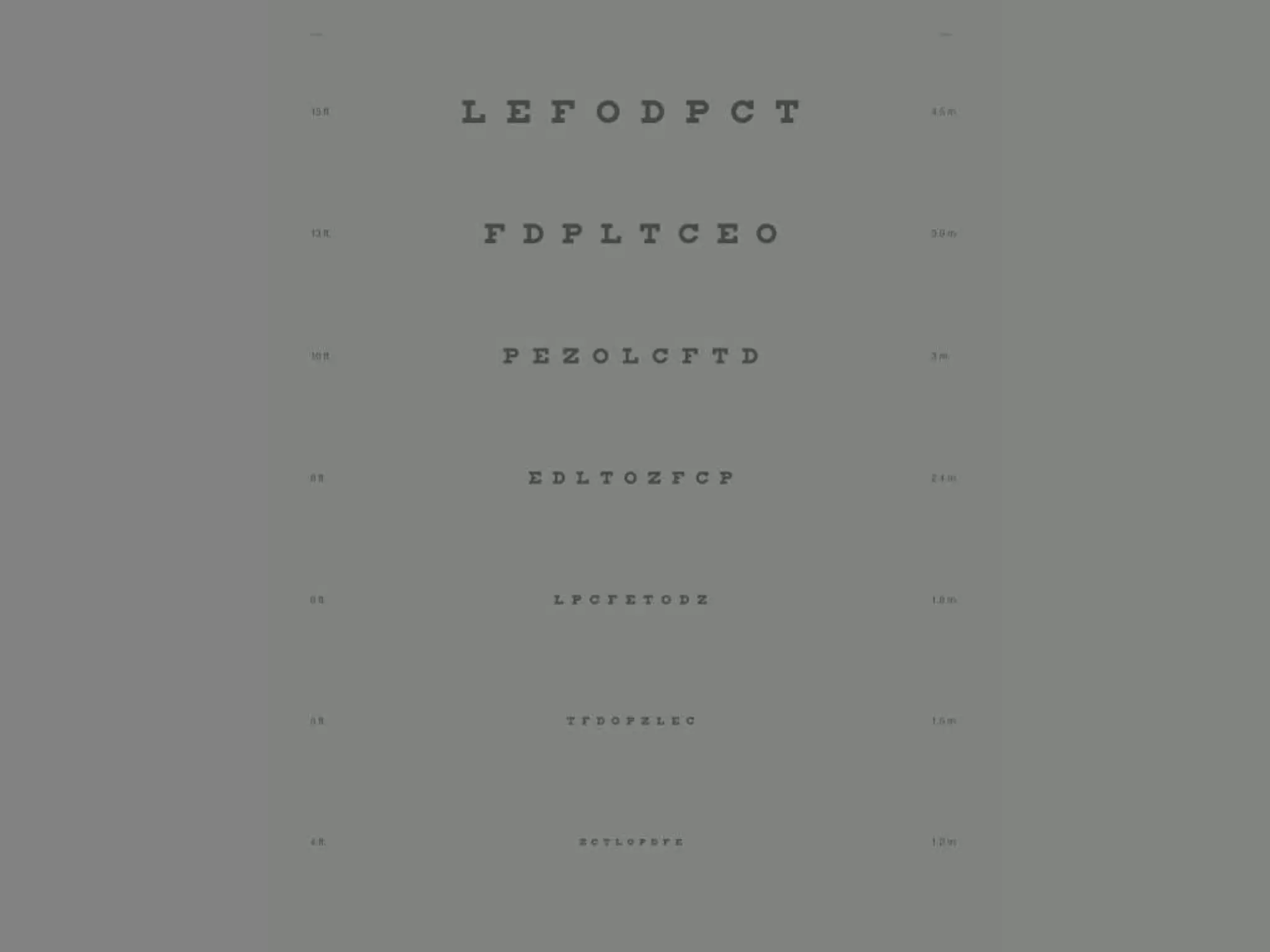
   • Contrast
         – “-- visual acuity depends on the contrast” 1
         – ”-- contrast sensitivity thus depends on the
           size of the object” 1


    1
        Näsänen 2007, 12
Modified from Joel
Schneider’s 3-page
Snellen Chart
How to design for the blind


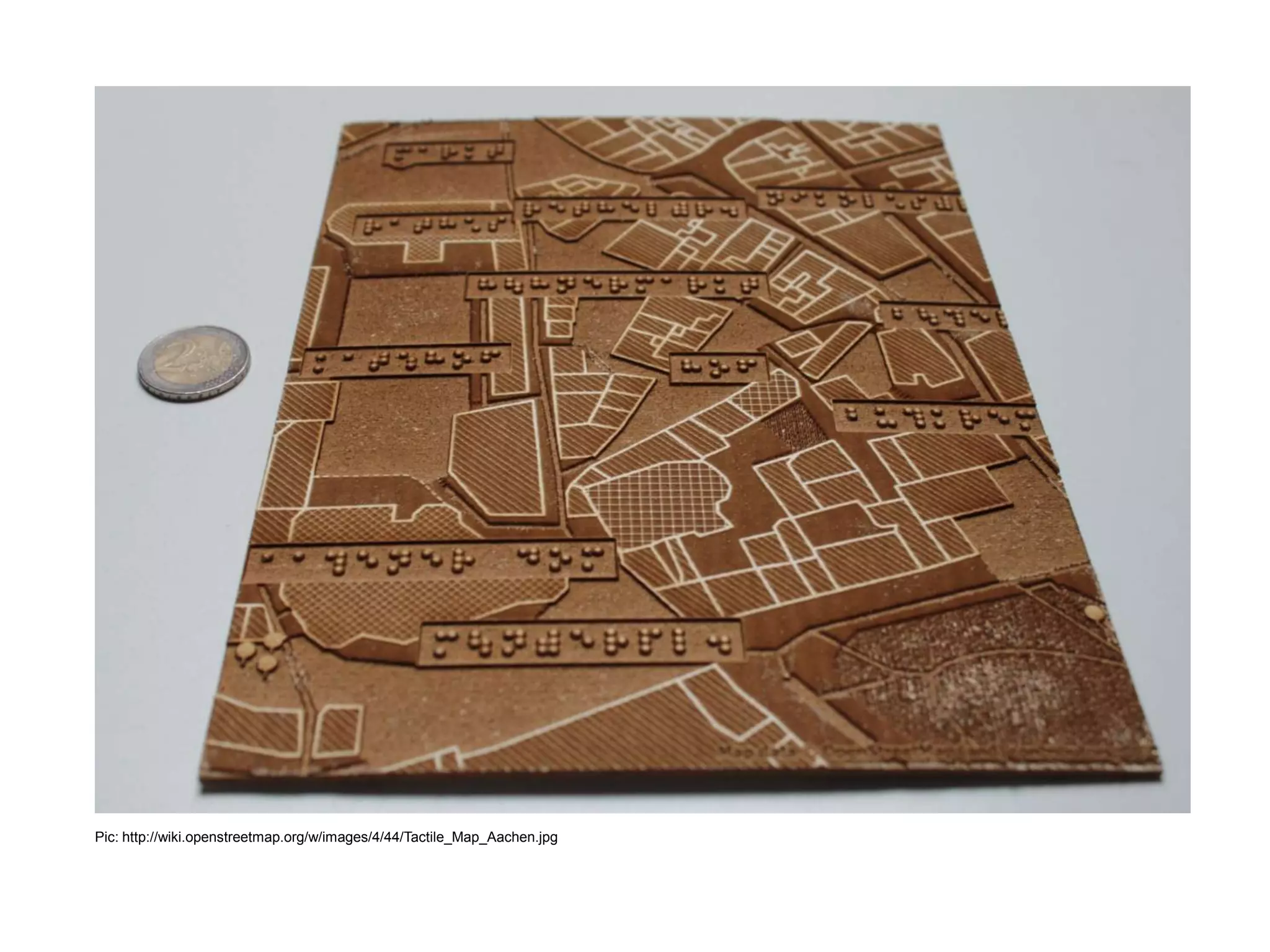
       • Tactile textures
          – Boundaries are easy to find1
              • Tactile maps
          – Abstract concepts can be demonstrated2


    1
      Anderson 1992, 290
    2
      Skytt 2012, 10–12.
Pic: http://wiki.openstreetmap.org/w/images/4/44/Tactile_Map_Aachen.jpg
How to design for the blind


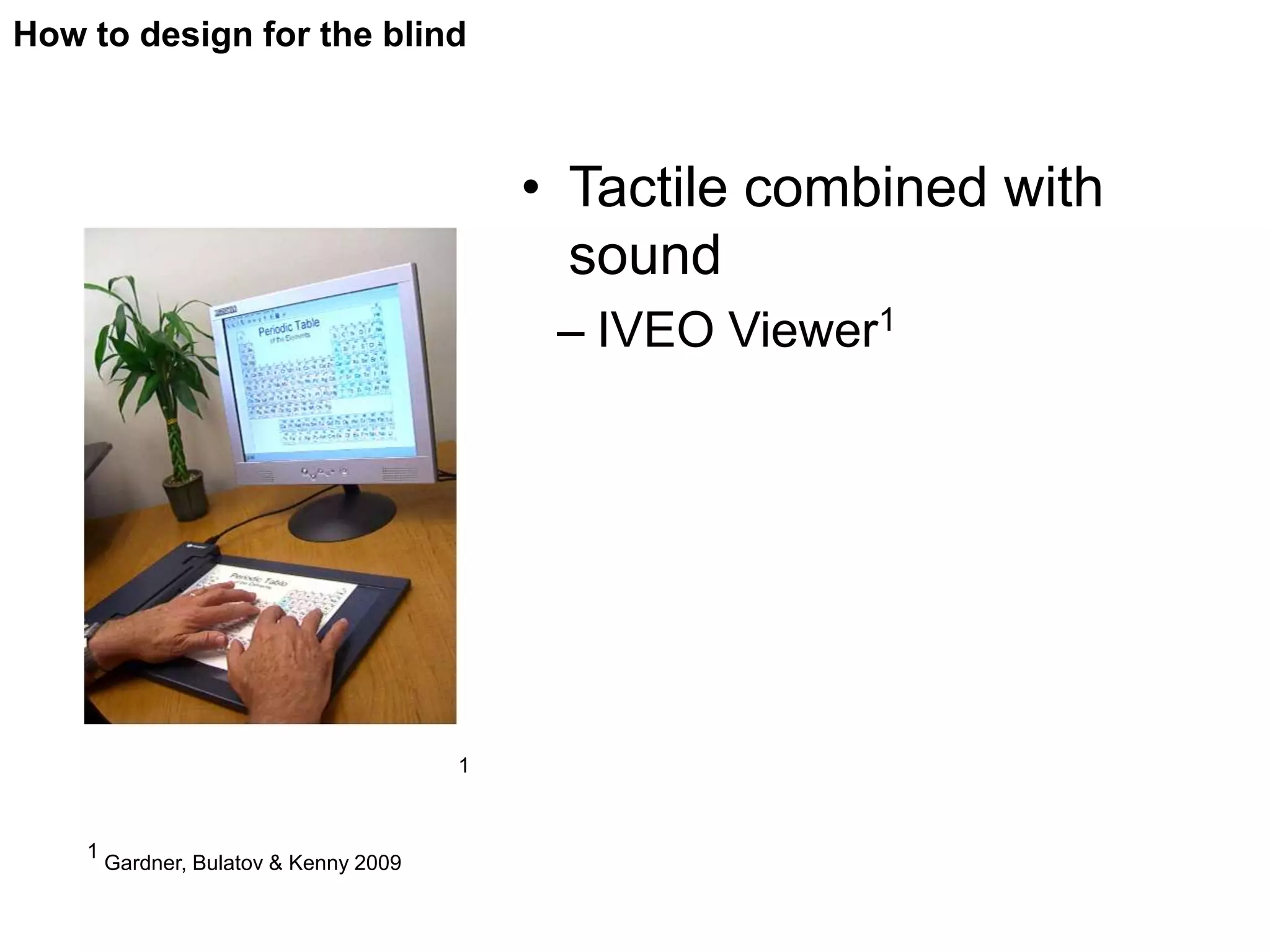
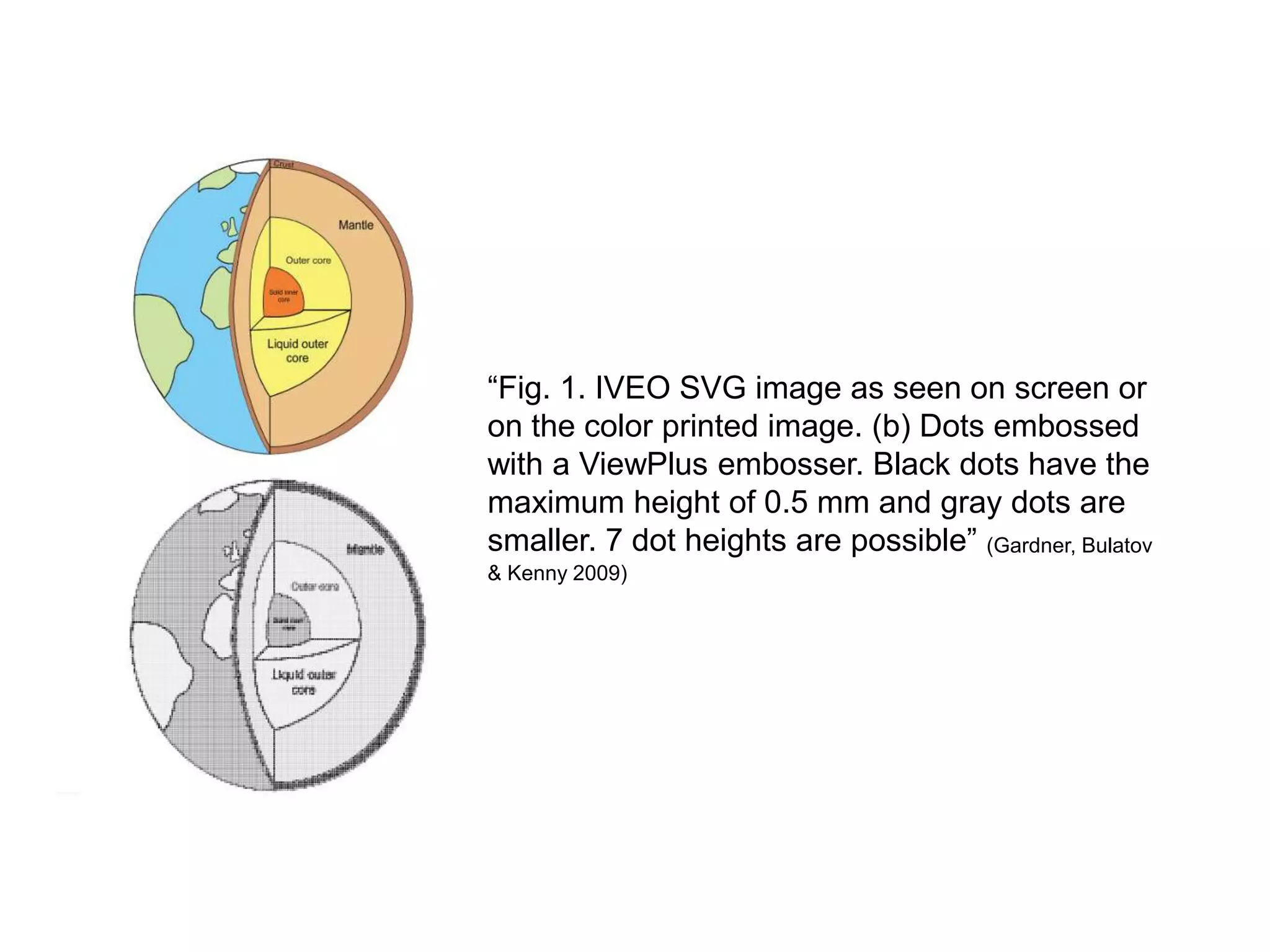
                                            • Tactile combined with
                                              sound
                                             – IVEO Viewer1


                                        1


    1
        Gardner, Bulatov & Kenny 2009
“Fig. 1. IVEO SVG image as seen on screen or
on the color printed image. (b) Dots embossed
with a ViewPlus embosser. Black dots have the
maximum height of 0.5 mm and gray dots are
smaller. 7 dot heights are possible” (Gardner, Bulatov
& Kenny 2009)
How to design for the blind


     • What about Scalable Vector Graphics in
       mainstream context?
How to design for the blind


     • “To be scalable means to increase or
       decrease uniformly. In terms of graphics,
       scalable means not being limited to a
       single, fixed, pixel size.”
        (http://www.w3.org/TR/SVG11/concepts.html)
Bushell 2012
• Screen readers & special displays
         – Design & development might target only a
           specific (seeing) group
              • Microsoft Windows first not accessible by screen
                readers1


1
    Vehmas 2005, 130
How to design for low vision


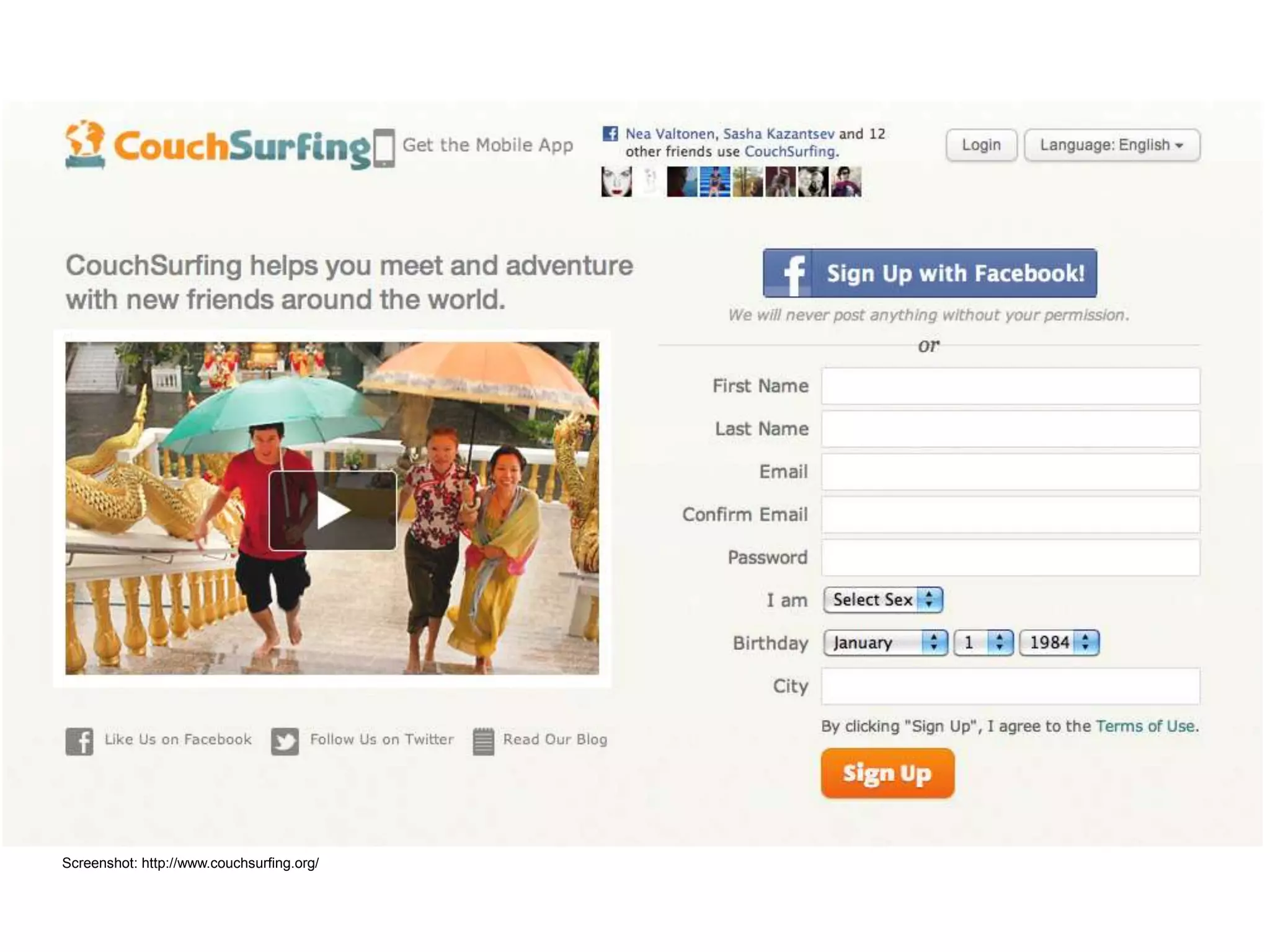
                     Distinguishable letters
             When a picture is formed into the retina,
             small details have lower contrast than larger
             items. 1
               Use bigger letters and graphical elements.
               Letterforms need to be easily
               distinguishable 1,2


   1Näsänen    2007
   2Dolan,   RGD Ontario 2010
Screenshot: http://www.couchsurfing.org/
Screenshot: http://ripetungi.com/wp-content/uploads/2010/02/twitter-users.png
How to design for low vision
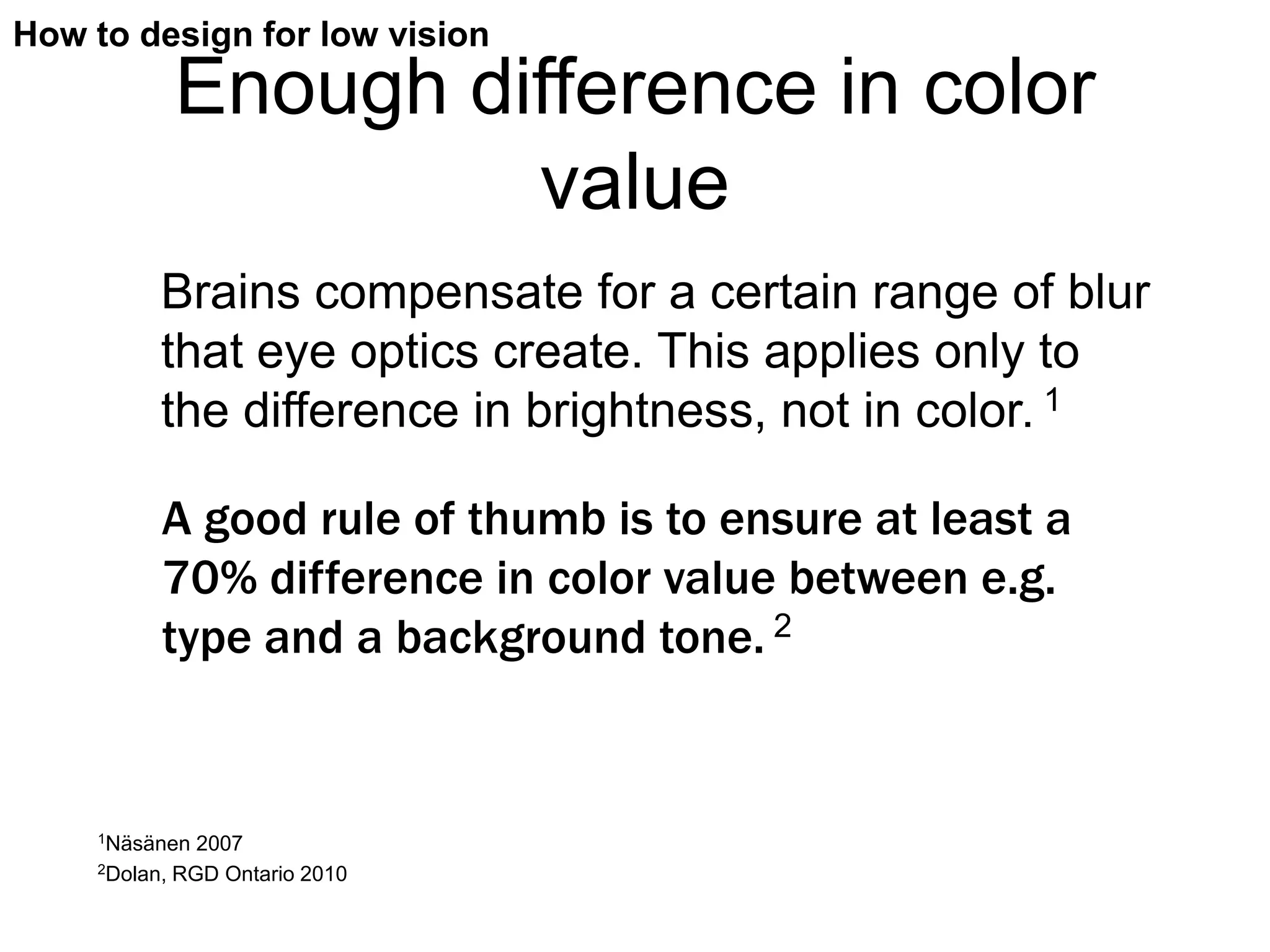
              Enough difference in color
                       value
          Brains compensate for a certain range of blur
          that eye optics create. This applies only to
          the difference in brightness, not in color. 1

          A good rule of thumb is to ensure at least a
          70% difference in color value between e.g.
          type and a background tone. 2


    1Näsänen    2007
    2Dolan,   RGD Ontario 2010
http://blog.mainstreethost.com/
How to design for low vision


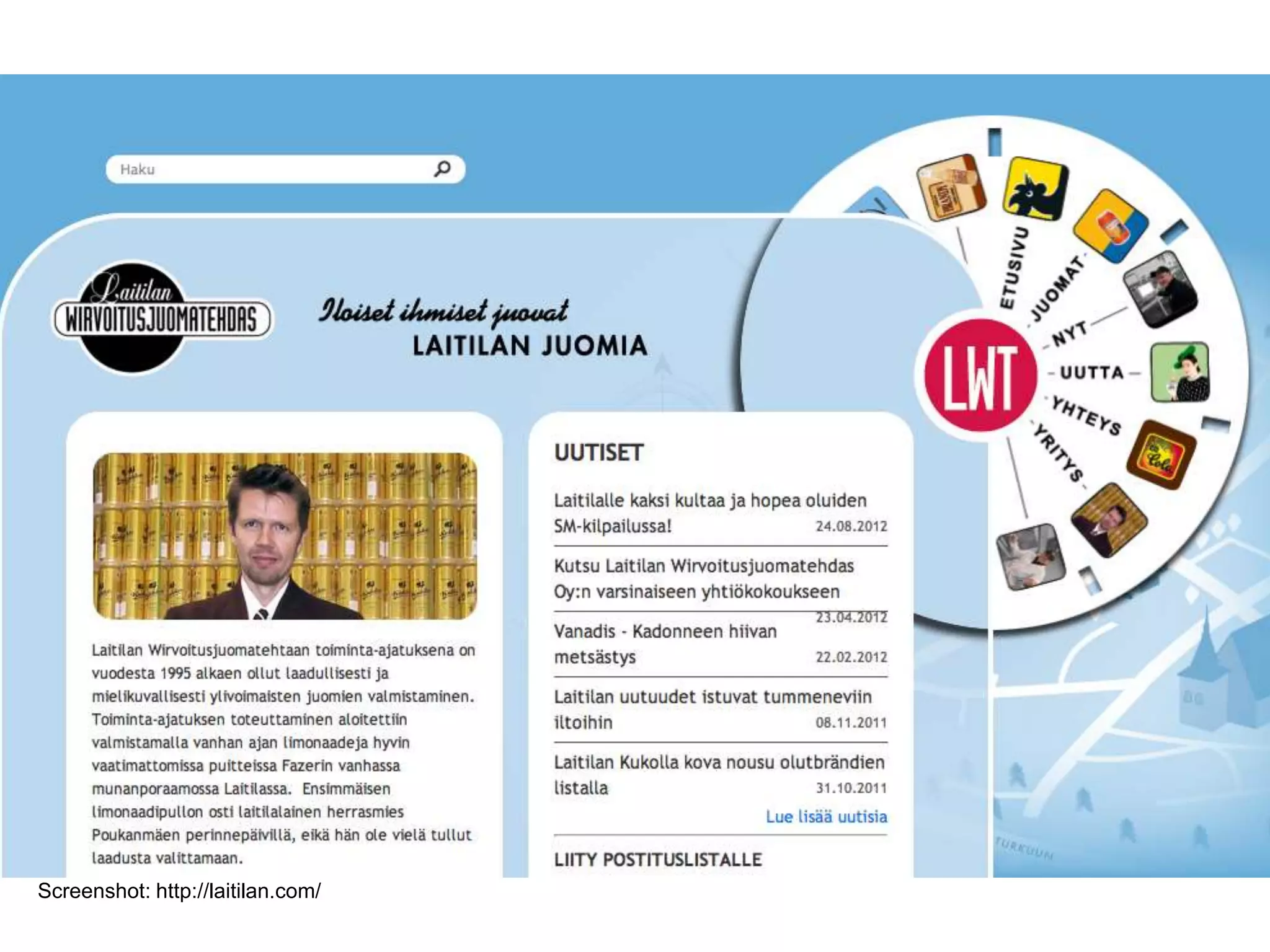
                       Focus on layout
         We see sharply only in the center of the
         visual field because the amount of ganglian
         cells reduces when not in the focus point. 1


         information needs to be clearly placed, and
         the layout can be understood with one
         glance.1


     1Näsänen   2007
Screenshot: http://laitilan.com/
Screenshot: http://www.mtv3.fi/
Screenshot: http://www.fox.com/
How to design for low vision


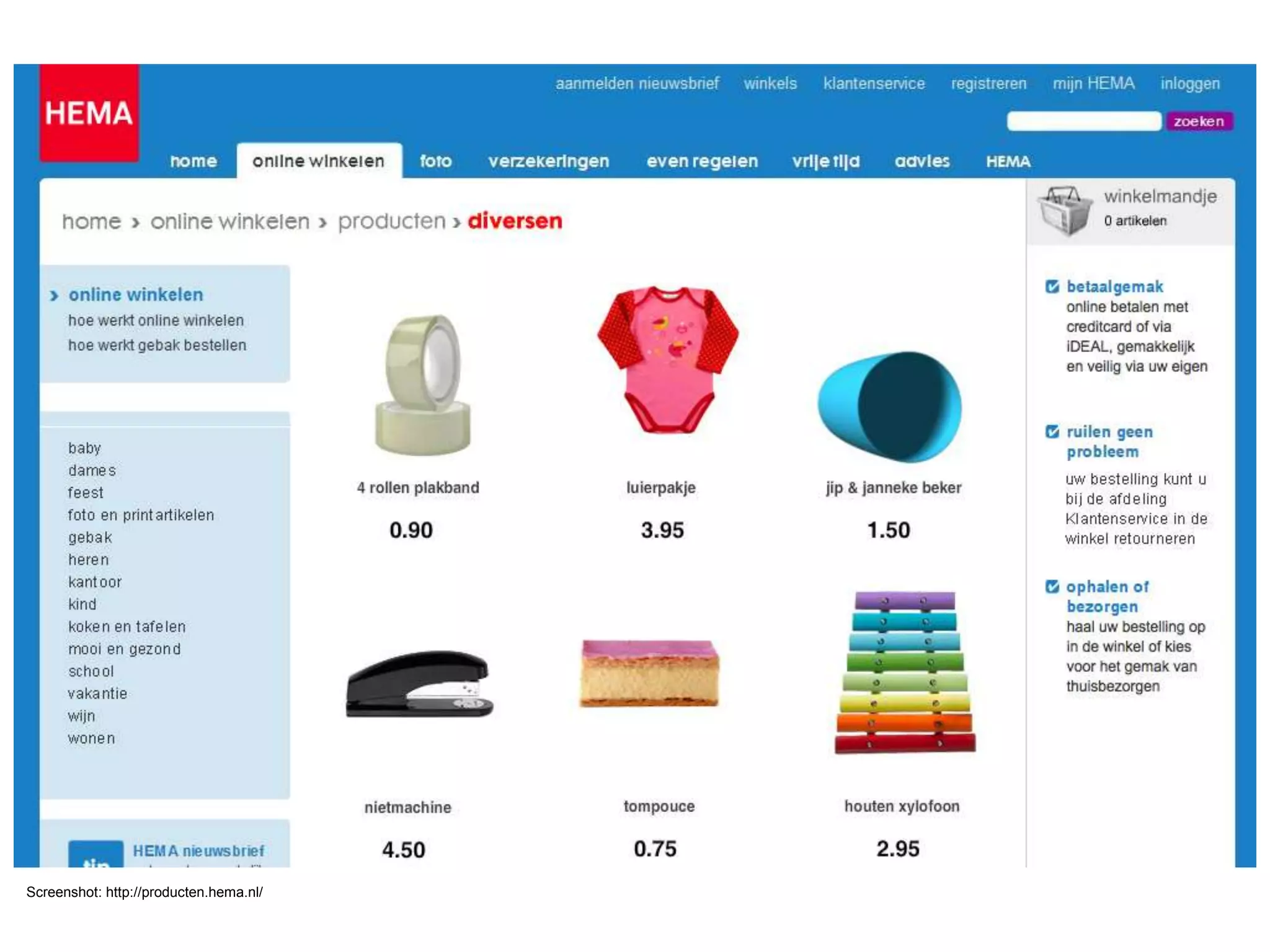
         Is extra bling bling needed?
          Every day we do approximately 100 000 eye
          fixations. Each fixation takes at least 0,15
          seconds.1


          Avoid animations and flashy content if they
          don’t bring extra value to the visualization.
          However, use of graphic visualizations is
          recommended.1

    1Näsänen   2007
Screenshot: http://producten.hema.nl/
How to design for low vision


                            Make it accessible
              There is a wide variance in users’ ability to
              operate a mouse, keyboard or other input
              device. Some people may use voice-
              recognition programs with spoken
              commands. 1
              Make all functionality fully accessible from a
              keyboard and create content that can be
              presented in different ways.1

    1Dolan,   RGD Ontario 2010
Pic: http://notabilia.net/
How to design for color blinds


   • Colors should never be the only method of
     conveying important information!


                       This is important
How to design for colorblinds


      • Avoid placing red and green together
             – Also minor color &contrast differences                                2


      • Desaturate images to see if they still have
        impact
                                            1


1http://blog.templatemonster.com/2012/03/21/designing-colorblind-friendly-website/
2 http://www.tfl.gov.uk/assets/downloads/standard-tube-map.pdf
How to design for colorblinds


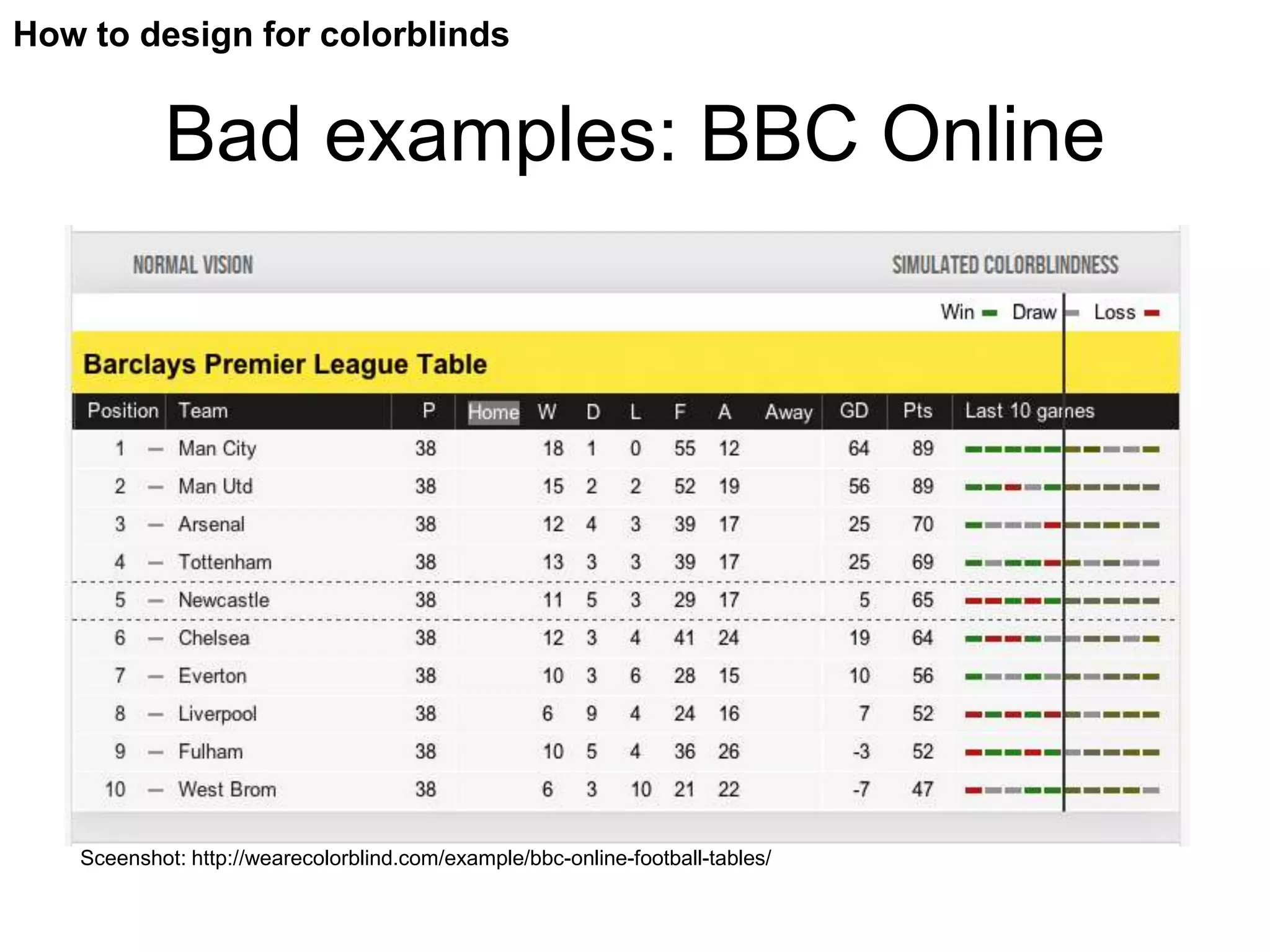
           Bad examples: BBC Online


   Sceenshot: http://wearecolorblind.com/example/bbc-online-football-tables/
How to design for colorblinds


   • In graphs
       – Place the legend directly in
         the chart
       – Display the type of data for
         each element in a tooltip

                                        Blue   Green Purple   Red
   • Name the color in text as
     well
How to design for colorblinds


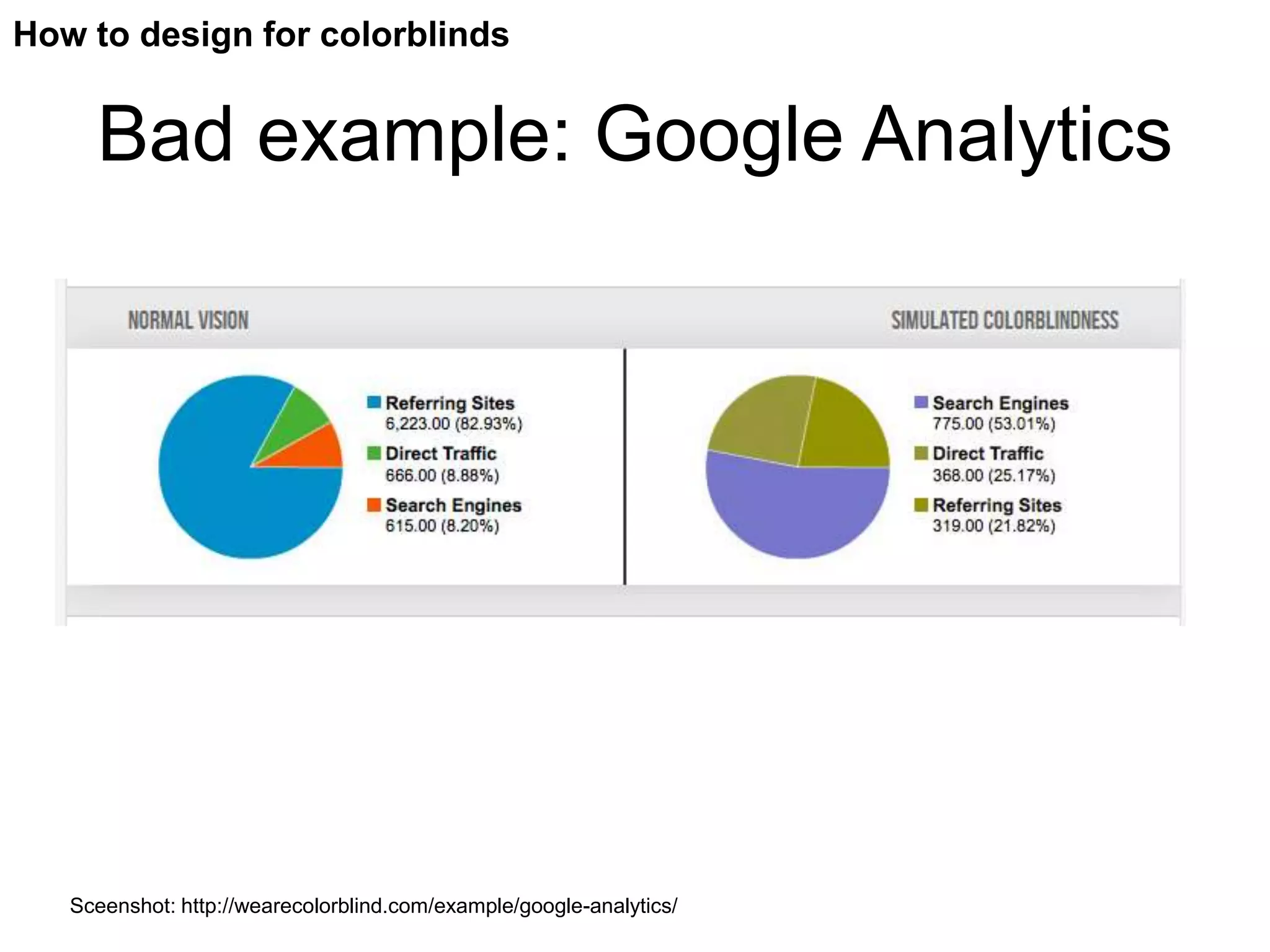
     Bad example: Google Analytics


   Sceenshot: http://wearecolorblind.com/example/google-analytics/
How to design for colorblinds


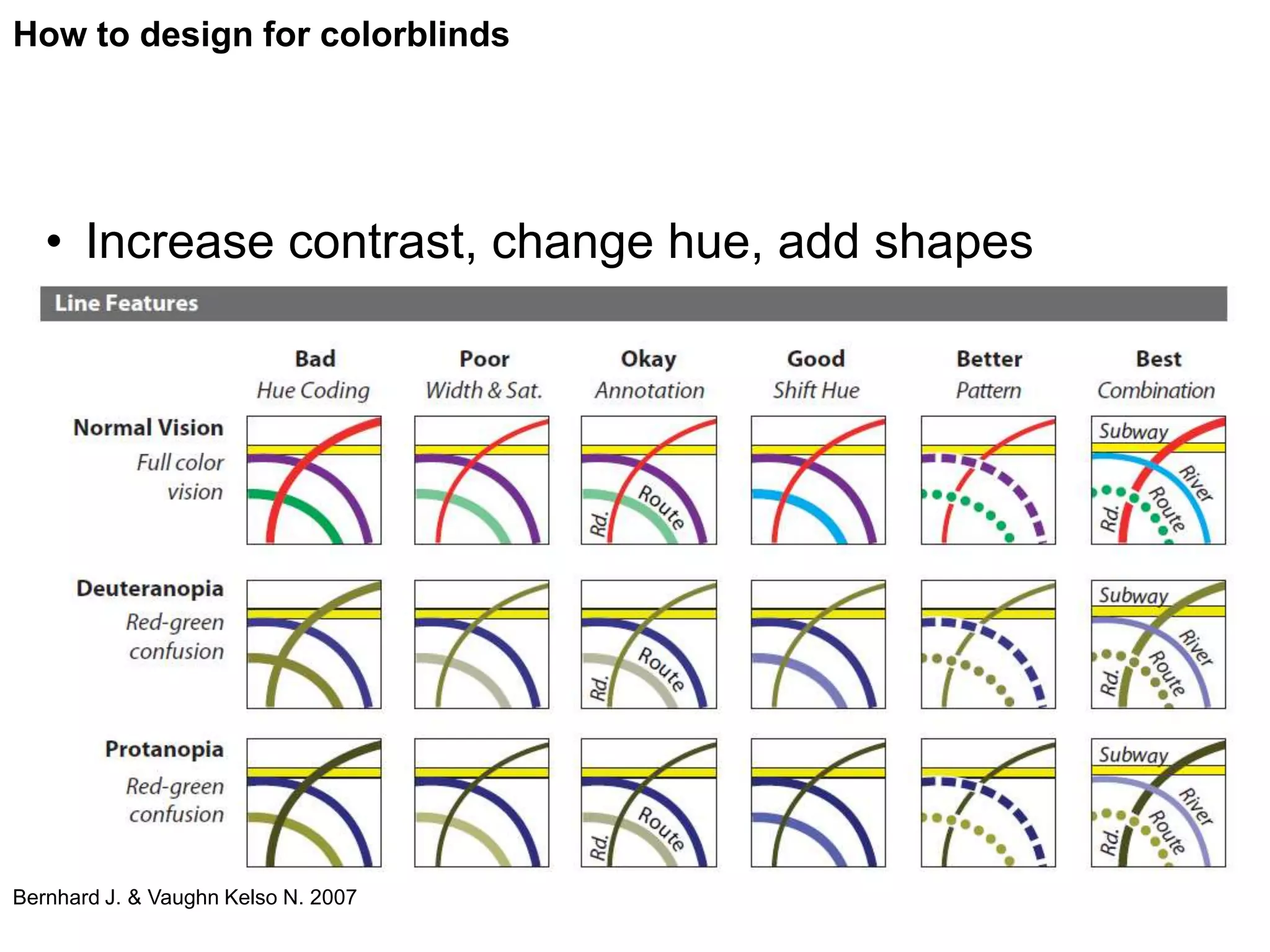
   • Increase contrast, change hue, add shapes


Bernhard J. & Vaughn Kelso N. 2007
How to design for colorblinds


   • Use varied icons and shapes


Bernhard J. & Vaughn Kelso N. 2007
How to design for colorblinds


                                   Problematic colors
                   High                     Medium            Low
                                            Light Green and
                   Green and Red                              Blue and Yellow
                                            Yellow
                   Green and Brown          Blue and Grey     Yellow and Violet
                   Blue and Purple          Green and Grey    Dark blue and Black
                   Green and Blue           Green and Black


Pic: http://jfly.iam.u-tokyo.ac.jp/color/
How to design for colorblinds

                   Unambiguous Colors
   • For both to colorblinds and non-colorblinds
                                                    Simulation
                             Original          Protan Deuter Tritan
            Black
            Orange
            Sky Blue
            Bluish Green
            Yellow
            Blue
            Vermillon
            Reddish Purple
                           Colors: http://jfly.iam.u-tokyo.ac.jp/color/image/pallete.jpg
Curious about color blindness?


• Watch video: ”No such thing as color – what it
  is like to be colorblind”
  – http://www.nosuchthingascolor.com/
• We are colorblind - Blog by Tom van
  Beveren, colorblind (deuteranomally)
  •   http://wearecolorblind.com/
Test your designs
• Color blindness simulation
  – http://vischeck.com/
  – http://www.colblindor.com/coblis-color-
    blindness-simulator/
• Contrast test
  – http://www.checkmycolours.com/
  – http://www.snook.ca/technical/colour_contrast
    /colour.html
• Grayscale images and visualizations
Conclusions
• Many people with visual impairments
  – Create accessible design
• Use guidelines in design
  – Contrast
  – Size
  – Color
  – Layout
  – Format
References
•   Anderson, Frances 1992. Art for all the children: approaches to art therapy for children with
    disabilities. Springfield, Charles C Thomas.
•   Bernhard, J.& Vaughn Kelso, N. 2007. Color Design for the Color Vision Impaired.
    Cartographic Perspectives, 58, p. 61-67.
•   Bushell, David 2012. Resolution Independence With SVG. Read 30.10.2012.
    http://coding.smashingmagazine.com/2012/01/16/resolution-independence-with-svg/
•   Colenbrander, August 2002. Visual Standards: Aspects and Ranges of Vision Loss with Emphasis
    on Population Surveys. International Council of Ophthalmology. Read 23.10.2012.
    http://www.icoph.org/downloads/visualstandardsreport.pdf
•   Color Blindness. Prevalence. Accessed 01.11.2012.
    http://www.colour-blindness.com/general/prevalence/
•   Dolan, D., A Practical Handbook on Accessible Graphic Design 2010, RGD Ontario
•   Flück, D. 2012. Colblindor - Color Blindness viewed through Colorblind Eyes. Accessed 30.10.2012.
    http://www.colblindor.com/
•   Gabriel-Petit, P. 2007. Ensuring Accessibility for People With Color-Deficient Vision. Accessed
    01.11.2012 http://www.uxmatters.com/mt/archives/2007/02/ensuring-accessibility-for-people-with-
    color-deficient-vision.php
•   Gardner, John; Bulatov, Vladimir & Kelly, Robert 2009. Making Journals Accessible to the Visually-
    Impaired – The Future is Near. Learned Publishing 22(4) 2009 pp. 314-319. Read 30.10.2012.
    http://www.viewplus.com/about/abstracts/09learnpubgardner.html
•   ICD Update and Revision Platform: Change the Definition of Blindness. World Health Organization.
    Read 23.10.2012.
    http://www.who.int/blindness/Change%20the%20Definition%20of%20Blindness.pdf
•   Malamed, C. 2012. Designing for Color Blindness.
    http://understandinggraphics.com/design/designing-for-color-blindness/
•   Mariotti, S. P., Global Data on Visual Impairments 2010, World Health Organization
References
•   Nelson, Scott 2003. A Professional Artist and Curator Who Is Blind. Art Beyond Sight – A Resource
    Guide to Art, Creativity and Visual Impairments, 28–29. Ed. Axel, Elisabeth & Levent, Nina. New York,
    AEB & AFB.
•   New estimates of visual impairment and blindness: 2010. World Health Organization. Read
    23.10.2012.
    http://www.who.int/blindness/en/
•   Näkövammaisuuden määrittely. Näkövammaisten Keskusliitto ry. Read 23.10.2012.
    http://www.nkl.fi/fi/etusivu/tietoa/maarittely
•   Sanastoa englanniksi. Näkövammaisten Keskusliitto ry. Read 23.10.2012.
    http://www.nkl.fi/fi/etusivu/tietoa/sanastoengl
•   Näsänen, Risto 2007. Visuaalisen käytettävyyden opas 2007. Read 18.10.2012.
    http://www.ttl.fi/fi/ergonomia/kognitiivinen_ergonomia/visuaalinen_kaytettavyys/Documents/Visuaalise
    n_kaytettavyyden_opas_2007.pdf
•   Okabe, M. & Ito, K. 2002. Color Universal Design (CUD) - How to make figures and presentations that
    are friendly to Colorblind people – Accessed 29.10.2012.
    http://jfly.iam.u-tokyo.ac.jp/color/
•   Saarelma, O. 2012. Värisokeus ja poikkeava värinäkö. Lääkärikirja Duodecim. Accessed 28.10.2012.
    http://www.terveyskirjasto.fi/terveyskirjasto/tk.koti?p_osio=100&p_artikkeli=dlk00347&p_teos=dlk&p_s
    elaus=7728
•   Scalable Vector Graphics (SVG) 1.1 (Second Edition), W3C Recommendation 2011. Read
    30.10.2012.
    http://www.w3.org/TR/SVG11/concepts.html
•   Schneider, Joel. 3-page Snellen Chart. Read 25.10.2012.
    http://www.i-see.org/eyecharts.html/#download
•   Skytt, Riitta 2012. Koskettavaa luettavaa. Tukilinja 3–4 2012. Read 16.10.2012.
    http://www.virtualmagnet.eu/magnet/asiakkaat/Tukilinja/tukilinja_030412.html/
•   Van Beveren, T. 2012. A quick introduction to colorblindness. Accessed 30.10.2012.

Visual Impairments

  • 1.
    Visual impairments 8.11.2012 Nina Kaijasilta Petri Myllys Maiju Tompuri
  • 2.
    Visual Impairments • Visualimpairments – a matter of definition – Visually impaired, vision impairment, partially sighted, low vision, legally blind, totally blind, functional loss of vision, eye disorder, retinal degeneration, albinism, cataracts, glaucoma, muscular problems, corneal disorders, diabetic retinopathy, congenital disorders, infection, cortical visual impairment
  • 3.
    Visual Impairments • Visually impaired – categorization between1: – Low vision / partially sighted2 – Blind • Based on WHO definition – Visual acuity & visual field defect 1 http://www.nkl.fi/fi/etusivu/tietoa/maarittely 2 http://www.nkl.fi/fi/etusivu/tietoa/sanastoengl
  • 4.
    Visual Impairments • 285.389M visually impaired people (2010 estimate)1 – Enough reason to visualization for visually impaired 1 http://www.who.int/blindness/en/
  • 5.
    Why to consider? “Awell-designed visualization facilitates the understanding of the key messages, speeds the process and reduces strain. Great visualizations take into consideration, how people receive and utilize information.” Näsänen, 2007 Accessible design
  • 6.
    Why to consider? “The power of the web is in its universality. Access by everyone regardless of disability is an essential aspect.” Tim Berners-Lee, creator of WWW
  • 7.
  • 8.
    Blindness • The WHO definition from 19721 – Case for revision: • Interesting issue – definition of blindness: • No distinction when it comes to perception of light 1 http://www.who.int/blindness/Change%20the%20Definition%20of%20Blindness.pdf
  • 9.
    Blindness • Another angle: – International Council of Ophthalmology recommends1 • Blindness: only total vision loss • Low vision: lesser degrees of vision loss • Visual impairment: loss of visual functions at the organ level 1 Colenbrander 2002, 17
  • 10.
    Blindness • Complete blindness is rare1,2 • So what exactly is visualization and to whom can we visualize? 1 http://www.nkl.fi/fi/etusivu/tietoa/maarittely 2 Nelson 2003, 29
  • 11.
  • 12.
    What’s low vision? Lowvision in the World Health Organization classifications1: •Moderate visual impairment •Severe visual impairment •visual field loss (loss of peripheral vision). 1http://www.who.int/mediacentre/factsheets/fs282/en/index.html
  • 13.
    Severe visual impairment Moderate visual impairment Mild vision loss Snellen chart: http://en.wikipedia.org/w/index.php?title=File:Snellen_chart.svg&page=1
  • 14.
    Low vision Why does it occur? • Uncorrected refractive errors (myopia, hyperopia or astigmatism), 43 % • Cataract, 33% • Glaucoma, 2% World Health Organization1 1http://www.who.int/mediacentre/factsheets/fs282/en/index.html
  • 15.
  • 16.
    Color blindness • The colorblind have a narrowed color perception • There is no treatment or cure for color blindness Pic: http://understandinggraphics.com/wp-content/uploads/2009/10/color-blind-chart.png
  • 17.
    Color vision • Red cones – L cones • Green cones – M cones • Blue cones – S cones Normal Vision Color Blindness (Protanopia) Pic: http://www.cis.rit.edu/fairchild/WhyIsColor/Questions/3-
  • 18.
    Normal vision Red-Blind/ ProtanopiaGreen-Blind/ Blue-Blind/Tritanopia Deuteranopia Monochromacy/ Red-Weak/ Green-Weak/ Blue-Weak/ Achromatopsia Protanomaly Deuteranomaly Tritanomaly Simulator: http://www.colblindor.com/coblis-color-blindness-simulator/
  • 19.
    Color blindness Prevalence (Caucasian) Type Men Women Cone absent 2.4% 0.03% L-cone absent (Protanopia) 1-1.3% 0.02% M-cone absent (Deuteranopia) 1-1.3% 0.01% S-cone absent (Tritanopia) 0.001% 0.03% Cone defect 6.3% 0.37% L-cone defect (Protanomaly) 1-1.3% 0.02% M-cone defect (Deuteranomaly) 4.5-5.0% 0.35% S-cone defect (Tritanomaly) 0.01-0.02% 0.01% Total 8 - 10% 0.3 – 0.5% Source: http://www.colour-blindness.com/general/prevalence/
  • 20.
  • 21.
    Color blindness Genetics • Color blindness carried by the X chromosone (recessive)
  • 22.
    Color blindness Ishihara - Color defiency test 1917 Original plates: http://colorvisiontesting.com/ishihara.htm
  • 23.
    Color blindness Hue Color Vision 1949 1 Color arrangement test 1947 2 1 Screenshot: http://www.colblindor.com/farnsworth-munsell-100-hue-color-vision- 2 Screenshot: http://www.colblindor.com/color-arrangement-test/ test/#prettyPhoto
  • 24.
    Color blindness RGB Anomaloscope 1907 1 2 1 Screenshots: http://www.colblindor.com/rgb-anomaloscope-color-blindness-test/ 2 Pic: https://www.good-lite.com/Details.cfm?ProdID=570
  • 25.
  • 26.
    Visualizing for blind? •What exactly is seeing? – Seeing could be thought as a mental interpretation of some input
  • 27.
    Visualization methods for personsblind or partially sighted
  • 28.
    How to designfor the blind • Louis Braille (1809 – 1852): braille system 1 1 http://en.wikipedia.org/wiki/File:Braille_alfabet.jpg
  • 29.
    How to designfor the blind • Contrast – “-- visual acuity depends on the contrast” 1 – ”-- contrast sensitivity thus depends on the size of the object” 1 1 Näsänen 2007, 12
  • 30.
  • 34.
    How to designfor the blind • Tactile textures – Boundaries are easy to find1 • Tactile maps – Abstract concepts can be demonstrated2 1 Anderson 1992, 290 2 Skytt 2012, 10–12.
  • 35.
  • 36.
    How to designfor the blind • Tactile combined with sound – IVEO Viewer1 1 1 Gardner, Bulatov & Kenny 2009
  • 37.
    “Fig. 1. IVEOSVG image as seen on screen or on the color printed image. (b) Dots embossed with a ViewPlus embosser. Black dots have the maximum height of 0.5 mm and gray dots are smaller. 7 dot heights are possible” (Gardner, Bulatov & Kenny 2009)
  • 38.
    How to designfor the blind • What about Scalable Vector Graphics in mainstream context?
  • 39.
    How to designfor the blind • “To be scalable means to increase or decrease uniformly. In terms of graphics, scalable means not being limited to a single, fixed, pixel size.” (http://www.w3.org/TR/SVG11/concepts.html)
  • 40.
  • 41.
    • Screen readers& special displays – Design & development might target only a specific (seeing) group • Microsoft Windows first not accessible by screen readers1 1 Vehmas 2005, 130
  • 42.
    How to designfor low vision Distinguishable letters When a picture is formed into the retina, small details have lower contrast than larger items. 1 Use bigger letters and graphical elements. Letterforms need to be easily distinguishable 1,2 1Näsänen 2007 2Dolan, RGD Ontario 2010
  • 43.
  • 44.
  • 45.
    How to designfor low vision Enough difference in color value Brains compensate for a certain range of blur that eye optics create. This applies only to the difference in brightness, not in color. 1 A good rule of thumb is to ensure at least a 70% difference in color value between e.g. type and a background tone. 2 1Näsänen 2007 2Dolan, RGD Ontario 2010
  • 46.
  • 47.
    How to designfor low vision Focus on layout We see sharply only in the center of the visual field because the amount of ganglian cells reduces when not in the focus point. 1 information needs to be clearly placed, and the layout can be understood with one glance.1 1Näsänen 2007
  • 48.
  • 49.
  • 50.
  • 51.
    How to designfor low vision Is extra bling bling needed? Every day we do approximately 100 000 eye fixations. Each fixation takes at least 0,15 seconds.1 Avoid animations and flashy content if they don’t bring extra value to the visualization. However, use of graphic visualizations is recommended.1 1Näsänen 2007
  • 52.
  • 53.
    How to designfor low vision Make it accessible There is a wide variance in users’ ability to operate a mouse, keyboard or other input device. Some people may use voice- recognition programs with spoken commands. 1 Make all functionality fully accessible from a keyboard and create content that can be presented in different ways.1 1Dolan, RGD Ontario 2010
  • 54.
  • 55.
    How to designfor color blinds • Colors should never be the only method of conveying important information! This is important
  • 56.
    How to designfor colorblinds • Avoid placing red and green together – Also minor color &contrast differences 2 • Desaturate images to see if they still have impact 1 1http://blog.templatemonster.com/2012/03/21/designing-colorblind-friendly-website/ 2 http://www.tfl.gov.uk/assets/downloads/standard-tube-map.pdf
  • 57.
    How to designfor colorblinds Bad examples: BBC Online Sceenshot: http://wearecolorblind.com/example/bbc-online-football-tables/
  • 58.
    How to designfor colorblinds • In graphs – Place the legend directly in the chart – Display the type of data for each element in a tooltip Blue Green Purple Red • Name the color in text as well
  • 59.
    How to designfor colorblinds Bad example: Google Analytics Sceenshot: http://wearecolorblind.com/example/google-analytics/
  • 60.
    How to designfor colorblinds • Increase contrast, change hue, add shapes Bernhard J. & Vaughn Kelso N. 2007
  • 61.
    How to designfor colorblinds • Use varied icons and shapes Bernhard J. & Vaughn Kelso N. 2007
  • 62.
    How to designfor colorblinds Problematic colors High Medium Low Light Green and Green and Red Blue and Yellow Yellow Green and Brown Blue and Grey Yellow and Violet Blue and Purple Green and Grey Dark blue and Black Green and Blue Green and Black Pic: http://jfly.iam.u-tokyo.ac.jp/color/
  • 63.
    How to designfor colorblinds Unambiguous Colors • For both to colorblinds and non-colorblinds Simulation Original Protan Deuter Tritan Black Orange Sky Blue Bluish Green Yellow Blue Vermillon Reddish Purple Colors: http://jfly.iam.u-tokyo.ac.jp/color/image/pallete.jpg
  • 64.
    Curious about colorblindness? • Watch video: ”No such thing as color – what it is like to be colorblind” – http://www.nosuchthingascolor.com/ • We are colorblind - Blog by Tom van Beveren, colorblind (deuteranomally) • http://wearecolorblind.com/
  • 65.
    Test your designs •Color blindness simulation – http://vischeck.com/ – http://www.colblindor.com/coblis-color- blindness-simulator/ • Contrast test – http://www.checkmycolours.com/ – http://www.snook.ca/technical/colour_contrast /colour.html • Grayscale images and visualizations
  • 66.
    Conclusions • Many peoplewith visual impairments – Create accessible design • Use guidelines in design – Contrast – Size – Color – Layout – Format
  • 67.
    References • Anderson, Frances 1992. Art for all the children: approaches to art therapy for children with disabilities. Springfield, Charles C Thomas. • Bernhard, J.& Vaughn Kelso, N. 2007. Color Design for the Color Vision Impaired. Cartographic Perspectives, 58, p. 61-67. • Bushell, David 2012. Resolution Independence With SVG. Read 30.10.2012. http://coding.smashingmagazine.com/2012/01/16/resolution-independence-with-svg/ • Colenbrander, August 2002. Visual Standards: Aspects and Ranges of Vision Loss with Emphasis on Population Surveys. International Council of Ophthalmology. Read 23.10.2012. http://www.icoph.org/downloads/visualstandardsreport.pdf • Color Blindness. Prevalence. Accessed 01.11.2012. http://www.colour-blindness.com/general/prevalence/ • Dolan, D., A Practical Handbook on Accessible Graphic Design 2010, RGD Ontario • Flück, D. 2012. Colblindor - Color Blindness viewed through Colorblind Eyes. Accessed 30.10.2012. http://www.colblindor.com/ • Gabriel-Petit, P. 2007. Ensuring Accessibility for People With Color-Deficient Vision. Accessed 01.11.2012 http://www.uxmatters.com/mt/archives/2007/02/ensuring-accessibility-for-people-with- color-deficient-vision.php • Gardner, John; Bulatov, Vladimir & Kelly, Robert 2009. Making Journals Accessible to the Visually- Impaired – The Future is Near. Learned Publishing 22(4) 2009 pp. 314-319. Read 30.10.2012. http://www.viewplus.com/about/abstracts/09learnpubgardner.html • ICD Update and Revision Platform: Change the Definition of Blindness. World Health Organization. Read 23.10.2012. http://www.who.int/blindness/Change%20the%20Definition%20of%20Blindness.pdf • Malamed, C. 2012. Designing for Color Blindness. http://understandinggraphics.com/design/designing-for-color-blindness/ • Mariotti, S. P., Global Data on Visual Impairments 2010, World Health Organization
  • 68.
    References • Nelson, Scott 2003. A Professional Artist and Curator Who Is Blind. Art Beyond Sight – A Resource Guide to Art, Creativity and Visual Impairments, 28–29. Ed. Axel, Elisabeth & Levent, Nina. New York, AEB & AFB. • New estimates of visual impairment and blindness: 2010. World Health Organization. Read 23.10.2012. http://www.who.int/blindness/en/ • Näkövammaisuuden määrittely. Näkövammaisten Keskusliitto ry. Read 23.10.2012. http://www.nkl.fi/fi/etusivu/tietoa/maarittely • Sanastoa englanniksi. Näkövammaisten Keskusliitto ry. Read 23.10.2012. http://www.nkl.fi/fi/etusivu/tietoa/sanastoengl • Näsänen, Risto 2007. Visuaalisen käytettävyyden opas 2007. Read 18.10.2012. http://www.ttl.fi/fi/ergonomia/kognitiivinen_ergonomia/visuaalinen_kaytettavyys/Documents/Visuaalise n_kaytettavyyden_opas_2007.pdf • Okabe, M. & Ito, K. 2002. Color Universal Design (CUD) - How to make figures and presentations that are friendly to Colorblind people – Accessed 29.10.2012. http://jfly.iam.u-tokyo.ac.jp/color/ • Saarelma, O. 2012. Värisokeus ja poikkeava värinäkö. Lääkärikirja Duodecim. Accessed 28.10.2012. http://www.terveyskirjasto.fi/terveyskirjasto/tk.koti?p_osio=100&p_artikkeli=dlk00347&p_teos=dlk&p_s elaus=7728 • Scalable Vector Graphics (SVG) 1.1 (Second Edition), W3C Recommendation 2011. Read 30.10.2012. http://www.w3.org/TR/SVG11/concepts.html • Schneider, Joel. 3-page Snellen Chart. Read 25.10.2012. http://www.i-see.org/eyecharts.html/#download • Skytt, Riitta 2012. Koskettavaa luettavaa. Tukilinja 3–4 2012. Read 16.10.2012. http://www.virtualmagnet.eu/magnet/asiakkaat/Tukilinja/tukilinja_030412.html/ • Van Beveren, T. 2012. A quick introduction to colorblindness. Accessed 30.10.2012.