Nets
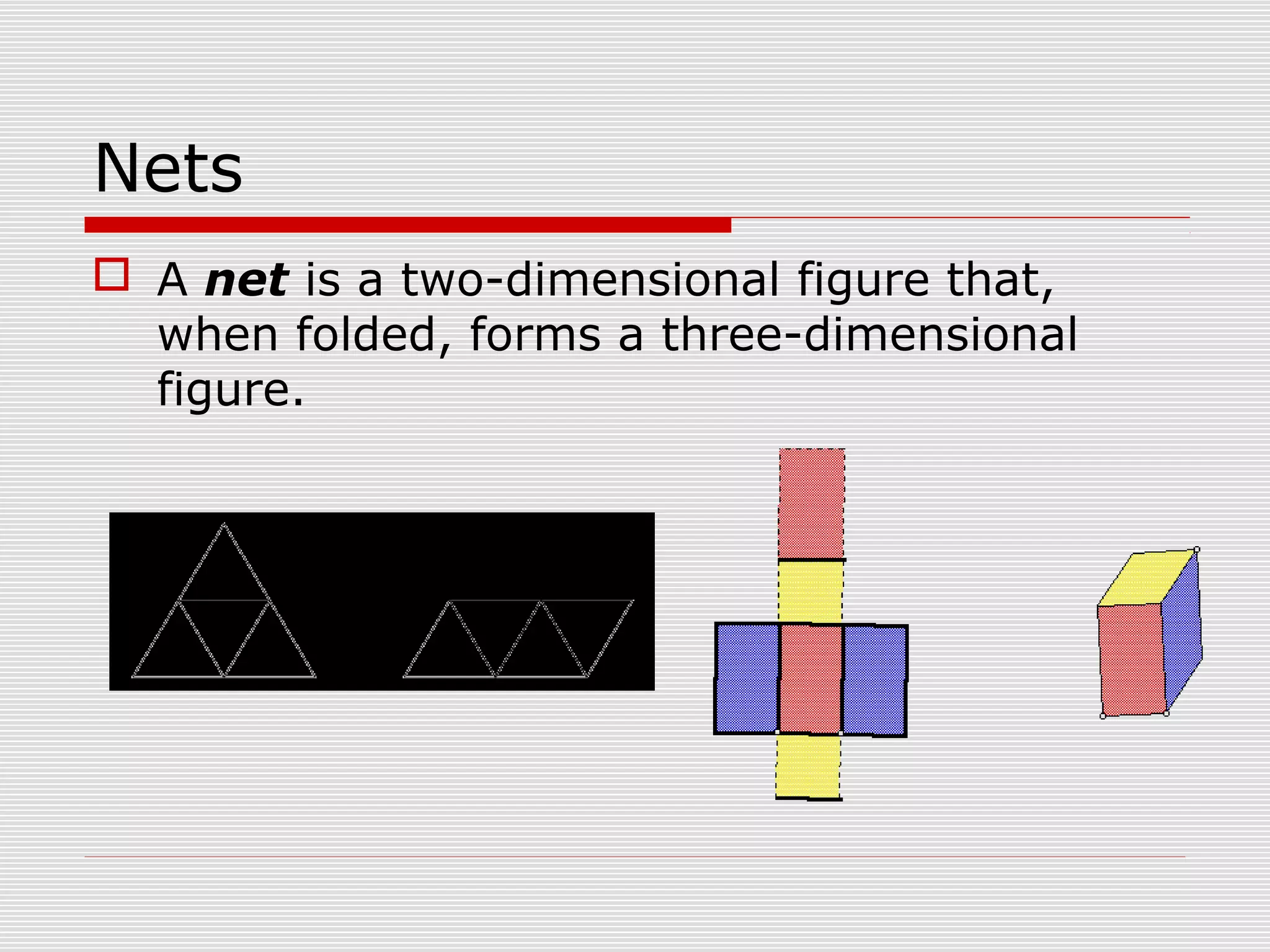
 A net is a two-dimensional figure that,
when folded, forms a three-dimensional
figure.
Identical Nets
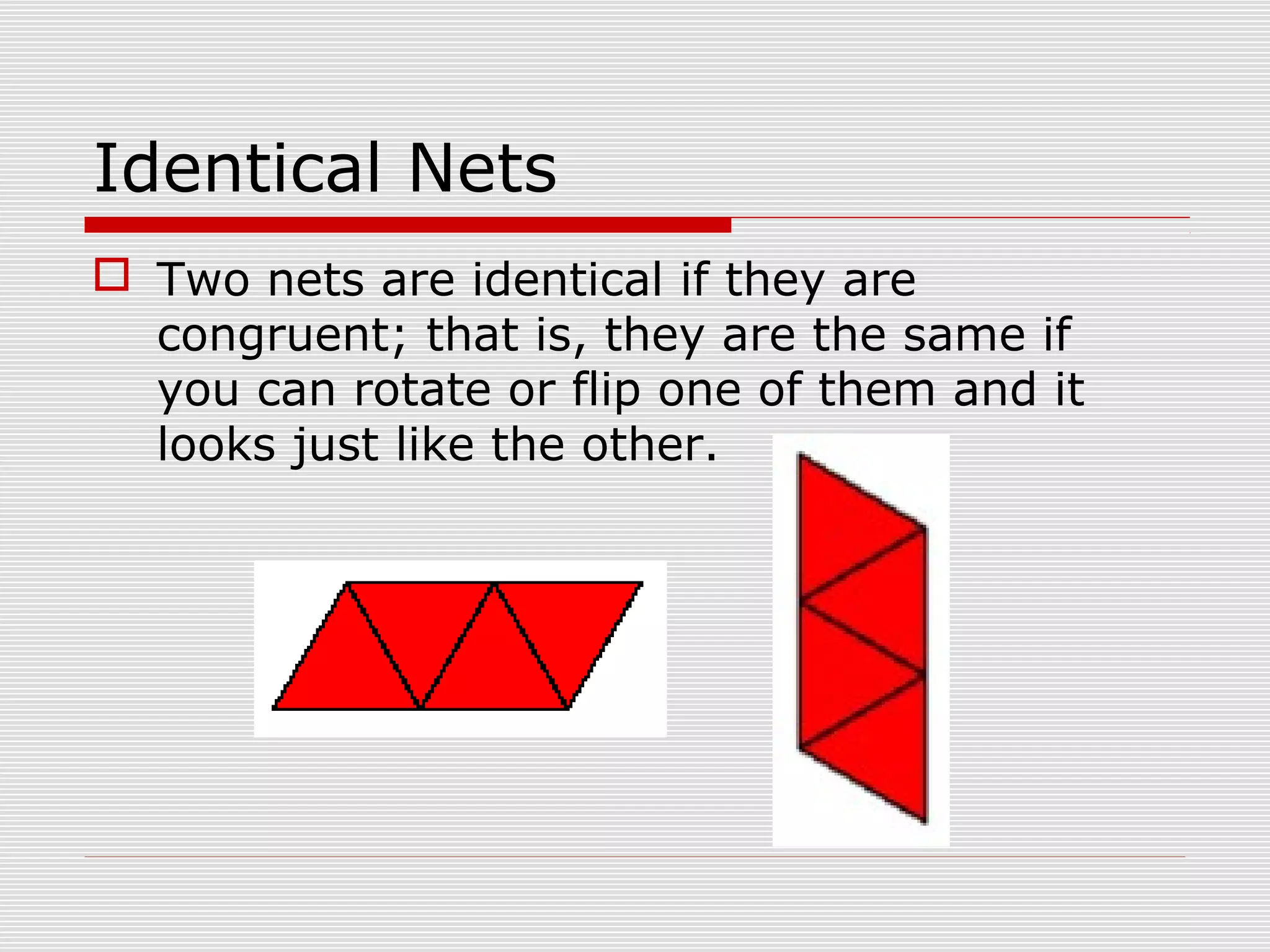
 Two nets are identical if they are
congruent; that is, they are the same if
you can rotate or flip one of them and it
looks just like the other.
Nets for a Cube
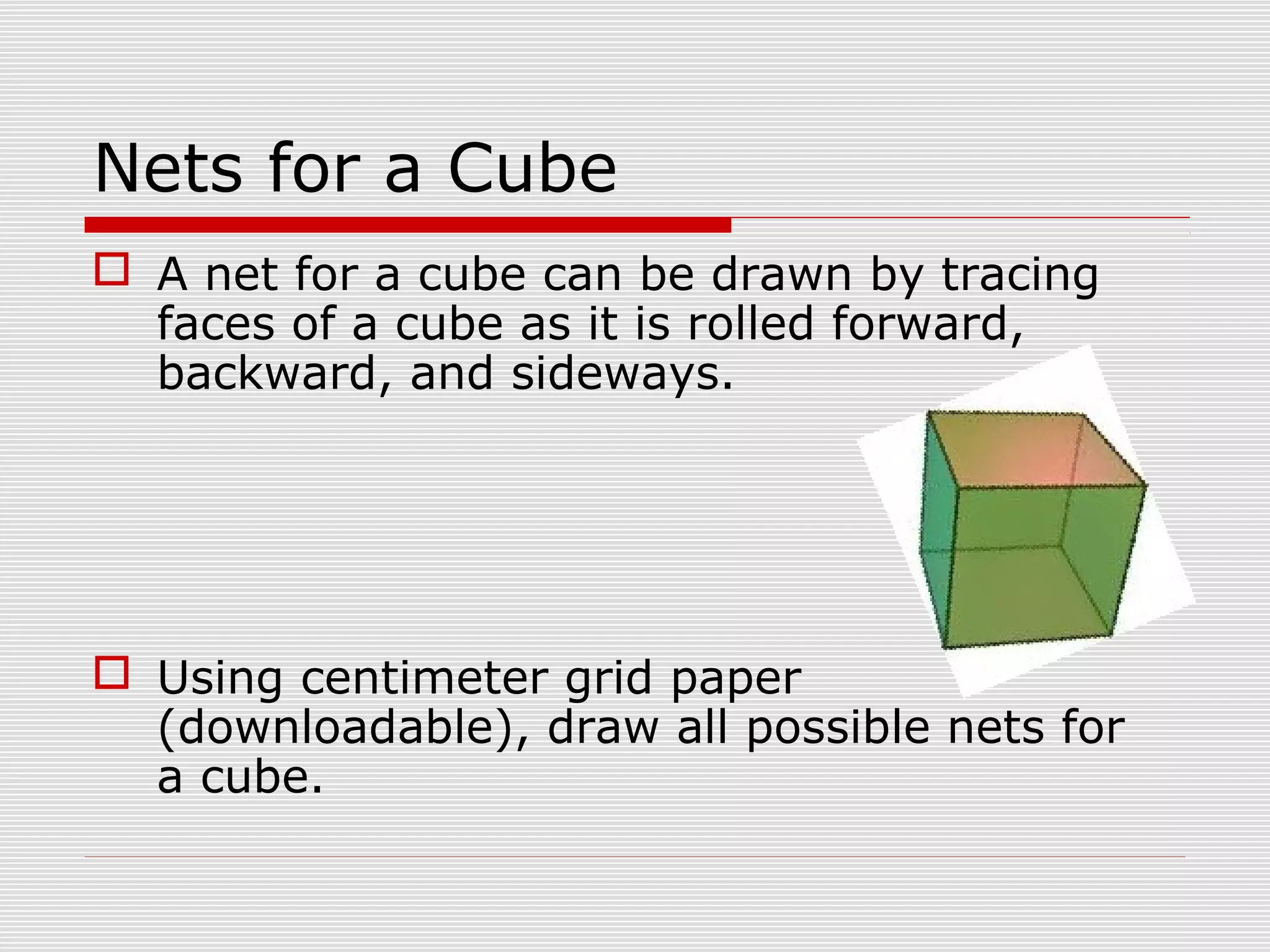
 A net for a cube can be drawn by tracing
faces of a cube as it is rolled forward,
backward, and sideways.
 Using centimeter grid paper
(downloadable), draw all possible nets for
a cube.
Nets for a Cube
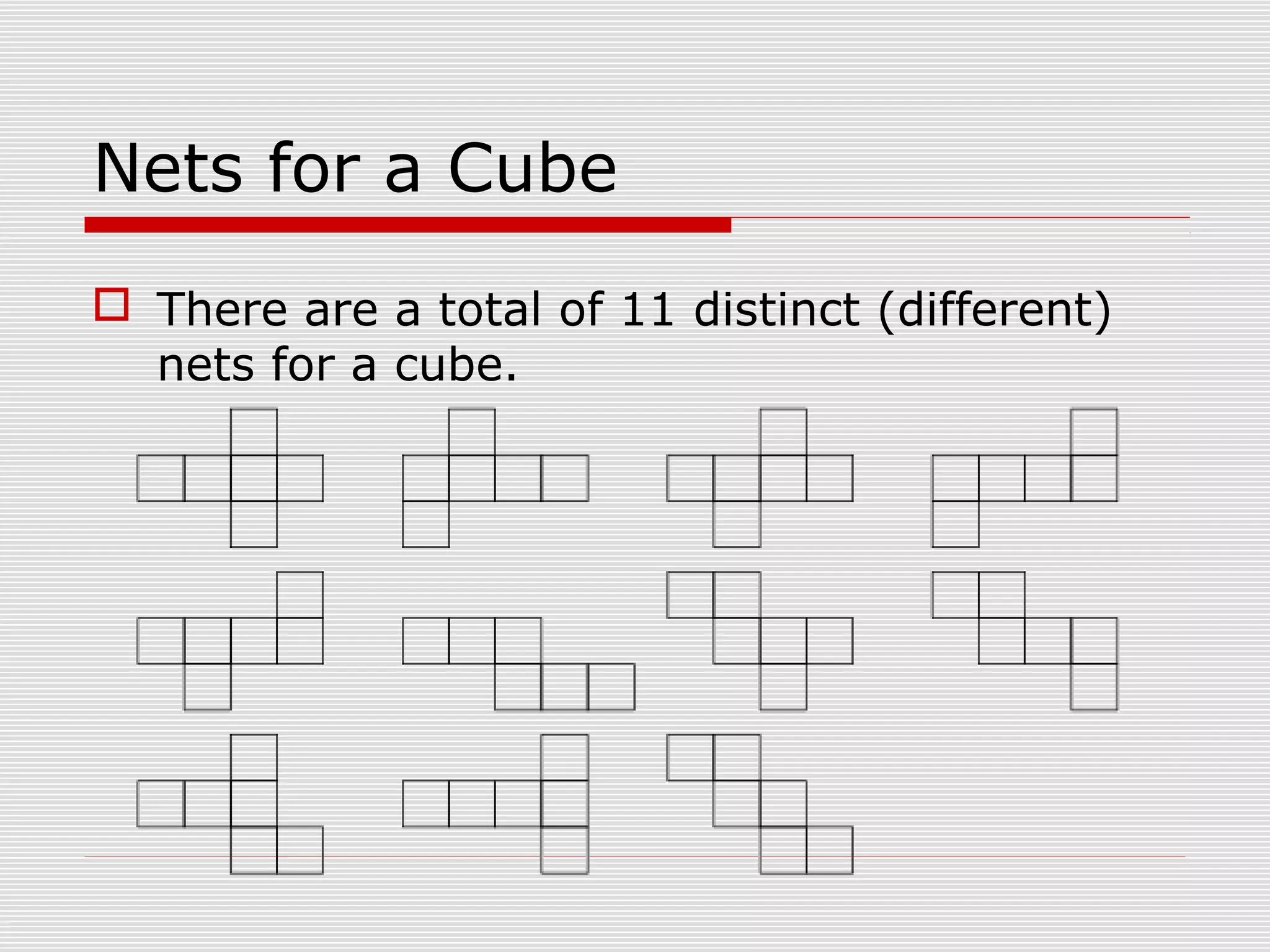
 There are a total of 11 distinct (different)
nets for a cube.
Nets for a Cube
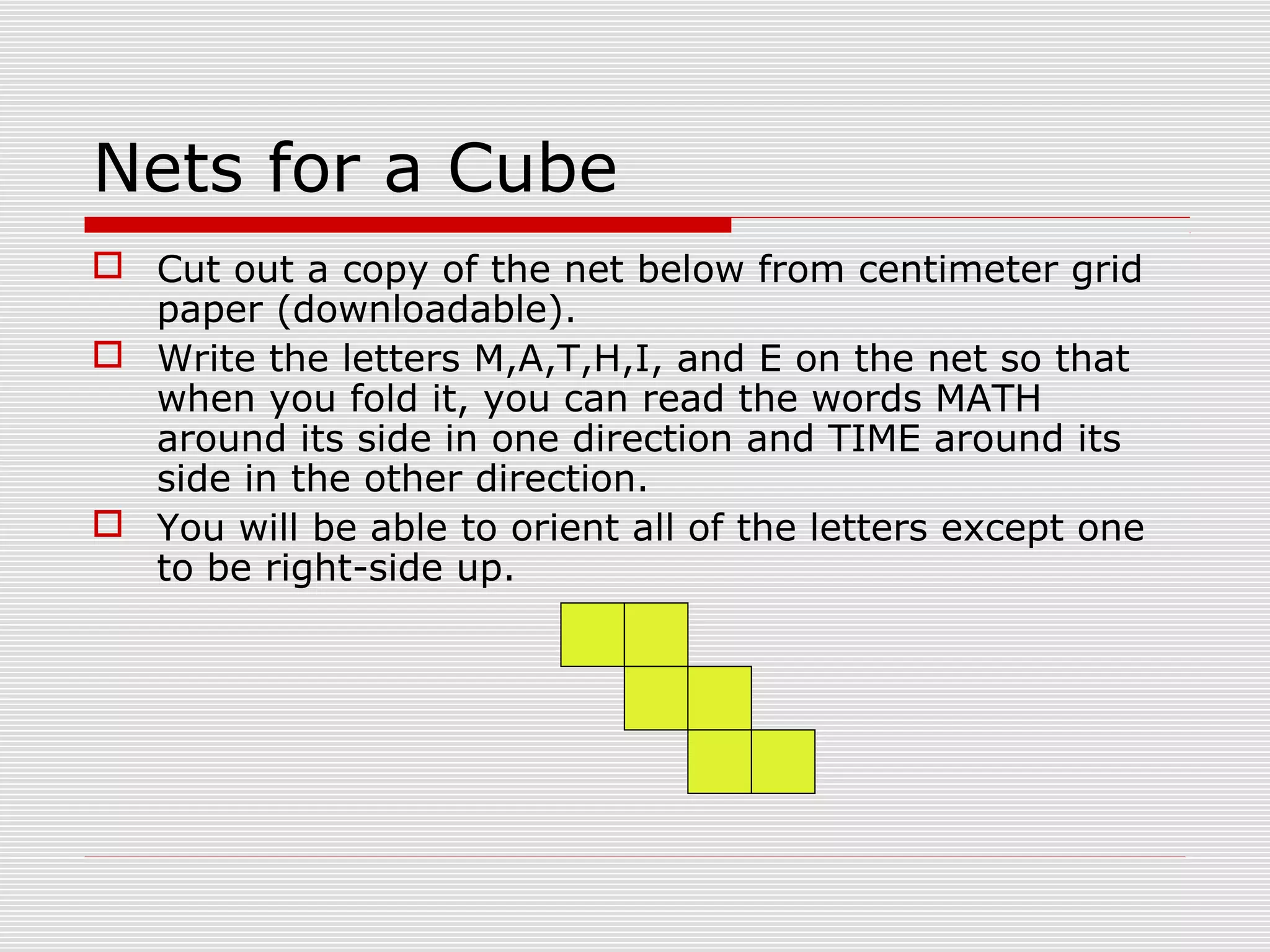
 Cut out a copy of the net below from centimeter grid
paper (downloadable).
 Write the letters M,A,T,H,I, and E on the net so that
when you fold it, you can read the words MATH
around its side in one direction and TIME around its
side in the other direction.
 You will be able to orient all of the letters except one
to be right-side up.
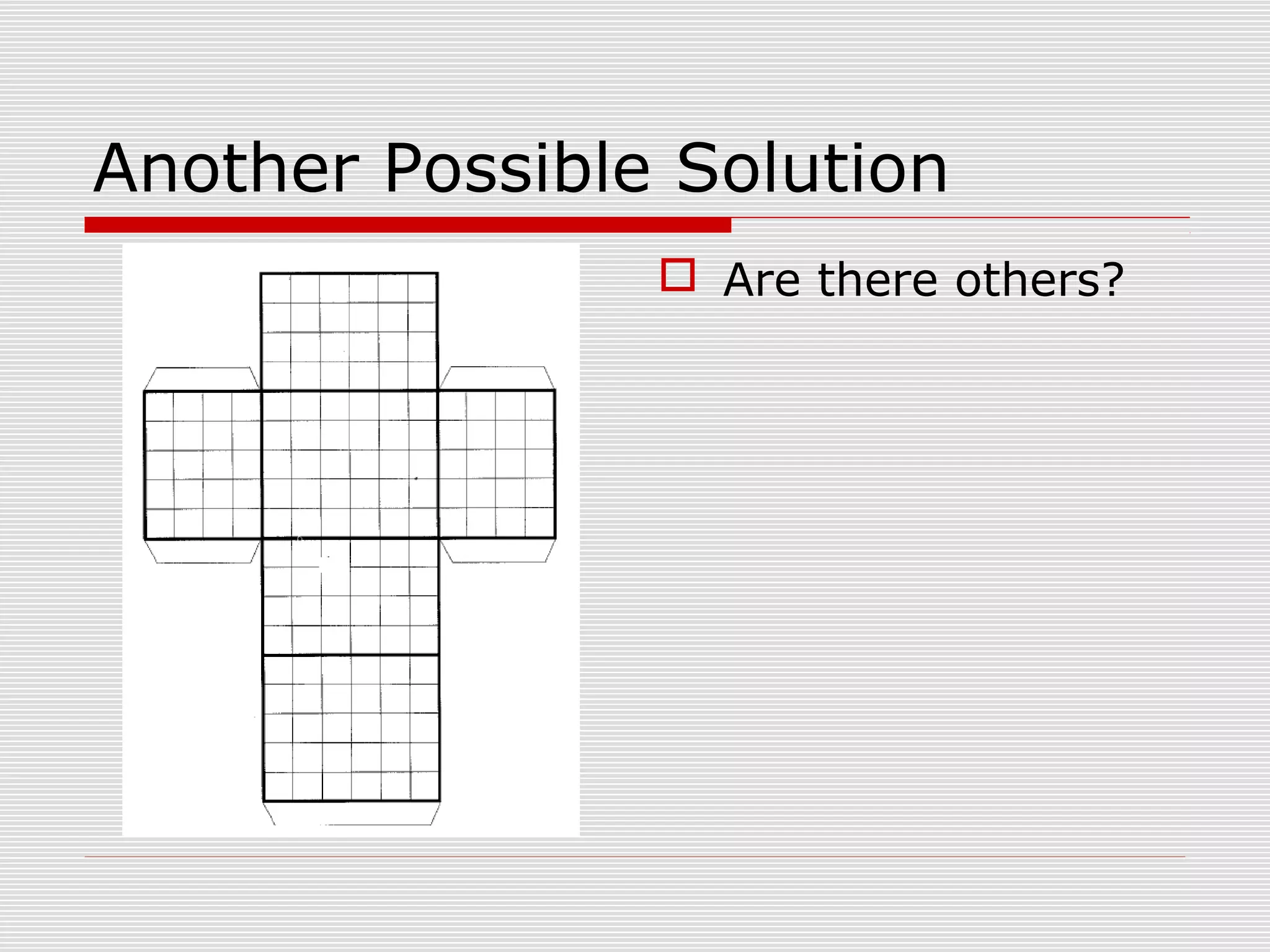
Nets for a Rectangular Prism
 One net for the yellow rectangular
prism is illustrated below. Roll a
rectangular prism on a piece of paper
or on centimeter grid paper and trace
to create another net.
Another Possible Solution
 Are there others?
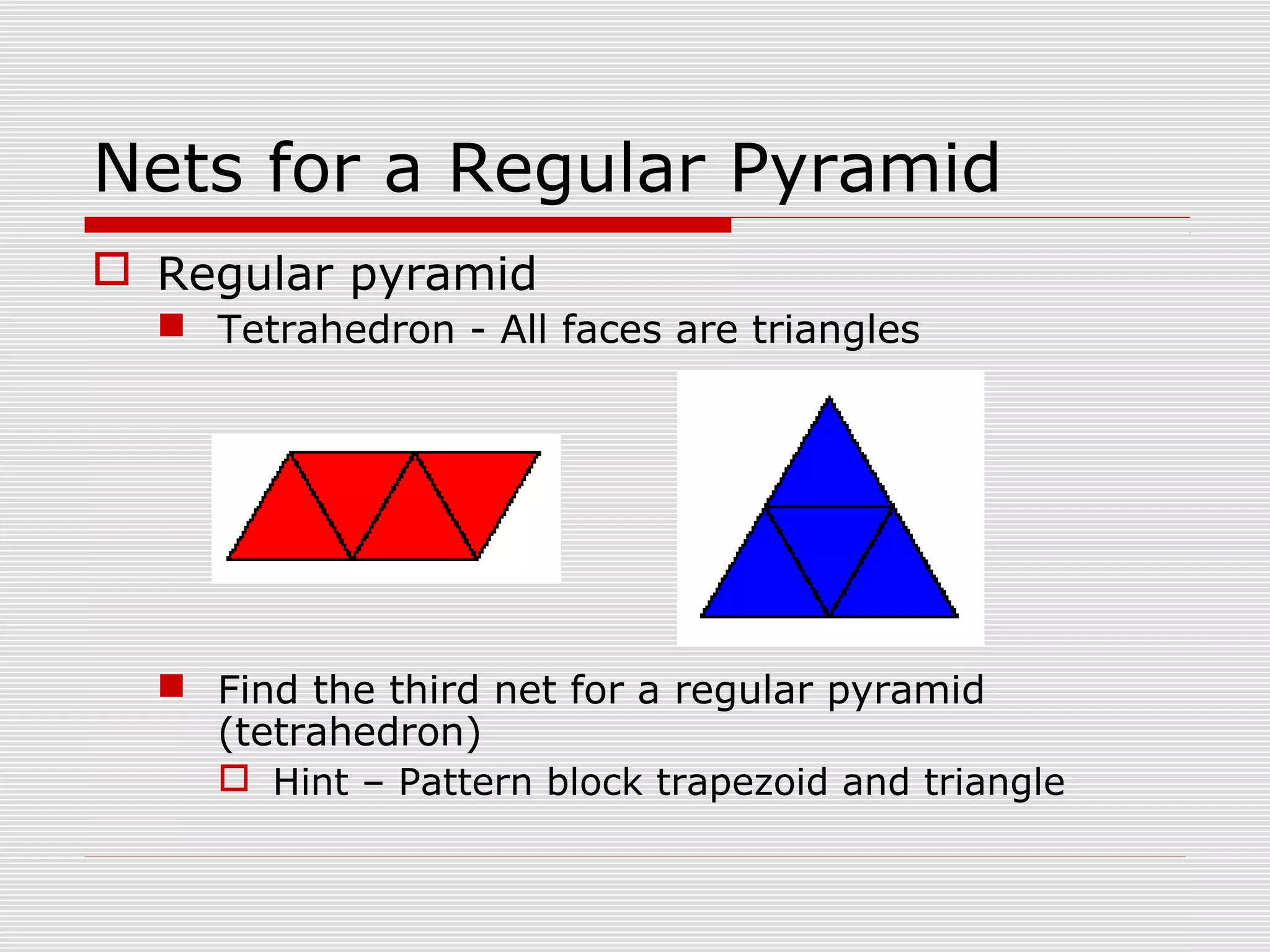
Nets for a Regular Pyramid
 Regular pyramid
 Tetrahedron - All faces are triangles
 Find the third net for a regular pyramid
(tetrahedron)
 Hint – Pattern block trapezoid and triangle
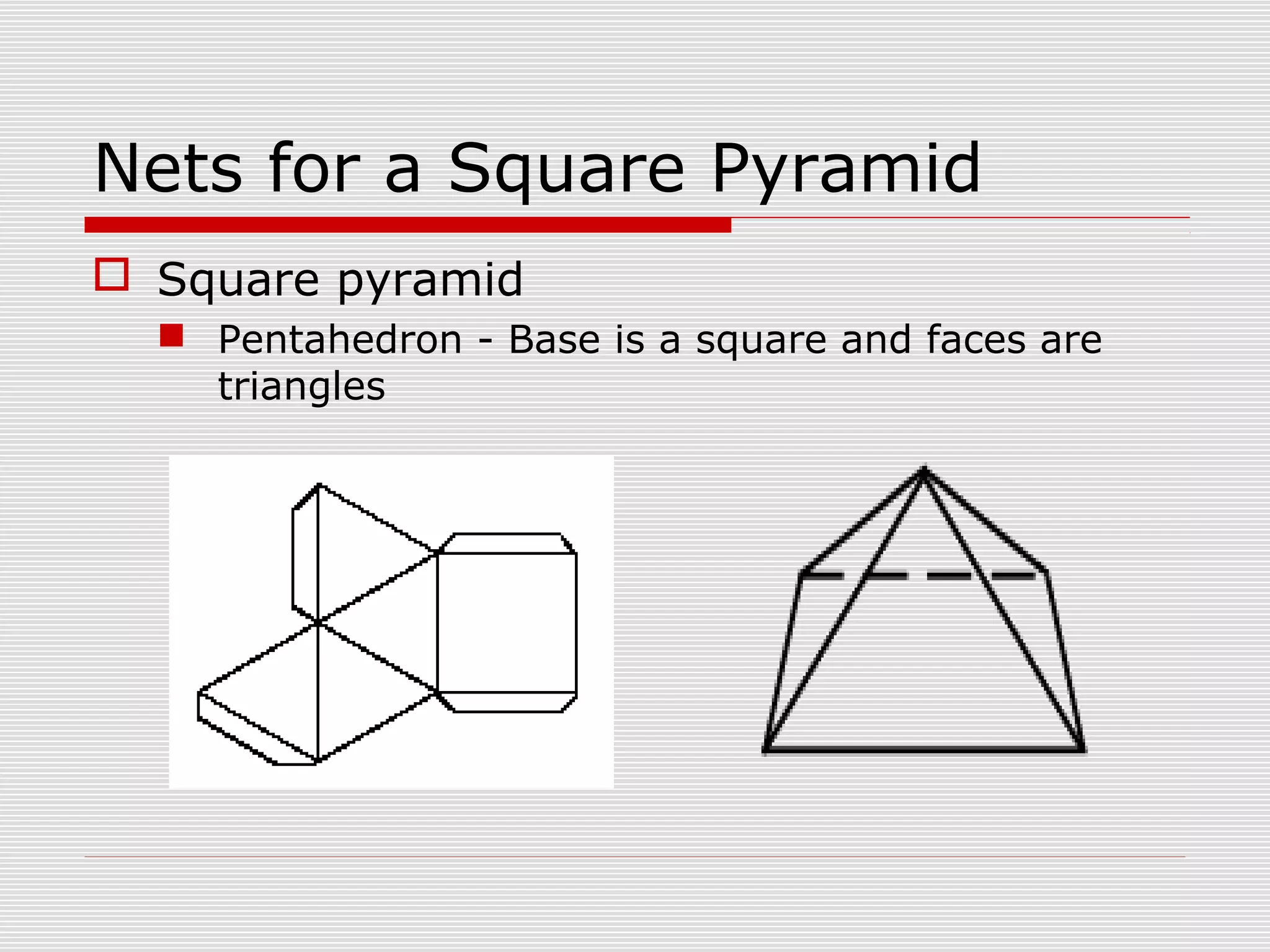
Nets for a Square Pyramid
 Square pyramid
 Pentahedron - Base is a square and faces are
triangles
Nets for a Square Pyramid
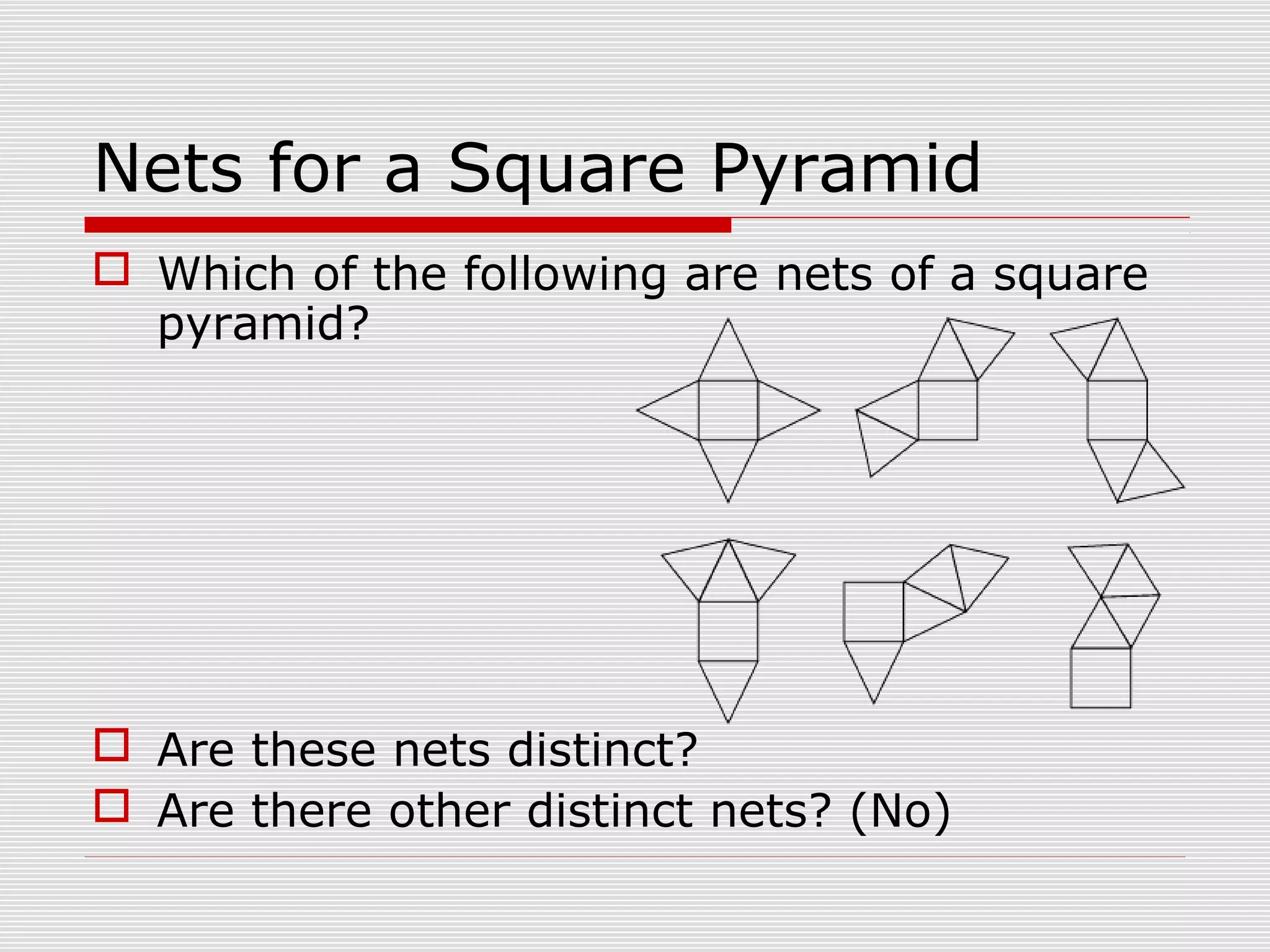
 Which of the following are nets of a square
pyramid?
 Are these nets distinct?
 Are there other distinct nets? (No)
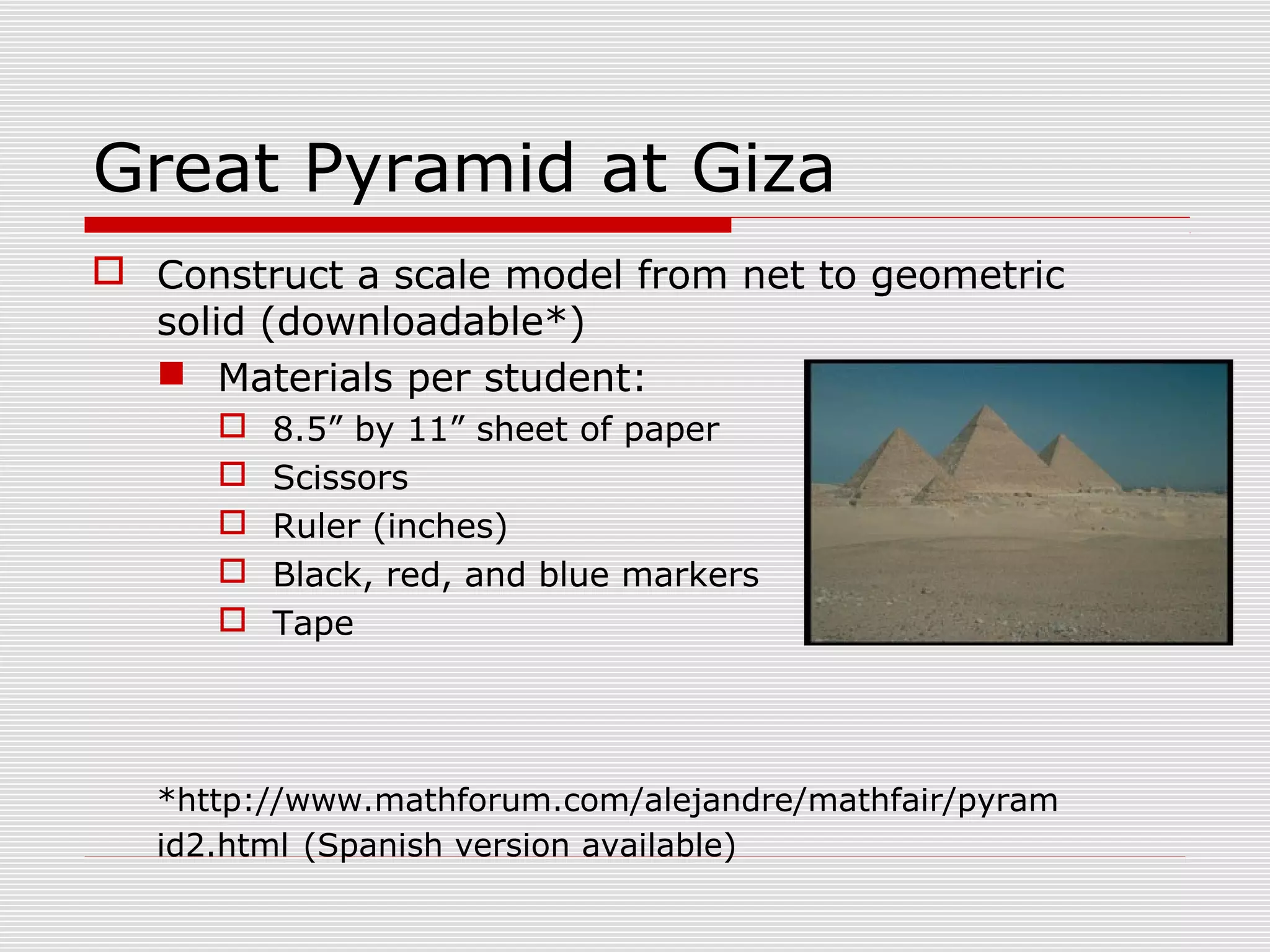
Great Pyramid at Giza
 Construct a scale model from net to geometric
solid (downloadable*)
 Materials per student:
 8.5” by 11” sheet of paper
 Scissors
 Ruler (inches)
 Black, red, and blue markers
 Tape
*http://www.mathforum.com/alejandre/mathfair/pyram
id2.html (Spanish version available)
Great Pyramid at Giza Directions
 Fold one corner of the paper
to the opposite side. Cut off
the extra rectangle. The
result is an 8½" square sheet
of paper.
 Fold the paper in half and in
half again. Open the paper
and mark the midpoint of
each side. Draw a line
connecting opposite
midpoints.
4 ¼”
8 ½”
More Great Pyramid Directions
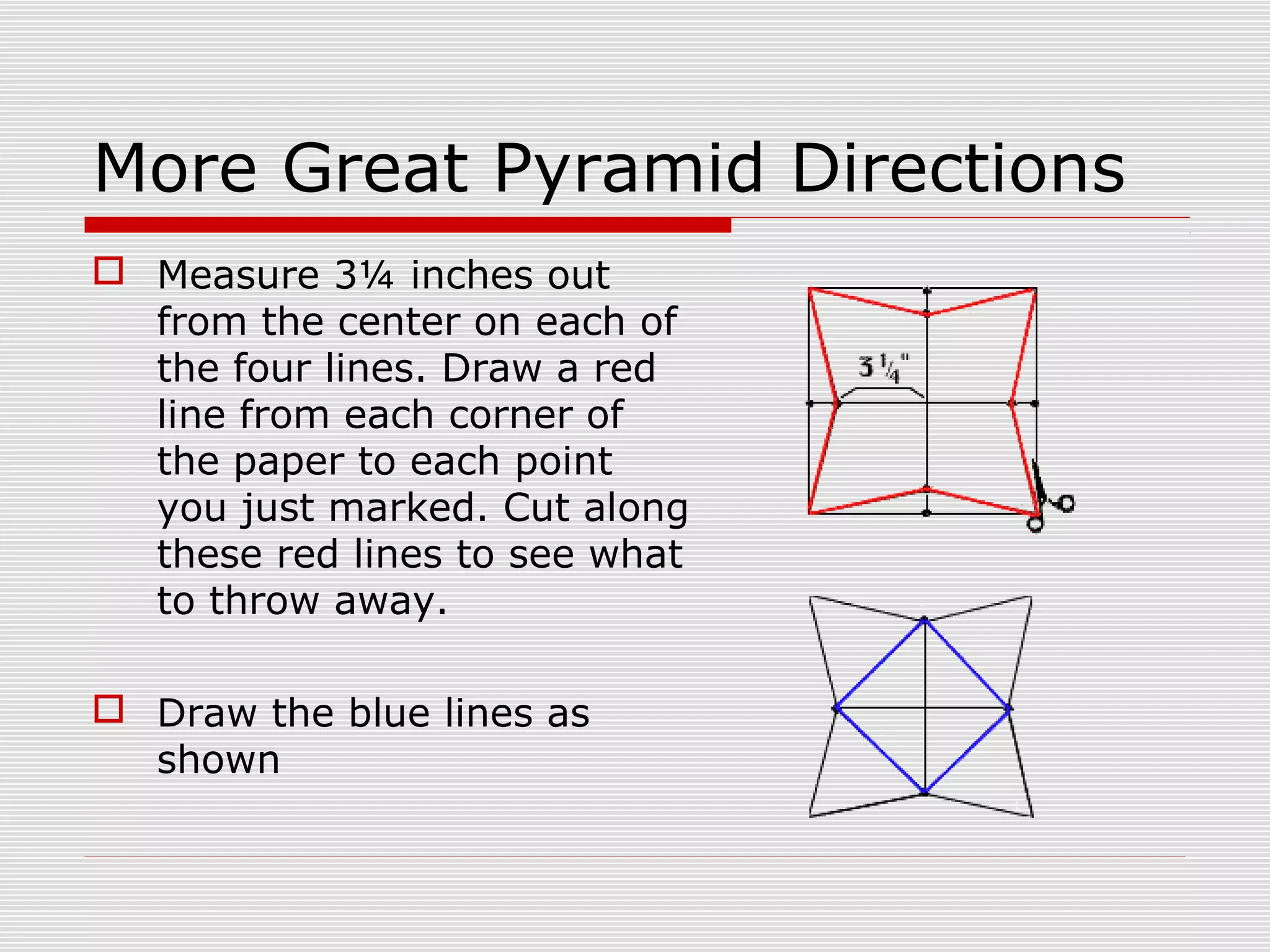
 Measure 3¼ inches out
from the center on each of
the four lines. Draw a red
line from each corner of
the paper to each point
you just marked. Cut along
these red lines to see what
to throw away.
 Draw the blue lines as
shown
Great Pyramid at Giza Scale Model
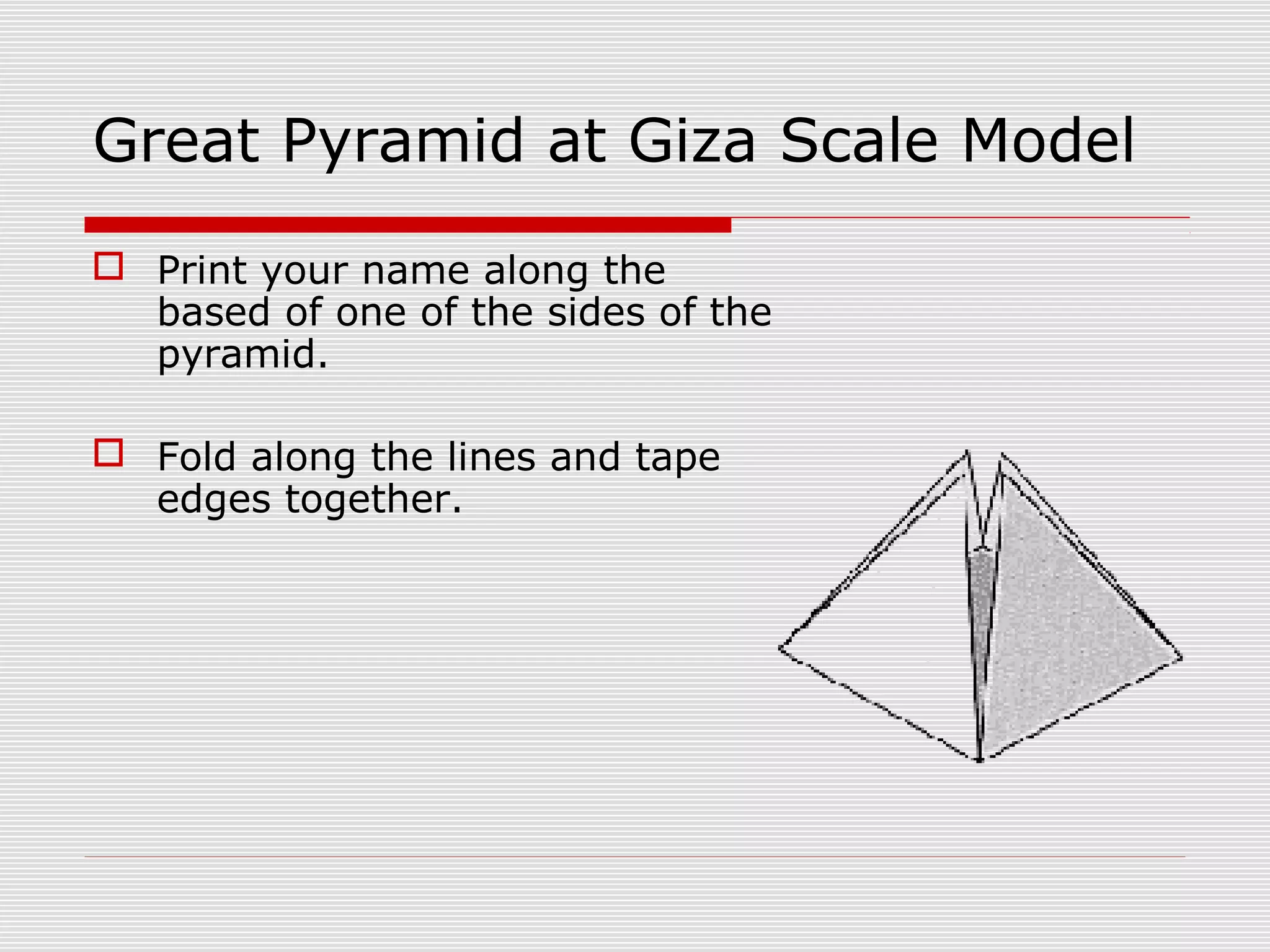
 Print your name along the
based of one of the sides of the
pyramid.
 Fold along the lines and tape
edges together.
Nets for a Cylinder
 Closed cylinder (top and bottom included)
 Rectangle and two congruent circles
 What relationship must exist between the
rectangle and the circles?
 Are other nets possible?
 Open cylinder - Any rectangular piece of
paper
Surface Area of a Cylinder
 Closed cylinder
 Surface Area = 2*Base area + Rectangle area
 2*Area of base (circle) = 2*πr2
 Area of rectangle = Circle circumference * height
= 2πrh
 Surface Area of Closed Cylinder =
(2πr2
+ 2πrh) sq units
 Open cylinder
 Surface Area = Area of rectangle
 Surface Area of Open Cylinder = 2πrh sq units
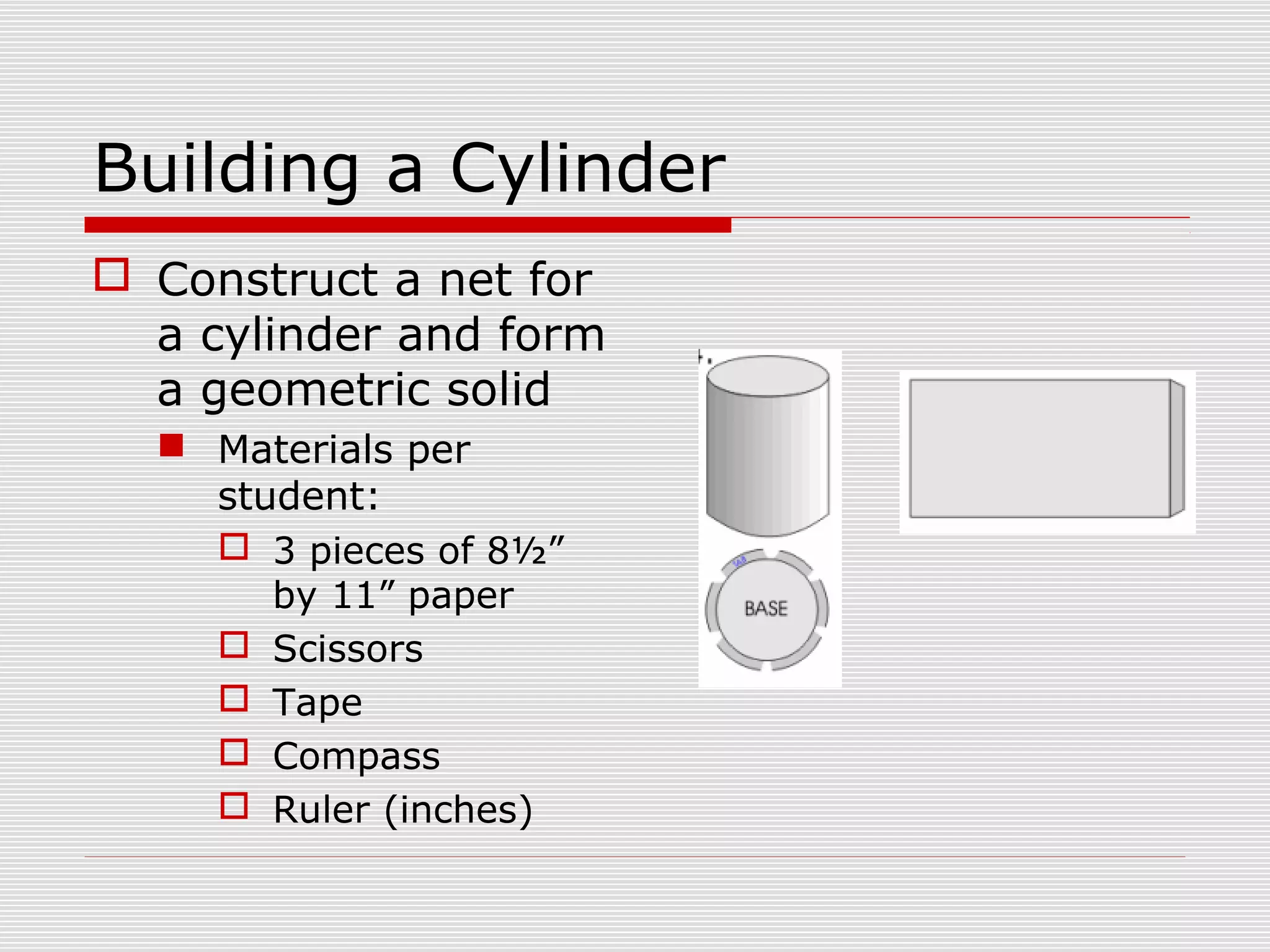
Building a Cylinder
 Construct a net for
a cylinder and form
a geometric solid
 Materials per
student:
 3 pieces of 8½”
by 11” paper
 Scissors
 Tape
 Compass
 Ruler (inches)
Building a Cylinder Directions
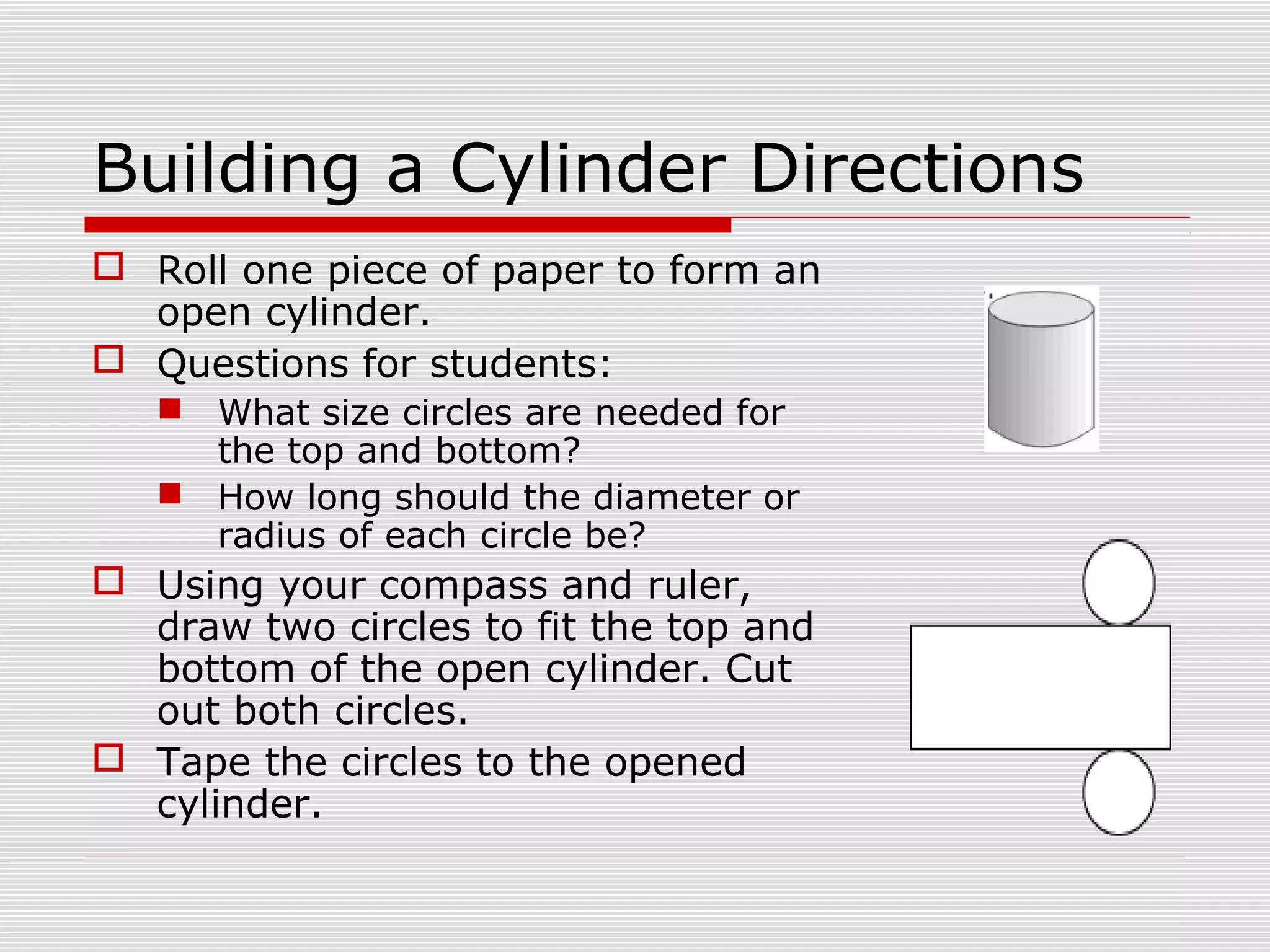
 Roll one piece of paper to form an
open cylinder.
 Questions for students:
 What size circles are needed for
the top and bottom?
 How long should the diameter or
radius of each circle be?
 Using your compass and ruler,
draw two circles to fit the top and
bottom of the open cylinder. Cut
out both circles.
 Tape the circles to the opened
cylinder.
Can Label Investigation
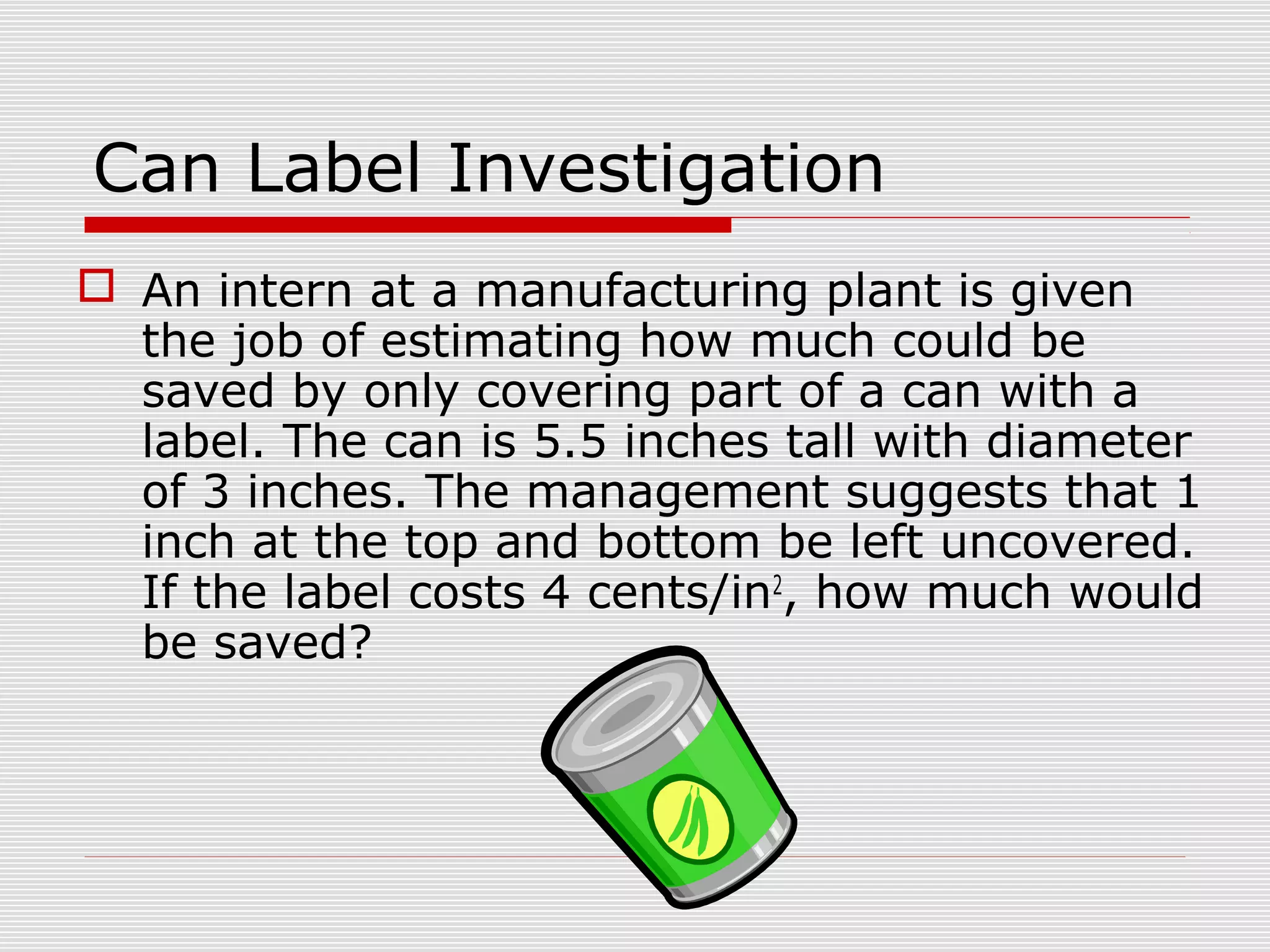
 An intern at a manufacturing plant is given
the job of estimating how much could be
saved by only covering part of a can with a
label. The can is 5.5 inches tall with diameter
of 3 inches. The management suggests that 1
inch at the top and bottom be left uncovered.
If the label costs 4 cents/in2
, how much would
be saved?
Nets for a Cone
 Closed cone (top or bottom
included)
 Circle and a sector of a larger
but related circle
 Circumference of the (smaller)
circle must equal the length of
the arc of the given sector
(from the larger circle).
 Open cone (party hat or ice
cream sugar cone)
 Circular sector
Cone Investigation
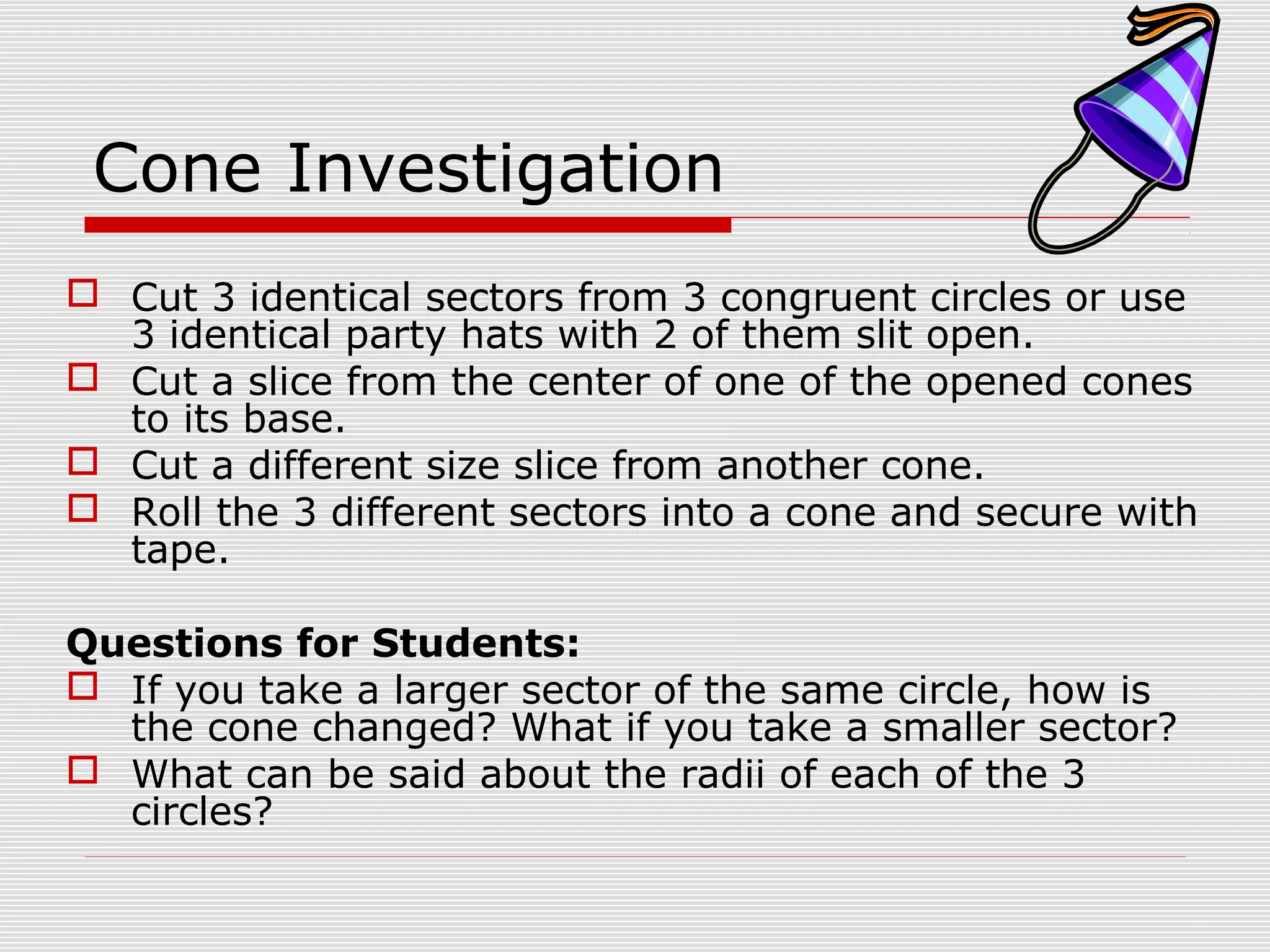
 Cut 3 identical sectors from 3 congruent circles or use
3 identical party hats with 2 of them slit open.
 Cut a slice from the center of one of the opened cones
to its base.
 Cut a different size slice from another cone.
 Roll the 3 different sectors into a cone and secure with
tape.
Questions for Students:
 If you take a larger sector of the same circle, how is
the cone changed? What if you take a smaller sector?
 What can be said about the radii of each of the 3
circles?
Cone Investigation continued
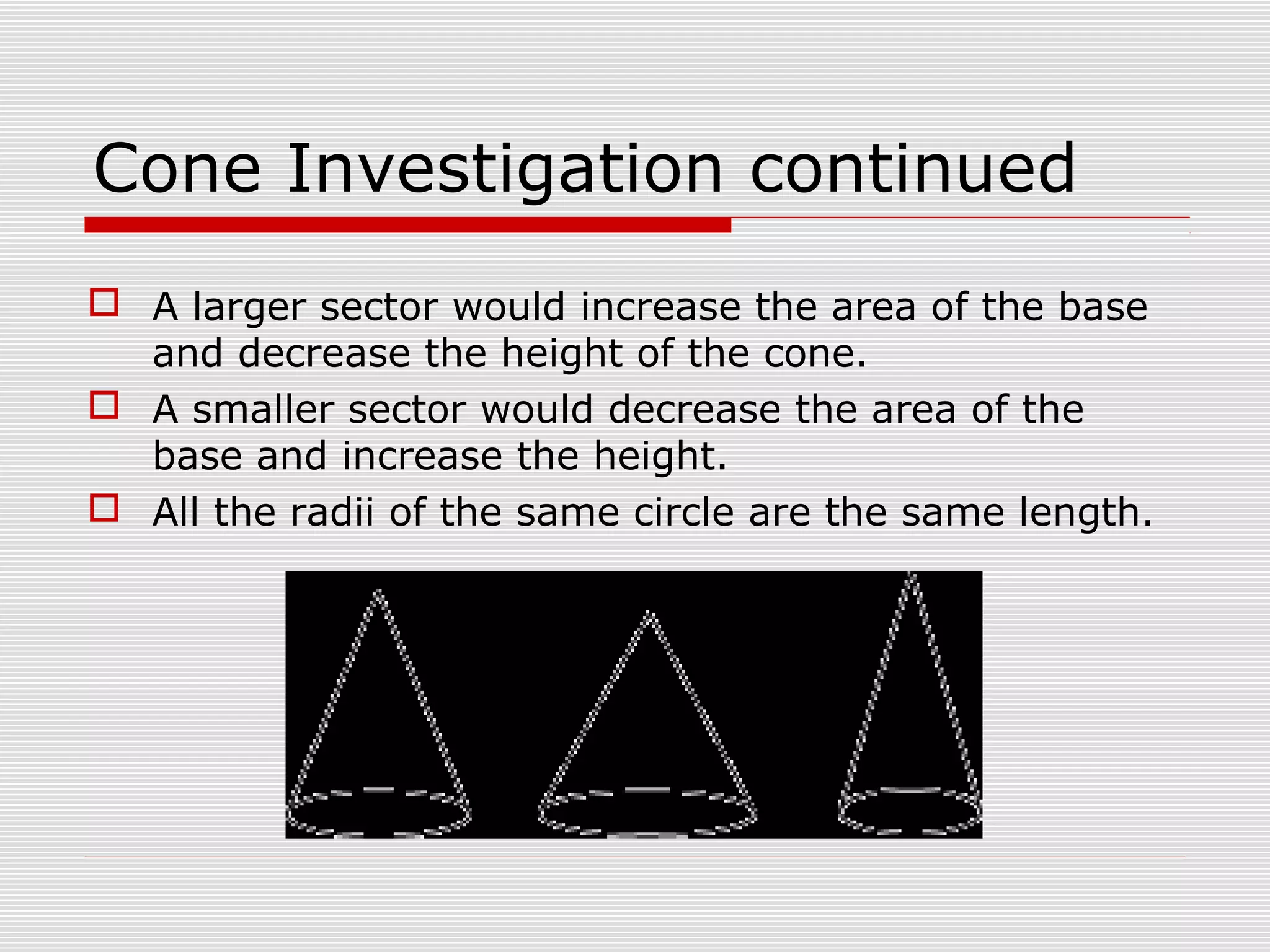
 A larger sector would increase the area of the base
and decrease the height of the cone.
 A smaller sector would decrease the area of the
base and increase the height.
 All the radii of the same circle are the same length.
Making Your Own Cone Investigation
 When making a cone from an 8.5” by
11” piece of paper, what is the
maximum height? Explain your
thinking and illustrate with a drawing.
Creating Nets from Shapes
 In small groups students create nets for
triangular (regular) pyramids
(downloadable isometric dot paper), square
pyramids, rectangular prisms, cylinders,
cones, and triangular prisms.
 Materials needed – Geometric solids, paper
(plain or centimeter grid), tape or glue
Questions for students:
 How many vertices does your net need?
 How many edges does your net need?
 How many faces does your net need?
 Is more than one net possible?
Alike or Different?
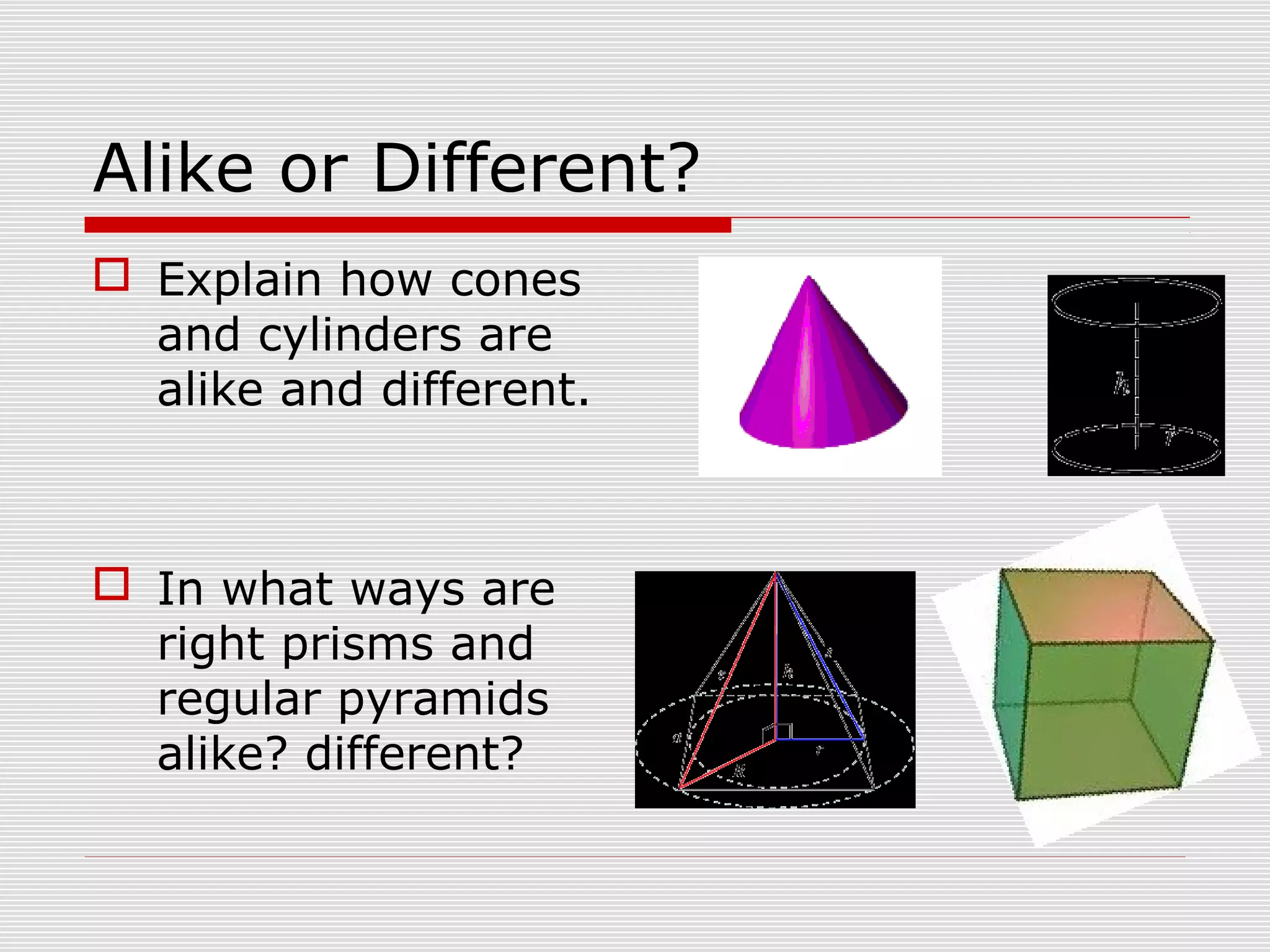
 Explain how cones
and cylinders are
alike and different.
 In what ways are
right prisms and
regular pyramids
alike? different?
Nets for Similar Cubes Using
Centimeter Cubes
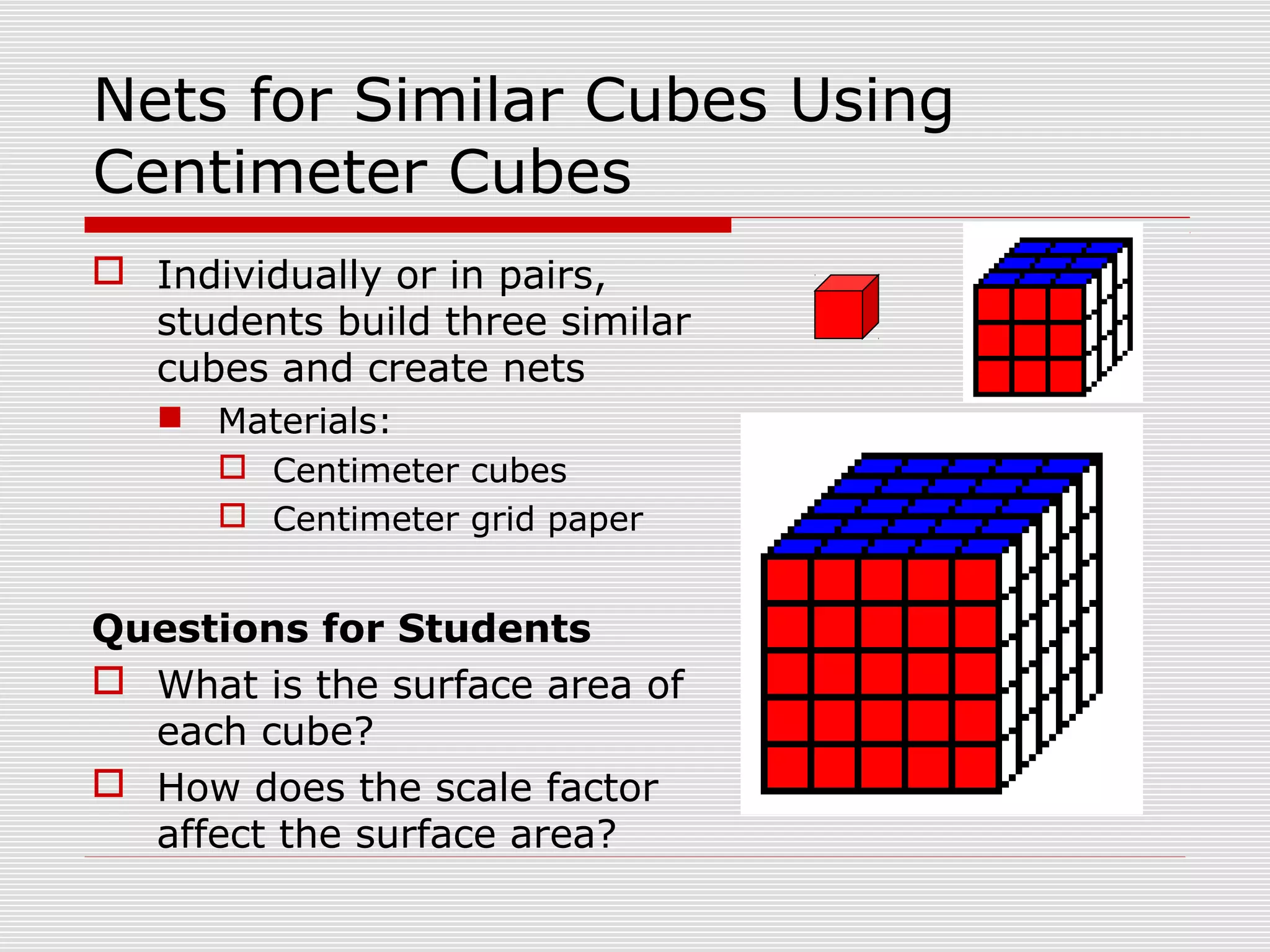
 Individually or in pairs,
students build three similar
cubes and create nets
 Materials:
 Centimeter cubes
 Centimeter grid paper
Questions for Students
 What is the surface area of
each cube?
 How does the scale factor
affect the surface area?

Nets

  • 1.
    Nets  A netis a two-dimensional figure that, when folded, forms a three-dimensional figure.
  • 2.
    Identical Nets  Twonets are identical if they are congruent; that is, they are the same if you can rotate or flip one of them and it looks just like the other.
  • 3.
    Nets for aCube  A net for a cube can be drawn by tracing faces of a cube as it is rolled forward, backward, and sideways.  Using centimeter grid paper (downloadable), draw all possible nets for a cube.
  • 4.
    Nets for aCube  There are a total of 11 distinct (different) nets for a cube.
  • 5.
    Nets for aCube  Cut out a copy of the net below from centimeter grid paper (downloadable).  Write the letters M,A,T,H,I, and E on the net so that when you fold it, you can read the words MATH around its side in one direction and TIME around its side in the other direction.  You will be able to orient all of the letters except one to be right-side up.
  • 6.
    Nets for aRectangular Prism  One net for the yellow rectangular prism is illustrated below. Roll a rectangular prism on a piece of paper or on centimeter grid paper and trace to create another net.
  • 7.
  • 8.
    Nets for aRegular Pyramid  Regular pyramid  Tetrahedron - All faces are triangles  Find the third net for a regular pyramid (tetrahedron)  Hint – Pattern block trapezoid and triangle
  • 9.
    Nets for aSquare Pyramid  Square pyramid  Pentahedron - Base is a square and faces are triangles
  • 10.
    Nets for aSquare Pyramid  Which of the following are nets of a square pyramid?  Are these nets distinct?  Are there other distinct nets? (No)
  • 11.
    Great Pyramid atGiza  Construct a scale model from net to geometric solid (downloadable*)  Materials per student:  8.5” by 11” sheet of paper  Scissors  Ruler (inches)  Black, red, and blue markers  Tape *http://www.mathforum.com/alejandre/mathfair/pyram id2.html (Spanish version available)
  • 12.
    Great Pyramid atGiza Directions  Fold one corner of the paper to the opposite side. Cut off the extra rectangle. The result is an 8½" square sheet of paper.  Fold the paper in half and in half again. Open the paper and mark the midpoint of each side. Draw a line connecting opposite midpoints. 4 ¼” 8 ½”
  • 13.
    More Great PyramidDirections  Measure 3¼ inches out from the center on each of the four lines. Draw a red line from each corner of the paper to each point you just marked. Cut along these red lines to see what to throw away.  Draw the blue lines as shown
  • 14.
    Great Pyramid atGiza Scale Model  Print your name along the based of one of the sides of the pyramid.  Fold along the lines and tape edges together.
  • 15.
    Nets for aCylinder  Closed cylinder (top and bottom included)  Rectangle and two congruent circles  What relationship must exist between the rectangle and the circles?  Are other nets possible?  Open cylinder - Any rectangular piece of paper
  • 16.
    Surface Area ofa Cylinder  Closed cylinder  Surface Area = 2*Base area + Rectangle area  2*Area of base (circle) = 2*πr2  Area of rectangle = Circle circumference * height = 2πrh  Surface Area of Closed Cylinder = (2πr2 + 2πrh) sq units  Open cylinder  Surface Area = Area of rectangle  Surface Area of Open Cylinder = 2πrh sq units
  • 17.
    Building a Cylinder Construct a net for a cylinder and form a geometric solid  Materials per student:  3 pieces of 8½” by 11” paper  Scissors  Tape  Compass  Ruler (inches)
  • 18.
    Building a CylinderDirections  Roll one piece of paper to form an open cylinder.  Questions for students:  What size circles are needed for the top and bottom?  How long should the diameter or radius of each circle be?  Using your compass and ruler, draw two circles to fit the top and bottom of the open cylinder. Cut out both circles.  Tape the circles to the opened cylinder.
  • 19.
    Can Label Investigation An intern at a manufacturing plant is given the job of estimating how much could be saved by only covering part of a can with a label. The can is 5.5 inches tall with diameter of 3 inches. The management suggests that 1 inch at the top and bottom be left uncovered. If the label costs 4 cents/in2 , how much would be saved?
  • 20.
    Nets for aCone  Closed cone (top or bottom included)  Circle and a sector of a larger but related circle  Circumference of the (smaller) circle must equal the length of the arc of the given sector (from the larger circle).  Open cone (party hat or ice cream sugar cone)  Circular sector
  • 21.
    Cone Investigation  Cut3 identical sectors from 3 congruent circles or use 3 identical party hats with 2 of them slit open.  Cut a slice from the center of one of the opened cones to its base.  Cut a different size slice from another cone.  Roll the 3 different sectors into a cone and secure with tape. Questions for Students:  If you take a larger sector of the same circle, how is the cone changed? What if you take a smaller sector?  What can be said about the radii of each of the 3 circles?
  • 22.
    Cone Investigation continued A larger sector would increase the area of the base and decrease the height of the cone.  A smaller sector would decrease the area of the base and increase the height.  All the radii of the same circle are the same length.
  • 23.
    Making Your OwnCone Investigation  When making a cone from an 8.5” by 11” piece of paper, what is the maximum height? Explain your thinking and illustrate with a drawing.
  • 24.
    Creating Nets fromShapes  In small groups students create nets for triangular (regular) pyramids (downloadable isometric dot paper), square pyramids, rectangular prisms, cylinders, cones, and triangular prisms.  Materials needed – Geometric solids, paper (plain or centimeter grid), tape or glue Questions for students:  How many vertices does your net need?  How many edges does your net need?  How many faces does your net need?  Is more than one net possible?
  • 25.
    Alike or Different? Explain how cones and cylinders are alike and different.  In what ways are right prisms and regular pyramids alike? different?
  • 26.
    Nets for SimilarCubes Using Centimeter Cubes  Individually or in pairs, students build three similar cubes and create nets  Materials:  Centimeter cubes  Centimeter grid paper Questions for Students  What is the surface area of each cube?  How does the scale factor affect the surface area?