Three-dimensional Shapes (3D)
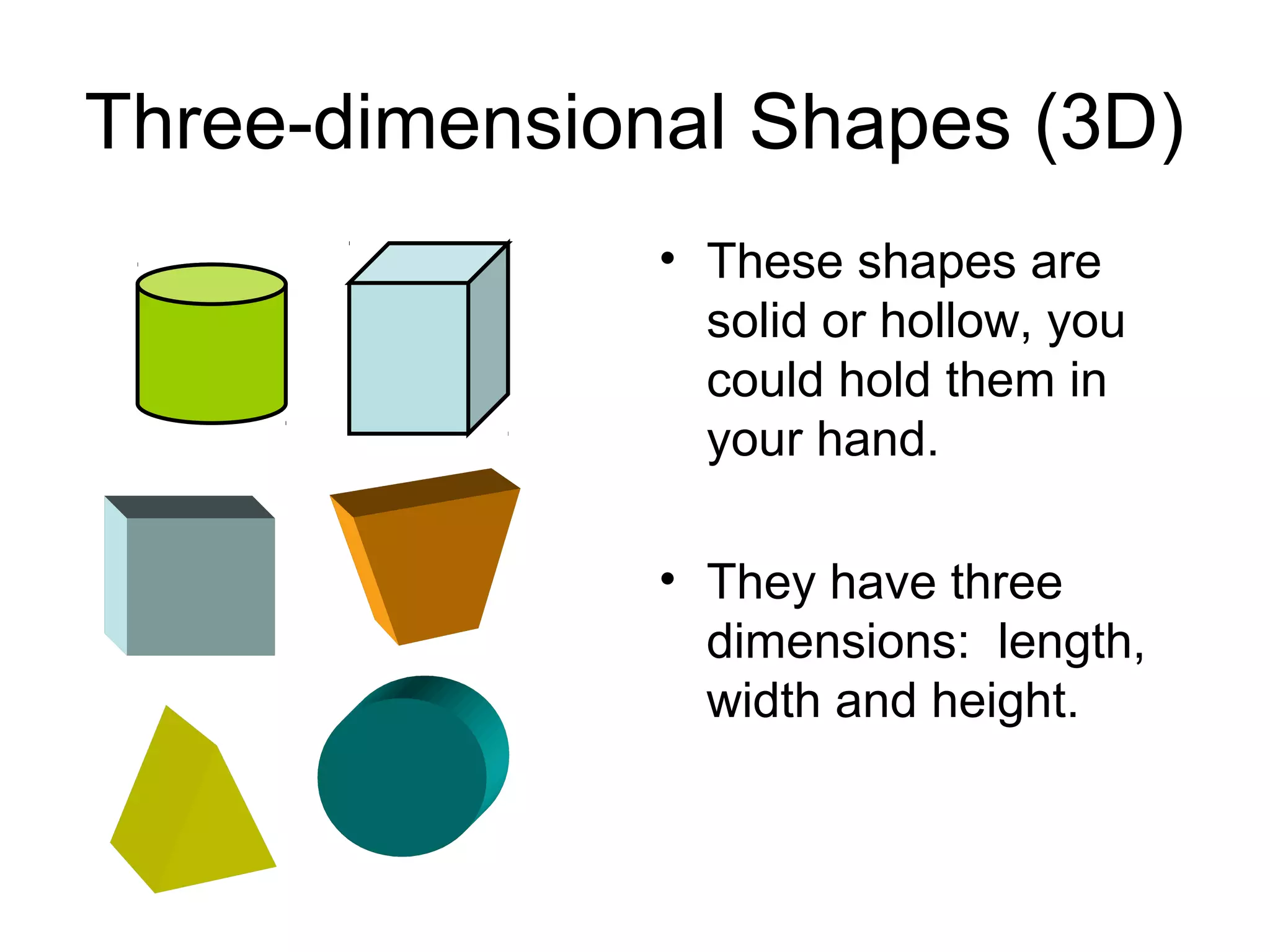
• These shapes are
solid or hollow, you
could hold them in
your hand.
• They have three
dimensions: length,
width and height.
Solid
• A shape you can
hold (3D).
• A solid has
length, width and
height.
• Examples:
– Cube
– Cylinder
– Sphere
– Cone
– Prism
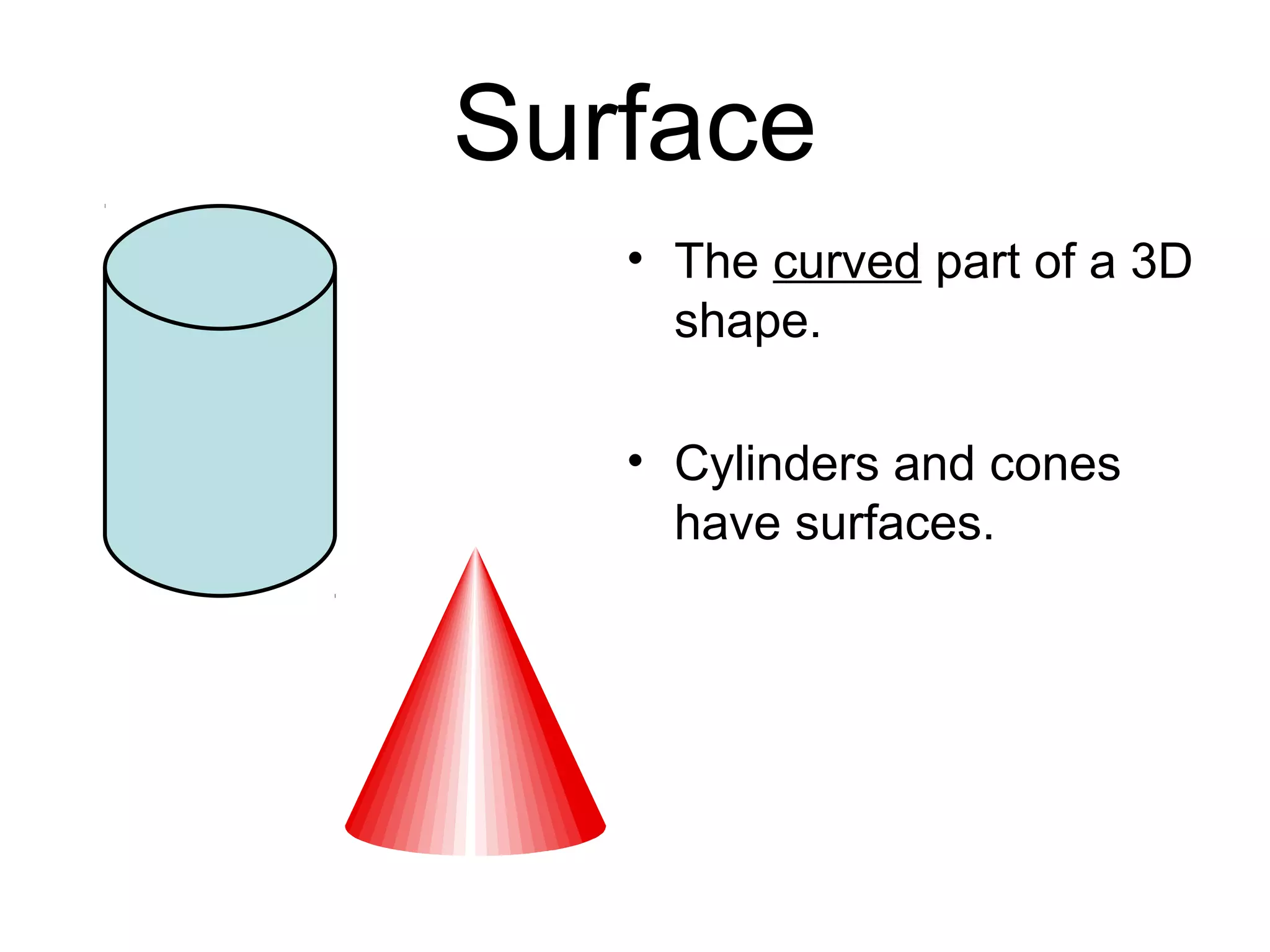
Surface
• The curved part of a 3D
shape.
• Cylinders and cones
have surfaces.
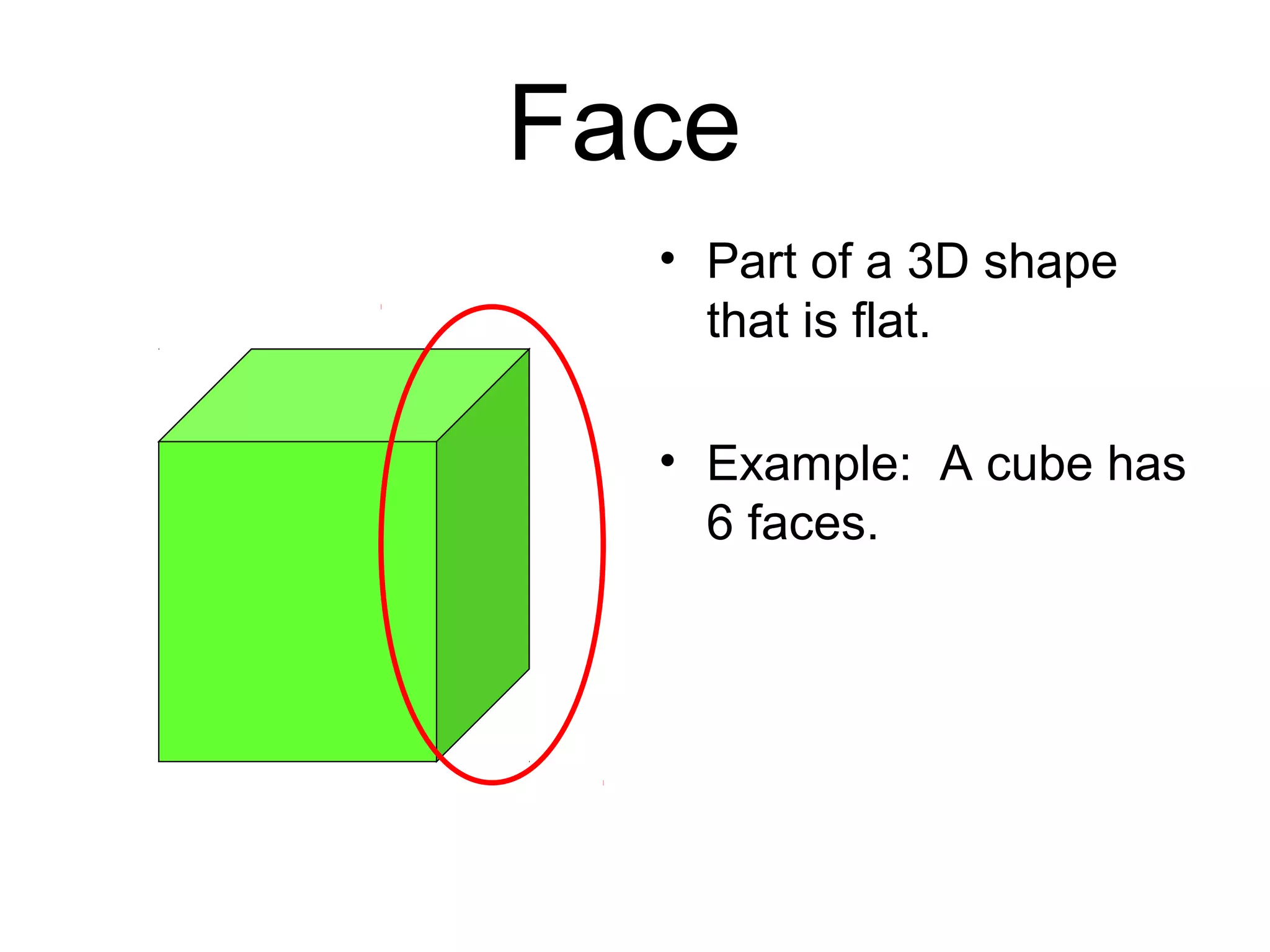
Face
• Part of a 3D shape
that is flat.
• Example: A cube has
6 faces.
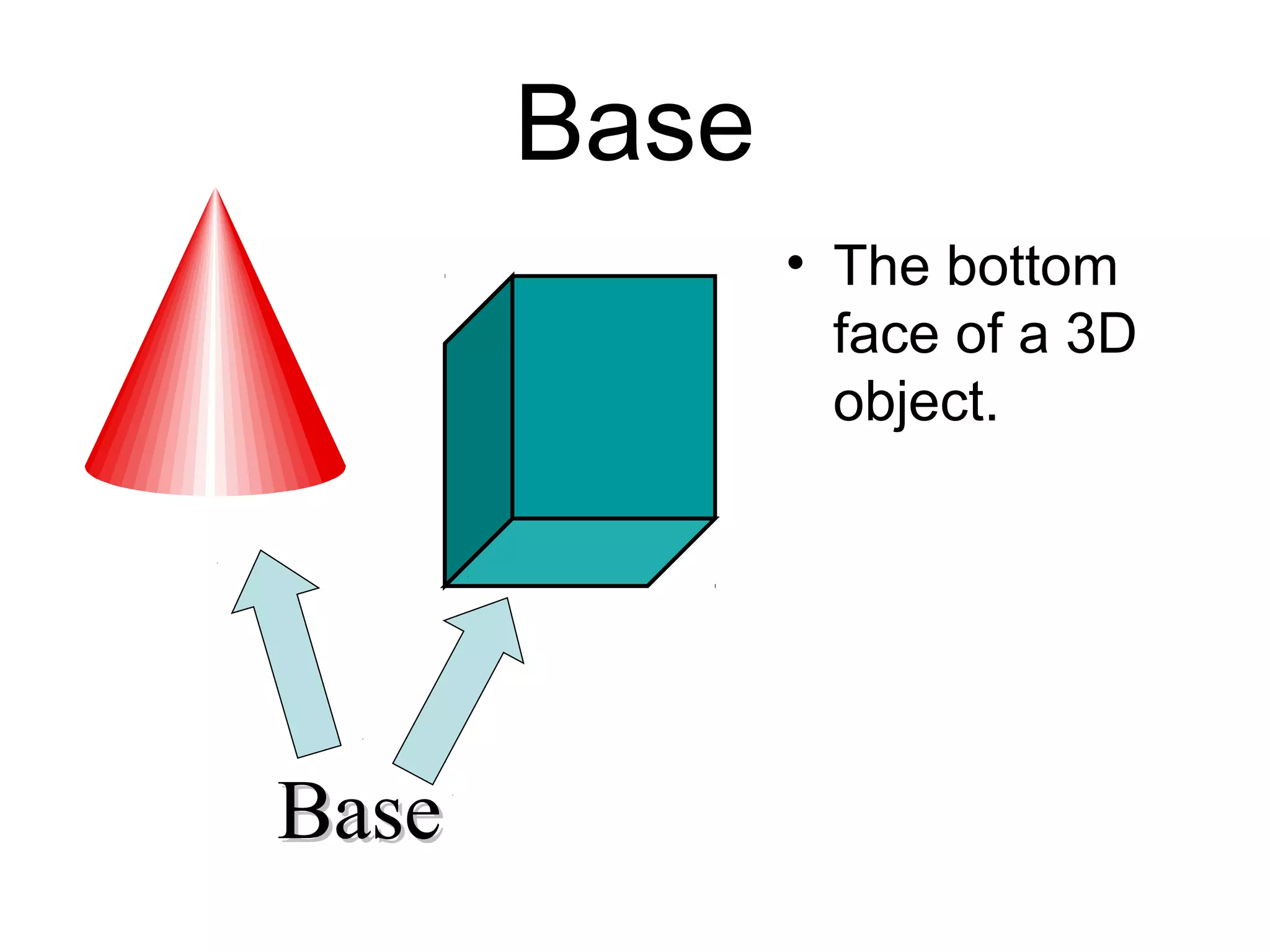
Base
• The bottom
face of a 3D
object.
BaseBase
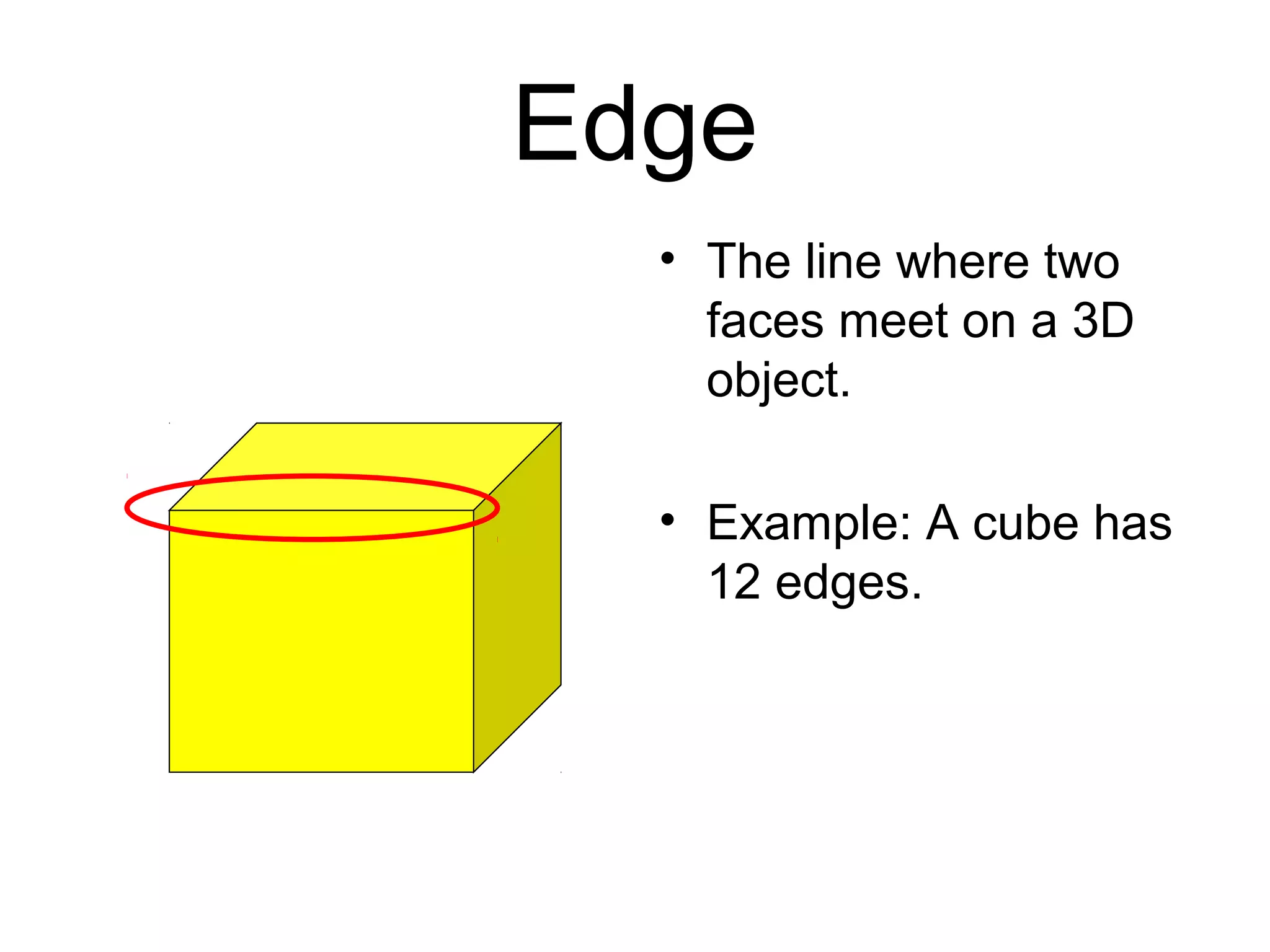
Edge
• The line where two
faces meet on a 3D
object.
• Example: A cube has
12 edges.
Corner
• The point where three
or more edges touch.
• This cube has 12
corners all together.
Vertex (Vertices)
• The point where three
or more edges meet.
• This cube has 12
vertices all together.
Cube
• A 3D shape (you can
hold it).
• It has 6 equal square
faces.
• Cubes in daily life:
– A box
– Blocks
– Dice
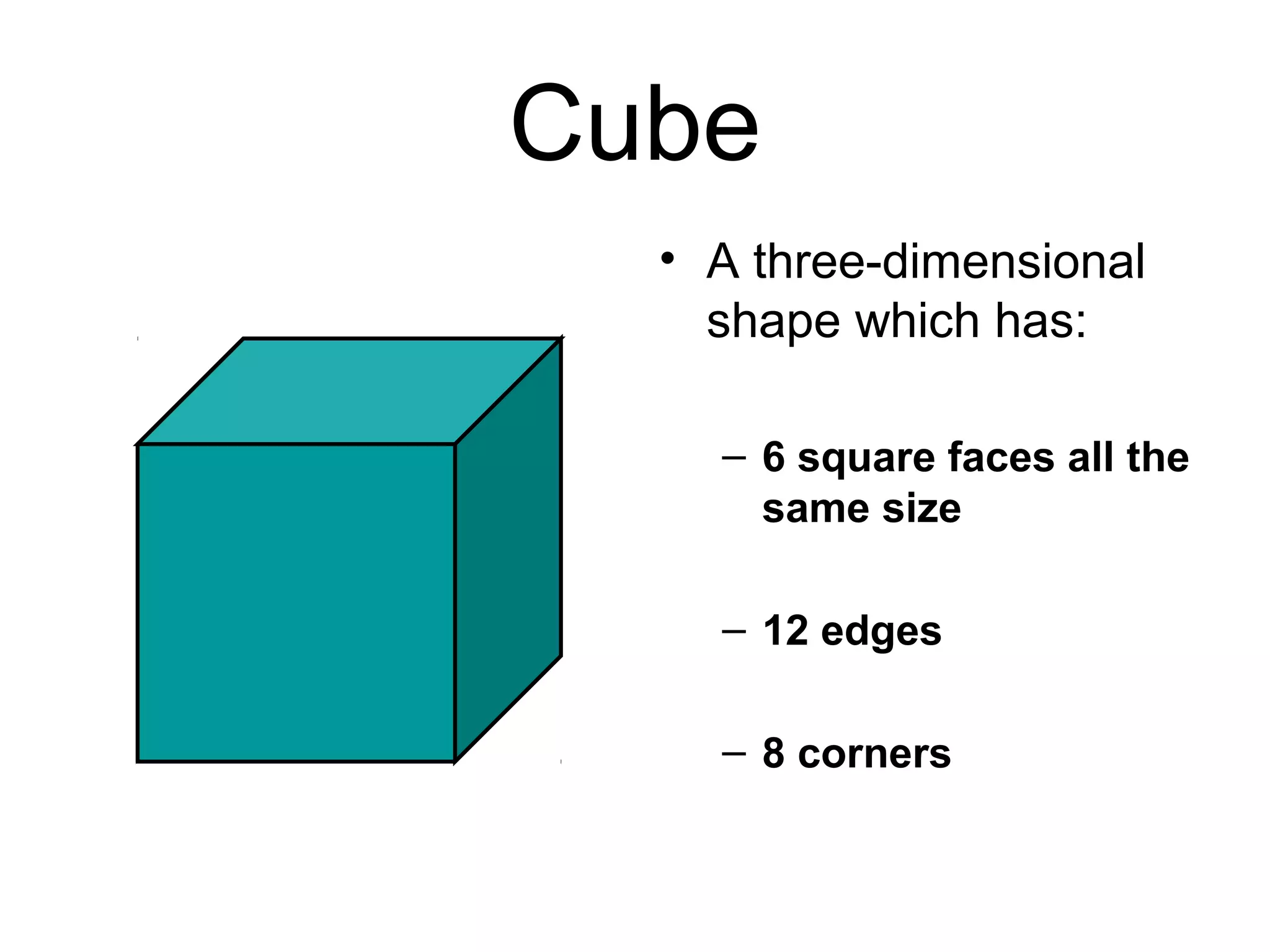
Cube
• A three-dimensional
shape which has:
– 6 square faces all the
same size
– 12 edges
– 8 corners
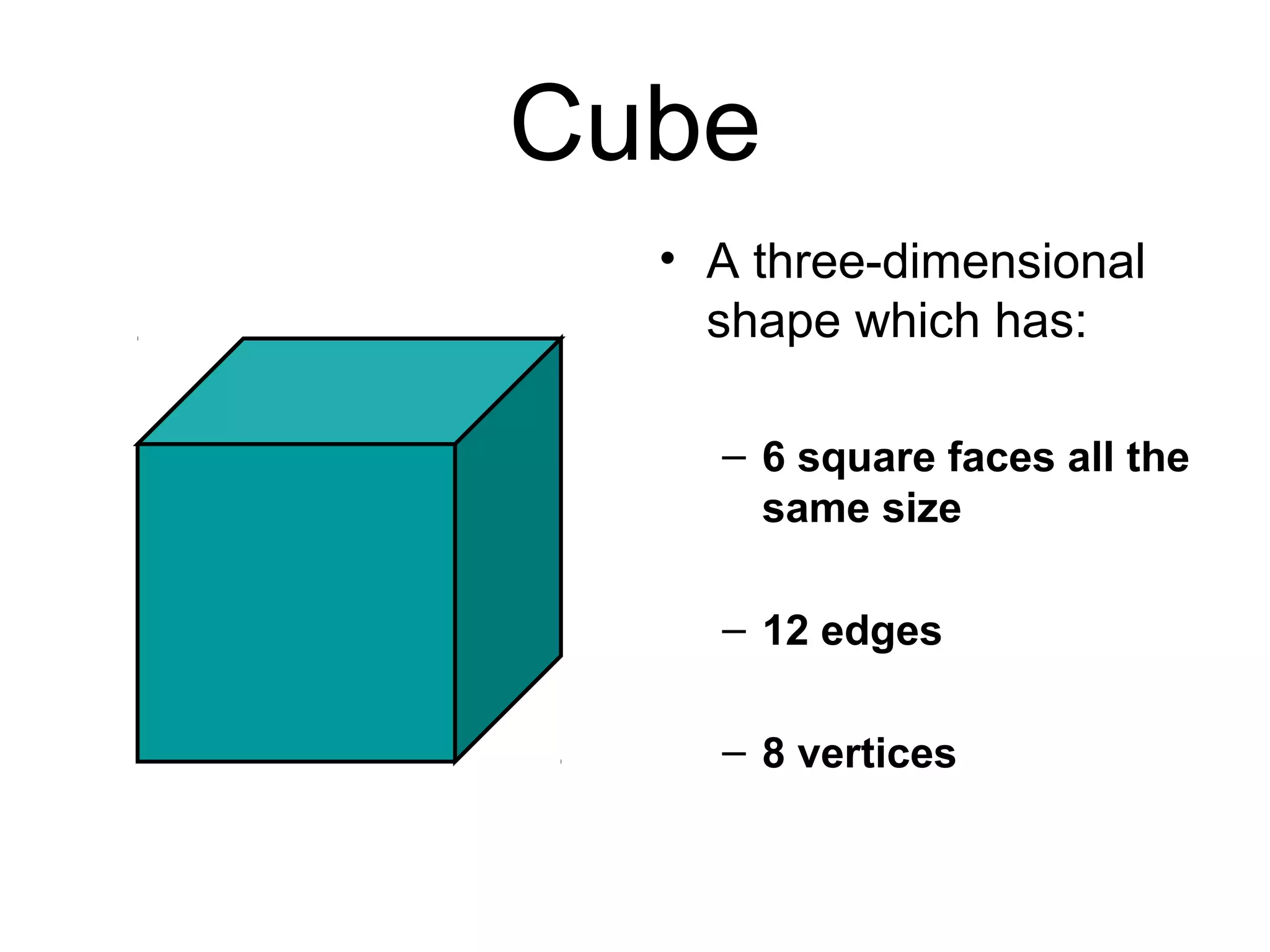
Cube
• A three-dimensional
shape which has:
– 6 square faces all the
same size
– 12 edges
– 8 vertices
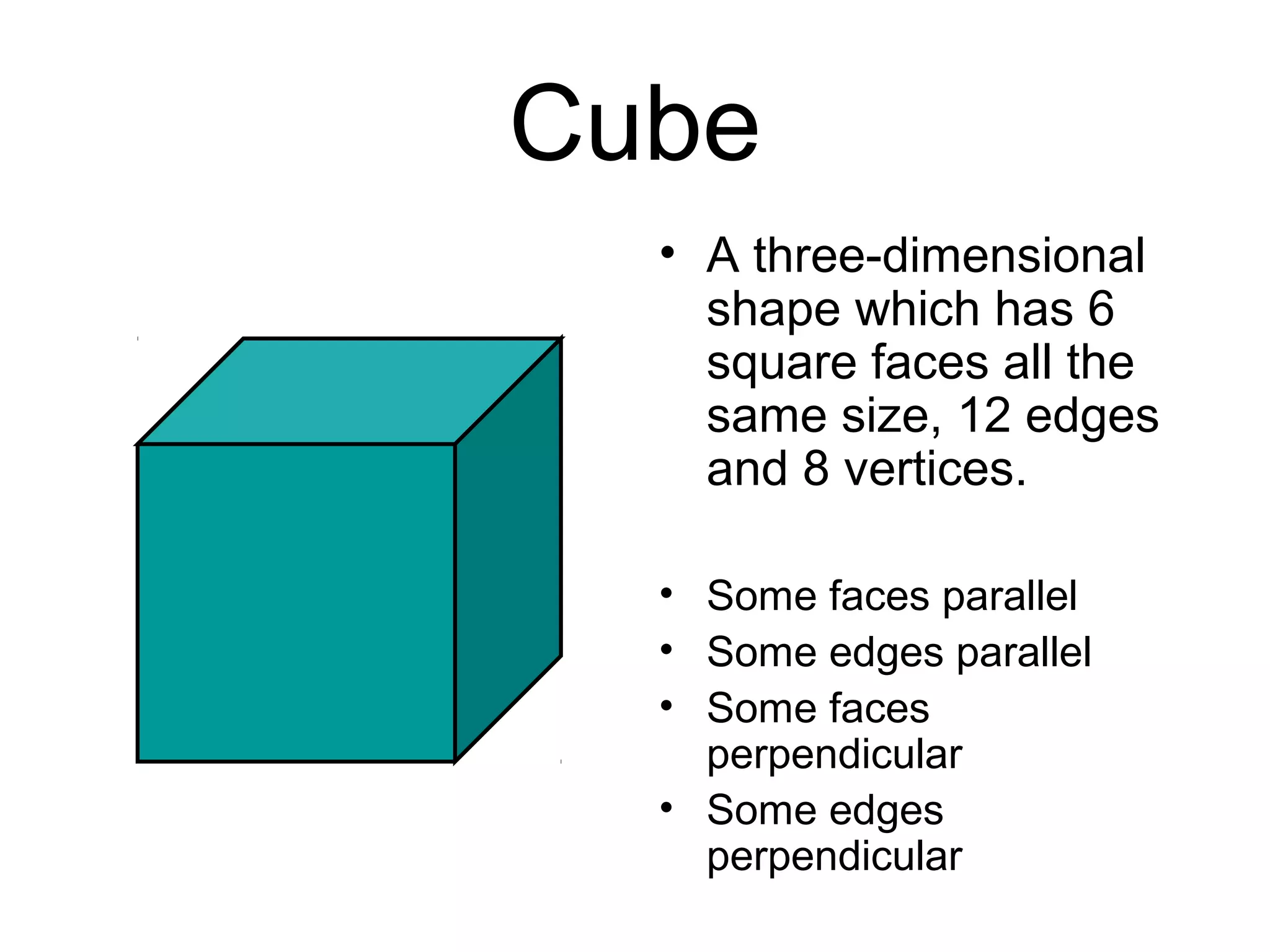
Cube
• A three-dimensional
shape which has 6
square faces all the
same size, 12 edges
and 8 vertices.
• Some faces parallel
• Some edges parallel
• Some faces
perpendicular
• Some edges
perpendicular
Sphere
• A 3D shape (you can
hold it) that can roll.
• A Sphere has no
corners or edges
• Spheres in daily life:
– A Ball
– A Globe
– A Marble
Sphere
• A perfectly round
three-dimensional
shape, like a ball. It
has only one curved
surface.
• A sphere has
– 0 faces
– 0 edges
– 0 corners
Sphere
• A perfectly round
three-dimensional
shape, like a ball. It
has only one curved
surface.
• A sphere has
– 0 faces
– 0 edges
– 0 vertices
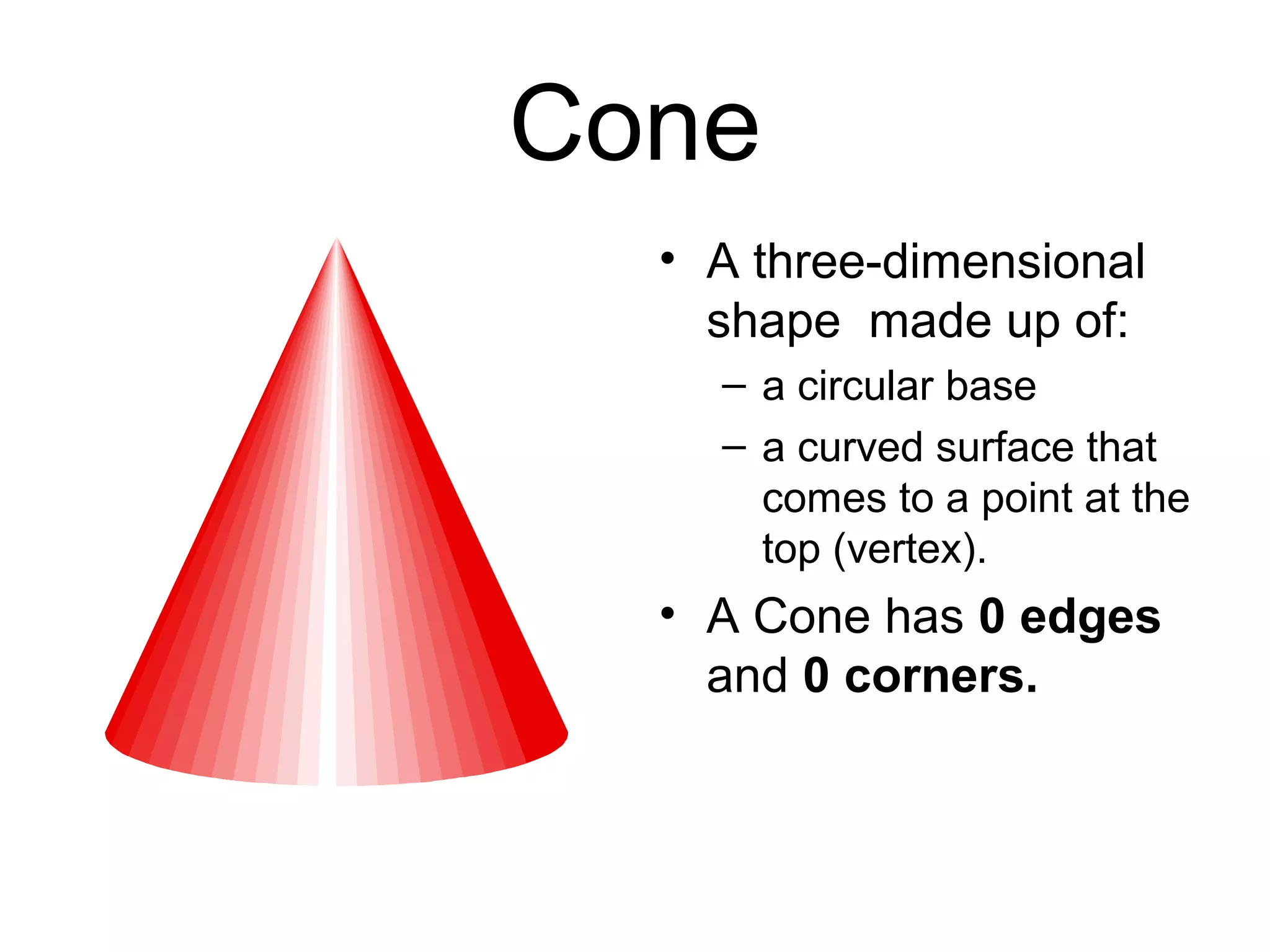
Cone
• A 3D shape (you can
hold it) that can roll.
• A Cone has a circle at
its base and a curved
surface that comes to
a point at its top
(vertex).
• Cones in daily life:
– Ice Cream Cone
– A Party Hat
Cone
• A three-dimensional
shape made up of:
– a circular base
– a curved surface that
comes to a point at the
top (vertex).
• A Cone has 0 edges
and 0 corners.
Cone
• A three-dimensional
shape made up of:
– a circular base
– a curved surface that
comes to a point at the
top (vertex).
• A Cone has 0 edges
and 0 vertices.
Cylinder
• A 3D shape (you can
hold it) that can roll.
• A Cylinder has 2
equal circles on its
ends.
• Cylinders in daily life:
– A Soup Can
– A Roll of Toilet Paper
Cylinder
• A three-dimensional
shape with one
curved surface and 2
equal circles on its
ends.
• A Cylinder has 2
faces, 1 surface, 0
edges and
0 corners.
Cylinder
• A three-dimensional
shape with one
curved surface and 2
equal circles on its
ends.
• A Cylinder has 2
faces, 1 surface, 0
edges and
0 vertices.
Pyramid
• A three-dimensional
shape which has a
polygon for its base
and triangular faces
which meet at one
point (vertex).
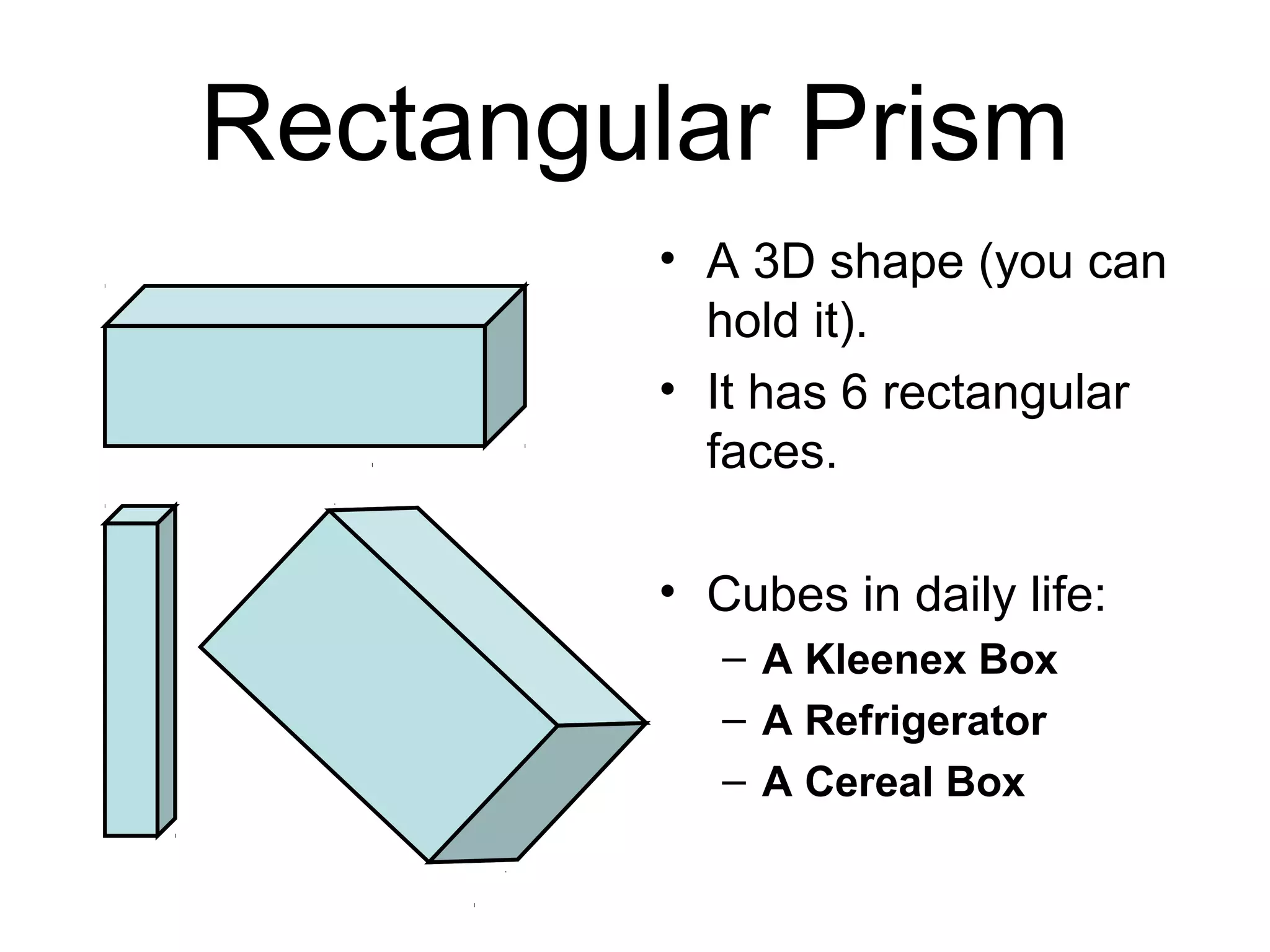
Rectangular Prism
• A 3D shape (you can
hold it).
• It has 6 rectangular
faces.
• Cubes in daily life:
– A Kleenex Box
– A Refrigerator
– A Cereal Box
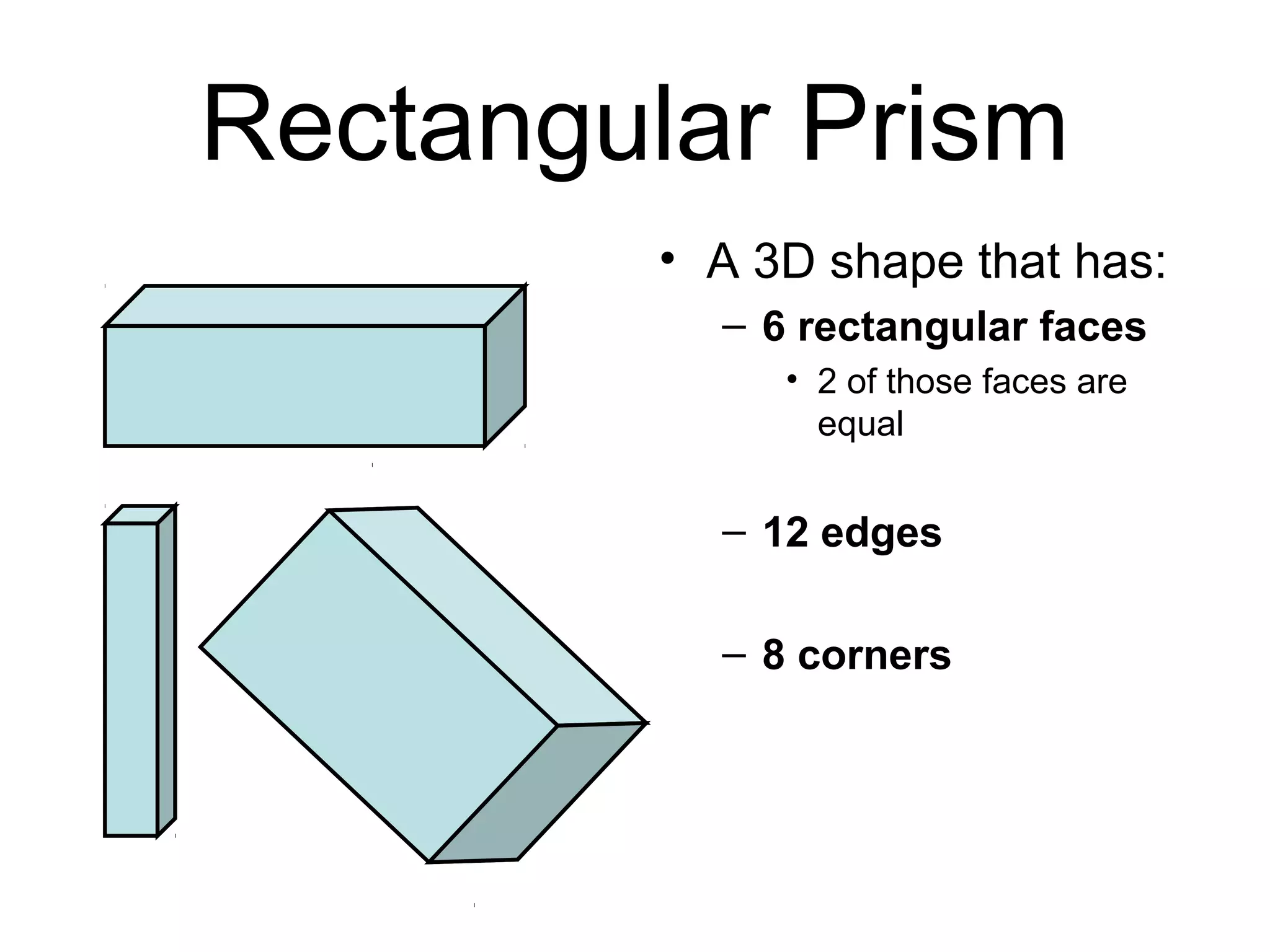
Rectangular Prism
• A 3D shape that has:
– 6 rectangular faces
• 2 of those faces are
equal
– 12 edges
– 8 corners
Rectangular Prism
• A 3D shape that has:
– 6 rectangular faces
• 2 of those faces are
equal
– 12 edges
– 8 vertices
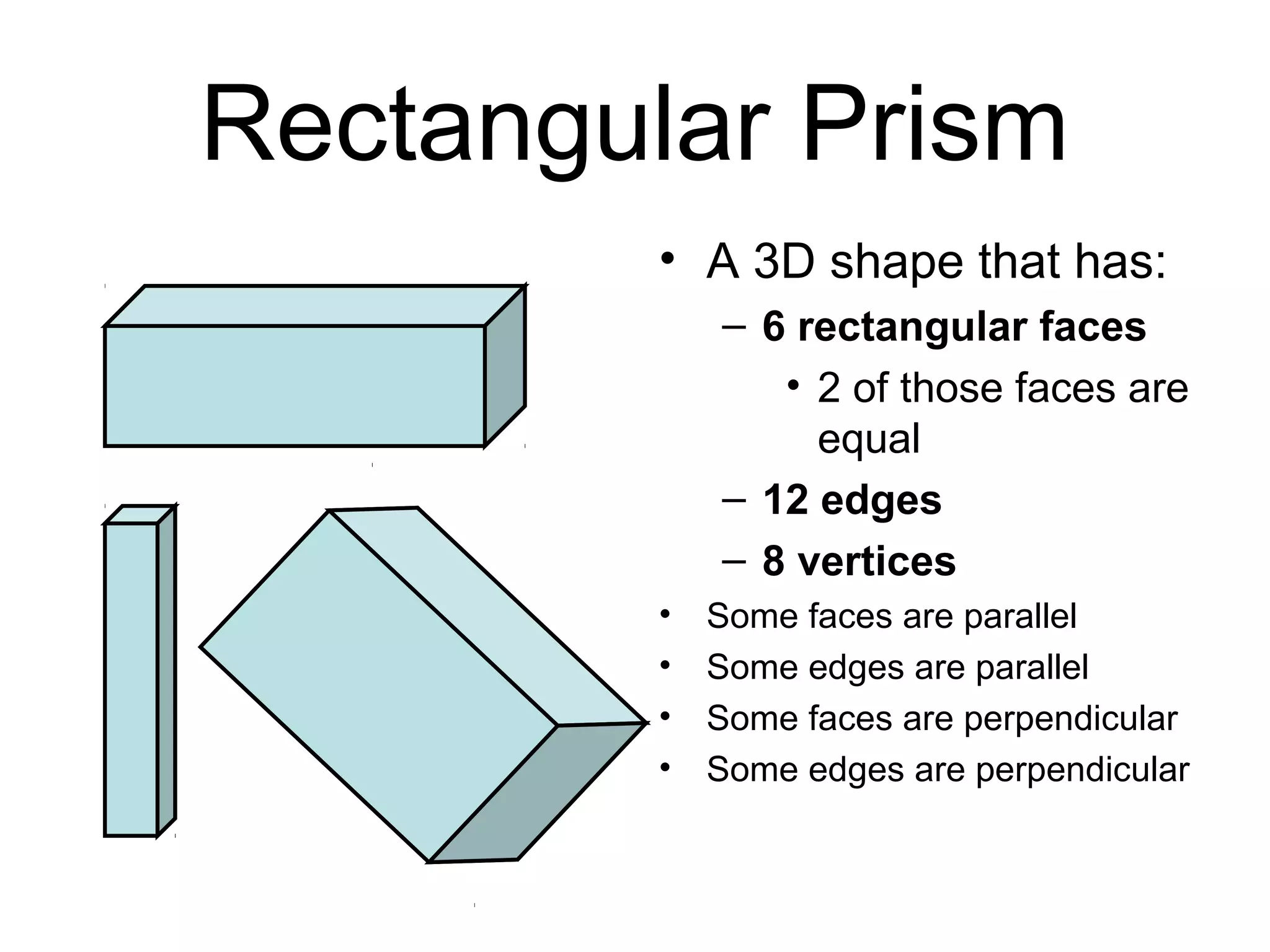
Rectangular Prism
• A 3D shape that has:
– 6 rectangular faces
• 2 of those faces are
equal
– 12 edges
– 8 vertices
• Some faces are parallel
• Some edges are parallel
• Some faces are perpendicular
• Some edges are perpendicular
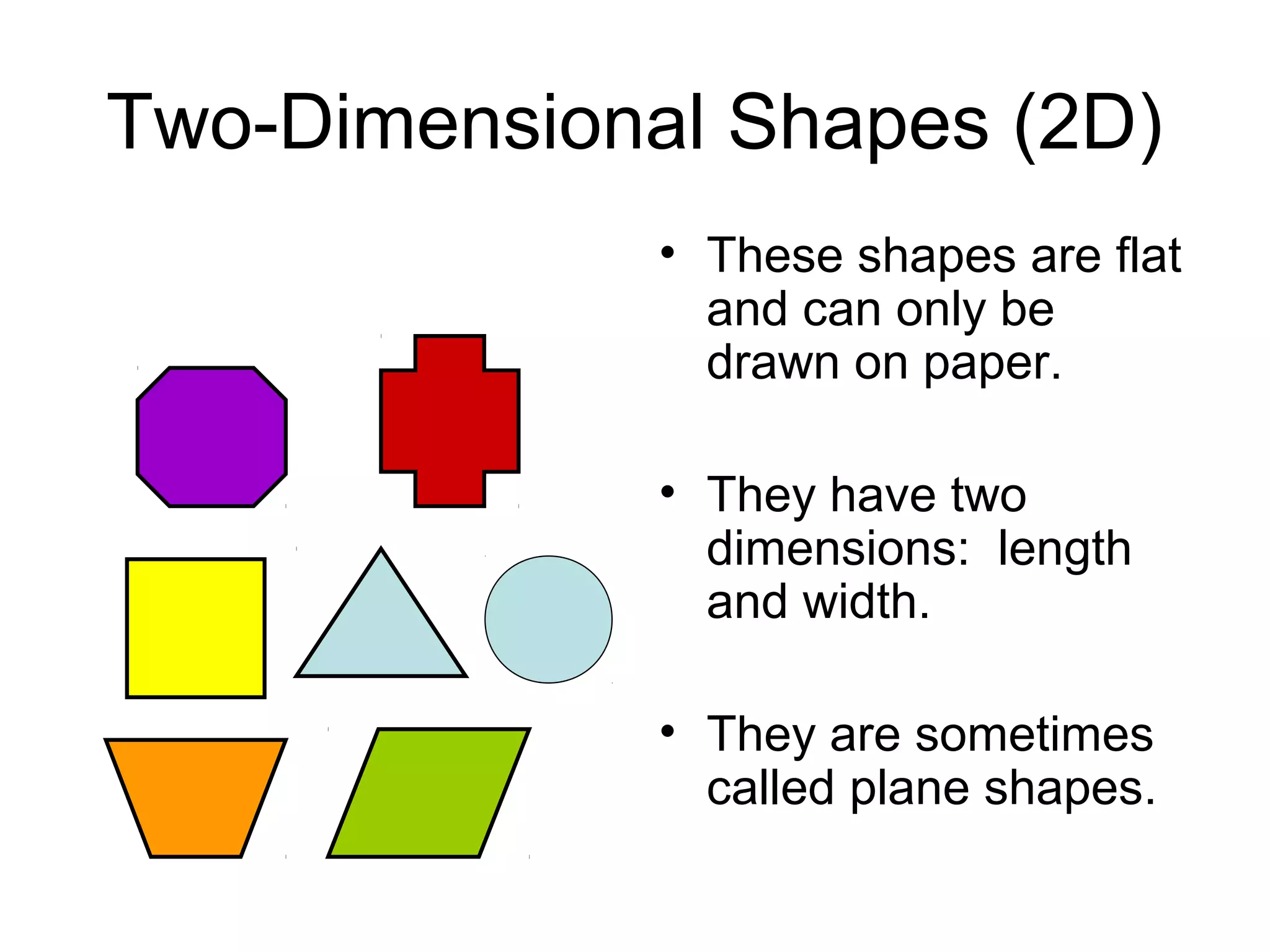
Two-Dimensional Shapes (2D)
• These shapes are flat
and can only be
drawn on paper.
• They have two
dimensions: length
and width.
• They are sometimes
called plane shapes.
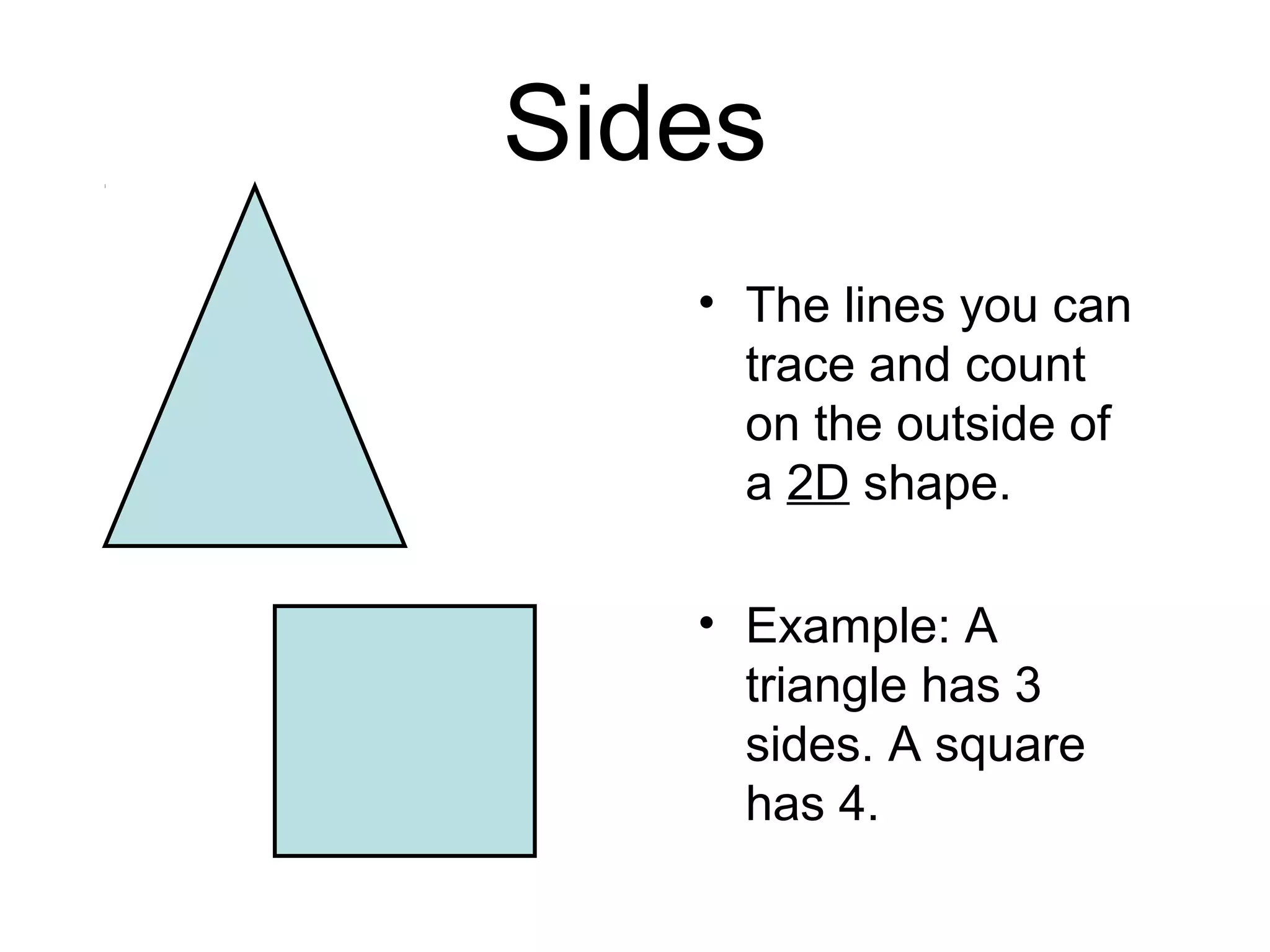
Sides
• The lines you can
trace and count
on the outside of
a 2D shape.
• Example: A
triangle has 3
sides. A square
has 4.
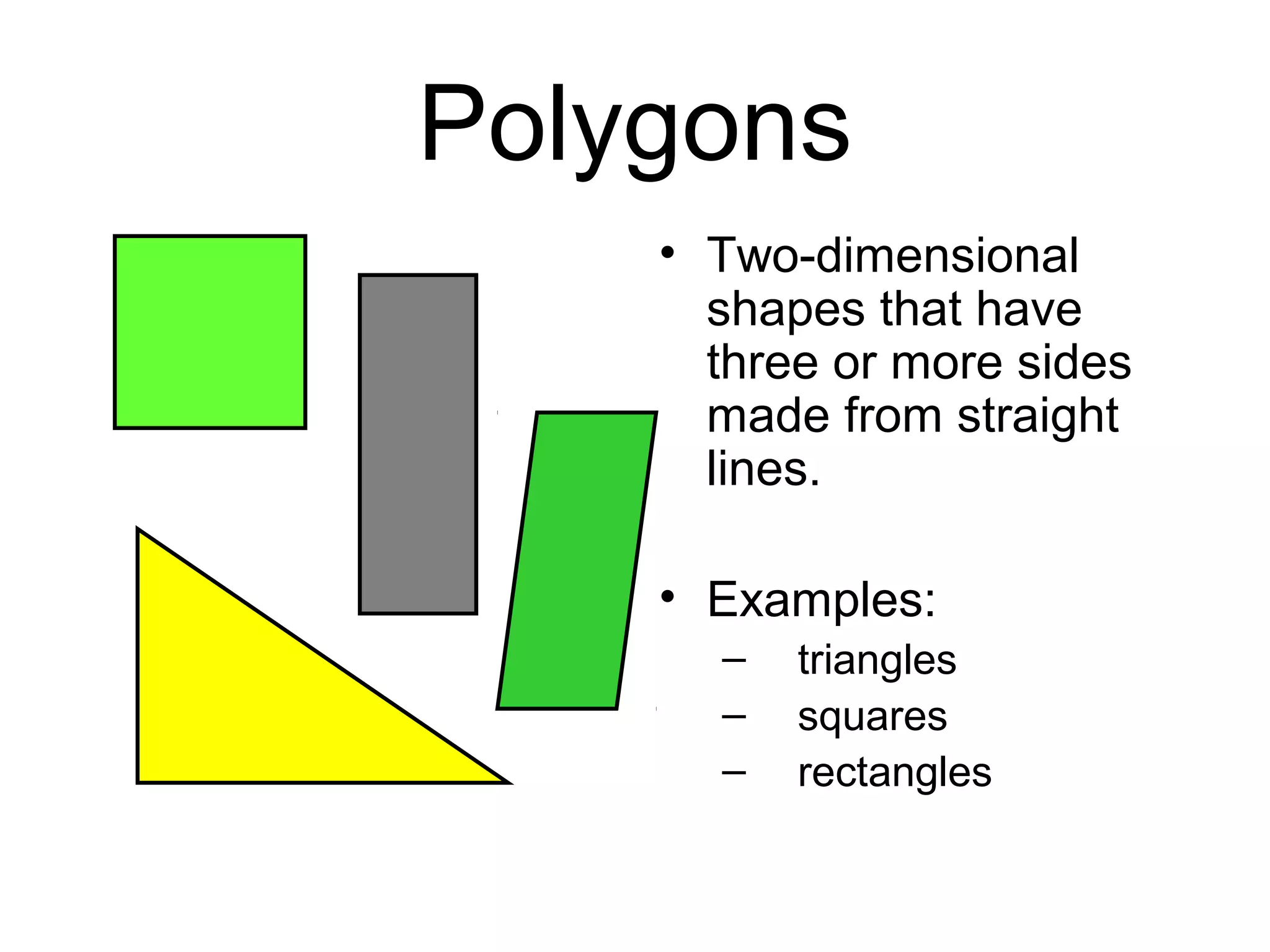
Polygons
• Two-dimensional
shapes that have
three or more sides
made from straight
lines.
• Examples:
– triangles
– squares
– rectangles
Quadrilaterals
• Any two-dimensional
shapes (polygon)
with 4 straight sides
and 4 angles
• Ex.
rhombus kite
rectangle trapezoid
square
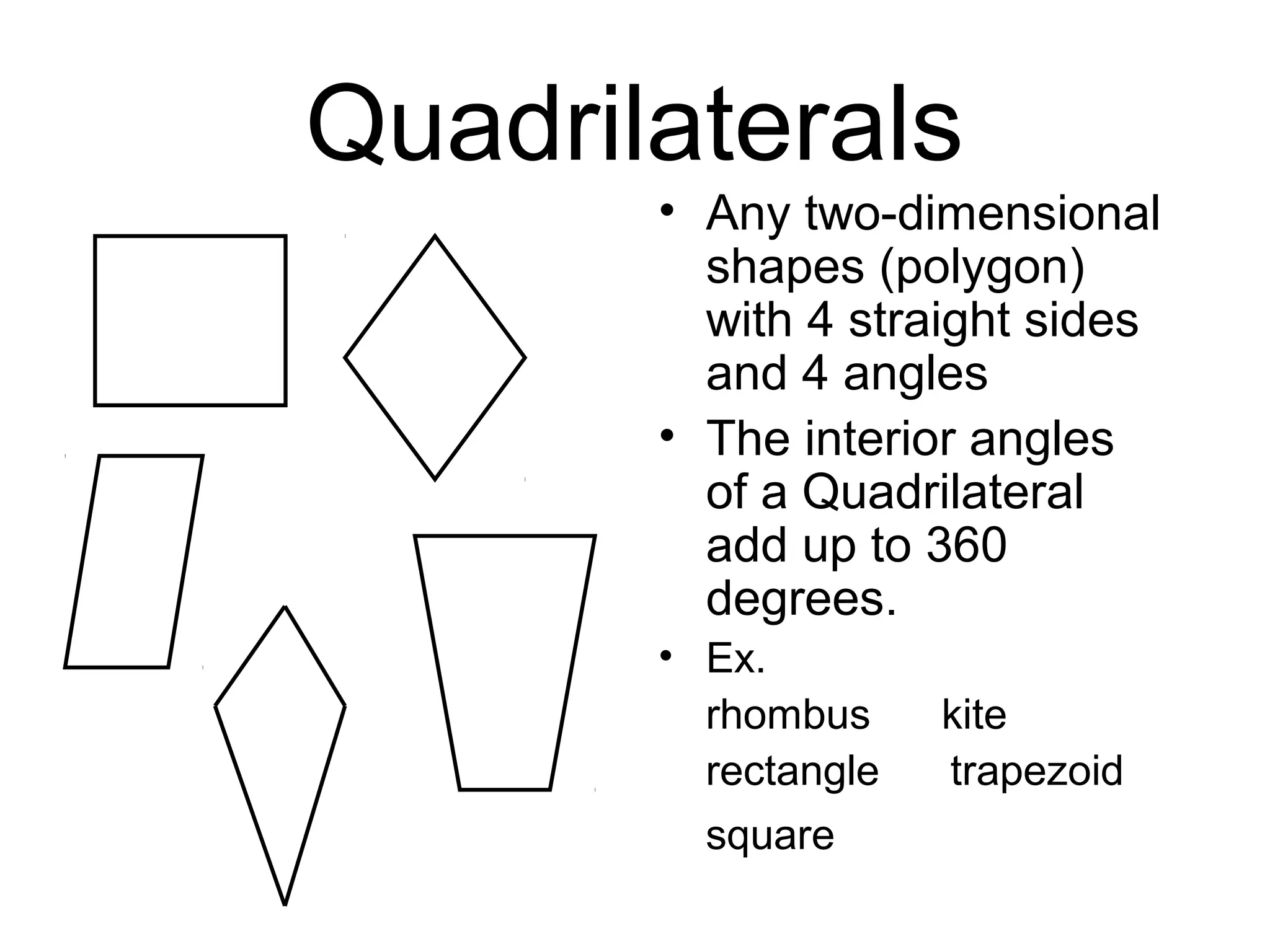
Quadrilaterals
• Any two-dimensional
shapes (polygon)
with 4 straight sides
and 4 angles
• The interior angles
of a Quadrilateral
add up to 360
degrees.
• Ex.
rhombus kite
rectangle trapezoid
square
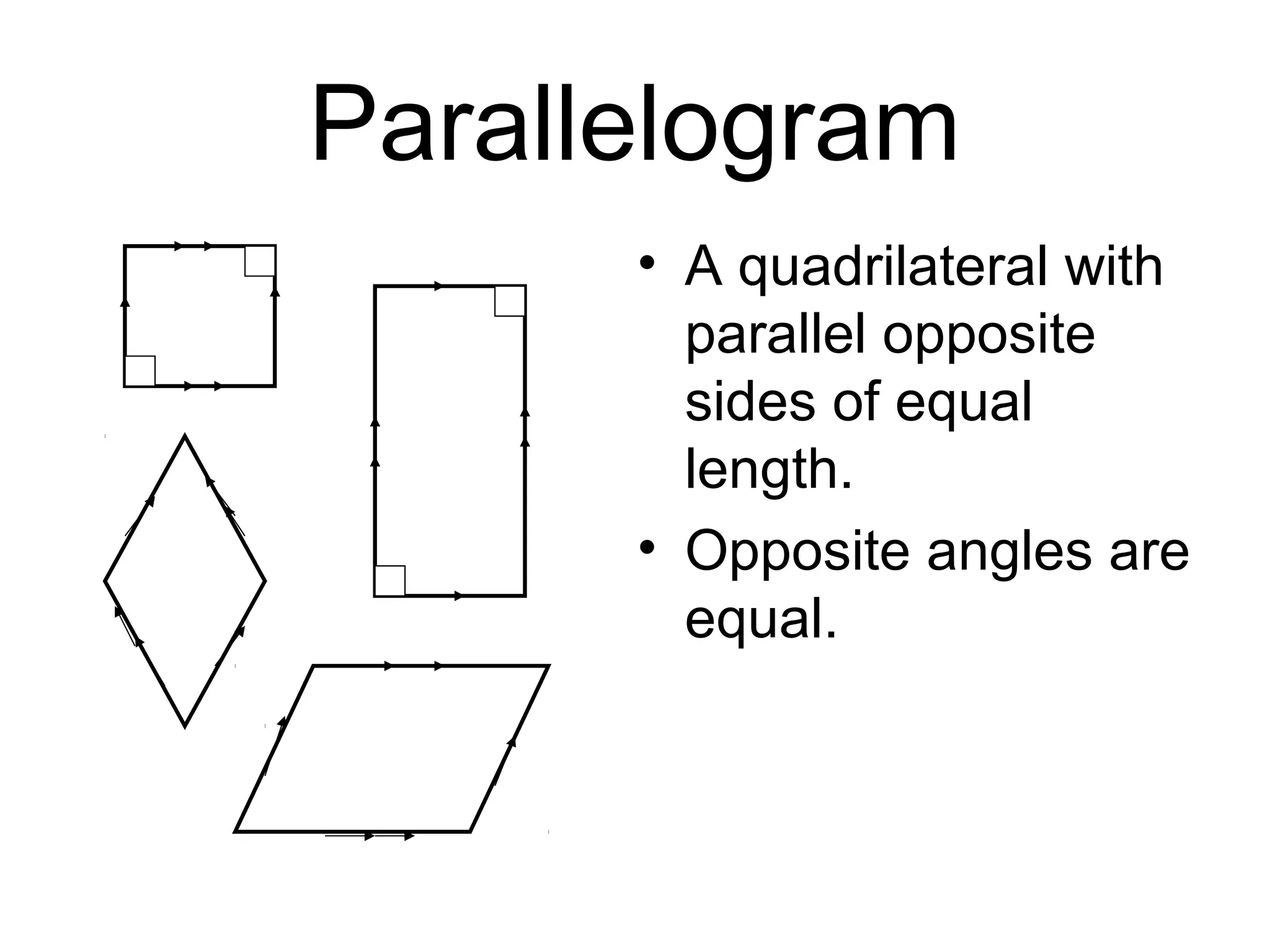
Parallelogram
• A quadrilateral with
parallel opposite
sides of equal
length.
• Opposite angles are
equal.
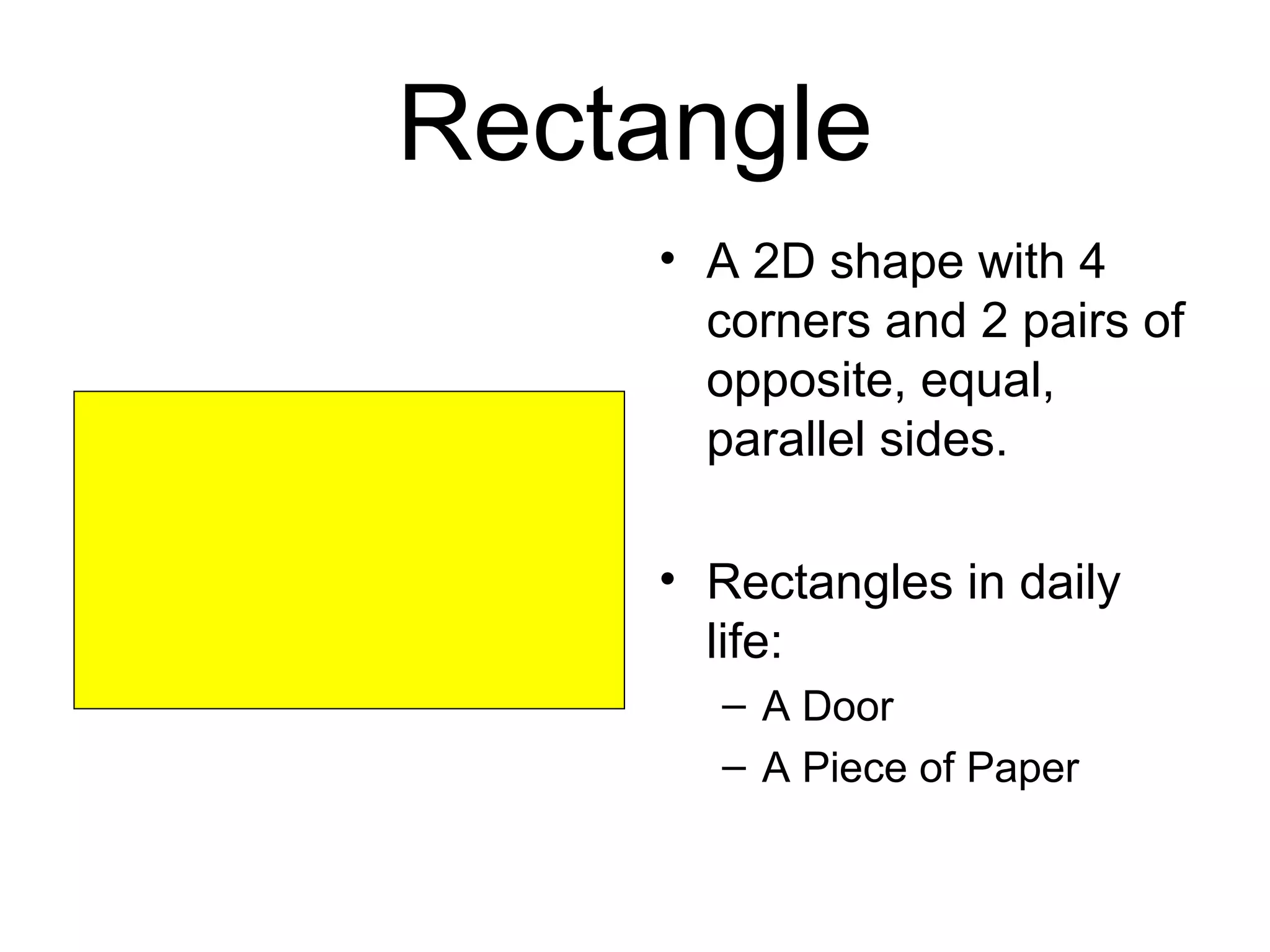
Rectangle
• A 2D shape with 4
corners and 2 pairs of
opposite, equal,
parallel sides.
• Rectangles in daily
life:
– A Door
– A Piece of Paper
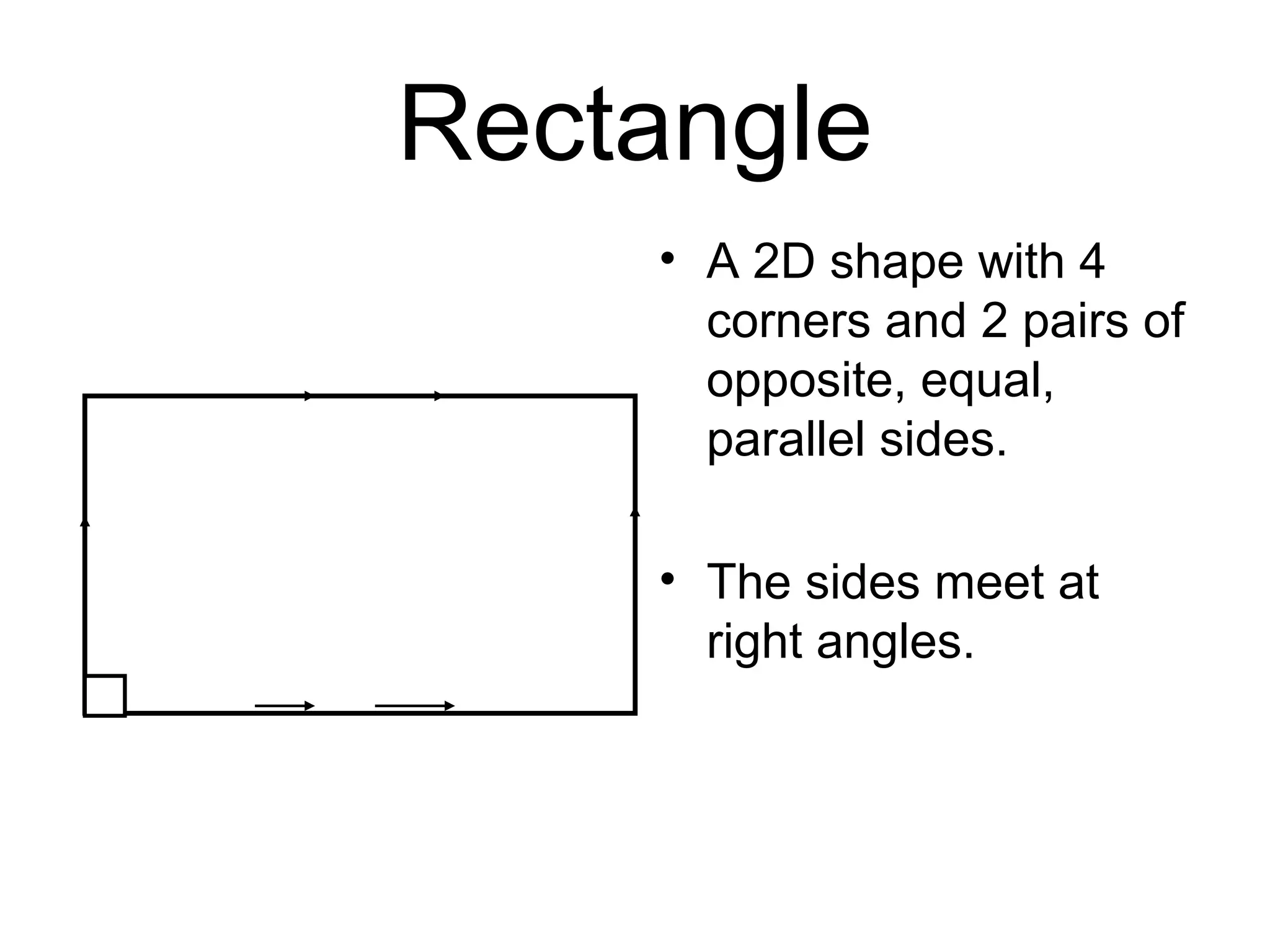
Rectangle
• A 2D shape with 4
corners and 2 pairs of
opposite, equal,
parallel sides.
• The sides meet at
right angles.
Rhombus
• A 2D shape with four
sides.
Rhombus
• A 2D, four-sided
shape with opposite
sides that are parallel.
• All the sides are the
same length.
Rhombus
• A 2D, four-sided
shape with opposite
sides that are parallel.
• All the sides are the
same length.
• Diagonals of a
Rhombus bisect each
other at right angles.
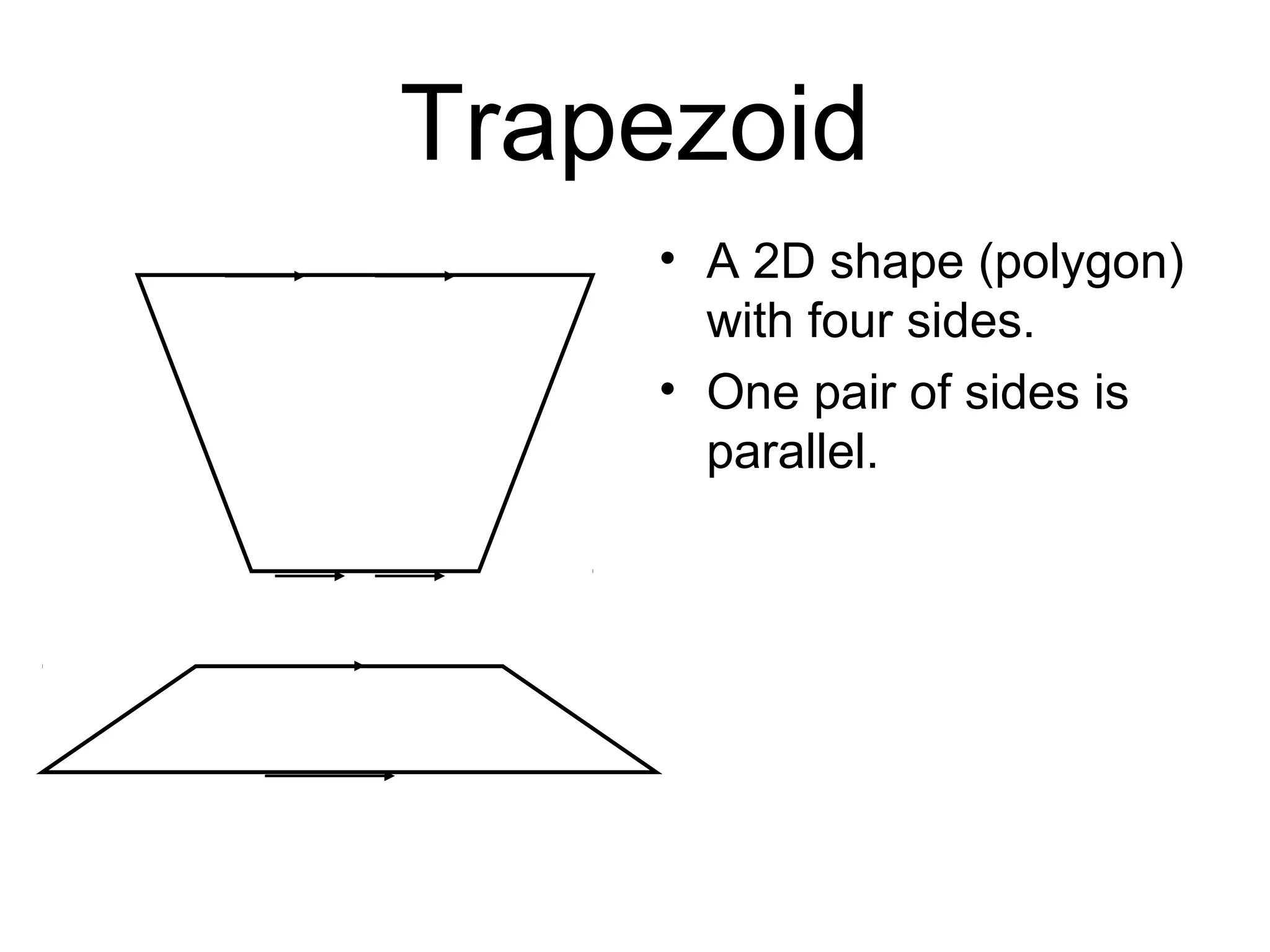
Trapezoid
• A 2D shape (polygon)
with four sides.
• One pair of sides is
parallel.
Trapezoid
• A 2D shape (polygon)
with four sides.
• One pair of sides is
parallel.
Circle
• A 2D shape with no
corners or edges.
• Circles in daily life:
– A Clock
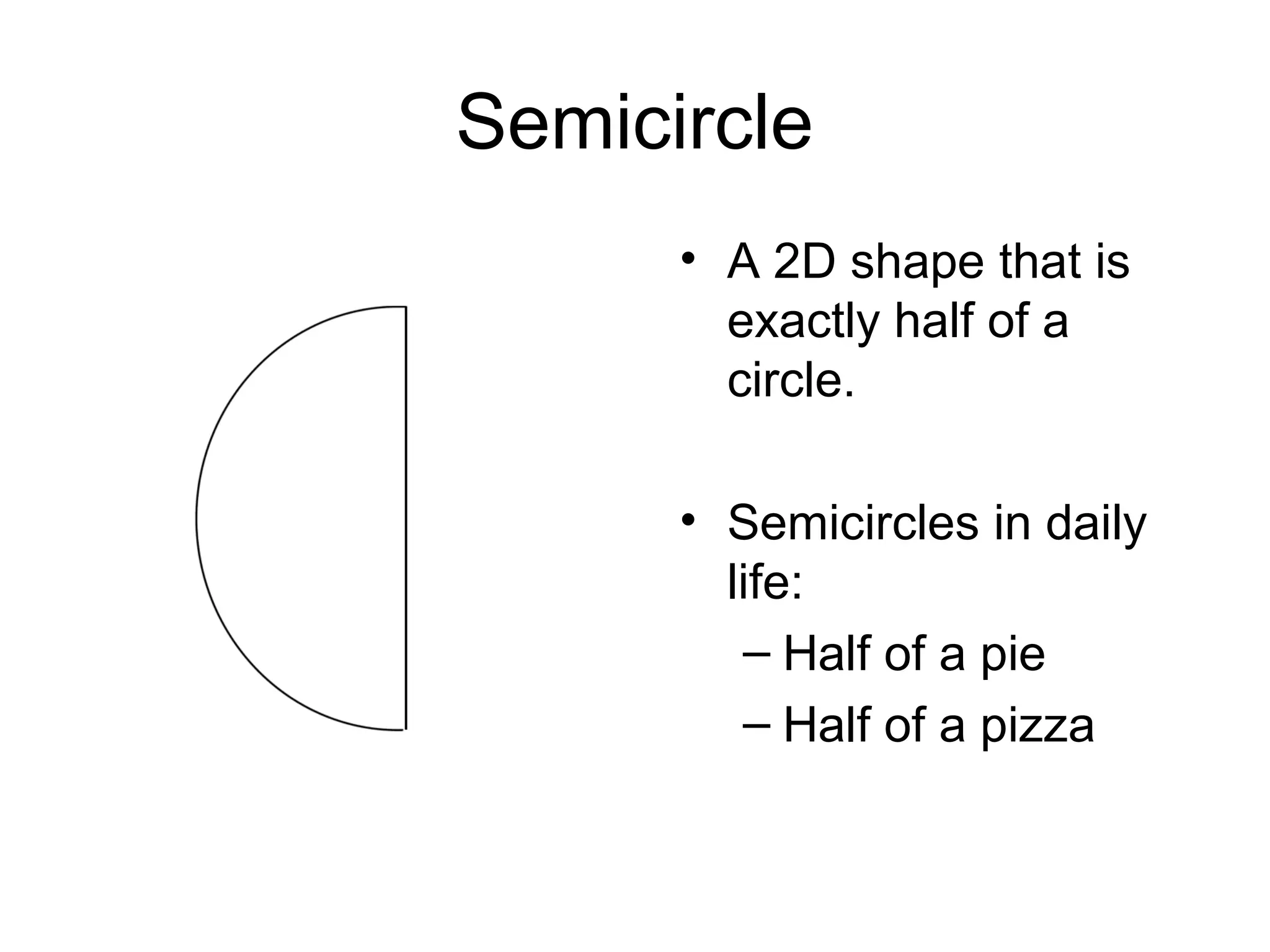
Semicircle
• A 2D shape that is
exactly half of a
circle.
• Semicircles in daily
life:
– Half of a pie
– Half of a pizza
Square
• 2D shape with 4
equal sides and 4
corners
• Squares in daily life:
– A Window
– Some Floor Tiles
– Some Ceiling Tiles
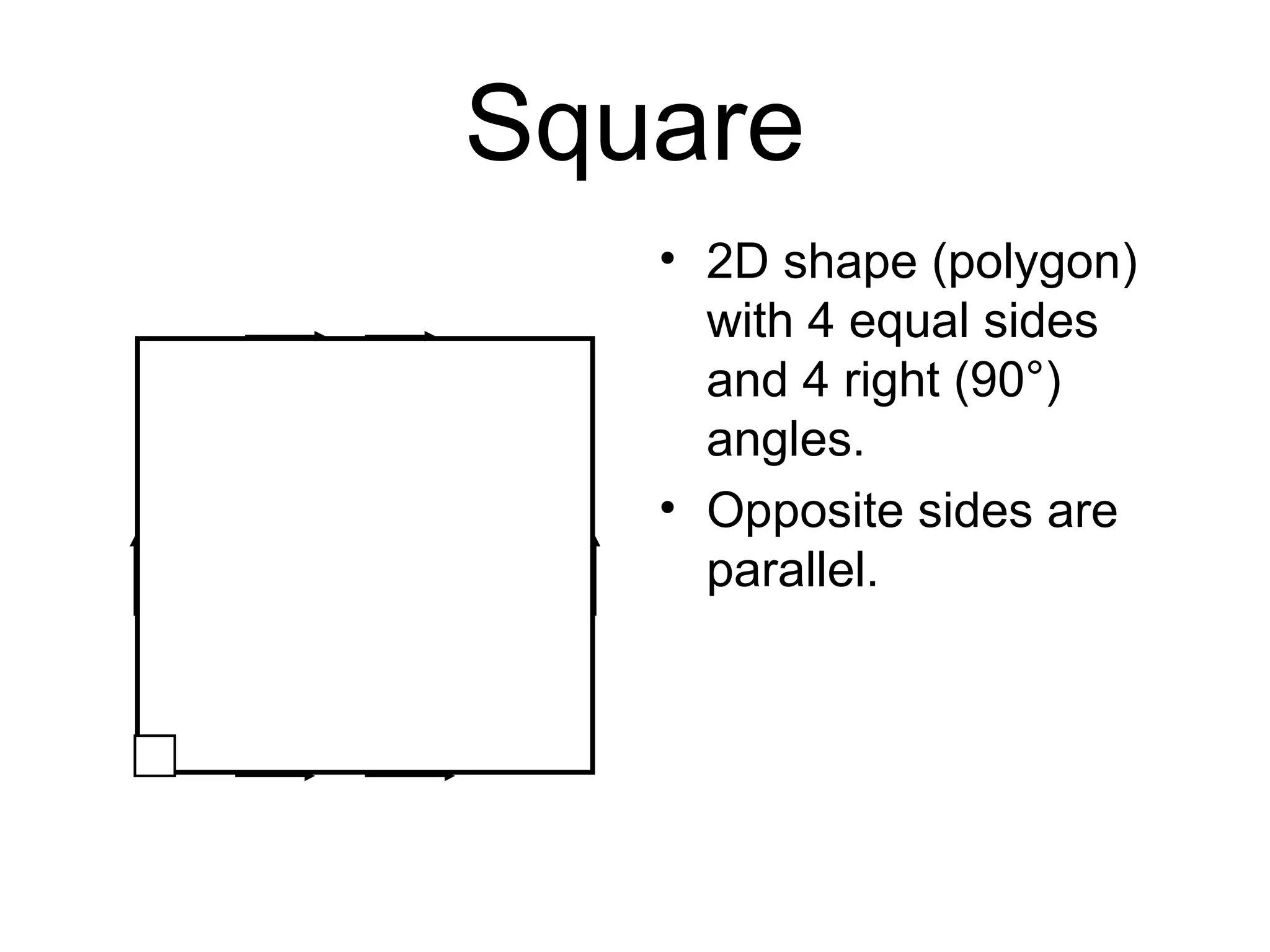
Square
• 2D shape (polygon)
with 4 equal sides
and 4 right (90°)
angles.
• Opposite sides are
parallel.
Triangle
• Two-dimensional
shape with three
straight sides and
three corners.
• Triangles in daily life:
– The front of a tent
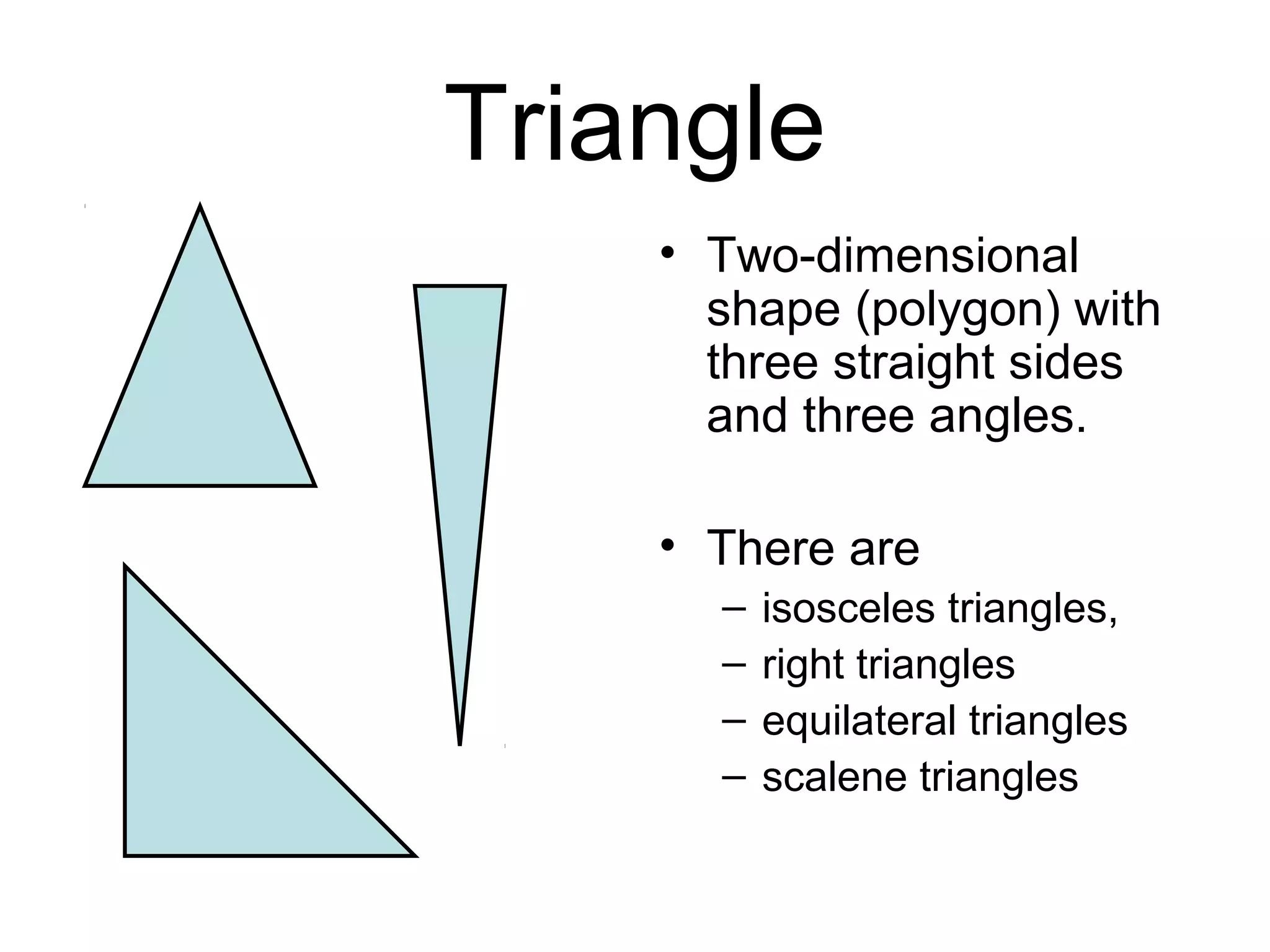
Triangle
• Two-dimensional
shape (polygon) with
three straight sides
and three angles.
• There are
– isosceles triangles,
– right triangles
– equilateral triangles
– scalene triangles
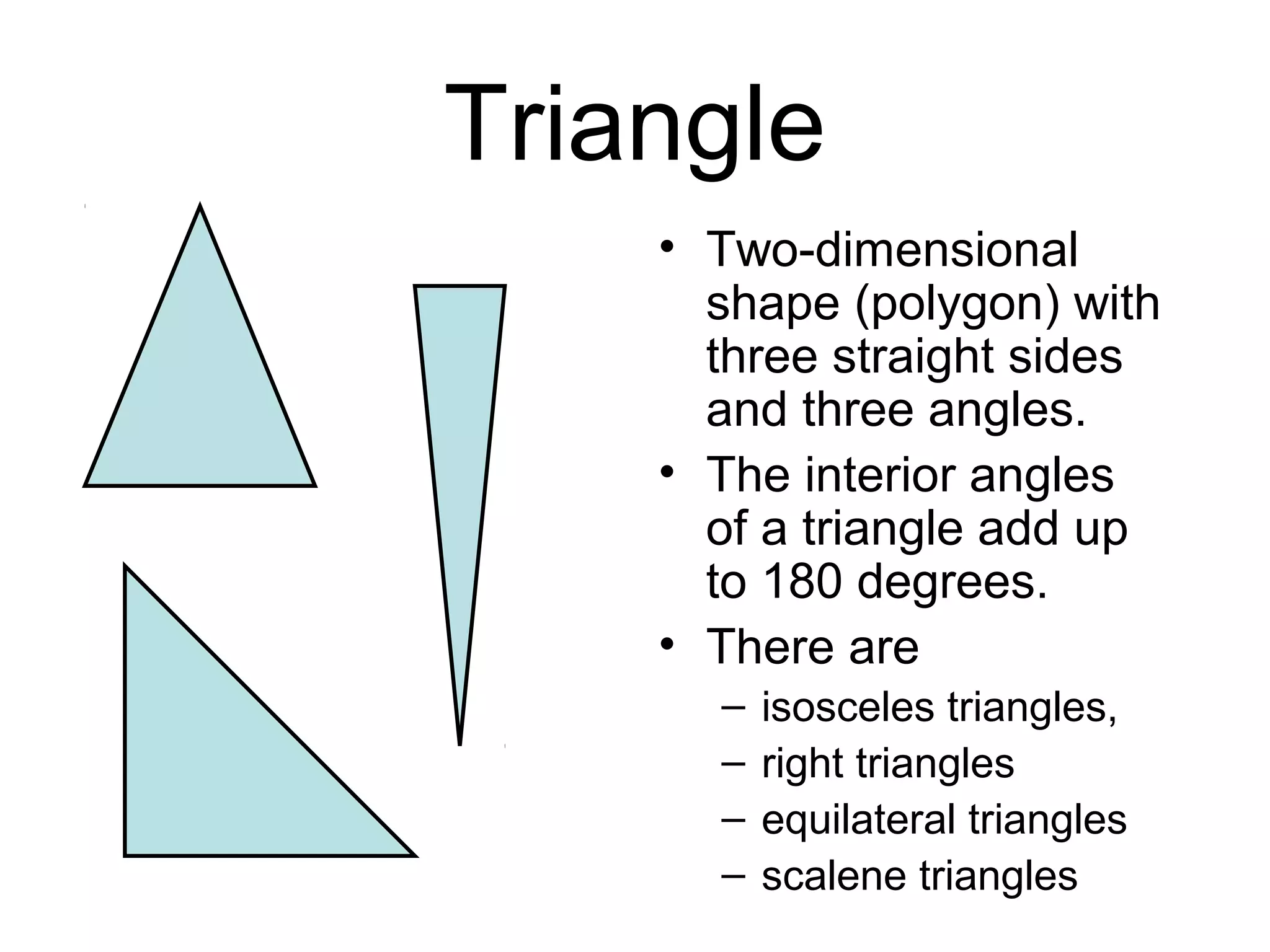
Triangle
• Two-dimensional
shape (polygon) with
three straight sides
and three angles.
• The interior angles
of a triangle add up
to 180 degrees.
• There are
– isosceles triangles,
– right triangles
– equilateral triangles
– scalene triangles
Patterns
• A repeating design.
Examples:Examples:
A BA B
A A BA A B
GrowingGrowing
Line
• A long, thin
mark that
continues
forever.
• It has no
endpoints.
Line
• An infinitely
long, thin, two-
dimensional
mark
• It has no
endpoints.
Parallel
• Lines that are the
same distance apart
from each other.
• These type of lines
stay the same
distance apart for
their whole length.
They do not need to
be straight or the
same length.
• They never intersect.
Perpendicular
• Lines that intersect at
a perfect right angle
(90º) to one another.
• In solid shapes,
edges could be at a
right angle to one
another.
• Faces could also be
at right angles to one
another.
Intersecting
• Crossing over one
another.
• These lines are
intersecting.
Line Segment
• A section of line
bounded by two
endpoints.
• A line segment
is not
continuous.
Point
• A single position
in space (dot).
Distance
• The length
between two
points or
objects.
AA BB
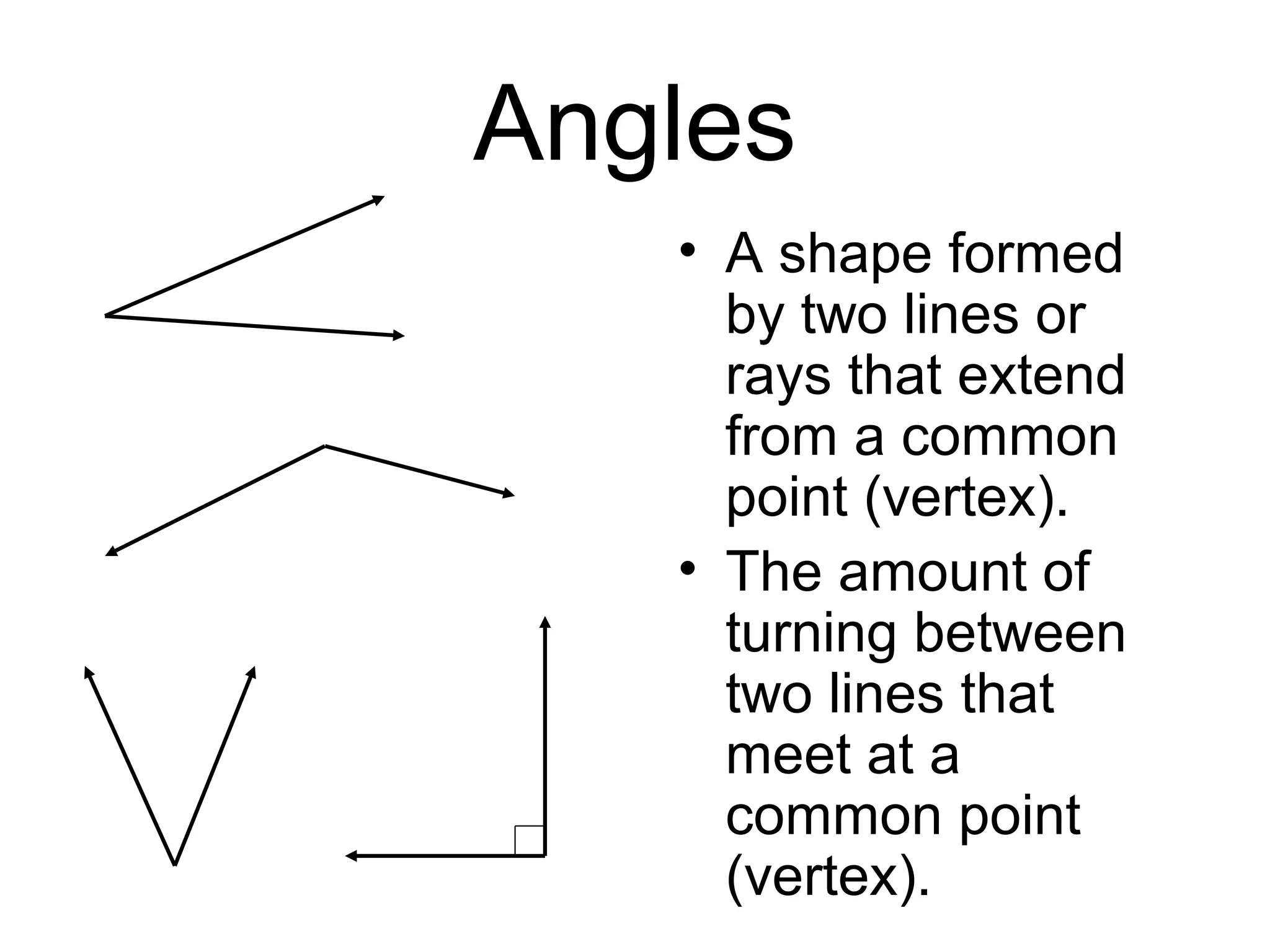
Angles
• A shape formed
by two lines or
rays that extend
from a common
point (vertex).
• The amount of
turning between
two lines that
meet at a
common point
(vertex).
Vertex (angles)
• The common
point between
two or more
rays or line
segments.
Acute Angle
• An angle that
measures less
than 90 degrees.
Right Angle
• An angle whose
measure is
exactly 90
degrees.
Obtuse Angle
• An angle whose
measure is more
than 90 degrees.
Straight Angle
• An angle whose
measure is
exactly 180
degrees.
• A straight line.
Interior Angles
• Any angle
inside a
polygon.
Congruent
• Two figures are
congruent if they
have the same
shape and size.
• Two angles are
congruent if they
have the same
measure.
Vertical Angles
• A pair of angles
directly opposite
each other
formed by the
intersection of
straight lines.
• Vertical angels
are congruent
(equal).
Isosceles Triangle
• A triangle with
2 equal sides
and 2 equal
angles
Equilateral Triangle
• A triangle with
3 equal sides and
3 equal angles.
Right Triangle
• A triangle with one
right angle (90
degrees).
Scalene Triangles
• A triangle with 3
different side
lengths and 3
different angle
measures.
Symmetry
• An object is
symmetrical
when you can
fold it in half and
the two halves
are congruent.
• One half is a
mirror image of
the other.
Symmetrical Not Symmetrical

Solid figures 6th grade power point

  • 1.
    Three-dimensional Shapes (3D) •These shapes are solid or hollow, you could hold them in your hand. • They have three dimensions: length, width and height.
  • 2.
    Solid • A shapeyou can hold (3D). • A solid has length, width and height. • Examples: – Cube – Cylinder – Sphere – Cone – Prism
  • 3.
    Surface • The curvedpart of a 3D shape. • Cylinders and cones have surfaces.
  • 4.
    Face • Part ofa 3D shape that is flat. • Example: A cube has 6 faces.
  • 5.
    Base • The bottom faceof a 3D object. BaseBase
  • 6.
    Edge • The linewhere two faces meet on a 3D object. • Example: A cube has 12 edges.
  • 7.
    Corner • The pointwhere three or more edges touch. • This cube has 12 corners all together.
  • 8.
    Vertex (Vertices) • Thepoint where three or more edges meet. • This cube has 12 vertices all together.
  • 9.
    Cube • A 3Dshape (you can hold it). • It has 6 equal square faces. • Cubes in daily life: – A box – Blocks – Dice
  • 10.
    Cube • A three-dimensional shapewhich has: – 6 square faces all the same size – 12 edges – 8 corners
  • 11.
    Cube • A three-dimensional shapewhich has: – 6 square faces all the same size – 12 edges – 8 vertices
  • 12.
    Cube • A three-dimensional shapewhich has 6 square faces all the same size, 12 edges and 8 vertices. • Some faces parallel • Some edges parallel • Some faces perpendicular • Some edges perpendicular
  • 13.
    Sphere • A 3Dshape (you can hold it) that can roll. • A Sphere has no corners or edges • Spheres in daily life: – A Ball – A Globe – A Marble
  • 14.
    Sphere • A perfectlyround three-dimensional shape, like a ball. It has only one curved surface. • A sphere has – 0 faces – 0 edges – 0 corners
  • 15.
    Sphere • A perfectlyround three-dimensional shape, like a ball. It has only one curved surface. • A sphere has – 0 faces – 0 edges – 0 vertices
  • 16.
    Cone • A 3Dshape (you can hold it) that can roll. • A Cone has a circle at its base and a curved surface that comes to a point at its top (vertex). • Cones in daily life: – Ice Cream Cone – A Party Hat
  • 17.
    Cone • A three-dimensional shapemade up of: – a circular base – a curved surface that comes to a point at the top (vertex). • A Cone has 0 edges and 0 corners.
  • 18.
    Cone • A three-dimensional shapemade up of: – a circular base – a curved surface that comes to a point at the top (vertex). • A Cone has 0 edges and 0 vertices.
  • 19.
    Cylinder • A 3Dshape (you can hold it) that can roll. • A Cylinder has 2 equal circles on its ends. • Cylinders in daily life: – A Soup Can – A Roll of Toilet Paper
  • 20.
    Cylinder • A three-dimensional shapewith one curved surface and 2 equal circles on its ends. • A Cylinder has 2 faces, 1 surface, 0 edges and 0 corners.
  • 21.
    Cylinder • A three-dimensional shapewith one curved surface and 2 equal circles on its ends. • A Cylinder has 2 faces, 1 surface, 0 edges and 0 vertices.
  • 22.
    Pyramid • A three-dimensional shapewhich has a polygon for its base and triangular faces which meet at one point (vertex).
  • 23.
    Rectangular Prism • A3D shape (you can hold it). • It has 6 rectangular faces. • Cubes in daily life: – A Kleenex Box – A Refrigerator – A Cereal Box
  • 24.
    Rectangular Prism • A3D shape that has: – 6 rectangular faces • 2 of those faces are equal – 12 edges – 8 corners
  • 25.
    Rectangular Prism • A3D shape that has: – 6 rectangular faces • 2 of those faces are equal – 12 edges – 8 vertices
  • 26.
    Rectangular Prism • A3D shape that has: – 6 rectangular faces • 2 of those faces are equal – 12 edges – 8 vertices • Some faces are parallel • Some edges are parallel • Some faces are perpendicular • Some edges are perpendicular
  • 27.
    Two-Dimensional Shapes (2D) •These shapes are flat and can only be drawn on paper. • They have two dimensions: length and width. • They are sometimes called plane shapes.
  • 28.
    Sides • The linesyou can trace and count on the outside of a 2D shape. • Example: A triangle has 3 sides. A square has 4.
  • 29.
    Polygons • Two-dimensional shapes thathave three or more sides made from straight lines. • Examples: – triangles – squares – rectangles
  • 30.
    Quadrilaterals • Any two-dimensional shapes(polygon) with 4 straight sides and 4 angles • Ex. rhombus kite rectangle trapezoid square
  • 31.
    Quadrilaterals • Any two-dimensional shapes(polygon) with 4 straight sides and 4 angles • The interior angles of a Quadrilateral add up to 360 degrees. • Ex. rhombus kite rectangle trapezoid square
  • 32.
    Parallelogram • A quadrilateralwith parallel opposite sides of equal length. • Opposite angles are equal.
  • 33.
    Rectangle • A 2Dshape with 4 corners and 2 pairs of opposite, equal, parallel sides. • Rectangles in daily life: – A Door – A Piece of Paper
  • 34.
    Rectangle • A 2Dshape with 4 corners and 2 pairs of opposite, equal, parallel sides. • The sides meet at right angles.
  • 35.
    Rhombus • A 2Dshape with four sides.
  • 36.
    Rhombus • A 2D,four-sided shape with opposite sides that are parallel. • All the sides are the same length.
  • 37.
    Rhombus • A 2D,four-sided shape with opposite sides that are parallel. • All the sides are the same length. • Diagonals of a Rhombus bisect each other at right angles.
  • 38.
    Trapezoid • A 2Dshape (polygon) with four sides. • One pair of sides is parallel.
  • 39.
    Trapezoid • A 2Dshape (polygon) with four sides. • One pair of sides is parallel.
  • 40.
    Circle • A 2Dshape with no corners or edges. • Circles in daily life: – A Clock
  • 41.
    Semicircle • A 2Dshape that is exactly half of a circle. • Semicircles in daily life: – Half of a pie – Half of a pizza
  • 42.
    Square • 2D shapewith 4 equal sides and 4 corners • Squares in daily life: – A Window – Some Floor Tiles – Some Ceiling Tiles
  • 43.
    Square • 2D shape(polygon) with 4 equal sides and 4 right (90°) angles. • Opposite sides are parallel.
  • 44.
    Triangle • Two-dimensional shape withthree straight sides and three corners. • Triangles in daily life: – The front of a tent
  • 45.
    Triangle • Two-dimensional shape (polygon)with three straight sides and three angles. • There are – isosceles triangles, – right triangles – equilateral triangles – scalene triangles
  • 46.
    Triangle • Two-dimensional shape (polygon)with three straight sides and three angles. • The interior angles of a triangle add up to 180 degrees. • There are – isosceles triangles, – right triangles – equilateral triangles – scalene triangles
  • 47.
    Patterns • A repeatingdesign. Examples:Examples: A BA B A A BA A B GrowingGrowing
  • 48.
    Line • A long,thin mark that continues forever. • It has no endpoints.
  • 49.
    Line • An infinitely long,thin, two- dimensional mark • It has no endpoints.
  • 50.
    Parallel • Lines thatare the same distance apart from each other. • These type of lines stay the same distance apart for their whole length. They do not need to be straight or the same length. • They never intersect.
  • 51.
    Perpendicular • Lines thatintersect at a perfect right angle (90º) to one another. • In solid shapes, edges could be at a right angle to one another. • Faces could also be at right angles to one another.
  • 52.
    Intersecting • Crossing overone another. • These lines are intersecting.
  • 53.
    Line Segment • Asection of line bounded by two endpoints. • A line segment is not continuous.
  • 54.
    Point • A singleposition in space (dot).
  • 55.
    Distance • The length betweentwo points or objects. AA BB
  • 56.
    Angles • A shapeformed by two lines or rays that extend from a common point (vertex). • The amount of turning between two lines that meet at a common point (vertex).
  • 57.
    Vertex (angles) • Thecommon point between two or more rays or line segments.
  • 58.
    Acute Angle • Anangle that measures less than 90 degrees.
  • 59.
    Right Angle • Anangle whose measure is exactly 90 degrees.
  • 60.
    Obtuse Angle • Anangle whose measure is more than 90 degrees.
  • 61.
    Straight Angle • Anangle whose measure is exactly 180 degrees. • A straight line.
  • 62.
    Interior Angles • Anyangle inside a polygon.
  • 63.
    Congruent • Two figuresare congruent if they have the same shape and size. • Two angles are congruent if they have the same measure.
  • 64.
    Vertical Angles • Apair of angles directly opposite each other formed by the intersection of straight lines. • Vertical angels are congruent (equal).
  • 65.
    Isosceles Triangle • Atriangle with 2 equal sides and 2 equal angles
  • 66.
    Equilateral Triangle • Atriangle with 3 equal sides and 3 equal angles.
  • 67.
    Right Triangle • Atriangle with one right angle (90 degrees).
  • 68.
    Scalene Triangles • Atriangle with 3 different side lengths and 3 different angle measures.
  • 69.
    Symmetry • An objectis symmetrical when you can fold it in half and the two halves are congruent. • One half is a mirror image of the other.
  • 70.