INTRODUCTION TO
PHARMACEUTICAL CLEAN
ROOM
Presented by: Kiran Kumar
M. Pharm First Sem.(Q.A.T.)
Roll no. 634
Padm . Dr. D. Y. Patil Institute Of
Pharmaceutical Sciences And
Research Pimpri , Pune-18
1
CONTENTS
 Purpose of clean protocol
 Introduction
 Classification
 Types of contamination
 Contamination sources
 Contamination control
 Clean room enviroment monitoring
 Conclusion
 Refrences
2
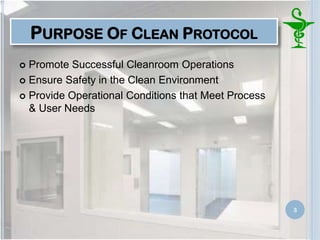
PURPOSE OF CLEAN PROTOCOL
 Promote Successful Cleanroom Operations
 Ensure Safety in the Clean Environment
 Provide Operational Conditions that Meet Process
& User Needs
3
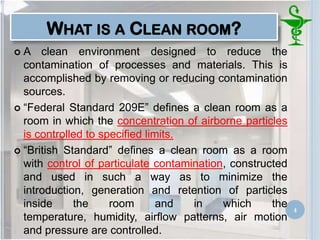
WHAT IS A CLEAN ROOM?
 A clean environment designed to reduce the
contamination of processes and materials. This is
accomplished by removing or reducing contamination
sources.
 “Federal Standard 209E” defines a clean room as a
room in which the concentration of airborne particles
is controlled to specified limits.
 “British Standard” defines a clean room as a room
with control of particulate contamination, constructed
and used in such a way as to minimize the
introduction, generation and retention of particles
inside the room and in which the
temperature, humidity, airflow patterns, air motion
and pressure are controlled.
4
PRINCIPLES OF THE CLEAN
ENVIRONMENT
 Air is highly (HEPA)
filtered (99.97% @
0.3μm)
 Layout should minimize
particle sources in
filtered air stream
 Air flow should remove
most particles generated
by process
5
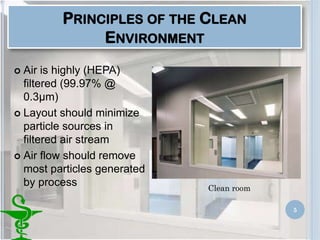
Clean room
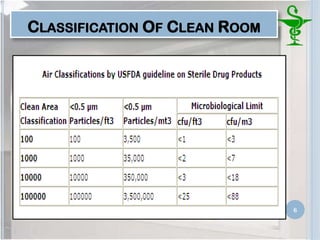
CLASSIFICATION OF CLEAN ROOM
6
ISO STANDARDS
7
8
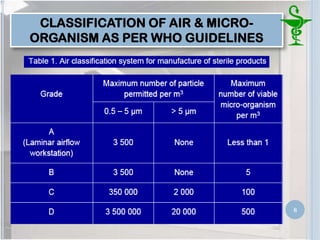
CLASSIFICATION OF AIR & MICRO-
ORGANISM AS PER WHO GUIDELINES
CLASSIFICATION AS PER EU CGMP
9
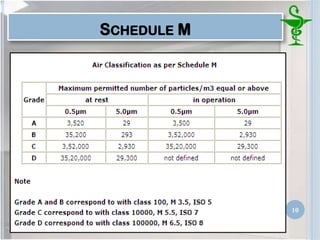
SCHEDULE M
10
11
Sr. no U.S. Federal
209 E
MHRA/TGA ISO
Standards
1 Class 100 A & B 5
2 Class 10,000 C 7
3 Class
1,00,000
D 8
Comparison of various grades described in
various guidelines
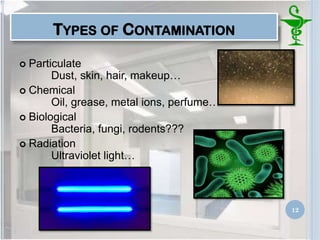
TYPES OF CONTAMINATION
 Particulate
Dust, skin, hair, makeup…
 Chemical
Oil, grease, metal ions, perfume…
 Biological
Bacteria, fungi, rodents???
 Radiation
Ultraviolet light…
12
CONTAMINATION SOURCES
 People ~75%
 Ventilation ~15%
 Room Structure ~5%
 Equipment ~5%
13
CONTAMINATION CONTROL
•Personnel Control
•Dress code
•Personal Hygiene
•Gowning
•Environmental Control
•Entrance and exit
•Materials and supplies
•Cleaning and maintenance
•Atmospheric (HVAC &
Microbial monitoring)
PERSONAL HYGIENE
 Shower each day before entry
 Control Dermatitis & Dandruff
 Do not smoke before or after entry
 No chewing gum or tobacco
 No Cosmetics , Jewellery or wrist watches should be
worn
 Leave all personal items in changing room
(wallets,keys,comb etc.)
 Avoid coughing and sneezing if unavoidable leave the
clean room
 Do not move vigorously(Brisk movements shed large
particles from body movement)
14
GOWNING
 Proper gowning order
 Hair cover
 Hood
 Shoe covers
 Coverall
 Gloves
 Face mask
 Safety Glasses
 Cotton garments shed
fibers. Hence, not used
15
Decron (polyster)
HVAC SYSTEM
 AIR HANDLING
SYSTEM:
 Requirements –
 Temp should be 15-25
C.
 Atleast 20 air changes
should be there per hr.
 Cleanliness
requirements i.e. class
100.
 Relative humidity 45-55
%.
 Pressure differential
between 2 area should
be 0.05-0.1 inch water
guage.
16
HEPA & UEPA
 High efficiency particulate air (HEPA):
 They are box type depth filters used for air filtration.
 These filters are made up of glass fibers.
 Efficiency of HEPA filters are 99.97% against 0.3 μm
particles.
 Testing for HEPA filters:
 Hot DOP test (efficiency testing), Cold DOP test
(integrity testing) , Air flow resistance test
 Ultra low penetration air (ULPA):
 Most ULPA filters are replaceable extended media
dry filters that have a minimum particle collection
efficiency of 99.9997 % efficient for particles greater
than or equal to 0.12-micron in size. 17
AIRFLOW DISTRIBUTION AND
CONTROL
 Unidirectional:(sometimes referred as laminar flow)
is an airflow pattern in which essentially the entire
body of air within a confined area moves with uniform
velocity and in single direction with generally parallel
airstreams. Clean rooms; class 100 and below have
unidirectional airflow pattern. Laminar air flow ----120
FPM
 Non-unidirectional: airflow is not unidirectional by
having a varying velocity, multiple pass circulation or
nonparallel flow direction. Conventional flow clean
rooms (class 1000 & 10000) have non-unidirectional
or mixed air flow patterns.
 Mixed patterns : combine some of each flow type. 18
19
ENTRY & EXIT
 Enter and exit quickly.
 Only one person may enter at a time.
 Each user must use their own access card.
 Pass from the gowning area to the clean area slowly
to reduce migration of particles between areas.
 Restricted no. of people in aseptic area.
 Drug sensitivity tests should be carried out for
employees working in critical area.
 Medical check-ups of people works in critical area
should be more frequent than other employees.
20
Some specific requirements
CLEAN ROOM ENVIRONMENT
MONITORING
Test Frequency
I. Particle Monitoring in air--------------6 monthly
II. HEPA Filter Integrity Testing---------Yearly
III. Air Changes Rate Calculation-------6 Monthly
IV. Air Pressure Differentials--------------Daily
V. Temperature and Humidity------------Daily
VI. Microbiological monitoring by---------Daily, and at
decreased
settle plates and / or swabs in frequency in
other
aseptic areas areas
21
CONCLUSION
 The main purpose of building a cleanroom suite is
to provide a vital element in the assurance of
product quality according to whole concept of good
pharmaceutical manufacturing operation.
 The resultant facility should prevent contamination
of the product, and should be seen to be doing so
by the incorporation of effective monitoring devices.
22
REFERENCES
 Current Good Manufacturing For pharmaceuticals;
Manohar A. Potdar; Page no:70-73.
 Pharmaceutical Quality Assurance, Manohar A.
Potdar , Nirali Prakashan; Page no:13.1-13.10
 Comparison of Quality Requirements for Sterile
Product Manufacture as Per Indian GMP and USFDA
;Yogita P, N Vishal Gupta, Natasha NS, Ashwini
Nageen L, R Sudeendra Bhat; Research Journal of
Pharmaceutical, Biological and Chemical Sciences;
Jan 2012 volume 3(1): 225-236.
 www.fda.gov
23
24
THANK YOU

pharmaceutical clean room

  • 1.
    INTRODUCTION TO PHARMACEUTICAL CLEAN ROOM Presentedby: Kiran Kumar M. Pharm First Sem.(Q.A.T.) Roll no. 634 Padm . Dr. D. Y. Patil Institute Of Pharmaceutical Sciences And Research Pimpri , Pune-18 1
  • 2.
    CONTENTS  Purpose ofclean protocol  Introduction  Classification  Types of contamination  Contamination sources  Contamination control  Clean room enviroment monitoring  Conclusion  Refrences 2
  • 3.
    PURPOSE OF CLEANPROTOCOL  Promote Successful Cleanroom Operations  Ensure Safety in the Clean Environment  Provide Operational Conditions that Meet Process & User Needs 3
  • 4.
    WHAT IS ACLEAN ROOM?  A clean environment designed to reduce the contamination of processes and materials. This is accomplished by removing or reducing contamination sources.  “Federal Standard 209E” defines a clean room as a room in which the concentration of airborne particles is controlled to specified limits.  “British Standard” defines a clean room as a room with control of particulate contamination, constructed and used in such a way as to minimize the introduction, generation and retention of particles inside the room and in which the temperature, humidity, airflow patterns, air motion and pressure are controlled. 4
  • 5.
    PRINCIPLES OF THECLEAN ENVIRONMENT  Air is highly (HEPA) filtered (99.97% @ 0.3μm)  Layout should minimize particle sources in filtered air stream  Air flow should remove most particles generated by process 5 Clean room
  • 6.
  • 7.
  • 8.
    8 CLASSIFICATION OF AIR& MICRO- ORGANISM AS PER WHO GUIDELINES
  • 9.
  • 10.
  • 11.
    11 Sr. no U.S.Federal 209 E MHRA/TGA ISO Standards 1 Class 100 A & B 5 2 Class 10,000 C 7 3 Class 1,00,000 D 8 Comparison of various grades described in various guidelines
  • 12.
    TYPES OF CONTAMINATION Particulate Dust, skin, hair, makeup…  Chemical Oil, grease, metal ions, perfume…  Biological Bacteria, fungi, rodents???  Radiation Ultraviolet light… 12
  • 13.
    CONTAMINATION SOURCES  People~75%  Ventilation ~15%  Room Structure ~5%  Equipment ~5% 13 CONTAMINATION CONTROL •Personnel Control •Dress code •Personal Hygiene •Gowning •Environmental Control •Entrance and exit •Materials and supplies •Cleaning and maintenance •Atmospheric (HVAC & Microbial monitoring)
  • 14.
    PERSONAL HYGIENE  Showereach day before entry  Control Dermatitis & Dandruff  Do not smoke before or after entry  No chewing gum or tobacco  No Cosmetics , Jewellery or wrist watches should be worn  Leave all personal items in changing room (wallets,keys,comb etc.)  Avoid coughing and sneezing if unavoidable leave the clean room  Do not move vigorously(Brisk movements shed large particles from body movement) 14
  • 15.
    GOWNING  Proper gowningorder  Hair cover  Hood  Shoe covers  Coverall  Gloves  Face mask  Safety Glasses  Cotton garments shed fibers. Hence, not used 15 Decron (polyster)
  • 16.
    HVAC SYSTEM  AIRHANDLING SYSTEM:  Requirements –  Temp should be 15-25 C.  Atleast 20 air changes should be there per hr.  Cleanliness requirements i.e. class 100.  Relative humidity 45-55 %.  Pressure differential between 2 area should be 0.05-0.1 inch water guage. 16
  • 17.
    HEPA & UEPA High efficiency particulate air (HEPA):  They are box type depth filters used for air filtration.  These filters are made up of glass fibers.  Efficiency of HEPA filters are 99.97% against 0.3 μm particles.  Testing for HEPA filters:  Hot DOP test (efficiency testing), Cold DOP test (integrity testing) , Air flow resistance test  Ultra low penetration air (ULPA):  Most ULPA filters are replaceable extended media dry filters that have a minimum particle collection efficiency of 99.9997 % efficient for particles greater than or equal to 0.12-micron in size. 17
  • 18.
    AIRFLOW DISTRIBUTION AND CONTROL Unidirectional:(sometimes referred as laminar flow) is an airflow pattern in which essentially the entire body of air within a confined area moves with uniform velocity and in single direction with generally parallel airstreams. Clean rooms; class 100 and below have unidirectional airflow pattern. Laminar air flow ----120 FPM  Non-unidirectional: airflow is not unidirectional by having a varying velocity, multiple pass circulation or nonparallel flow direction. Conventional flow clean rooms (class 1000 & 10000) have non-unidirectional or mixed air flow patterns.  Mixed patterns : combine some of each flow type. 18
  • 19.
  • 20.
    ENTRY & EXIT Enter and exit quickly.  Only one person may enter at a time.  Each user must use their own access card.  Pass from the gowning area to the clean area slowly to reduce migration of particles between areas.  Restricted no. of people in aseptic area.  Drug sensitivity tests should be carried out for employees working in critical area.  Medical check-ups of people works in critical area should be more frequent than other employees. 20 Some specific requirements
  • 21.
    CLEAN ROOM ENVIRONMENT MONITORING TestFrequency I. Particle Monitoring in air--------------6 monthly II. HEPA Filter Integrity Testing---------Yearly III. Air Changes Rate Calculation-------6 Monthly IV. Air Pressure Differentials--------------Daily V. Temperature and Humidity------------Daily VI. Microbiological monitoring by---------Daily, and at decreased settle plates and / or swabs in frequency in other aseptic areas areas 21
  • 22.
    CONCLUSION  The mainpurpose of building a cleanroom suite is to provide a vital element in the assurance of product quality according to whole concept of good pharmaceutical manufacturing operation.  The resultant facility should prevent contamination of the product, and should be seen to be doing so by the incorporation of effective monitoring devices. 22
  • 23.
    REFERENCES  Current GoodManufacturing For pharmaceuticals; Manohar A. Potdar; Page no:70-73.  Pharmaceutical Quality Assurance, Manohar A. Potdar , Nirali Prakashan; Page no:13.1-13.10  Comparison of Quality Requirements for Sterile Product Manufacture as Per Indian GMP and USFDA ;Yogita P, N Vishal Gupta, Natasha NS, Ashwini Nageen L, R Sudeendra Bhat; Research Journal of Pharmaceutical, Biological and Chemical Sciences; Jan 2012 volume 3(1): 225-236.  www.fda.gov 23
  • 24.