HVAC: VENTILATION
A lecture series by Dr. Tomas Ucol-Ganiron Jr
VENTILATING

-the process of "changing" or replacing air in any
space to provide high indoor air quality (i.e. to
control temperature, replenish oxygen, or remove
moisture, odors, smoke, heat, dust, airborne
bacteria, and carbon dioxide).
VENTILATION

-the intentional movement of air from outside a building to the
inside.

-includes both the exchange of air to the outside as well as circulation
of air within the building.

-one of the most important factors for maintaining acceptable indoor
air quality in buildings
METHODS OF
VENTILATING A BUILDING

1. Mechanical      or Forced Ventilation-is used to control
indoor air quality. Excess humidity, odors, and
contaminants can often be controlled via dilution or
replacement with outside air. However, in humid climates
much energy is required to remove excess moisture from
ventilation air.
METHODS OF
VENTILATING A BUILDING

Kitchens and bathrooms typically have mechanical exhaust to control
odors and sometimes humidity. Kitchens have additional problems to deal
with such as smoke and grease . Factors in the design of such systems
include the flow rate (which is a function of the fan speed and exhaust
vent size) and noise level. If ducting for the fans traverse unheated space
(e.g., an attic), the ducting should be insulated as well to prevent
condensation on the ducting. Direct drive fans are available for many
applications, and can reduce maintenance needs.
METHODS OF
VENTILATING A BUILDING

Ceiling fans and table/floor fans circulate air within a room for the
purpose of reducing the perceived temperature because of
evaporation of perspiration on the skin of the occupants. Because hot
air rises, ceiling fans may be used to keep a room warmer in the
winter by circulating the warm stratified air from the ceiling to the
floor. Ceiling fans do not provide ventilation as defined as the
introduction of outside air.
METHODS OF
VENTILATING A BUILDING

2. Natural Ventilation- is the ventilation of a building with outside air
without the use of a fan or other mechanical system. It can be achieved
with open windows or trickle vents when the spaces to ventilate are small
and the architecture permits. In more complex systems warm air in the
building can be allowed to rise and flow out upper openings to the outside
(stack effect) thus forcing cool outside air to be drawn into the building
naturally through openings in the lower areas.
METHODS OF
VENTILATING A BUILDING

These systems use very little energy but care must be taken to ensure the
occupants' comfort. In warm or humid months, in many climates,
maintaining thermal comfort solely via natural ventilation may not be
possible so conventional air conditioning systems are used as backups.
Air-side economizers perform the same function as natural ventilation,
but use mechanical systems' fans, ducts, dampers, and control systems to
introduce and distribute cool outdoor air when appropriate.
TYPES OF VENTILATION
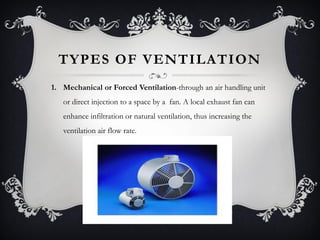
1. Mechanical or Forced Ventilation-through an air handling unit
   or direct injection to a space by a fan. A local exhaust fan can
   enhance infiltration or natural ventilation, thus increasing the
   ventilation air flow rate.
TYPES OF VENTILATION

2. Natural Ventilation-occurs when the air in a space is changed
with outdoor air without the use of mechanical systems, such as a fan.
Most often natural ventilation is assured through operable windows
but it can also be achieved through temperature and pressure
differences between spaces.
TYPES OF VENTILATION
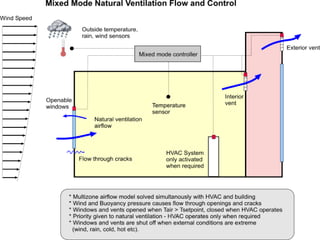
3. Mixed Mode Ventilation or Hybrid Ventilation- utilizes both
mechanical and natural ventilation processes. The mechanical and
natural components may be used in conjunction with each other or
separately at different times of day. The natural component,
sometimes subject to unpredictable external weather conditions may
not always be adequate to ventilate the desired space. The mechanical
component is then used to increase the overall ventilation rate so that
the desired internal conditions are met.
TYPES OF VENTILATION
4. Infiltration-is separate from ventilation, but is often used to provide
ventilation air.

HVAC: Ventillation

  • 1.
    HVAC: VENTILATION A lectureseries by Dr. Tomas Ucol-Ganiron Jr
  • 2.
    VENTILATING -the process of"changing" or replacing air in any space to provide high indoor air quality (i.e. to control temperature, replenish oxygen, or remove moisture, odors, smoke, heat, dust, airborne bacteria, and carbon dioxide).
  • 3.
    VENTILATION -the intentional movementof air from outside a building to the inside. -includes both the exchange of air to the outside as well as circulation of air within the building. -one of the most important factors for maintaining acceptable indoor air quality in buildings
  • 4.
    METHODS OF VENTILATING ABUILDING 1. Mechanical or Forced Ventilation-is used to control indoor air quality. Excess humidity, odors, and contaminants can often be controlled via dilution or replacement with outside air. However, in humid climates much energy is required to remove excess moisture from ventilation air.
  • 5.
    METHODS OF VENTILATING ABUILDING Kitchens and bathrooms typically have mechanical exhaust to control odors and sometimes humidity. Kitchens have additional problems to deal with such as smoke and grease . Factors in the design of such systems include the flow rate (which is a function of the fan speed and exhaust vent size) and noise level. If ducting for the fans traverse unheated space (e.g., an attic), the ducting should be insulated as well to prevent condensation on the ducting. Direct drive fans are available for many applications, and can reduce maintenance needs.
  • 6.
    METHODS OF VENTILATING ABUILDING Ceiling fans and table/floor fans circulate air within a room for the purpose of reducing the perceived temperature because of evaporation of perspiration on the skin of the occupants. Because hot air rises, ceiling fans may be used to keep a room warmer in the winter by circulating the warm stratified air from the ceiling to the floor. Ceiling fans do not provide ventilation as defined as the introduction of outside air.
  • 7.
    METHODS OF VENTILATING ABUILDING 2. Natural Ventilation- is the ventilation of a building with outside air without the use of a fan or other mechanical system. It can be achieved with open windows or trickle vents when the spaces to ventilate are small and the architecture permits. In more complex systems warm air in the building can be allowed to rise and flow out upper openings to the outside (stack effect) thus forcing cool outside air to be drawn into the building naturally through openings in the lower areas.
  • 8.
    METHODS OF VENTILATING ABUILDING These systems use very little energy but care must be taken to ensure the occupants' comfort. In warm or humid months, in many climates, maintaining thermal comfort solely via natural ventilation may not be possible so conventional air conditioning systems are used as backups. Air-side economizers perform the same function as natural ventilation, but use mechanical systems' fans, ducts, dampers, and control systems to introduce and distribute cool outdoor air when appropriate.
  • 9.
    TYPES OF VENTILATION 1.Mechanical or Forced Ventilation-through an air handling unit or direct injection to a space by a fan. A local exhaust fan can enhance infiltration or natural ventilation, thus increasing the ventilation air flow rate.
  • 10.
    TYPES OF VENTILATION 2.Natural Ventilation-occurs when the air in a space is changed with outdoor air without the use of mechanical systems, such as a fan. Most often natural ventilation is assured through operable windows but it can also be achieved through temperature and pressure differences between spaces.
  • 12.
    TYPES OF VENTILATION 3.Mixed Mode Ventilation or Hybrid Ventilation- utilizes both mechanical and natural ventilation processes. The mechanical and natural components may be used in conjunction with each other or separately at different times of day. The natural component, sometimes subject to unpredictable external weather conditions may not always be adequate to ventilate the desired space. The mechanical component is then used to increase the overall ventilation rate so that the desired internal conditions are met.
  • 14.
    TYPES OF VENTILATION 4.Infiltration-is separate from ventilation, but is often used to provide ventilation air.