

SingleAxisSolarTrackingSystem
M.Vishnu Chittan
Research Scholar
Dept. of physics & Electronics,
GIS,GITAM University,
Vishakhapatnam.
Whatissolartracker?
The technology which is used by a system to follow the sun from
dawn to dusk for capturing the maximum sunlight for various
applications.
As indicated above the amount of energy captured by a solar
system can be maximized if the solar panel can follow the ecliptic
path of the Sun so that the plane of the solar panel or the array is
always perpendicular to the direction of the Sun.
Automatic mechanical tracking systems make it possible to track
the Sun's position to maximize energy capture.
BASICCONCEPT
 Basically, Sunlight has two components, the “direct beam”
that carries about 90% of the solar energy, and the “diffuse
sunlight” that carries the remaining. As the majority of the
energy is in the direct beam, maximizing collection requires
the sun to be visible to the panels as long as possible.
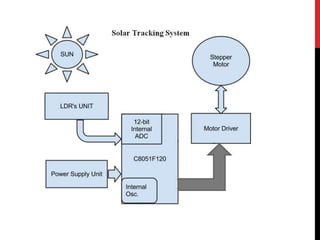
PARTSOFTHESYSTEM
The main parts of the system are
 Solar Panel
 Sensor circuit (LDR array ).
 Stepper motor
 ULN 2003
 C8051F120 Microcontroller
SOLARPANEL
HowSolarCellsWork
 When a photon with sufficient energy impinges upon a semiconductor, it can
transfer enough energy to an electron to free it from the bonds of the
semiconductor's valence band so that it is free to move and thus carry an electric
current. The junction in a semiconductor diode provides the necessary electric
field to cause the current to flow in an external circuit.
 The typical output voltage of a PV cell ranges between 0.5 and 0.6 Volts and the
energy conversion efficiency from less than 10% to over 20%. An array of cells
can therefore generate about 200 Watts of electrical power per square meter when
illuminated by solar radiation of 1000 Watts per square meter. The corresponding
current density will be about 400 Amps/m2. Because of climatic conditions the
intensity of the insolation rarely reaches 1000 W/m2.
SINGLEAXISTRACKERS
 Track the sun from east to west using a single pivot point
 Increase solar yield up to 34%
 Simple, effective design
 Low maintenance
 Lower cost compared to dual axis
 Minimal points of failure
DUALAXISTRACKERS
 Track the sun from east to west, and north to south using two pivot points.
 Increases solar yield up to 37%.
 Complex design – more motors and sensors.
 Higher maintenance.
 Higher cost due to additional parts and installation time.
 Additional points of failure.
WhatisLDR?
 LDR stands for Light Dependent Resistor or Photo resistor, which is a
passive electronic component, basically a resistor which has a resistance that
varies depending on the light intensity.
 A photo resistor is made of a high resistance semiconductor that absorbs
photons and based on the quantity and frequency of the absorbed photons the
semiconductor material give bound electrons enough energy to jump into the
conduction band.
 The resulting free electrons conduct electricity resulting in lowering
resistance of the photoresistor. The number of electrons is dependent of the
photon's frequency.
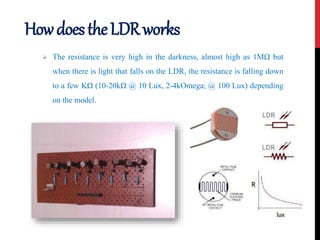
HowdoestheLDRworks
 The resistance is very high in the darkness, almost high as 1MΩ but
when there is light that falls on the LDR, the resistance is falling down
to a few KΩ (10-20kΩ @ 10 Lux, 2-4kOmega; @ 100 Lux) depending
on the model.
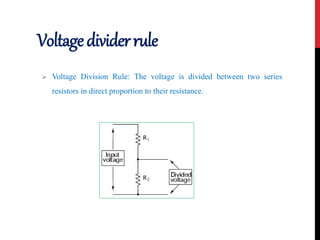
Voltagedividerrule
 Voltage Division Rule: The voltage is divided between two series
resistors in direct proportion to their resistance.
Steppermotor
 A stepper motor is a special type of electric motor that moves in increments,
or steps, rather than turning smoothly as a conventional motor does. The size
of the increment is measured in degrees and can vary depending on the
application. Typical increments are 0.9 or 1.8 degrees, with 400 or 200
increments thus representing a full circle. The speed of the motor is
determined by the time delay between each incremental movement.
 A stepper, or stepping motor converts electronic pulses into proportionate
mechanical movement. Each revolution of the stepper motor's shaft is made
up of a series of discrete individual steps. A step is defined as the angular
rotation produced by the output shaft each time the motor receives a step
pulse.
MotorDriver(ULN2803)
 The eight NPN Darlington connected transistors in this family of arrays is
ideally suited for interfacing between low logic level digital circuitry (such as
TTL, CMOS or PMOS/NMOS) and the higher current/voltage requirements of
lamps, relays, printer hammers or other similar loads for a broad range of
computer, industrial, and consumer applications.
 All devices feature open–collector outputs and free wheeling clamp diodes for
transient suppression.
 The ULN2803 is designed to be compatible with standard TTL families
 While the ULN2804 is optimized for 6 to 15 volt high level CMOS or PMOS.
ULN 2803
C8051F120
 12-Bit (C8051F120/1/4/5) and 10-Bit (C8051F122/3/6/7) ADC s.
 Built-in Temperature Sensor.
 8-bit ADC.
 8 External Inputs (Single-Ended or Differential).
 Two 12-bit DACs.
 8448 Bytes Internal Data RAM (8k + 256).
 128k Bytes Banked FLASH.
 In-System programmable between 1024-byte Sectors.
 External 64k Byte Data Memory Interface.
HardwareSetup
APPLICATIONS:
 They are useful as the sun’s position in the sky will alter gradually during a
day and over the seasons throughout the year.
 Advantages to utilizing a tracker system like this will depend mostly on it’s
positioning in determining exactly how well it will enhance the effectiveness
of the panels.
 Energy manufacturing is at an optimum and energy output is enhanced year
round.
 This is particularly significant through out the summer season with its long
days of sunshine readily available to capture and no energy will be lost.
PROTOTYPE:
Solar tracking system

Solar tracking system

  • 1.
    SingleAxisSolarTrackingSystem M.Vishnu Chittan Research Scholar Dept.of physics & Electronics, GIS,GITAM University, Vishakhapatnam.
  • 2.
    Whatissolartracker? The technology whichis used by a system to follow the sun from dawn to dusk for capturing the maximum sunlight for various applications. As indicated above the amount of energy captured by a solar system can be maximized if the solar panel can follow the ecliptic path of the Sun so that the plane of the solar panel or the array is always perpendicular to the direction of the Sun. Automatic mechanical tracking systems make it possible to track the Sun's position to maximize energy capture.
  • 3.
    BASICCONCEPT  Basically, Sunlighthas two components, the “direct beam” that carries about 90% of the solar energy, and the “diffuse sunlight” that carries the remaining. As the majority of the energy is in the direct beam, maximizing collection requires the sun to be visible to the panels as long as possible.
  • 4.
    PARTSOFTHESYSTEM The main partsof the system are  Solar Panel  Sensor circuit (LDR array ).  Stepper motor  ULN 2003  C8051F120 Microcontroller
  • 5.
  • 6.
    HowSolarCellsWork  When aphoton with sufficient energy impinges upon a semiconductor, it can transfer enough energy to an electron to free it from the bonds of the semiconductor's valence band so that it is free to move and thus carry an electric current. The junction in a semiconductor diode provides the necessary electric field to cause the current to flow in an external circuit.  The typical output voltage of a PV cell ranges between 0.5 and 0.6 Volts and the energy conversion efficiency from less than 10% to over 20%. An array of cells can therefore generate about 200 Watts of electrical power per square meter when illuminated by solar radiation of 1000 Watts per square meter. The corresponding current density will be about 400 Amps/m2. Because of climatic conditions the intensity of the insolation rarely reaches 1000 W/m2.
  • 7.
    SINGLEAXISTRACKERS  Track thesun from east to west using a single pivot point  Increase solar yield up to 34%  Simple, effective design  Low maintenance  Lower cost compared to dual axis  Minimal points of failure
  • 8.
    DUALAXISTRACKERS  Track thesun from east to west, and north to south using two pivot points.  Increases solar yield up to 37%.  Complex design – more motors and sensors.  Higher maintenance.  Higher cost due to additional parts and installation time.  Additional points of failure.
  • 10.
    WhatisLDR?  LDR standsfor Light Dependent Resistor or Photo resistor, which is a passive electronic component, basically a resistor which has a resistance that varies depending on the light intensity.  A photo resistor is made of a high resistance semiconductor that absorbs photons and based on the quantity and frequency of the absorbed photons the semiconductor material give bound electrons enough energy to jump into the conduction band.  The resulting free electrons conduct electricity resulting in lowering resistance of the photoresistor. The number of electrons is dependent of the photon's frequency.
  • 11.
    HowdoestheLDRworks  The resistanceis very high in the darkness, almost high as 1MΩ but when there is light that falls on the LDR, the resistance is falling down to a few KΩ (10-20kΩ @ 10 Lux, 2-4kOmega; @ 100 Lux) depending on the model.
  • 12.
    Voltagedividerrule  Voltage DivisionRule: The voltage is divided between two series resistors in direct proportion to their resistance.
  • 13.
    Steppermotor  A steppermotor is a special type of electric motor that moves in increments, or steps, rather than turning smoothly as a conventional motor does. The size of the increment is measured in degrees and can vary depending on the application. Typical increments are 0.9 or 1.8 degrees, with 400 or 200 increments thus representing a full circle. The speed of the motor is determined by the time delay between each incremental movement.  A stepper, or stepping motor converts electronic pulses into proportionate mechanical movement. Each revolution of the stepper motor's shaft is made up of a series of discrete individual steps. A step is defined as the angular rotation produced by the output shaft each time the motor receives a step pulse.
  • 15.
    MotorDriver(ULN2803)  The eightNPN Darlington connected transistors in this family of arrays is ideally suited for interfacing between low logic level digital circuitry (such as TTL, CMOS or PMOS/NMOS) and the higher current/voltage requirements of lamps, relays, printer hammers or other similar loads for a broad range of computer, industrial, and consumer applications.  All devices feature open–collector outputs and free wheeling clamp diodes for transient suppression.  The ULN2803 is designed to be compatible with standard TTL families  While the ULN2804 is optimized for 6 to 15 volt high level CMOS or PMOS.
  • 16.
  • 17.
    C8051F120  12-Bit (C8051F120/1/4/5)and 10-Bit (C8051F122/3/6/7) ADC s.  Built-in Temperature Sensor.  8-bit ADC.  8 External Inputs (Single-Ended or Differential).  Two 12-bit DACs.  8448 Bytes Internal Data RAM (8k + 256).  128k Bytes Banked FLASH.  In-System programmable between 1024-byte Sectors.  External 64k Byte Data Memory Interface.
  • 18.
  • 19.
    APPLICATIONS:  They areuseful as the sun’s position in the sky will alter gradually during a day and over the seasons throughout the year.  Advantages to utilizing a tracker system like this will depend mostly on it’s positioning in determining exactly how well it will enhance the effectiveness of the panels.  Energy manufacturing is at an optimum and energy output is enhanced year round.  This is particularly significant through out the summer season with its long days of sunshine readily available to capture and no energy will be lost.
  • 20.