Dual Axis Solar Tracking using Arduino
Overview
 As the energy demand and the environmental problems increase, the natural energy
sources have become very important as an alternative to the conventional energy
sources.
 Sun is a very abundant source of power. Even so, only a fraction of the entire energy is
harnessed and that too not efficiently. The main cause of this is the high cost of
installation of solar cells. Also solar cells are mostly kept fixed, so they do not obtain
the optimum amount of sunlight throughout the day. This paper aims at the
development of a simple process to track the sun and attain maximum efficiency using
Microcontroller.
What is Solar Tracker? And difference between
Dual and Single axis Tracker
 SOLAR TRACKER is a device which changes the position of the panel in a way that
makes the sun’s rays to fall perpendicular to the panel so that the efficiency of the
system can be improved. The sun can be tracked exactly with the use of single axis or
dual axis tracking.
 Single Axis Tracker: In this the panel rotates around a centre axis. These consist of
horizontal single axis tracker and tilted solar panel modules or vertical single axis
tracker and vertical tilted solar panel.
 Dual Axis Tracker: These tracking system involves both horizontal and vertical axis,
by using which the sun’s apparent motion can be tracked anywhere in the world. These
tracker tracks the sun’s motion in all four directions that is from east to west and as well
as from north to south for added power output.
Solar Tracking System Requirement
 Solar Cell
 Voltage regulator
 Arduino nano
 Light Dependent Resistor (LDR) sensor
 L298 motor driver
 Geared dc motor
 8 diode
Solar Cells
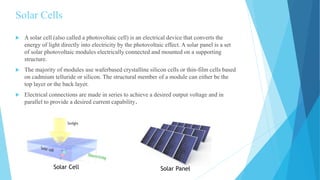
 A solar cell (also called a photovoltaic cell) is an electrical device that converts the
energy of light directly into electricity by the photovoltaic effect. A solar panel is a set
of solar photovoltaic modules electrically connected and mounted on a supporting
structure.
 The majority of modules use waferbased crystalline silicon cells or thin-film cells based
on cadmium telluride or silicon. The structural member of a module can either be the
top layer or the back layer.
 Electrical connections are made in series to achieve a desired output voltage and in
parallel to provide a desired current capability.
Solar Cell Solar Panel
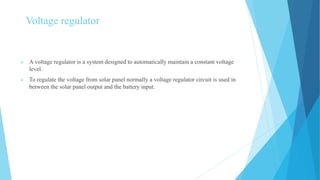
Voltage regulator
 A voltage regulator is a system designed to automatically maintain a constant voltage
level.
 To regulate the voltage from solar panel normally a voltage regulator circuit is used in
between the solar panel output and the battery input.
Arduino Nano
 Arduino nano is a small ,compatible,flexible and breadboard friendly microcontroller
board,developed by Arduino.cc in Italy,based on ATmega328p .
 It comes with exactly the same functionality as in Arduino UNO but quite in small size.
 Arduino nano pinout contains 14 digital pins,8 analog pins,2 reset pins and 6 power
pins.
 Arduino nano is used ,which works as a controlling unit.
 LDR are also connected to analog pins of the Aurdino.
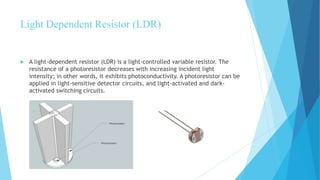
Light Dependent Resistor (LDR)
 A light-dependent resistor (LDR) is a light-controlled variable resistor. The
resistance of a photoresistor decreases with increasing incident light
intensity; in other words, it exhibits photoconductivity. A photoresistor can be
applied in light-sensitive detector circuits, and light-activated and dark-
activated switching circuits.
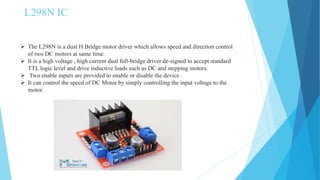
L298N IC
 The L298N is a dual H Bridge motor driver which allows speed and direction control
of two DC motors at same time.
 It is a high voltage , high current dual full-bridge driver de-signed to accept standard
TTL logic level and drive inductive loads such as DC and stepping motors.
 Two enable inputs are provided to enable or disable the device .
 It can control the speed of DC Motor by simply controlling the input voltage to the
motor.
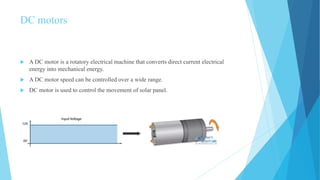
DC motors
 A DC motor is a rotatory electrical machine that converts direct current electrical
energy into mechanical energy.
 A DC motor speed can be controlled over a wide range.
 DC motor is used to control the movement of solar panel.
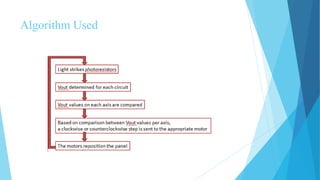
Algorithm Used
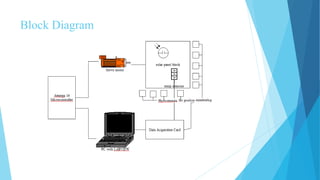
Block Diagram
RESULT AND DISCUSSION
 Data extracted are examined to indicate the characteristics of the effective solar system.
We know that earth keeps rotating around the sun, thus to gain maximum voltage suns
position is important. More the intensity of light falls on solar panel more will be the
output voltage. If the panel is static then the intensity of light on panel decreases and the
hence the resulting output voltages will also be low. So moving panels are more
efficient than the static panels.
THANK YOU

Dual axis solar tracking using arduino with lab view (1)

  • 1.
    Dual Axis SolarTracking using Arduino
  • 2.
    Overview  As theenergy demand and the environmental problems increase, the natural energy sources have become very important as an alternative to the conventional energy sources.  Sun is a very abundant source of power. Even so, only a fraction of the entire energy is harnessed and that too not efficiently. The main cause of this is the high cost of installation of solar cells. Also solar cells are mostly kept fixed, so they do not obtain the optimum amount of sunlight throughout the day. This paper aims at the development of a simple process to track the sun and attain maximum efficiency using Microcontroller.
  • 3.
    What is SolarTracker? And difference between Dual and Single axis Tracker  SOLAR TRACKER is a device which changes the position of the panel in a way that makes the sun’s rays to fall perpendicular to the panel so that the efficiency of the system can be improved. The sun can be tracked exactly with the use of single axis or dual axis tracking.  Single Axis Tracker: In this the panel rotates around a centre axis. These consist of horizontal single axis tracker and tilted solar panel modules or vertical single axis tracker and vertical tilted solar panel.  Dual Axis Tracker: These tracking system involves both horizontal and vertical axis, by using which the sun’s apparent motion can be tracked anywhere in the world. These tracker tracks the sun’s motion in all four directions that is from east to west and as well as from north to south for added power output.
  • 4.
    Solar Tracking SystemRequirement  Solar Cell  Voltage regulator  Arduino nano  Light Dependent Resistor (LDR) sensor  L298 motor driver  Geared dc motor  8 diode
  • 5.
    Solar Cells  Asolar cell (also called a photovoltaic cell) is an electrical device that converts the energy of light directly into electricity by the photovoltaic effect. A solar panel is a set of solar photovoltaic modules electrically connected and mounted on a supporting structure.  The majority of modules use waferbased crystalline silicon cells or thin-film cells based on cadmium telluride or silicon. The structural member of a module can either be the top layer or the back layer.  Electrical connections are made in series to achieve a desired output voltage and in parallel to provide a desired current capability. Solar Cell Solar Panel
  • 6.
    Voltage regulator  Avoltage regulator is a system designed to automatically maintain a constant voltage level.  To regulate the voltage from solar panel normally a voltage regulator circuit is used in between the solar panel output and the battery input.
  • 7.
    Arduino Nano  Arduinonano is a small ,compatible,flexible and breadboard friendly microcontroller board,developed by Arduino.cc in Italy,based on ATmega328p .  It comes with exactly the same functionality as in Arduino UNO but quite in small size.  Arduino nano pinout contains 14 digital pins,8 analog pins,2 reset pins and 6 power pins.  Arduino nano is used ,which works as a controlling unit.  LDR are also connected to analog pins of the Aurdino.
  • 8.
    Light Dependent Resistor(LDR)  A light-dependent resistor (LDR) is a light-controlled variable resistor. The resistance of a photoresistor decreases with increasing incident light intensity; in other words, it exhibits photoconductivity. A photoresistor can be applied in light-sensitive detector circuits, and light-activated and dark- activated switching circuits.
  • 9.
    L298N IC  TheL298N is a dual H Bridge motor driver which allows speed and direction control of two DC motors at same time.  It is a high voltage , high current dual full-bridge driver de-signed to accept standard TTL logic level and drive inductive loads such as DC and stepping motors.  Two enable inputs are provided to enable or disable the device .  It can control the speed of DC Motor by simply controlling the input voltage to the motor.
  • 10.
    DC motors  ADC motor is a rotatory electrical machine that converts direct current electrical energy into mechanical energy.  A DC motor speed can be controlled over a wide range.  DC motor is used to control the movement of solar panel.
  • 11.
  • 12.
  • 13.
    RESULT AND DISCUSSION Data extracted are examined to indicate the characteristics of the effective solar system. We know that earth keeps rotating around the sun, thus to gain maximum voltage suns position is important. More the intensity of light falls on solar panel more will be the output voltage. If the panel is static then the intensity of light on panel decreases and the hence the resulting output voltages will also be low. So moving panels are more efficient than the static panels.
  • 14.