PREPARED BY
CONTENT
 INTRODUCTION
 WHAT IS SOLAR TRACKERS
 NEED OF SOLAR TRACKERS
 CIRCUIT DIAGRAM
 WORKING PRINCIPLE
 HARDWARE COPONENTS
 ADVANTAGES
 DISADVANTAGES
 APPLICATIONS
 CONCLUSION
INTRODUCTION
 Renewable energy solutions are becoming popular.
 Maximizing output from solar system increases efficiency.
 Presently solar panels are of fixed type which lower the efficiency.
 Maintaining vertical direction between light and panel maximizes
efficiency.
 Solar panels are used to convert the light energy into the electrical
energy.
WHAT IS SOLAR TRACKER?
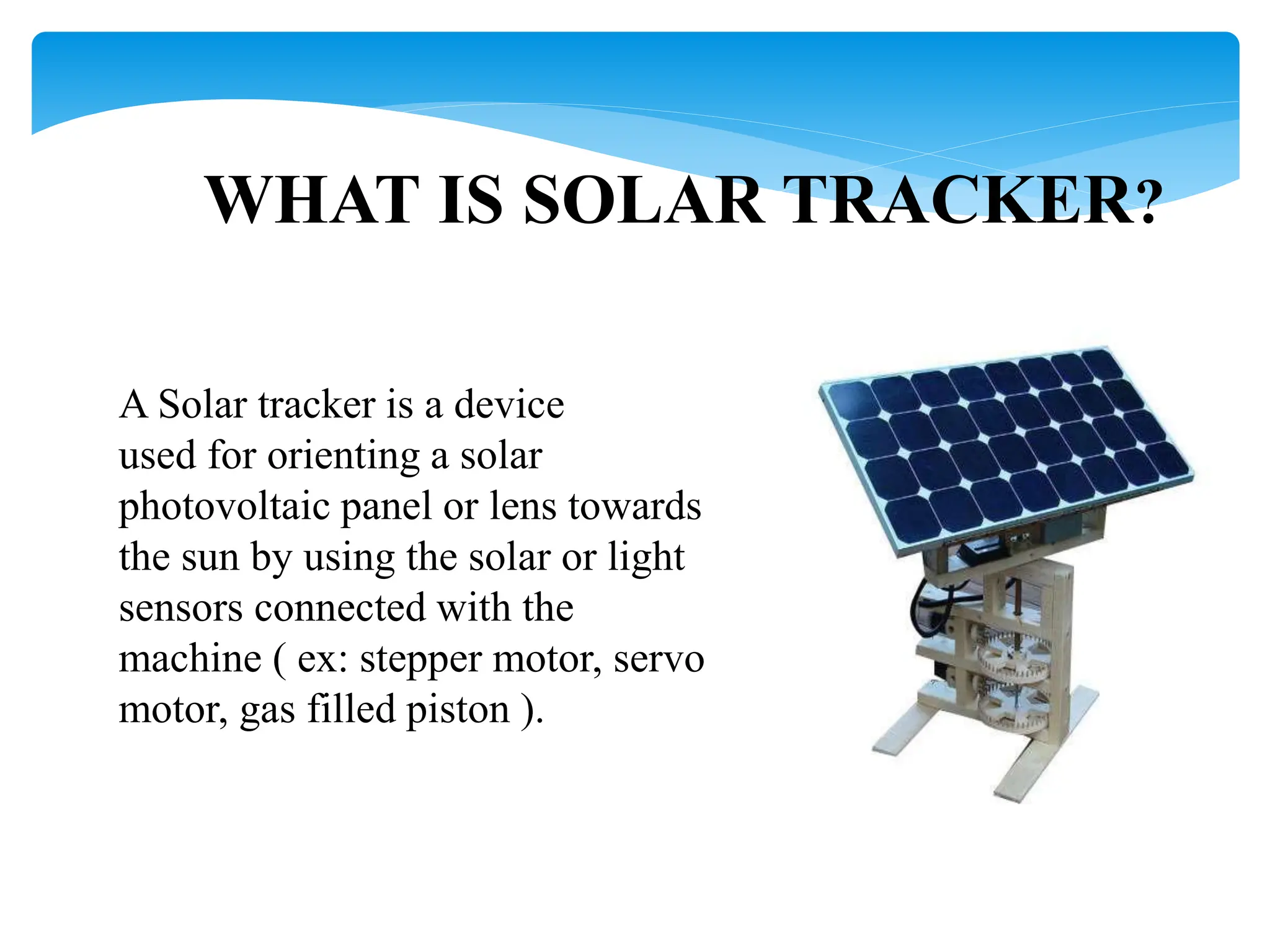
A Solar tracker is a device
used for orienting a solar
photovoltaic panel or lens towards
the sun by using the solar or light
sensors connected with the
machine ( ex: stepper motor, servo
motor, gas filled piston ).
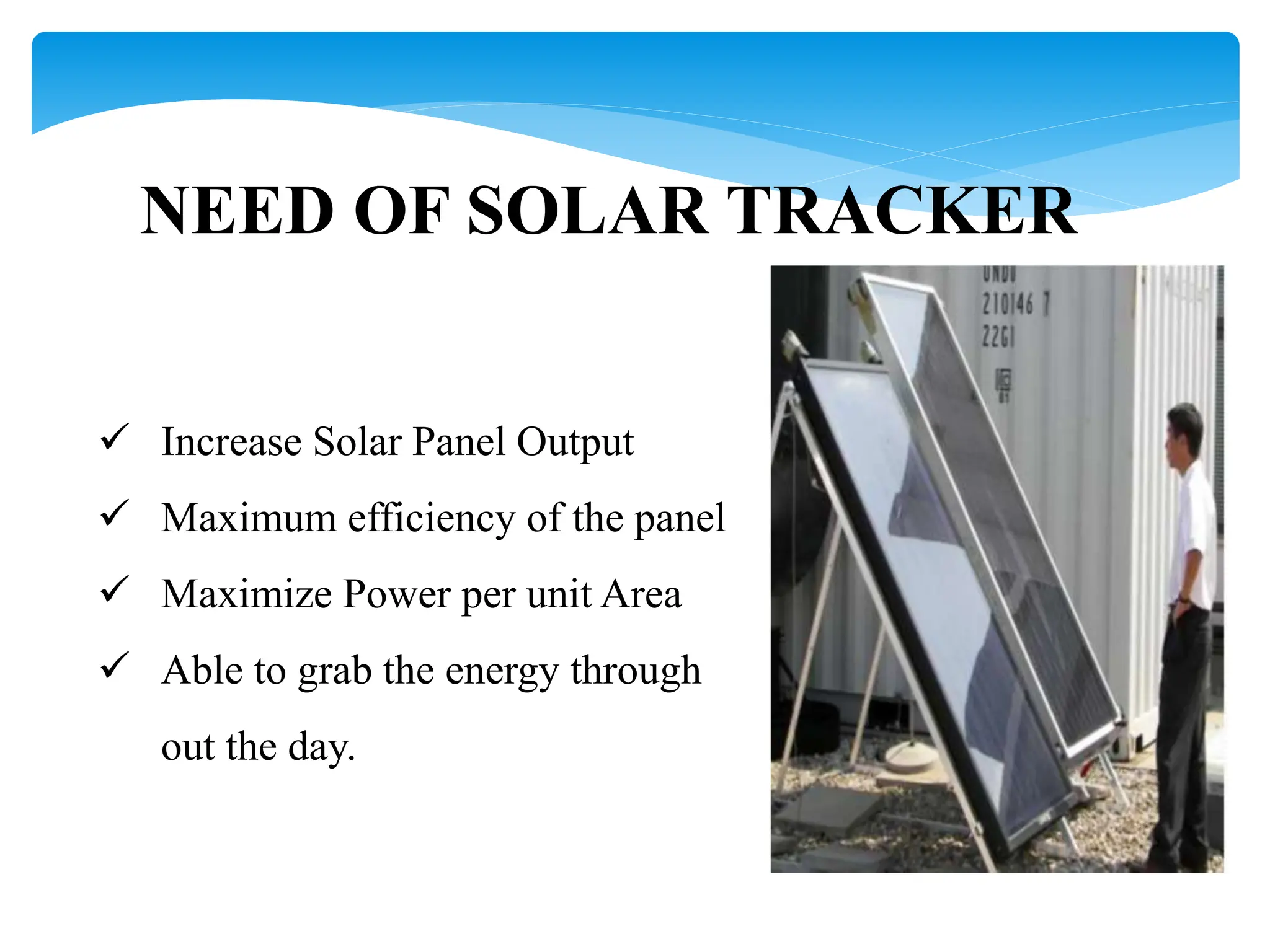
NEED OF SOLAR TRACKER
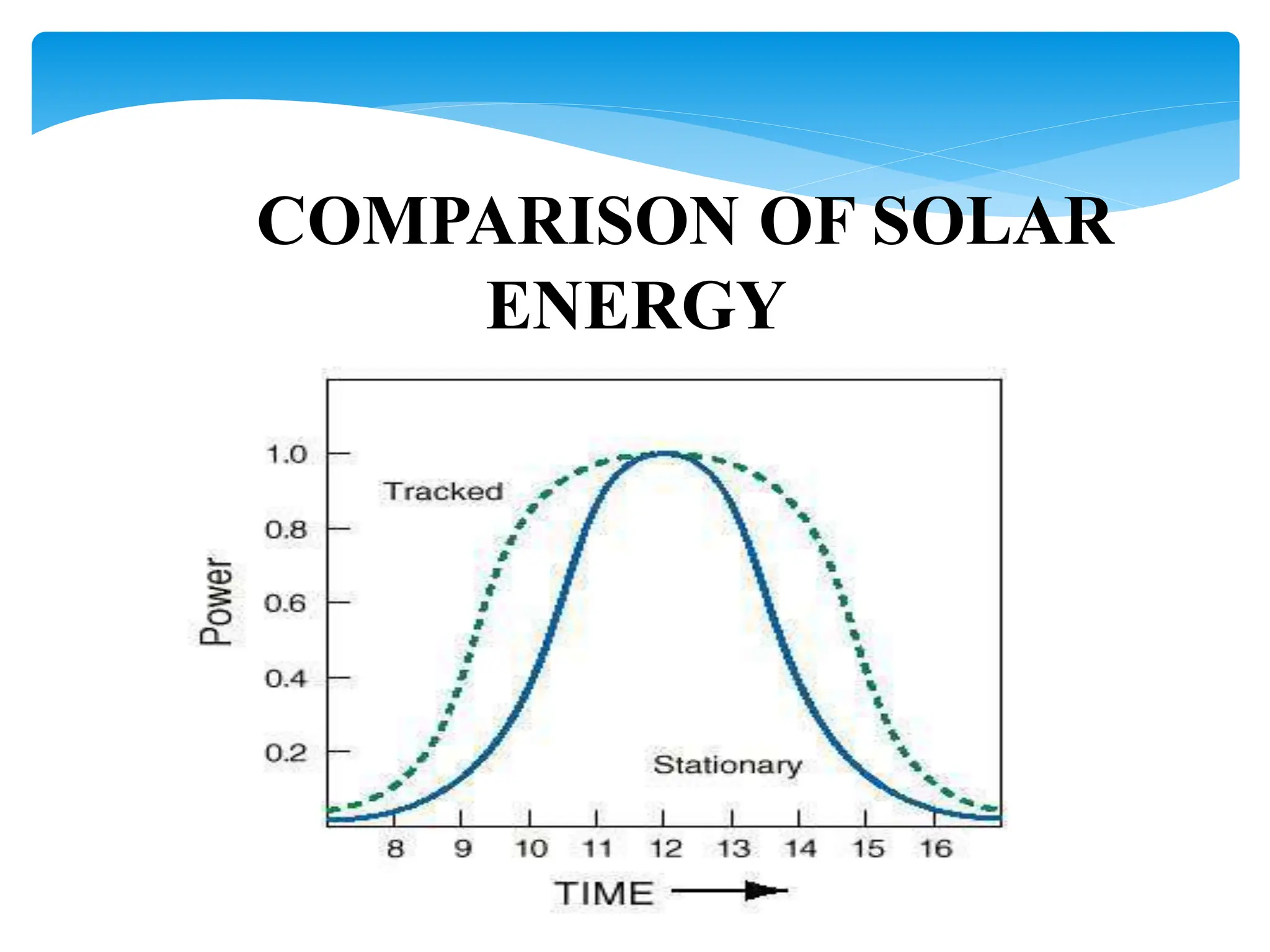
 Increase Solar Panel Output
 Maximum efficiency of the panel
 Maximize Power per unit Area
 Able to grab the energy through
out the day.
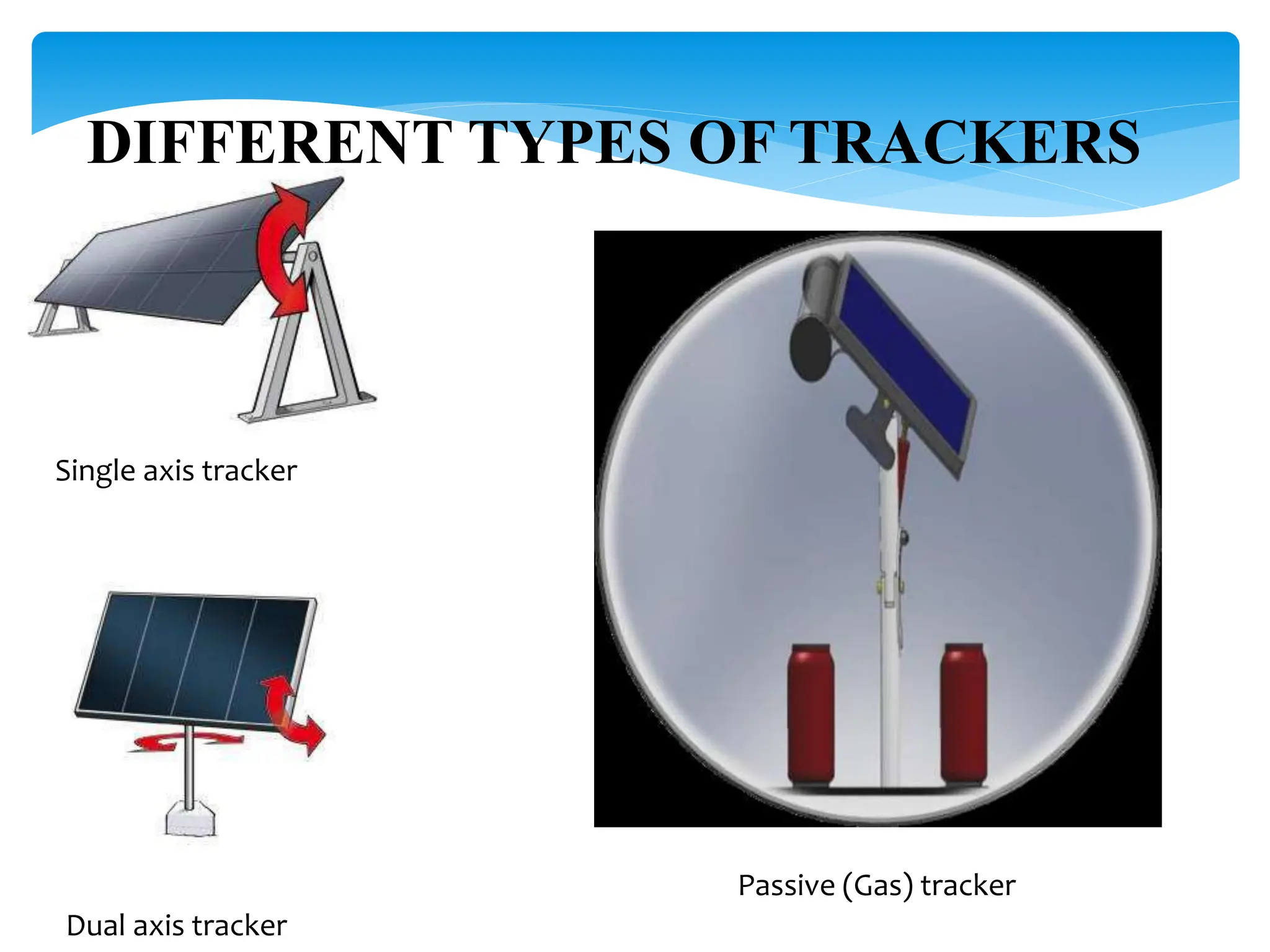
DIFFERENT TYPES OF TRACKERS
Single axis tracker
Dual axis tracker
Passive (Gas) tracker
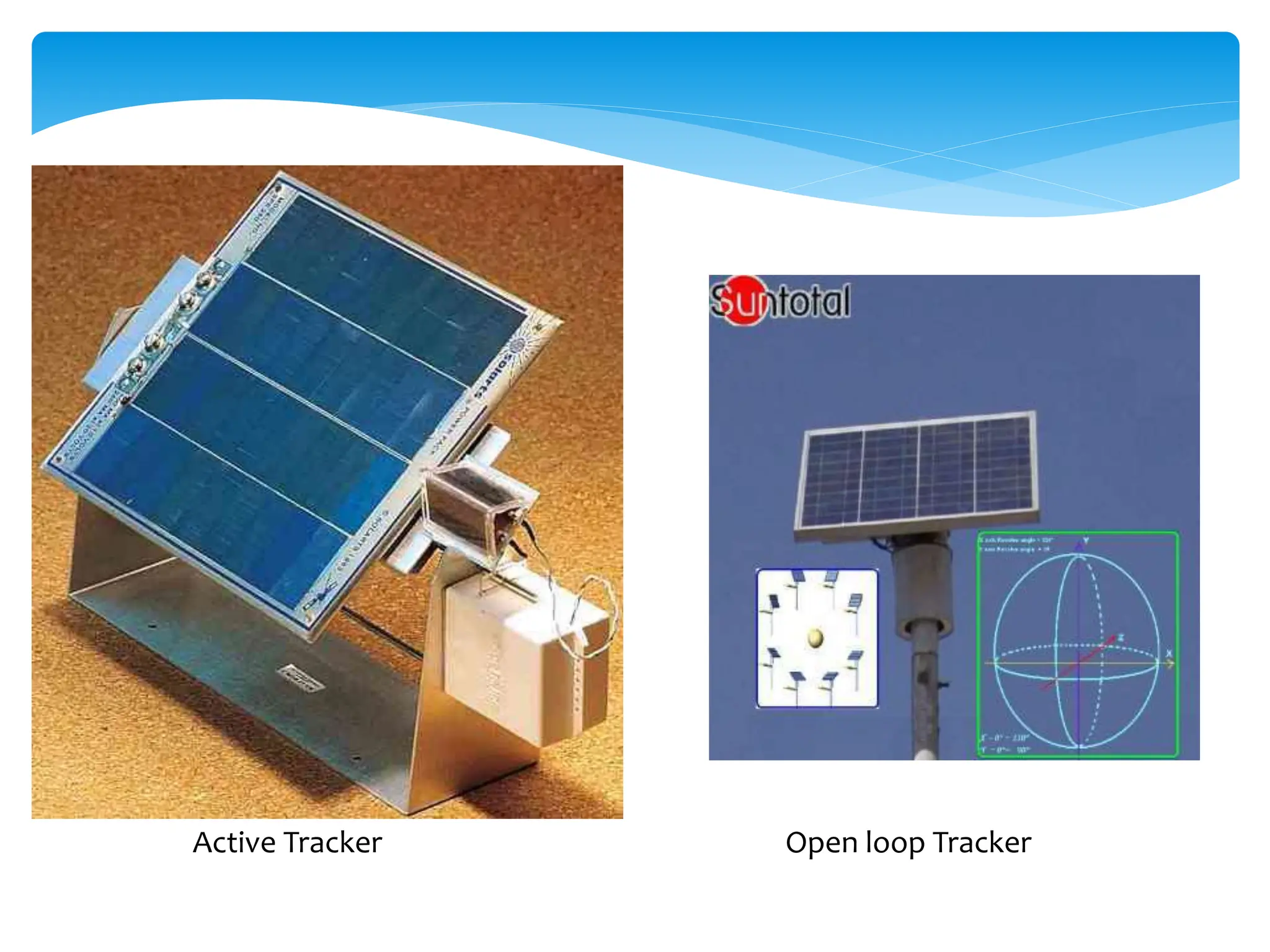
Active Tracker Open loop Tracker
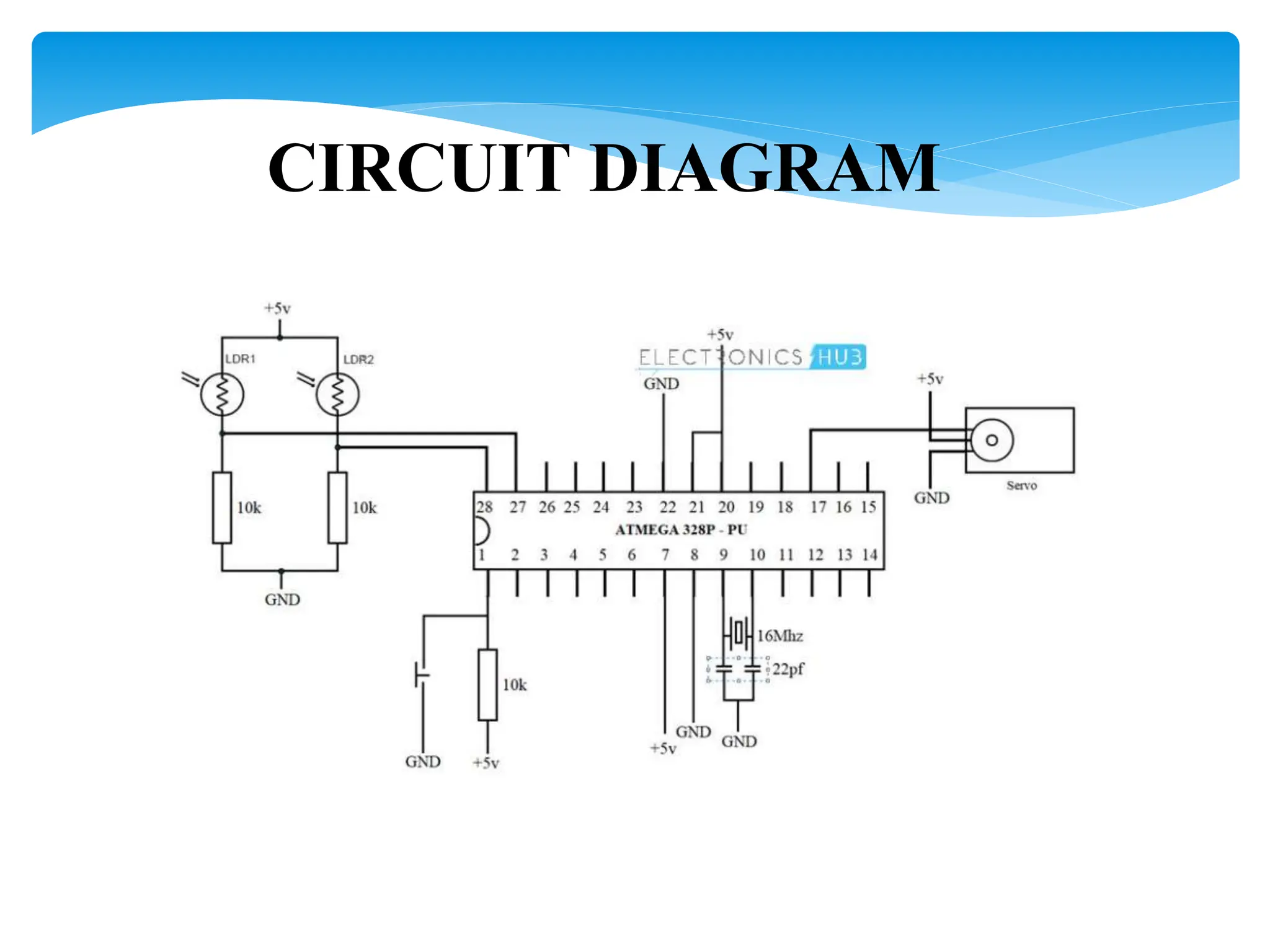
CIRCUIT DIAGRAM
COMPARISON OF SOLAR
ENERGY
WORKING PRINCIPLE
 The Sun tracking solar panel consists of two LDRs, solar panel and a servo motor
and ATmega328 Micro controller.
 Two light dependent resistors are arranged on the edges of the solar panel.
 Light dependent resistors produce low resistance when light falls on them.
 The servo motor connected to the panel rotates the panel in the direction of Sun.
 Panel is arranged in such a way that light on two LDRs is compared and panel is
rotated towards LDR which have high intensity.
 When the intensity of the light falling on right LDR is more, panel slowly moves
towards right and if intensity on the left LDR is more, panel slowly moves
towards left .In the noon time, Sun is ahead and intensity of light on both the panels
is same.In such cases, panel is constant and there is no rotation.
COMPONENTS USED
 Solar panel
 ATmega328 Micro Controller
 Light Dependent Resistor (LDR)
 DC Motor
 Ceramic Capacitors
 Cardboard
 Connecting Wires
SOLAR PANEL
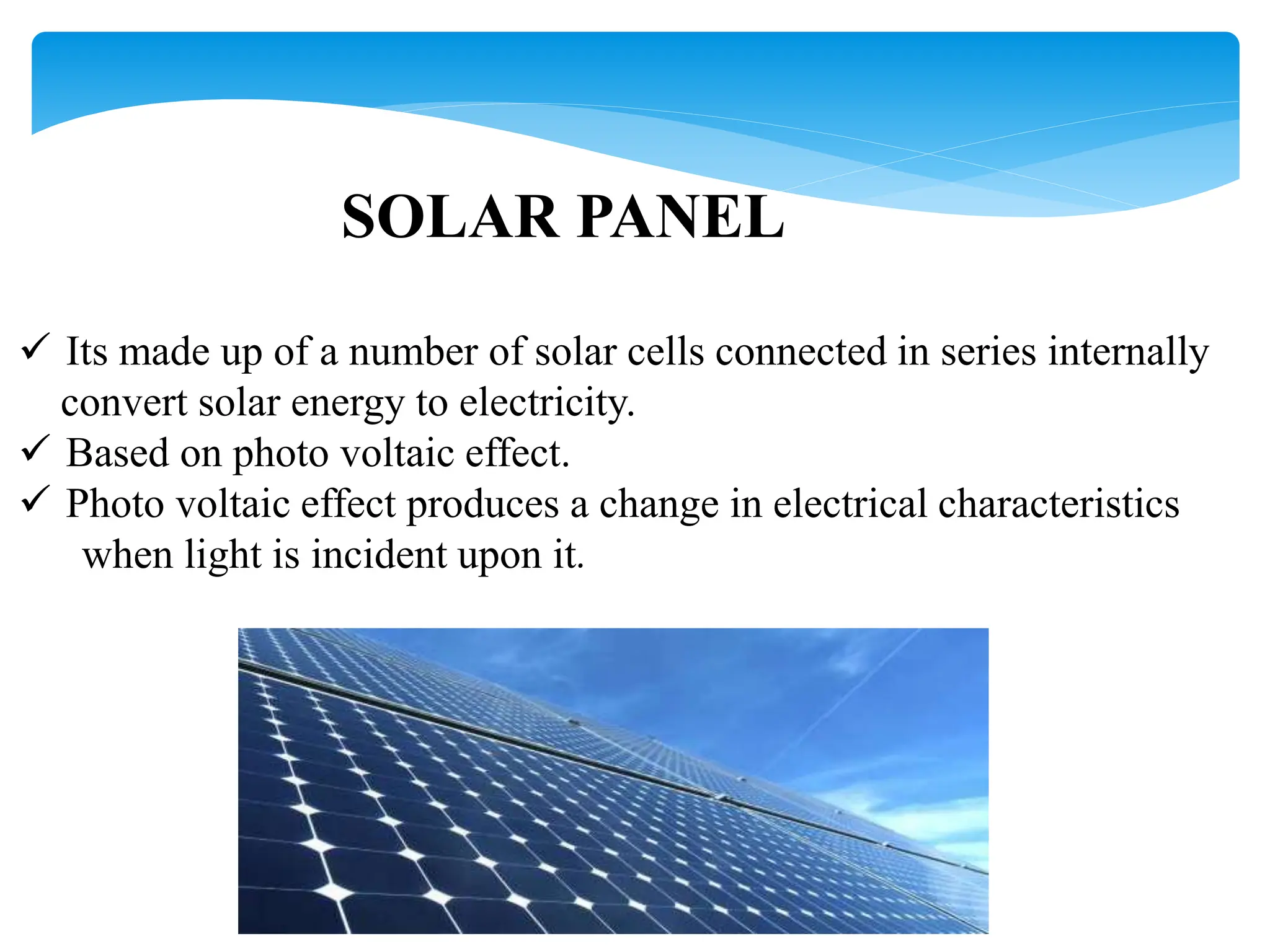
 Its made up of a number of solar cells connected in series internally
convert solar energy to electricity.
 Based on photo voltaic effect.
 Photo voltaic effect produces a change in electrical characteristics
when light is incident upon it.
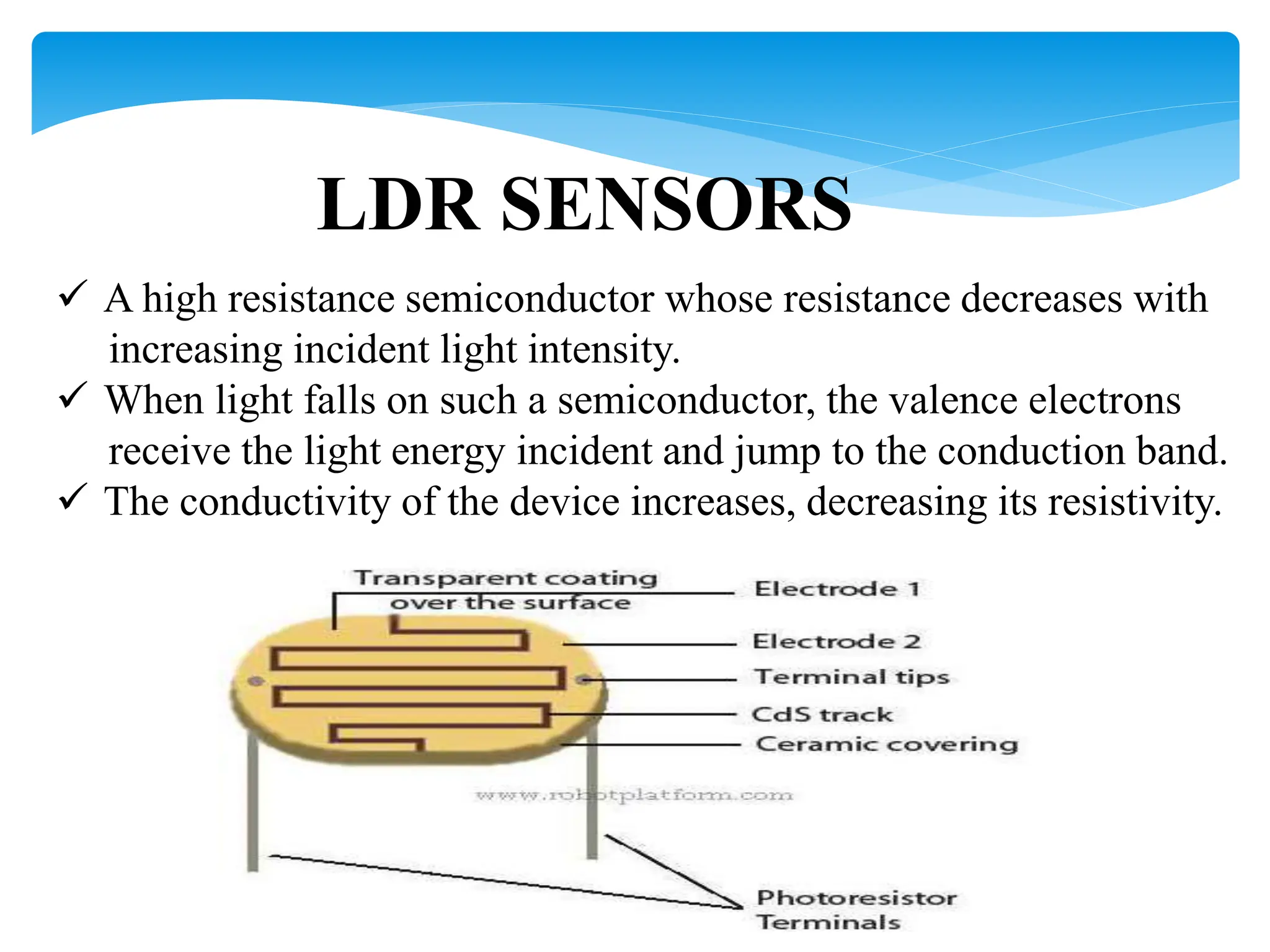
LDR SENSORS
 A high resistance semiconductor whose resistance decreases with
increasing incident light intensity.
 When light falls on such a semiconductor, the valence electrons
receive the light energy incident and jump to the conduction band.
 The conductivity of the device increases, decreasing its resistivity.
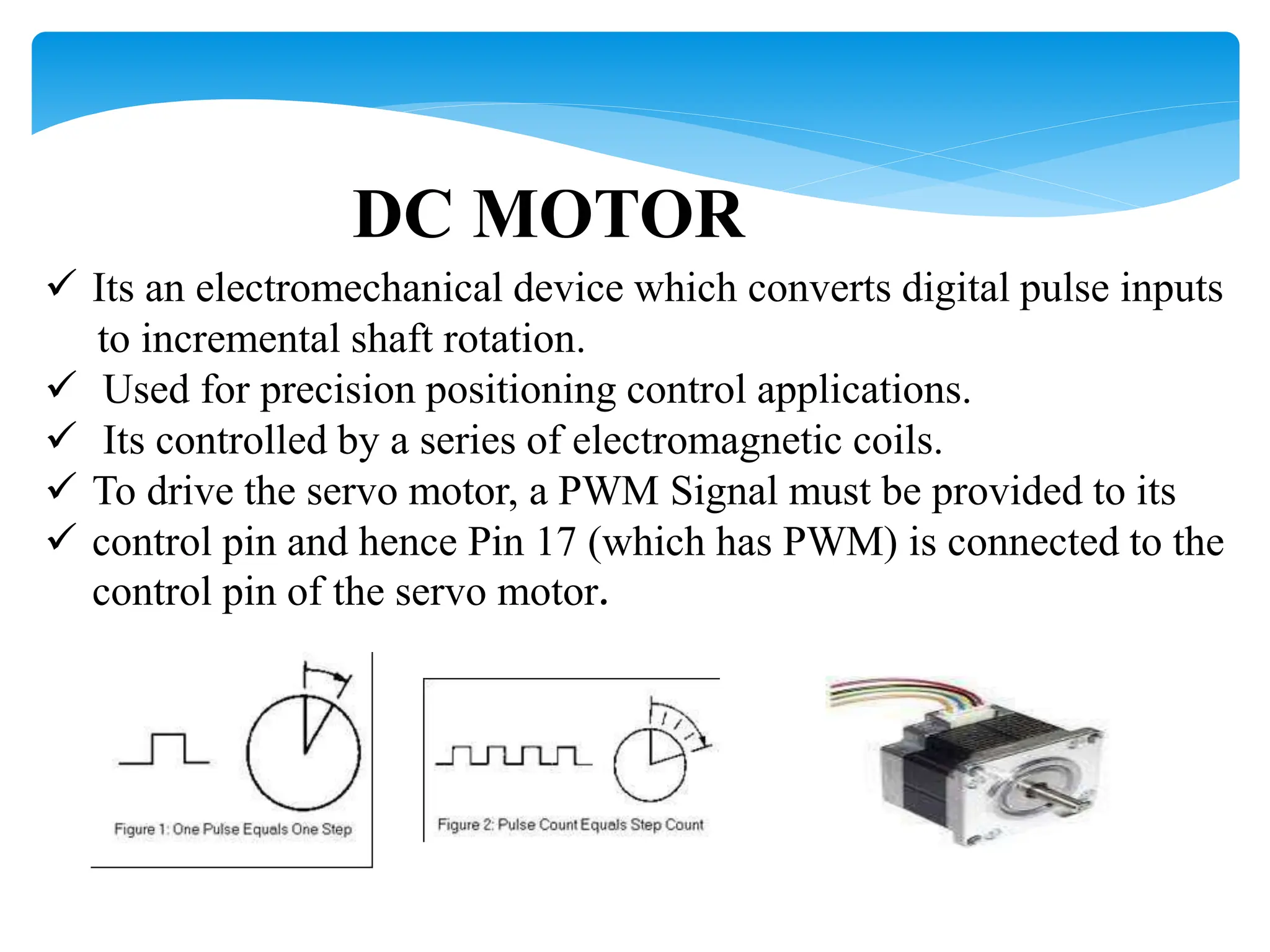
DC MOTOR
 Its an electromechanical device which converts digital pulse inputs
to incremental shaft rotation.
 Used for precision positioning control applications.
 Its controlled by a series of electromagnetic coils.
 To drive the servo motor, a PWM Signal must be provided to its
 control pin and hence Pin 17 (which has PWM) is connected to the
control pin of the servo motor.
ATmega328 Micro Controller
 ATmega328 is an AVR family micro controller.
 It is based on advanced RISC architecture.
 It is an 8-bit controller.
 It has 32K Bytes of Programmable Flash memory.
 1K Bytes of EEPROM.
 2K Bytes of SRAM.
 It has 23 programmable I/O pins.
ADVANTAGES
 The solar energy can be reused as it is non-renewable resource.
 This also saves money as there is no need to pay for energy used
(excluding the initial setup cost).
 Helps in maximizing the solar energy absorption by
continuously tracking the sun.
 Eco-Friendly
DISADVANTAGES
 Solar electricity is not available at night and is less available in
cloudy weather conditions. Therefore, a storage or complimentary
power system is required.
 Although solar energy can be saved to batteries, they are heavy and
occupy more space and required to change time to time.
APPLICATIONS
 These panels can be used to power the traffic lights and streetlights
 These can be used in home to power the appliances using solar power.
 These can be used in industries as more energy can be saved by
rotating the panel.
CONCLUSION
 The invention of Solar Tracking System helps us improve the
performance of PV solar system in a simple way.
 Used relative method of sunlight strength.
 Improved the utilization rate of solar energy and efficiency of
photovoltaic power generation system.
solar tracker sunflower model based.pptx

solar tracker sunflower model based.pptx

  • 1.
  • 2.
    CONTENT  INTRODUCTION  WHATIS SOLAR TRACKERS  NEED OF SOLAR TRACKERS  CIRCUIT DIAGRAM  WORKING PRINCIPLE  HARDWARE COPONENTS  ADVANTAGES  DISADVANTAGES  APPLICATIONS  CONCLUSION
  • 3.
    INTRODUCTION  Renewable energysolutions are becoming popular.  Maximizing output from solar system increases efficiency.  Presently solar panels are of fixed type which lower the efficiency.  Maintaining vertical direction between light and panel maximizes efficiency.  Solar panels are used to convert the light energy into the electrical energy.
  • 4.
    WHAT IS SOLARTRACKER? A Solar tracker is a device used for orienting a solar photovoltaic panel or lens towards the sun by using the solar or light sensors connected with the machine ( ex: stepper motor, servo motor, gas filled piston ).
  • 5.
    NEED OF SOLARTRACKER  Increase Solar Panel Output  Maximum efficiency of the panel  Maximize Power per unit Area  Able to grab the energy through out the day.
  • 6.
    DIFFERENT TYPES OFTRACKERS Single axis tracker Dual axis tracker Passive (Gas) tracker
  • 7.
    Active Tracker Openloop Tracker
  • 8.
  • 9.
  • 10.
    WORKING PRINCIPLE  TheSun tracking solar panel consists of two LDRs, solar panel and a servo motor and ATmega328 Micro controller.  Two light dependent resistors are arranged on the edges of the solar panel.  Light dependent resistors produce low resistance when light falls on them.  The servo motor connected to the panel rotates the panel in the direction of Sun.  Panel is arranged in such a way that light on two LDRs is compared and panel is rotated towards LDR which have high intensity.  When the intensity of the light falling on right LDR is more, panel slowly moves towards right and if intensity on the left LDR is more, panel slowly moves towards left .In the noon time, Sun is ahead and intensity of light on both the panels is same.In such cases, panel is constant and there is no rotation.
  • 11.
    COMPONENTS USED  Solarpanel  ATmega328 Micro Controller  Light Dependent Resistor (LDR)  DC Motor  Ceramic Capacitors  Cardboard  Connecting Wires
  • 12.
    SOLAR PANEL  Itsmade up of a number of solar cells connected in series internally convert solar energy to electricity.  Based on photo voltaic effect.  Photo voltaic effect produces a change in electrical characteristics when light is incident upon it.
  • 13.
    LDR SENSORS  Ahigh resistance semiconductor whose resistance decreases with increasing incident light intensity.  When light falls on such a semiconductor, the valence electrons receive the light energy incident and jump to the conduction band.  The conductivity of the device increases, decreasing its resistivity.
  • 14.
    DC MOTOR  Itsan electromechanical device which converts digital pulse inputs to incremental shaft rotation.  Used for precision positioning control applications.  Its controlled by a series of electromagnetic coils.  To drive the servo motor, a PWM Signal must be provided to its  control pin and hence Pin 17 (which has PWM) is connected to the control pin of the servo motor.
  • 15.
    ATmega328 Micro Controller ATmega328 is an AVR family micro controller.  It is based on advanced RISC architecture.  It is an 8-bit controller.  It has 32K Bytes of Programmable Flash memory.  1K Bytes of EEPROM.  2K Bytes of SRAM.  It has 23 programmable I/O pins.
  • 16.
    ADVANTAGES  The solarenergy can be reused as it is non-renewable resource.  This also saves money as there is no need to pay for energy used (excluding the initial setup cost).  Helps in maximizing the solar energy absorption by continuously tracking the sun.  Eco-Friendly
  • 17.
    DISADVANTAGES  Solar electricityis not available at night and is less available in cloudy weather conditions. Therefore, a storage or complimentary power system is required.  Although solar energy can be saved to batteries, they are heavy and occupy more space and required to change time to time.
  • 18.
    APPLICATIONS  These panelscan be used to power the traffic lights and streetlights  These can be used in home to power the appliances using solar power.  These can be used in industries as more energy can be saved by rotating the panel.
  • 19.
    CONCLUSION  The inventionof Solar Tracking System helps us improve the performance of PV solar system in a simple way.  Used relative method of sunlight strength.  Improved the utilization rate of solar energy and efficiency of photovoltaic power generation system.