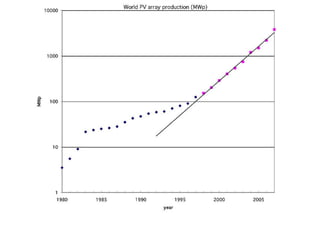
Solar Photovoltaic Energy Principles -1
Solar Energy – Contents
• An Overview of Photovoltaics
• PV – Principle of Operation
• Technologies
An overview of Photovoltaics
• Photovoltaic systems are solar energy systems
that produce electricity from sunlight.
• Photovoltaic (PV) systems produce clean energy,
reliable energy with out consuming fossil fuels and
can be used in a wide variety of applications.
• A common application of PV technology is proving
power for watches and radios.
• On large scale, many utilities have recently
installed large photovoltaic arrays to provide
consumers with solar-generated electricity, or as
back-up system for critical equipment.
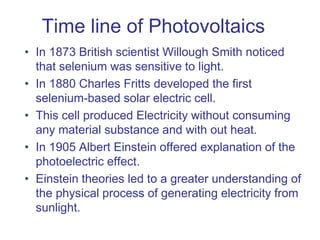
Time line of Photovoltaics
• In 1873 British scientist Willough Smith noticed
that selenium was sensitive to light.
• In 1880 Charles Fritts developed the first
selenium-based solar electric cell.
• This cell produced Electricity without consuming
any material substance and with out heat.
• In 1905 Albert Einstein offered explanation of the
photoelectric effect.
• Einstein theories led to a greater understanding of
the physical process of generating electricity from
sunlight.
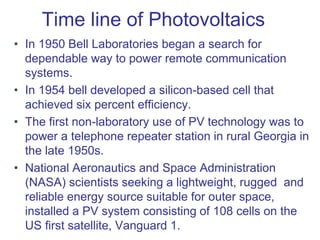
Time line of Photovoltaics
• In 1950 Bell Laboratories began a search for
dependable way to power remote communication
systems.
• In 1954 bell developed a silicon-based cell that
achieved six percent efficiency.
• The first non-laboratory use of PV technology was to
power a telephone repeater station in rural Georgia in
the late 1950s.
• National Aeronautics and Space Administration
(NASA) scientists seeking a lightweight, rugged and
reliable energy source suitable for outer space,
installed a PV system consisting of 108 cells on the
US first satellite, Vanguard 1.
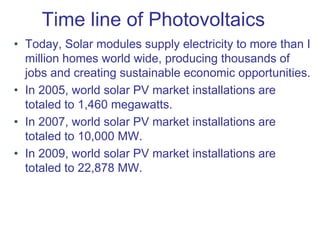
Time line of Photovoltaics
• Today, Solar modules supply electricity to more than I
million homes world wide, producing thousands of
jobs and creating sustainable economic opportunities.
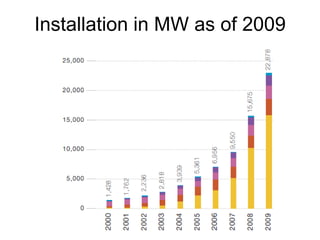
• In 2005, world solar PV market installations are
totaled to 1,460 megawatts.
• In 2007, world solar PV market installations are
totaled to 10,000 MW.
• In 2009, world solar PV market installations are
totaled to 22,878 MW.
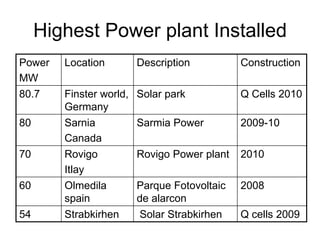
Highest Power plant Installed
Power
MW
Location Description Construction
80.7 Finster world,
Germany
Solar park Q Cells 2010
80 Sarnia
Canada
Sarmia Power 2009-10
70 Rovigo
Itlay
Rovigo Power plant 2010
60 Olmedila
spain
Parque Fotovoltaic
de alarcon
2008
54 Strabkirhen Solar Strabkirhen Q cells 2009
Installation in MW as of 2009
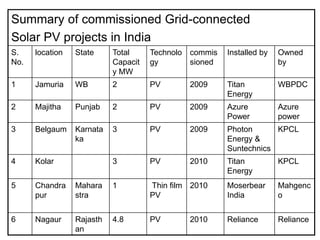
Summary of commissioned Grid-connected
Solar PV projects in India
S.
No.
location State Total
Capacit
y MW
Technolo
gy
commis
sioned
Installed by Owned
by
1 Jamuria WB 2 PV 2009 Titan
Energy
WBPDC
2 Majitha Punjab 2 PV 2009 Azure
Power
Azure
power
3 Belgaum Karnata
ka
3 PV 2009 Photon
Energy &
Suntechnics
KPCL
4 Kolar 3 PV 2010 Titan
Energy
KPCL
5 Chandra
pur
Mahara
stra
1 Thin film
PV
2010 Moserbear
India
Mahgenc
o
6 Nagaur Rajasth
an
4.8 PV 2010 Reliance Reliance
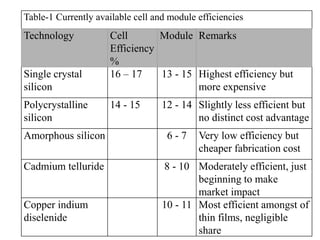
Table-1 Currently available cell and module efficiencies
Technology Cell
Efficiency
%
Module Remarks
Single crystal
silicon
16 – 17 13 - 15 Highest efficiency but
more expensive
Polycrystalline
silicon
14 - 15 12 - 14 Slightly less efficient but
no distinct cost advantage
Amorphous silicon 6 - 7 Very low efficiency but
cheaper fabrication cost
Cadmium telluride 8 - 10 Moderately efficient, just
beginning to make
market impact
Copper indium
diselenide
10 - 11 Most efficient amongst of
thin films, negligible
share
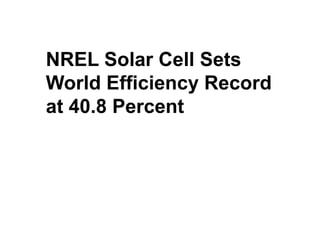
NREL Solar Cell Sets
World Efficiency Record
at 40.8 Percent
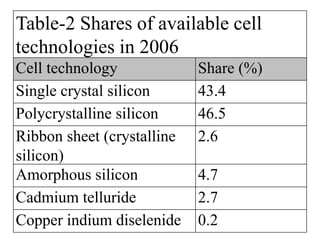
Table-2 Shares of available cell
technologies in 2006
Cell technology Share (%)
Single crystal silicon 43.4
Polycrystalline silicon 46.5
Ribbon sheet (crystalline
silicon)
2.6
Amorphous silicon 4.7
Cadmium telluride 2.7
Copper indium diselenide 0.2
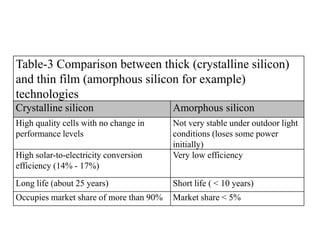
Table-3 Comparison between thick (crystalline silicon)
and thin film (amorphous silicon for example)
technologies
Crystalline silicon Amorphous silicon
High quality cells with no change in
performance levels
Not very stable under outdoor light
conditions (loses some power
initially)
High solar-to-electricity conversion
efficiency (14% - 17%)
Very low efficiency
Long life (about 25 years) Short life ( < 10 years)
Occupies market share of more than 90% Market share < 5%
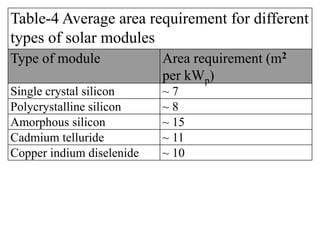
Table-4 Average area requirement for different
types of solar modules
Type of module Area requirement (m2
per kWp)
Single crystal silicon ~ 7
Polycrystalline silicon ~ 8
Amorphous silicon ~ 15
Cadmium telluride ~ 11
Copper indium diselenide ~ 10
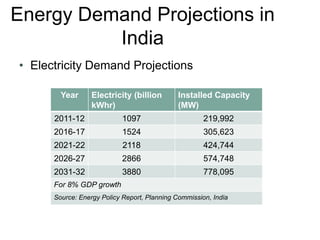
Energy Demand Projections in
India
• Electricity Demand Projections
Year Electricity (billion
kWhr)
Installed Capacity
(MW)
2011-12 1097 219,992
2016-17 1524 305,623
2021-22 2118 424,744
2026-27 2866 574,748
2031-32 3880 778,095
For 8% GDP growth
Source: Energy Policy Report, Planning Commission, India
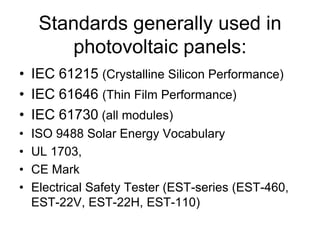
Standards generally used in
photovoltaic panels:
• IEC 61215 (Crystalline Silicon Performance)
• IEC 61646 (Thin Film Performance)
• IEC 61730 (all modules)
• ISO 9488 Solar Energy Vocabulary
• UL 1703,
• CE Mark
• Electrical Safety Tester (EST-series (EST-460,
EST-22V, EST-22H, EST-110)
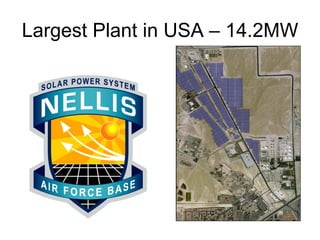
Largest Plant in USA – 14.2MW
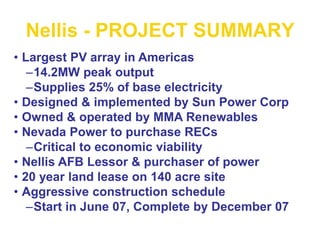
Nellis - PROJECT SUMMARY
• Largest PV array in Americas
–14.2MW peak output
–Supplies 25% of base electricity
• Designed & implemented by Sun Power Corp
• Owned & operated by MMA Renewables
• Nevada Power to purchase RECs
–Critical to economic viability
• Nellis AFB Lessor & purchaser of power
• 20 year land lease on 140 acre site
• Aggressive construction schedule
–Start in June 07, Complete by December 07
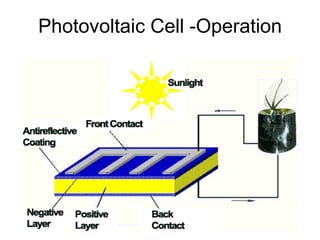
Photovoltaic Cell -Operation
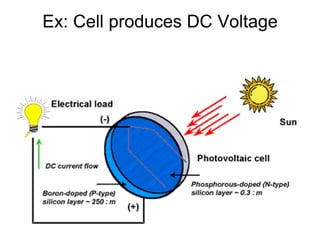
Ex: Cell produces DC Voltage
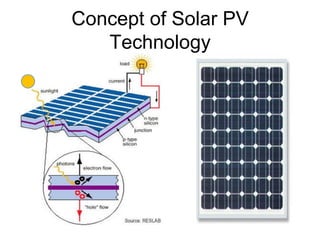
Concept of Solar PV
Technology
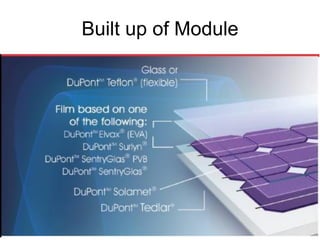
Built up of Module
Types of PV Cell:
• Single crystal Silicon Cells:
• Made using cells saw-cut from a single
cylindrical crystal of silicon, this is the most
efficient of the photovoltaic (PV)
• technologies. The principle advantage of
monocrystal cells are their high
efficiencies, typically around 15%,
• although the manufacturing process
required to produce monocrystal silicon is
complicated, resulting in slightly higher
costs than other technologies.
Types of PV Cell:
Multicrystalline Silicon Cells:
• Made from cells cut from an ingot of melted and recrystallised
silicon. In the manufacturing process, molten silicon
• is cast into ingots of polycrystalline silicon, these ingots are then
saw-cut into very thin wafers and assembled into
• complete cells. Multicrystalline cells are cheaper to produce than
monocrystalline ones, due to the simpler
• manufacturing process. However, they tend to be slightly less
efficient, with average efficiencies of around 12%,
• creating a granular texture.
• Thick-film Silicon:
• Another multicrystalline technology where the silicon is deposited in
a continuous process onto a base material
• giving a fine grained, sparkling appearance. Like all crystalline PV,
this is encapsulated in a transparent insulating
• polymer with a tempered glass cover and usually bound into a
strong aluminium frame.
Types of PV Cell:
Amorphous Silicon:
• Amorphous silicon cells are composed of silicon atoms in a
thin homogenous layer rather than a crystal structure
• and it absorbs light more effectively than crystalline silicon,
so the cells can be thinner. For this reason, amorphous
• silicon is also known as a "thin film" PV technology.
Amorphous silicon can be deposited on a wide range of
• substrates, both rigid and flexible, which makes it ideal for
curved surfaces and "fold-away" modules. Amorphous
• cells are, however, less efficient than crystalline based
cells, with typical efficiencies of around 6%, but they are
• easier and therefore cheaper to produce. Their low cost
makes them ideally suited for many applications where
• high efficiency is not required and low cost is important.
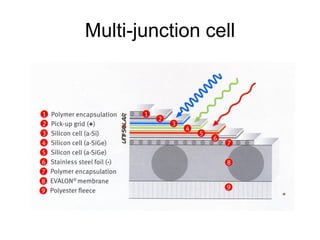
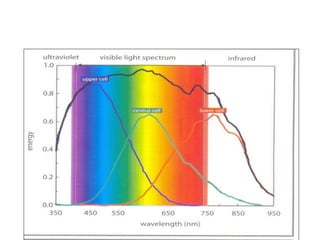
Multi-junction cell
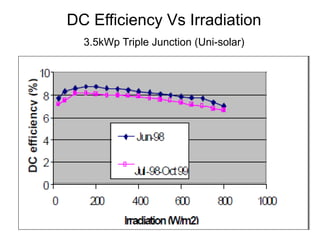
DC Efficiency Vs Irradiation
3.5kWp Triple Junction (Uni-solar)
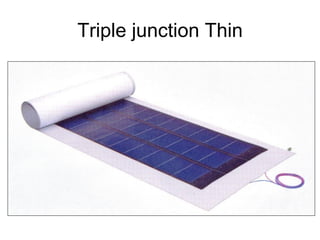
Triple junction Thin
Top ten cell suppliers (by power) in 2009
• First Solar
• Suntech
• Sharp
• Yingli
• Trina Solar
• Sunpower Corporation
• Kyocera Corporation
• Canadian Solar
• SolarWorld AG
• Sanyo Electric
7.5 GW of installations were completed and connected in
2009
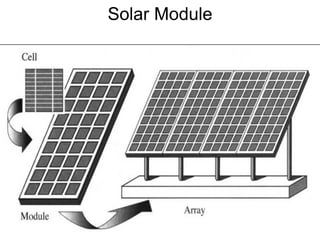
Solar Module
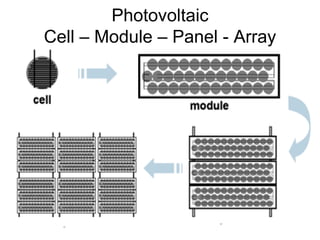
Photovoltaic
Cell – Module – Panel - Array
Standards generally used in
photovoltaic panels:
• IEC 61215 (Crystalline Silicon Performance)
• IEC 61646 (Thin Film Performance)
• IEC 61730 (all modules)
• ISO 9488 Solar Energy Vocabulary
• UL 1703,
• CE Mark
• Electrical Safety Tester (EST-series (EST-460,
EST-22V, EST-22H, EST-110)
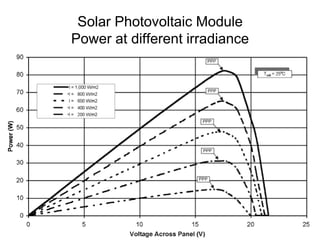
Solar Photovoltaic Module
Power at different irradiance
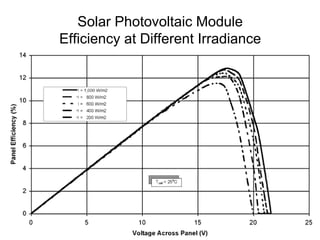
Solar Photovoltaic Module
Efficiency at Different Irradiance
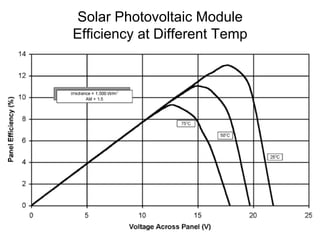
Solar Photovoltaic Module
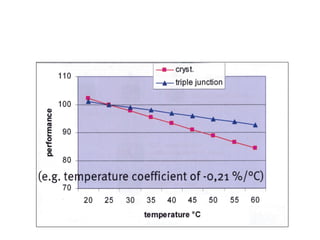
Efficiency at Different Temp
Solar Photovoltaic Module
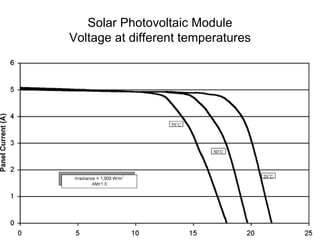
Voltage at different temperatures
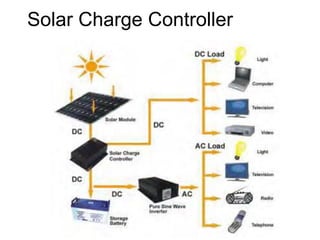
Solar Charge Controller
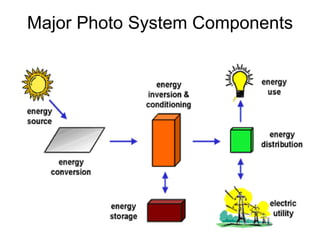
Major Photo System Components
Concentrated Solar Power
• Solar power/ solar energy to refer to the conversion of sunlight into electricity. This can be done either
through the photovoltaic effect or by heating a transfer fluid to produce steam to run a generator.
Solar energy technologies harness the sun's energy for practical ends. These technologies date from
the time of the early Greeks, Native Americans and Chinese, who warmed their buildings by orienting
them toward the sun. Modern solar technologies provide heating, lighting, electricity and even flight.
Concentrated sunlight has been used to perform useful tasks from the time of ancient China. A legend
claims Archimedes used polished shields to concentrate sunlight on the invading Roman fleet and
repel them from Syracuse in 212 BC. Leonardo Da Vinci conceived using large-scale solar
concentrators to weld copper in the 15th century. In 1866, Auguste Mouchout success fully powered a
steam engine with sunlight, the first known example of a concentrating solar-powered mechanical
device. Over the following 50 years, inventors such as John Ericsson, and Frank Shuman developed
solar-powered devices for irrigation, refrigeration and locomotion. The progeny of these early
developments are the concentrating solar thermal power plants of today.
Concentrating Solar Thermal (CST) systems use lenses or mirrors and tracking systems to focus a
large area of sunlight into a small beam. This is then used to generate electricity. Moreover, the high
temperatures produced by CST systems can be used to provide process heat and steam for a variety
of secondary commercial applications (cogeneration). However, CST technologies require direct
insolation to function and are of limited use in locations with significant cloud cover. The main
methods for producing a concentrated beam are the solar trough, solar power tower and parabolic
dish; the solar bowl is more rarely used. Each concentration method is capable of producing high
temperatures and high efficiencies, but they vary in the way they track the sun and focus light.
Solar Power, captures all the knowledge you need to know on this topic into one comprehensive
report. The report looks at the basics of solar energy, the basics of Concentrated Solar Power, the
technologies used in this process, cost analysis of all the technologies, major ongoing projects, and
much more. The report also analyzes the major players involved in the industry.
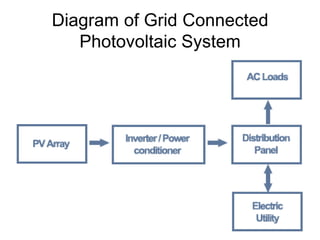
Diagram of Grid Connected
Photovoltaic System
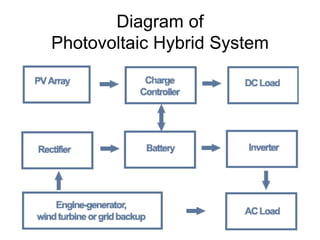
Diagram of
Photovoltaic Hybrid System
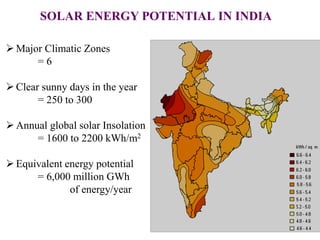
SOLAR ENERGY POTENTIAL IN INDIA
 Major Climatic Zones
= 6
 Clear sunny days in the year
= 250 to 300
 Annual global solar Insolation
= 1600 to 2200 kWh/m2
 Equivalent energy potential
= 6,000 million GWh
of energy/year
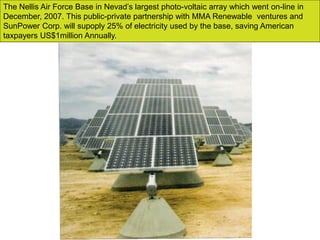
The Nellis Air Force Base in Nevad’s largest photo-voltaic array which went on-line in
December, 2007. This public-private partnership with MMA Renewable ventures and
SunPower Corp. will supoply 25% of electricity used by the base, saving American
taxpayers US$1million Annually.
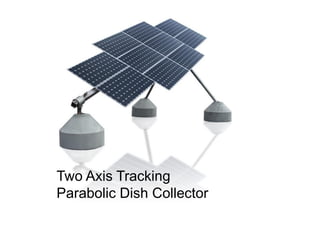
Two Axis Tracking
Parabolic Dish Collector
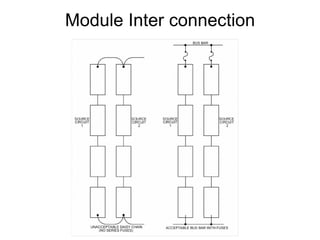
Module Inter connection
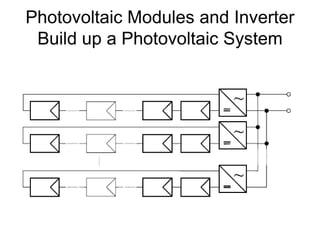
Photovoltaic Modules and Inverter
Build up a Photovoltaic System
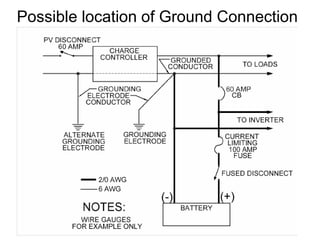
Possible location of Ground Connection

Solar PV energy principles part 1

  • 1.
  • 2.
    Solar Energy –Contents • An Overview of Photovoltaics • PV – Principle of Operation • Technologies
  • 3.
    An overview ofPhotovoltaics • Photovoltaic systems are solar energy systems that produce electricity from sunlight. • Photovoltaic (PV) systems produce clean energy, reliable energy with out consuming fossil fuels and can be used in a wide variety of applications. • A common application of PV technology is proving power for watches and radios. • On large scale, many utilities have recently installed large photovoltaic arrays to provide consumers with solar-generated electricity, or as back-up system for critical equipment.
  • 4.
    Time line ofPhotovoltaics • In 1873 British scientist Willough Smith noticed that selenium was sensitive to light. • In 1880 Charles Fritts developed the first selenium-based solar electric cell. • This cell produced Electricity without consuming any material substance and with out heat. • In 1905 Albert Einstein offered explanation of the photoelectric effect. • Einstein theories led to a greater understanding of the physical process of generating electricity from sunlight.
  • 5.
    Time line ofPhotovoltaics • In 1950 Bell Laboratories began a search for dependable way to power remote communication systems. • In 1954 bell developed a silicon-based cell that achieved six percent efficiency. • The first non-laboratory use of PV technology was to power a telephone repeater station in rural Georgia in the late 1950s. • National Aeronautics and Space Administration (NASA) scientists seeking a lightweight, rugged and reliable energy source suitable for outer space, installed a PV system consisting of 108 cells on the US first satellite, Vanguard 1.
  • 6.
    Time line ofPhotovoltaics • Today, Solar modules supply electricity to more than I million homes world wide, producing thousands of jobs and creating sustainable economic opportunities. • In 2005, world solar PV market installations are totaled to 1,460 megawatts. • In 2007, world solar PV market installations are totaled to 10,000 MW. • In 2009, world solar PV market installations are totaled to 22,878 MW.
  • 7.
    Highest Power plantInstalled Power MW Location Description Construction 80.7 Finster world, Germany Solar park Q Cells 2010 80 Sarnia Canada Sarmia Power 2009-10 70 Rovigo Itlay Rovigo Power plant 2010 60 Olmedila spain Parque Fotovoltaic de alarcon 2008 54 Strabkirhen Solar Strabkirhen Q cells 2009
  • 8.
  • 9.
    Summary of commissionedGrid-connected Solar PV projects in India S. No. location State Total Capacit y MW Technolo gy commis sioned Installed by Owned by 1 Jamuria WB 2 PV 2009 Titan Energy WBPDC 2 Majitha Punjab 2 PV 2009 Azure Power Azure power 3 Belgaum Karnata ka 3 PV 2009 Photon Energy & Suntechnics KPCL 4 Kolar 3 PV 2010 Titan Energy KPCL 5 Chandra pur Mahara stra 1 Thin film PV 2010 Moserbear India Mahgenc o 6 Nagaur Rajasth an 4.8 PV 2010 Reliance Reliance
  • 10.
    Table-1 Currently availablecell and module efficiencies Technology Cell Efficiency % Module Remarks Single crystal silicon 16 – 17 13 - 15 Highest efficiency but more expensive Polycrystalline silicon 14 - 15 12 - 14 Slightly less efficient but no distinct cost advantage Amorphous silicon 6 - 7 Very low efficiency but cheaper fabrication cost Cadmium telluride 8 - 10 Moderately efficient, just beginning to make market impact Copper indium diselenide 10 - 11 Most efficient amongst of thin films, negligible share
  • 11.
    NREL Solar CellSets World Efficiency Record at 40.8 Percent
  • 13.
    Table-2 Shares ofavailable cell technologies in 2006 Cell technology Share (%) Single crystal silicon 43.4 Polycrystalline silicon 46.5 Ribbon sheet (crystalline silicon) 2.6 Amorphous silicon 4.7 Cadmium telluride 2.7 Copper indium diselenide 0.2
  • 14.
    Table-3 Comparison betweenthick (crystalline silicon) and thin film (amorphous silicon for example) technologies Crystalline silicon Amorphous silicon High quality cells with no change in performance levels Not very stable under outdoor light conditions (loses some power initially) High solar-to-electricity conversion efficiency (14% - 17%) Very low efficiency Long life (about 25 years) Short life ( < 10 years) Occupies market share of more than 90% Market share < 5%
  • 15.
    Table-4 Average arearequirement for different types of solar modules Type of module Area requirement (m2 per kWp) Single crystal silicon ~ 7 Polycrystalline silicon ~ 8 Amorphous silicon ~ 15 Cadmium telluride ~ 11 Copper indium diselenide ~ 10
  • 16.
    Energy Demand Projectionsin India • Electricity Demand Projections Year Electricity (billion kWhr) Installed Capacity (MW) 2011-12 1097 219,992 2016-17 1524 305,623 2021-22 2118 424,744 2026-27 2866 574,748 2031-32 3880 778,095 For 8% GDP growth Source: Energy Policy Report, Planning Commission, India
  • 17.
    Standards generally usedin photovoltaic panels: • IEC 61215 (Crystalline Silicon Performance) • IEC 61646 (Thin Film Performance) • IEC 61730 (all modules) • ISO 9488 Solar Energy Vocabulary • UL 1703, • CE Mark • Electrical Safety Tester (EST-series (EST-460, EST-22V, EST-22H, EST-110)
  • 18.
    Largest Plant inUSA – 14.2MW
  • 19.
    Nellis - PROJECTSUMMARY • Largest PV array in Americas –14.2MW peak output –Supplies 25% of base electricity • Designed & implemented by Sun Power Corp • Owned & operated by MMA Renewables • Nevada Power to purchase RECs –Critical to economic viability • Nellis AFB Lessor & purchaser of power • 20 year land lease on 140 acre site • Aggressive construction schedule –Start in June 07, Complete by December 07
  • 21.
  • 22.
  • 23.
    Concept of SolarPV Technology
  • 24.
  • 25.
    Types of PVCell: • Single crystal Silicon Cells: • Made using cells saw-cut from a single cylindrical crystal of silicon, this is the most efficient of the photovoltaic (PV) • technologies. The principle advantage of monocrystal cells are their high efficiencies, typically around 15%, • although the manufacturing process required to produce monocrystal silicon is complicated, resulting in slightly higher costs than other technologies.
  • 26.
    Types of PVCell: Multicrystalline Silicon Cells: • Made from cells cut from an ingot of melted and recrystallised silicon. In the manufacturing process, molten silicon • is cast into ingots of polycrystalline silicon, these ingots are then saw-cut into very thin wafers and assembled into • complete cells. Multicrystalline cells are cheaper to produce than monocrystalline ones, due to the simpler • manufacturing process. However, they tend to be slightly less efficient, with average efficiencies of around 12%, • creating a granular texture. • Thick-film Silicon: • Another multicrystalline technology where the silicon is deposited in a continuous process onto a base material • giving a fine grained, sparkling appearance. Like all crystalline PV, this is encapsulated in a transparent insulating • polymer with a tempered glass cover and usually bound into a strong aluminium frame.
  • 27.
    Types of PVCell: Amorphous Silicon: • Amorphous silicon cells are composed of silicon atoms in a thin homogenous layer rather than a crystal structure • and it absorbs light more effectively than crystalline silicon, so the cells can be thinner. For this reason, amorphous • silicon is also known as a "thin film" PV technology. Amorphous silicon can be deposited on a wide range of • substrates, both rigid and flexible, which makes it ideal for curved surfaces and "fold-away" modules. Amorphous • cells are, however, less efficient than crystalline based cells, with typical efficiencies of around 6%, but they are • easier and therefore cheaper to produce. Their low cost makes them ideally suited for many applications where • high efficiency is not required and low cost is important.
  • 28.
  • 30.
    DC Efficiency VsIrradiation 3.5kWp Triple Junction (Uni-solar)
  • 32.
  • 33.
    Top ten cellsuppliers (by power) in 2009 • First Solar • Suntech • Sharp • Yingli • Trina Solar • Sunpower Corporation • Kyocera Corporation • Canadian Solar • SolarWorld AG • Sanyo Electric 7.5 GW of installations were completed and connected in 2009
  • 34.
  • 35.
  • 36.
    Standards generally usedin photovoltaic panels: • IEC 61215 (Crystalline Silicon Performance) • IEC 61646 (Thin Film Performance) • IEC 61730 (all modules) • ISO 9488 Solar Energy Vocabulary • UL 1703, • CE Mark • Electrical Safety Tester (EST-series (EST-460, EST-22V, EST-22H, EST-110)
  • 37.
    Solar Photovoltaic Module Powerat different irradiance
  • 38.
    Solar Photovoltaic Module Efficiencyat Different Irradiance
  • 39.
  • 40.
    Solar Photovoltaic Module Voltageat different temperatures
  • 41.
  • 42.
  • 43.
    Concentrated Solar Power •Solar power/ solar energy to refer to the conversion of sunlight into electricity. This can be done either through the photovoltaic effect or by heating a transfer fluid to produce steam to run a generator. Solar energy technologies harness the sun's energy for practical ends. These technologies date from the time of the early Greeks, Native Americans and Chinese, who warmed their buildings by orienting them toward the sun. Modern solar technologies provide heating, lighting, electricity and even flight. Concentrated sunlight has been used to perform useful tasks from the time of ancient China. A legend claims Archimedes used polished shields to concentrate sunlight on the invading Roman fleet and repel them from Syracuse in 212 BC. Leonardo Da Vinci conceived using large-scale solar concentrators to weld copper in the 15th century. In 1866, Auguste Mouchout success fully powered a steam engine with sunlight, the first known example of a concentrating solar-powered mechanical device. Over the following 50 years, inventors such as John Ericsson, and Frank Shuman developed solar-powered devices for irrigation, refrigeration and locomotion. The progeny of these early developments are the concentrating solar thermal power plants of today. Concentrating Solar Thermal (CST) systems use lenses or mirrors and tracking systems to focus a large area of sunlight into a small beam. This is then used to generate electricity. Moreover, the high temperatures produced by CST systems can be used to provide process heat and steam for a variety of secondary commercial applications (cogeneration). However, CST technologies require direct insolation to function and are of limited use in locations with significant cloud cover. The main methods for producing a concentrated beam are the solar trough, solar power tower and parabolic dish; the solar bowl is more rarely used. Each concentration method is capable of producing high temperatures and high efficiencies, but they vary in the way they track the sun and focus light. Solar Power, captures all the knowledge you need to know on this topic into one comprehensive report. The report looks at the basics of solar energy, the basics of Concentrated Solar Power, the technologies used in this process, cost analysis of all the technologies, major ongoing projects, and much more. The report also analyzes the major players involved in the industry.
  • 44.
    Diagram of GridConnected Photovoltaic System
  • 45.
  • 46.
    SOLAR ENERGY POTENTIALIN INDIA  Major Climatic Zones = 6  Clear sunny days in the year = 250 to 300  Annual global solar Insolation = 1600 to 2200 kWh/m2  Equivalent energy potential = 6,000 million GWh of energy/year
  • 48.
    The Nellis AirForce Base in Nevad’s largest photo-voltaic array which went on-line in December, 2007. This public-private partnership with MMA Renewable ventures and SunPower Corp. will supoply 25% of electricity used by the base, saving American taxpayers US$1million Annually.
  • 49.
  • 51.
  • 52.
    Photovoltaic Modules andInverter Build up a Photovoltaic System
  • 53.
    Possible location ofGround Connection