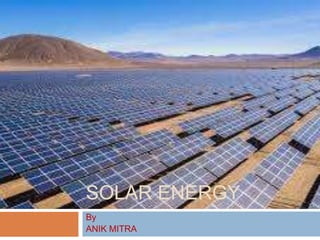
SOLAR ENERGY
By
ANIK MITRA
WHAT IS SOLAR ENERGY ?
 There are two types of solar energy :- Thermal energy
and Electric energy
 Thermal Energy :- This energy possessed by an object
or system due to the movement of particles within the
object or the system.
 Electric Energy :- This energy is produced direct from
sunlight via Photovoltaic cell.
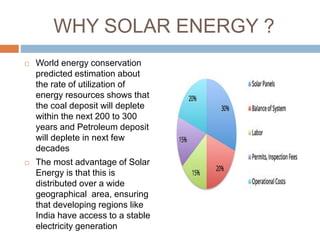
WHY SOLAR ENERGY ?
 World energy conservation
predicted estimation about
the rate of utilization of
energy resources shows that
the coal deposit will deplete
within the next 200 to 300
years and Petroleum deposit
will deplete in next few
decades
 The most advantage of Solar
Energy is that this is
distributed over a wide
geographical area, ensuring
that developing regions like
India have access to a stable
electricity generation
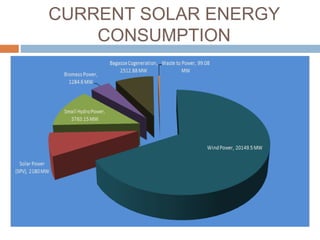
CURRENT SOLAR ENERGY
CONSUMPTION
HISTORY OF SOLAR POWER
 1838- Edmund Bacquerel observed materials which converts lights
into energy.
 1876-78 – William Adams wrote the first book about solar energy
called : “A substitute for fuel in tropical country” was able to power a
2.5 hp steam engine .
 1860 – Auguste Mouchout , used direct conversion of solar radiation
into mechanical power.
 1895-Aubrey Eneas formed the first solar company.
 1904 – Henry Willsie built two huge plants in California to generate
power. He was the first to use the power at night after generating it
in the presence of sunlight .
HISTORY OF SOLAR POWER
 1954 – Calvin fuller , Gerald Pearson and Daryl Chaplin of bell
laboratories discovered the silicon as the source of semiconductor
physics , which leads to construction of solar panel with a efficiency
of 6%.
 1956- First commercial solar cell was made available to the public
at a very expensive rate $ 300 per watt.
 1958- Vanguard I was the first satellite was launched that used
solar energy to generate electricity .
 1970 – Energy Crisis ! ( OPEC coil embargo ) solar energy history
was created as the price of the solar energy dropped down to $20
per watt.
WHAT IS PV CELL ??
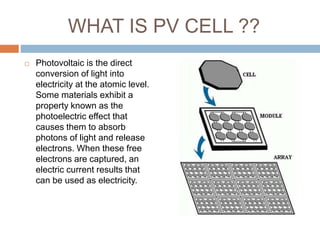
 Photovoltaic is the direct
conversion of light into
electricity at the atomic level.
Some materials exhibit a
property known as the
photoelectric effect that
causes them to absorb
photons of light and release
electrons. When these free
electrons are captured, an
electric current results that
can be used as electricity.
HOW PV CELL IS
MANUFACTURED ?
 Step 1: Pre-check and Pretreatment
 Step 2: Texturing
 Step 3: Acid Cleaning
 Step 4: Diffusion
 Step 5: Etching & Edge Isolation
 Step 6: Post-Etching Washing
 Step 7: Anti-Reflective Coating Deposition
 Step 8: Contact Printing and Drying
 Step 9: Testing and Cell Sorting
HOW PV CELL WORKS ??
 Sunlight first strike on the PV cell upper surface and the photons
are absorbed by the semiconductor materials such as Silicon,
Germanium.
 Electrons are knocked loose from their atom which allow them to
flow through the material to produce electricity. This is called
photovoltaic effect.
 Now the array of PV cell converts the energy of photons to the
electrical energy . But as PV cell is basically a diode so it only can
produce the DC voltage .
 In the consumer end we need the electrical energy in the form of AC
signals so to convert the DC to AC we fit voltage step inverters to
convert the DC to AC as per our requirements.
 The rest part is transmitting and distributing the electrical energy to
the consumer end
HOW PV CELL WORKS ??
 When more electricity is generated then the excess electricity can
be stored in a battery and the stored energy in the battery be used
as the source of energy at the night time.
 When the battery is full the excess electricity can be exported back
to the utility grid , when your system is connected to it.
 Utility supplied electricity can also been drawn from the grid when
the sunlight is not up to the mark or not sufficient.
 The electricity in and out in the utility grid is measured by the utility
meter, it spins backward ( when power needed is less than
generated ) and forward ( when power needed is more than
generated ). This is measured as to charge anyone when he uses
the energy of utility company . This is known as “net-metering”
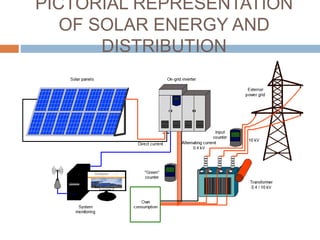
PICTORIAL REPRESENTATION
OF SOLAR ENERGY AND
DISTRIBUTION
OTHER TYPES OF SOLAR
POWER
 Passive solar energy :- Here solar energy is harnessed without
using any mechanical devices . Drying clothes is one of the
example of the passive solar energy . Also it has some other
features like :- passive solar heating , passive solar cooling and Day
lighting.
 Active solar energy :- This employs mechanical or electrical
equipment for functioning and increasing efficiency . As an example
waters pumps are used as to circulate water through active solar
energy heating system.
 Solar Thermal energy :- This energy is taken from the incident ray
to the material . It is basically direct heating method . Example :-
Solar pool heating , Solar space heating .
 Concentrated solar energy :- By this technique we can fulfill our
demand of the energy required but this is beyond our scope .
APPLICATION OF SOLAR
ENERGY
 Solar water heating :- A solar water heating unit comprises a
blackened flat plate metal collector with an associated metal tubing
facing the general direction of the sun. The plate collector has a
transparent glass cover above and a layer of thermal insulation
beneath it.
 Solar Heating of Buildings:- For collecting the solar radiation by
some element of the building itself i.e. solar energy is admitted
directly into the building through large South-facing windows. And
using separate solar collectors which may heat either water or air or
storage devices which can accumulate the collected solar energy
for use at night and during inclement days.
 Solar-pumping: In solar pumping, the power generated by solar-
energy is utilized for pumping water for irrigation purposes.
ADVANTAGES OF SOLAR
POWER
 Environment friendly :- The main advantage of this power is that it is
environment friendly because there is no use petroleum , coal and
other fossil fuels . The fossil fuels mainly contributes carbon dioxide
, carbon monoxide , sulphur dioxide etc which mainly the cause of
global warming and acid rains. Also it reduces the transportation
cost of vehicles and radioactive waste hazards.
 Saves Money/Profitable :- Initial stages demand a lot of money
because the plant has to be set which requires a hefty amount of
money . But in the long run it saves money because no other
expenses like thermal power plant and it becomes free .
 No maintenance/Low Maintenance :- This is another advantage of
the solar plant that this almost doesn’t require any maintenance as
compared to thermal power plant.
DISADVANTAGE OF SOLAR
POWER
 Initial Cost :- In the starting the cost is too high for that reason many
projects regarding this are stuck due to lack of capital . Cost rise
due to presence of semiconducting material .
 Efficiency :- This another staggering point of the solar power
because the efficiency is near to the 20 % to 22% of a plant and
requires really large area to achieve a high efficient production.
 Sunlight problem :- In many places due to inadequate sunlight the
generation of the solar power is less which depicts that if there is
less intensity of sunlight then less generation. Also If the day is
overcast then also the efficiency reduces.
 Speed :- Solar car’s speed is less compared to diesel and petrol
triggered car so the acceptance is low .
CONCLUSION
 Despite having such disadvantages the need of energy demand can
only be solved by renewable energies .
 Solar power is one of the renewable energies from where we can
generate the required amount of energy we need because sunlight
is infinite hence total photon energy is next to infinite. This is the
solution of our energy crisis as fossil fuels are depleting heavily .
 Only Solar power cannot suffice the requirements other resources
must be used .
 We need New engineering and scientist brain to develop more
efficient way to convert energy .

Solar energy slides

  • 1.
  • 2.
    WHAT IS SOLARENERGY ?  There are two types of solar energy :- Thermal energy and Electric energy  Thermal Energy :- This energy possessed by an object or system due to the movement of particles within the object or the system.  Electric Energy :- This energy is produced direct from sunlight via Photovoltaic cell.
  • 3.
    WHY SOLAR ENERGY?  World energy conservation predicted estimation about the rate of utilization of energy resources shows that the coal deposit will deplete within the next 200 to 300 years and Petroleum deposit will deplete in next few decades  The most advantage of Solar Energy is that this is distributed over a wide geographical area, ensuring that developing regions like India have access to a stable electricity generation
  • 4.
  • 5.
    HISTORY OF SOLARPOWER  1838- Edmund Bacquerel observed materials which converts lights into energy.  1876-78 – William Adams wrote the first book about solar energy called : “A substitute for fuel in tropical country” was able to power a 2.5 hp steam engine .  1860 – Auguste Mouchout , used direct conversion of solar radiation into mechanical power.  1895-Aubrey Eneas formed the first solar company.  1904 – Henry Willsie built two huge plants in California to generate power. He was the first to use the power at night after generating it in the presence of sunlight .
  • 6.
    HISTORY OF SOLARPOWER  1954 – Calvin fuller , Gerald Pearson and Daryl Chaplin of bell laboratories discovered the silicon as the source of semiconductor physics , which leads to construction of solar panel with a efficiency of 6%.  1956- First commercial solar cell was made available to the public at a very expensive rate $ 300 per watt.  1958- Vanguard I was the first satellite was launched that used solar energy to generate electricity .  1970 – Energy Crisis ! ( OPEC coil embargo ) solar energy history was created as the price of the solar energy dropped down to $20 per watt.
  • 7.
    WHAT IS PVCELL ??  Photovoltaic is the direct conversion of light into electricity at the atomic level. Some materials exhibit a property known as the photoelectric effect that causes them to absorb photons of light and release electrons. When these free electrons are captured, an electric current results that can be used as electricity.
  • 8.
    HOW PV CELLIS MANUFACTURED ?  Step 1: Pre-check and Pretreatment  Step 2: Texturing  Step 3: Acid Cleaning  Step 4: Diffusion  Step 5: Etching & Edge Isolation  Step 6: Post-Etching Washing  Step 7: Anti-Reflective Coating Deposition  Step 8: Contact Printing and Drying  Step 9: Testing and Cell Sorting
  • 9.
    HOW PV CELLWORKS ??  Sunlight first strike on the PV cell upper surface and the photons are absorbed by the semiconductor materials such as Silicon, Germanium.  Electrons are knocked loose from their atom which allow them to flow through the material to produce electricity. This is called photovoltaic effect.  Now the array of PV cell converts the energy of photons to the electrical energy . But as PV cell is basically a diode so it only can produce the DC voltage .  In the consumer end we need the electrical energy in the form of AC signals so to convert the DC to AC we fit voltage step inverters to convert the DC to AC as per our requirements.  The rest part is transmitting and distributing the electrical energy to the consumer end
  • 10.
    HOW PV CELLWORKS ??  When more electricity is generated then the excess electricity can be stored in a battery and the stored energy in the battery be used as the source of energy at the night time.  When the battery is full the excess electricity can be exported back to the utility grid , when your system is connected to it.  Utility supplied electricity can also been drawn from the grid when the sunlight is not up to the mark or not sufficient.  The electricity in and out in the utility grid is measured by the utility meter, it spins backward ( when power needed is less than generated ) and forward ( when power needed is more than generated ). This is measured as to charge anyone when he uses the energy of utility company . This is known as “net-metering”
  • 11.
    PICTORIAL REPRESENTATION OF SOLARENERGY AND DISTRIBUTION
  • 12.
    OTHER TYPES OFSOLAR POWER  Passive solar energy :- Here solar energy is harnessed without using any mechanical devices . Drying clothes is one of the example of the passive solar energy . Also it has some other features like :- passive solar heating , passive solar cooling and Day lighting.  Active solar energy :- This employs mechanical or electrical equipment for functioning and increasing efficiency . As an example waters pumps are used as to circulate water through active solar energy heating system.  Solar Thermal energy :- This energy is taken from the incident ray to the material . It is basically direct heating method . Example :- Solar pool heating , Solar space heating .  Concentrated solar energy :- By this technique we can fulfill our demand of the energy required but this is beyond our scope .
  • 13.
    APPLICATION OF SOLAR ENERGY Solar water heating :- A solar water heating unit comprises a blackened flat plate metal collector with an associated metal tubing facing the general direction of the sun. The plate collector has a transparent glass cover above and a layer of thermal insulation beneath it.  Solar Heating of Buildings:- For collecting the solar radiation by some element of the building itself i.e. solar energy is admitted directly into the building through large South-facing windows. And using separate solar collectors which may heat either water or air or storage devices which can accumulate the collected solar energy for use at night and during inclement days.  Solar-pumping: In solar pumping, the power generated by solar- energy is utilized for pumping water for irrigation purposes.
  • 14.
    ADVANTAGES OF SOLAR POWER Environment friendly :- The main advantage of this power is that it is environment friendly because there is no use petroleum , coal and other fossil fuels . The fossil fuels mainly contributes carbon dioxide , carbon monoxide , sulphur dioxide etc which mainly the cause of global warming and acid rains. Also it reduces the transportation cost of vehicles and radioactive waste hazards.  Saves Money/Profitable :- Initial stages demand a lot of money because the plant has to be set which requires a hefty amount of money . But in the long run it saves money because no other expenses like thermal power plant and it becomes free .  No maintenance/Low Maintenance :- This is another advantage of the solar plant that this almost doesn’t require any maintenance as compared to thermal power plant.
  • 15.
    DISADVANTAGE OF SOLAR POWER Initial Cost :- In the starting the cost is too high for that reason many projects regarding this are stuck due to lack of capital . Cost rise due to presence of semiconducting material .  Efficiency :- This another staggering point of the solar power because the efficiency is near to the 20 % to 22% of a plant and requires really large area to achieve a high efficient production.  Sunlight problem :- In many places due to inadequate sunlight the generation of the solar power is less which depicts that if there is less intensity of sunlight then less generation. Also If the day is overcast then also the efficiency reduces.  Speed :- Solar car’s speed is less compared to diesel and petrol triggered car so the acceptance is low .
  • 16.
    CONCLUSION  Despite havingsuch disadvantages the need of energy demand can only be solved by renewable energies .  Solar power is one of the renewable energies from where we can generate the required amount of energy we need because sunlight is infinite hence total photon energy is next to infinite. This is the solution of our energy crisis as fossil fuels are depleting heavily .  Only Solar power cannot suffice the requirements other resources must be used .  We need New engineering and scientist brain to develop more efficient way to convert energy .