BY:
Prof. RanjitKumar Parmar
Head of the Dept.
Govt. Polytechnic Junagadh
at
Om Engineering College Junagadh
I am here NOT to give you any thing
NEW, but to RETHINK what we
know in a NEW and NOVEL way…
What’s an Electrical
Engineering in
Reality?
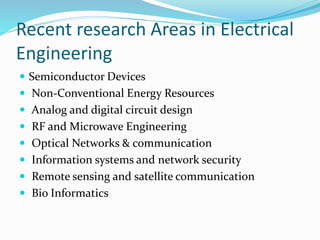
Recent research Areas in Electrical
Engineering
 Semiconductor Devices
 Non-Conventional Energy Resources
 Analog and digital circuit design
 RF and Microwave Engineering
 Optical Networks & communication
 Information systems and network security
 Remote sensing and satellite communication
 Bio Informatics
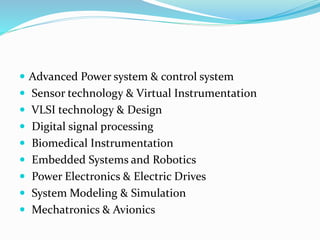
 Advanced Power system & control system
 Sensor technology & Virtual Instrumentation
 VLSI technology & Design
 Digital signal processing
 Biomedical Instrumentation
 Embedded Systems and Robotics
 Power Electronics & Electric Drives
 System Modeling & Simulation
 Mechatronics & Avionics
Major Sons…
 Smart Grids
 Large capacity batteries
 Wireless Power Transfer
 Higher Efficiency of PV cells
 Ultra fast Traction
Smart Grid
 Present Vs Past consumer
 Present Vs Past Loads
 Multiple point Power generation
 Selling of surplus power
 Complex structure
 Penetration of Smart devices up to consumer premises
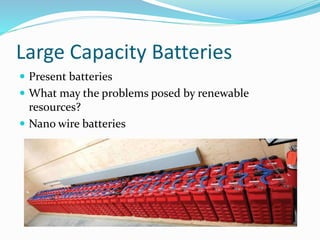
Large Capacity Batteries
 Present batteries
 What may the problems posed by renewable
resources?
 Nano wire batteries
Wireless power transfer
Shall we see video ?
 Bored of Wired charging?
 What are IoT devices?
 Wireless wearable Tech
 What may be future of Wireless charging?
 Be ready for new term: WITRICITY
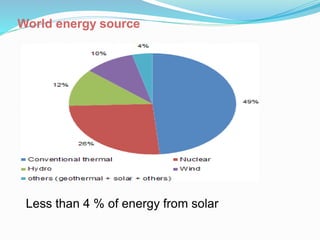
World energy source
Less than 4 % of energy from solar
March 30, 2016
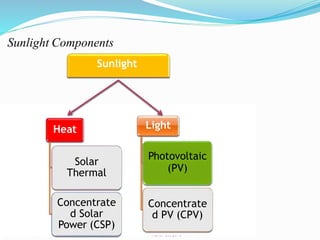
Heat
Solar
Thermal
Concentrate
d Solar
Power (CSP)
Light
Photovoltaic
(PV)
Concentrate
d PV (CPV)
Sunlight
Sunlight Components
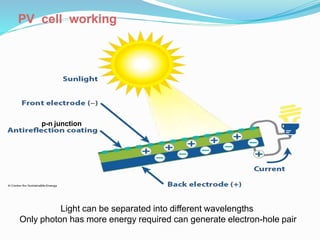
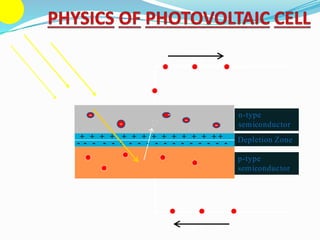
p-n junction
Light can be separated into different wavelengths
Only photon has more energy required can generate electron-hole pair
PV cell working
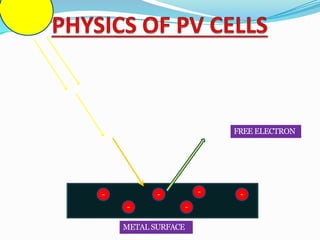
- --
- -
METAL SURFACE
FREE ELECTRON
-
n-type
semiconductor
p-type
semiconductor
+ + + + + + + + + + + + + + +
- - - - - - - - - - - - - - - - - - Depletion Zone
- -
-
-
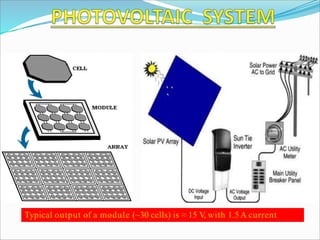
Typical output of a module (~30 cells) is ≈ 15 V, with 1.5A current
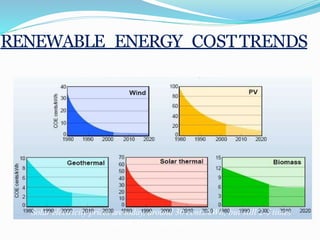
Solar electricity prices are today, around 30 cents/kWh, but still 2-5 times
average Residential electricity tariffs
RENEWABLE ENERGY COSTTRENDS
In terms of overall installed PV capacity, India comes fourth after Japan, Germany and U.S.
(With Installed capacity of 110MW)
In the area of Photovoltaics India today is the second largest manufacturer in the world of
PV panels based on crystalline solar cells.

(Industrial production in this area has reached a level of 11 MW per year which is about
10% of the world’s total PVproduction)
A major drive has also been initiated by the Government to export Indian PV products,
systems, technologies and services
(Solar Photovoltaic plant and equipment has been exported to countries in the Middle
East and Africa)
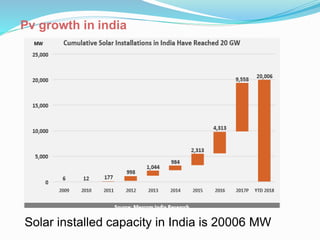
Pv growth in india
Solar installed capacity in India is 20006 MW
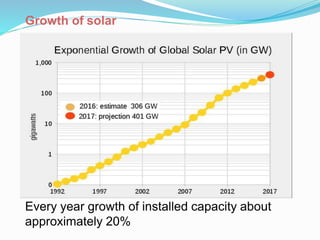
Growth of solar
Every year growth of installed capacity about
approximately 20%
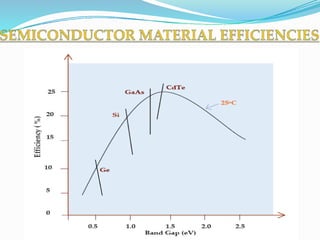
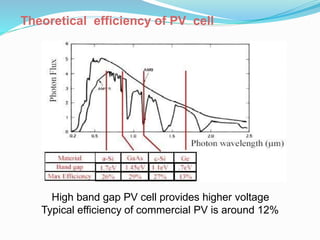
High band gap PV cell provides higher voltage
Typical efficiency of commercial PV is around 12%
Theoretical efficiency of PV cell
Types of solar cells
• MONOCRYSTALLINE
• POLYCRYSTALLINE
• THIN FILM
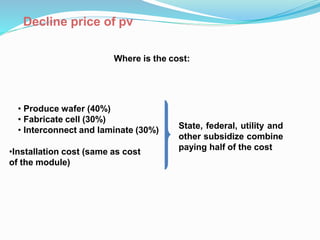
Where is the cost:
• Produce wafer (40%)
• Fabricate cell (30%)
• Interconnect and laminate (30%)
•Installation cost (same as cost
of the module)
State, federal, utility and
other subsidize combine
paying half of the cost
Decline price of pv
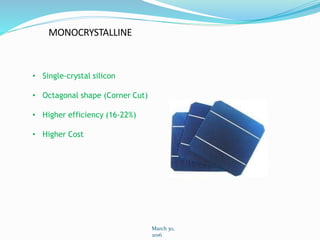
MONOCRYSTALLINE
March 30,
2016
• Single-crystal silicon
• Octagonal shape (Corner Cut)
• Higher efficiency (16-22%)
• Higher Cost
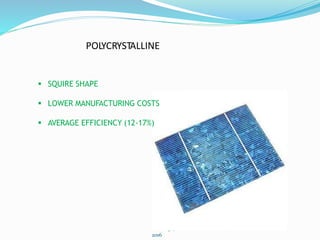
POLYCRYSTALLINE
March 30,
2016
 SQUIRE SHAPE
 LOWER MANUFACTURING COSTS
 AVERAGE EFFICIENCY (12-17%)
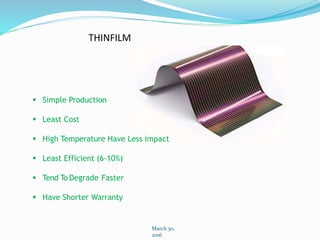
THINFILM
March 30,
2016
 Simple Production
 Least Cost
 High Temperature Have Less impact
 Least Efficient (6-10%)
 Tend To Degrade Faster
 Have Shorter Warranty
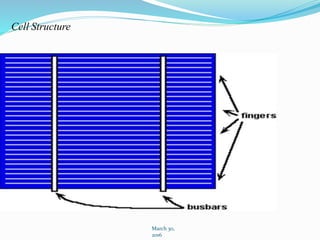
Cell Structure
March 30,
2016
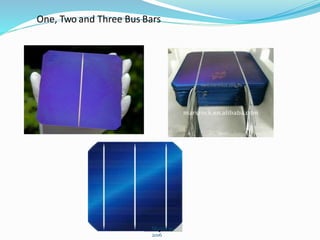
One, Two and Three Bus Bars
March 30,
2016
SOLAR PV MODULE
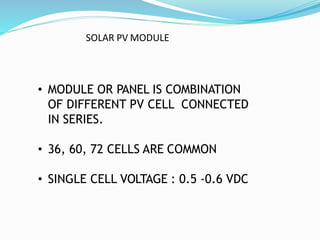
• MODULE OR PANEL IS COMBINATION
OF DIFFERENT PV CELL CONNECTED
IN SERIES.
• 36, 60, 72 CELLS ARE COMMON
• SINGLE CELL VOLTAGE : 0.5 -0.6 VDC
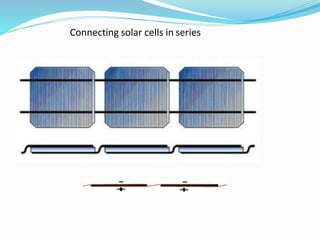
Connecting solar cells in series
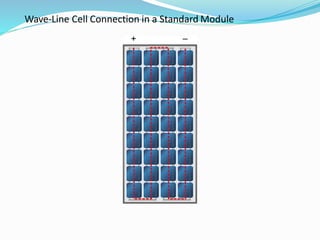
Wave-Line Cell Connection in a Standard Module
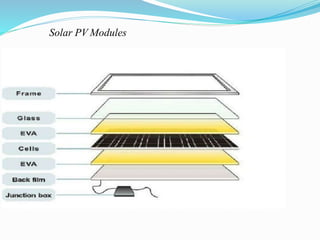
Solar PV Modules
If the PV market growth continues at rate of
20% continues in 50 year, there will be 5 TW
of energy provide by PV cells on the ground
Within 50 years, photovoltaic will supply
more than half of the world’s energy
requirement
Future reality ?
Now you guess
Future of Energy…
For more visit my YouTube Channel
Recent trends in electrical engineering

Recent trends in electrical engineering

  • 1.
    BY: Prof. RanjitKumar Parmar Headof the Dept. Govt. Polytechnic Junagadh at Om Engineering College Junagadh
  • 2.
    I am hereNOT to give you any thing NEW, but to RETHINK what we know in a NEW and NOVEL way…
  • 3.
  • 4.
    Recent research Areasin Electrical Engineering  Semiconductor Devices  Non-Conventional Energy Resources  Analog and digital circuit design  RF and Microwave Engineering  Optical Networks & communication  Information systems and network security  Remote sensing and satellite communication  Bio Informatics
  • 5.
     Advanced Powersystem & control system  Sensor technology & Virtual Instrumentation  VLSI technology & Design  Digital signal processing  Biomedical Instrumentation  Embedded Systems and Robotics  Power Electronics & Electric Drives  System Modeling & Simulation  Mechatronics & Avionics
  • 6.
    Major Sons…  SmartGrids  Large capacity batteries  Wireless Power Transfer  Higher Efficiency of PV cells  Ultra fast Traction
  • 7.
    Smart Grid  PresentVs Past consumer  Present Vs Past Loads  Multiple point Power generation  Selling of surplus power  Complex structure  Penetration of Smart devices up to consumer premises
  • 8.
    Large Capacity Batteries Present batteries  What may the problems posed by renewable resources?  Nano wire batteries
  • 9.
  • 10.
     Bored ofWired charging?
  • 11.
     What areIoT devices?  Wireless wearable Tech  What may be future of Wireless charging?  Be ready for new term: WITRICITY
  • 13.
    World energy source Lessthan 4 % of energy from solar
  • 14.
    March 30, 2016 Heat Solar Thermal Concentrate dSolar Power (CSP) Light Photovoltaic (PV) Concentrate d PV (CPV) Sunlight Sunlight Components
  • 15.
    p-n junction Light canbe separated into different wavelengths Only photon has more energy required can generate electron-hole pair PV cell working
  • 16.
    - -- - - METALSURFACE FREE ELECTRON -
  • 17.
    n-type semiconductor p-type semiconductor + + ++ + + + + + + + + + + + - - - - - - - - - - - - - - - - - - Depletion Zone - - - -
  • 18.
    Typical output ofa module (~30 cells) is ≈ 15 V, with 1.5A current
  • 20.
    Solar electricity pricesare today, around 30 cents/kWh, but still 2-5 times average Residential electricity tariffs RENEWABLE ENERGY COSTTRENDS
  • 21.
    In terms ofoverall installed PV capacity, India comes fourth after Japan, Germany and U.S. (With Installed capacity of 110MW) In the area of Photovoltaics India today is the second largest manufacturer in the world of PV panels based on crystalline solar cells. (Industrial production in this area has reached a level of 11 MW per year which is about 10% of the world’s total PVproduction) A major drive has also been initiated by the Government to export Indian PV products, systems, technologies and services (Solar Photovoltaic plant and equipment has been exported to countries in the Middle East and Africa)
  • 23.
    Pv growth inindia Solar installed capacity in India is 20006 MW
  • 24.
    Growth of solar Everyyear growth of installed capacity about approximately 20%
  • 25.
    High band gapPV cell provides higher voltage Typical efficiency of commercial PV is around 12% Theoretical efficiency of PV cell
  • 26.
    Types of solarcells • MONOCRYSTALLINE • POLYCRYSTALLINE • THIN FILM
  • 27.
    Where is thecost: • Produce wafer (40%) • Fabricate cell (30%) • Interconnect and laminate (30%) •Installation cost (same as cost of the module) State, federal, utility and other subsidize combine paying half of the cost Decline price of pv
  • 28.
    MONOCRYSTALLINE March 30, 2016 • Single-crystalsilicon • Octagonal shape (Corner Cut) • Higher efficiency (16-22%) • Higher Cost
  • 29.
    POLYCRYSTALLINE March 30, 2016  SQUIRESHAPE  LOWER MANUFACTURING COSTS  AVERAGE EFFICIENCY (12-17%)
  • 30.
    THINFILM March 30, 2016  SimpleProduction  Least Cost  High Temperature Have Less impact  Least Efficient (6-10%)  Tend To Degrade Faster  Have Shorter Warranty
  • 31.
  • 32.
    One, Two andThree Bus Bars March 30, 2016
  • 33.
    SOLAR PV MODULE •MODULE OR PANEL IS COMBINATION OF DIFFERENT PV CELL CONNECTED IN SERIES. • 36, 60, 72 CELLS ARE COMMON • SINGLE CELL VOLTAGE : 0.5 -0.6 VDC
  • 34.
  • 35.
    Wave-Line Cell Connectionin a Standard Module
  • 36.
  • 38.
    If the PVmarket growth continues at rate of 20% continues in 50 year, there will be 5 TW of energy provide by PV cells on the ground Within 50 years, photovoltaic will supply more than half of the world’s energy requirement Future reality ?
  • 39.
  • 40.
    For more visitmy YouTube Channel