Solar Energy:
The Ultimate Renewable
Resource
Prepared by:
Fortaleza, Debbie Lou
Esloyo, Genelyn
Espadero, Bernard
Magaspag, Wilther jan
Manait, Frederick
Marcelo, Jenvy Claire
Pulgado, Kimberly
Quinatagcan, Sharwin
What is Solar Energy?
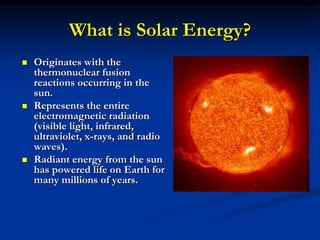
 Originates with the
thermonuclear fusion
reactions occurring in the
sun.
 Represents the entire
electromagnetic radiation
(visible light, infrared,
ultraviolet, x-rays, and radio
waves).
 Radiant energy from the sun
has powered life on Earth for
many millions of years.
 is radiant light and heat from the Sun that is
harnessed using a range of ever-evolving
technologies such as solar
heating, photovoltaics, solar thermal
energy, solar architecture, molten salt power
plants and artificial photosynthesis.
 It is an important source of renewable
energy and its technologies are broadly
characterized as either passive solar or active
solar depending on how they capture and
distribute solar energy or convert it into solar
power.
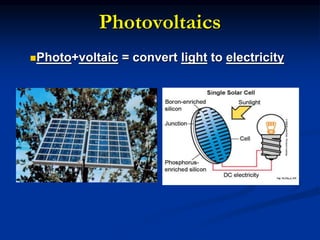
Photovoltaics
Photo+voltaic = convert light to electricity
Photovoltaic Solar Panel
 absorb sunlight as a source of energy to
generate electricity. A photovoltaic (PV) module
is a packaged, connected assembly of typically
6x10 photovoltaic solar cells. Photovoltaic
modules constitute the photovoltaic array of
a photovoltaic cell that generates and
supplies solar electricity in commercial and
residential applications.
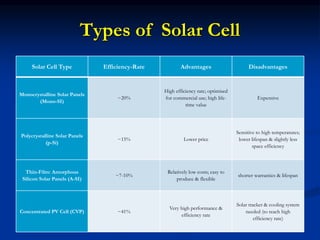
Types of Solar Cell
Solar Cell Type Efficiency-Rate Advantages Disadvantages
Monocrystalline Solar Panels
(Mono-SI)
~20%
High efficiency rate; optimised
for commercial use; high life-
time value
Expensive
Polycrystalline Solar Panels
(p-Si)
~15% Lower price
Sensitive to high temperatures;
lower lifespan & slightly less
space efficiency
Thin-Film: Amorphous
Silicon Solar Panels (A-SI)
~7-10%
Relatively low costs; easy to
produce & flexible
shorter warranties & lifespan
Concentrated PV Cell (CVP) ~41%
Very high performance &
efficiency rate
Solar tracker & cooling system
needed (to reach high
efficiency rate)
Advantages and Disadvantages
 Advantages
 Solar power is pollution free and causes no greenhouse
gases to be emitted after installation
 Renewable clean power that is available every day of the
year, even cloudy days produce some power
 Return on investment unlike paying for utility bills
 Virtually no maintenance as solar panels last over 30 years
 Ability to live grid free if all power generated provides
enough for the home / building
 Can be installed virtually anywhere; in a field to on a
building
Disadvantages
 High initial costs for material and installation and long
ROI
 Needs lots of space as efficiency is not 100% yet
 No solar power at night so there is a need for a large
battery bank
 Depending on geographical location the size of the
solar panels vary for the same power generation
 Cloudy days and during winter months do not produce
much energy
 Solar powered cars do not have the same speeds and
power as typical gas powered cars
Solar Cells Background
 1839 - French physicist A. E. Becquerel first recognized the
photovoltaic effect.
 1883 - first solar cell built, by Charles Fritts, coated semiconductor
selenium with an extremely thin layer of gold to form the junctions.
 1954 - Bell Laboratories, experimenting with semiconductors,
accidentally found that silicon doped with certain impurities was
very sensitive to light. Daryl Chapin, Calvin Fuller and Gerald
Pearson, invented the first practical device for converting sunlight
into useful electrical power. Resulted in the production of the first
practical solar cells with a sunlight energy conversion efficiency of
around 6%.
 1958 - First spacecraft to use solar panels was US satellite Vanguard
1
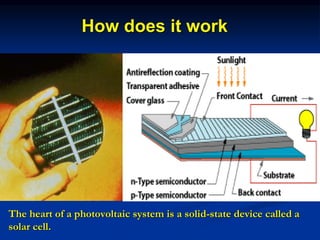
The heart of a photovoltaic system is a solid-state device called a
solar cell.
How does it work
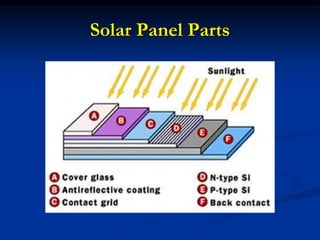
Solar Panel Parts
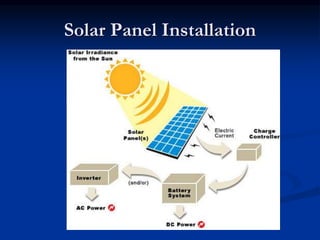
Solar Panel Installation
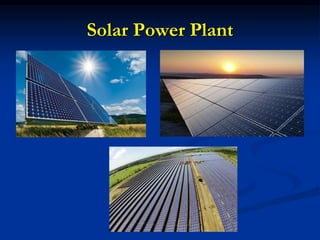
Solar Power Plant
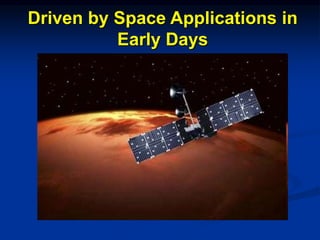
Driven by Space Applications in
Early Days
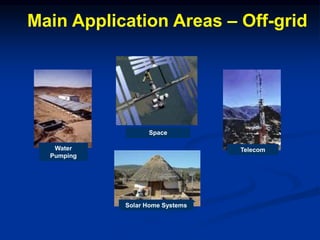
Solar Home Systems
Space
Water
Pumping
Telecom
Main Application Areas – Off-grid
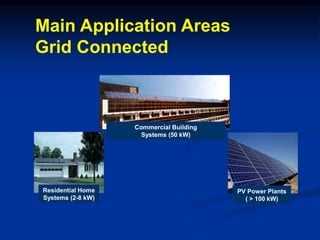
Residential Home
Systems (2-8 kW)
PV Power Plants
( > 100 kW)
Commercial Building
Systems (50 kW)
Main Application Areas
Grid Connected
So why Solar Power?
 With the amount of solar energy the planet
receives we have the potential to provide at
least 1,000 times the energy consumed globally.
(in 2008)
 On a sunny day the sun gives off 1,000 watts of
energy to the earths surface per square meter
 Sunlight is infinite, unlike many of our other
energy sources
Benefits
 Powered by the Sun
 Zero emissions
 Little maintenance once installed
 Can last a lifetime
 For every $mill. Invested, 5-15 jobs are created

Solar Power Plant Presentation Recent.ppt

  • 1.
    Solar Energy: The UltimateRenewable Resource Prepared by: Fortaleza, Debbie Lou Esloyo, Genelyn Espadero, Bernard Magaspag, Wilther jan Manait, Frederick Marcelo, Jenvy Claire Pulgado, Kimberly Quinatagcan, Sharwin
  • 2.
    What is SolarEnergy?  Originates with the thermonuclear fusion reactions occurring in the sun.  Represents the entire electromagnetic radiation (visible light, infrared, ultraviolet, x-rays, and radio waves).  Radiant energy from the sun has powered life on Earth for many millions of years.
  • 3.
     is radiantlight and heat from the Sun that is harnessed using a range of ever-evolving technologies such as solar heating, photovoltaics, solar thermal energy, solar architecture, molten salt power plants and artificial photosynthesis.  It is an important source of renewable energy and its technologies are broadly characterized as either passive solar or active solar depending on how they capture and distribute solar energy or convert it into solar power.
  • 4.
  • 5.
    Photovoltaic Solar Panel absorb sunlight as a source of energy to generate electricity. A photovoltaic (PV) module is a packaged, connected assembly of typically 6x10 photovoltaic solar cells. Photovoltaic modules constitute the photovoltaic array of a photovoltaic cell that generates and supplies solar electricity in commercial and residential applications.
  • 6.
    Types of SolarCell Solar Cell Type Efficiency-Rate Advantages Disadvantages Monocrystalline Solar Panels (Mono-SI) ~20% High efficiency rate; optimised for commercial use; high life- time value Expensive Polycrystalline Solar Panels (p-Si) ~15% Lower price Sensitive to high temperatures; lower lifespan & slightly less space efficiency Thin-Film: Amorphous Silicon Solar Panels (A-SI) ~7-10% Relatively low costs; easy to produce & flexible shorter warranties & lifespan Concentrated PV Cell (CVP) ~41% Very high performance & efficiency rate Solar tracker & cooling system needed (to reach high efficiency rate)
  • 7.
    Advantages and Disadvantages Advantages  Solar power is pollution free and causes no greenhouse gases to be emitted after installation  Renewable clean power that is available every day of the year, even cloudy days produce some power  Return on investment unlike paying for utility bills  Virtually no maintenance as solar panels last over 30 years  Ability to live grid free if all power generated provides enough for the home / building  Can be installed virtually anywhere; in a field to on a building
  • 8.
    Disadvantages  High initialcosts for material and installation and long ROI  Needs lots of space as efficiency is not 100% yet  No solar power at night so there is a need for a large battery bank  Depending on geographical location the size of the solar panels vary for the same power generation  Cloudy days and during winter months do not produce much energy  Solar powered cars do not have the same speeds and power as typical gas powered cars
  • 9.
    Solar Cells Background 1839 - French physicist A. E. Becquerel first recognized the photovoltaic effect.  1883 - first solar cell built, by Charles Fritts, coated semiconductor selenium with an extremely thin layer of gold to form the junctions.  1954 - Bell Laboratories, experimenting with semiconductors, accidentally found that silicon doped with certain impurities was very sensitive to light. Daryl Chapin, Calvin Fuller and Gerald Pearson, invented the first practical device for converting sunlight into useful electrical power. Resulted in the production of the first practical solar cells with a sunlight energy conversion efficiency of around 6%.  1958 - First spacecraft to use solar panels was US satellite Vanguard 1
  • 10.
    The heart ofa photovoltaic system is a solid-state device called a solar cell. How does it work
  • 11.
  • 12.
  • 13.
  • 14.
    Driven by SpaceApplications in Early Days
  • 15.
  • 16.
    Residential Home Systems (2-8kW) PV Power Plants ( > 100 kW) Commercial Building Systems (50 kW) Main Application Areas Grid Connected
  • 17.
    So why SolarPower?  With the amount of solar energy the planet receives we have the potential to provide at least 1,000 times the energy consumed globally. (in 2008)  On a sunny day the sun gives off 1,000 watts of energy to the earths surface per square meter  Sunlight is infinite, unlike many of our other energy sources
  • 18.
    Benefits  Powered bythe Sun  Zero emissions  Little maintenance once installed  Can last a lifetime  For every $mill. Invested, 5-15 jobs are created