New Technologies in PV System
Presented By
Mohammad Zishan Alam
STEAG Energy Services India Pvt. Ltd.
Sunday, December 09, 20181
CONTENT
1. Introduction
2. Working principle of PV system
3. Classification of PV Technology
4. Efficiency of PV cells
5. New Emerging Technology5. New Emerging Technology
6. Impacts on Environment
7. Economical Aspect
8. Indian Scenario
9. World Scenario
10. Future Prospects
11. Conclusion
Sunday, December 09, 20182
1. Introduction
A photovoltaic cell (PV cell) is a specialized
semiconductor diode that converts visible light into
direct current (DC).
Some PV cells can also convert infrared(IR)or
ultraviolet (UV) radiation into DC electricity.
The first PV cells were made of silicon combined, orThe first PV cells were made of silicon combined, or
doped, with other elements to affect the behavior
of electrons or holes (electron absences within
atoms). Other materials, such as copper indium
diselenide (CIS), cadmium telluride (CdTe), and gallium
arsenide(GaAs), have been developed for use in PV
cells.
Sunday, December 09, 20183
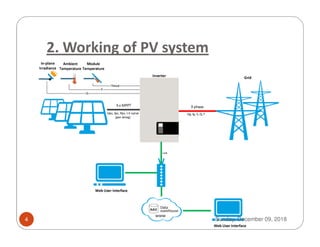
2. Working of PV system
Sunday, December 09, 20184
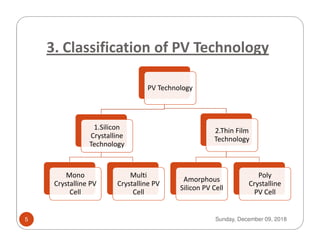
3. Classification of PV Technology
PV Technology
1.Silicon1.Silicon
Crystalline
Technology
Mono
Crystalline PV
Cell
Multi
Crystalline PV
Cell
2.Thin Film
Technology
Amorphous
Silicon PV Cell
Poly
Crystalline
PV Cell
Sunday, December 09, 20185
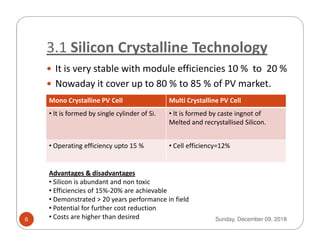
3.1 Silicon Crystalline Technology
It is very stable with module efficiencies 10 % to 20 %
Nowaday it cover up to 80 % to 85 % of PV market.
Mono Crystalline PV Cell Multi Crystalline PV Cell
• It is formed by single cylinder of Si. • It is formed by caste ingnot of
Melted and recrystallised Silicon.Melted and recrystallised Silicon.
• Operating efficiency upto 15 % • Cell efficiency=12%
Advantages & disadvantages
• Silicon is abundant and non toxic
• Efficiencies of 15%-20% are achievable
• Demonstrated > 20 years performance in field
• Potential for further cost reduction
• Costs are higher than desired Sunday, December 09, 20186
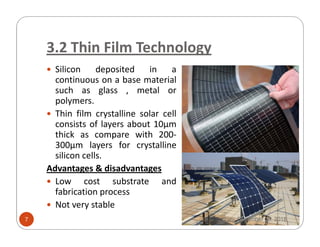
3.2 Thin Film Technology
Silicon deposited in a
continuous on a base material
such as glass , metal or
polymers.
Thin film crystalline solar cell
consists of layers about 10μmconsists of layers about 10μm
thick as compare with 200-
300μm layers for crystalline
silicon cells.
Advantages & disadvantages
Low cost substrate and
fabrication process
Not very stable
Sunday, December 09, 20187
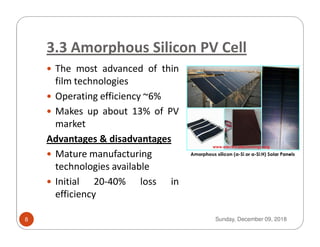
3.3 Amorphous Silicon PV Cell
The most advanced of thin
film technologies
Operating efficiency ~6%
Makes up about 13% of PV
marketmarket
Advantages & disadvantages
Mature manufacturing
technologies available
Initial 20-40% loss in
efficiency
Sunday, December 09, 20188
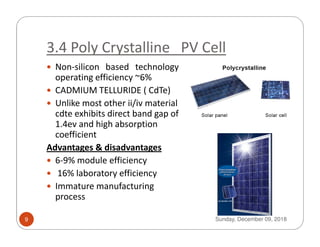
3.4 Poly Crystalline PV Cell
Non-silicon based technology
operating efficiency ~6%
CADMIUM TELLURIDE ( CdTe)
Unlike most other ii/iv material
cdte exhibits direct band gap of
1.4ev and high absorption1.4ev and high absorption
coefficient
Advantages & disadvantages
6-9% module efficiency
16% laboratory efficiency
Immature manufacturing
process
Sunday, December 09, 20189
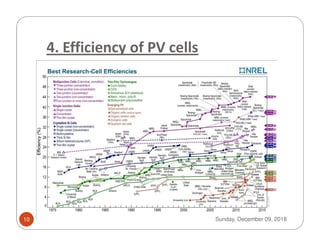
4. Efficiency of PV cells
Sunday, December 09, 201810
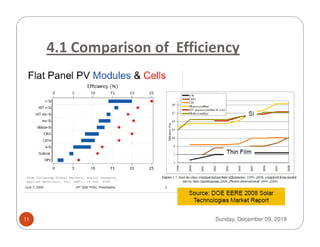
4.1 Comparison of Efficiency
Sunday, December 09, 201811
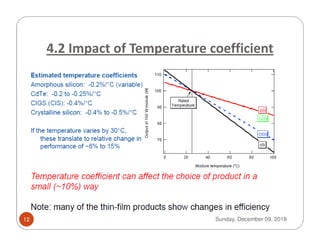
4.2 Impact of Temperature coefficient
Sunday, December 09, 201812
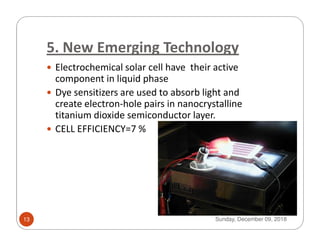
5. New Emerging Technology
Electrochemical solar cell have their active
component in liquid phase
Dye sensitizers are used to absorb light and
create electron-hole pairs in nanocrystalline
titanium dioxide semiconductor layer.
CELL EFFICIENCY=7 %CELL EFFICIENCY=7 %
Sunday, December 09, 201813
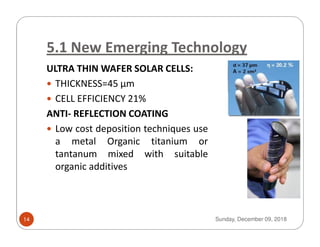
5.1 New Emerging Technology
ULTRA THIN WAFER SOLAR CELLS:
THICKNESS=45 μm
CELL EFFICIENCY 21%
ANTI- REFLECTION COATING
Low cost deposition techniques useLow cost deposition techniques use
a metal Organic titanium or
tantanum mixed with suitable
organic additives
Sunday, December 09, 201814
6. Impact on Envoriment
Exhaustion of raw materials
Co2 emission during fabrication process acidification
Disposal problems of hazardous semi
Conductor material
In Spite Of All These Environmental concerns,
Solar Photovoltaic Is One Of The Cleanest
Form Of Energy.
Sunday, December 09, 201815
7.Economical aspect
Pv unit : price per peak watt (wp)
Peak watt is the amount of power output a pv module
produces at standard test conditions (stc) of a module
operating temperature of 25°c in full noontime
sunshine (irradiance) of 1,000watts per square metersunshine (irradiance) of 1,000watts per square meter
A typical 1kwp system produces approximately 1600-
2000 kwh energy in india and australia
A typical 2000 watt peak (2KWP) SOLAR ENERGY
System costing rs 440000 (including installation) will
correspond to a price of rs 220/wp
Sunday, December 09, 201816
8.Indian scenario
In terms of overall installed PV capacity, India comes after
China,Japan, Germany and U.S. (With Installed capacity of
26 GW ).
In the area of Photovoltaics India today is the second
largest manufacturer in the world of PV panels based on
crystalline solar cells. (Industrial production in this area hascrystalline solar cells. (Industrial production in this area has
reached a level of 11 MW per year which is about 10% of
the world’s total PV production).
A major drive has also been initiated by the Government to
export Indian PV products, systems, technologies and
services (Solar Photovoltaic plant and equipment has been
exported to countries in the Middle East and Africa).
Sunday, December 09, 201817
9.World scenario
Through out the world the growth of photovoltic is
extremely dynamic and varies strongly by country.
Worldwide total photovoltaic installation is more than
75GW.
At present solar photovoltaic is not the prime contributor
to the electrical capacities but the pace at which
advancement of PV technology and with the rising demandadvancement of PV technology and with the rising demand
of cleaner source of energy it is expected by 2030 solar PV
will have a leading role in electricity generation,
Research is underway for new fabrication techniques, like
those used for microchips. Alternative materials like
cadmium sulfide and gallium arsenide ,thin-film cells are in
development
Sunday, December 09, 201818
10.Future Prospects
BY 2020 global solar output could be 276 Terawatt
hours, which would equal 30% of Africa's energy
needs or 1% of global demand.
This would replace the output of 75 new coal fired
power stations.
The global solar infrastructure would have anThe global solar infrastructure would have an
investment value of US$75 billion a year. By 2040
global solar output could be more than 9000 Terawatt
hours, or 26% of the expected global demand.
Report European Photovoltaic Industry
Association (EPIA) and Greenpeace
Sunday, December 09, 201819
11.Conclusion
The key to successful solar energy installation is to use
quality components that have long lifetimes and require
minimal maintenance.
The future is bright for continued pv technology
dissemination
Pv technology fills a significant need in supplyingPv technology fills a significant need in supplying
electricity, creating local jobs and promoting economic
development in rural areas, avoiding the external
environmental costs associated with traditional electrical
generation technologies.
Major power policy reforms and tax incentives will play a
major role if all the above said is to be effectively realized.
Sunday, December 09, 201820
Sunday, December 09, 201821

New Technologies In PV system

  • 1.
    New Technologies inPV System Presented By Mohammad Zishan Alam STEAG Energy Services India Pvt. Ltd. Sunday, December 09, 20181
  • 2.
    CONTENT 1. Introduction 2. Workingprinciple of PV system 3. Classification of PV Technology 4. Efficiency of PV cells 5. New Emerging Technology5. New Emerging Technology 6. Impacts on Environment 7. Economical Aspect 8. Indian Scenario 9. World Scenario 10. Future Prospects 11. Conclusion Sunday, December 09, 20182
  • 3.
    1. Introduction A photovoltaiccell (PV cell) is a specialized semiconductor diode that converts visible light into direct current (DC). Some PV cells can also convert infrared(IR)or ultraviolet (UV) radiation into DC electricity. The first PV cells were made of silicon combined, orThe first PV cells were made of silicon combined, or doped, with other elements to affect the behavior of electrons or holes (electron absences within atoms). Other materials, such as copper indium diselenide (CIS), cadmium telluride (CdTe), and gallium arsenide(GaAs), have been developed for use in PV cells. Sunday, December 09, 20183
  • 4.
    2. Working ofPV system Sunday, December 09, 20184
  • 5.
    3. Classification ofPV Technology PV Technology 1.Silicon1.Silicon Crystalline Technology Mono Crystalline PV Cell Multi Crystalline PV Cell 2.Thin Film Technology Amorphous Silicon PV Cell Poly Crystalline PV Cell Sunday, December 09, 20185
  • 6.
    3.1 Silicon CrystallineTechnology It is very stable with module efficiencies 10 % to 20 % Nowaday it cover up to 80 % to 85 % of PV market. Mono Crystalline PV Cell Multi Crystalline PV Cell • It is formed by single cylinder of Si. • It is formed by caste ingnot of Melted and recrystallised Silicon.Melted and recrystallised Silicon. • Operating efficiency upto 15 % • Cell efficiency=12% Advantages & disadvantages • Silicon is abundant and non toxic • Efficiencies of 15%-20% are achievable • Demonstrated > 20 years performance in field • Potential for further cost reduction • Costs are higher than desired Sunday, December 09, 20186
  • 7.
    3.2 Thin FilmTechnology Silicon deposited in a continuous on a base material such as glass , metal or polymers. Thin film crystalline solar cell consists of layers about 10μmconsists of layers about 10μm thick as compare with 200- 300μm layers for crystalline silicon cells. Advantages & disadvantages Low cost substrate and fabrication process Not very stable Sunday, December 09, 20187
  • 8.
    3.3 Amorphous SiliconPV Cell The most advanced of thin film technologies Operating efficiency ~6% Makes up about 13% of PV marketmarket Advantages & disadvantages Mature manufacturing technologies available Initial 20-40% loss in efficiency Sunday, December 09, 20188
  • 9.
    3.4 Poly CrystallinePV Cell Non-silicon based technology operating efficiency ~6% CADMIUM TELLURIDE ( CdTe) Unlike most other ii/iv material cdte exhibits direct band gap of 1.4ev and high absorption1.4ev and high absorption coefficient Advantages & disadvantages 6-9% module efficiency 16% laboratory efficiency Immature manufacturing process Sunday, December 09, 20189
  • 10.
    4. Efficiency ofPV cells Sunday, December 09, 201810
  • 11.
    4.1 Comparison ofEfficiency Sunday, December 09, 201811
  • 12.
    4.2 Impact ofTemperature coefficient Sunday, December 09, 201812
  • 13.
    5. New EmergingTechnology Electrochemical solar cell have their active component in liquid phase Dye sensitizers are used to absorb light and create electron-hole pairs in nanocrystalline titanium dioxide semiconductor layer. CELL EFFICIENCY=7 %CELL EFFICIENCY=7 % Sunday, December 09, 201813
  • 14.
    5.1 New EmergingTechnology ULTRA THIN WAFER SOLAR CELLS: THICKNESS=45 μm CELL EFFICIENCY 21% ANTI- REFLECTION COATING Low cost deposition techniques useLow cost deposition techniques use a metal Organic titanium or tantanum mixed with suitable organic additives Sunday, December 09, 201814
  • 15.
    6. Impact onEnvoriment Exhaustion of raw materials Co2 emission during fabrication process acidification Disposal problems of hazardous semi Conductor material In Spite Of All These Environmental concerns, Solar Photovoltaic Is One Of The Cleanest Form Of Energy. Sunday, December 09, 201815
  • 16.
    7.Economical aspect Pv unit: price per peak watt (wp) Peak watt is the amount of power output a pv module produces at standard test conditions (stc) of a module operating temperature of 25°c in full noontime sunshine (irradiance) of 1,000watts per square metersunshine (irradiance) of 1,000watts per square meter A typical 1kwp system produces approximately 1600- 2000 kwh energy in india and australia A typical 2000 watt peak (2KWP) SOLAR ENERGY System costing rs 440000 (including installation) will correspond to a price of rs 220/wp Sunday, December 09, 201816
  • 17.
    8.Indian scenario In termsof overall installed PV capacity, India comes after China,Japan, Germany and U.S. (With Installed capacity of 26 GW ). In the area of Photovoltaics India today is the second largest manufacturer in the world of PV panels based on crystalline solar cells. (Industrial production in this area hascrystalline solar cells. (Industrial production in this area has reached a level of 11 MW per year which is about 10% of the world’s total PV production). A major drive has also been initiated by the Government to export Indian PV products, systems, technologies and services (Solar Photovoltaic plant and equipment has been exported to countries in the Middle East and Africa). Sunday, December 09, 201817
  • 18.
    9.World scenario Through outthe world the growth of photovoltic is extremely dynamic and varies strongly by country. Worldwide total photovoltaic installation is more than 75GW. At present solar photovoltaic is not the prime contributor to the electrical capacities but the pace at which advancement of PV technology and with the rising demandadvancement of PV technology and with the rising demand of cleaner source of energy it is expected by 2030 solar PV will have a leading role in electricity generation, Research is underway for new fabrication techniques, like those used for microchips. Alternative materials like cadmium sulfide and gallium arsenide ,thin-film cells are in development Sunday, December 09, 201818
  • 19.
    10.Future Prospects BY 2020global solar output could be 276 Terawatt hours, which would equal 30% of Africa's energy needs or 1% of global demand. This would replace the output of 75 new coal fired power stations. The global solar infrastructure would have anThe global solar infrastructure would have an investment value of US$75 billion a year. By 2040 global solar output could be more than 9000 Terawatt hours, or 26% of the expected global demand. Report European Photovoltaic Industry Association (EPIA) and Greenpeace Sunday, December 09, 201819
  • 20.
    11.Conclusion The key tosuccessful solar energy installation is to use quality components that have long lifetimes and require minimal maintenance. The future is bright for continued pv technology dissemination Pv technology fills a significant need in supplyingPv technology fills a significant need in supplying electricity, creating local jobs and promoting economic development in rural areas, avoiding the external environmental costs associated with traditional electrical generation technologies. Major power policy reforms and tax incentives will play a major role if all the above said is to be effectively realized. Sunday, December 09, 201820
  • 21.