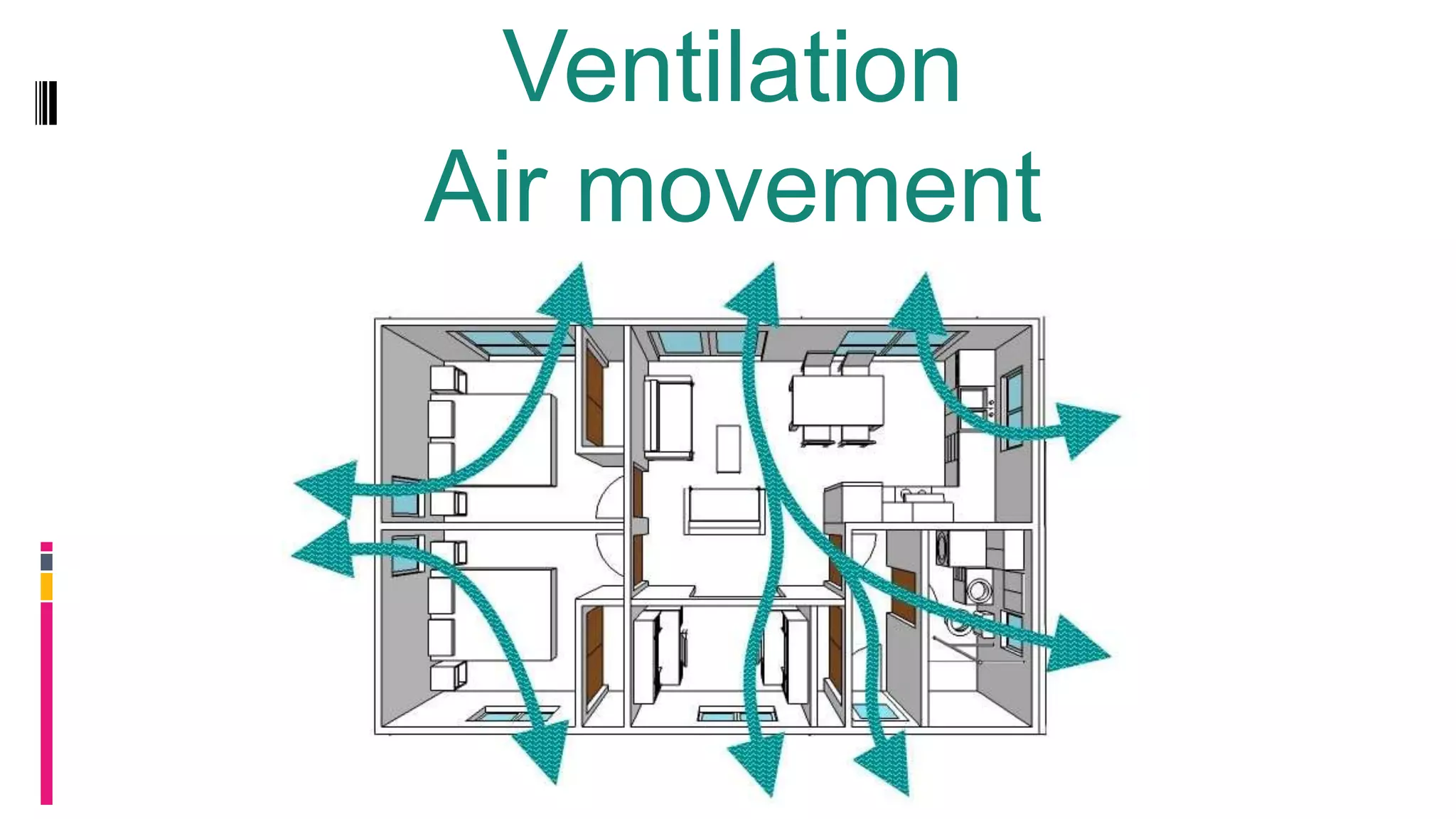
Ventilation
Air movement
This lecture is about
 Fundamentals of building ventilation
 Natural Ventilation
 Wind patterns
 Openings
 Building strategies
Why is it necessary to ventilate?
 Air for breathing
 Adult man has frequency of breathing typically 16 times per minute –8 l/min.
 Respiration
Why is it necessary to ventilate?
 Indoor environment in a room has to meet level suitable for
 people and theirs activity.
 In an industrial building ventilation requirements may relate
 also to industrial processes.
 In an agricultural building all focus aims to animals.
Ventilation is one of systems keeping habitable environment.
Information about wind patterns and
prevailing wind direction
Functions of ventilation
Three distinctly different functions
- Supply of fresh air
- Convective cooling
- Physiological cooling
Achieved by - air movement
Ventilation
In Architectural terms, Ventilation is the
intentional introduction of outdoor air into a
space and is mainly used to control indoor
air quality by diluting and displacing indoor
pollutants; it can also be used for purposes
of thermal comfort or dehumidification.
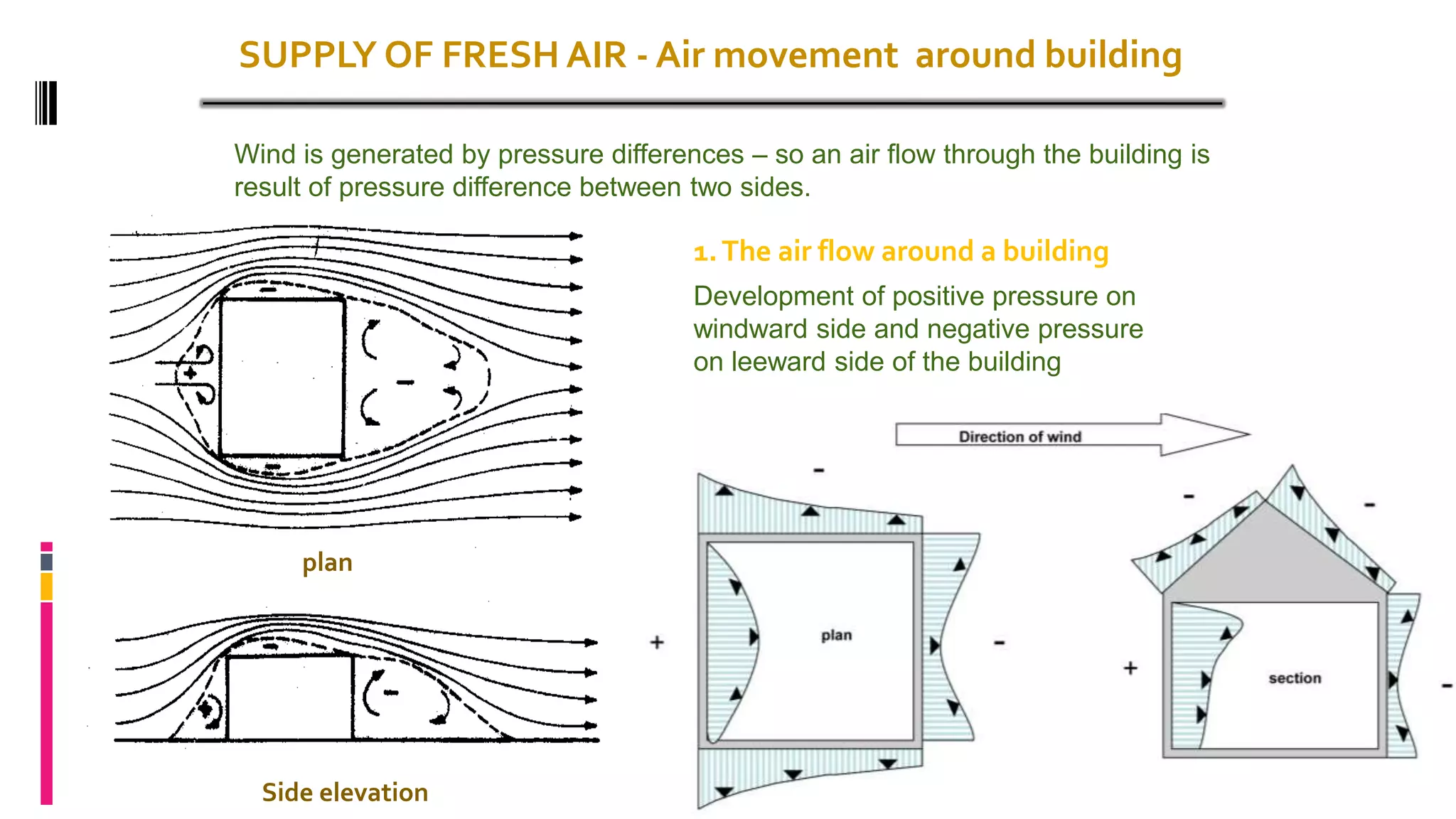
SUPPLY OF FRESH AIR - Air movement around building
Wind is generated by pressure differences – so an air flow through the building is
result of pressure difference between two sides.
1.The air flow around a building
Development of positive pressure on
windward side and negative pressure
on leeward side of the building
Side elevation
plan
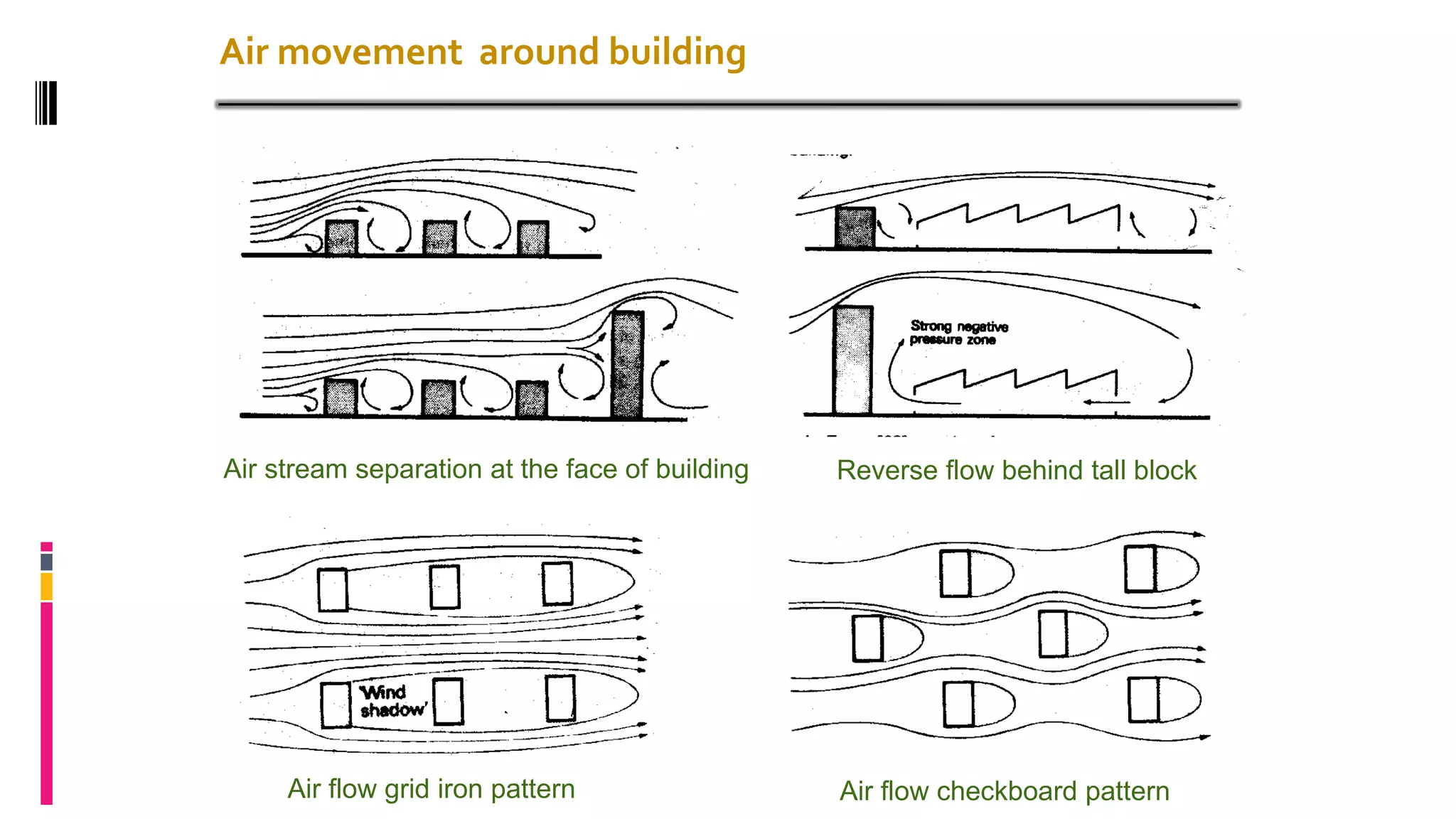
Air stream separation at the face of building Reverse flow behind tall block
Air flow grid iron pattern Air flow checkboard pattern
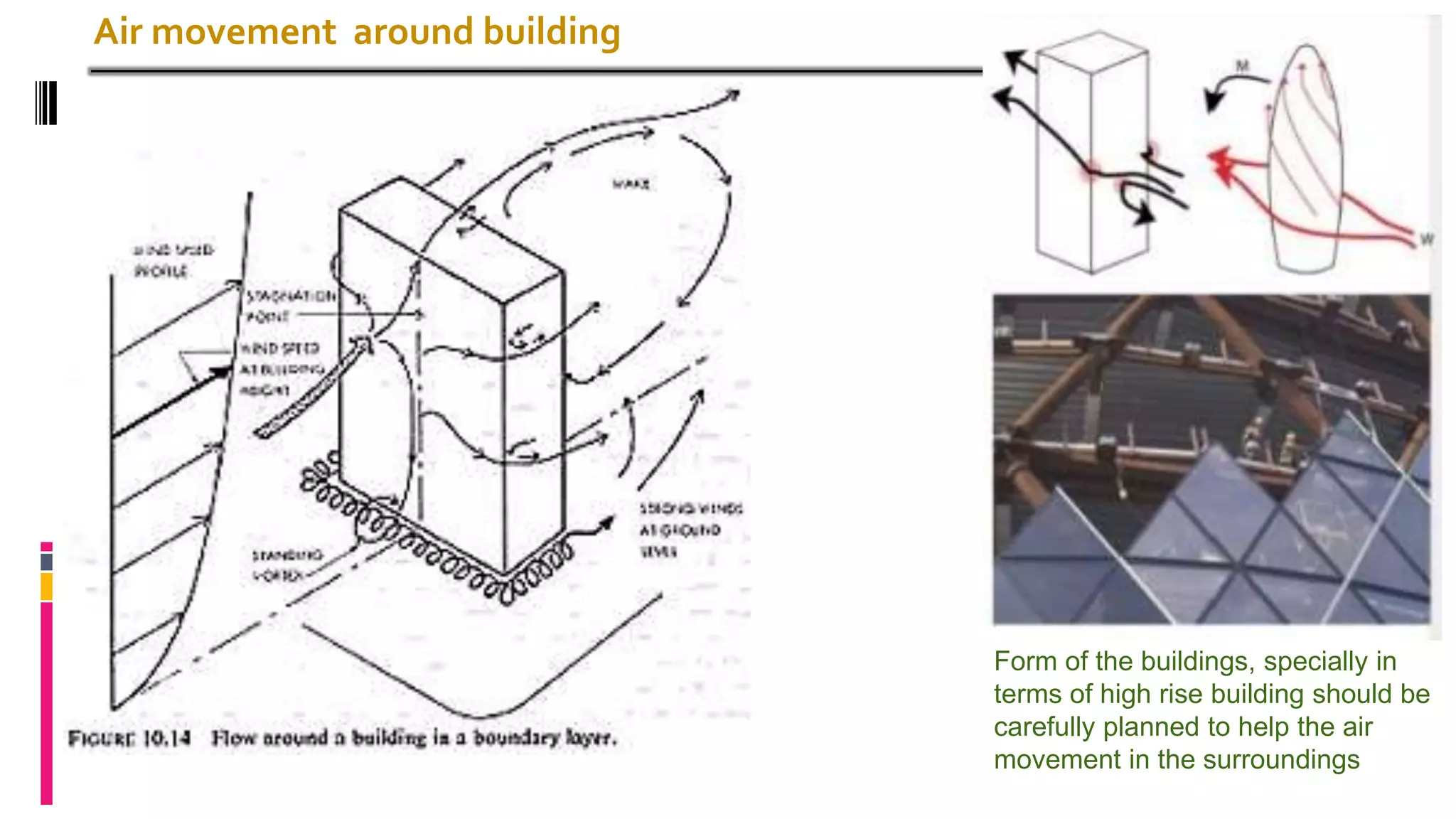
Air movement around building
Form of the buildings, specially in
terms of high rise building should be
carefully planned to help the air
movement in the surroundings
30 St Mary Axe, informally known as
The Gherkin, is a commercial skyscraper in
London's primary financial district.
It was completed in December 2003 and
opened in April 2004.[10] With 41 floors, it is
180 metres (591 ft) tall.
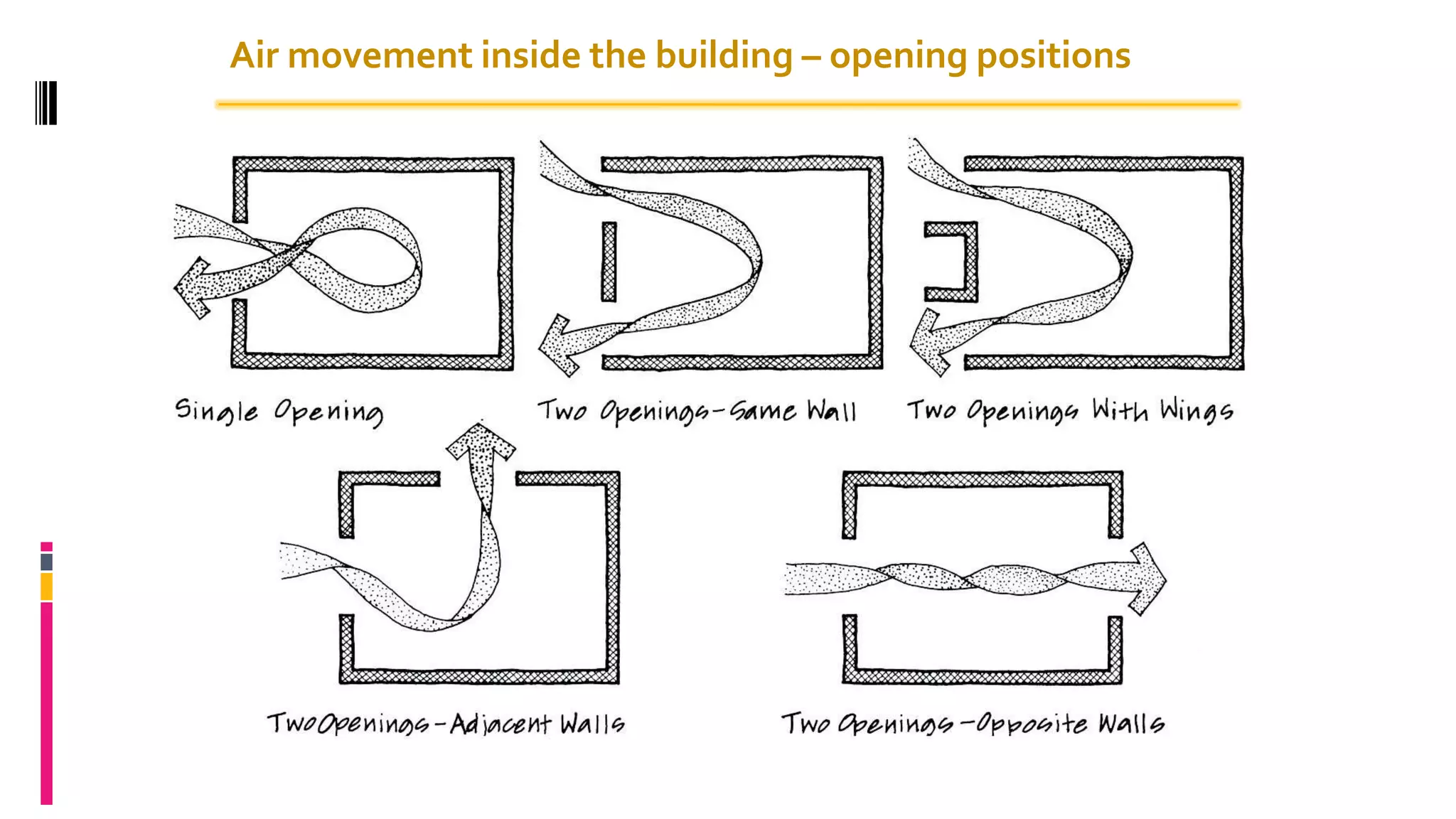
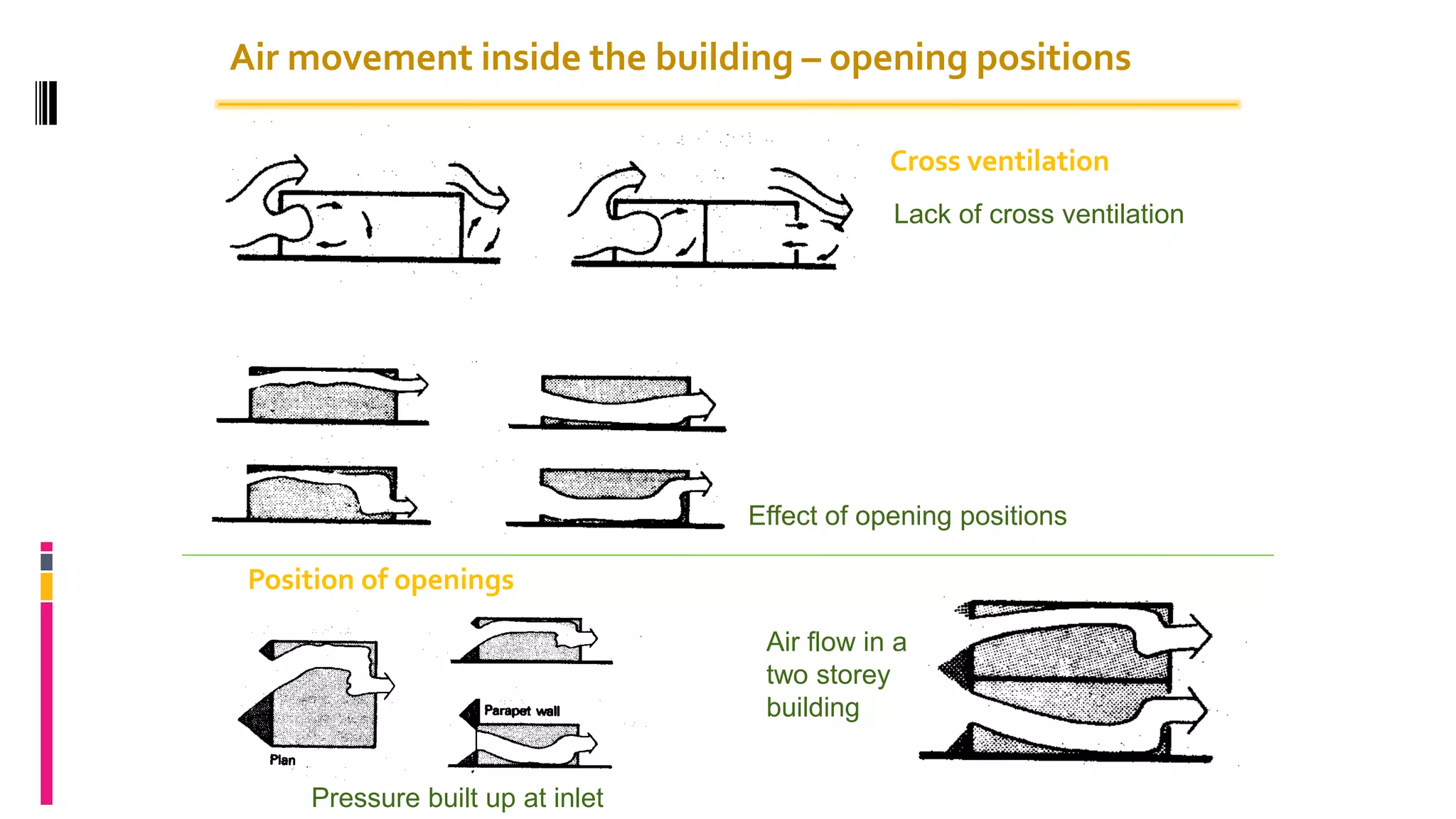
Air movement inside the building – opening positions
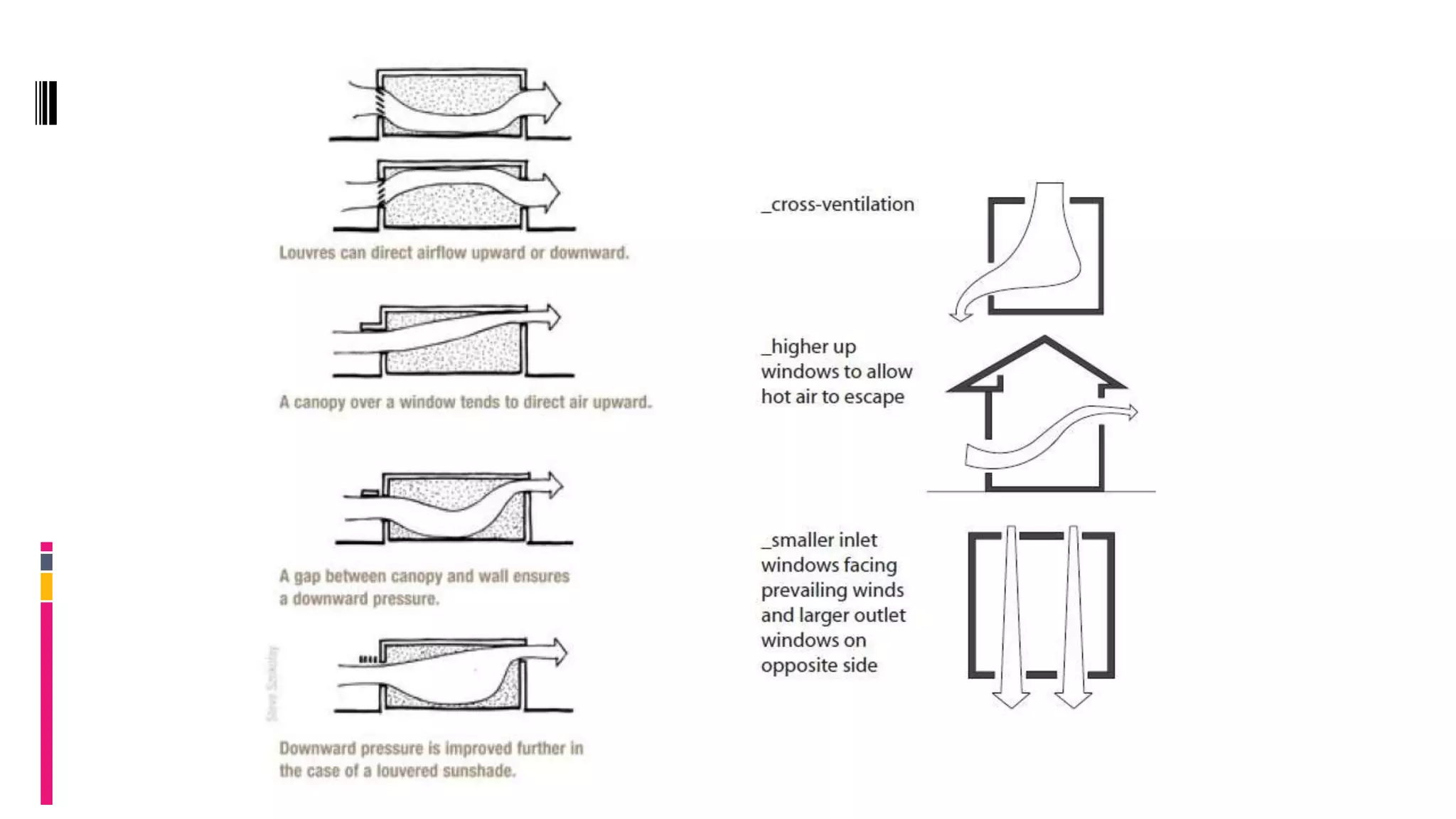
Cross ventilation
Lack of cross ventilation
Effect of opening positions
Pressure built up at inlet
Air flow in a
two storey
building
Position of openings
Air movement inside the building – opening positions
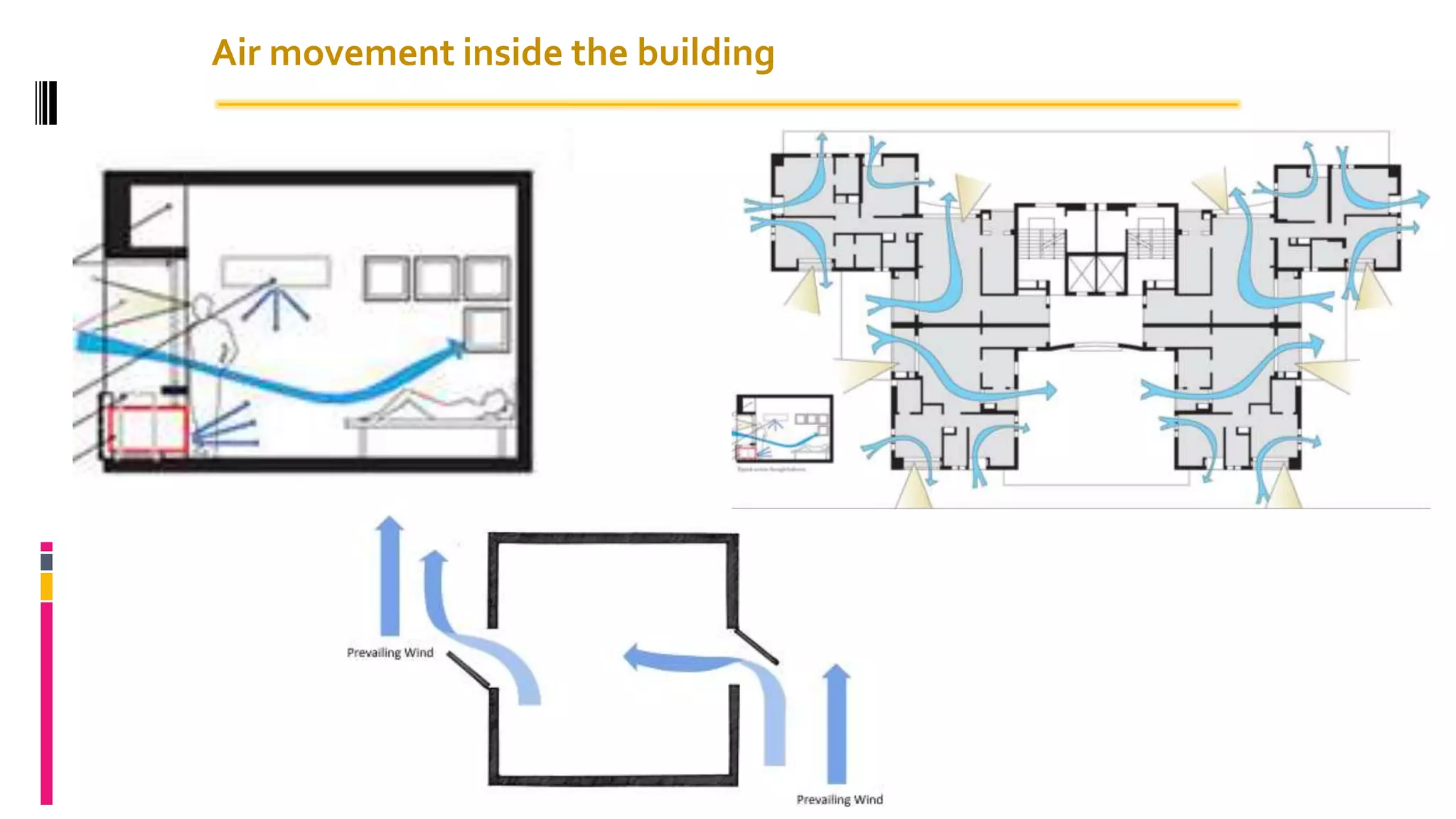
Air movement inside the building
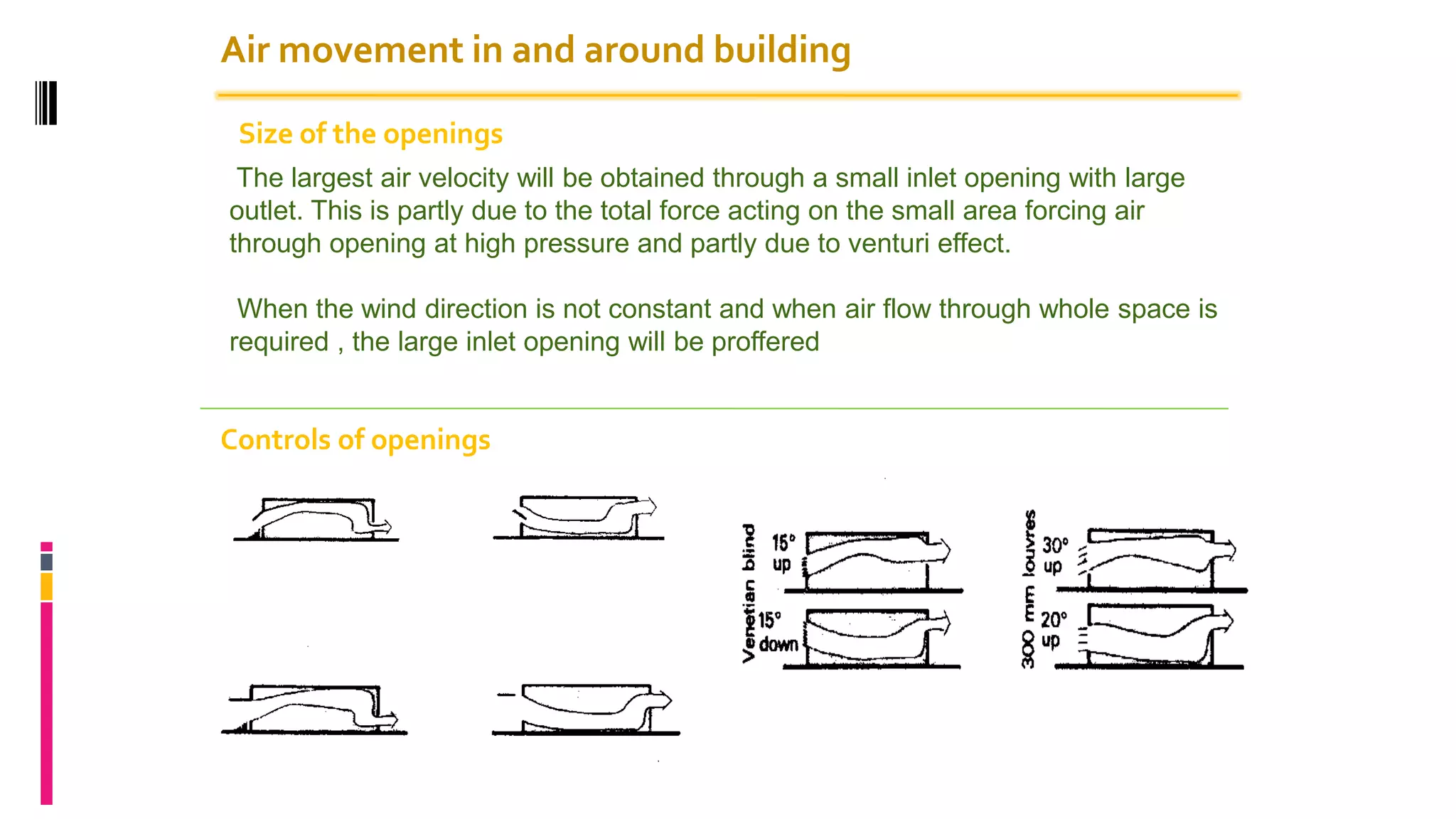
Size of the openings
The largest air velocity will be obtained through a small inlet opening with large
outlet. This is partly due to the total force acting on the small area forcing air
through opening at high pressure and partly due to venturi effect.
When the wind direction is not constant and when air flow through whole space is
required , the large inlet opening will be proffered
Controls of openings
Effect of sashes
Effect of louvers
Effect of canopies
Effect ofVenetian
blinds
Air movement in and around building
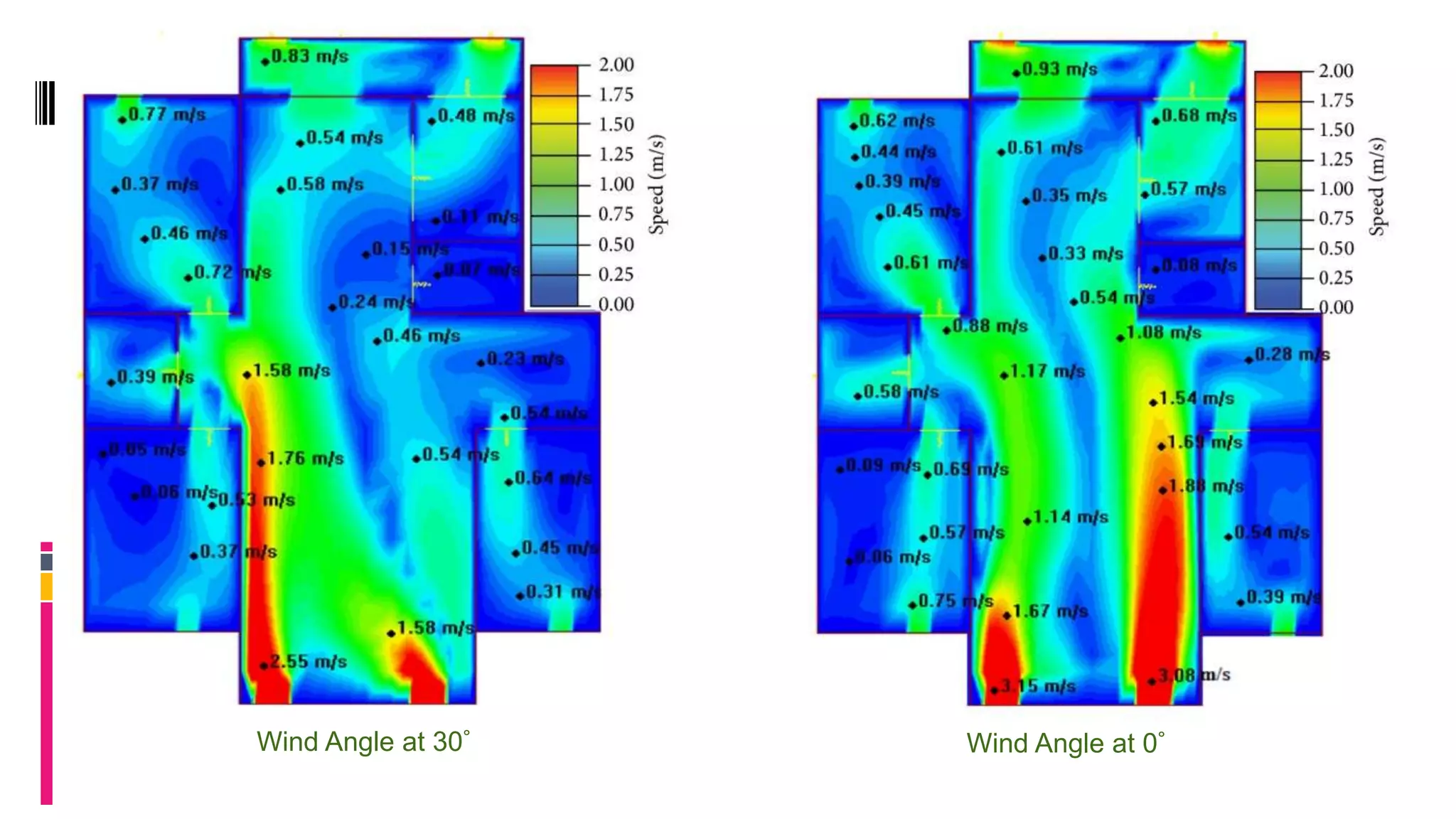
Wind Angle at 75˚
A study done in a residential
building for understanding the
effect of wind angles
Wind Angle at 0˚Wind Angle at 30˚
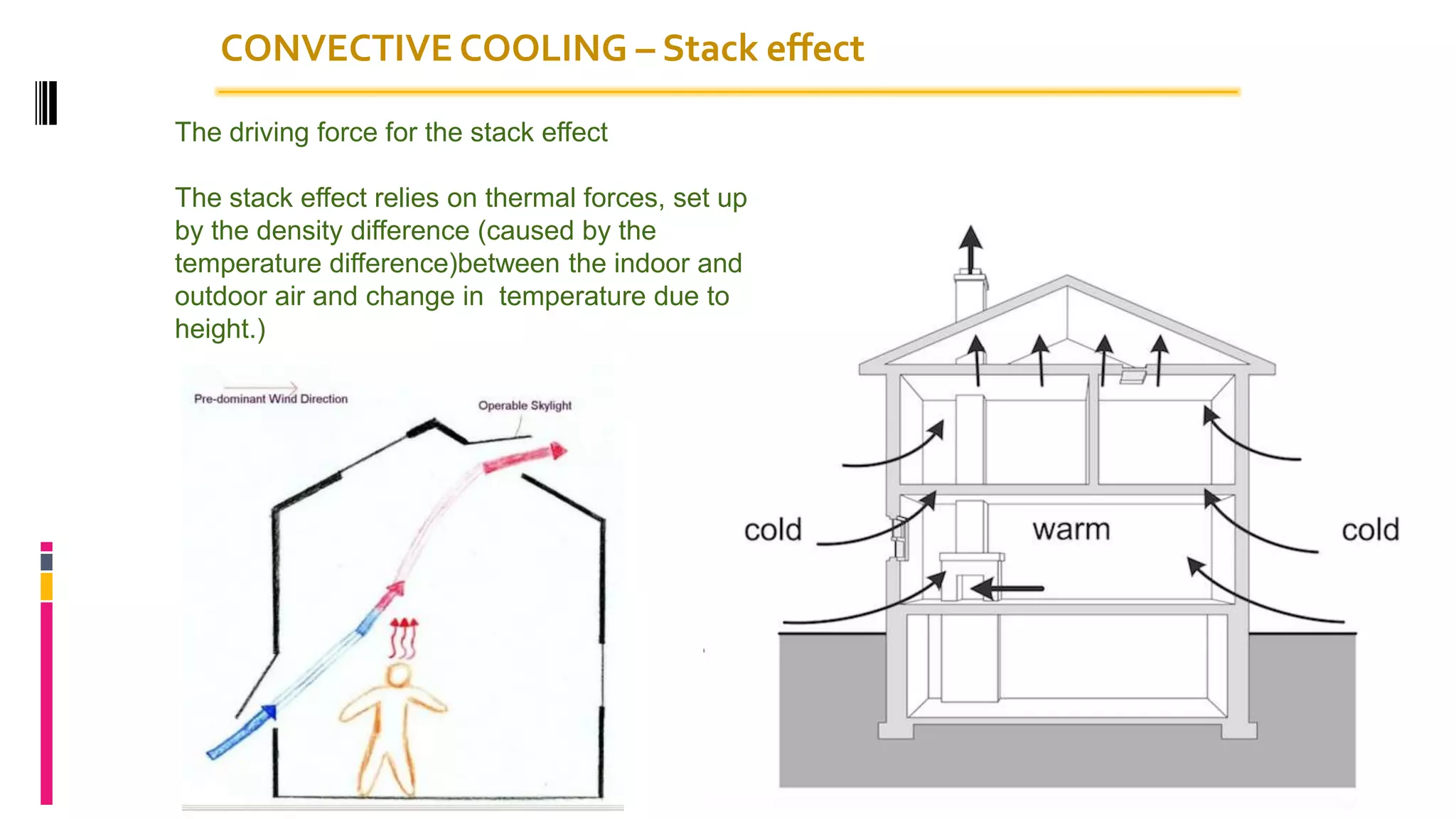
CONVECTIVE COOLING – Stack effect
The driving force for the stack effect
The stack effect relies on thermal forces, set up
by the density difference (caused by the
temperature difference)between the indoor and
outdoor air and change in temperature due to
height.)
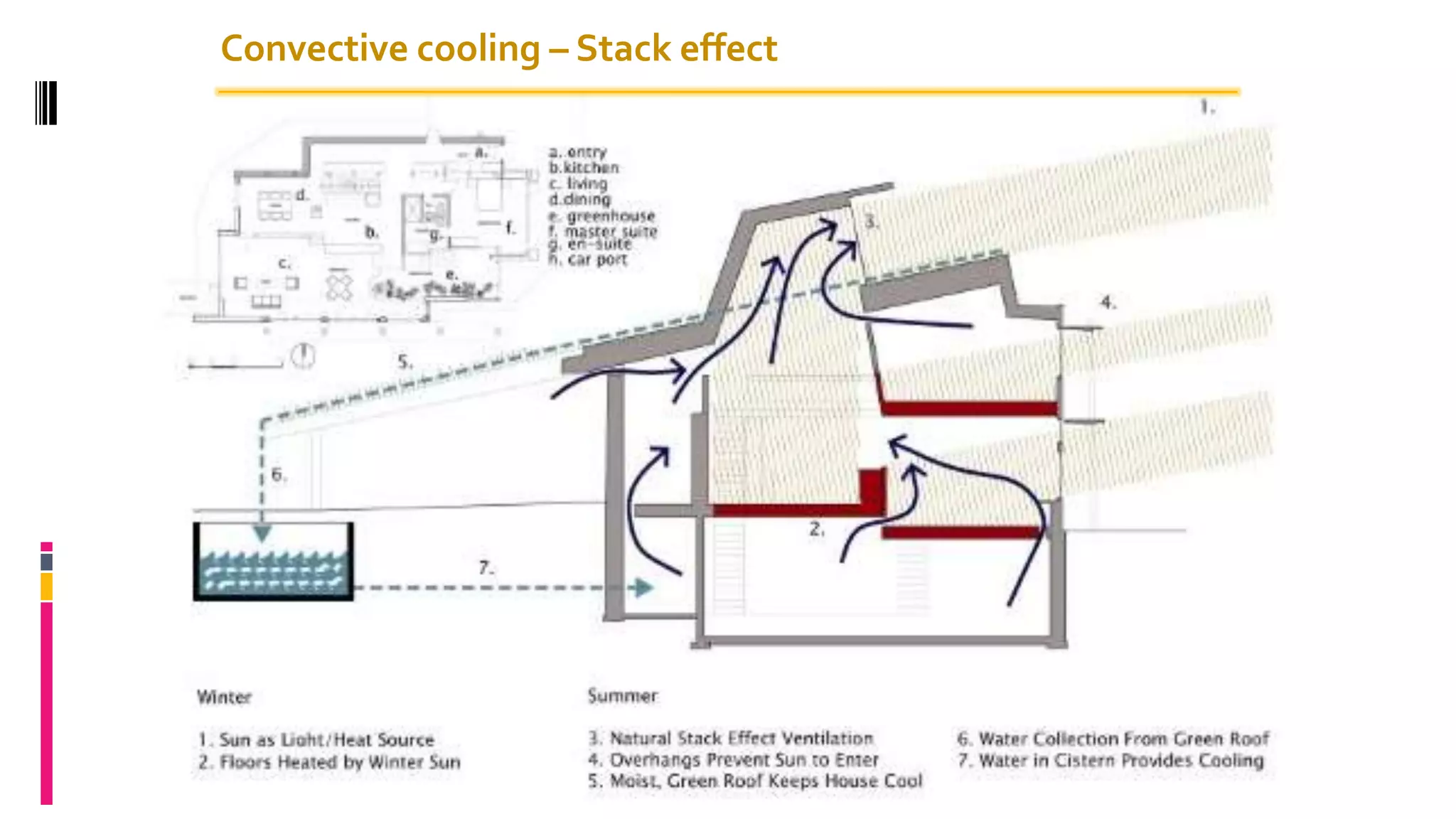
Convective cooling – Stack effect
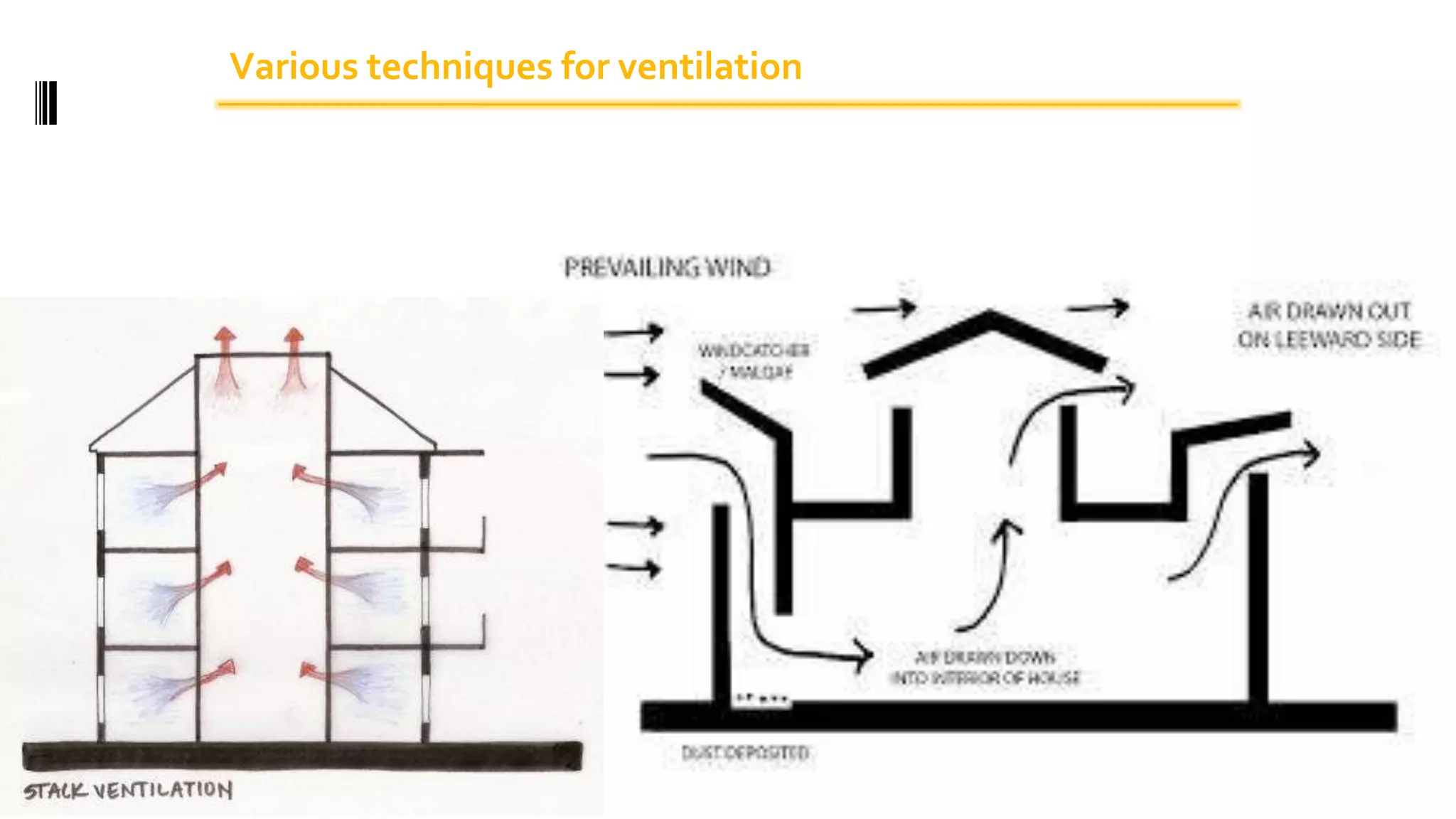
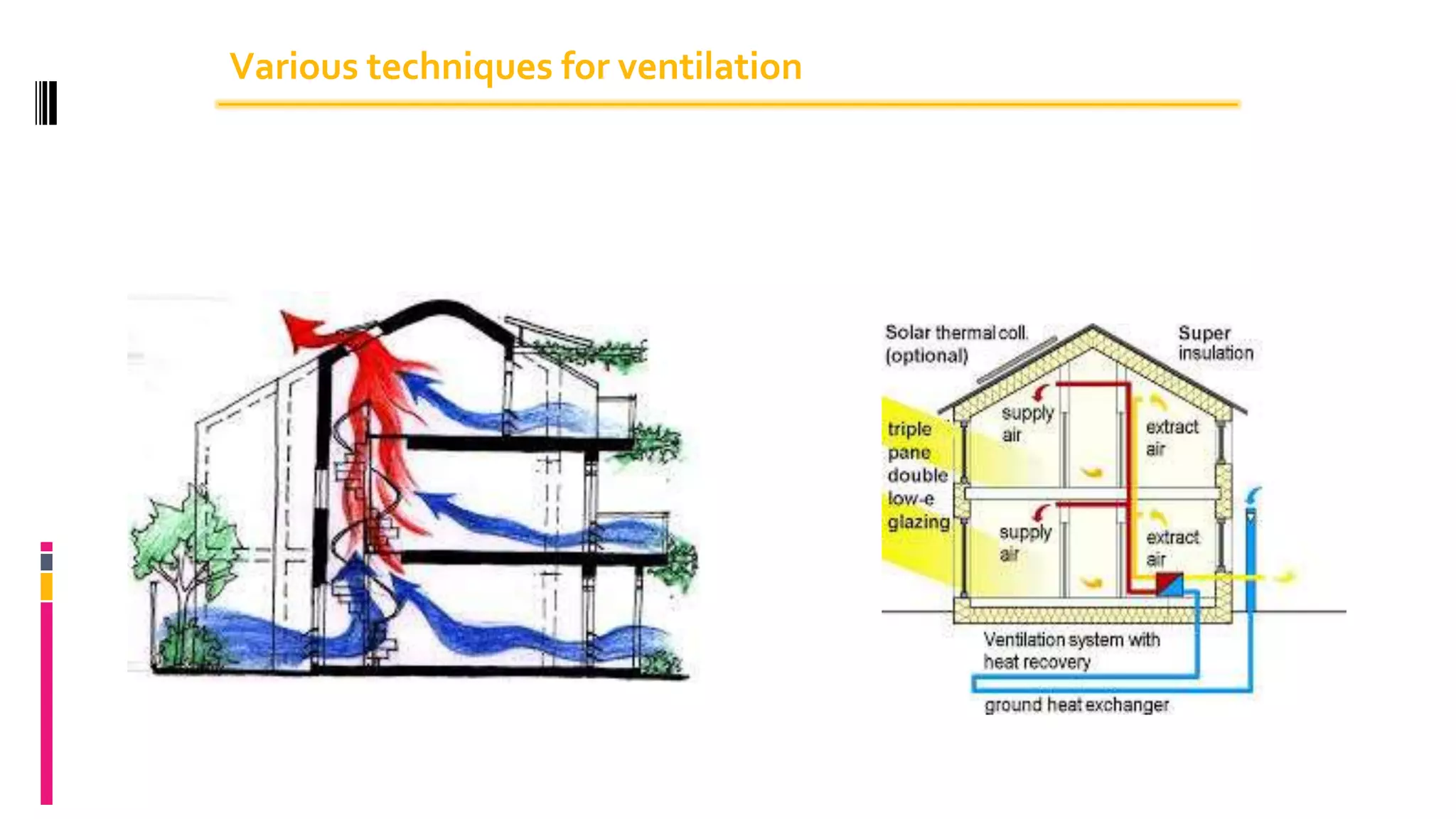
Various techniques for ventilation
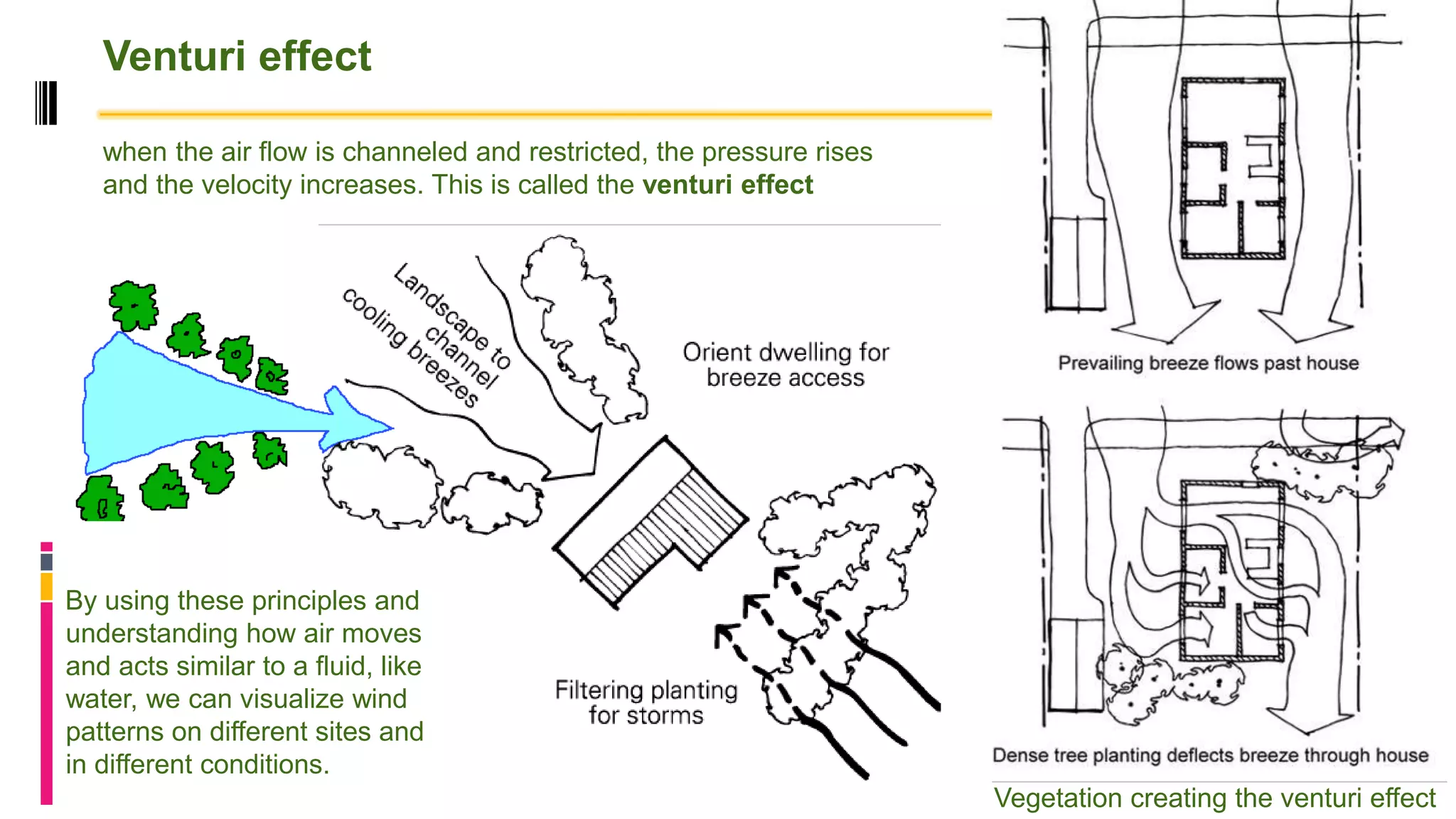
The Venturi effect is the reduction in fluid pressure that results when a fluid flows
through a constricted section of pipe.
Venturi effect
To increase speed of air
to reduce temperature.
when the air flow is channeled and restricted, the pressure rises
and the velocity increases. This is called the venturi effect
By using these principles and
understanding how air moves
and acts similar to a fluid, like
water, we can visualize wind
patterns on different sites and
in different conditions.
Venturi effect
Vegetation creating the venturi effect
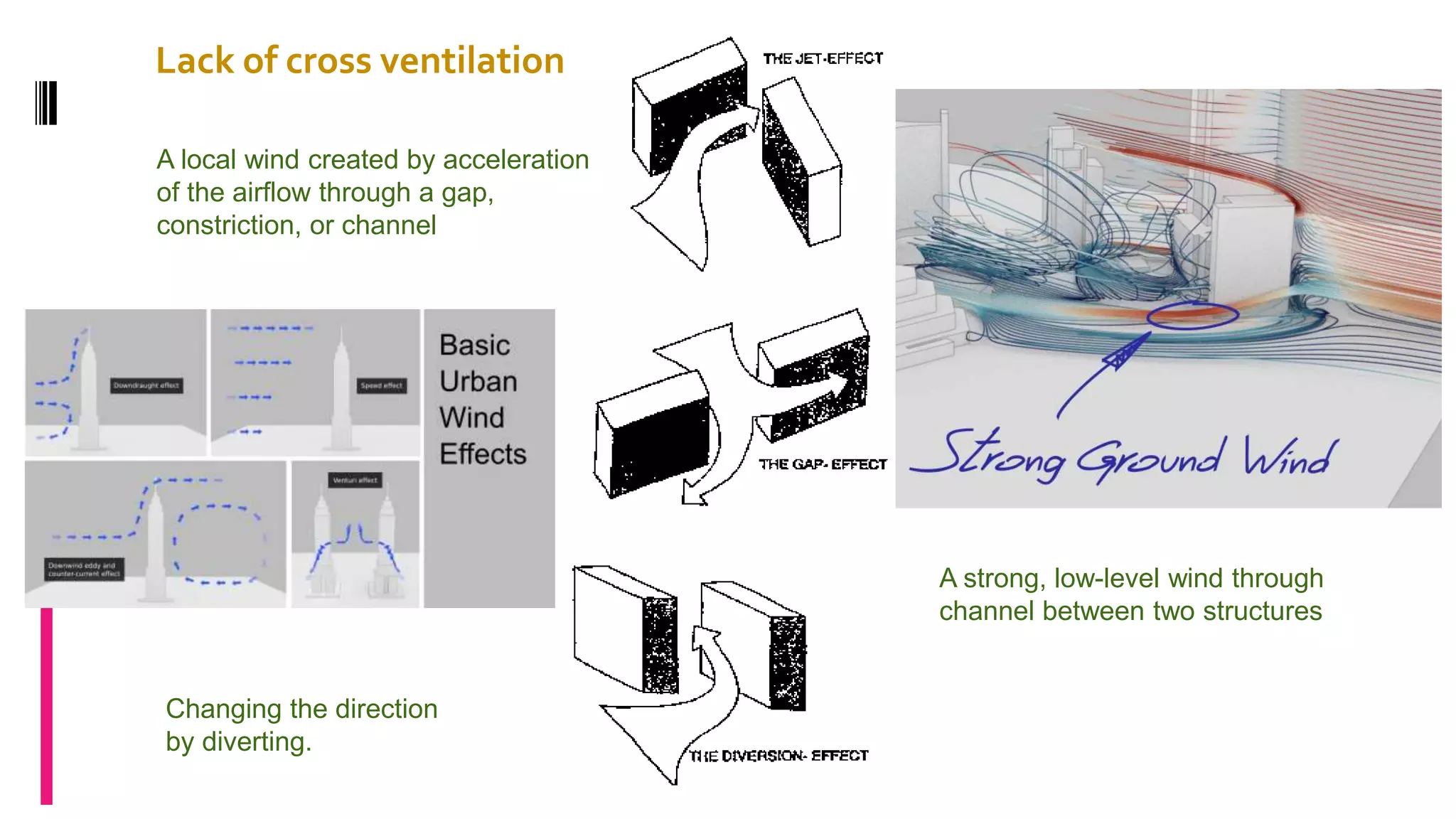
A local wind created by acceleration
of the airflow through a gap,
constriction, or channel
Changing the direction
by diverting.
A strong, low-level wind through
channel between two structures
Lack of cross ventilation
Humidity control
Wind scoop – in hot and dry climate humidification is necessary which
can be associated with evaporative cooling
Functions of wind scoop
controlled air supply
Filtering out sand and dust
evaporative cooling.
humidification
Various techniques for ventilation
Open jet wind stimulator
On basis of experiments following factors can be isolated which affect the
indoor flow
- Orientation - size of openings
- Cross ventilation - controls of openings
- Position of openings
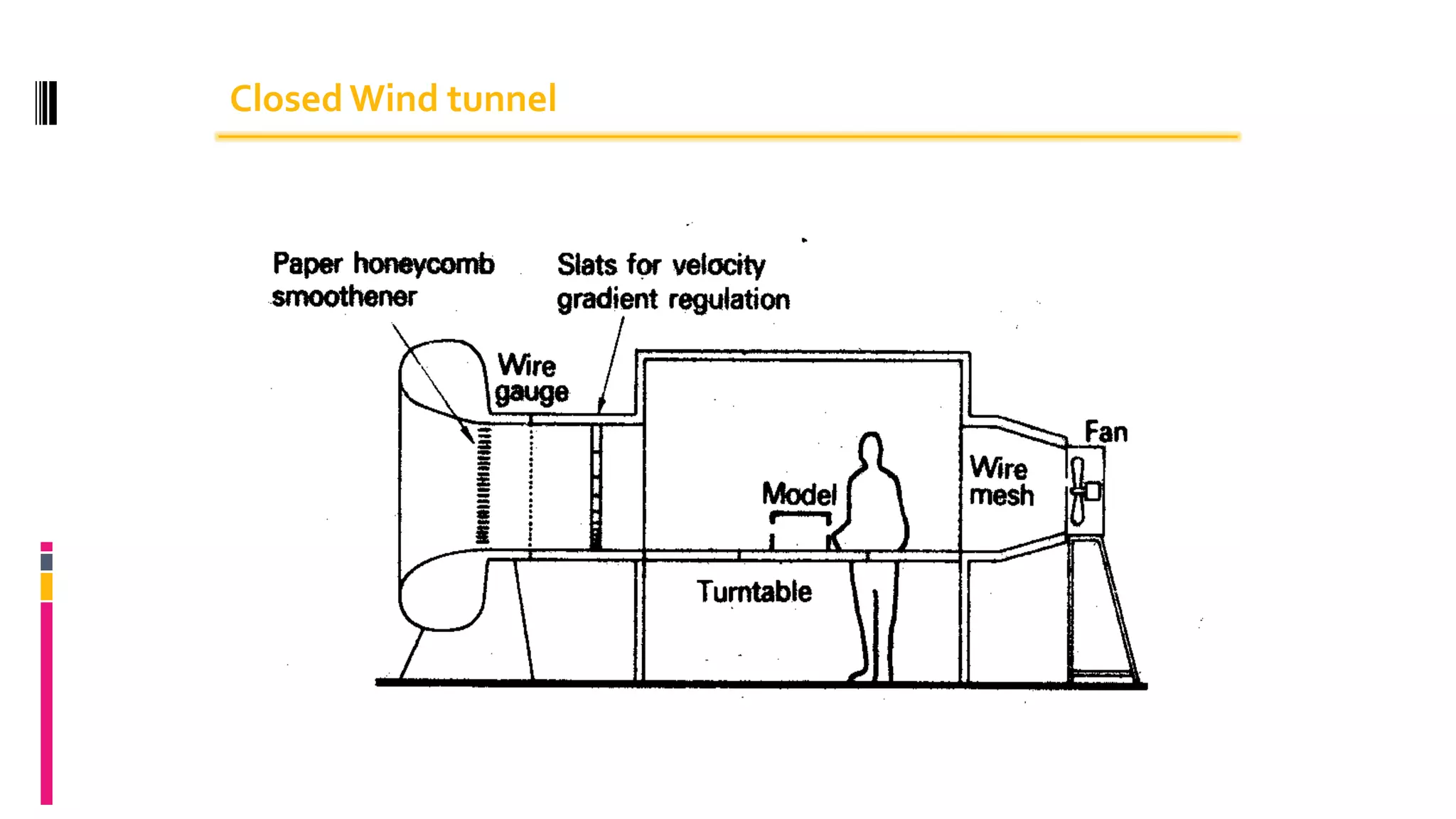
Experiments to check ventilation in models
Closed Wind tunnel

Ventilation - Air movement

  • 1.
  • 2.
    This lecture isabout  Fundamentals of building ventilation  Natural Ventilation  Wind patterns  Openings  Building strategies
  • 3.
    Why is itnecessary to ventilate?  Air for breathing  Adult man has frequency of breathing typically 16 times per minute –8 l/min.  Respiration
  • 4.
    Why is itnecessary to ventilate?  Indoor environment in a room has to meet level suitable for  people and theirs activity.  In an industrial building ventilation requirements may relate  also to industrial processes.  In an agricultural building all focus aims to animals. Ventilation is one of systems keeping habitable environment.
  • 5.
    Information about windpatterns and prevailing wind direction Functions of ventilation Three distinctly different functions - Supply of fresh air - Convective cooling - Physiological cooling Achieved by - air movement Ventilation In Architectural terms, Ventilation is the intentional introduction of outdoor air into a space and is mainly used to control indoor air quality by diluting and displacing indoor pollutants; it can also be used for purposes of thermal comfort or dehumidification.
  • 6.
    SUPPLY OF FRESHAIR - Air movement around building Wind is generated by pressure differences – so an air flow through the building is result of pressure difference between two sides. 1.The air flow around a building Development of positive pressure on windward side and negative pressure on leeward side of the building Side elevation plan
  • 7.
    Air stream separationat the face of building Reverse flow behind tall block Air flow grid iron pattern Air flow checkboard pattern Air movement around building
  • 8.
    Air movement aroundbuilding Form of the buildings, specially in terms of high rise building should be carefully planned to help the air movement in the surroundings
  • 9.
    30 St MaryAxe, informally known as The Gherkin, is a commercial skyscraper in London's primary financial district. It was completed in December 2003 and opened in April 2004.[10] With 41 floors, it is 180 metres (591 ft) tall.
  • 10.
    Air movement insidethe building – opening positions
  • 11.
    Air movement insidethe building – opening positions
  • 13.
    Cross ventilation Lack ofcross ventilation Effect of opening positions Pressure built up at inlet Air flow in a two storey building Position of openings Air movement inside the building – opening positions
  • 14.
    Air movement insidethe building
  • 15.
    Size of theopenings The largest air velocity will be obtained through a small inlet opening with large outlet. This is partly due to the total force acting on the small area forcing air through opening at high pressure and partly due to venturi effect. When the wind direction is not constant and when air flow through whole space is required , the large inlet opening will be proffered Controls of openings Effect of sashes Effect of louvers Effect of canopies Effect ofVenetian blinds Air movement in and around building
  • 16.
    Wind Angle at75˚ A study done in a residential building for understanding the effect of wind angles
  • 17.
    Wind Angle at0˚Wind Angle at 30˚
  • 18.
    CONVECTIVE COOLING –Stack effect The driving force for the stack effect The stack effect relies on thermal forces, set up by the density difference (caused by the temperature difference)between the indoor and outdoor air and change in temperature due to height.)
  • 19.
  • 20.
  • 21.
    The Venturi effectis the reduction in fluid pressure that results when a fluid flows through a constricted section of pipe. Venturi effect To increase speed of air to reduce temperature.
  • 22.
    when the airflow is channeled and restricted, the pressure rises and the velocity increases. This is called the venturi effect By using these principles and understanding how air moves and acts similar to a fluid, like water, we can visualize wind patterns on different sites and in different conditions. Venturi effect Vegetation creating the venturi effect
  • 23.
    A local windcreated by acceleration of the airflow through a gap, constriction, or channel Changing the direction by diverting. A strong, low-level wind through channel between two structures Lack of cross ventilation
  • 24.
    Humidity control Wind scoop– in hot and dry climate humidification is necessary which can be associated with evaporative cooling Functions of wind scoop controlled air supply Filtering out sand and dust evaporative cooling. humidification
  • 25.
  • 26.
    Open jet windstimulator On basis of experiments following factors can be isolated which affect the indoor flow - Orientation - size of openings - Cross ventilation - controls of openings - Position of openings Experiments to check ventilation in models
  • 27.

Editor's Notes

  • #6 Ventilation is the process by which ‘clean’ air (normally outdoor air) is intentionally provided to a space and stale air is removed. This may be accomplished by either natural or mechanical means.
  • #19 It can occur through an open window(when the air is still) the warmer and lighter air will flow out at the top and cooler denser air will flow in at the bottom Special provision can be made in the form of ventilating shafts. The larger the cross sectional area of the shaft, the greater the temperature difference: the greater the motive force and more air will be moved.