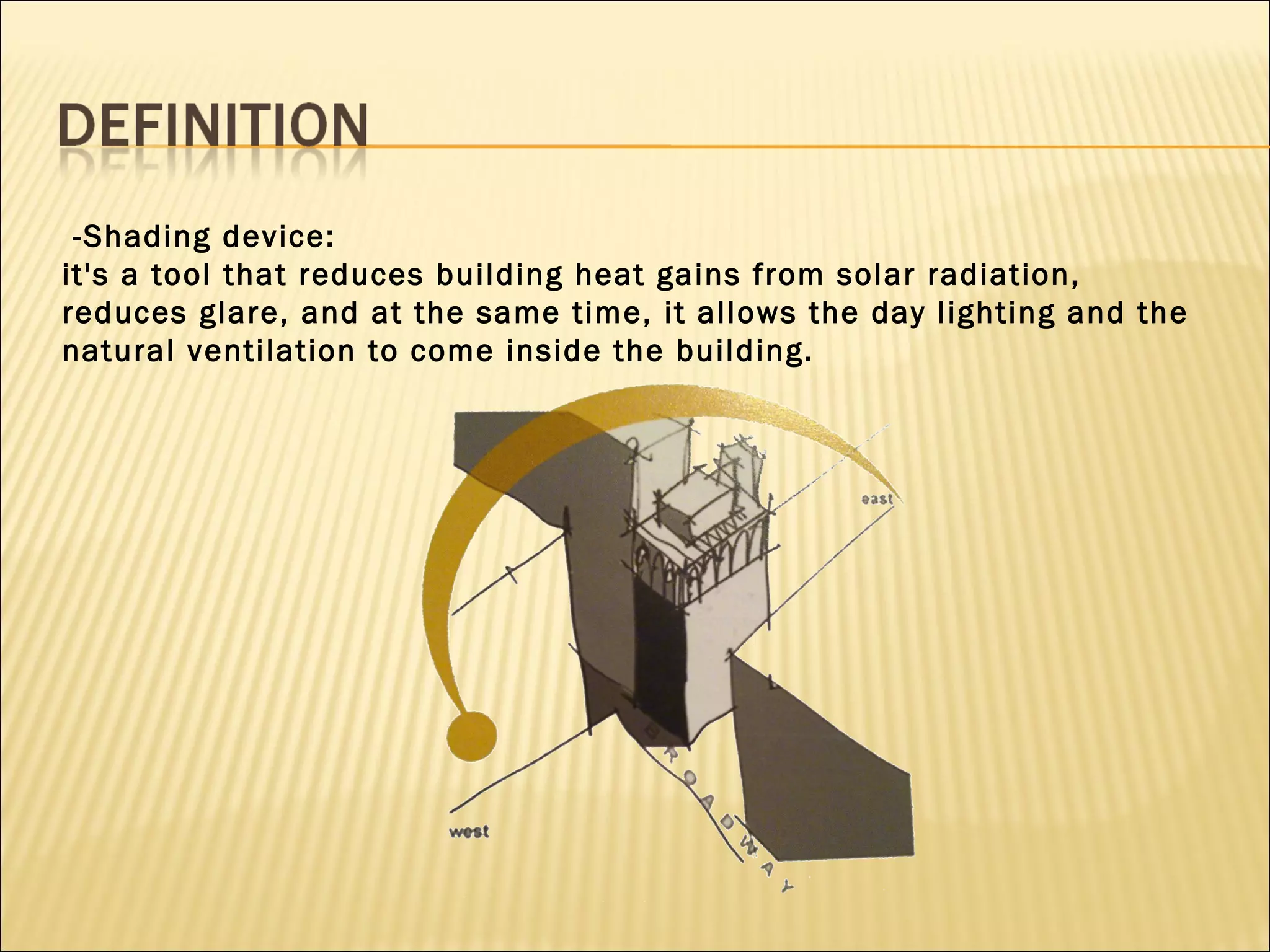
-Shading device: it's a tool that reduces building heat gains from solar radiation, reduces glare, and at the same time, it allows the day lighting and the natural ventilation to come inside the building.
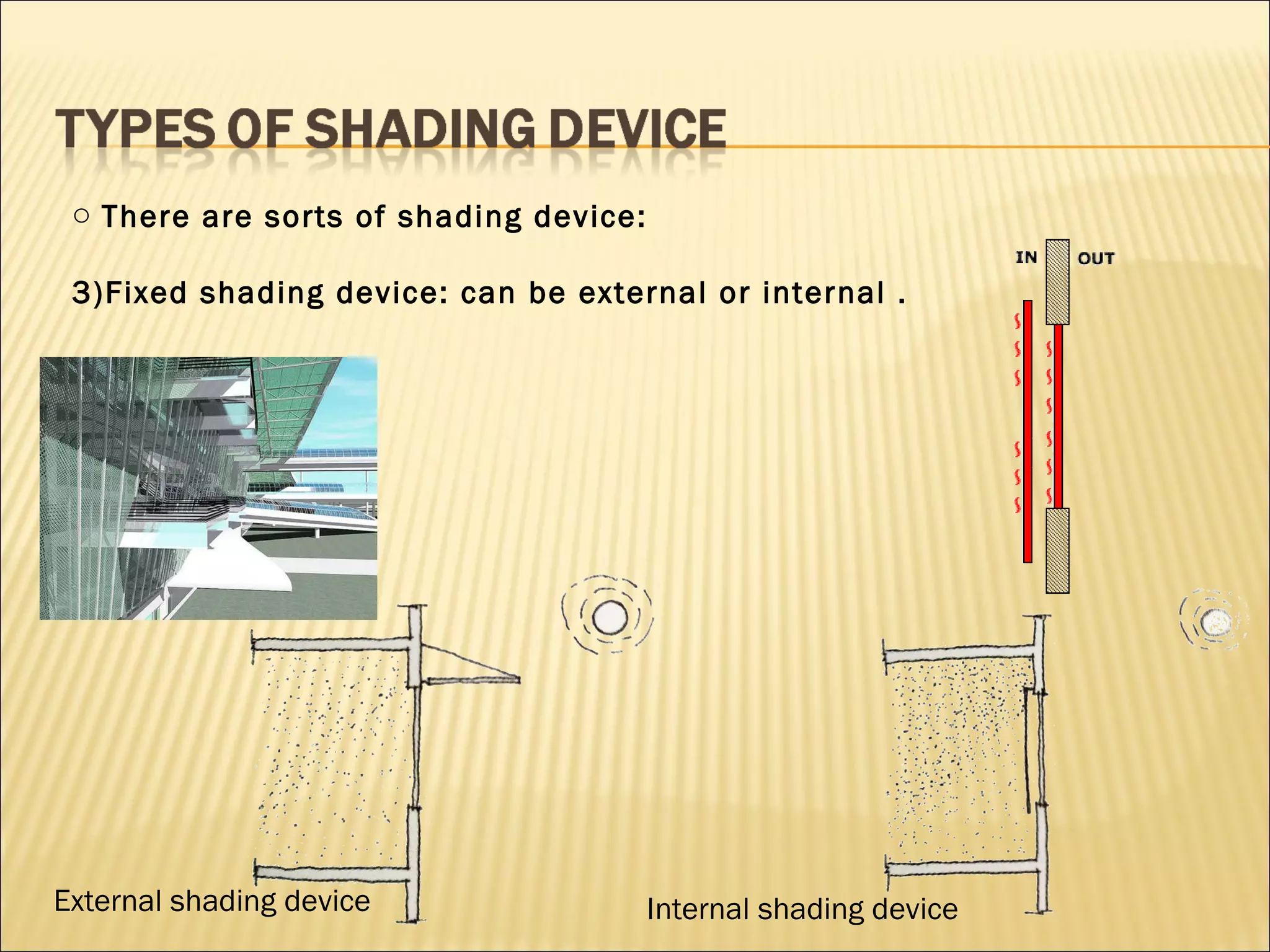
There are sorts of shading device: Fixed shading device: can be external or internal . External shading device Internal shading device
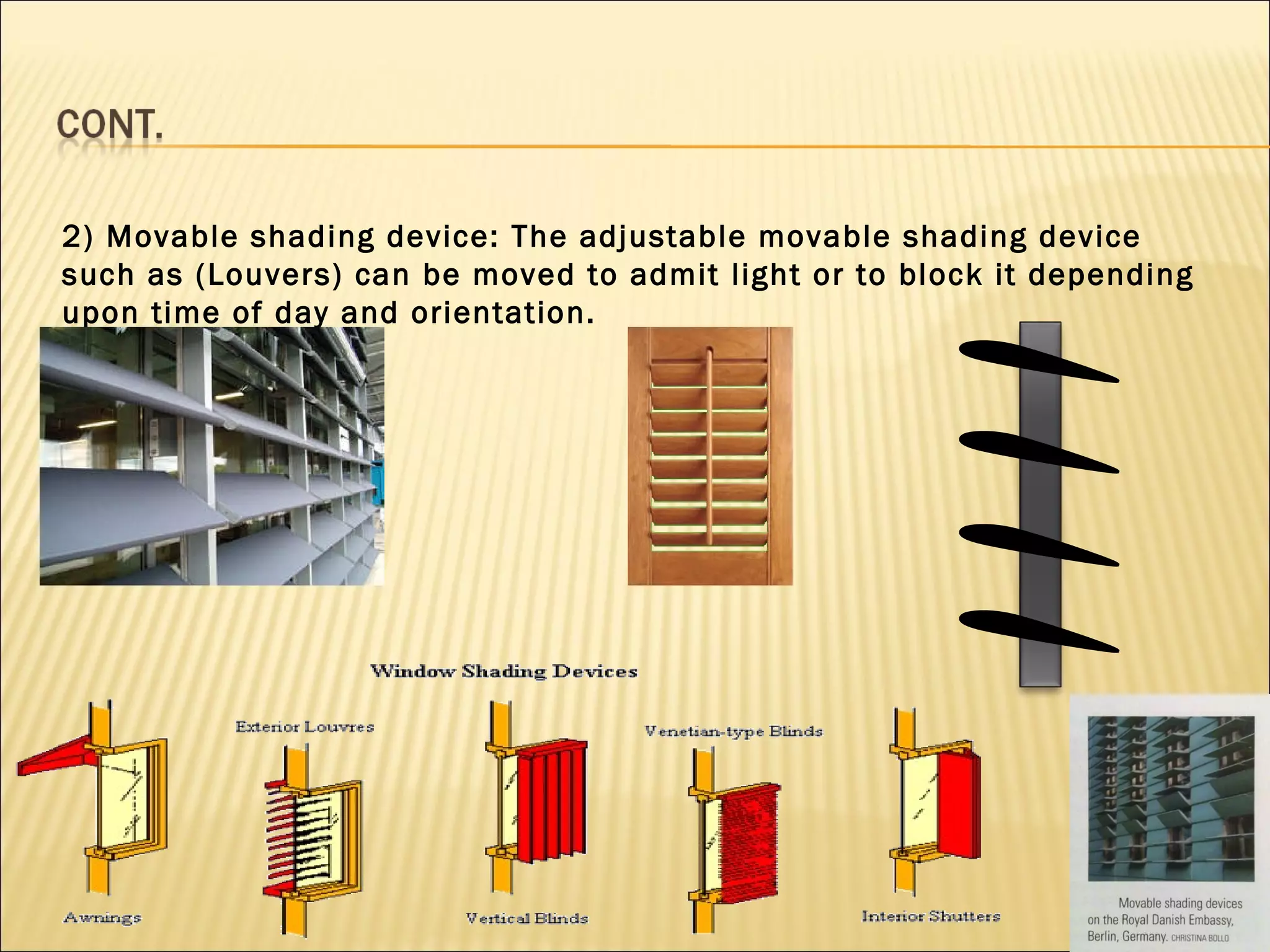
2) Movable shading device: The adjustable movable shading device such as (Louvers) can be moved to admit light or to block it depending upon time of day and orientation.
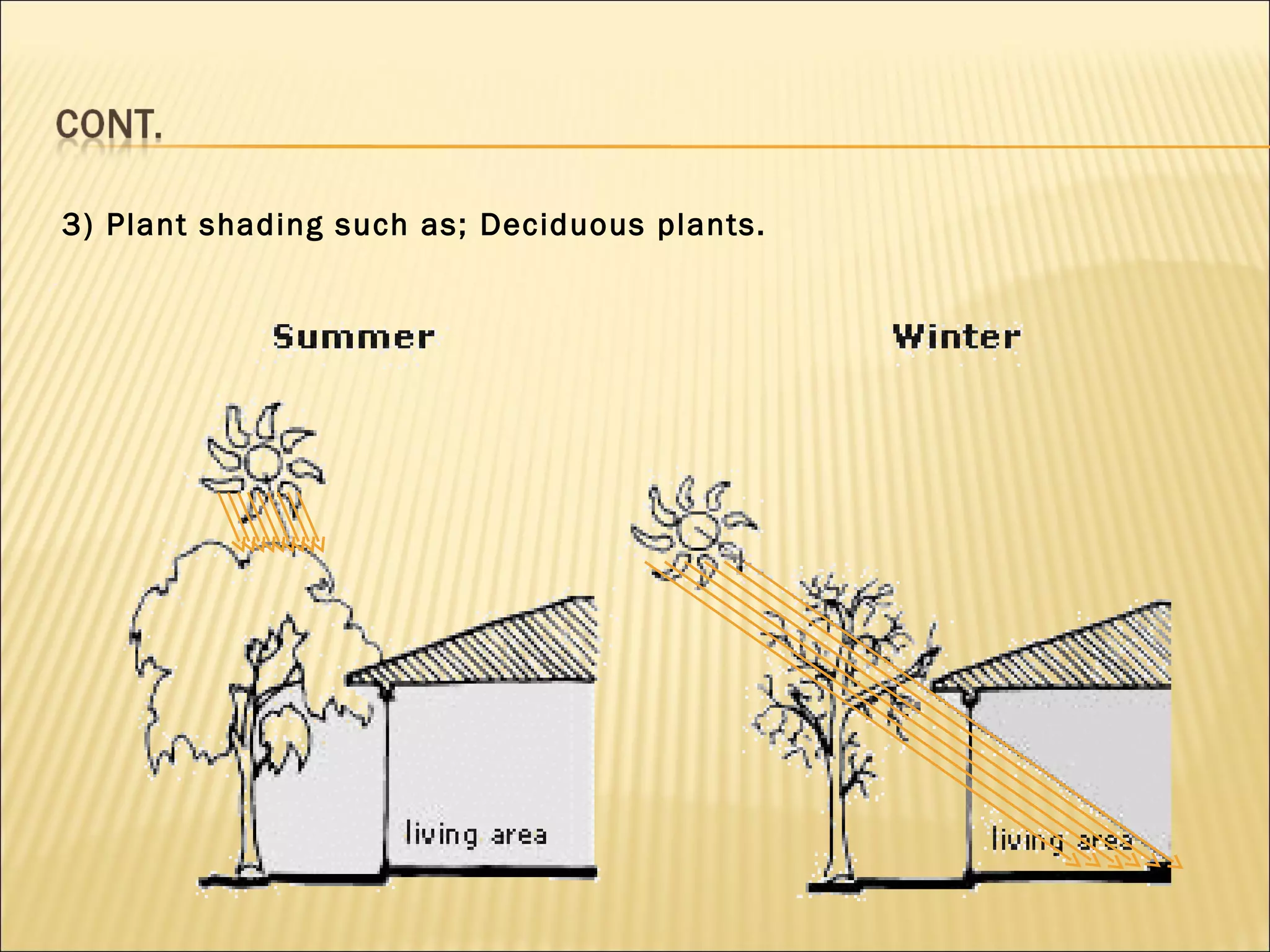
3) Plant shading such as; Deciduous plants.
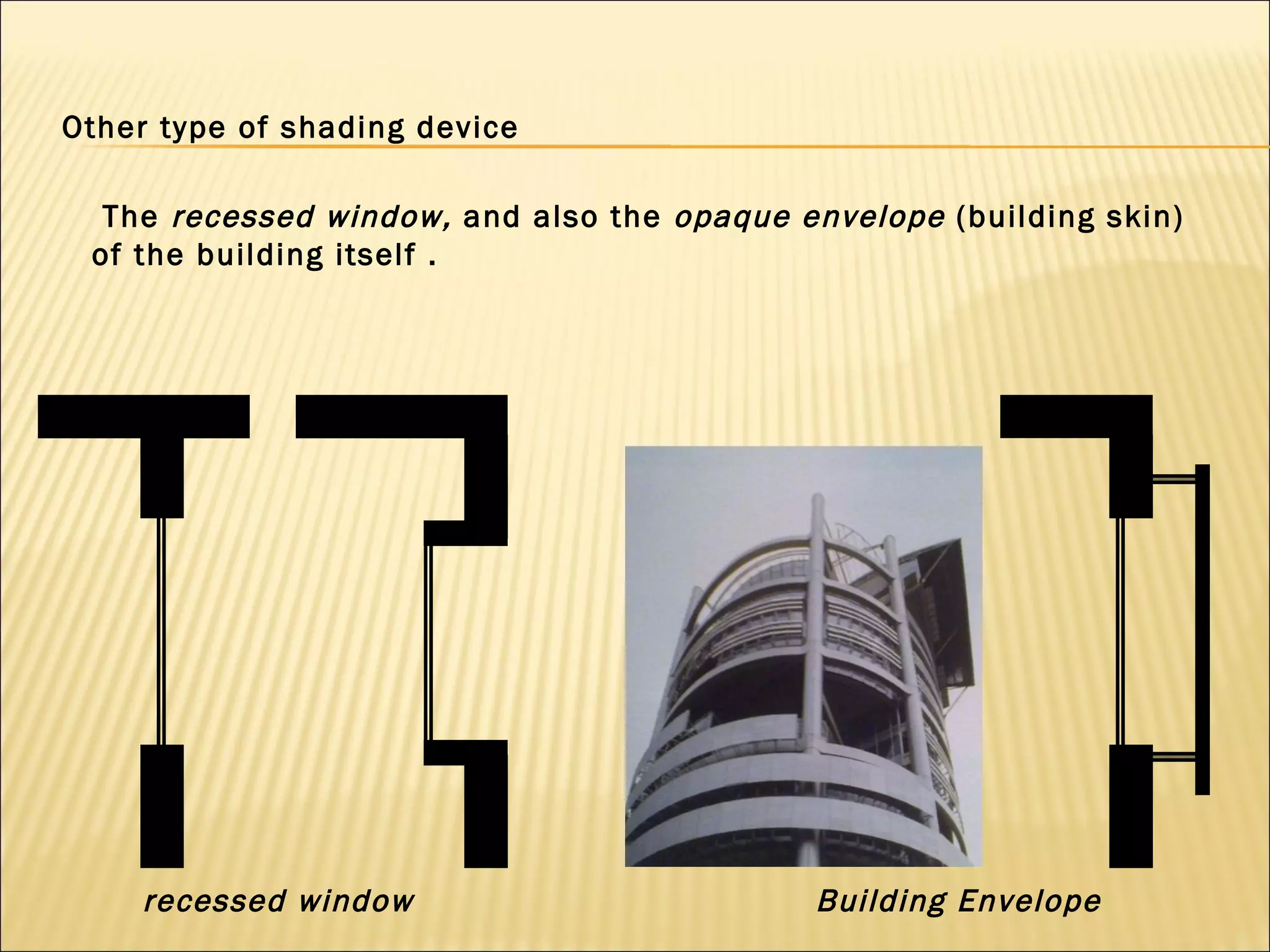
Other type of shading device  The  recessed window,  and also the  opaque envelope  (building skin) of the building itself . recessed window Building Envelope
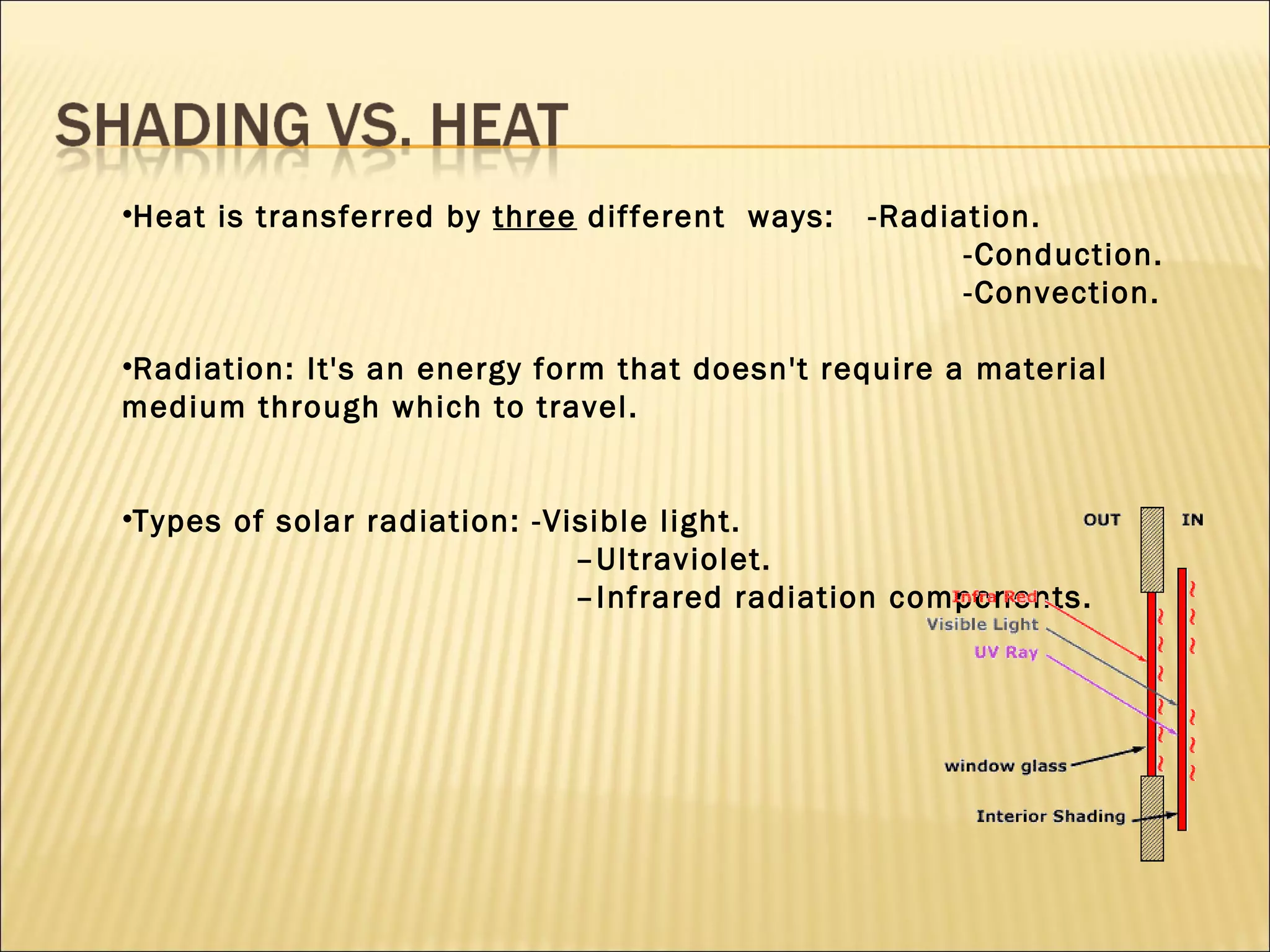
Heat is transferred by  three  different  ways:  -Radiation.   -Conduction.   -Convection. Radiation: It's an energy form that doesn't require a material medium through which to travel. Types of solar radiation: -Visible light. – Ultraviolet.  – Infrared radiation components.
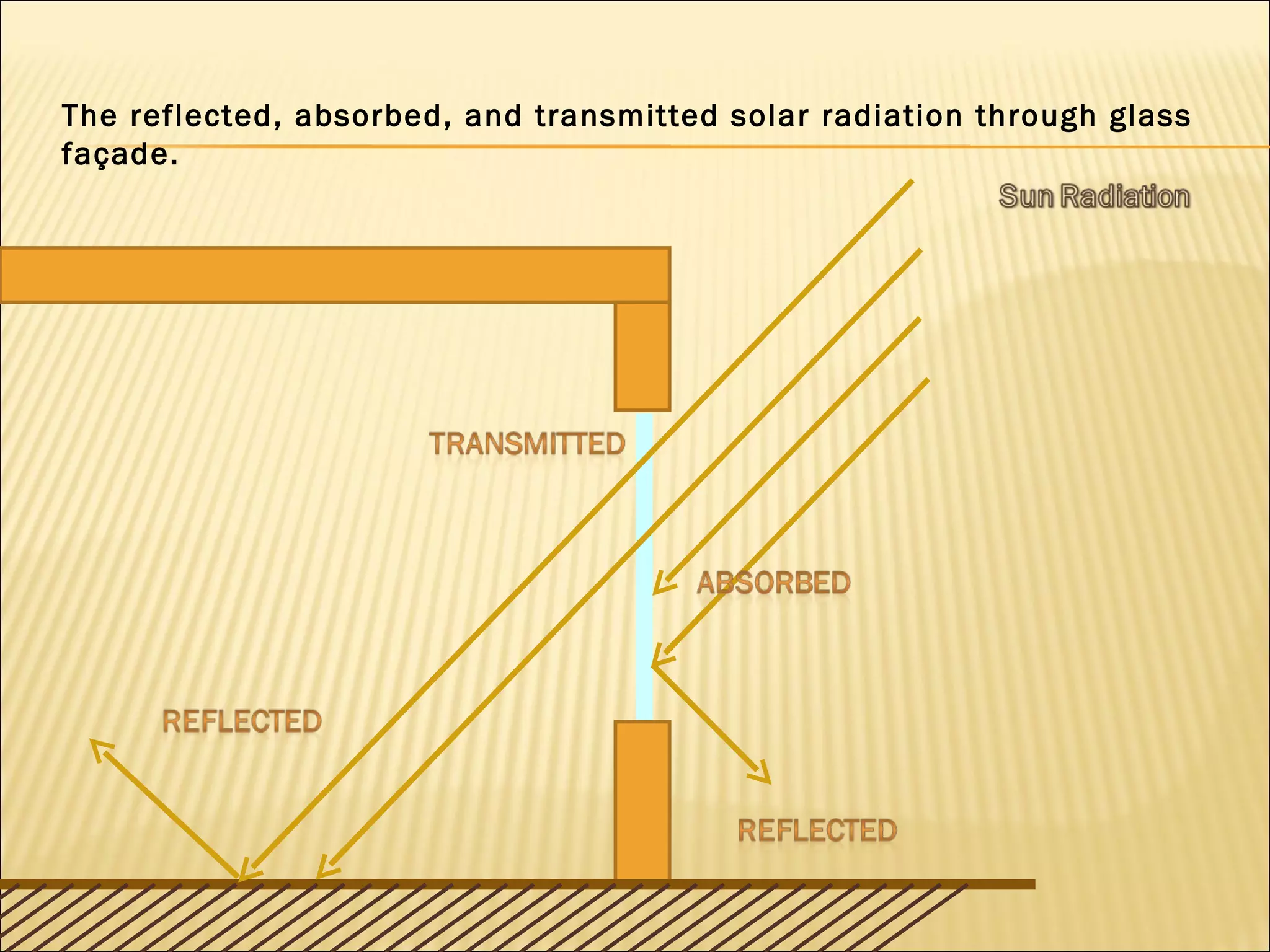
The reflected, absorbed, and transmitted solar radiation through glass façade.
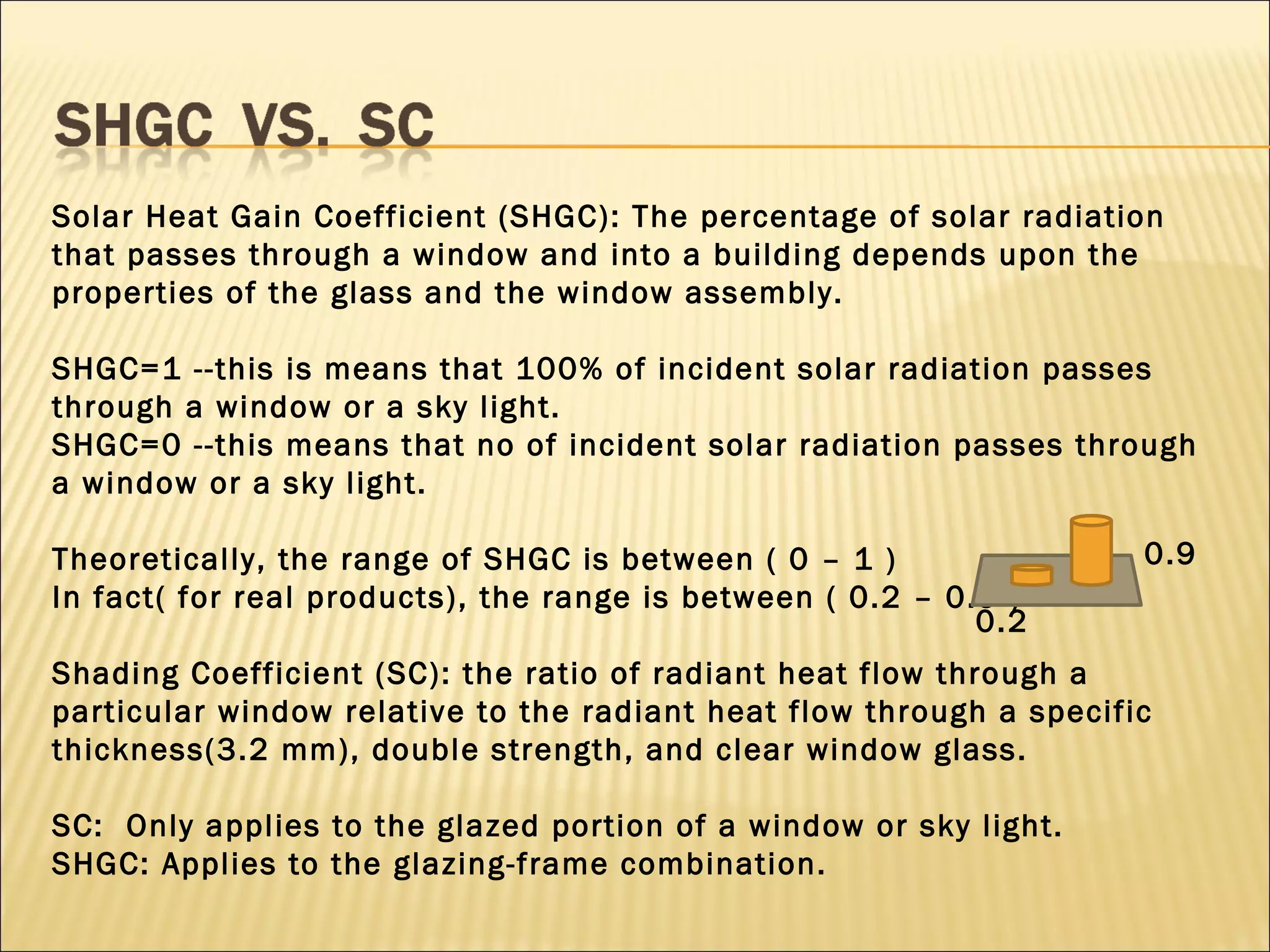
Solar Heat Gain Coefficient (SHGC): The percentage of solar radiation that passes through a window and into a building depends upon the properties of the glass and the window assembly.  SHGC=1 --this is means that 100% of incident solar radiation passes through a window or a sky light. SHGC=0 --this means that no of incident solar radiation passes through a window or a sky light.  Theoretically, the range of SHGC is between ( 0 – 1 ) In fact( for real products), the range is between ( 0.2 – 0.9 ) Shading Coefficient (SC): the ratio of radiant heat flow through a particular window relative to the radiant heat flow through a specific thickness(3.2 mm), double strength, and clear window glass. SC:  Only applies to the glazed portion of a window or sky light. SHGC: Applies to the glazing-frame combination. 0.2 0.9
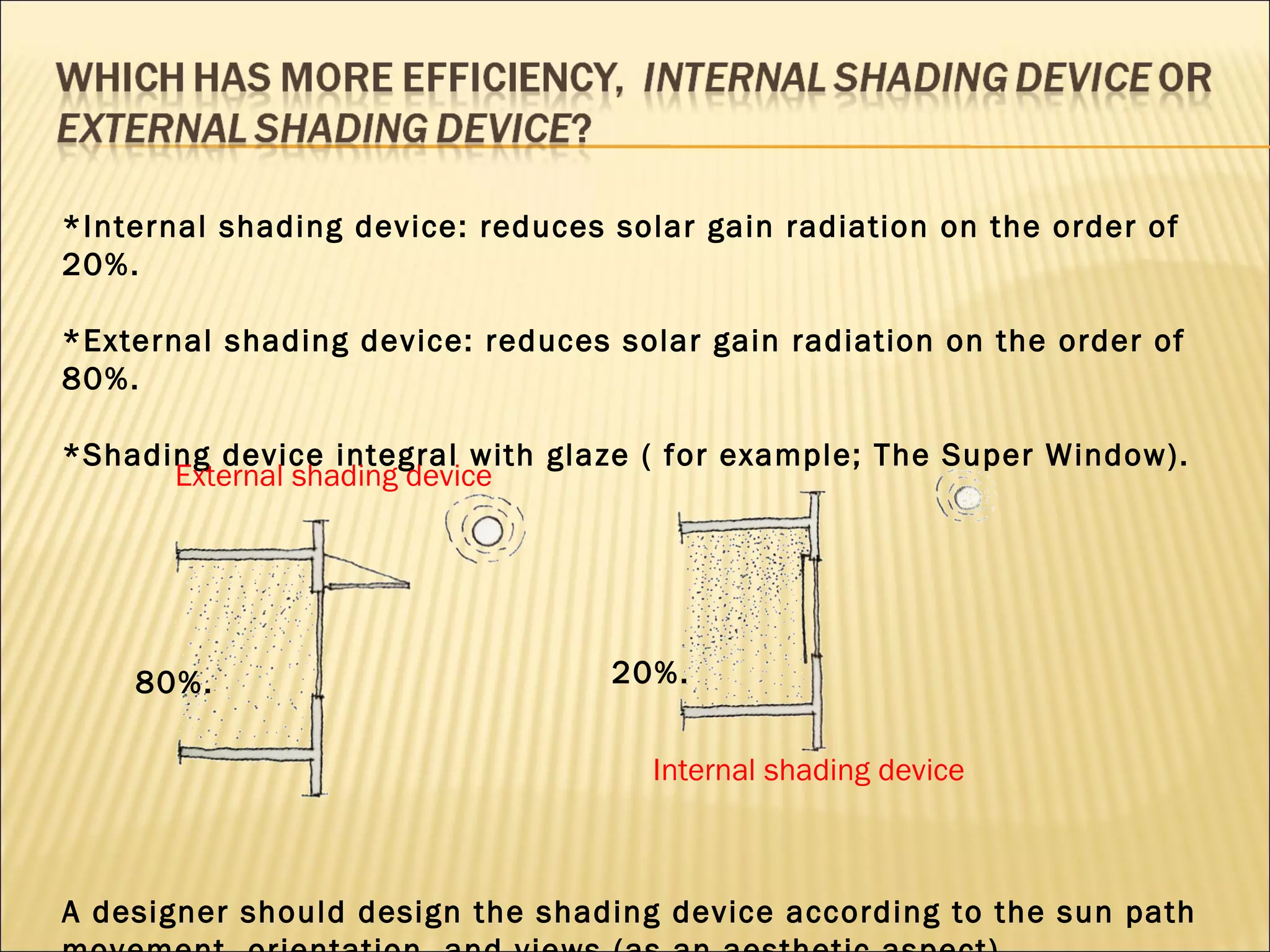
*Internal shading device: reduces solar gain radiation on the order of 20%.  *External shading device: reduces solar gain radiation on the order of 80%. *Shading device integral with glaze ( for example; The Super Window). A designer should design the shading device according to the sun path movement, orientation, and views (as an aesthetic aspect). External shading device Internal shading device 20%.  80%.
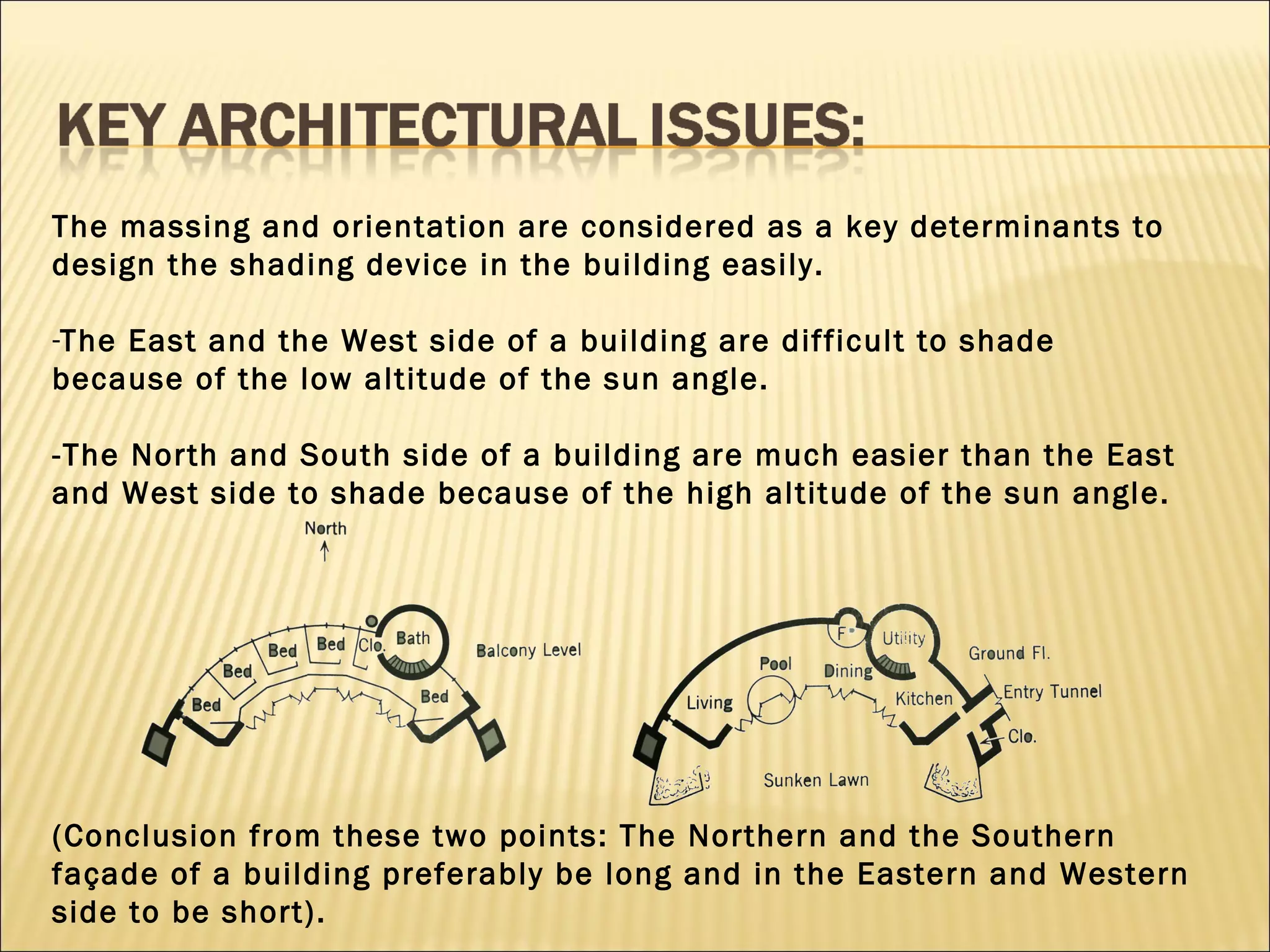
The massing and orientation are considered as a key determinants to design the shading device in the building easily.  The East and the West side of a building are difficult to shade because of the low altitude of the sun angle. -The North and South side of a building are much easier than the East and West side to shade because of the high altitude of the sun angle.  (Conclusion from these two points: The Northern and the Southern  façade of a building preferably be long and in the Eastern and Western side to be short).
 
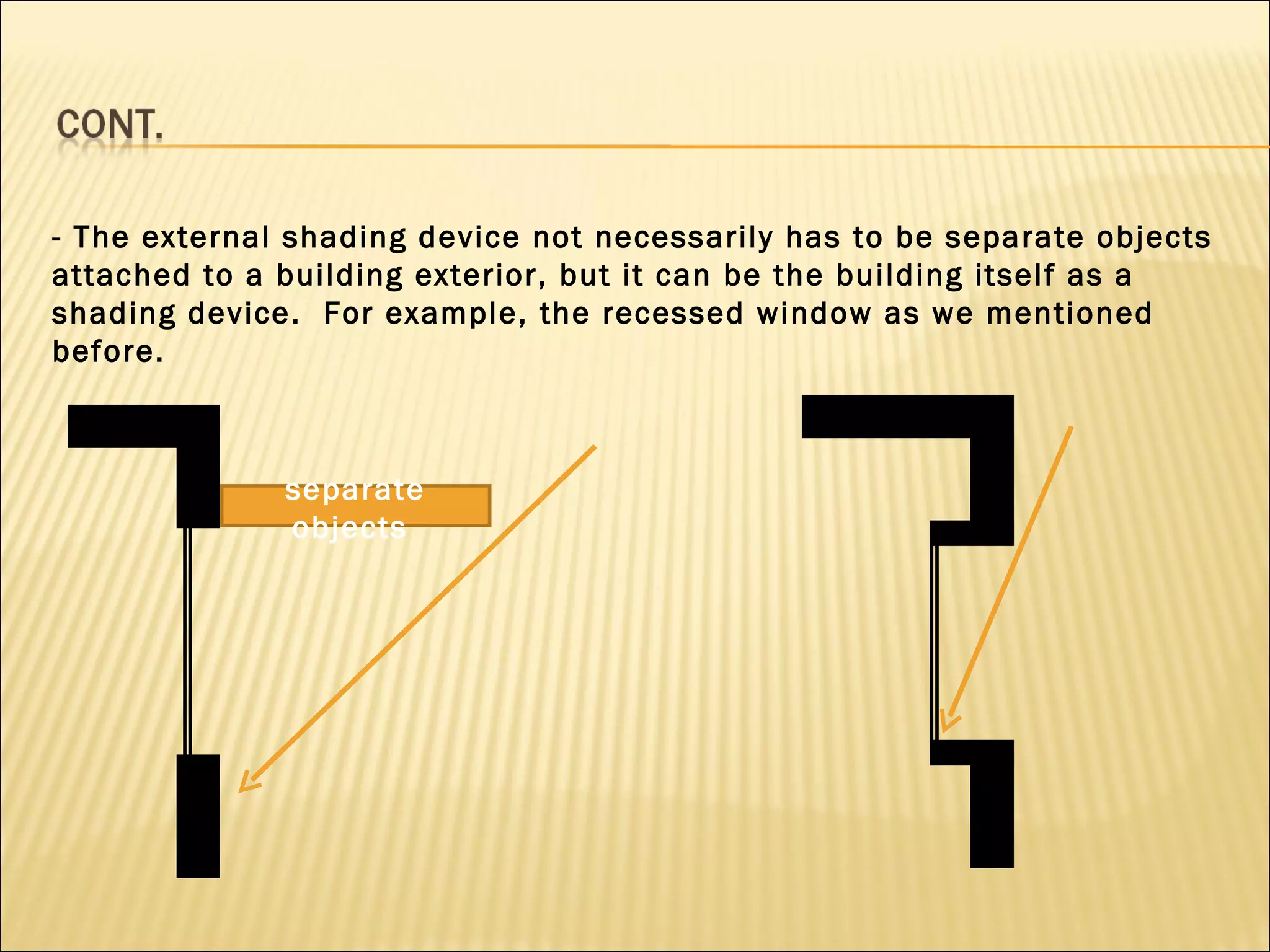
- The external shading device not necessarily has to be separate objects attached to a building exterior, but it can be the building itself as a shading device.  For example, the recessed window as we mentioned before. separate objects
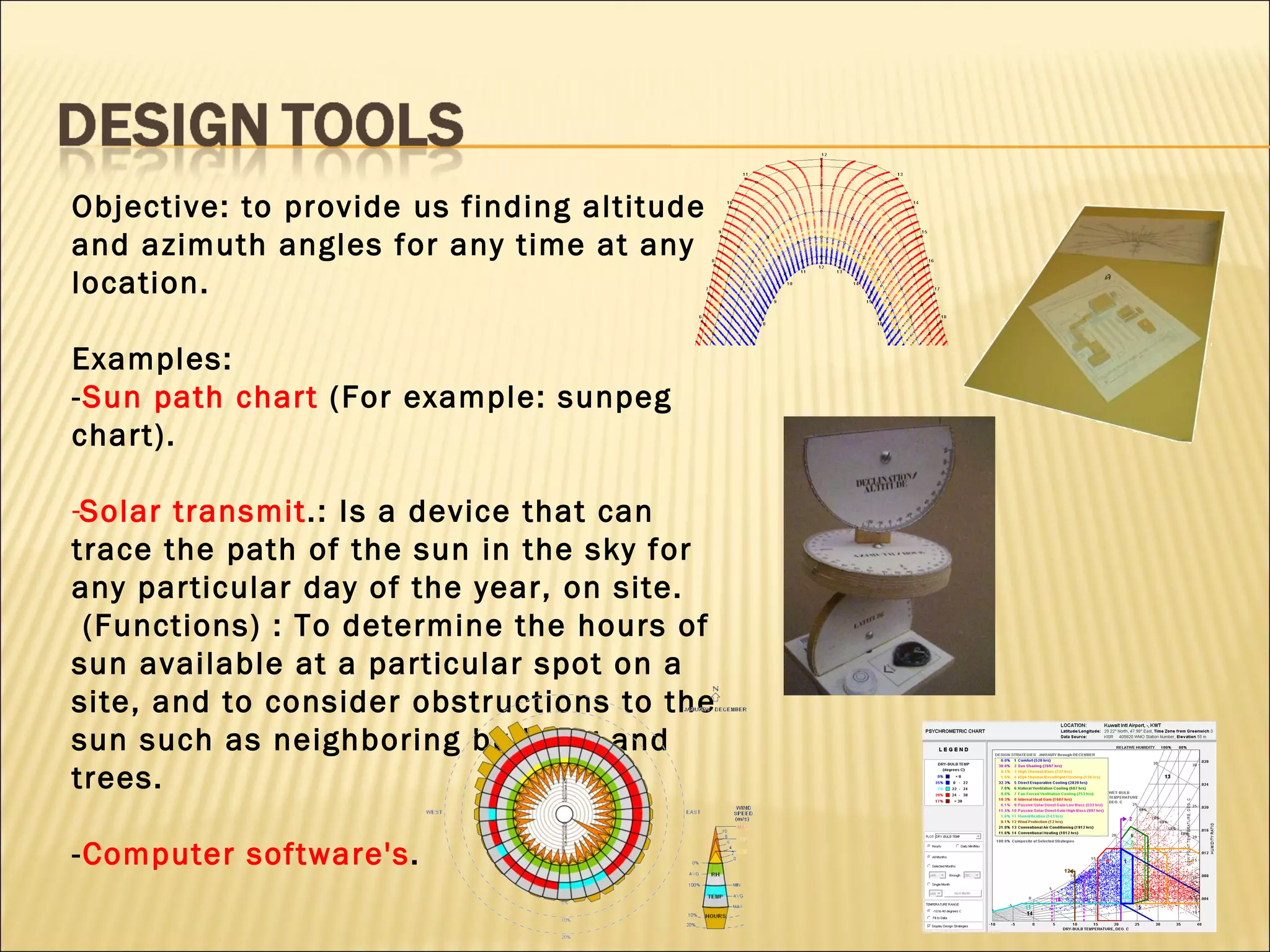
Objective: to provide us finding altitude and azimuth angles for any time at any location. Examples: - Sun path chart  (For example: sunpeg chart). Solar transmit .: Is a device that can trace the path of the sun in the sky for any particular day of the year, on site. (Functions) : To determine the hours of sun available at a particular spot on a site, and to consider obstructions to the sun such as neighboring building and trees. - Computer software's .
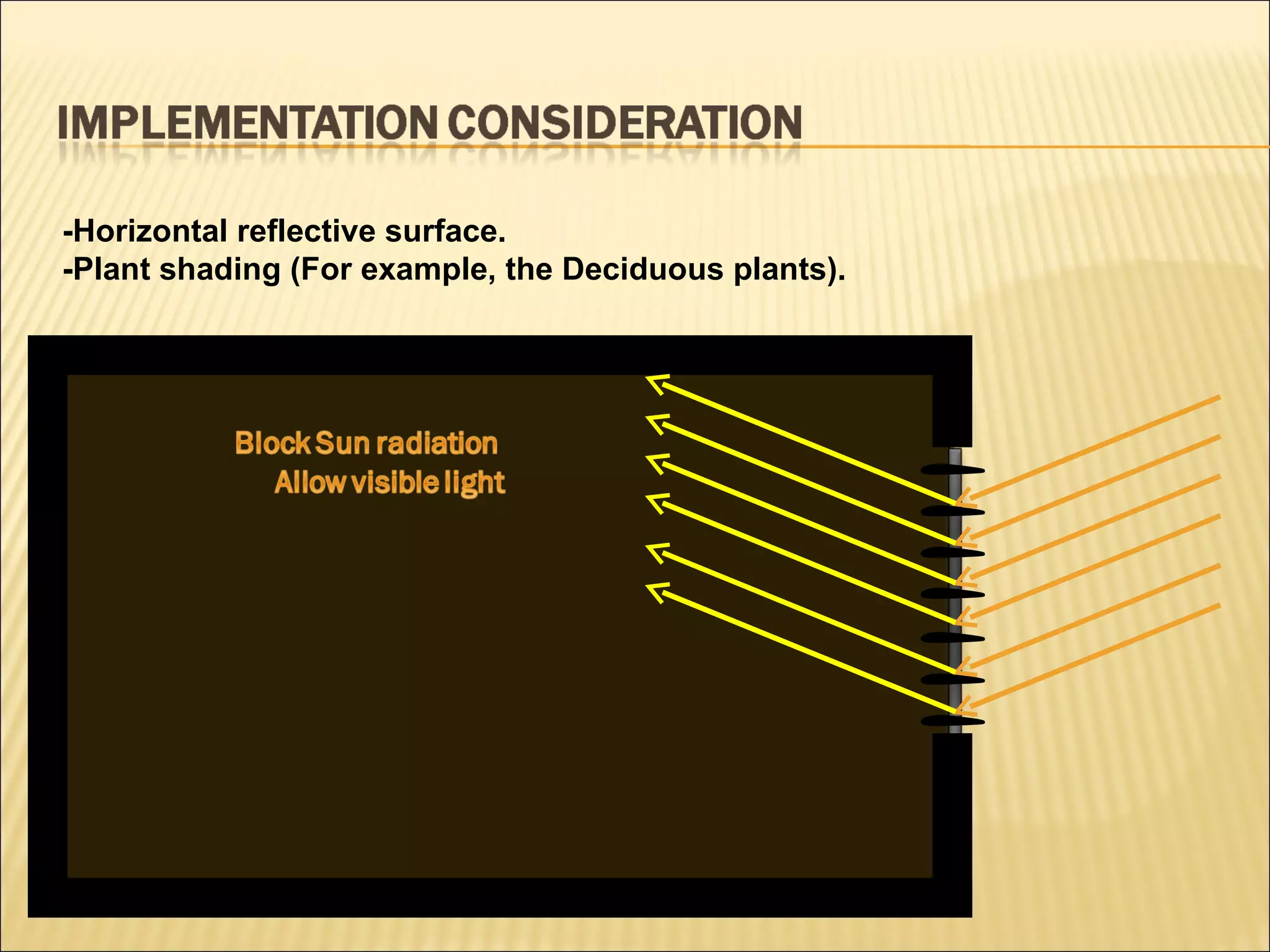
-Horizontal reflective surface.  -Plant shading (For example, the Deciduous plants).
1-Determine the shading  requirements; which are building and space that are dependent upon climate, building envelope, function, visual and thermal comfort expectation. 2-Determine the situation of the shading device whether it's exterior, integral with glass, or interior. 3-design development of the shading device. 4-Chech the performance of the proposed shading device ( testing ). 5-Modifying the shading device (adjustments).
 

GreenStudio - Chapter 4 2 7 Shading Devices

  • 1.
  • 2.
    -Shading device: it'sa tool that reduces building heat gains from solar radiation, reduces glare, and at the same time, it allows the day lighting and the natural ventilation to come inside the building.
  • 3.
    There are sortsof shading device: Fixed shading device: can be external or internal . External shading device Internal shading device
  • 4.
    2) Movable shadingdevice: The adjustable movable shading device such as (Louvers) can be moved to admit light or to block it depending upon time of day and orientation.
  • 5.
    3) Plant shadingsuch as; Deciduous plants.
  • 6.
    Other type ofshading device The recessed window, and also the opaque envelope (building skin) of the building itself . recessed window Building Envelope
  • 7.
    Heat is transferredby three different ways: -Radiation. -Conduction. -Convection. Radiation: It's an energy form that doesn't require a material medium through which to travel. Types of solar radiation: -Visible light. – Ultraviolet. – Infrared radiation components.
  • 8.
    The reflected, absorbed,and transmitted solar radiation through glass façade.
  • 9.
    Solar Heat GainCoefficient (SHGC): The percentage of solar radiation that passes through a window and into a building depends upon the properties of the glass and the window assembly. SHGC=1 --this is means that 100% of incident solar radiation passes through a window or a sky light. SHGC=0 --this means that no of incident solar radiation passes through a window or a sky light. Theoretically, the range of SHGC is between ( 0 – 1 ) In fact( for real products), the range is between ( 0.2 – 0.9 ) Shading Coefficient (SC): the ratio of radiant heat flow through a particular window relative to the radiant heat flow through a specific thickness(3.2 mm), double strength, and clear window glass. SC: Only applies to the glazed portion of a window or sky light. SHGC: Applies to the glazing-frame combination. 0.2 0.9
  • 10.
    *Internal shading device:reduces solar gain radiation on the order of 20%. *External shading device: reduces solar gain radiation on the order of 80%. *Shading device integral with glaze ( for example; The Super Window). A designer should design the shading device according to the sun path movement, orientation, and views (as an aesthetic aspect). External shading device Internal shading device 20%. 80%.
  • 11.
    The massing andorientation are considered as a key determinants to design the shading device in the building easily. The East and the West side of a building are difficult to shade because of the low altitude of the sun angle. -The North and South side of a building are much easier than the East and West side to shade because of the high altitude of the sun angle. (Conclusion from these two points: The Northern and the Southern façade of a building preferably be long and in the Eastern and Western side to be short).
  • 12.
  • 13.
    - The externalshading device not necessarily has to be separate objects attached to a building exterior, but it can be the building itself as a shading device. For example, the recessed window as we mentioned before. separate objects
  • 14.
    Objective: to provideus finding altitude and azimuth angles for any time at any location. Examples: - Sun path chart (For example: sunpeg chart). Solar transmit .: Is a device that can trace the path of the sun in the sky for any particular day of the year, on site. (Functions) : To determine the hours of sun available at a particular spot on a site, and to consider obstructions to the sun such as neighboring building and trees. - Computer software's .
  • 15.
    -Horizontal reflective surface. -Plant shading (For example, the Deciduous plants).
  • 16.
    1-Determine the shading requirements; which are building and space that are dependent upon climate, building envelope, function, visual and thermal comfort expectation. 2-Determine the situation of the shading device whether it's exterior, integral with glass, or interior. 3-design development of the shading device. 4-Chech the performance of the proposed shading device ( testing ). 5-Modifying the shading device (adjustments).
  • 17.