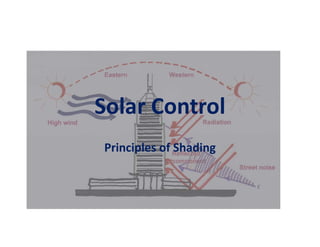
Solar ControlSolar Control 
Principles of Shading 
InsolationInsolation
– The total Solar radiation/ Solar force/ 
– Components: 
• Direct radiation from the sun 
Diff d di ti f th k ( t h )• Diffused radiation from the sky (atmosphere)
• Reflected radiation from the ground & nearby 
buildings.g
– The intensity of Insolation depends on
• The atmosphere and solar altitude (angle in degree)
• Trees/Vegetation
• Nature of the ground near the reference point 
( fl ti )(reflective )
Paths of solar force (Insolation)Paths of solar force (Insolation)
• Through structure (materials)
– Indirect transmission (emission)
• Through glasses 
– Direct transmission and emission (needs much 
protection)
– green house effectgreen house effect
Solar ControlSolar Control
• Protecting the solar force away from building 
surfacesurface 
[Protecting solar force during   overheated 
i d/ i h f ]period/ in the afternoon]
• Admitting it during under‐heated period / 
morning
Methods in solar controlMethods in solar control
• ShadingShading
– Shading external walls of buildings
– Shading glazed partsShading glazed parts
– Shading outdoor spaces 
Ways of Achieving ShadingWays of Achieving Shading
1. Proper orientation (using sun chart)p ( g )
2.    Trees/plants (types, distance)
3.   Design of building volumes or shapes (Typology: 
Zigzag, Court yard, protruding and recess forms)g g, y , p g )
4.   Design of screens and shading devices (sun‐
breakers overhangs)breakers, overhangs) 
Sun Control requires:Sun Control requires:
• Understanding the dynamic and seasonalUnderstanding the dynamic and seasonal 
pattern of sunlight and shadow for the 
purpose of annual shading
• Checking sun light penetration andChecking sun light penetration and 
effectiveness of required sun controls using 
graphic projections (sun path diagrams or sun 
shadow chart)
Knowing how exactly the sun strikes a building helps 
t i l l l tto precisely calculate:
– Proper orientation of a buildingProper orientation of a building 
– Orientation, size and shape of individual windows
– The length of the effective overhang of a sun shadeThe length of the effective overhang of a sun shade 
(horizontal)
– Depth of a fin (vertical shading elements)Depth of a fin (vertical shading elements) 
– Angle of a solar collector
– The placement of treesThe placement of trees
– The placement of a court yard 
– The length of the shadows cast by near by buildingsThe length of the shadows cast by near by buildings
Locating Sun’s Position and Angle of Radiationg g
Knowing the sun’s position for any time of the dayKnowing the sun s position for any time of the day 
and any day of the year, to determine:
fThe over heated period of the year
The under heated period and 
The over heated hours of the day
Th d h t d h f th dThe under heated hours of the day
Astronomer’s concept about earth‐sun 
l i hirelationship
O th t t /24 h it i• Our earth rotates once/24 hours on its axis
• Our earth revolves once/year around the sunOur earth revolves once/year around the sun
• The earth’s axis of rotation is not 
di lperpendicular
• As the earth orbits the sun, its axis always 
remains tipped in the same direction
Designer’s ConceptDesigner s Concept 
• Unlike astronomers designers think that theUnlike astronomers, designers think that the 
sun moves about a fixed earth‐
Apparent sun motion
Change in seasons:Change in seasons:
• Equinox: Here the sun stands directly over the q y
equator, days and nights are exactly twelve hours 
long
• Summer solstice: When the earth’s axis tipped 
toward the sun (the sun is high in the sky)toward the sun (the sun is high in the sky)
• Winter Solstice: When the earth’s axis leans awayWinter Solstice: When the earth s axis leans away 
from the sun (the sun daily path lowers and stops)
The term Solstice literally means the place where the 
sun stands still. (Solar noon)
Dec Jan Feb Mar Apr May June
OVERHEA
D IN
ADDIS
WINTER
Dec Jan Feb Mar Apr May June
Dec Nov Oct Sep Aug July June
WINTER
SOLISTIC
E
EQUINO
X
SUMER
SOLISTIC
E
SUN’S POSITIONSUN S POSITION
• It is possible to locate sun’s position for everyIt is possible to locate sun s position for every 
time of the day and every month of the year 
using the following two angles:using the following two angles:
A = angle of altitude above the horizonA = angle of altitude above the horizon 
B angle of bearing from the southB = angle of bearing from the south
Sun charts (solar charts)Sun charts (solar charts)
• Altitude (A) and Bearing (B) angles for everyAltitude (A) and Bearing (B) angles for every 
time of a day and every month of a year
• Daily path of the sun for every month(21st) 
• Also called sun‐path diagrams
• For a given latitude
‘Solar noon’ in solar chart:Solar noon in solar chart:
• It is where the sun is exactly due south orIt is where the sun is exactly due south or 
north. In this position it is easier to compute 
the sun’s altitude The upper and lower curvesthe sun s altitude. The upper and lower curves 
in solar chart show Sun path (cone of 
revolution) at “solar noon”revolution) at  solar noon .
Shadow ChartShadow Chart 
A “Flag pole” Shadow paths taken at “solarA  Flag pole  Shadow paths taken at  solar 
noon” will give the same cone of revolution 
but reversed for the sun position at the southbut reversed, for the sun position at the south 
we will have shadow of “Flag Pole” at the 
northnorth.
Orientation of buildings for shadingOrientation of buildings for shading
Optimum orientation gives:
• Maximum radiation (under heated period) 
• Reduced radiation (overheated period)
Orientation…Orientation…
– East and west ‐‐‐least advantageousEast and west  least advantageous
– South‐east and south‐west ‐‐‐reasonably 
satisfactory
– South‐‐‐ the most advantageous
• Warming (winter)
• Cooling (summer)
h h– North‐South
Building typology for shadingBuilding typology for shading
• zigzag forms recessed verandaszigzag forms, recessed verandas  
• Courtyards: 
Shaded outdoor space for hot areasShaded outdoor space for hot areas,
patios with pool (trees, plants and water in  the enclosed 
space will cool the air by  evaporation)p y p )
• Inward‐ looking house – smaller or few  openings, 
Solid forms 
• Protruding forms 
Shading DevicesShading Devices 
• Overhangs 
i l fi / b k• Vertical fins /sun breakers
• Sun‐breakers 
– The most efficient
– Have got visual effects 
– Various types
Sun‐breakersSun breakers
• Fixed sun breakers horizontal/vertical/ eggFixed sun breakers horizontal/vertical/ egg 
crate  
• Movable (shutter) 
• Adjustable exterior lovers (metal/plastics)
• Curtain, Venetian blinds,
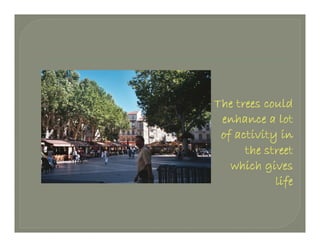
Trees for shadingTrees for shading
• Their type and distance
id• Deciduous trees 
• Maximum shade during summer (hot) 
D i h i l h i i l i i• Dropping their leaves when maximum insolation is 
needed‐ during cold winter months
It i thIt i thIt is theIt is the
utilityutilityyy
polespoles
whichwhichwhichwhich
givesgives
charactercharacter
to mostto mosto oo o
streetsstreets
P lP lPeople arePeople are
waitingwaiting
for busfor bus
in thein the
hot sunhot sun
with nowith nowith nowith no
shadeshade
Shading requirement at Urban design 
l llevel
• designing buildings to shade each other (compact 
morphology) 
• north – south residential streets are mostly shaded  if 
they are designed narrow and defined by storied 
buildingsbuildings.
• Urban trees and plants have big importance for 
shading, cooling and aesthetic value.shading, cooling and aesthetic value.
solar control

solar control

  • 1.
  • 2.
    InsolationInsolation – The total Solar radiation/ Solar force/  – Components:  •Direct radiation from the sun  Diff d di ti f th k ( t h )• Diffused radiation from the sky (atmosphere) • Reflected radiation from the ground & nearby  buildings.g – The intensity of Insolation depends on • The atmosphere and solar altitude (angle in degree) • Trees/Vegetation • Nature of the ground near the reference point  ( fl ti )(reflective )
  • 3.
    Paths of solarforce (Insolation)Paths of solar force (Insolation) • Through structure (materials) – Indirect transmission (emission) • Through glasses  – Direct transmission and emission (needs much  protection) – green house effectgreen house effect
  • 4.
  • 5.
    Methods in solarcontrolMethods in solar control • ShadingShading – Shading external walls of buildings – Shading glazed partsShading glazed parts – Shading outdoor spaces 
  • 6.
    Ways of AchievingShadingWays of Achieving Shading 1. Proper orientation (using sun chart)p ( g ) 2.    Trees/plants (types, distance) 3.   Design of building volumes or shapes (Typology:  Zigzag, Court yard, protruding and recess forms)g g, y , p g ) 4.   Design of screens and shading devices (sun‐ breakers overhangs)breakers, overhangs) 
  • 7.
    Sun Control requires:Sun Control requires: •Understanding the dynamic and seasonalUnderstanding the dynamic and seasonal  pattern of sunlight and shadow for the  purpose of annual shading • Checking sun light penetration andChecking sun light penetration and  effectiveness of required sun controls using  graphic projections (sun path diagrams or sun  shadow chart)
  • 8.
    Knowing how exactly the sun strikes a building helps  t i ll l tto precisely calculate: – Proper orientation of a buildingProper orientation of a building  – Orientation, size and shape of individual windows – The length of the effective overhang of a sun shadeThe length of the effective overhang of a sun shade  (horizontal) – Depth of a fin (vertical shading elements)Depth of a fin (vertical shading elements)  – Angle of a solar collector – The placement of treesThe placement of trees – The placement of a court yard  – The length of the shadows cast by near by buildingsThe length of the shadows cast by near by buildings
  • 9.
    Locating Sun’s Position and Angle of Radiationg g Knowing thesun’s position for any time of the dayKnowing the sun s position for any time of the day  and any day of the year, to determine: fThe over heated period of the year The under heated period and  The over heated hours of the day Th d h t d h f th dThe under heated hours of the day
  • 10.
    Astronomer’s concept about earth‐sun  l i hirelationship Oth t t /24 h it i• Our earth rotates once/24 hours on its axis • Our earth revolves once/year around the sunOur earth revolves once/year around the sun • The earth’s axis of rotation is not  di lperpendicular • As the earth orbits the sun, its axis always  remains tipped in the same direction
  • 14.
    Designer’s ConceptDesigner s Concept  •Unlike astronomers designers think that theUnlike astronomers, designers think that the  sun moves about a fixed earth‐ Apparent sun motion
  • 15.
    Change in seasons:Change in seasons: •Equinox: Here the sun stands directly over the q y equator, days and nights are exactly twelve hours  long • Summer solstice: When the earth’s axis tipped  toward the sun (the sun is high in the sky)toward the sun (the sun is high in the sky) • Winter Solstice: When the earth’s axis leans awayWinter Solstice: When the earth s axis leans away  from the sun (the sun daily path lowers and stops)
  • 16.
    The term Solstice literally means the place where the  sun stands still. (Solar noon) Dec JanFeb Mar Apr May June OVERHEA D IN ADDIS WINTER Dec Jan Feb Mar Apr May June Dec Nov Oct Sep Aug July June WINTER SOLISTIC E EQUINO X SUMER SOLISTIC E
  • 17.
    SUN’S POSITIONSUN S POSITION •It is possible to locate sun’s position for everyIt is possible to locate sun s position for every  time of the day and every month of the year  using the following two angles:using the following two angles: A = angle of altitude above the horizonA = angle of altitude above the horizon  B angle of bearing from the southB = angle of bearing from the south
  • 18.
    Sun charts (solarcharts)Sun charts (solar charts) • Altitude (A) and Bearing (B) angles for everyAltitude (A) and Bearing (B) angles for every  time of a day and every month of a year • Daily path of the sun for every month(21st)  • Also called sun‐path diagrams • For a given latitude
  • 20.
    ‘Solar noon’ insolar chart:Solar noon in solar chart: • It is where the sun is exactly due south orIt is where the sun is exactly due south or  north. In this position it is easier to compute  the sun’s altitude The upper and lower curvesthe sun s altitude. The upper and lower curves  in solar chart show Sun path (cone of  revolution) at “solar noon”revolution) at  solar noon .
  • 21.
    Shadow ChartShadow Chart  A “Flagpole” Shadow paths taken at “solarA  Flag pole  Shadow paths taken at  solar  noon” will give the same cone of revolution  but reversed for the sun position at the southbut reversed, for the sun position at the south  we will have shadow of “Flag Pole” at the  northnorth.
  • 22.
    Orientation of buildingsfor shadingOrientation of buildings for shading Optimum orientation gives: • Maximum radiation (under heated period)  • Reduced radiation (overheated period)
  • 23.
    Orientation…Orientation… – East andwest ‐‐‐least advantageousEast and west  least advantageous – South‐east and south‐west ‐‐‐reasonably  satisfactory – South‐‐‐ the most advantageous • Warming (winter) • Cooling (summer) h h– North‐South
  • 24.
    Building typology forshadingBuilding typology for shading • zigzag forms recessed verandaszigzag forms, recessed verandas   • Courtyards:  Shaded outdoor space for hot areasShaded outdoor space for hot areas, patios with pool (trees, plants and water in  the enclosed  space will cool the air by  evaporation)p y p ) • Inward‐ looking house – smaller or few  openings,  Solid forms  • Protruding forms 
  • 26.
    Shading DevicesShading Devices  • Overhangs  il fi / b k• Vertical fins /sun breakers • Sun‐breakers  – The most efficient – Have got visual effects  – Various types
  • 27.
    Sun‐breakersSun breakers • Fixedsun breakers horizontal/vertical/ eggFixed sun breakers horizontal/vertical/ egg  crate   • Movable (shutter)  • Adjustable exterior lovers (metal/plastics) • Curtain, Venetian blinds,
  • 33.
    Trees for shadingTrees for shading •Their type and distance id• Deciduous trees  • Maximum shade during summer (hot)  D i h i l h i i l i i• Dropping their leaves when maximum insolation is  needed‐ during cold winter months
  • 36.
    It i thIti thIt is theIt is the utilityutilityyy polespoles whichwhichwhichwhich givesgives charactercharacter to mostto mosto oo o streetsstreets
  • 37.
    P lP lPeoplearePeople are waitingwaiting for busfor bus in thein the hot sunhot sun with nowith nowith nowith no shadeshade
  • 41.
    Shading requirement at Urban design  l llevel • designing buildings to shade each other (compact  morphology)  •north – south residential streets are mostly shaded  if  they are designed narrow and defined by storied  buildingsbuildings. • Urban trees and plants have big importance for  shading, cooling and aesthetic value.shading, cooling and aesthetic value.