HUMAN COMFORT DESIGN
GUIDELINES Prepared by
FAIZAN
AND
NEHA
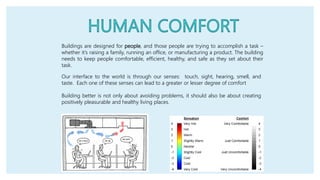
Buildings are designed for people, and those people are trying to accomplish a task –
whether it’s raising a family, running an office, or manufacturing a product. The building
needs to keep people comfortable, efficient, healthy, and safe as they set about their
task.
Our interface to the world is through our senses: touch, sight, hearing, smell, and
taste. Each one of these senses can lead to a greater or lesser degree of comfort
Building better is not only about avoiding problems, it should also be about creating
positively pleasurable and healthy living places.
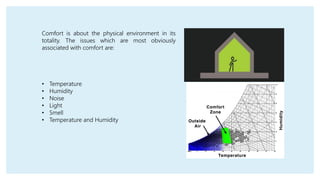
Comfort is about the physical environment in its
totality. The issues which are most obviously
associated with comfort are:
• Temperature
• Humidity
• Noise
• Light
• Smell
• Temperature and Humidity
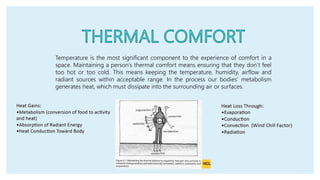
Temperature is the most significant component to the experience of comfort in a
space. Maintaining a person’s thermal comfort means ensuring that they don’t feel
too hot or too cold. This means keeping the temperature, humidity, airflow and
radiant sources within acceptable range. In the process our bodies’ metabolism
generates heat, which must dissipate into the surrounding air or surfaces.
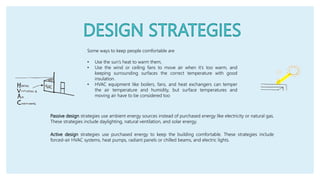
Passive design strategies use ambient energy sources instead of purchased energy like electricity or natural gas.
These strategies include daylighting, natural ventilation, and solar energy.
Some ways to keep people comfortable are
• Use the sun’s heat to warm them,
• Use the wind or ceiling fans to move air when it’s too warm, and
keeping surrounding surfaces the correct temperature with good
insulation.
• HVAC equipment like boilers, fans, and heat exchangers can temper
the air temperature and humidity, but surface temperatures and
moving air have to be considered too
Active design strategies use purchased energy to keep the building comfortable. These strategies include
forced-air HVAC systems, heat pumps, radiant panels or chilled beams, and electric lights.
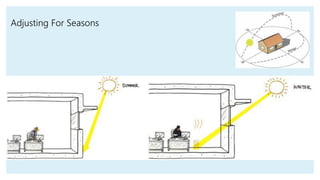
Adjusting For Seasons
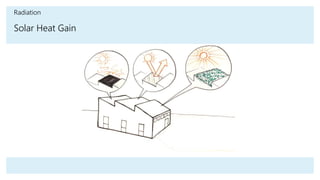
Solar Heat Gain
Radiation
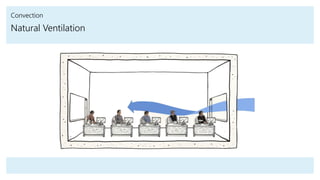
Convection
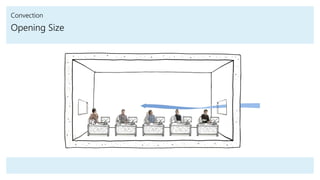
Natural Ventilation
Convection
Opening Size
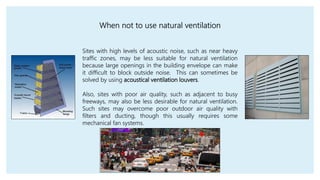
Sites with high levels of acoustic noise, such as near heavy
traffic zones, may be less suitable for natural ventilation
because large openings in the building envelope can make
it difficult to block outside noise. This can sometimes be
solved by using acoustical ventilation louvers.
Also, sites with poor air quality, such as adjacent to busy
freeways, may also be less desirable for natural ventilation.
Such sites may overcome poor outdoor air quality with
filters and ducting, though this usually requires some
mechanical fan systems.
When not to use natural ventilation
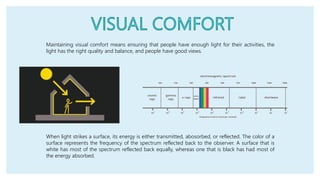
Maintaining visual comfort means ensuring that people have enough light for their activities, the
light has the right quality and balance, and people have good views.
When light strikes a surface, its energy is either transmitted, abosorbed, or reflected. The color of a
surface represents the frequency of the spectrum reflected back to the observer. A surface that is
white has most of the spectrum reflected back equally, whereas one that is black has had most of
the energy absorbed.
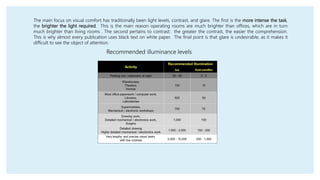
Recommended illuminance levels
The main focus on visual comfort has traditionally been light levels, contrast, and glare. The first is the more intense the task,
the brighter the light required. This is the main reason operating rooms are much brighter than offices, which are in turn
much brighter than living rooms . The second pertains to contrast: the greater the contrast, the easier the comprehension.
This is why almost every publication uses black text on white paper. The final point is that glare is undesirable, as it makes it
difficult to see the object of attention.
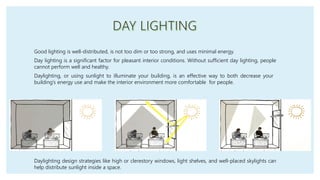
Good lighting is well-distributed, is not too dim or too strong, and uses minimal energy.
Day lighting is a significant factor for pleasant interior conditions. Without sufficient day lighting, people
cannot perform well and healthy.
Daylighting, or using sunlight to illuminate your building, is an effective way to both decrease your
building’s energy use and make the interior environment more comfortable for people.
Daylighting design strategies like high or clerestory windows, light shelves, and well-placed skylights can
help distribute sunlight inside a space.
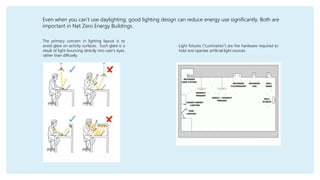
Even when you can’t use daylighting, good lighting design can reduce energy use significantly. Both are
important in Net Zero Energy Buildings.
Light fixtures ("Luminaires") are the hardware required to
hold and operate artificial light sources
The primary concern in lighting layout is to
avoid glare on activity surfaces. Such glare is a
result of light bouncing directly into user's eyes,
rather than diffusely.
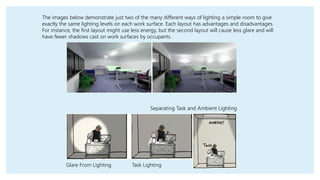
The images below demonstrate just two of the many different ways of lighting a simple room to give
exactly the same lighting levels on each work surface. Each layout has advantages and disadvantages.
For instance, the first layout might use less energy, but the second layout will cause less glare and will
have fewer shadows cast on work surfaces by occupants.
Glare From Lighting Task Lighting
Separating Task and Ambient Lighting
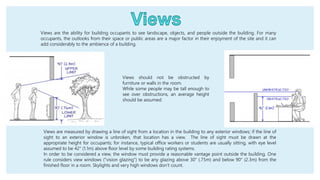
Views are the ability for building occupants to see landscape, objects, and people outside the building. For many
occupants, the outlooks from their space or public areas are a major factor in their enjoyment of the site and it can
add considerably to the ambience of a building.
Views are measured by drawing a line of sight from a location in the building to any exterior windows; if the line of
sight to an exterior window is unbroken, that location has a view. The line of sight must be drawn at the
appropriate height for occupants; for instance, typical office workers or students are usually sitting, with eye level
assumed to be 42" (1.1m) above floor level by some building rating systems.
In order to be considered a view, the window must provide a reasonable vantage point outside the building. One
rule considers view windows ("vision glazing") to be any glazing above 30" (.75m) and below 90" (2.3m) from the
finished floor in a room. Skylights and very high windows don’t count.
Views should not be obstructed by
furniture or walls in the room.
While some people may be tall enough to
see over obstructions, an average height
should be assumed.
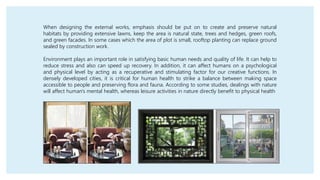
When designing the external works, emphasis should be put on to create and preserve natural
habitats by providing extensive lawns, keep the area is natural state, trees and hedges, green roofs,
and green facades. In some cases which the area of plot is small, rooftop planting can replace ground
sealed by construction work.
Environment plays an important role in satisfying basic human needs and quality of life. It can help to
reduce stress and also can speed up recovery. In addition, it can affect humans on a psychological
and physical level by acting as a recuperative and stimulating factor for our creative functions. In
densely developed cities, it is critical for human health to strike a balance between making space
accessible to people and preserving flora and fauna. According to some studies, dealings with nature
will affect human's mental health, whereas leisure activities in nature directly benefit to physical health
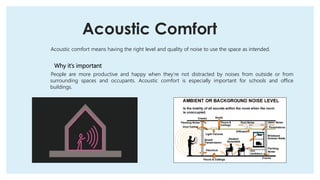
Acoustic Comfort
Acoustic comfort means having the right level and quality of noise to use the space as intended.
Why it’s important
People are more productive and happy when they’re not distracted by noises from outside or from
surrounding spaces and occupants. Acoustic comfort is especially important for schools and office
buildings.
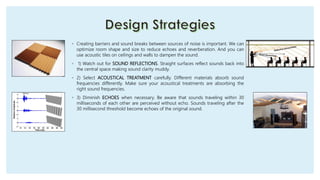
◦ Creating barriers and sound breaks between sources of noise is important. We can
optimize room shape and size to reduce echoes and reverberation. And you can
use acoustic tiles on ceilings and walls to dampen the sound.
◦ 1) Watch out for SOUND REFLECTIONS. Straight surfaces reflect sounds back into
the central space making sound clarity muddy.
◦ 2) Select ACOUSTICAL TREATMENT carefully. Different materials absorb sound
frequencies differently. Make sure your acoustical treatments are absorbing the
right sound frequencies.
◦ 3) Diminish ECHOES when necessary. Be aware that sounds traveling within 30
milliseconds of each other are perceived without echo. Sounds traveling after the
30 millisecond threshold become echoes of the original sound.
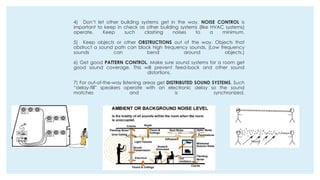
4) Don’t let other building systems get in the way. NOISE CONTROL is
important to keep in check as other building systems (like HVAC systems)
operate. Keep such clashing noises to a minimum.
5) Keep objects or other OBSTRUCTIONS out of the way. Objects that
obstruct a sound path can block high frequency sounds. (Low frequency
sounds can bend around objects.)
6) Get good PATTERN CONTROL. Make sure sound systems for a room get
good sound coverage. This will prevent feed-back and other sound
distortions.
7) For out-of-the-way listening areas get DISTRIBUTED SOUND SYSTEMS. Such
“delay-fill” speakers operate with an electronic delay so the sound
matches and is synchronized.
The presence of smell can deeply affect our experiences in one
location or another. The smell of flowers and grasses, dust,
exhaust ,baked goods, bleach, each suggests a particular setting
and perhaps even specific memories of places and events.
. Ventilation and infiltration are only part of the acceptable
indoor air quality and thermal comfort problem
. A large number of pollutants come a time in the air with
tobacco smoke. This affects the eyes, the nose and it is a risk
factor for different diseases. Reduce air pollution by tobacco
smoke can not be done only by increasing the air exchange
rate.
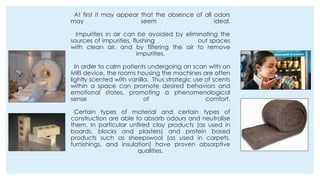
At first it may appear that the absence of all odors
may seem ideal.
Impurities in air can be avoided by eliminating the
sources of impurities, flushing out spaces
with clean air, and by filtering the air to remove
impurities.
In order to calm patients undergoing an scan with an
MRI device, the rooms housing the machines are often
lightly scented with vanilla. Thus strategic use of scents
within a space can promote desired behaviors and
emotional states, promoting a phenomenological
sense of comfort.
Certain types of material and certain types of
construction are able to absorb odours and neutralise
them. In particular unfired clay products (as used in
boards, blocks and plasters) and protein based
products such as sheepswool (as used in carpets,
furnishings, and insulation) have proven absorptive
qualities.
HUMAN COMFORT - BULDING SERVICES

HUMAN COMFORT - BULDING SERVICES

  • 1.
    HUMAN COMFORT DESIGN GUIDELINESPrepared by FAIZAN AND NEHA
  • 2.
    Buildings are designedfor people, and those people are trying to accomplish a task – whether it’s raising a family, running an office, or manufacturing a product. The building needs to keep people comfortable, efficient, healthy, and safe as they set about their task. Our interface to the world is through our senses: touch, sight, hearing, smell, and taste. Each one of these senses can lead to a greater or lesser degree of comfort Building better is not only about avoiding problems, it should also be about creating positively pleasurable and healthy living places.
  • 3.
    Comfort is aboutthe physical environment in its totality. The issues which are most obviously associated with comfort are: • Temperature • Humidity • Noise • Light • Smell • Temperature and Humidity
  • 4.
    Temperature is themost significant component to the experience of comfort in a space. Maintaining a person’s thermal comfort means ensuring that they don’t feel too hot or too cold. This means keeping the temperature, humidity, airflow and radiant sources within acceptable range. In the process our bodies’ metabolism generates heat, which must dissipate into the surrounding air or surfaces.
  • 5.
    Passive design strategiesuse ambient energy sources instead of purchased energy like electricity or natural gas. These strategies include daylighting, natural ventilation, and solar energy. Some ways to keep people comfortable are • Use the sun’s heat to warm them, • Use the wind or ceiling fans to move air when it’s too warm, and keeping surrounding surfaces the correct temperature with good insulation. • HVAC equipment like boilers, fans, and heat exchangers can temper the air temperature and humidity, but surface temperatures and moving air have to be considered too Active design strategies use purchased energy to keep the building comfortable. These strategies include forced-air HVAC systems, heat pumps, radiant panels or chilled beams, and electric lights.
  • 6.
  • 7.
  • 8.
  • 9.
  • 10.
    Sites with highlevels of acoustic noise, such as near heavy traffic zones, may be less suitable for natural ventilation because large openings in the building envelope can make it difficult to block outside noise. This can sometimes be solved by using acoustical ventilation louvers. Also, sites with poor air quality, such as adjacent to busy freeways, may also be less desirable for natural ventilation. Such sites may overcome poor outdoor air quality with filters and ducting, though this usually requires some mechanical fan systems. When not to use natural ventilation
  • 11.
    Maintaining visual comfortmeans ensuring that people have enough light for their activities, the light has the right quality and balance, and people have good views. When light strikes a surface, its energy is either transmitted, abosorbed, or reflected. The color of a surface represents the frequency of the spectrum reflected back to the observer. A surface that is white has most of the spectrum reflected back equally, whereas one that is black has had most of the energy absorbed.
  • 12.
    Recommended illuminance levels Themain focus on visual comfort has traditionally been light levels, contrast, and glare. The first is the more intense the task, the brighter the light required. This is the main reason operating rooms are much brighter than offices, which are in turn much brighter than living rooms . The second pertains to contrast: the greater the contrast, the easier the comprehension. This is why almost every publication uses black text on white paper. The final point is that glare is undesirable, as it makes it difficult to see the object of attention.
  • 13.
    Good lighting iswell-distributed, is not too dim or too strong, and uses minimal energy. Day lighting is a significant factor for pleasant interior conditions. Without sufficient day lighting, people cannot perform well and healthy. Daylighting, or using sunlight to illuminate your building, is an effective way to both decrease your building’s energy use and make the interior environment more comfortable for people. Daylighting design strategies like high or clerestory windows, light shelves, and well-placed skylights can help distribute sunlight inside a space.
  • 14.
    Even when youcan’t use daylighting, good lighting design can reduce energy use significantly. Both are important in Net Zero Energy Buildings. Light fixtures ("Luminaires") are the hardware required to hold and operate artificial light sources The primary concern in lighting layout is to avoid glare on activity surfaces. Such glare is a result of light bouncing directly into user's eyes, rather than diffusely.
  • 15.
    The images belowdemonstrate just two of the many different ways of lighting a simple room to give exactly the same lighting levels on each work surface. Each layout has advantages and disadvantages. For instance, the first layout might use less energy, but the second layout will cause less glare and will have fewer shadows cast on work surfaces by occupants. Glare From Lighting Task Lighting Separating Task and Ambient Lighting
  • 16.
    Views are theability for building occupants to see landscape, objects, and people outside the building. For many occupants, the outlooks from their space or public areas are a major factor in their enjoyment of the site and it can add considerably to the ambience of a building. Views are measured by drawing a line of sight from a location in the building to any exterior windows; if the line of sight to an exterior window is unbroken, that location has a view. The line of sight must be drawn at the appropriate height for occupants; for instance, typical office workers or students are usually sitting, with eye level assumed to be 42" (1.1m) above floor level by some building rating systems. In order to be considered a view, the window must provide a reasonable vantage point outside the building. One rule considers view windows ("vision glazing") to be any glazing above 30" (.75m) and below 90" (2.3m) from the finished floor in a room. Skylights and very high windows don’t count. Views should not be obstructed by furniture or walls in the room. While some people may be tall enough to see over obstructions, an average height should be assumed.
  • 17.
    When designing theexternal works, emphasis should be put on to create and preserve natural habitats by providing extensive lawns, keep the area is natural state, trees and hedges, green roofs, and green facades. In some cases which the area of plot is small, rooftop planting can replace ground sealed by construction work. Environment plays an important role in satisfying basic human needs and quality of life. It can help to reduce stress and also can speed up recovery. In addition, it can affect humans on a psychological and physical level by acting as a recuperative and stimulating factor for our creative functions. In densely developed cities, it is critical for human health to strike a balance between making space accessible to people and preserving flora and fauna. According to some studies, dealings with nature will affect human's mental health, whereas leisure activities in nature directly benefit to physical health
  • 18.
    Acoustic Comfort Acoustic comfortmeans having the right level and quality of noise to use the space as intended. Why it’s important People are more productive and happy when they’re not distracted by noises from outside or from surrounding spaces and occupants. Acoustic comfort is especially important for schools and office buildings.
  • 19.
    ◦ Creating barriersand sound breaks between sources of noise is important. We can optimize room shape and size to reduce echoes and reverberation. And you can use acoustic tiles on ceilings and walls to dampen the sound. ◦ 1) Watch out for SOUND REFLECTIONS. Straight surfaces reflect sounds back into the central space making sound clarity muddy. ◦ 2) Select ACOUSTICAL TREATMENT carefully. Different materials absorb sound frequencies differently. Make sure your acoustical treatments are absorbing the right sound frequencies. ◦ 3) Diminish ECHOES when necessary. Be aware that sounds traveling within 30 milliseconds of each other are perceived without echo. Sounds traveling after the 30 millisecond threshold become echoes of the original sound.
  • 20.
    4) Don’t letother building systems get in the way. NOISE CONTROL is important to keep in check as other building systems (like HVAC systems) operate. Keep such clashing noises to a minimum. 5) Keep objects or other OBSTRUCTIONS out of the way. Objects that obstruct a sound path can block high frequency sounds. (Low frequency sounds can bend around objects.) 6) Get good PATTERN CONTROL. Make sure sound systems for a room get good sound coverage. This will prevent feed-back and other sound distortions. 7) For out-of-the-way listening areas get DISTRIBUTED SOUND SYSTEMS. Such “delay-fill” speakers operate with an electronic delay so the sound matches and is synchronized.
  • 21.
    The presence ofsmell can deeply affect our experiences in one location or another. The smell of flowers and grasses, dust, exhaust ,baked goods, bleach, each suggests a particular setting and perhaps even specific memories of places and events. . Ventilation and infiltration are only part of the acceptable indoor air quality and thermal comfort problem . A large number of pollutants come a time in the air with tobacco smoke. This affects the eyes, the nose and it is a risk factor for different diseases. Reduce air pollution by tobacco smoke can not be done only by increasing the air exchange rate.
  • 22.
    At first itmay appear that the absence of all odors may seem ideal. Impurities in air can be avoided by eliminating the sources of impurities, flushing out spaces with clean air, and by filtering the air to remove impurities. In order to calm patients undergoing an scan with an MRI device, the rooms housing the machines are often lightly scented with vanilla. Thus strategic use of scents within a space can promote desired behaviors and emotional states, promoting a phenomenological sense of comfort. Certain types of material and certain types of construction are able to absorb odours and neutralise them. In particular unfired clay products (as used in boards, blocks and plasters) and protein based products such as sheepswool (as used in carpets, furnishings, and insulation) have proven absorptive qualities.