Sun Shading Devices
CLIMATOLOGY
ROHIT KUMAR
ASSISTANT PROFESSOR
MBS SPA 2016
Introduction
Sun Shading Devices inhibit the solar radiation
(block, allow,, etc.) incident on a building and are
used either internally or externally or in between the
internal and the external building space.
They can be any mechanical equipment (like
dynamic facades), projections (chajja), cantilevers,
louvres, fins, jaalis, or even textiles.
They can be fixed, manual and automatic moveable
The primary objective of creating a comfortable
internal environment, that is, cool in the summer and
warm in the winter.
Importance of Sun Shading Devices
Solar radiation is an important factor of thermal
comfort. Sun Shading Devices improve internal
environment in order to provide greater comfort for
occupants.
To reduce the heat gains during summer and promote
heat gain during winter, reduce the HVAC loads and
therefore minimize energy costs. Use of shading device
can improve building energy performance.
To prevent glare (causing discomfort or disablility of
vision).
To increase useful daylight availability.
To create a sense of security- internal sun shading
devices like curtains help to beautify internal space and
create a sense of privacy.
Use of shading
Solar controls should be considered for all glazed
openings exposed to direct sunlight.
Solar control is particularly important on south to
west-facing facades, since the solar gains will
coincide with the hottest part of the day.
Solar control is also vital for lightweight buildings
with large areas of glazing.
Constraints of shading devices
Sun path and wind direction are usually different.
Maintenance of air flow through the non-air-
conditioned buildings during the cooler hours of
the day.
There will be a need for admitting controlled levels
of diffused daylight.
In most cases there will be a requirement of views
out of the window.
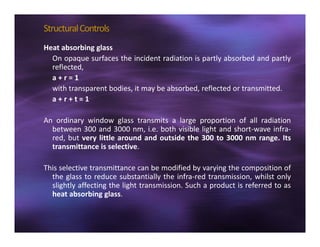
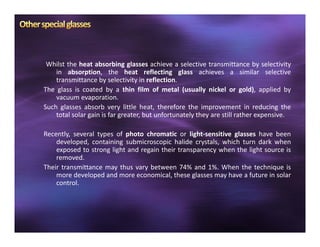
Solar shading
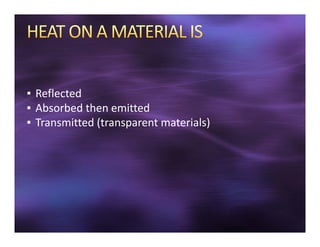
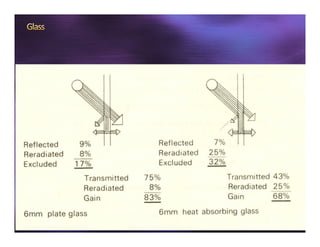
When sunlight hits a pane of glass, it
splits into three components –
Reflected : no effect on heating.
Absorbed: glass heats up which would
transfer heat by conduction and also emits heat (and)
Transmitted: Heat up surface behind it.
The proportion between the three components is
determined by the ‘angle of incidence’ and by the
type of glazing.
For most types of glazing, the transmitted component
is very small if the angle of incidence is larger than
45º from the normal to the glazing.
If the angle is more than 60º , most of the radiation is
reflected.
Types of Sun Shading Devices
On the basis of their position in a building:-
Internal
External
Interpane
Internal Sun Shading Devices
Limit the glare resulting from solar radiation.
Usually are adjustable and allow occupants to
regulate the amount of direct light entering their
space.
Curtains
Venetianblinds
Verticallouvreblinds
Rollerblinds
Pleated blinds
Blackout blinds
External Sun Shading Devices
Most thermally efficient as it controls the amount of
radiation entering the building externally.
Horizontal, Vertical or egg-crate devices
Vegetation and other buildings can also act as
shading devices.
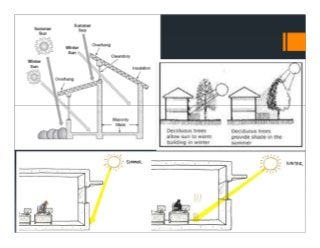
Horizontal Devices: to shade a window during
hot summer months, but to allow sunlight to shine
through a window in the winter, to help warm a
building.
Vertical Devices: Primarily useful for east and
west exposures to improve the insulation value of
glass in winter months by acting as a windbreak.
Slanted Vertical Fin Vertical Fins
The egg-crate: A combination of vertical and
horizontal shading elements commonly used in hot
climate regions because of their high shading
efficiencies. The horizontal elements control ground
glare from reflected solar rays. The device works well
on walls
Shading from External Environment
Shade from
buildings
DESIGNING SHADING DEVICE
1. Understand the sun path of the place.
2. Select shading type
 Horizontal
 Vertical
 Egg crate
3. Identify category
 Fixed
 Adjustable
4. Calculate design dimensions
 Understand horizontal and vertical shadow angles
1. Sun paths
2. & 3. Select Shading Type & Category
Orientation Suggested Shading Type
North fixed or adjustable shading placed horizontally above window
East and West adjustable vertical screens outside window
NE and NW adjustable shading
SE and SW planting
Climatic zones Requirements
Hot and dry Complete one year round shading
Warm and humid Complete year round shading , but design should be made such that 
ventilation is not affected
Temperature Complete year round shading but only during major sunshine hours
Cold and cloudy No shading
Cold and sunny Shading during summer months only
Composite  Shading during summer months only
Shading from External Environment
 Shadow angles are formed by sun shading
devices or projections on a wall exposed to the
sun.
Different design of sun shading devices form
different shadow angles.
 The performance of shading device is
specified by two angles :
 Horizontal shadow angle
 Vertical shadow angle
 These angles depend on the position of the
sun and the orientation where the window is
facing.
Horizontal shadow angle
The horizontal shadow angle (HSA) is
required for (or cast by) vertical shading
devices.
It is the horizontal angle between the
normal of the window pane and the azimuth
of the sun.
HSA = wall azimuth – solar azimuth
Horizontal shadow angle
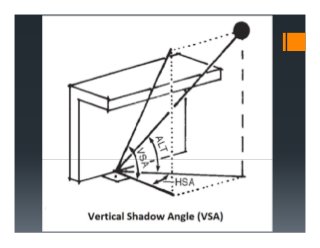
Vertical shadow angle
The vertical shadow angle (VSA) is required for
(or cast by) horizontal shading devices.
It is the angle between the ground line and
altitude of the sun.
Vertical shadow angle
Actually it is measured on a vertical plane normal to the
elevation considered.
If we imagine a virtual plane between the bottom left-hand and
right-hand corners of the window and the sun, then the VSA is
the angle this plane forms with the ground plane.
tan VSA = tan(altitude) / cos(HSA)
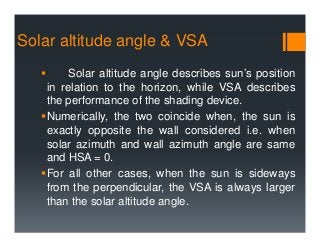
Solar altitude angle & VSA
 Solar altitude angle describes sun’s position
in relation to the horizon, while VSA describes
the performance of the shading device.
Numerically, the two coincide when, the sun is
exactly opposite the wall considered i.e. when
solar azimuth and wall azimuth angle are same
and HSA = 0.
For all other cases, when the sun is sideways
from the perpendicular, the VSA is always larger
than the solar altitude angle.
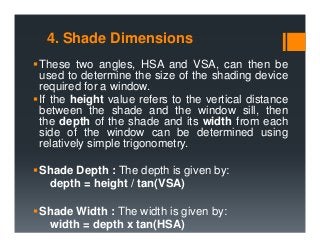
4. Shade Dimensions
These two angles, HSA and VSA, can then be
used to determine the size of the shading device
required for a window.
If the height value refers to the vertical distance
between the shade and the window sill, then
the depth of the shade and its width from each
side of the window can be determined using
relatively simple trigonometry.
Shade Depth : The depth is given by:
depth = height / tan(VSA)
Shade Width : The width is given by:
width = depth x tan(HSA)
Disadvantages of Sun Shading Devices
Difficulties can be experienced in handling the
internal shading devices like curtains and blinds.
In the use of shading devices like light shelves,
problems with low angle winter sunlight penetration
can give rise to glare.
If the building is highly stylized (e.g. Neoclassical or
glass cube), it may be impossible to reconcile
external shading with the original style.
Shading always blocks a part of the view. As a
minimum, it blocks the portion of the sky where the
sun travels.
Some shading methods are extremely specific to
compass orientation (azimuth). For example, fixed
horizontal shading may leak sunlight into the
building during the morning or afternoon unless it is
Presentation on Sun Shading Devices: Presenters: Binisha Gurung ,
Nishu Shrestha, Prabal Dahal, Rojina Nakarma, Suchitra Bhatta
Presentation: Solar control and shading
Hübe, Helena Bülow. "ESTIMATION OF THE PERFORMANCE OF SUNSHADES 
USING OUTDOOR MEASUREMENTS AND THE SOFTWARE TOOL PARASOL V 
2.0." Lund University. Web. 28 Nov. 2014. 
<http://lup.lub.lu.se/luur/download?func=downloadFile&recordOId=699802
&fileOId=711430>.
Bahr, Wassim. 1 Dec. 2009. Web. 28 Nov. 2014. <http://www.sesam‐
uae.com/greenbuilding/presantation/5. Wassim Bahr, AUD.pdf>.
Mohammad Arif, Kamal. "A S Tudy on S Hading of B Uildings as a P Reventive
M Easure for P Assive C Ooling and E Nergy C Onservation in B Uildings." 
International Journal of Civil & Environmental Engineering, 1 Dec. 2010. Web. 
28 Nov. 2014. <http://www.ijens.org/102406‐5252 IJCEE‐IJENS.pdf>.
Web. 3 Dec. 2014. <http://www.bembook.ipsa.us>.
Web. 3 Dec. 2014. <http://www.usc.edu>.
Web. 3 Dec. 2014. <http://www.earchitect.co.uk>.
References:

7. Shading devices

  • 1.
    Sun Shading Devices CLIMATOLOGY ROHITKUMAR ASSISTANT PROFESSOR MBS SPA 2016
  • 2.
    Introduction Sun Shading Devicesinhibit the solar radiation (block, allow,, etc.) incident on a building and are used either internally or externally or in between the internal and the external building space. They can be any mechanical equipment (like dynamic facades), projections (chajja), cantilevers, louvres, fins, jaalis, or even textiles. They can be fixed, manual and automatic moveable The primary objective of creating a comfortable internal environment, that is, cool in the summer and warm in the winter.
  • 3.
    Importance of SunShading Devices Solar radiation is an important factor of thermal comfort. Sun Shading Devices improve internal environment in order to provide greater comfort for occupants. To reduce the heat gains during summer and promote heat gain during winter, reduce the HVAC loads and therefore minimize energy costs. Use of shading device can improve building energy performance. To prevent glare (causing discomfort or disablility of vision). To increase useful daylight availability. To create a sense of security- internal sun shading devices like curtains help to beautify internal space and create a sense of privacy.
  • 4.
    Use of shading Solarcontrols should be considered for all glazed openings exposed to direct sunlight. Solar control is particularly important on south to west-facing facades, since the solar gains will coincide with the hottest part of the day. Solar control is also vital for lightweight buildings with large areas of glazing.
  • 5.
    Constraints of shadingdevices Sun path and wind direction are usually different. Maintenance of air flow through the non-air- conditioned buildings during the cooler hours of the day. There will be a need for admitting controlled levels of diffused daylight. In most cases there will be a requirement of views out of the window.
  • 6.
    Solar shading When sunlighthits a pane of glass, it splits into three components – Reflected : no effect on heating. Absorbed: glass heats up which would transfer heat by conduction and also emits heat (and) Transmitted: Heat up surface behind it. The proportion between the three components is determined by the ‘angle of incidence’ and by the type of glazing. For most types of glazing, the transmitted component is very small if the angle of incidence is larger than 45º from the normal to the glazing. If the angle is more than 60º , most of the radiation is reflected.
  • 7.
    Types of SunShading Devices On the basis of their position in a building:- Internal External Interpane
  • 8.
    Internal Sun ShadingDevices Limit the glare resulting from solar radiation. Usually are adjustable and allow occupants to regulate the amount of direct light entering their space.
  • 9.
  • 10.
    External Sun ShadingDevices Most thermally efficient as it controls the amount of radiation entering the building externally. Horizontal, Vertical or egg-crate devices Vegetation and other buildings can also act as shading devices.
  • 11.
    Horizontal Devices: toshade a window during hot summer months, but to allow sunlight to shine through a window in the winter, to help warm a building.
  • 12.
    Vertical Devices: Primarilyuseful for east and west exposures to improve the insulation value of glass in winter months by acting as a windbreak. Slanted Vertical Fin Vertical Fins
  • 13.
    The egg-crate: Acombination of vertical and horizontal shading elements commonly used in hot climate regions because of their high shading efficiencies. The horizontal elements control ground glare from reflected solar rays. The device works well on walls
  • 14.
    Shading from ExternalEnvironment Shade from buildings
  • 16.
    DESIGNING SHADING DEVICE 1.Understand the sun path of the place. 2. Select shading type  Horizontal  Vertical  Egg crate 3. Identify category  Fixed  Adjustable 4. Calculate design dimensions  Understand horizontal and vertical shadow angles
  • 17.
  • 19.
    2. & 3.Select Shading Type & Category Orientation Suggested Shading Type North fixed or adjustable shading placed horizontally above window East and West adjustable vertical screens outside window NE and NW adjustable shading SE and SW planting Climatic zones Requirements Hot and dry Complete one year round shading Warm and humid Complete year round shading , but design should be made such that  ventilation is not affected Temperature Complete year round shading but only during major sunshine hours Cold and cloudy No shading Cold and sunny Shading during summer months only Composite  Shading during summer months only
  • 20.
    Shading from ExternalEnvironment  Shadow angles are formed by sun shading devices or projections on a wall exposed to the sun. Different design of sun shading devices form different shadow angles.  The performance of shading device is specified by two angles :  Horizontal shadow angle  Vertical shadow angle  These angles depend on the position of the sun and the orientation where the window is facing.
  • 21.
    Horizontal shadow angle Thehorizontal shadow angle (HSA) is required for (or cast by) vertical shading devices. It is the horizontal angle between the normal of the window pane and the azimuth of the sun. HSA = wall azimuth – solar azimuth
  • 22.
  • 23.
    Vertical shadow angle Thevertical shadow angle (VSA) is required for (or cast by) horizontal shading devices. It is the angle between the ground line and altitude of the sun.
  • 24.
  • 25.
    Vertical shadow angle Actuallyit is measured on a vertical plane normal to the elevation considered. If we imagine a virtual plane between the bottom left-hand and right-hand corners of the window and the sun, then the VSA is the angle this plane forms with the ground plane. tan VSA = tan(altitude) / cos(HSA)
  • 27.
    Solar altitude angle& VSA  Solar altitude angle describes sun’s position in relation to the horizon, while VSA describes the performance of the shading device. Numerically, the two coincide when, the sun is exactly opposite the wall considered i.e. when solar azimuth and wall azimuth angle are same and HSA = 0. For all other cases, when the sun is sideways from the perpendicular, the VSA is always larger than the solar altitude angle.
  • 28.
    4. Shade Dimensions Thesetwo angles, HSA and VSA, can then be used to determine the size of the shading device required for a window. If the height value refers to the vertical distance between the shade and the window sill, then the depth of the shade and its width from each side of the window can be determined using relatively simple trigonometry. Shade Depth : The depth is given by: depth = height / tan(VSA) Shade Width : The width is given by: width = depth x tan(HSA)
  • 30.
    Disadvantages of SunShading Devices Difficulties can be experienced in handling the internal shading devices like curtains and blinds. In the use of shading devices like light shelves, problems with low angle winter sunlight penetration can give rise to glare. If the building is highly stylized (e.g. Neoclassical or glass cube), it may be impossible to reconcile external shading with the original style. Shading always blocks a part of the view. As a minimum, it blocks the portion of the sky where the sun travels. Some shading methods are extremely specific to compass orientation (azimuth). For example, fixed horizontal shading may leak sunlight into the building during the morning or afternoon unless it is
  • 31.
    Presentation on SunShading Devices: Presenters: Binisha Gurung , Nishu Shrestha, Prabal Dahal, Rojina Nakarma, Suchitra Bhatta Presentation: Solar control and shading Hübe, Helena Bülow. "ESTIMATION OF THE PERFORMANCE OF SUNSHADES  USING OUTDOOR MEASUREMENTS AND THE SOFTWARE TOOL PARASOL V  2.0." Lund University. Web. 28 Nov. 2014.  <http://lup.lub.lu.se/luur/download?func=downloadFile&recordOId=699802 &fileOId=711430>. Bahr, Wassim. 1 Dec. 2009. Web. 28 Nov. 2014. <http://www.sesam‐ uae.com/greenbuilding/presantation/5. Wassim Bahr, AUD.pdf>. Mohammad Arif, Kamal. "A S Tudy on S Hading of B Uildings as a P Reventive M Easure for P Assive C Ooling and E Nergy C Onservation in B Uildings."  International Journal of Civil & Environmental Engineering, 1 Dec. 2010. Web.  28 Nov. 2014. <http://www.ijens.org/102406‐5252 IJCEE‐IJENS.pdf>. Web. 3 Dec. 2014. <http://www.bembook.ipsa.us>. Web. 3 Dec. 2014. <http://www.usc.edu>. Web. 3 Dec. 2014. <http://www.earchitect.co.uk>. References: