Downloaded 1,086 times
![Asian Architecture [ARC 2213/2234]
PROJECT 1: CASE STUDY
Bioclimatic Architecture:
A Sustainable Design Approach in attempt to Connect with
Nature while Maintaining Building Comfort based on Local
Climate in Sekeping Serendah
NAME: Joanne Bernice Chua Yunn Tze
STUDENT ID: 0315905
LECTURER: Mr. Koh Jing Hao
SUBMISSION DATE: 9 June 2015](https://image.slidesharecdn.com/mergeddocument-150706165630-lva1-app6891/85/Bioclimatic-Architecture-1-320.jpg)





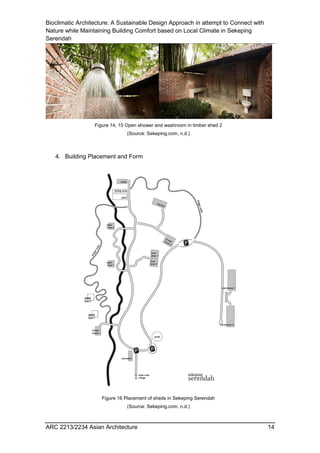

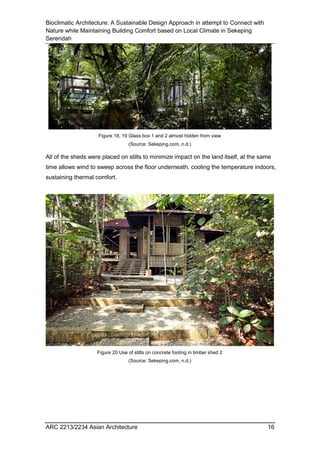


This document provides a case study on bioclimatic architecture at Sekeping Serendah, a private eco-retreat in Malaysia. It discusses how the retreat's shed designs use passive strategies like natural ventilation, daylighting, and shading to maintain thermal comfort without mechanical systems. The strategies are analyzed in relation to building comfort factors like temperature, humidity, and light levels. The document concludes that Sekeping Serendah successfully achieves comfort through bioclimatic principles that harmonize its buildings with the local climate and environment.


![Asian architecture [arc2234] case study paper](https://cdn.slidesharecdn.com/ss_thumbnails/asianarchitecturearc2234-casestudypaper-141209082112-conversion-gate01-thumbnail.jpg?width=640&height=640&fit=bounds)


