CHAPTER 4: Soil Survey,
classification and evaluation
4.1 SOIL SURVEY
•Introduction of Soil Survey
•Stages in Soil Survey Program
•Types of Soil Survey
•Steps in Soil Survey
•Land Capability Classification
4.2 SOIL CLASSIFACTION
•Soil Classification Systems
•Soil Classification Scheme
4.3 LAND EVALUATION
4.1 SOIL SURVEY
Introduction to Soil Survey
• Soil Survey = the process of classifying soil
types and other soil properties in a given area
and geo-encoding such information
• published results of soil survey activities
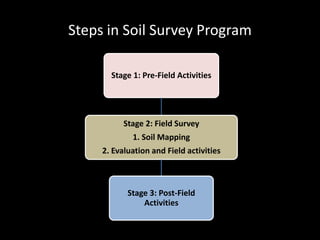
Steps in Soil Survey Program
Stage 1: Pre-Field Activities
Stage 2: Field Survey
1. Soil Mapping
2. Evaluation and Field activities
Stage 3: Post-Field
Activities
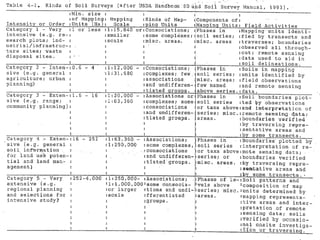
Kinds of Soil Survey
• Reconnaissance Surveys
• Detailed Special Surveys
• Special Purpose Surveys
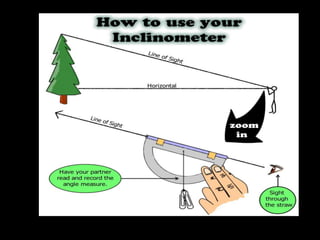
Step 1: Delineating Soil Unit
• Delineating soil unit with respect to
topography
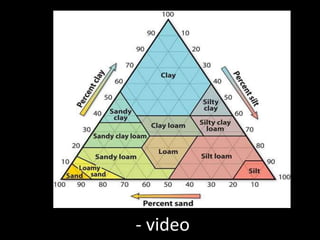
• determination of texture
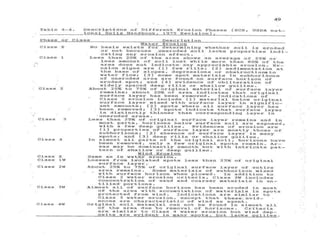
• Determination of slope – Erosion phases
• Vegetation
- video
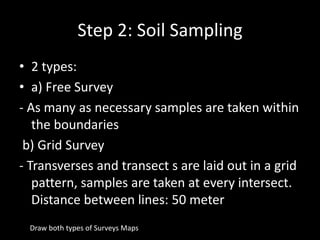
Step 2: Soil Sampling
• 2 types:
• a) Free Survey
- As many as necessary samples are taken within
the boundaries
b) Grid Survey
- Transverses and transect s are laid out in a grid
pattern, samples are taken at every intersect.
Distance between lines: 50 meter
Draw both types of Surveys Maps
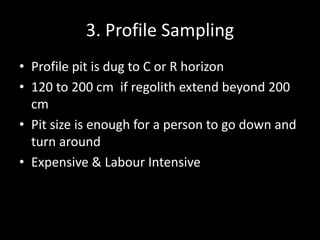
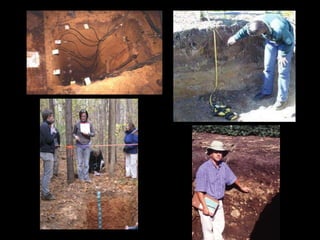
3. Profile Sampling
• Profile pit is dug to C or R horizon
• 120 to 200 cm if regolith extend beyond 200
cm
• Pit size is enough for a person to go down and
turn around
• Expensive & Labour Intensive
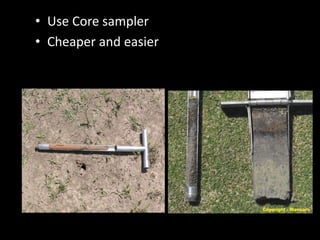
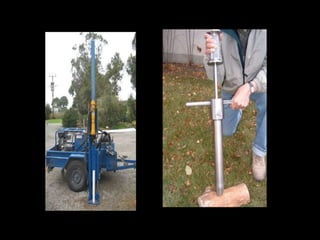
• Use Core sampler
• Cheaper and easier
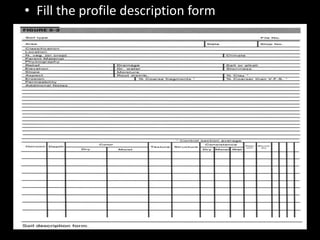
• Fill the profile description form
• Expressing the physical phases of soil
- Soil Texture
- Soil Structure
- Soil Consistence/Soil Strength
- Soil Color
- Soil Permeability
- Soil Temperature
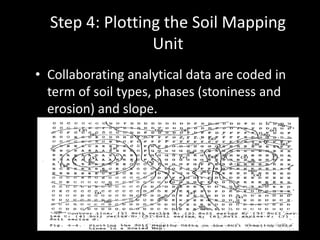
Step 4: Plotting the Soil Mapping
Unit
• Collaborating analytical data are coded in
term of soil types, phases (stoniness and
erosion) and slope.
Step 5: Correlation
• Previous profile study
• if the profile under study indicates very close
similarities with an established profile existing
in another place the soil under study is name
after the other soil
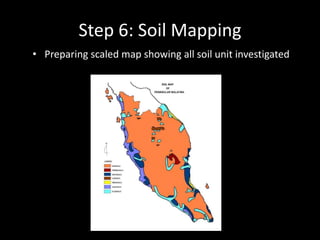
Step 6: Soil Mapping
• Preparing scaled map showing all soil unit investigated
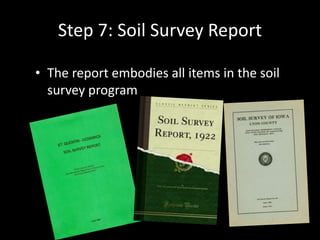
Step 7: Soil Survey Report
• The report embodies all items in the soil
survey program
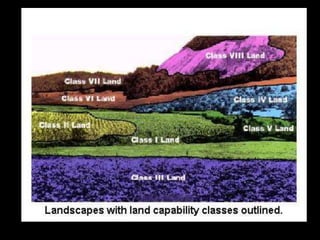
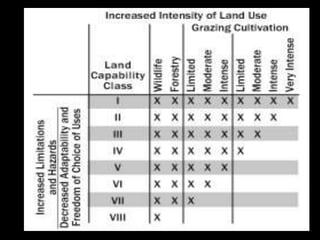
Step 8: Land Capability Classification
• refers to the productive capacity of the soil for
intensive as influence by soil fertility, moisture
supply and depth of solum
• 2 main points land capability
a) soil limitation -soil physical aspect that restrict
crop production
b) climatic limitation - adverse climatic problem
QUESTIONS AND DISCUSSION?
4.2 SOIL CLASSIFICATION
Introduction to Soil Classification
• grouping soils by their intrinsic property (soil
morphology), behavior, or genesis, results in classes
that can be interpreted for many diverse uses.
• No universally accepted classification system
• Based on field: Agriculture, Engineering, OSHA
• Lead to confusion
Most common for Agriculture :
US Soil Taxonomy (1975)
FAO/UNESCO Soil Classification (1974)
FAO Soil Classification
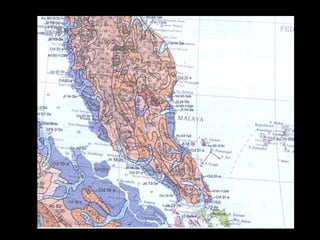
• first published in form of the UNESCO Soil
Map of the World (1974)
• Many of the names offered in that
classification are known in many countries

and do have similar meanings.
• Many countries modified this system to fit
their particular needs.
• Soil Units form 26 World Classes.
• intended for mapping soils at a continental
scale but not at local scale.
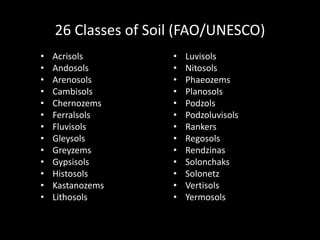
26 Classes of Soil (FAO/UNESCO)
• Acrisols
• Andosols
• Arenosols
• Cambisols
• Chernozems
• Ferralsols
• Fluvisols
• Gleysols
• Greyzems
• Gypsisols
• Histosols
• Kastanozems
• Lithosols
• Luvisols
• Nitosols
• Phaeozems
• Planosols
• Podzols
• Podzoluvisols
• Rankers
• Regosols
• Rendzinas
• Solonchaks
• Solonetz
• Vertisols
• Yermosols
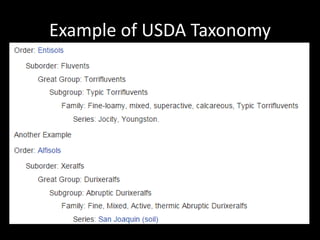
USDA Soil Taxonomy
• developed by United States Department of
Agriculture and the National Cooperative
Soil Survey provides an elaborate
classification of soil types according to
several parameters (most commonly their
properties) and in 7 levels; Order >>
Suborder >> Great Group >> Subgroup >>
Family >> Series.
• 12 orders
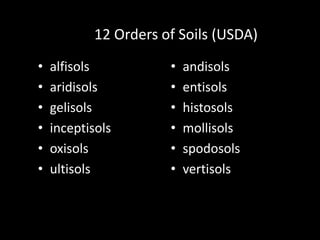
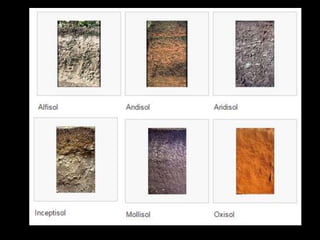
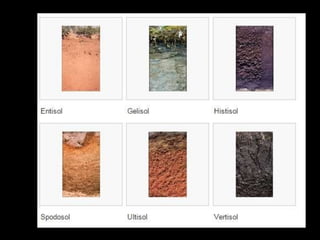
12 Orders of Soils (USDA)
• alfisols
• aridisols
• gelisols
• inceptisols
• oxisols
• ultisols
• andisols
• entisols
• histosols
• mollisols
• spodosols
• vertisols
Example of USDA Taxonomy
4.3 LAND EVALUATION
Introduction to Land Evaluation
• the process of valuing real property (usually
market value).
• requires appraisals because they occur
infrequently and every property is unique
(especially their location, a key factor in
valuation)
• Land Appraisal consists 2 phases: a) land
characterization b) socio-economy aspect
The End

Soil Survey, Classification and Evaluation

  • 1.
    CHAPTER 4: SoilSurvey, classification and evaluation 4.1 SOIL SURVEY •Introduction of Soil Survey •Stages in Soil Survey Program •Types of Soil Survey •Steps in Soil Survey •Land Capability Classification 4.2 SOIL CLASSIFACTION •Soil Classification Systems •Soil Classification Scheme 4.3 LAND EVALUATION
  • 2.
    4.1 SOIL SURVEY Introductionto Soil Survey • Soil Survey = the process of classifying soil types and other soil properties in a given area and geo-encoding such information • published results of soil survey activities
  • 3.
    Steps in SoilSurvey Program Stage 1: Pre-Field Activities Stage 2: Field Survey 1. Soil Mapping 2. Evaluation and Field activities Stage 3: Post-Field Activities
  • 4.
    Kinds of SoilSurvey • Reconnaissance Surveys • Detailed Special Surveys • Special Purpose Surveys
  • 6.
    Step 1: DelineatingSoil Unit • Delineating soil unit with respect to topography • determination of texture • Determination of slope – Erosion phases • Vegetation
  • 7.
  • 10.
    Step 2: SoilSampling • 2 types: • a) Free Survey - As many as necessary samples are taken within the boundaries b) Grid Survey - Transverses and transect s are laid out in a grid pattern, samples are taken at every intersect. Distance between lines: 50 meter Draw both types of Surveys Maps
  • 11.
    3. Profile Sampling •Profile pit is dug to C or R horizon • 120 to 200 cm if regolith extend beyond 200 cm • Pit size is enough for a person to go down and turn around • Expensive & Labour Intensive
  • 13.
    • Use Coresampler • Cheaper and easier
  • 15.
    • Fill theprofile description form
  • 16.
    • Expressing thephysical phases of soil - Soil Texture - Soil Structure - Soil Consistence/Soil Strength - Soil Color - Soil Permeability - Soil Temperature
  • 17.
    Step 4: Plottingthe Soil Mapping Unit • Collaborating analytical data are coded in term of soil types, phases (stoniness and erosion) and slope.
  • 18.
    Step 5: Correlation •Previous profile study • if the profile under study indicates very close similarities with an established profile existing in another place the soil under study is name after the other soil
  • 19.
    Step 6: SoilMapping • Preparing scaled map showing all soil unit investigated
  • 20.
    Step 7: SoilSurvey Report • The report embodies all items in the soil survey program
  • 21.
    Step 8: LandCapability Classification • refers to the productive capacity of the soil for intensive as influence by soil fertility, moisture supply and depth of solum • 2 main points land capability a) soil limitation -soil physical aspect that restrict crop production b) climatic limitation - adverse climatic problem
  • 24.
  • 25.
    4.2 SOIL CLASSIFICATION Introductionto Soil Classification • grouping soils by their intrinsic property (soil morphology), behavior, or genesis, results in classes that can be interpreted for many diverse uses. • No universally accepted classification system • Based on field: Agriculture, Engineering, OSHA • Lead to confusion Most common for Agriculture : US Soil Taxonomy (1975) FAO/UNESCO Soil Classification (1974)
  • 26.
    FAO Soil Classification •first published in form of the UNESCO Soil Map of the World (1974) • Many of the names offered in that classification are known in many countries and do have similar meanings. • Many countries modified this system to fit their particular needs. • Soil Units form 26 World Classes. • intended for mapping soils at a continental scale but not at local scale.
  • 27.
    26 Classes ofSoil (FAO/UNESCO) • Acrisols • Andosols • Arenosols • Cambisols • Chernozems • Ferralsols • Fluvisols • Gleysols • Greyzems • Gypsisols • Histosols • Kastanozems • Lithosols • Luvisols • Nitosols • Phaeozems • Planosols • Podzols • Podzoluvisols • Rankers • Regosols • Rendzinas • Solonchaks • Solonetz • Vertisols • Yermosols
  • 29.
    USDA Soil Taxonomy •developed by United States Department of Agriculture and the National Cooperative Soil Survey provides an elaborate classification of soil types according to several parameters (most commonly their properties) and in 7 levels; Order >> Suborder >> Great Group >> Subgroup >> Family >> Series. • 12 orders
  • 30.
    12 Orders ofSoils (USDA) • alfisols • aridisols • gelisols • inceptisols • oxisols • ultisols • andisols • entisols • histosols • mollisols • spodosols • vertisols
  • 33.
  • 35.
    4.3 LAND EVALUATION Introductionto Land Evaluation • the process of valuing real property (usually market value). • requires appraisals because they occur infrequently and every property is unique (especially their location, a key factor in valuation) • Land Appraisal consists 2 phases: a) land characterization b) socio-economy aspect
  • 37.