SOIL MICROBIOLOGY -
BIOTIC AND ABIOTIC INTERACTIONS
Dr. S. Anu Kiruthika
Bengaluru North University
Bengaluru.
1
INTRODUCTION
• Soils are one of the Earth's essential natural resources, yet they are
often taken for granted.
• Most people do not realize that soils are a living, breathing world
supporting nearly all terrestrial life.
• Soils and the functions they play within an ecosystem vary greatly from
one location to another as a result of many factors, including differences
in.
 Climate, the animal and plant life living on them, soil's parent material,
the position of the soil on the landscape, and the age of soil.
2
Composition of Soil
Soils are composed of four main components:
1. Mineral particles of different sizes.
2. Organic materials from the remains of dead
plants and animals.
3. Water that fills open pore spaces.
4. Air that fills open pore spaces.
3
Uses of Soil
• The use and function of a soil depends on the amount of
each component.
• For example, a good soil for growing agricultural plants has
about 45% minerals, 5% organic matter, 25% air, and 25%
water.
• Plants that live in wetlands require more water and less air.
• Soils used as raw material for bricks need to be completely
free of organic matter.
4
The Five Soil Forming Factors
The properties of a soil are the result of the interaction
between the five soil forming factors.
These factors are:
1. Parent Material
2. Climate
3. Organisms
4. Topography
5. Time
5
1. Parent Material
• The material from which soil is formed determines
many of its properties.
• The parent material of a soil may be bedrock, organic
material, construction material, or loose soil material
deposited by wind, water, glaciers, volcanoes, or
moved down a slope by gravity.
6
2. Climate
• Heat, rain, ice, snow, wind, sunshine, and other
environmental forces break down parent material,
• move loose soil material,
• determine the animals and plants able to survive at a
location,
• and affect the rates of soil forming processes and the
resulting soil properties.
7
3. Organisms
• Soil is home to large numbers of plants, animals, and
microorganisms.
• The physical and chemical properties of a soil determine
the type and number of organisms that can survive in
that soil.
• Organisms also shape the soil they live in.
8
• For example, the growth of roots and the movement
of animals and microorganisms shift materials and
chemicals around in soil profile.
• The dead remains of soil organisms become organic
matter that enriches the soil with carbon and
nutrients.
9
• Animals and microorganisms living in the soil control the rates
of decomposition for organic and waste materials.
• Organisms in soil contribute to the exchange of gases such as
carbon dioxide, oxygen, and nitrogen between soil and the
atmosphere.
• They also help soil filter impurities in water.
• Human actions transform soil as well, as we farm, build, dam,
dig, process, transport, and dispose of waste.
10
4. Topography
• The location of a soil on a landscape also affects its
formation and its resulting properties.
• For example, soils at the bottom of a hill will get more
water than soils on the hillside, and soils on slopes that
get direct sunlight will be drier than soils on slopes that
do not.
11
5. Time
• The amount of time that the other 4 factors listed above
have been interacting with each other affects the
properties of the soil.
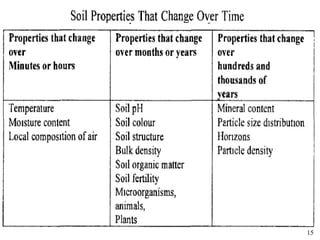
• Some properties, such as temperature and moisture
content, change quickly, often over minutes and hours.
• Others, such as Mineral changes, occur very slowly over
hundreds or thousands of years.
12
The soil profiles
• The five soil forming factors differ from place to place causing soil properties to
vary from one location to another.
• Each area of soil on a landscape has unique characteristics.
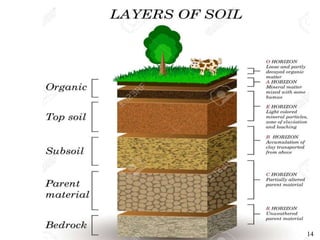
• A vertical section at one location is called a soli profile.
• When we look closely at the properties of a soil profile and consider the five
soil forming factors.
• Soil horizons can be as thin as a few millimeters or thicker than a meter.
• Individual horizons are identified by the properties they contain that are
different from the horizons above and below them.
13
14
15
• Some on horizons are formed as a result of the weathering of minerals and
decomposition of organic materials that move down the soil profile over time.
• This movement, called illuviation (accumulation), influences the horizon's
composition and properties.
• Other horizons may be formed by the disturbance of the soil profile from
erosion, deposition, or biological activity.
• Soils may also have been altered by human activity.
• For example, builders compact soil, change its composition, move soil from one
location to another, or replace horizons in a different order from their original
formation.
16
Moisture in soil
• Moisture plays a major role in the chemical, biological and physical activities
that take place in soil.
• Chemically, moisture transports substances through the profile.
• This affects soil properties such as colour, texture, pH, and fertility.
• Biologically, moisture determines the types of plants that grow in soil and affects
the way the roots are distributed.
• For example, in desert areas where soils are dry, plants such as cacti must store
water, or send roots deep into soil to tap water buried tens of meters below the
surface.
17
• Plants in tropical regions have many of their roots near the surface where
organic material stores much of the water and nutrients the plants need.
• Agricultural plants grow best in soils were water occupies approximately
one-fourth of the soil volume as vapour or liquid.
• Physically, soil moisture is part of the hydrologic cycle.
• Water falls on the soil surface as precipitation.
• This water seeps down into soil in a process called infiltration.
18
• After water infiltrates soil, it is stored in the horizons, taken up by
plants, moved upward by evaporation, or moved downward into
the underlying bedrock to become ground water.
• The amount of moisture contained in a soil can change rapidly,
sometimes increasing within minutes or hours.
• In contrast, it might take weeks or months for soils to dry out.
19
• If a soil horizon is compacted, has very small pore spaces, or is
saturated with water, infiltration will occur slowly, increasing the
potential for flooding in an area.
• If the water cannot move down into soil fast enough, it will flow
over the surface as runoff and may rapidly end up in streams or
other water bodies.
• When soil is not covered by vegetation and the slope of the land is
steep, water erosion occurs.
20
• Deep scars are formed in the landscape as a result of the
combined force of the runoff water and soil particles
flowing over the surface.
• When a soil horizon is dry, or has large pore spaces that
are similar in size to the horizon above, water will infiltrate
the horizon quickly.
• If soil gets too dry and is not covered by vegetation, wind
erosion may occur.
21
Soil Temperature
• The temperature of a soil can change quickly.
• Near earth surface, it changes almost as quickly as the air temperature
changes, but because soil is denser than air, its temperature variations
are less.
• Daily and annual cycles of soil temperature can be measured.
• During a typical day, soil is cool in the morning, warms during the
afternoon, and then cools down again at night.
• Over the course of the year, soil warms up or cools down with the
seasons.
22
• Because soil temperature changes more slowly than air
temperature, it acts as an insulator, protecting soil organisms and
buried pipes from the extremes of air temperature variations.
• In temperate regions, the surface soil may freeze in winter and
thaw in the spring, while in some colder climates, a permanent
layer of ice, called permafrost, is found below the soil surface.
• In either case, the ground never freezes below a certain depth.
23
• The overlying soil acts as insulation so that the
temperature of the deeper layers of soil is almost
constant throughout the year.
• Temperature greatly affects the chemical and
biological activity in soil.
• Generally, the warmer the soil, the greater the
biological activity of microorganisms living in the soil.
24
• Microorganisms in warm tropical soils break down organic
materials much faster than microorganisms in cold climate soils.
• Near the surface, the temperature and moisture of soil affect the
atmosphere as heat and water vapour are exchanged between
the land and the air.
• These effects are smaller than those at the surfaces of oceans,
seas, and large lakes, but can significantly influence local weather
conditions.
25
• Hurricanes (cyclone) have been found to intensify
when they pass over soil that is saturated with water.
• Meteorologists have found that their forecasts can be
improved if they factor soil temperature and moisture
into their calculations.
26
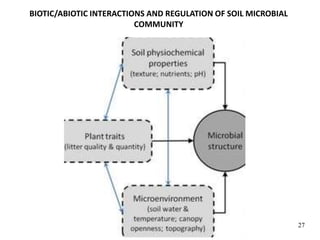
BIOTIC/ABIOTIC INTERACTIONS AND REGULATION OF SOIL MICROBIAL
COMMUNITY
27
THE END
28

Biotic And Abiotic interactions

  • 1.
    SOIL MICROBIOLOGY - BIOTICAND ABIOTIC INTERACTIONS Dr. S. Anu Kiruthika Bengaluru North University Bengaluru. 1
  • 2.
    INTRODUCTION • Soils areone of the Earth's essential natural resources, yet they are often taken for granted. • Most people do not realize that soils are a living, breathing world supporting nearly all terrestrial life. • Soils and the functions they play within an ecosystem vary greatly from one location to another as a result of many factors, including differences in.  Climate, the animal and plant life living on them, soil's parent material, the position of the soil on the landscape, and the age of soil. 2
  • 3.
    Composition of Soil Soilsare composed of four main components: 1. Mineral particles of different sizes. 2. Organic materials from the remains of dead plants and animals. 3. Water that fills open pore spaces. 4. Air that fills open pore spaces. 3
  • 4.
    Uses of Soil •The use and function of a soil depends on the amount of each component. • For example, a good soil for growing agricultural plants has about 45% minerals, 5% organic matter, 25% air, and 25% water. • Plants that live in wetlands require more water and less air. • Soils used as raw material for bricks need to be completely free of organic matter. 4
  • 5.
    The Five SoilForming Factors The properties of a soil are the result of the interaction between the five soil forming factors. These factors are: 1. Parent Material 2. Climate 3. Organisms 4. Topography 5. Time 5
  • 6.
    1. Parent Material •The material from which soil is formed determines many of its properties. • The parent material of a soil may be bedrock, organic material, construction material, or loose soil material deposited by wind, water, glaciers, volcanoes, or moved down a slope by gravity. 6
  • 7.
    2. Climate • Heat,rain, ice, snow, wind, sunshine, and other environmental forces break down parent material, • move loose soil material, • determine the animals and plants able to survive at a location, • and affect the rates of soil forming processes and the resulting soil properties. 7
  • 8.
    3. Organisms • Soilis home to large numbers of plants, animals, and microorganisms. • The physical and chemical properties of a soil determine the type and number of organisms that can survive in that soil. • Organisms also shape the soil they live in. 8
  • 9.
    • For example,the growth of roots and the movement of animals and microorganisms shift materials and chemicals around in soil profile. • The dead remains of soil organisms become organic matter that enriches the soil with carbon and nutrients. 9
  • 10.
    • Animals andmicroorganisms living in the soil control the rates of decomposition for organic and waste materials. • Organisms in soil contribute to the exchange of gases such as carbon dioxide, oxygen, and nitrogen between soil and the atmosphere. • They also help soil filter impurities in water. • Human actions transform soil as well, as we farm, build, dam, dig, process, transport, and dispose of waste. 10
  • 11.
    4. Topography • Thelocation of a soil on a landscape also affects its formation and its resulting properties. • For example, soils at the bottom of a hill will get more water than soils on the hillside, and soils on slopes that get direct sunlight will be drier than soils on slopes that do not. 11
  • 12.
    5. Time • Theamount of time that the other 4 factors listed above have been interacting with each other affects the properties of the soil. • Some properties, such as temperature and moisture content, change quickly, often over minutes and hours. • Others, such as Mineral changes, occur very slowly over hundreds or thousands of years. 12
  • 13.
    The soil profiles •The five soil forming factors differ from place to place causing soil properties to vary from one location to another. • Each area of soil on a landscape has unique characteristics. • A vertical section at one location is called a soli profile. • When we look closely at the properties of a soil profile and consider the five soil forming factors. • Soil horizons can be as thin as a few millimeters or thicker than a meter. • Individual horizons are identified by the properties they contain that are different from the horizons above and below them. 13
  • 14.
  • 15.
  • 16.
    • Some onhorizons are formed as a result of the weathering of minerals and decomposition of organic materials that move down the soil profile over time. • This movement, called illuviation (accumulation), influences the horizon's composition and properties. • Other horizons may be formed by the disturbance of the soil profile from erosion, deposition, or biological activity. • Soils may also have been altered by human activity. • For example, builders compact soil, change its composition, move soil from one location to another, or replace horizons in a different order from their original formation. 16
  • 17.
    Moisture in soil •Moisture plays a major role in the chemical, biological and physical activities that take place in soil. • Chemically, moisture transports substances through the profile. • This affects soil properties such as colour, texture, pH, and fertility. • Biologically, moisture determines the types of plants that grow in soil and affects the way the roots are distributed. • For example, in desert areas where soils are dry, plants such as cacti must store water, or send roots deep into soil to tap water buried tens of meters below the surface. 17
  • 18.
    • Plants intropical regions have many of their roots near the surface where organic material stores much of the water and nutrients the plants need. • Agricultural plants grow best in soils were water occupies approximately one-fourth of the soil volume as vapour or liquid. • Physically, soil moisture is part of the hydrologic cycle. • Water falls on the soil surface as precipitation. • This water seeps down into soil in a process called infiltration. 18
  • 19.
    • After waterinfiltrates soil, it is stored in the horizons, taken up by plants, moved upward by evaporation, or moved downward into the underlying bedrock to become ground water. • The amount of moisture contained in a soil can change rapidly, sometimes increasing within minutes or hours. • In contrast, it might take weeks or months for soils to dry out. 19
  • 20.
    • If asoil horizon is compacted, has very small pore spaces, or is saturated with water, infiltration will occur slowly, increasing the potential for flooding in an area. • If the water cannot move down into soil fast enough, it will flow over the surface as runoff and may rapidly end up in streams or other water bodies. • When soil is not covered by vegetation and the slope of the land is steep, water erosion occurs. 20
  • 21.
    • Deep scarsare formed in the landscape as a result of the combined force of the runoff water and soil particles flowing over the surface. • When a soil horizon is dry, or has large pore spaces that are similar in size to the horizon above, water will infiltrate the horizon quickly. • If soil gets too dry and is not covered by vegetation, wind erosion may occur. 21
  • 22.
    Soil Temperature • Thetemperature of a soil can change quickly. • Near earth surface, it changes almost as quickly as the air temperature changes, but because soil is denser than air, its temperature variations are less. • Daily and annual cycles of soil temperature can be measured. • During a typical day, soil is cool in the morning, warms during the afternoon, and then cools down again at night. • Over the course of the year, soil warms up or cools down with the seasons. 22
  • 23.
    • Because soiltemperature changes more slowly than air temperature, it acts as an insulator, protecting soil organisms and buried pipes from the extremes of air temperature variations. • In temperate regions, the surface soil may freeze in winter and thaw in the spring, while in some colder climates, a permanent layer of ice, called permafrost, is found below the soil surface. • In either case, the ground never freezes below a certain depth. 23
  • 24.
    • The overlyingsoil acts as insulation so that the temperature of the deeper layers of soil is almost constant throughout the year. • Temperature greatly affects the chemical and biological activity in soil. • Generally, the warmer the soil, the greater the biological activity of microorganisms living in the soil. 24
  • 25.
    • Microorganisms inwarm tropical soils break down organic materials much faster than microorganisms in cold climate soils. • Near the surface, the temperature and moisture of soil affect the atmosphere as heat and water vapour are exchanged between the land and the air. • These effects are smaller than those at the surfaces of oceans, seas, and large lakes, but can significantly influence local weather conditions. 25
  • 26.
    • Hurricanes (cyclone)have been found to intensify when they pass over soil that is saturated with water. • Meteorologists have found that their forecasts can be improved if they factor soil temperature and moisture into their calculations. 26
  • 27.
    BIOTIC/ABIOTIC INTERACTIONS ANDREGULATION OF SOIL MICROBIAL COMMUNITY 27
  • 28.