SOIL
METHODS FOR CONSERVATION
           OF

 RESOURCES
Made By   Keshav Priyadarshi
–         X-D Roll No. - 09
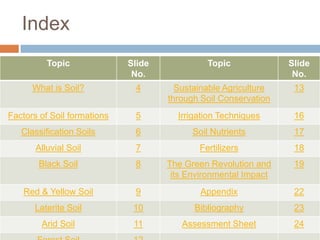
Index
          Topic              Slide            Topic              Slide
                              No.                                 No.
      What is Soil?           4        Sustainable Agriculture    13
                                     through Soil Conservation
Factors of Soil formations    5        Irrigation Techniques      16
   Classification Soils       6            Soil Nutrients         17
       Alluvial Soil          7             Fertilizers           18
       Black Soil             8      The Green Revolution and     19
                                      its Environmental Impact
    Red & Yellow Soil         9              Appendix             22
      Laterite Soil           10           Bibliography           23
        Arid Soil             11        Assessment Sheet          24
What is soil?
                            Top soil
                            the upper soil layer
Top most layer of earth
crust consisting of          Subsoil weathered
organic and inorganic        rocks sand and
                             silt clay
matters is called soil.
Soil is a renewable
resource.                       Substratum
                                weathered parent
                                rock material
Soil is a living system.
It is the medium of plant
growth and
supports different types         Unweathered
of living organisms on           parent bed rock

the earth.
Factors of Soil formations

A.   Relief,
B.   Parent rock or bed rock,
C.   Climate,
D.   Time are important factors
     in the formation of soil.
E.   Actions of running
     water, wind and glaciers,
F.   Activities of decomposers
     etc.
G.   Chemical and organic
Classification Soils
Major types of Soils
found in India.
•   Alluvial Soil
•   Black Soil
•Red and Yellow
Soils
•   Laterite Soils
•   Arid Soils
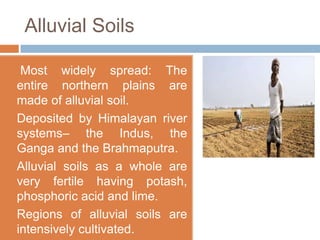
Alluvial Soils

a.    Most widely spread: The
     entire northern plains are
     made of alluvial soil.
b.   Deposited by Himalayan river
     systems– the Indus, the
     Ganga and the Brahmaputra.
c.   Alluvial soils as a whole are
     very fertile having potash,
     phosphoric acid and lime.
d.   Regions of alluvial soils are
     intensively cultivated.
Black Soils
a.   These soils are also known as regur soils
     or black cotton soil.
b.   Climatic condition along with the parent
     rock material are the important factors for
     the formation of black soil.
c.   They are well-known for their capacity to
     hold moisture. In addition, they are rich in
     soil nutrients.
d.   These soils are generally poor in
     phosphoric contents.
e.   These soils are sticky when wet and
     difficult to work on unless tilled
     immediately after the first shower or
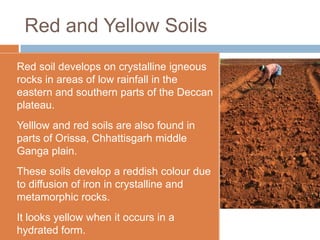
Red and Yellow Soils
a.   Red soil develops on crystalline igneous
     rocks in areas of low rainfall in the
     eastern and southern parts of the Deccan
     plateau.
b.   Yelllow and red soils are also found in
     parts of Orissa, Chhattisgarh middle
     Ganga plain.
c.   These soils develop a reddish colour due
     to diffusion of iron in crystalline and
     metamorphic rocks.
d.   It looks yellow when it occurs in a
     hydrated form.
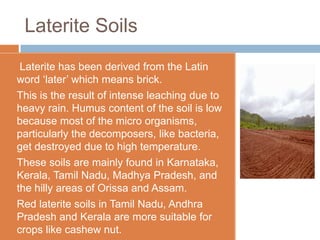
Laterite Soils
a.    Laterite has been derived from the Latin
     word ‘later’ which means brick.
b.   This is the result of intense leaching due to
     heavy rain. Humus content of the soil is low
     because most of the micro organisms,
     particularly the decomposers, like bacteria,
     get destroyed due to high temperature.
c.   These soils are mainly found in Karnataka,
     Kerala, Tamil Nadu, Madhya Pradesh, and
     the hilly areas of Orissa and Assam.
d.   Red laterite soils in Tamil Nadu, Andhra
     Pradesh and Kerala are more suitable for
     crops like cashew nut.
Arid Soils
a.    Arid soils range from red to brown in colour.
b.   They are generally sandy in texture and
     saline in nature.
c.   In some areas the salt content is very high
     and common salt is obtained by evaporating
     the water.
d.   Due to the dry climate, high
     temperature, evaporation is faster and the soil
     lacks humus and moisture.
e.   The lower horizons of the soil are occupied by
     Kankar because of the increasing calcium
     content downwards.
f.   The Kankar layer formations in the bottom
     horizons restrict the infiltration of water.
g.   After proper irrigation these soils become
     cultivable as has been in the case of western
     Rajasthan.
Forest Soils
a.    These soils are found in the hilly and
     mountainous areas where sufficient rain
     forests are available.
b.   The soils texture varies according to the
     mountain environment where they are
     formed. They are loamy and silty in
     valley sides and coarse grained in the
     upper slopes.
c.   In the snow covered areas of
     Himalayas, these soils experience
     denudation and are acidic with low
     humus content.
d.   The soils found in the lower parts of the
     valleys particularly on the river terraces
     and alluvial fans are fertile.
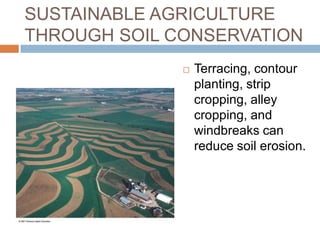
SUSTAINABLE AGRICULTURE
THROUGH SOIL CONSERVATION
                 Terracing, contour
                  planting, strip
                  cropping, alley
                  cropping, and
                  windbreaks can
                  reduce soil erosion.
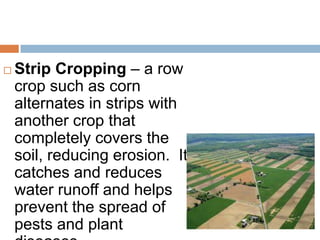
   Strip Cropping – a row
    crop such as corn
    alternates in strips with
    another crop that
    completely covers the
    soil, reducing erosion. It
    catches and reduces
    water runoff and helps
    prevent the spread of
    pests and plant
Cover Cropping (alley cropping) – several
crops are planted together in strips or alleys
between trees and shrubs that can provide
shade (which reduces water loss by
evaporation) and helps to retain and slowly
release soil moisture.
Irrigation Techniques

    Conventional center-pivot irrigation- allows
     80% of the water input to reach crops
    Gravity-flow irrigation- Valves that send
     water down irrigation ditches.
    Drip irrigation- Can raise water efficiency to
     90-95% and reduce water use by 37-70%.
    Floodplain irrigation- allowing the natural
     floods to irrigate the crops. Soils in flood
     zones tend to be nutrient rich and fertile.
Soil Nutrients

 Macronutrients are larger in
 atomic structure. Ex. Nitrogen,
 Phosphorus & Potassium.

 Micronutrients
These are smaller in atomic
structure. Plants need them in
small amounts.
Fertilizers

   Organic Fertilizers – animal manure, crop
    residues, bone meal, and compost
Inorganic Fertilizers – man-made from chemical
compounds
       Benefits – exact compositions are known;
     they are soluble & thus immediately available
     to the plant
       Costs – quickly leach away; this pollutes the
     water; doesn’t help the water holding capacity
     of the soil like organic fertilizers do.
THE GREEN REVOLUTION AND ITS
    ENVIRONMENTAL IMPACT


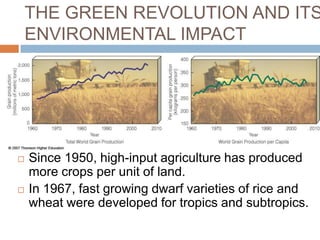
   Since 1950, high-input agriculture has produced
    more crops per unit of land.
   In 1967, fast growing dwarf varieties of rice and
    wheat were developed for tropics and subtropics.
THE GREEN REVOLUTION AND ITS
     ENVIRONMENTAL IMPACT
   Lack of water, high costs for small farmers, and
    physical limits to increasing crop yields hinder
    expansion of the green revolution.
   Since 1978 the amount of irrigated land per
    person has declined due to:
     Depletion   of underground water supplies.
     Inefficient irrigation methods.

     Salt build-up.

     Cost of irrigating crops.
THE GREEN REVOLUTION AND ITS
ENVIRONMENTAL IMPACT
   Modern agriculture has a greater harmful
    environmental impact than any human activity.
   Loss of a variety of genetically different crop and
    livestock strains might limit raw material needed
    for future green and gene revolutions.
     In the U.S., 97% of the food plant varieties available
      in the 1940 no longer exist in large quantities.
Bibliography
    Birkeland, Peter W. Soils and Geomorphology, 3rd
    Edition. New York: Oxford University Press, 1999.
   Chesworth, Edited by Ward (2008), Encyclopedia of soil
    science, Dordrecht, Netherland: Springer, xxiv, ISBN 1-
    4020-3994-8
   Voroney, R. P., 2006. The Soil Habitat in Soil
    Microbiology, Ecology and Biochemistry, Eldor A. Paul
    ed. ISBN=0-12-546807-5
   James A. Danoff-Burg, Columbia University. The
    Terrestrial Influence: Geology and Soils
   Janet Raloff. Dirt Is Not Soil. ScienceNews July 17th,
    2008)
   Taylor, S. A., and G. L. Ashcroft. 1972. Physical
    Edaphology
Assessment Sheet
Soil

Soil

  • 1.
    SOIL METHODS FOR CONSERVATION OF RESOURCES Made By Keshav Priyadarshi – X-D Roll No. - 09
  • 2.
    Index Topic Slide Topic Slide No. No. What is Soil? 4 Sustainable Agriculture 13 through Soil Conservation Factors of Soil formations 5 Irrigation Techniques 16 Classification Soils 6 Soil Nutrients 17 Alluvial Soil 7 Fertilizers 18 Black Soil 8 The Green Revolution and 19 its Environmental Impact Red & Yellow Soil 9 Appendix 22 Laterite Soil 10 Bibliography 23 Arid Soil 11 Assessment Sheet 24
  • 3.
    What is soil? Top soil the upper soil layer Top most layer of earth crust consisting of Subsoil weathered organic and inorganic rocks sand and silt clay matters is called soil. Soil is a renewable resource. Substratum weathered parent rock material Soil is a living system. It is the medium of plant growth and supports different types Unweathered of living organisms on parent bed rock the earth.
  • 4.
    Factors of Soilformations A. Relief, B. Parent rock or bed rock, C. Climate, D. Time are important factors in the formation of soil. E. Actions of running water, wind and glaciers, F. Activities of decomposers etc. G. Chemical and organic
  • 5.
    Classification Soils Major typesof Soils found in India. • Alluvial Soil • Black Soil •Red and Yellow Soils • Laterite Soils • Arid Soils
  • 6.
    Alluvial Soils a. Most widely spread: The entire northern plains are made of alluvial soil. b. Deposited by Himalayan river systems– the Indus, the Ganga and the Brahmaputra. c. Alluvial soils as a whole are very fertile having potash, phosphoric acid and lime. d. Regions of alluvial soils are intensively cultivated.
  • 7.
    Black Soils a. These soils are also known as regur soils or black cotton soil. b. Climatic condition along with the parent rock material are the important factors for the formation of black soil. c. They are well-known for their capacity to hold moisture. In addition, they are rich in soil nutrients. d. These soils are generally poor in phosphoric contents. e. These soils are sticky when wet and difficult to work on unless tilled immediately after the first shower or
  • 8.
    Red and YellowSoils a. Red soil develops on crystalline igneous rocks in areas of low rainfall in the eastern and southern parts of the Deccan plateau. b. Yelllow and red soils are also found in parts of Orissa, Chhattisgarh middle Ganga plain. c. These soils develop a reddish colour due to diffusion of iron in crystalline and metamorphic rocks. d. It looks yellow when it occurs in a hydrated form.
  • 9.
    Laterite Soils a. Laterite has been derived from the Latin word ‘later’ which means brick. b. This is the result of intense leaching due to heavy rain. Humus content of the soil is low because most of the micro organisms, particularly the decomposers, like bacteria, get destroyed due to high temperature. c. These soils are mainly found in Karnataka, Kerala, Tamil Nadu, Madhya Pradesh, and the hilly areas of Orissa and Assam. d. Red laterite soils in Tamil Nadu, Andhra Pradesh and Kerala are more suitable for crops like cashew nut.
  • 10.
    Arid Soils a. Arid soils range from red to brown in colour. b. They are generally sandy in texture and saline in nature. c. In some areas the salt content is very high and common salt is obtained by evaporating the water. d. Due to the dry climate, high temperature, evaporation is faster and the soil lacks humus and moisture. e. The lower horizons of the soil are occupied by Kankar because of the increasing calcium content downwards. f. The Kankar layer formations in the bottom horizons restrict the infiltration of water. g. After proper irrigation these soils become cultivable as has been in the case of western Rajasthan.
  • 11.
    Forest Soils a. These soils are found in the hilly and mountainous areas where sufficient rain forests are available. b. The soils texture varies according to the mountain environment where they are formed. They are loamy and silty in valley sides and coarse grained in the upper slopes. c. In the snow covered areas of Himalayas, these soils experience denudation and are acidic with low humus content. d. The soils found in the lower parts of the valleys particularly on the river terraces and alluvial fans are fertile.
  • 12.
    SUSTAINABLE AGRICULTURE THROUGH SOILCONSERVATION  Terracing, contour planting, strip cropping, alley cropping, and windbreaks can reduce soil erosion.
  • 13.
    Strip Cropping – a row crop such as corn alternates in strips with another crop that completely covers the soil, reducing erosion. It catches and reduces water runoff and helps prevent the spread of pests and plant
  • 14.
    Cover Cropping (alleycropping) – several crops are planted together in strips or alleys between trees and shrubs that can provide shade (which reduces water loss by evaporation) and helps to retain and slowly release soil moisture.
  • 15.
    Irrigation Techniques  Conventional center-pivot irrigation- allows 80% of the water input to reach crops  Gravity-flow irrigation- Valves that send water down irrigation ditches.  Drip irrigation- Can raise water efficiency to 90-95% and reduce water use by 37-70%.  Floodplain irrigation- allowing the natural floods to irrigate the crops. Soils in flood zones tend to be nutrient rich and fertile.
  • 16.
    Soil Nutrients Macronutrientsare larger in atomic structure. Ex. Nitrogen, Phosphorus & Potassium. Micronutrients These are smaller in atomic structure. Plants need them in small amounts.
  • 17.
    Fertilizers  Organic Fertilizers – animal manure, crop residues, bone meal, and compost Inorganic Fertilizers – man-made from chemical compounds Benefits – exact compositions are known; they are soluble & thus immediately available to the plant Costs – quickly leach away; this pollutes the water; doesn’t help the water holding capacity of the soil like organic fertilizers do.
  • 18.
    THE GREEN REVOLUTIONAND ITS ENVIRONMENTAL IMPACT  Since 1950, high-input agriculture has produced more crops per unit of land.  In 1967, fast growing dwarf varieties of rice and wheat were developed for tropics and subtropics.
  • 19.
    THE GREEN REVOLUTIONAND ITS ENVIRONMENTAL IMPACT  Lack of water, high costs for small farmers, and physical limits to increasing crop yields hinder expansion of the green revolution.  Since 1978 the amount of irrigated land per person has declined due to:  Depletion of underground water supplies.  Inefficient irrigation methods.  Salt build-up.  Cost of irrigating crops.
  • 20.
    THE GREEN REVOLUTIONAND ITS ENVIRONMENTAL IMPACT  Modern agriculture has a greater harmful environmental impact than any human activity.  Loss of a variety of genetically different crop and livestock strains might limit raw material needed for future green and gene revolutions.  In the U.S., 97% of the food plant varieties available in the 1940 no longer exist in large quantities.
  • 21.
    Bibliography  Birkeland, Peter W. Soils and Geomorphology, 3rd Edition. New York: Oxford University Press, 1999.  Chesworth, Edited by Ward (2008), Encyclopedia of soil science, Dordrecht, Netherland: Springer, xxiv, ISBN 1- 4020-3994-8  Voroney, R. P., 2006. The Soil Habitat in Soil Microbiology, Ecology and Biochemistry, Eldor A. Paul ed. ISBN=0-12-546807-5  James A. Danoff-Burg, Columbia University. The Terrestrial Influence: Geology and Soils  Janet Raloff. Dirt Is Not Soil. ScienceNews July 17th, 2008)  Taylor, S. A., and G. L. Ashcroft. 1972. Physical Edaphology
  • 22.