
Edaphic factor
Dr. . R. D. Madhekar
Assistant professor,
Department of Botany,
S. B. E. S. College of Science,
Aurangabad.
• Soil Formation
• Soil Profile
• Physicochemical Properties of
Soil
• Major Soil Types of India
• Soil Erosion
• Soil Conservation
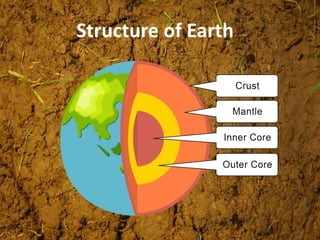
Structure of Earth
What is soil?
 Derived from latin word “Solum”
 Study called as Soil science, Pedology, Edaphology.
 Weathered material of earth’s crust which is mixed with organic
material in which micro-organisms live and plants grow
 Significance:
 Natural habitat for plants, animals, micro-organisms.
 Ultimate source of food production.
 helpful for agriculture, horticulture, Forestry.
 Important for Geology, Petrology, Mineralogy, Paleobotany,
Paleozoology.
How is Soil Produced?
• Soil: Stratified mixture of organic and inorganic
materials which are decomposition products.
• Inorganic material derived from Weathering of
parent rocks and minerals.
• Organic material derived from decomposition/
Metabolic actions of living organisms.
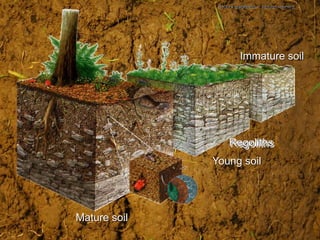
• Soil formation – complex process, takes place in
two steps
1) Weathering:
Breakdown of soil forming rocks into regoliths
by some physical, Chemical or Biological agents.
2) Pedogenesis:
Regoliths by various processes develop in mature
soil
Mature soil
Young soil
Regoliths
Immature soil
Soil Forming Rocks
• 1) Igneous Rocks:
– Formed due to cooling of molten magma or lava.
– E.g. Granite, Diorite, Basalt
• 2) Sedimentary Rocks :
– Formed from decomposition of weathering minerals
of Igneous rocks.
– E.g. Shales, Sandstones, Limestone
• 3) Metamorphic Rocks :
– Formed by change of pr-existing rocks through heat
and pressure.
– E. g. Gneiss, Slate, Quartzite, Marble
Physical Weathering:
• Mechanical or physical weathering involves the breakdown
of rocks and soils through direct contact with atmospheric
conditions such as heat, water, ice and pressure.
• Commonly occurs in desserts, high altitude, high latitude
and in localities with marked topographic relief and sparse
vegetation cover.
• Chemical composition of the rock does not change
• Agents:
Temperature Water
Ice Gravity
Wind
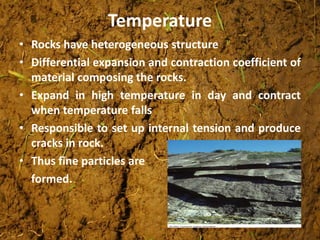
Temperature
• Rocks have heterogeneous structure
• Differential expansion and contraction coefficient of
material composing the rocks.
• Expand in high temperature in day and contract
when temperature falls
• Responsible to set up internal tension and produce
cracks in rock.
• Thus fine particles are
formed.
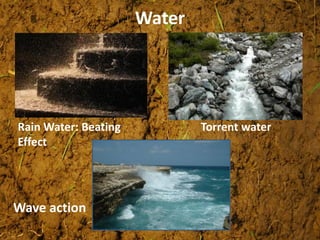
Water
Rain Water: Beating
Effect
Torrent water
Wave action
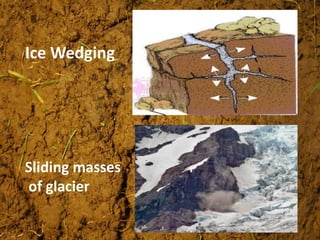
Ice Wedging
Sliding masses
of glacier
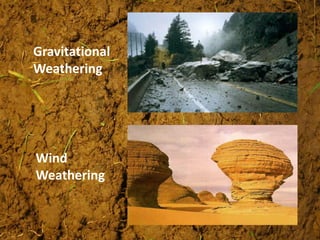
Gravitational
Weathering
Wind
Weathering
Chemical Weathering
• Chemical decomposition of parent material
in to the new mineral complexes takes place.
• Require moisture and air.
• Types:
– Oxidation
– Hydrolysis
– Carbonation
– Organic Acids
– Acid Rain
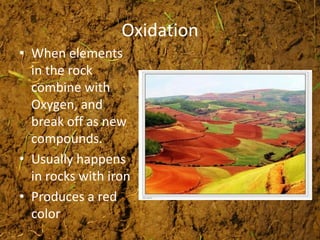
Oxidation
• When elements
in the rock
combine with
Oxygen, and
break off as new
compounds.
• Usually happens
in rocks with iron
• Produces a red
color
Hydrolysis
• When chemicals in the rock react with water,
causing some of the minerals to break away
from the rock.
• Often happens with metals like Potassium &
Aluminum
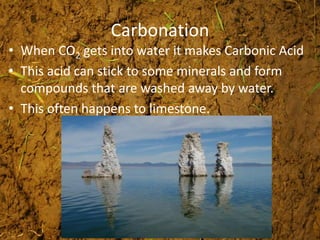
Carbonation
• When CO2 gets into water it makes Carbonic Acid
• This acid can stick to some minerals and form
compounds that are washed away by water.
• This often happens to limestone.
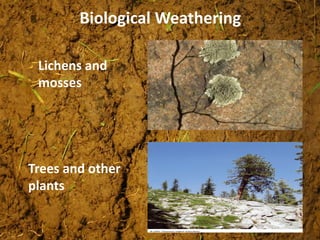
Biological Weathering
Trees and other
plants
Lichens and
mosses
Products of weathering and soil types
• Soil formed on parent bedrock : Residual / Sedentary
• The soil forming by weathering: Embryonic /Primary soil
• Soil carried to other places by carriers : Secondary /
Transported soil / Loess
• By water : Alluvial, Lacustrine ( Lake soil), Marine
deposits
• By Gravity : Colluvial soil
• Sand storms : Sand Dunes
Pedogenesis
• Decomposition and Humification:
– breakdown of plant derived material into its
simpler organic constituents. This is accomplished
by enzymes, earthworms, mites and other
organisms.
• Formation of organo-mineral complexes:
- Mature soil system becomes complex system of
living and nonliving material not inert but alive.
The basic unit of study: Soil Profiles
 Vertical section of earth crust generally up to 1.83
or up to parent rock to show different layers or
horizons of soil to study the soil in its undisturbed
state : soil profile.
• Smallest three dimensional volume needed to give
full representation of horizontal variability of soil :
Pedon / Horizon
Cont.
• Variation in Structure, thickness, consistency,
texture, porosity, colour, chemical composition.
• vary from place to place
• Depends on climate, vegetation and parent rock
• Top soil thicker in forest
• Four Horizons:
O – Organic horizons A, B, C – Mineral Horizon
R- Bed Rock or Parent rock
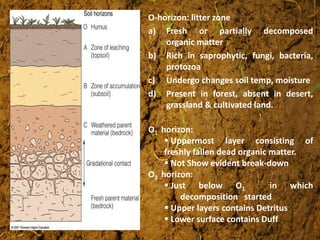
O-horizon: litter zone
a) Fresh or partially decomposed
organic matter
b) Rich in saprophytic, fungi, bacteria,
protozoa
c) Undergo changes soil temp, moisture
d) Present in forest, absent in desert,
grassland & cultivated land.
O1 horizon:
 Uppermost layer consisting of
freshly fallen dead organic matter.
 Not Show evident break-down
O2 horizon:
 Just below O1 in which
decomposition started
 Upper layers contains Detritus
 Lower surface contains Duff
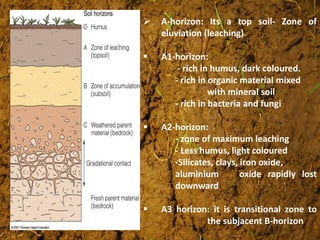
 A-horizon: Its a top soil- Zone of
eluviation (leaching)
 A1-horizon:
- rich in humus, dark coloured.
- rich in organic material mixed
with mineral soil
- rich in bacteria and fungi
 A2-horizon:
- zone of maximum leaching
- Less humus, light coloured
-Silicates, clays, iron oxide,
aluminium oxide rapidly lost
downward
 A3 horizon: it is transitional zone to
the subjacent B-horizon
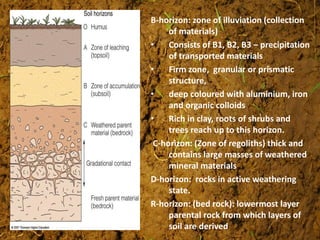
B-horizon: zone of illuviation (collection
of materials)
• Consists of B1, B2, B3 – precipitation
of transported materials
• Firm zone, granular or prismatic
structure,
• deep coloured with aluminium, iron
and organic colloids
• Rich in clay, roots of shrubs and
trees reach up to this horizon.
C-horizon: (Zone of regoliths) thick and
contains large masses of weathered
mineral materials
D-horizon: rocks in active weathering
state.
R-horizon: (bed rock): lowermost layer
parental rock from which layers of
soil are derived
Physical Properties of the Soil
1. Soil Density: Average 2.86 mg/ml, depends on degree of weathering.
2. Porosity: Percentage of soil volume occupied by pore space.
- necessary for holding water, and for the free gaseous exchange of
oxygen and carbon dioxide between the plant roots and the soil surface
- Coarse texture has more air spaces, Organic matter increases the
porosity
3. Soil temperature: is influenced by soil colour, texture, water
content, also by altitude and slope.
– Affected by climate and vegetation type.
– Greatly affects physico-chemical and biological processes in the soil
4. Soil water:
- Acts as solvent and transporting agent for many minerals
and organic materials.
- maintains the texture of soil texture, arrangement and
compactness of soil particles and makes the soil liveable for
plants and animals
Types of soil water-
1. Gravitational water:
2. Hygroscopic water:
3. Capillary water:
4. Combined water:
5. Water vapour:
-The total water present in soil- holard
-Water absorbed by plant- chesard
• -Remaining water - echard
5.Permeability :
- Determines the movement of water through pore spaces.
- Higher in loose soil and lower in compact soil.
6. Soil Atmosphere :
- Gases found in pore spaces of soil profiles
- Three main gases namely: Oxygen, carbon dioxide and nitrogen.
- Different from atmospheric air with more carbon dioxide, moisture
and less oxygen.
- Influenced by temperature, wind, rainfall and pressure
- Important in growth of roots, Seed germination, and microbial
Activity.
7. Soil solution :
- Contains almost all the essential minerals
- chemical nature depends on the nature of parent matter,
organic matter and climate factors
- Primary source of inorganic nutrients for plants
- soils may be eutrophic or oligotrophic
Morphology of Soil
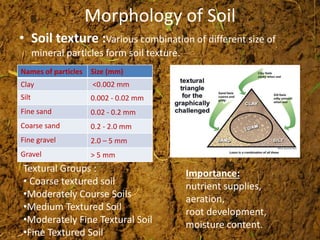
• Soil texture :Various combination of different size of
mineral particles form soil texture.
Names of particles Size (mm)
Clay <0.002 mm
Silt 0.002 - 0.02 mm
Fine sand 0.02 - 0.2 mm
Coarse sand 0.2 - 2.0 mm
Fine gravel 2.0 – 5 mm
Gravel > 5 mm
Textural Groups :
• Coarse textured soil
•Moderately Course Soils
•Medium Textured Soil
•Moderately Fine Textural Soil
•Fine Textured Soil
Importance:
nutrient supplies,
aeration,
root development,
moisture content.
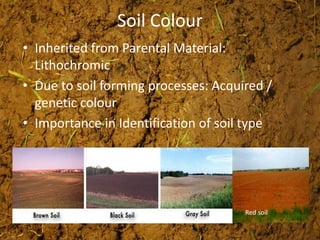
Soil Colour
• Inherited from Parental Material:
Lithochromic
• Due to soil forming processes: Acquired /
genetic colour
• Importance in Identification of soil type
Red soil
Chemical properties of soil
1. Chemical composition:.
 Inorganic: mainly Ca, Mg, Fe, Al, Si, Na, K and traces Mn, Zn,
Co, I, Cu. It influences the pH of soil
 Organic: proteins, amino acids, aromatic compounds, purine,
pyrimidines, sugar, alchohol, fats, oils, resins, waxes and
lignin.
 Organic matter and humus forms the organic compounds.
 Chemical nature of soil greatly influences the plant growth
and type of vegetation.
2. Soil pH:
- Ranges between 2.2 – 9.6.
- Influenced by mineral content, climate, weathering
and rainfall
- Determines the vegetation type of an area
- Warm and dry climate soil- Strongly basic
- Acidic soils occur in high rainfall regions (Western
ghats, Kerala, Assam),
- Affects the availability of nutrients and minerals.
- Many chemical reactions centres around the pH.
- Plants growing in the soil having pH 6.6 : Calcicoles
- Plants growing in the soil having pH 3.8 to 4.0 :
Calcifuges.
- Neutral or slightly acidic soil is best for growth of
majority of soil.
3.Soil humus:
Complex organic substance resulting from the breakdown of plant material and other
organic compounds in a process called humification. Naturally or from composting.
Types of humus: Depending on the level of decomposition, humus can be classified into
Mor, moder, mull (Muller 1879,1884)
1.Mor:
Acidic and support abundant fungal growth and low number of soil bacteria
Three layers: L, F and H layer
Low calcium content developed on sandy soils under conifers
2.Moder:
Transitional stage of decomposition (mountain grassland soils)
litter of low thickness (2-3 cm)
medium humified humus
3.Mull:
Neutral or alkaline and contain rich microflora of bacteria
Lacks distinct layering of Mor
Fully decomposed organic matter, Dark coloured
high biological activity (evergreen thick forest soil)
Soil Enzymes:
There are 50 enzymes in various types of soil.
• The main source of soil enzymes are microorganisms,
soil animals and plant roots.
• Catalyze biological reactions in the soil
• Maintain soil fertility and support plant life.
• Common enzymes are-
• Amylases (wheat roots), catalases, invertases,
dehydrogenases, phenol oxidases,
glycerophosphatases and urease (earthworm) etc.
• Saline soil have high activity of ureases
• Dehydrogenase is highest in forest soil and absent in
alkali soils.
• Soil organisms
• Plants, animals and microorganisms are also important
component of the soil
• Soil organisms play a major role in decomposition,
fertility and porosity of the soil.
Classification of soil organisms:
• Soil microflora: bacteria, fungi, algae viruses
• Soil macroflora: oxylophytes (acid), Halophytes
(saline), Psammophytes (sand), Lithophytes (rock) and
Chasmophytes (crevices)
• Soil microfauna: protozoa, nematodes,
• Soil mesofauna: micro-arthropods, insect larvae
• Soil macrofauna: insects, annelids, grasshoppers, ants,
earthworm, snakes,
The major soil types found in India
• Eight major types according to Indian Council of
Agricultural Research (ICAR).
– Alluvial soils
– Black soils
– Red soils
– Laterite soils
– Desert soils
– Mountain soils
– Saline and Alkaline soils
– Peaty and Marshy soils
• ALLUVIAL SOILS
 Covers about 40 percent of land area of the country.
 Coarser in upper section and finest in delta.
 Light to dark in colour.
 Rich in Potash & Humus.
 Poor in Phosphorous and Nitrogen.
 Highly fertile, good for all crops (kharif & rabi).
– Crops: Rice, Wheat, Sugarcane, Cotton, Jute.
– Areas: Punjab, Haryana, U.P, Bihar, W.B, Assam,
Parts of Orissa, delta regions of S.India
Types (a)Young Khadar soils: these are newer alluvium
of sandy, pale brown composition,
• (b) Old Bhangar soils: these consist ofolder
alluvium
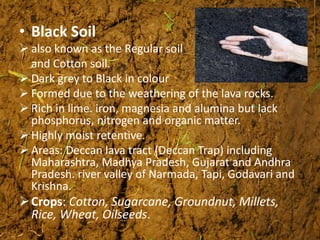
• Black Soil
 also known as the Regular soil
and Cotton soil.
 Dark grey to Black in colour
 Formed due to the weathering of the lava rocks.
 Rich in lime. iron, magnesia and alumina but lack
phosphorus, nitrogen and organic matter.
 Highly moist retentive.
 Areas: Deccan lava tract (Deccan Trap) including
Maharashtra, Madhya Pradesh, Gujarat and Andhra
Pradesh. river valley of Narmada, Tapi, Godavari and
Krishna.
Crops: Cotton, Sugarcane, Groundnut, Millets,
Rice, Wheat, Oilseeds.
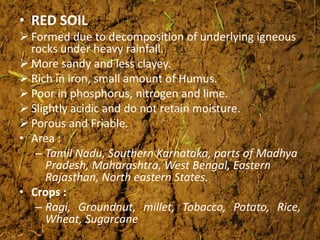
• RED SOIL
 Formed due to decomposition of underlying igneous
rocks under heavy rainfall.
 More sandy and less clayey.
 Rich in iron, small amount of Humus.
 Poor in phosphorus, nitrogen and lime.
 Slightly acidic and do not retain moisture.
 Porous and Friable.
• Area :
– Tamil Nadu, Southern Karnataka, parts of Madhya
Pradesh, Maharashtra, West Bengal, Eastern
Rajasthan, North eastern States.
• Crops :
– Ragi, Groundnut, millet, Tobacco, Potato, Rice,
Wheat, Sugarcane
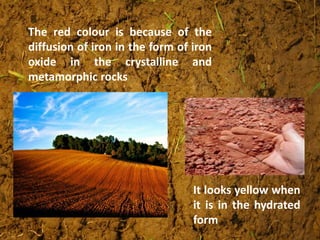
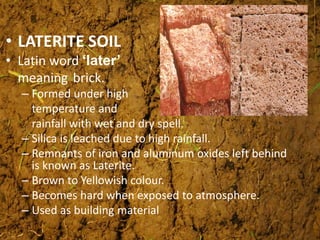
The red colour is because of the
diffusion of iron in the form of iron
oxide in the crystalline and
metamorphic rocks
It looks yellow when
it is in the hydrated
form
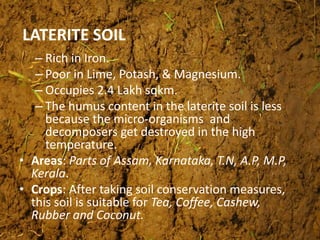
• LATERITE SOIL
• Latin word ‘later’
meaning brick.
– Formed under high
temperature and
rainfall with wet and dry spell.
– Silica is leached due to high rainfall.
– Remnants of iron and aluminum oxides left behind
is known as Laterite.
– Brown to Yellowish colour.
– Becomes hard when exposed to atmosphere.
– Used as building material
LATERITE SOIL
– Rich in Iron.
– Poor in Lime, Potash, & Magnesium.
– Occupies 2.4 Lakh sqkm.
– The humus content in the laterite soil is less
because the micro-organisms and
decomposers get destroyed in the high
temperature.
• Areas: Parts of Assam, Karnataka, T.N, A.P, M.P,
Kerala.
• Crops: After taking soil conservation measures,
this soil is suitable for Tea, Coffee, Cashew,
Rubber and Coconut.
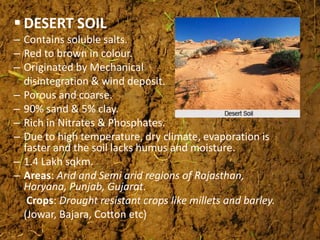
 DESERT SOIL
– Contains soluble salts.
– Red to brown in colour.
– Originated by Mechanical
disintegration & wind deposit.
– Porous and coarse.
– 90% sand & 5% clay.
– Rich in Nitrates & Phosphates.
– Due to high temperature, dry climate, evaporation is
faster and the soil lacks humus and moisture.
– 1.4 Lakh sqkm.
– Areas: Arid and Semi arid regions of Rajasthan,
Haryana, Punjab, Gujarat.
– Crops: Drought resistant crops like millets and barley.
(Jowar, Bajara, Cotton etc)
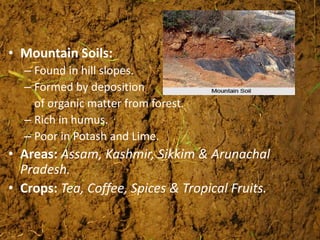
• Mountain Soils:
– Found in hill slopes.
– Formed by deposition
of organic matter from forest.
– Rich in humus.
– Poor in Potash and Lime.
• Areas: Assam, Kashmir, Sikkim & Arunachal
Pradesh.
• Crops: Tea, Coffee, Spices & Tropical Fruits.
SALINE & ALKALINE SOIL
– Contains salts like Sodium, Magnesium, Calcium.
– Infertile, unfit for cultivation.
– Sandy to loamy in texture.
• Areas:
– Parts of Gujarat, Rajasthan, Punjab, Haryana, U.P &
Maharashtra.
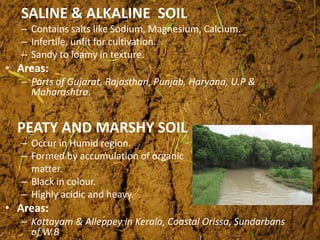
PEATY AND MARSHY SOIL
– Occur in Humid region.
– Formed by accumulation of organic
matter.
– Black in colour.
– Highly acidic and heavy.
• Areas:
– Kottayam & Alleppey in Kerala, Coastal Orissa, Sundarbans
of W.B
• Top layer of the soil is the feeding zone of the plant
• Soil is not inert matter of minerals, indeed healthy
soil is alive.
• Term derived from latin word “erodere” (tearing
away).
• Rama Rao (1962) : Creeping death of the soil.
• Odum (1966) : Part of soil pollution.
Soil Erosion
• Cont.
• Physical detachment of soil particles from their original
place and transporting these particles to another place.
• Weathering vs. Erosion:
Weathering occurs in situ, or "with no movement", and
thus should not to be confused with erosion, which
involves the movement and disintegration of rocks and
minerals by agents such as water, ice, wind, and
gravity.
Agents of Soil Erosion
 Removal of top soil by different agents.
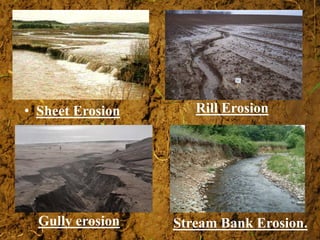
1. Water erosion
Sheet erosion, Rill erosion, Gully erosion,
Riperion (stream bank erosion).
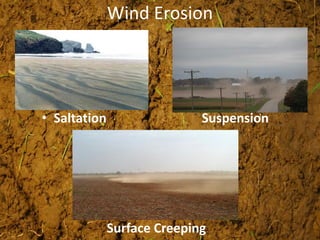
2. Wind erosion
Saltation, Suspension, Surface creep.
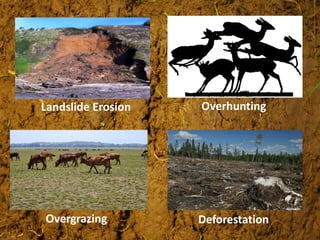
3. Landslide erosion
4.Erosion due to overgrazing, Overhunting
and deforestation
• Sheet Erosion Rill Erosion
Gully erosion Stream Bank Erosion.
Wind Erosion
• Saltation Suspension
Surface Creeping
Landslide Erosion
Overgrazing
Overhunting
Deforestation
Soil Conservation
• Protection, Improvement and sustainable
renewable of soil at any place.
• Principles:
1. Protection of soil from rain drops
2. To prevent water from concentrating and
moving down the slope
3. To encourage more water to enter soil.
4. To increase the size of soil particle.
5. Reduction in wind velocity near the ground
by growing vegetational cover.
Soil conservation methods
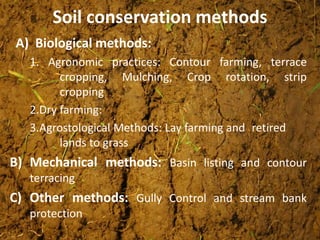
A) Biological methods:
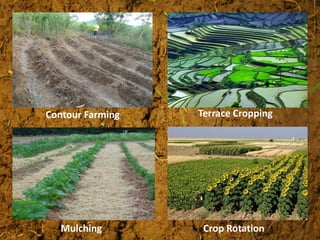
1. Agronomic practices: Contour farming, terrace
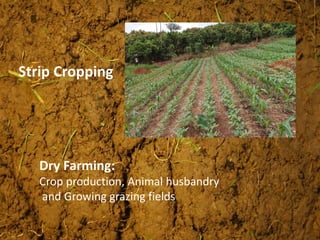
cropping, Mulching, Crop rotation, strip
cropping
2.Dry farming:
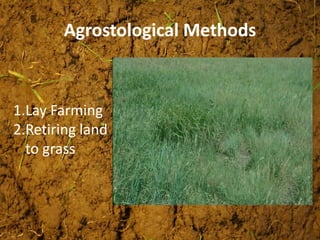
3.Agrostological Methods: Lay farming and retired
lands to grass
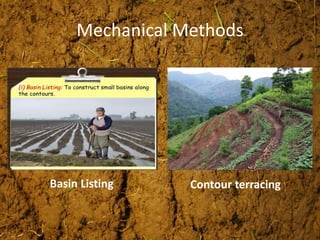
B) Mechanical methods: Basin listing and contour
terracing
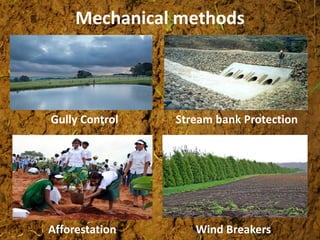
C) Other methods: Gully Control and stream bank
protection
Contour Farming Terrace Cropping
Mulching Crop Rotation
Strip Cropping
Dry Farming:
Crop production, Animal husbandry
and Growing grazing fields
Agrostological Methods
1.Lay Farming
2.Retiring land
to grass
Mechanical Methods
Basin Listing Contour terracing
Mechanical methods
Gully Control Stream bank Protection
Afforestation Wind Breakers
Edaphic Factor

Edaphic Factor

  • 1.
    Edaphic factor Dr. .R. D. Madhekar Assistant professor, Department of Botany, S. B. E. S. College of Science, Aurangabad.
  • 2.
    • Soil Formation •Soil Profile • Physicochemical Properties of Soil • Major Soil Types of India • Soil Erosion • Soil Conservation
  • 3.
  • 4.
    What is soil? Derived from latin word “Solum”  Study called as Soil science, Pedology, Edaphology.  Weathered material of earth’s crust which is mixed with organic material in which micro-organisms live and plants grow  Significance:  Natural habitat for plants, animals, micro-organisms.  Ultimate source of food production.  helpful for agriculture, horticulture, Forestry.  Important for Geology, Petrology, Mineralogy, Paleobotany, Paleozoology.
  • 5.
    How is SoilProduced? • Soil: Stratified mixture of organic and inorganic materials which are decomposition products. • Inorganic material derived from Weathering of parent rocks and minerals. • Organic material derived from decomposition/ Metabolic actions of living organisms.
  • 6.
    • Soil formation– complex process, takes place in two steps 1) Weathering: Breakdown of soil forming rocks into regoliths by some physical, Chemical or Biological agents. 2) Pedogenesis: Regoliths by various processes develop in mature soil
  • 7.
  • 8.
    Soil Forming Rocks •1) Igneous Rocks: – Formed due to cooling of molten magma or lava. – E.g. Granite, Diorite, Basalt • 2) Sedimentary Rocks : – Formed from decomposition of weathering minerals of Igneous rocks. – E.g. Shales, Sandstones, Limestone • 3) Metamorphic Rocks : – Formed by change of pr-existing rocks through heat and pressure. – E. g. Gneiss, Slate, Quartzite, Marble
  • 9.
    Physical Weathering: • Mechanicalor physical weathering involves the breakdown of rocks and soils through direct contact with atmospheric conditions such as heat, water, ice and pressure. • Commonly occurs in desserts, high altitude, high latitude and in localities with marked topographic relief and sparse vegetation cover. • Chemical composition of the rock does not change • Agents: Temperature Water Ice Gravity Wind
  • 10.
    Temperature • Rocks haveheterogeneous structure • Differential expansion and contraction coefficient of material composing the rocks. • Expand in high temperature in day and contract when temperature falls • Responsible to set up internal tension and produce cracks in rock. • Thus fine particles are formed.
  • 11.
  • 12.
  • 13.
  • 14.
    Chemical Weathering • Chemicaldecomposition of parent material in to the new mineral complexes takes place. • Require moisture and air. • Types: – Oxidation – Hydrolysis – Carbonation – Organic Acids – Acid Rain
  • 15.
    Oxidation • When elements inthe rock combine with Oxygen, and break off as new compounds. • Usually happens in rocks with iron • Produces a red color
  • 16.
    Hydrolysis • When chemicalsin the rock react with water, causing some of the minerals to break away from the rock. • Often happens with metals like Potassium & Aluminum
  • 17.
    Carbonation • When CO2gets into water it makes Carbonic Acid • This acid can stick to some minerals and form compounds that are washed away by water. • This often happens to limestone.
  • 18.
    Biological Weathering Trees andother plants Lichens and mosses
  • 19.
    Products of weatheringand soil types • Soil formed on parent bedrock : Residual / Sedentary • The soil forming by weathering: Embryonic /Primary soil • Soil carried to other places by carriers : Secondary / Transported soil / Loess • By water : Alluvial, Lacustrine ( Lake soil), Marine deposits • By Gravity : Colluvial soil • Sand storms : Sand Dunes
  • 20.
    Pedogenesis • Decomposition andHumification: – breakdown of plant derived material into its simpler organic constituents. This is accomplished by enzymes, earthworms, mites and other organisms. • Formation of organo-mineral complexes: - Mature soil system becomes complex system of living and nonliving material not inert but alive.
  • 21.
    The basic unitof study: Soil Profiles  Vertical section of earth crust generally up to 1.83 or up to parent rock to show different layers or horizons of soil to study the soil in its undisturbed state : soil profile. • Smallest three dimensional volume needed to give full representation of horizontal variability of soil : Pedon / Horizon
  • 22.
    Cont. • Variation inStructure, thickness, consistency, texture, porosity, colour, chemical composition. • vary from place to place • Depends on climate, vegetation and parent rock • Top soil thicker in forest • Four Horizons: O – Organic horizons A, B, C – Mineral Horizon R- Bed Rock or Parent rock
  • 23.
    O-horizon: litter zone a)Fresh or partially decomposed organic matter b) Rich in saprophytic, fungi, bacteria, protozoa c) Undergo changes soil temp, moisture d) Present in forest, absent in desert, grassland & cultivated land. O1 horizon:  Uppermost layer consisting of freshly fallen dead organic matter.  Not Show evident break-down O2 horizon:  Just below O1 in which decomposition started  Upper layers contains Detritus  Lower surface contains Duff
  • 24.
     A-horizon: Itsa top soil- Zone of eluviation (leaching)  A1-horizon: - rich in humus, dark coloured. - rich in organic material mixed with mineral soil - rich in bacteria and fungi  A2-horizon: - zone of maximum leaching - Less humus, light coloured -Silicates, clays, iron oxide, aluminium oxide rapidly lost downward  A3 horizon: it is transitional zone to the subjacent B-horizon
  • 25.
    B-horizon: zone ofilluviation (collection of materials) • Consists of B1, B2, B3 – precipitation of transported materials • Firm zone, granular or prismatic structure, • deep coloured with aluminium, iron and organic colloids • Rich in clay, roots of shrubs and trees reach up to this horizon. C-horizon: (Zone of regoliths) thick and contains large masses of weathered mineral materials D-horizon: rocks in active weathering state. R-horizon: (bed rock): lowermost layer parental rock from which layers of soil are derived
  • 26.
    Physical Properties ofthe Soil 1. Soil Density: Average 2.86 mg/ml, depends on degree of weathering. 2. Porosity: Percentage of soil volume occupied by pore space. - necessary for holding water, and for the free gaseous exchange of oxygen and carbon dioxide between the plant roots and the soil surface - Coarse texture has more air spaces, Organic matter increases the porosity 3. Soil temperature: is influenced by soil colour, texture, water content, also by altitude and slope. – Affected by climate and vegetation type. – Greatly affects physico-chemical and biological processes in the soil
  • 27.
    4. Soil water: -Acts as solvent and transporting agent for many minerals and organic materials. - maintains the texture of soil texture, arrangement and compactness of soil particles and makes the soil liveable for plants and animals Types of soil water- 1. Gravitational water: 2. Hygroscopic water: 3. Capillary water: 4. Combined water: 5. Water vapour: -The total water present in soil- holard -Water absorbed by plant- chesard • -Remaining water - echard
  • 28.
    5.Permeability : - Determinesthe movement of water through pore spaces. - Higher in loose soil and lower in compact soil. 6. Soil Atmosphere : - Gases found in pore spaces of soil profiles - Three main gases namely: Oxygen, carbon dioxide and nitrogen. - Different from atmospheric air with more carbon dioxide, moisture and less oxygen. - Influenced by temperature, wind, rainfall and pressure - Important in growth of roots, Seed germination, and microbial Activity. 7. Soil solution : - Contains almost all the essential minerals - chemical nature depends on the nature of parent matter, organic matter and climate factors - Primary source of inorganic nutrients for plants - soils may be eutrophic or oligotrophic
  • 29.
    Morphology of Soil •Soil texture :Various combination of different size of mineral particles form soil texture. Names of particles Size (mm) Clay <0.002 mm Silt 0.002 - 0.02 mm Fine sand 0.02 - 0.2 mm Coarse sand 0.2 - 2.0 mm Fine gravel 2.0 – 5 mm Gravel > 5 mm Textural Groups : • Coarse textured soil •Moderately Course Soils •Medium Textured Soil •Moderately Fine Textural Soil •Fine Textured Soil Importance: nutrient supplies, aeration, root development, moisture content.
  • 30.
    Soil Colour • Inheritedfrom Parental Material: Lithochromic • Due to soil forming processes: Acquired / genetic colour • Importance in Identification of soil type Red soil
  • 31.
    Chemical properties ofsoil 1. Chemical composition:.  Inorganic: mainly Ca, Mg, Fe, Al, Si, Na, K and traces Mn, Zn, Co, I, Cu. It influences the pH of soil  Organic: proteins, amino acids, aromatic compounds, purine, pyrimidines, sugar, alchohol, fats, oils, resins, waxes and lignin.  Organic matter and humus forms the organic compounds.  Chemical nature of soil greatly influences the plant growth and type of vegetation.
  • 32.
    2. Soil pH: -Ranges between 2.2 – 9.6. - Influenced by mineral content, climate, weathering and rainfall - Determines the vegetation type of an area - Warm and dry climate soil- Strongly basic - Acidic soils occur in high rainfall regions (Western ghats, Kerala, Assam), - Affects the availability of nutrients and minerals. - Many chemical reactions centres around the pH. - Plants growing in the soil having pH 6.6 : Calcicoles - Plants growing in the soil having pH 3.8 to 4.0 : Calcifuges. - Neutral or slightly acidic soil is best for growth of majority of soil.
  • 33.
    3.Soil humus: Complex organicsubstance resulting from the breakdown of plant material and other organic compounds in a process called humification. Naturally or from composting. Types of humus: Depending on the level of decomposition, humus can be classified into Mor, moder, mull (Muller 1879,1884) 1.Mor: Acidic and support abundant fungal growth and low number of soil bacteria Three layers: L, F and H layer Low calcium content developed on sandy soils under conifers 2.Moder: Transitional stage of decomposition (mountain grassland soils) litter of low thickness (2-3 cm) medium humified humus 3.Mull: Neutral or alkaline and contain rich microflora of bacteria Lacks distinct layering of Mor Fully decomposed organic matter, Dark coloured high biological activity (evergreen thick forest soil)
  • 34.
    Soil Enzymes: There are50 enzymes in various types of soil. • The main source of soil enzymes are microorganisms, soil animals and plant roots. • Catalyze biological reactions in the soil • Maintain soil fertility and support plant life. • Common enzymes are- • Amylases (wheat roots), catalases, invertases, dehydrogenases, phenol oxidases, glycerophosphatases and urease (earthworm) etc. • Saline soil have high activity of ureases • Dehydrogenase is highest in forest soil and absent in alkali soils.
  • 35.
    • Soil organisms •Plants, animals and microorganisms are also important component of the soil • Soil organisms play a major role in decomposition, fertility and porosity of the soil. Classification of soil organisms: • Soil microflora: bacteria, fungi, algae viruses • Soil macroflora: oxylophytes (acid), Halophytes (saline), Psammophytes (sand), Lithophytes (rock) and Chasmophytes (crevices) • Soil microfauna: protozoa, nematodes, • Soil mesofauna: micro-arthropods, insect larvae • Soil macrofauna: insects, annelids, grasshoppers, ants, earthworm, snakes,
  • 36.
    The major soiltypes found in India • Eight major types according to Indian Council of Agricultural Research (ICAR). – Alluvial soils – Black soils – Red soils – Laterite soils – Desert soils – Mountain soils – Saline and Alkaline soils – Peaty and Marshy soils
  • 37.
    • ALLUVIAL SOILS Covers about 40 percent of land area of the country.  Coarser in upper section and finest in delta.  Light to dark in colour.  Rich in Potash & Humus.  Poor in Phosphorous and Nitrogen.  Highly fertile, good for all crops (kharif & rabi). – Crops: Rice, Wheat, Sugarcane, Cotton, Jute. – Areas: Punjab, Haryana, U.P, Bihar, W.B, Assam, Parts of Orissa, delta regions of S.India Types (a)Young Khadar soils: these are newer alluvium of sandy, pale brown composition, • (b) Old Bhangar soils: these consist ofolder alluvium
  • 38.
    • Black Soil also known as the Regular soil and Cotton soil.  Dark grey to Black in colour  Formed due to the weathering of the lava rocks.  Rich in lime. iron, magnesia and alumina but lack phosphorus, nitrogen and organic matter.  Highly moist retentive.  Areas: Deccan lava tract (Deccan Trap) including Maharashtra, Madhya Pradesh, Gujarat and Andhra Pradesh. river valley of Narmada, Tapi, Godavari and Krishna. Crops: Cotton, Sugarcane, Groundnut, Millets, Rice, Wheat, Oilseeds.
  • 39.
    • RED SOIL Formed due to decomposition of underlying igneous rocks under heavy rainfall.  More sandy and less clayey.  Rich in iron, small amount of Humus.  Poor in phosphorus, nitrogen and lime.  Slightly acidic and do not retain moisture.  Porous and Friable. • Area : – Tamil Nadu, Southern Karnataka, parts of Madhya Pradesh, Maharashtra, West Bengal, Eastern Rajasthan, North eastern States. • Crops : – Ragi, Groundnut, millet, Tobacco, Potato, Rice, Wheat, Sugarcane
  • 40.
    The red colouris because of the diffusion of iron in the form of iron oxide in the crystalline and metamorphic rocks It looks yellow when it is in the hydrated form
  • 41.
    • LATERITE SOIL •Latin word ‘later’ meaning brick. – Formed under high temperature and rainfall with wet and dry spell. – Silica is leached due to high rainfall. – Remnants of iron and aluminum oxides left behind is known as Laterite. – Brown to Yellowish colour. – Becomes hard when exposed to atmosphere. – Used as building material
  • 42.
    LATERITE SOIL – Richin Iron. – Poor in Lime, Potash, & Magnesium. – Occupies 2.4 Lakh sqkm. – The humus content in the laterite soil is less because the micro-organisms and decomposers get destroyed in the high temperature. • Areas: Parts of Assam, Karnataka, T.N, A.P, M.P, Kerala. • Crops: After taking soil conservation measures, this soil is suitable for Tea, Coffee, Cashew, Rubber and Coconut.
  • 43.
     DESERT SOIL –Contains soluble salts. – Red to brown in colour. – Originated by Mechanical disintegration & wind deposit. – Porous and coarse. – 90% sand & 5% clay. – Rich in Nitrates & Phosphates. – Due to high temperature, dry climate, evaporation is faster and the soil lacks humus and moisture. – 1.4 Lakh sqkm. – Areas: Arid and Semi arid regions of Rajasthan, Haryana, Punjab, Gujarat. – Crops: Drought resistant crops like millets and barley. (Jowar, Bajara, Cotton etc)
  • 44.
    • Mountain Soils: –Found in hill slopes. – Formed by deposition of organic matter from forest. – Rich in humus. – Poor in Potash and Lime. • Areas: Assam, Kashmir, Sikkim & Arunachal Pradesh. • Crops: Tea, Coffee, Spices & Tropical Fruits.
  • 45.
    SALINE & ALKALINESOIL – Contains salts like Sodium, Magnesium, Calcium. – Infertile, unfit for cultivation. – Sandy to loamy in texture. • Areas: – Parts of Gujarat, Rajasthan, Punjab, Haryana, U.P & Maharashtra. PEATY AND MARSHY SOIL – Occur in Humid region. – Formed by accumulation of organic matter. – Black in colour. – Highly acidic and heavy. • Areas: – Kottayam & Alleppey in Kerala, Coastal Orissa, Sundarbans of W.B
  • 46.
    • Top layerof the soil is the feeding zone of the plant • Soil is not inert matter of minerals, indeed healthy soil is alive. • Term derived from latin word “erodere” (tearing away). • Rama Rao (1962) : Creeping death of the soil. • Odum (1966) : Part of soil pollution. Soil Erosion
  • 47.
    • Cont. • Physicaldetachment of soil particles from their original place and transporting these particles to another place. • Weathering vs. Erosion: Weathering occurs in situ, or "with no movement", and thus should not to be confused with erosion, which involves the movement and disintegration of rocks and minerals by agents such as water, ice, wind, and gravity.
  • 48.
    Agents of SoilErosion  Removal of top soil by different agents. 1. Water erosion Sheet erosion, Rill erosion, Gully erosion, Riperion (stream bank erosion). 2. Wind erosion Saltation, Suspension, Surface creep. 3. Landslide erosion 4.Erosion due to overgrazing, Overhunting and deforestation
  • 49.
    • Sheet ErosionRill Erosion Gully erosion Stream Bank Erosion.
  • 50.
    Wind Erosion • SaltationSuspension Surface Creeping
  • 51.
  • 52.
    Soil Conservation • Protection,Improvement and sustainable renewable of soil at any place. • Principles: 1. Protection of soil from rain drops 2. To prevent water from concentrating and moving down the slope 3. To encourage more water to enter soil. 4. To increase the size of soil particle. 5. Reduction in wind velocity near the ground by growing vegetational cover.
  • 53.
    Soil conservation methods A)Biological methods: 1. Agronomic practices: Contour farming, terrace cropping, Mulching, Crop rotation, strip cropping 2.Dry farming: 3.Agrostological Methods: Lay farming and retired lands to grass B) Mechanical methods: Basin listing and contour terracing C) Other methods: Gully Control and stream bank protection
  • 54.
    Contour Farming TerraceCropping Mulching Crop Rotation
  • 55.
    Strip Cropping Dry Farming: Cropproduction, Animal husbandry and Growing grazing fields
  • 56.
  • 57.
  • 58.
    Mechanical methods Gully ControlStream bank Protection Afforestation Wind Breakers