POTASSIUM (K) FIXATION IN DIFFERENT CLAY
MINERALS
CONTENTS
• Potassium
• Forms of potassium
• Fixation of potassium
• Relation to clay minerals
• Factor affecting potassium fixation
• Practical implications of fixed potassium
• References
POTASSIUM (K)
• K Constitutes About 2.5% Of Earth Crusts, The Seventh Abundant Element And Fourth Abundant
Mineral. It Is Found In Large Concentration 1-5% In Plants.
• Roles Of K+ In Plants
• Osmotic Regulation,
• Translocation Of Assimilates,
• Metabolic Processes,
• Improving Quality Of Fruits, Flowers And Vegetables,
• Imparting Resistance To Disease, Pests And Environmental Stress.
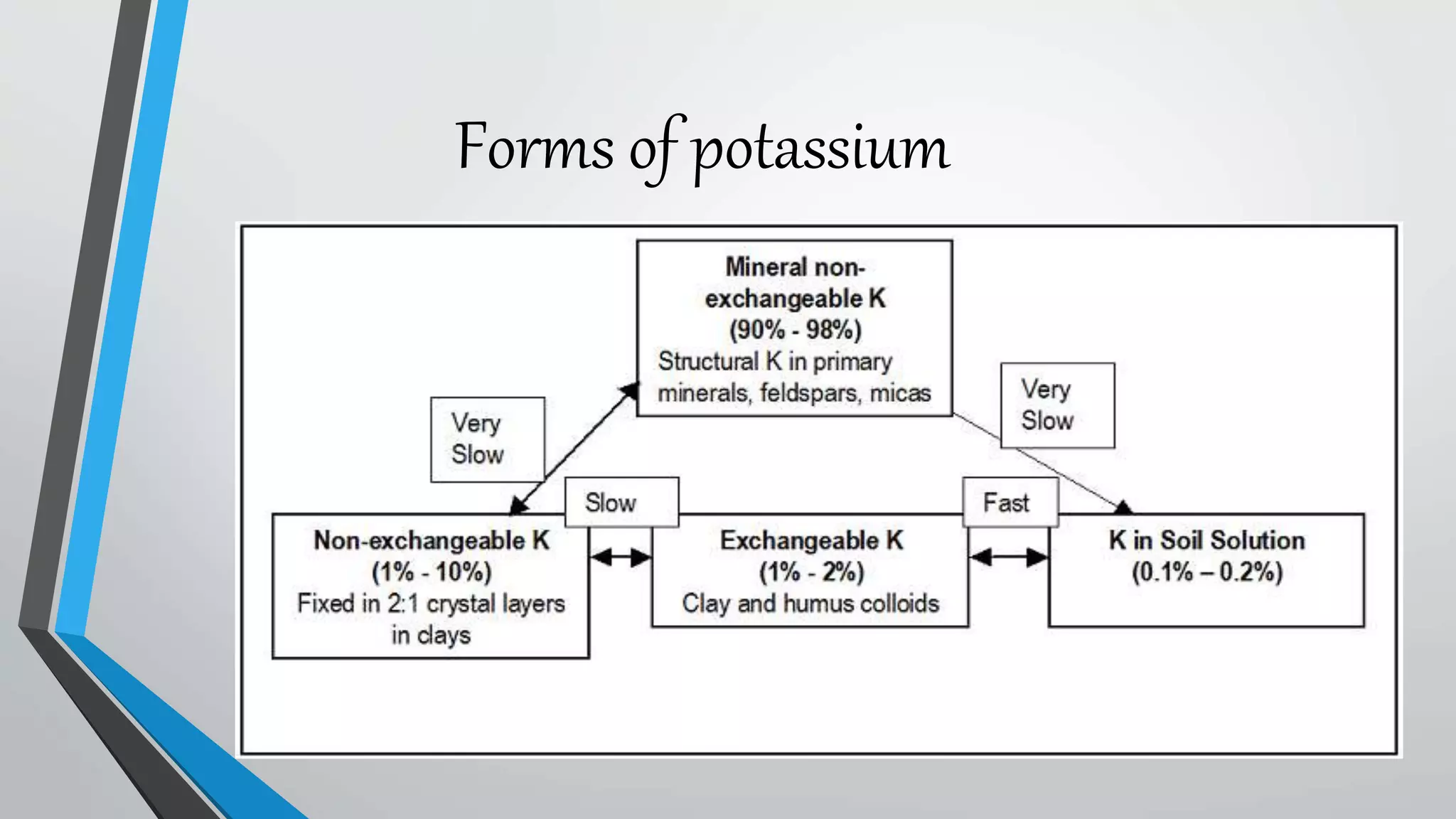
Forms of potassium
FIXATION OF POTASSIUM
• Fixation Of Potassium Was First Reported By Kellner In 1887 And Dyer In 1894
• The K Which Penetrates The Intermicellar And Gets Fit Snugly Into The Holes And such are held
tightly as they come in contact.
• Becomes Relatively Nonexchangeable Called Fixed (Rich 1968, Bolt Et Al 1976, Van Der Marel
1959)
LATTICE HOLE THEORY
•According to PAGE AND BAVER,1940, the exposed surface and surfaces
between sheets of 2:1 layer mineral consist of oxygen ions, arranged
hexagonally.
•The opening within the hexagon is equal to the diameter of an oxygen ion (2.8Å).
•Any cation(K) with similar size can get fitted
EXPANDIBLE LAYER SILICATE
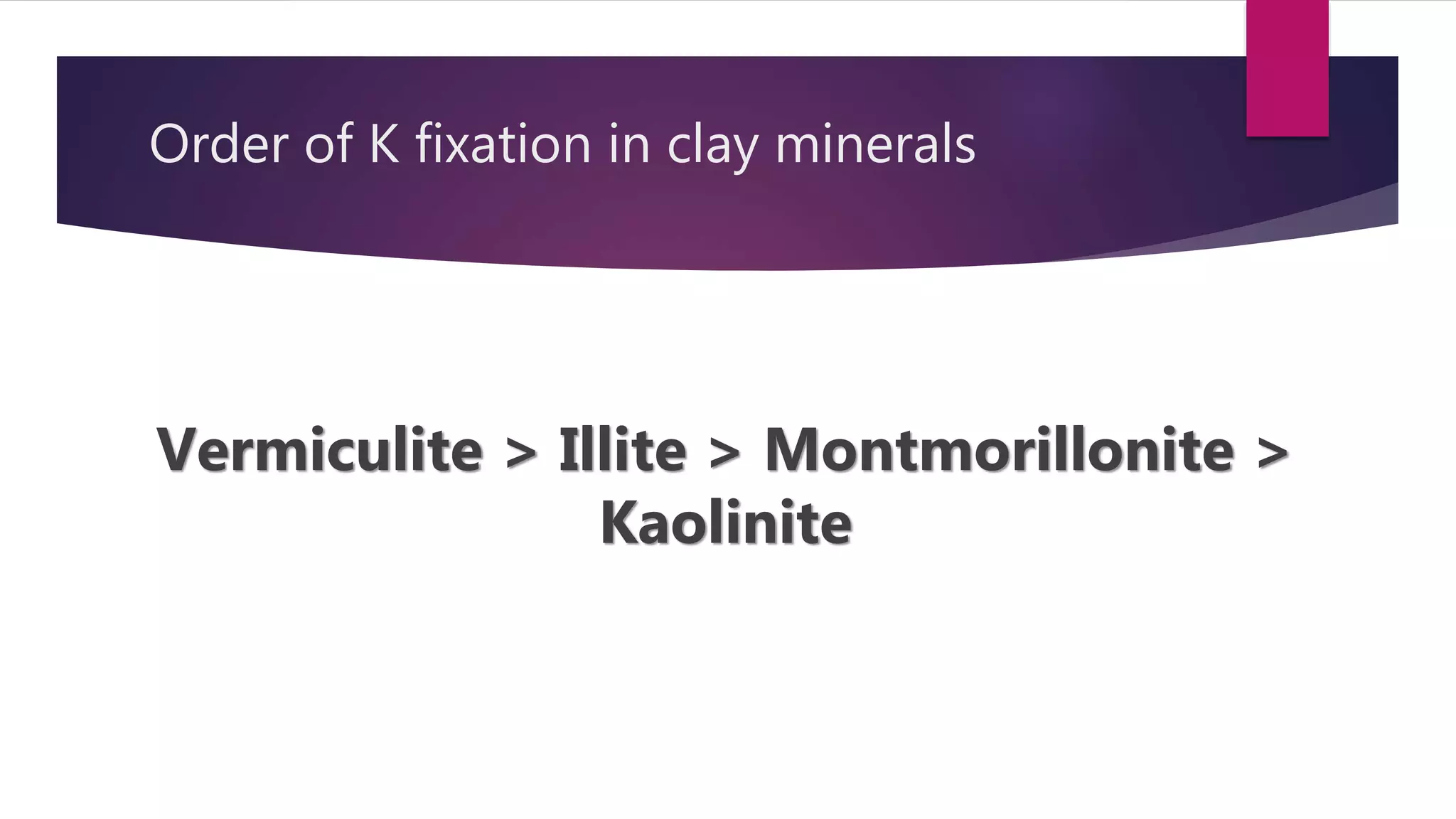
Order of K fixation in clay minerals
Vermiculite > Illite > Montmorillonite >
Kaolinite
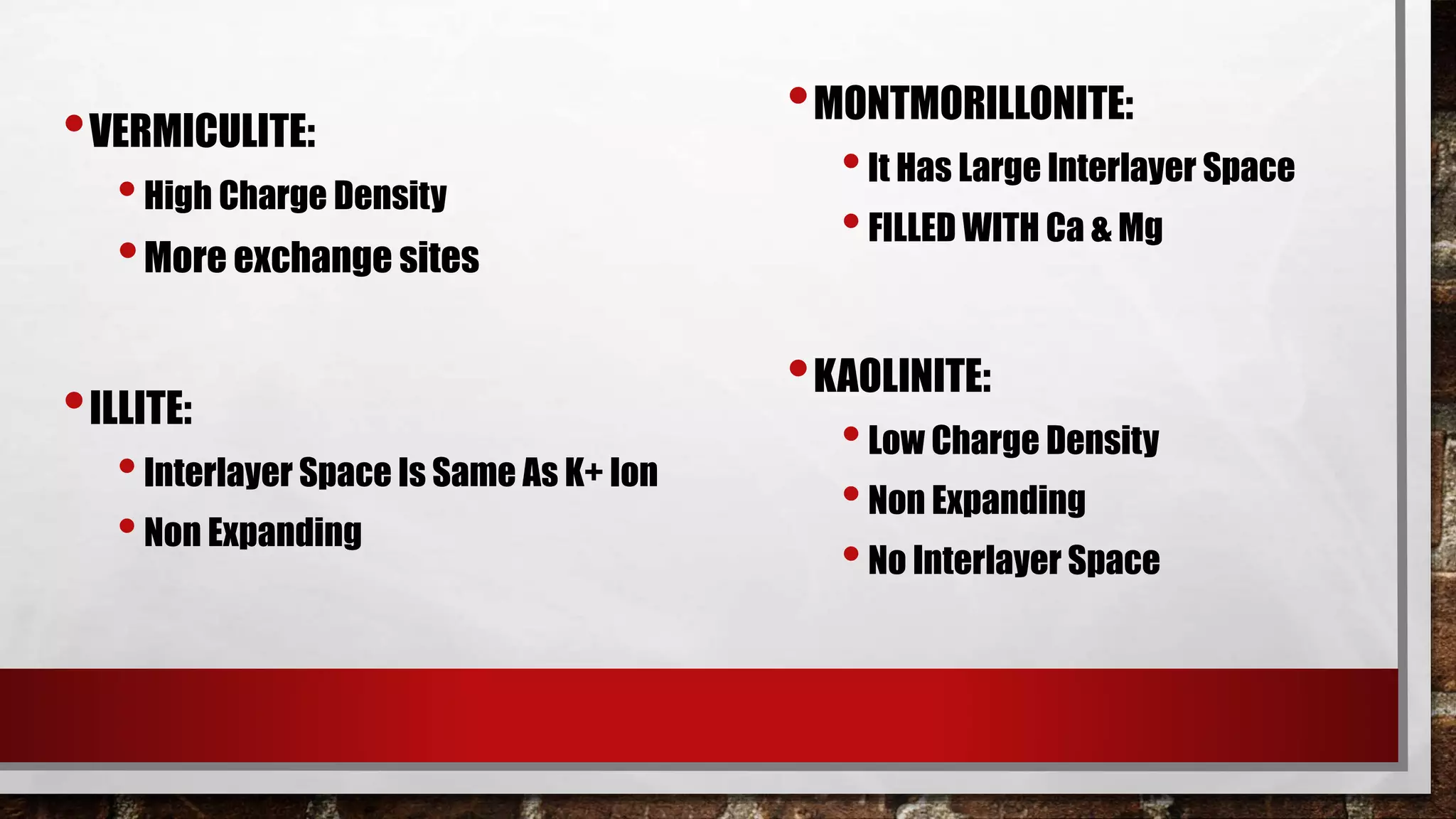
•VERMICULITE:
•High Charge Density
•More exchange sites
•ILLITE:
•Interlayer Space Is Same As K+ Ion
•Non Expanding
•MONTMORILLONITE:
•It Has Large Interlayer Space
•FILLED WITH Ca & Mg
•KAOLINITE:
•Low Charge Density
•Non Expanding
•No Interlayer Space
FACTORS AFFECTING POTASSIUM FIXATION
• CHARGE DENSITY OF CLAY:
Vermiculites fix more potassium compared to smectites due to
internal charge density.
• EXTENT OF WEDGE ZONE:
Deeper the wedge zone higher the amount of potassium fixed.
• SOLUTION CONCENTRATION
The solution K+ concentration affects the equilibrium between
exchangeable and fixed K+ in soil.
• NATURE AND CONCENTRATION OF OTHER CATIONS
The presence of cations like NH4+ (2.86Å) and Rb+(2.96Å) compete
with the K+ ion for interlayer space.
PRACTICAL IMPLICATION OF FIXED K+
• TISDALAND NELSON (1975) Said That Potassium Fixation Is A Process Of Conserving
Potassium In Nature.
• Non Exchangeable K+ Contributes Substantially To K+ Availability In Soils.
• HAYLOCKS (1956) Introduced Terms Of “STEP-K” And “CONSTANT RATE K” As A
Measure Of Potassium Reserve In Soils.
REFERENCES
• FUNDAMENTALS OF SOIL SCIENCE – ISSS (A.SUBBA RAO, M.S.BRAR)
• INTRODUCTORY SOIL SCIENCE – D.K DAS
potassium  fixation in different clay minerals

potassium fixation in different clay minerals

  • 1.
    POTASSIUM (K) FIXATIONIN DIFFERENT CLAY MINERALS
  • 2.
    CONTENTS • Potassium • Formsof potassium • Fixation of potassium • Relation to clay minerals • Factor affecting potassium fixation • Practical implications of fixed potassium • References
  • 3.
    POTASSIUM (K) • KConstitutes About 2.5% Of Earth Crusts, The Seventh Abundant Element And Fourth Abundant Mineral. It Is Found In Large Concentration 1-5% In Plants. • Roles Of K+ In Plants • Osmotic Regulation, • Translocation Of Assimilates, • Metabolic Processes, • Improving Quality Of Fruits, Flowers And Vegetables, • Imparting Resistance To Disease, Pests And Environmental Stress.
  • 4.
  • 5.
    FIXATION OF POTASSIUM •Fixation Of Potassium Was First Reported By Kellner In 1887 And Dyer In 1894 • The K Which Penetrates The Intermicellar And Gets Fit Snugly Into The Holes And such are held tightly as they come in contact. • Becomes Relatively Nonexchangeable Called Fixed (Rich 1968, Bolt Et Al 1976, Van Der Marel 1959)
  • 6.
    LATTICE HOLE THEORY •Accordingto PAGE AND BAVER,1940, the exposed surface and surfaces between sheets of 2:1 layer mineral consist of oxygen ions, arranged hexagonally. •The opening within the hexagon is equal to the diameter of an oxygen ion (2.8Å). •Any cation(K) with similar size can get fitted
  • 7.
  • 8.
    Order of Kfixation in clay minerals Vermiculite > Illite > Montmorillonite > Kaolinite
  • 10.
    •VERMICULITE: •High Charge Density •Moreexchange sites •ILLITE: •Interlayer Space Is Same As K+ Ion •Non Expanding •MONTMORILLONITE: •It Has Large Interlayer Space •FILLED WITH Ca & Mg •KAOLINITE: •Low Charge Density •Non Expanding •No Interlayer Space
  • 11.
    FACTORS AFFECTING POTASSIUMFIXATION • CHARGE DENSITY OF CLAY: Vermiculites fix more potassium compared to smectites due to internal charge density. • EXTENT OF WEDGE ZONE: Deeper the wedge zone higher the amount of potassium fixed.
  • 12.
    • SOLUTION CONCENTRATION Thesolution K+ concentration affects the equilibrium between exchangeable and fixed K+ in soil. • NATURE AND CONCENTRATION OF OTHER CATIONS The presence of cations like NH4+ (2.86Å) and Rb+(2.96Å) compete with the K+ ion for interlayer space.
  • 13.
    PRACTICAL IMPLICATION OFFIXED K+ • TISDALAND NELSON (1975) Said That Potassium Fixation Is A Process Of Conserving Potassium In Nature. • Non Exchangeable K+ Contributes Substantially To K+ Availability In Soils. • HAYLOCKS (1956) Introduced Terms Of “STEP-K” And “CONSTANT RATE K” As A Measure Of Potassium Reserve In Soils.
  • 14.
    REFERENCES • FUNDAMENTALS OFSOIL SCIENCE – ISSS (A.SUBBA RAO, M.S.BRAR) • INTRODUCTORY SOIL SCIENCE – D.K DAS