James Wagner
What Will Be Covered?
 Chapter 3: Soil Science
 Chapter 4: Water Management
 Chapter 5: Tree Nutrition and Fertilization
Soil
 Substrate of Rock, Sand, Silt and Clay
 Organic Matter
 Water & Air
Soil
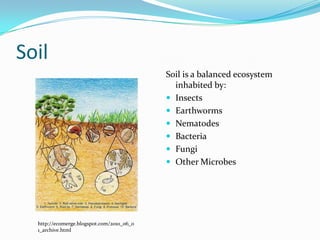
                                           Soil is a balanced ecosystem
                                             inhabited by:
                                            Insects
                                            Earthworms
                                            Nematodes
                                            Bacteria
                                            Fungi
                                            Other Microbes


  http://ecomerge.blogspot.com/2010_06_0
  1_archive.html
Soil
Soil provides plants with:
 Root support
 Nutrients
 Water
 Gas exchange (O2 & CO2)
Soil
Soil ecology can differ due to:
 Underlying geology
 Geographic location
 Climate
 What types of plants grow there
Physical Properties
 Soils are the result of the weathering of parent
  material over a long period of time.
 Geology influences soil. Weathered rock–Sediment
  from waterways.
Physical Properties
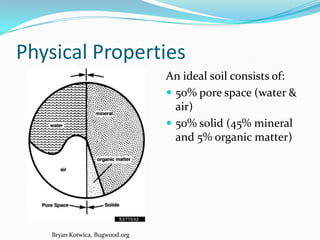
                                 An ideal soil consists of:
                                  50% pore space (water &
                                   air)
                                  50% solid (45% mineral
                                   and 5% organic matter)


    Bryan Kotwica, Bugwood.org
Physical Properties
Soil Profile
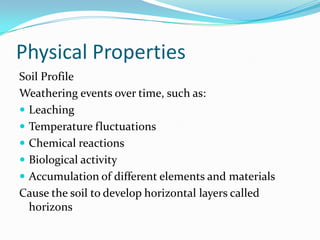
Weathering events over time, such as:
 Leaching
 Temperature fluctuations
 Chemical reactions
 Biological activity
 Accumulation of different elements and materials
Cause the soil to develop horizontal layers called
  horizons
Physical Properties
Soil Profile
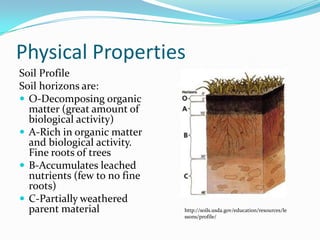
Soil horizons are:
 O-Decomposing organic
  matter (great amount of
  biological activity)
 A-Rich in organic matter
  and biological activity.
  Fine roots of trees
 B-Accumulates leached
  nutrients (few to no fine
  roots)
 C-Partially weathered
  parent material             http://soils.usda.gov/education/resources/le
                              ssons/profile/
Physical Properties
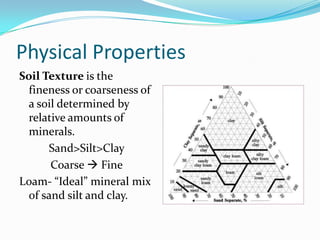
Soil Texture is the
  fineness or coarseness of
  a soil determined by
  relative amounts of
  minerals.
      Sand>Silt>Clay
       Coarse  Fine
Loam- “Ideal” mineral mix
  of sand silt and clay.
Physical Properties
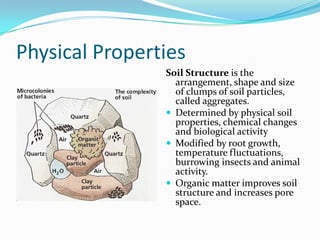
                Soil Structure is the
                  arrangement, shape and size
                  of clumps of soil particles,
                  called aggregates.
                 Determined by physical soil
                  properties, chemical changes
                  and biological activity
                 Modified by root growth,
                  temperature fluctuations,
                  burrowing insects and animal
                  activity.
                 Organic matter improves soil
                  structure and increases pore
                  space.
Physical Properties
 Soil structure helps determine the amount of macropores
    (air movement or gas exchange) and micropores (water
    retention) a soil contains because pore space occurs within
    and between aggregates.
   Soil Texture influences pore space due to particle size.
    Sandy soils tend to have more macropores and less
    micropores than soils with more clay.
   Bulk Density measures the mass of the soil per unit of
    dried soil volume. Bulk density can be used as an indicator
    of pore space and soil compaction.
   Greater bulk density=more micropores than macropores
   Different soil textures have different ranges of bulk density
Physical Properties
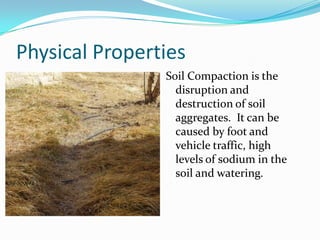
                Soil Compaction is the
                  disruption and
                  destruction of soil
                  aggregates. It can be
                  caused by foot and
                  vehicle traffic, high
                  levels of sodium in the
                  soil and watering.
Physical Properties
Soil compaction
 Reduces water infiltration and availability
 Root growth
 Gas exchange
 Biological activity
Chemical Properties
Soil pH
 Measure of soil acidity or alkalinity
 Many effects on soil ecology and soil chemistry
 Greatly affects the availability of soil mineral nutrients
  to plants
 Difficult to alter due to soil buffering capacity
Chemical Properties
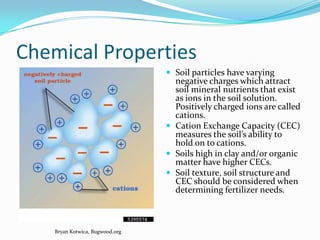
                                  Soil particles have varying
                                   negative charges which attract
                                   soil mineral nutrients that exist
                                   as ions in the soil solution.
                                   Positively charged ions are called
                                   cations.
                                  Cation Exchange Capacity (CEC)
                                   measures the soil’s ability to
                                   hold on to cations.
                                  Soils high in clay and/or organic
                                   matter have higher CECs.
                                  Soil texture, soil structure and
                                   CEC should be considered when
                                   determining fertilizer needs.


    Bryan Kotwica, Bugwood.org
Chemical Properties
 Saline soils occur when a soil have excess levels of
  soluble salts which can be toxic to plants
 Sodic soils have excess levels of sodium which raises
  the soil pH and destroys the soil structure.
Biological Activity
 Animals, insects, bacteria, fungi and other organisms help
    cycle nutrients through the soil and help decompose
    organic matter.
   The rhizosphere is a microzone of intense biological
    activity surrounding actively elongating roots. This
    environment can be very different from the surrounding
    soil.
   Mycorrhizae-certain fungi can form beneficial symbiotic
    relationships with tree roots
   Actinomycetes are soil-dwelling bacteria that play a critical
    role in the decomposition of organic matter
   Certain atmospheric nitrogen-fixing soil bacteria form
    beneficial relationships with certain tree roots
Soil Moisture and Plant Growth
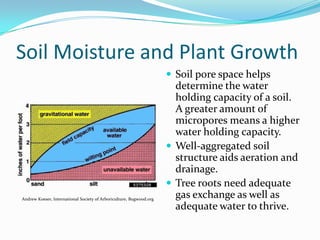
                                                                      Soil pore space helps
                                                                       determine the water
                                                                       holding capacity of a soil.
                                                                       A greater amount of
                                                                       micropores means a higher
                                                                       water holding capacity.
                                                                      Well-aggregated soil
                                                                       structure aids aeration and
                                                                       drainage.
                                                                      Tree roots need adequate
Andrew Koeser, International Society of Arboriculture, Bugwood.org
                                                                       gas exchange as well as
                                                                       adequate water to thrive.
Urban Soils
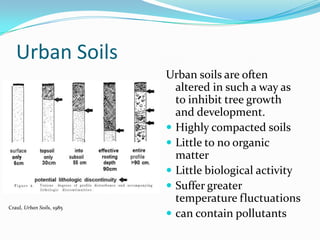
                           Urban soils are often
                             altered in such a way as
                             to inhibit tree growth
                             and development.
                            Highly compacted soils
                            Little to no organic
                             matter
                            Little biological activity
                            Suffer greater
                             temperature fluctuations
Craul, Urban Soils, 1985
                            can contain pollutants
Urban Soil Improvement
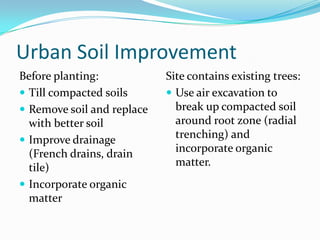
Before planting:            Site contains existing trees:
 Till compacted soils       Use air excavation to
 Remove soil and replace     break up compacted soil
  with better soil            around root zone (radial
 Improve drainage
                              trenching) and
  (French drains, drain       incorporate organic
  tile)                       matter.
 Incorporate organic
  matter
Water and Trees
 Water is vital to trees.
 Large trees can absorb hundreds of gallons of water from
    soil in a day.
   Up to 95% of the water taken up by trees can be lost
    through transpiration.
   Water use varies due to tree species, size, soil, air
    temperature, humidity, light and wind.
   Inadequate soil moisture can lead to root loss, leaf
    abscission, twig dieback and tree death.
   Too much water can result in poor nutrient uptake, poor
    root development, disease and death.
Irrigation
 Trees generally need less water than turf
 Proper tree selection and planting may reduce
  irrigation needs.
 Irrigation is most important for newly transplanted
  trees, which can need frequent irrigation
Irrigation
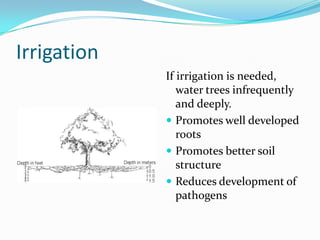
             If irrigation is needed,
                water trees infrequently
                and deeply.
              Promotes well developed
                roots
              Promotes better soil
                structure
              Reduces development of
                pathogens
Irrigation
 Shallow, frequent watering can lead to poor root
 development, soil compaction and disease.
Irrigation Systems
 Sprinklers-When properly used they can be very
  efficient and economical. Higher potential for water
  loss due to evaporation.
 Drip-Delivers water to plant more precisely than
  sprinklers with less potential for runoff. Drip systems
  can plug so they need to be monitored.
 Other systems include soil injection, soaker hose,
  basin irrigation and temporary, portable drip systems.
Water Conservation
 Drought tolerant landscaping (Xeriscaping)
 Minimum irrigation-provides just enough water to
  maintain plant health, growth and appearance.
 Group plants with the same water requirements
  together on the same irrigation schedule
  (hydrozones).
 Requires an understanding of water budgets, soil and
  plant water loss, water-holding capacity, application
  rates, infiltration rate and irrigation system efficiency.
 Water needs can also be determined using soil probes,
  tensiometers and electronic moisture sensors.
Water Conservation
Recycled water used in irrigation can be effective but
 salinity, phytotoxicity and increases in soil pH are
 potential problems.
Water Conservation
The use of mulch around the base of trees can reduce
  soil moisture evaporation, as well as:
 Improve soil structure
 Improve water infiltration
 Moderate soil temperature
 Reduce weed competition
 Reduce soil compaction and erosion
 Organic mulches increase soil organic matter as they
  decompose
Water Conservation
 Soil amendments to increase water hold capacity
 Limit turf plantings
 Reduce or eliminate fertilizer applications during
  drought conditions
 Antitranspirants-for temporary use only. Long term
  use can be toxic to some plants
Flooding and Drainage
 For some tree species only a short period of flooding can be
  harmful as photosynthesis shuts down.
Drainage
 Best to establish proper drainage before planting.
 Improving the soil structure works best
 French drains, drain pipe/tiles will remove gravitational water,
  but do not make up for poor soil structure.
 With after planting drainage improvements care must be taken
  not to damage the root system.
 When irrigating, water application rate should not exceed the
  infiltration rate of the soil.
 Soil aeration can relieve some drainage problems caused by soil
  compaction.
Flooding and Drainage
 Water flow over impervious surfaces (parking lots,
  roads) can cause flooding and carry pollutants.
 “Rain gardens” to catch drainage from impervious
  surfaces can reduce storm water runoff. However
  plantings must be tolerant of flooding, pollutants and
  drought conditions.
Introduction
 Trees require certain essential elements to function
  and grow.
 An essential element (or nutrient) is a chemical
  constituent that is involved in the metabolism of the
  tree or that is necessary for the tree to complete its life
  cycle.
 In nature these elements are present, replenished and
  recycled by the decomposition of organic matter.
Introduction
In urban setting, the soil may be different because of:
 Removal of soil
 Removal of fallen leaves or other potential organic
  matter
 Lack of beneficial soil-dwelling organisms
Tree Requirements
 Trees take up essential elements dissolved in water
    through their roots. Each element plays a specific role
    and cannot be substituted by another element.
   Essential elements are divided into:
   Macroelements-needed in larger amounts
   Microelements-needed in smaller amounts
   Trees and other plants can only utilize essential
    nutrients in the form of specific ions.
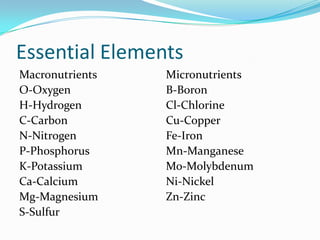
Essential Elements
Macronutrients   Micronutrients
O-Oxygen         B-Boron
H-Hydrogen       Cl-Chlorine
C-Carbon         Cu-Copper
N-Nitrogen       Fe-Iron
P-Phosphorus     Mn-Manganese
K-Potassium      Mo-Molybdenum
Ca-Calcium       Ni-Nickel
Mg-Magnesium     Zn-Zinc
S-Sulfur
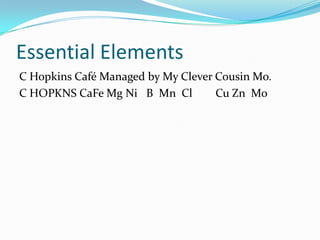
Essential Elements
C Hopkins Café Managed by My Clever Cousin Mo.
C HOPKNS CaFe Mg Ni B Mn Cl         Cu Zn Mo
Tree Requirements
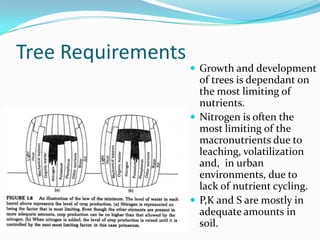
                     Growth and development
                      of trees is dependant on
                      the most limiting of
                      nutrients.
                     Nitrogen is often the
                      most limiting of the
                      macronutrients due to
                      leaching, volatilization
                      and, in urban
                      environments, due to
                      lack of nutrient cycling.
                     P,K and S are mostly in
                      adequate amounts in
                      soil.
Tree Requirements
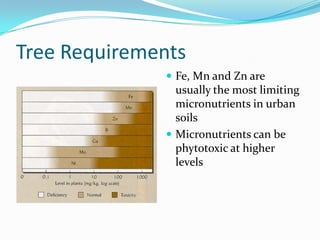
               Fe, Mn and Zn are
                usually the most limiting
                micronutrients in urban
                soils
               Micronutrients can be
                phytotoxic at higher
                levels
Tree Requirements
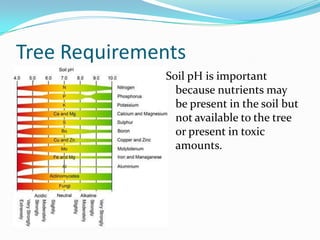
              Soil pH is important
                because nutrients may
                be present in the soil but
                not available to the tree
                or present in toxic
                amounts.
Fertilizer
                                                    Available in many forms
                                                    Complete fertilizer
                                                     contains N, P and K.
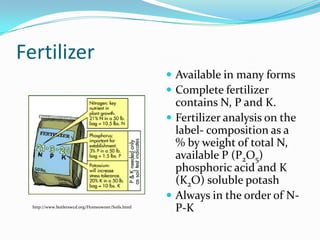
                                                    Fertilizer analysis on the
                                                     label- composition as a
                                                     % by weight of total N,
                                                     available P (P2O5)
                                                     phosphoric acid and K
                                                     (K2O) soluble potash
                                                    Always in the order of N-
  http://www.butlerswcd.org/Homeowner/Soils.html
                                                     P-K
Fertilizer
 Because phosphoric acid contains 44% P and soluble
    potash contains 83% K, the percent P and K on the
    label must be multiplied by .44 and .83, respectively to
    calculate the percent amount of P and K. For example:
    A 50 lbs. bag of 10-6-4 fertilizer contains
   5 lbs. N
   3 lbs. P
   2 lbs K
   Complete fertilizers are not always needed
Fertilizer
 May be organic or inorganic
 Inorganic fertilizers release their elements quickly so
  they are available to plants quickly
 They may “burn” the plants and are susceptible to
  leaching and volatilization.
 Organic fertilizers are composed of naturally occurring
  or synthetic carbon-based molecules that must
  decompose in the soil to release their elements.
Fertilizer
Slow release fertilizers are a preferred choice for
  fertilizing trees, either with organic fertilizers or
  coated inorganic fertilizers.
Fertilizer
Application rates
Depends on age, health, species, form of fertilizer,
 application method, site conditions and desired goal.
Fertilizer
Prescription fertilization
 Based on soil tests and foliar analysis
 Determines the amount and availability of essential
  nutrients in the soil and how deficient the tree is in
  specific nutrients.
Fertilizer
Timing
Timing of fertilizer applications depend on the tree,
  fertilizer type, soil conditions and CEC.
Fertilizer
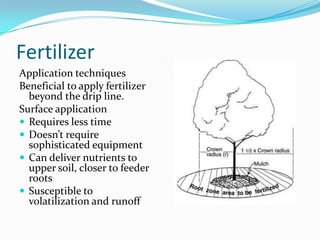
Application techniques
Beneficial to apply fertilizer
  beyond the drip line.
Surface application
 Requires less time
 Doesn’t require
  sophisticated equipment
 Can deliver nutrients to
  upper soil, closer to feeder
  roots
 Susceptible to
  volatilization and runoff
Fertilizer
Subsurface application
 Drill hole
 Soil injection
Foliar, implants and injection can be used to correct
  minor deficiencies, but do not provide long-term
  impact
Fertilizer
Over application of fertilizer can result in
 Burning-higher solute content in soil than in root
  draws water out of the root
 Runoff and leaching-nutrients can pollute waterways
  and ground water
 Fertilizer salts can raise soil pH affecting the
  availability of nutrients

Soil management

  • 1.
  • 2.
    What Will BeCovered?  Chapter 3: Soil Science  Chapter 4: Water Management  Chapter 5: Tree Nutrition and Fertilization
  • 3.
    Soil  Substrate ofRock, Sand, Silt and Clay  Organic Matter  Water & Air
  • 4.
    Soil Soil is a balanced ecosystem inhabited by:  Insects  Earthworms  Nematodes  Bacteria  Fungi  Other Microbes http://ecomerge.blogspot.com/2010_06_0 1_archive.html
  • 5.
    Soil Soil provides plantswith:  Root support  Nutrients  Water  Gas exchange (O2 & CO2)
  • 6.
    Soil Soil ecology candiffer due to:  Underlying geology  Geographic location  Climate  What types of plants grow there
  • 7.
    Physical Properties  Soilsare the result of the weathering of parent material over a long period of time.  Geology influences soil. Weathered rock–Sediment from waterways.
  • 8.
    Physical Properties An ideal soil consists of:  50% pore space (water & air)  50% solid (45% mineral and 5% organic matter) Bryan Kotwica, Bugwood.org
  • 9.
    Physical Properties Soil Profile Weatheringevents over time, such as:  Leaching  Temperature fluctuations  Chemical reactions  Biological activity  Accumulation of different elements and materials Cause the soil to develop horizontal layers called horizons
  • 10.
    Physical Properties Soil Profile Soilhorizons are:  O-Decomposing organic matter (great amount of biological activity)  A-Rich in organic matter and biological activity. Fine roots of trees  B-Accumulates leached nutrients (few to no fine roots)  C-Partially weathered parent material http://soils.usda.gov/education/resources/le ssons/profile/
  • 11.
    Physical Properties Soil Textureis the fineness or coarseness of a soil determined by relative amounts of minerals. Sand>Silt>Clay Coarse  Fine Loam- “Ideal” mineral mix of sand silt and clay.
  • 12.
    Physical Properties Soil Structure is the arrangement, shape and size of clumps of soil particles, called aggregates.  Determined by physical soil properties, chemical changes and biological activity  Modified by root growth, temperature fluctuations, burrowing insects and animal activity.  Organic matter improves soil structure and increases pore space.
  • 13.
    Physical Properties  Soilstructure helps determine the amount of macropores (air movement or gas exchange) and micropores (water retention) a soil contains because pore space occurs within and between aggregates.  Soil Texture influences pore space due to particle size. Sandy soils tend to have more macropores and less micropores than soils with more clay.  Bulk Density measures the mass of the soil per unit of dried soil volume. Bulk density can be used as an indicator of pore space and soil compaction.  Greater bulk density=more micropores than macropores  Different soil textures have different ranges of bulk density
  • 14.
    Physical Properties Soil Compaction is the disruption and destruction of soil aggregates. It can be caused by foot and vehicle traffic, high levels of sodium in the soil and watering.
  • 15.
    Physical Properties Soil compaction Reduces water infiltration and availability  Root growth  Gas exchange  Biological activity
  • 16.
    Chemical Properties Soil pH Measure of soil acidity or alkalinity  Many effects on soil ecology and soil chemistry  Greatly affects the availability of soil mineral nutrients to plants  Difficult to alter due to soil buffering capacity
  • 17.
    Chemical Properties  Soil particles have varying negative charges which attract soil mineral nutrients that exist as ions in the soil solution. Positively charged ions are called cations.  Cation Exchange Capacity (CEC) measures the soil’s ability to hold on to cations.  Soils high in clay and/or organic matter have higher CECs.  Soil texture, soil structure and CEC should be considered when determining fertilizer needs. Bryan Kotwica, Bugwood.org
  • 18.
    Chemical Properties  Salinesoils occur when a soil have excess levels of soluble salts which can be toxic to plants  Sodic soils have excess levels of sodium which raises the soil pH and destroys the soil structure.
  • 19.
    Biological Activity  Animals,insects, bacteria, fungi and other organisms help cycle nutrients through the soil and help decompose organic matter.  The rhizosphere is a microzone of intense biological activity surrounding actively elongating roots. This environment can be very different from the surrounding soil.  Mycorrhizae-certain fungi can form beneficial symbiotic relationships with tree roots  Actinomycetes are soil-dwelling bacteria that play a critical role in the decomposition of organic matter  Certain atmospheric nitrogen-fixing soil bacteria form beneficial relationships with certain tree roots
  • 20.
    Soil Moisture andPlant Growth  Soil pore space helps determine the water holding capacity of a soil. A greater amount of micropores means a higher water holding capacity.  Well-aggregated soil structure aids aeration and drainage.  Tree roots need adequate Andrew Koeser, International Society of Arboriculture, Bugwood.org gas exchange as well as adequate water to thrive.
  • 21.
    Urban Soils Urban soils are often altered in such a way as to inhibit tree growth and development.  Highly compacted soils  Little to no organic matter  Little biological activity  Suffer greater temperature fluctuations Craul, Urban Soils, 1985  can contain pollutants
  • 22.
    Urban Soil Improvement Beforeplanting: Site contains existing trees:  Till compacted soils  Use air excavation to  Remove soil and replace break up compacted soil with better soil around root zone (radial  Improve drainage trenching) and (French drains, drain incorporate organic tile) matter.  Incorporate organic matter
  • 24.
    Water and Trees Water is vital to trees.  Large trees can absorb hundreds of gallons of water from soil in a day.  Up to 95% of the water taken up by trees can be lost through transpiration.  Water use varies due to tree species, size, soil, air temperature, humidity, light and wind.  Inadequate soil moisture can lead to root loss, leaf abscission, twig dieback and tree death.  Too much water can result in poor nutrient uptake, poor root development, disease and death.
  • 25.
    Irrigation  Trees generallyneed less water than turf  Proper tree selection and planting may reduce irrigation needs.  Irrigation is most important for newly transplanted trees, which can need frequent irrigation
  • 26.
    Irrigation If irrigation is needed, water trees infrequently and deeply.  Promotes well developed roots  Promotes better soil structure  Reduces development of pathogens
  • 27.
    Irrigation  Shallow, frequentwatering can lead to poor root development, soil compaction and disease.
  • 28.
    Irrigation Systems  Sprinklers-Whenproperly used they can be very efficient and economical. Higher potential for water loss due to evaporation.  Drip-Delivers water to plant more precisely than sprinklers with less potential for runoff. Drip systems can plug so they need to be monitored.  Other systems include soil injection, soaker hose, basin irrigation and temporary, portable drip systems.
  • 29.
    Water Conservation  Droughttolerant landscaping (Xeriscaping)  Minimum irrigation-provides just enough water to maintain plant health, growth and appearance.  Group plants with the same water requirements together on the same irrigation schedule (hydrozones).  Requires an understanding of water budgets, soil and plant water loss, water-holding capacity, application rates, infiltration rate and irrigation system efficiency.  Water needs can also be determined using soil probes, tensiometers and electronic moisture sensors.
  • 30.
    Water Conservation Recycled waterused in irrigation can be effective but salinity, phytotoxicity and increases in soil pH are potential problems.
  • 31.
    Water Conservation The useof mulch around the base of trees can reduce soil moisture evaporation, as well as:  Improve soil structure  Improve water infiltration  Moderate soil temperature  Reduce weed competition  Reduce soil compaction and erosion  Organic mulches increase soil organic matter as they decompose
  • 32.
    Water Conservation  Soilamendments to increase water hold capacity  Limit turf plantings  Reduce or eliminate fertilizer applications during drought conditions  Antitranspirants-for temporary use only. Long term use can be toxic to some plants
  • 33.
    Flooding and Drainage For some tree species only a short period of flooding can be harmful as photosynthesis shuts down. Drainage  Best to establish proper drainage before planting.  Improving the soil structure works best  French drains, drain pipe/tiles will remove gravitational water, but do not make up for poor soil structure.  With after planting drainage improvements care must be taken not to damage the root system.  When irrigating, water application rate should not exceed the infiltration rate of the soil.  Soil aeration can relieve some drainage problems caused by soil compaction.
  • 34.
    Flooding and Drainage Water flow over impervious surfaces (parking lots, roads) can cause flooding and carry pollutants.  “Rain gardens” to catch drainage from impervious surfaces can reduce storm water runoff. However plantings must be tolerant of flooding, pollutants and drought conditions.
  • 36.
    Introduction  Trees requirecertain essential elements to function and grow.  An essential element (or nutrient) is a chemical constituent that is involved in the metabolism of the tree or that is necessary for the tree to complete its life cycle.  In nature these elements are present, replenished and recycled by the decomposition of organic matter.
  • 37.
    Introduction In urban setting,the soil may be different because of:  Removal of soil  Removal of fallen leaves or other potential organic matter  Lack of beneficial soil-dwelling organisms
  • 38.
    Tree Requirements  Treestake up essential elements dissolved in water through their roots. Each element plays a specific role and cannot be substituted by another element.  Essential elements are divided into:  Macroelements-needed in larger amounts  Microelements-needed in smaller amounts  Trees and other plants can only utilize essential nutrients in the form of specific ions.
  • 39.
    Essential Elements Macronutrients Micronutrients O-Oxygen B-Boron H-Hydrogen Cl-Chlorine C-Carbon Cu-Copper N-Nitrogen Fe-Iron P-Phosphorus Mn-Manganese K-Potassium Mo-Molybdenum Ca-Calcium Ni-Nickel Mg-Magnesium Zn-Zinc S-Sulfur
  • 40.
    Essential Elements C HopkinsCafé Managed by My Clever Cousin Mo. C HOPKNS CaFe Mg Ni B Mn Cl Cu Zn Mo
  • 41.
    Tree Requirements  Growth and development of trees is dependant on the most limiting of nutrients.  Nitrogen is often the most limiting of the macronutrients due to leaching, volatilization and, in urban environments, due to lack of nutrient cycling.  P,K and S are mostly in adequate amounts in soil.
  • 42.
    Tree Requirements  Fe, Mn and Zn are usually the most limiting micronutrients in urban soils  Micronutrients can be phytotoxic at higher levels
  • 43.
    Tree Requirements Soil pH is important because nutrients may be present in the soil but not available to the tree or present in toxic amounts.
  • 44.
    Fertilizer  Available in many forms  Complete fertilizer contains N, P and K.  Fertilizer analysis on the label- composition as a % by weight of total N, available P (P2O5) phosphoric acid and K (K2O) soluble potash  Always in the order of N- http://www.butlerswcd.org/Homeowner/Soils.html P-K
  • 45.
    Fertilizer  Because phosphoricacid contains 44% P and soluble potash contains 83% K, the percent P and K on the label must be multiplied by .44 and .83, respectively to calculate the percent amount of P and K. For example: A 50 lbs. bag of 10-6-4 fertilizer contains  5 lbs. N  3 lbs. P  2 lbs K  Complete fertilizers are not always needed
  • 46.
    Fertilizer  May beorganic or inorganic  Inorganic fertilizers release their elements quickly so they are available to plants quickly  They may “burn” the plants and are susceptible to leaching and volatilization.  Organic fertilizers are composed of naturally occurring or synthetic carbon-based molecules that must decompose in the soil to release their elements.
  • 47.
    Fertilizer Slow release fertilizersare a preferred choice for fertilizing trees, either with organic fertilizers or coated inorganic fertilizers.
  • 48.
    Fertilizer Application rates Depends onage, health, species, form of fertilizer, application method, site conditions and desired goal.
  • 49.
    Fertilizer Prescription fertilization  Basedon soil tests and foliar analysis  Determines the amount and availability of essential nutrients in the soil and how deficient the tree is in specific nutrients.
  • 50.
    Fertilizer Timing Timing of fertilizerapplications depend on the tree, fertilizer type, soil conditions and CEC.
  • 51.
    Fertilizer Application techniques Beneficial toapply fertilizer beyond the drip line. Surface application  Requires less time  Doesn’t require sophisticated equipment  Can deliver nutrients to upper soil, closer to feeder roots  Susceptible to volatilization and runoff
  • 52.
    Fertilizer Subsurface application  Drillhole  Soil injection Foliar, implants and injection can be used to correct minor deficiencies, but do not provide long-term impact
  • 53.
    Fertilizer Over application offertilizer can result in  Burning-higher solute content in soil than in root draws water out of the root  Runoff and leaching-nutrients can pollute waterways and ground water  Fertilizer salts can raise soil pH affecting the availability of nutrients