A PRESETATION ON
CROP RESPONSE PRODUCTION FUNCTION
Introduction
Plant response to nutrients was one of the earliest subjects of scientific plant
investigation. The classical work of Liebig, Blackman, Mitscherlich and others were the basis
for formulating several theories on growth factor limitation and plant response. Knowledge
of these theories lead to better understanding of plant respond to inputs and other
management practices.
Plant growth is a function of its growth factors, which may be considered as
variables, the magnitude and interactions of which determine the amount of growth. This
may be expressed in the form of an equation.
G = f (x1, x2, x3, ………………, xn )
Where , G is a measure of some growth and x1 to xn are various growth factors. )
1. Law of Minimum (Justus Von Liebig, 1840)
Liebig states that the deficiency or absence of one necessary constituent, all
others being present, the soil is rendered barren for all those crops of the life of which
one constituent is indisepensable. It is sometimes referred to as the barrel concept.
The law postulates that when a nutrient in the soil is in the minimum, it limits
the action of other nutrients which may be present in the optimum. Thus, when P2O5 is in
the minimum, crop yield is determined by the status of the P2O5 in the soil.
Fig.: Limiting factors
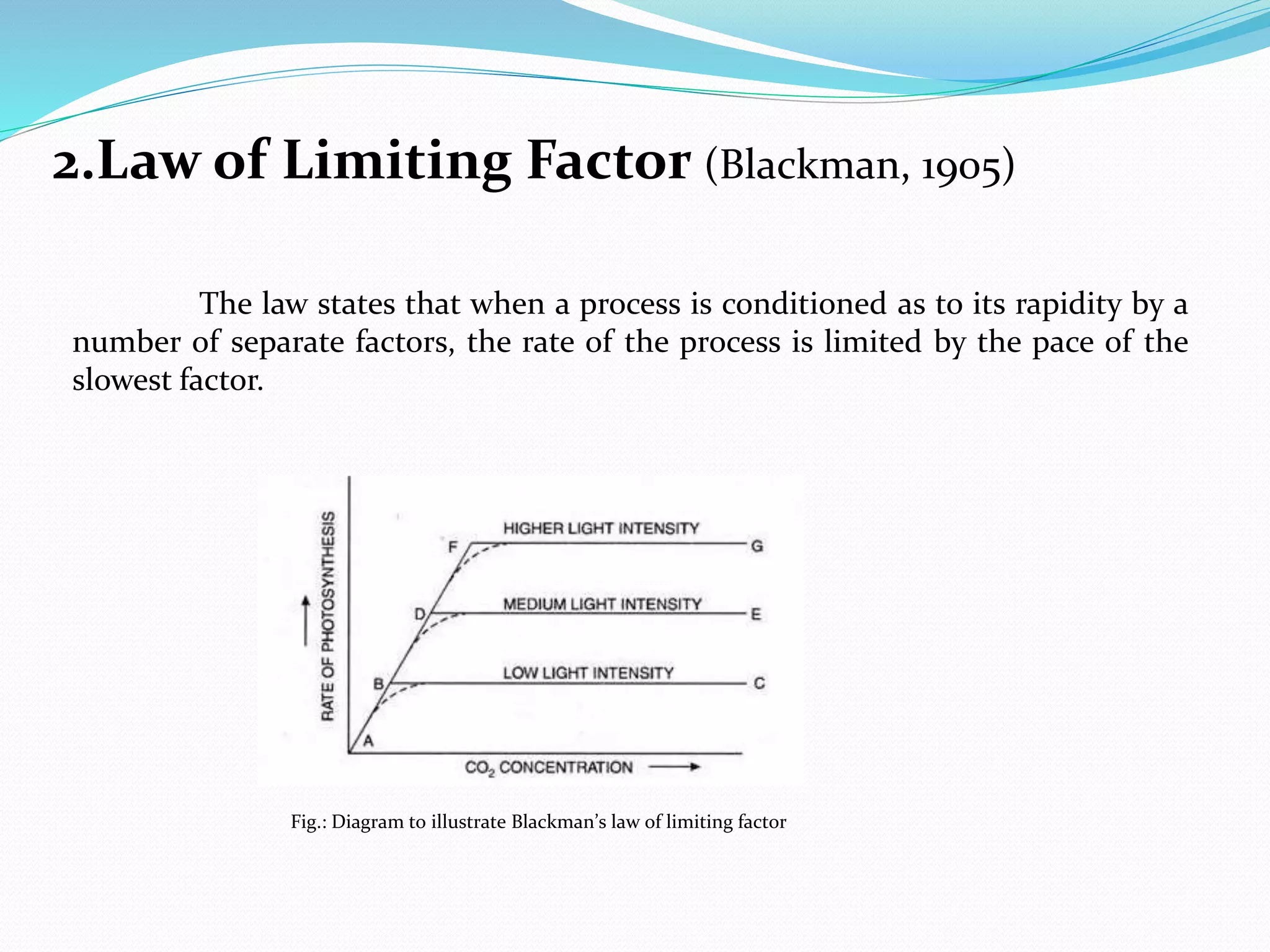
2.Law of Limiting Factor (Blackman, 1905)
The law states that when a process is conditioned as to its rapidity by a
number of separate factors, the rate of the process is limited by the pace of the
slowest factor.
Fig.: Diagram to illustrate Blackman’s law of limiting factor
3. Theory Of Nitrogen Constant 318 (Willcox)
The nitrogen constant 318 represent the amount of nitrogen
absorbed per acre by all kinds of plants in a single growth cycle if all
conditions are at optimum.
The constant 318 was used for calculating the maximum possible yield of
crops with the equation
y = k/n
Where,
y = above ground dry matter
n = nitrogen percentage
k = a constant
4. Spillman’s Equation
Spillman exposed the relationship between the amount of growth and
quantity of growth factor as
Y = M(1-Rx )
Where,
Y = amount of growth produced by a given quantity of growth factor X
M = maximum yield possible when all growth factors are present in
optimum amounts
X = quantity of growth factors
R = a constant
5. Baule Unit (Baule, 1918)
Baule suggested that the unit of fertilizer, or any other growth factor, be
taken as that amount necessary to produce a yield that is 50% of the difference
between the maximum possible yield and the yield before that unit was applied.
Plants require different amount of Nitrogen, phosphorus and potassium,
but the amount in pounds of each required to produce a yield that is 50% of the
maximum possible yield is called 1 Baule Unit.
The values of the baule unit in pounds per acre of N, P2O5 and K2O are 223,
45 and 76 respectively. Therefore, 1baule unit of N = 1baule unit of P2O5 = 1unit of
K2O.
Reference
Reddy S.R. Growth regulator and growth analysis. Principles of crop production. First
Edition. Ludhiana. Mrs. Usha Raj Kumar for Kalyani Publishers, New Delhi. 2000.
p 20-26.
THANK YOU

Crop response production function

  • 1.
    A PRESETATION ON CROPRESPONSE PRODUCTION FUNCTION
  • 2.
    Introduction Plant response tonutrients was one of the earliest subjects of scientific plant investigation. The classical work of Liebig, Blackman, Mitscherlich and others were the basis for formulating several theories on growth factor limitation and plant response. Knowledge of these theories lead to better understanding of plant respond to inputs and other management practices. Plant growth is a function of its growth factors, which may be considered as variables, the magnitude and interactions of which determine the amount of growth. This may be expressed in the form of an equation. G = f (x1, x2, x3, ………………, xn ) Where , G is a measure of some growth and x1 to xn are various growth factors. )
  • 3.
    1. Law ofMinimum (Justus Von Liebig, 1840) Liebig states that the deficiency or absence of one necessary constituent, all others being present, the soil is rendered barren for all those crops of the life of which one constituent is indisepensable. It is sometimes referred to as the barrel concept. The law postulates that when a nutrient in the soil is in the minimum, it limits the action of other nutrients which may be present in the optimum. Thus, when P2O5 is in the minimum, crop yield is determined by the status of the P2O5 in the soil. Fig.: Limiting factors
  • 4.
    2.Law of LimitingFactor (Blackman, 1905) The law states that when a process is conditioned as to its rapidity by a number of separate factors, the rate of the process is limited by the pace of the slowest factor. Fig.: Diagram to illustrate Blackman’s law of limiting factor
  • 5.
    3. Theory OfNitrogen Constant 318 (Willcox) The nitrogen constant 318 represent the amount of nitrogen absorbed per acre by all kinds of plants in a single growth cycle if all conditions are at optimum. The constant 318 was used for calculating the maximum possible yield of crops with the equation y = k/n Where, y = above ground dry matter n = nitrogen percentage k = a constant
  • 6.
    4. Spillman’s Equation Spillmanexposed the relationship between the amount of growth and quantity of growth factor as Y = M(1-Rx ) Where, Y = amount of growth produced by a given quantity of growth factor X M = maximum yield possible when all growth factors are present in optimum amounts X = quantity of growth factors R = a constant
  • 7.
    5. Baule Unit(Baule, 1918) Baule suggested that the unit of fertilizer, or any other growth factor, be taken as that amount necessary to produce a yield that is 50% of the difference between the maximum possible yield and the yield before that unit was applied. Plants require different amount of Nitrogen, phosphorus and potassium, but the amount in pounds of each required to produce a yield that is 50% of the maximum possible yield is called 1 Baule Unit. The values of the baule unit in pounds per acre of N, P2O5 and K2O are 223, 45 and 76 respectively. Therefore, 1baule unit of N = 1baule unit of P2O5 = 1unit of K2O.
  • 8.
    Reference Reddy S.R. Growthregulator and growth analysis. Principles of crop production. First Edition. Ludhiana. Mrs. Usha Raj Kumar for Kalyani Publishers, New Delhi. 2000. p 20-26.
  • 9.