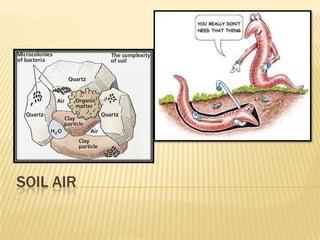
SOIL AIR
   Importance of soil air :-
             it is used for the respiration by the root
             Decomposition of the organic matter by the microorganisms.

 Most desired condition is well aerated soil –
  where oxygen exchange between soil air and
  athmospheric air is rapid.
 Factors which influence rate of gases exchange
             pore spores
             Temperature`
             Depth of soil
             Wetting and drying
             covering
PORE SPACE
 Called void – have a portion of the soil volume
  not occupied by solid.
 It made by:
                Irregular shapes of primary aggregates and their aggregation.
                Forces of penetrating roots
                Microorganism
                Expanding gases entrapped by water.

 Pores occupied by water and air
 %PS depends on :-
                               Soil texture
                               Aggregate arrangement
                               Structure
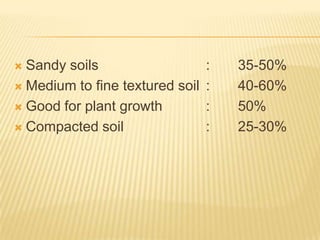
 Sandy soils                    :   35-50%
 Medium to fine textured soil   :   40-60%
 Good for plant growth          :   50%
 Compacted soil                 :   25-30%
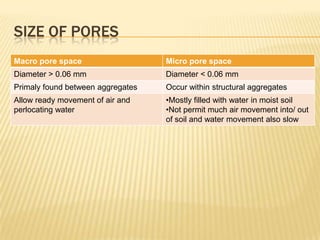
SIZE OF PORES
Macro pore space                   Micro pore space
Diameter > 0.06 mm                 Diameter < 0.06 mm
Primaly found between aggregates   Occur within structural aggregates
Allow ready movement of air and    •Mostly filled with water in moist soil
perlocating water                  •Not permit much air movement into/ out
                                   of soil and water movement also slow
SOIL AERATION

 Process- air in soil replaced by air from
  atmosphere.
 In well – aerated soils, the soil is similar to
  the atmosphere, while poor- aerated soils
  usually contain < o2 and > co2 than the
  atmosphere.
 Vital process – largely controls the soil levels
  of o2 and co2.
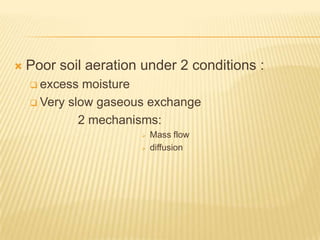
   Poor soil aeration under 2 conditions :
     excess  moisture
     Very slow gaseous exchange

             2 mechanisms:
                         Mass flow
                         diffusion
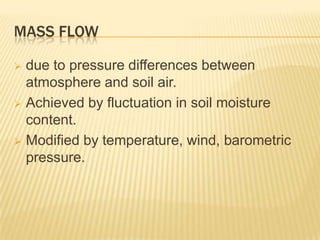
MASS FLOW

 due to pressure differences between
  atmosphere and soil air.
 Achieved by fluctuation in soil moisture
  content.
 Modified by temperature, wind, barometric
  pressure.
DIFFUSION

 More important than mass flow.
 Involve great bulk of gaseous exchange.

 Each gas moves in a direction determined by
  its own partial pressure.
 Diffusion allows extensive movement of air
  from one area to another even though there
  is no overall pressure gradient.
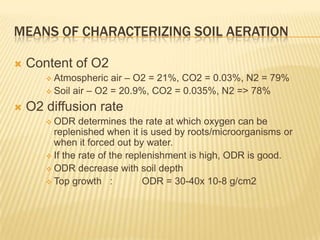
MEANS OF CHARACTERIZING SOIL AERATION

   Content of O2
        Atmospheric   air – O2 = 21%, CO2 = 0.03%, N2 = 79%
        Soil air – O2 = 20.9%, CO2 = 0.035%, N2 => 78%

   O2 diffusion rate
        ODR    determines the rate at which oxygen can be
         replenished when it is used by roots/microorganisms or
         when it forced out by water.
        If the rate of the replenishment is high, ODR is good.
        ODR decrease with soil depth
        Top growth :           ODR = 30-40x 10-8 g/cm2
 Oxidation and reduction potential
 Measure of tendency of a substance to
  accept or donate electrons.
 If a oxidation and reduction potential is high,
  the substance is called oxidizing agent.
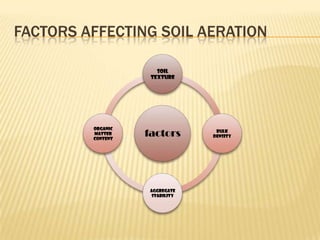
FACTORS AFFECTING SOIL AERATION

                      Soil
                    texture


         Organic
         matter
         content
                   factors        Bulk
                                 density


                    Aggregate
                     stability
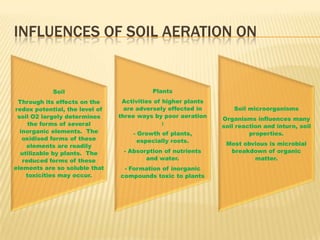
INFLUENCES OF SOIL AERATION ON


            Soil                          Plants
 Through its effects on the      Activities of higher plants
redox potential, the level of     are adversely effected in        Soil microorganisms
 soil O2 largely determines     three ways by poor aeration    Organisms influences many
     the forms of several                      :               soil reaction and inturn, soil
  inorganic elements. The           - Growth of plants,                 properties.
   oxidised forms of these            especially roots.
    elements are readily                                        Most obvious is microbial
  utilizable by plants. The      - Absorption of nutrients       breakdown of organic
   reduced forms of these               and water.                      matter.
elements are so soluble that     - Formation of inorganic
    toxicities may occur.       compounds toxic to plants
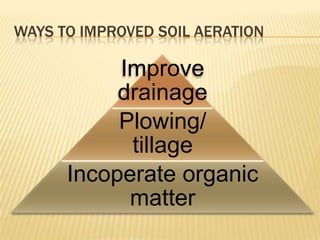
WAYS TO IMPROVED SOIL AERATION

           Improve
           drainage
           Plowing/
            tillage
      Incoperate organic
            matter

Soil air

  • 1.
  • 2.
    Importance of soil air :-  it is used for the respiration by the root  Decomposition of the organic matter by the microorganisms.  Most desired condition is well aerated soil – where oxygen exchange between soil air and athmospheric air is rapid.  Factors which influence rate of gases exchange  pore spores  Temperature`  Depth of soil  Wetting and drying  covering
  • 3.
    PORE SPACE  Calledvoid – have a portion of the soil volume not occupied by solid.  It made by:  Irregular shapes of primary aggregates and their aggregation.  Forces of penetrating roots  Microorganism  Expanding gases entrapped by water.  Pores occupied by water and air  %PS depends on :-  Soil texture  Aggregate arrangement  Structure
  • 4.
     Sandy soils : 35-50%  Medium to fine textured soil : 40-60%  Good for plant growth : 50%  Compacted soil : 25-30%
  • 5.
    SIZE OF PORES Macropore space Micro pore space Diameter > 0.06 mm Diameter < 0.06 mm Primaly found between aggregates Occur within structural aggregates Allow ready movement of air and •Mostly filled with water in moist soil perlocating water •Not permit much air movement into/ out of soil and water movement also slow
  • 6.
    SOIL AERATION  Process-air in soil replaced by air from atmosphere.  In well – aerated soils, the soil is similar to the atmosphere, while poor- aerated soils usually contain < o2 and > co2 than the atmosphere.  Vital process – largely controls the soil levels of o2 and co2.
  • 7.
    Poor soil aeration under 2 conditions :  excess moisture  Very slow gaseous exchange 2 mechanisms:  Mass flow  diffusion
  • 8.
    MASS FLOW  dueto pressure differences between atmosphere and soil air.  Achieved by fluctuation in soil moisture content.  Modified by temperature, wind, barometric pressure.
  • 9.
    DIFFUSION  More importantthan mass flow.  Involve great bulk of gaseous exchange.  Each gas moves in a direction determined by its own partial pressure.  Diffusion allows extensive movement of air from one area to another even though there is no overall pressure gradient.
  • 10.
    MEANS OF CHARACTERIZINGSOIL AERATION  Content of O2  Atmospheric air – O2 = 21%, CO2 = 0.03%, N2 = 79%  Soil air – O2 = 20.9%, CO2 = 0.035%, N2 => 78%  O2 diffusion rate  ODR determines the rate at which oxygen can be replenished when it is used by roots/microorganisms or when it forced out by water.  If the rate of the replenishment is high, ODR is good.  ODR decrease with soil depth  Top growth : ODR = 30-40x 10-8 g/cm2
  • 11.
     Oxidation andreduction potential  Measure of tendency of a substance to accept or donate electrons.  If a oxidation and reduction potential is high, the substance is called oxidizing agent.
  • 12.
    FACTORS AFFECTING SOILAERATION Soil texture Organic matter content factors Bulk density Aggregate stability
  • 13.
    INFLUENCES OF SOILAERATION ON Soil Plants Through its effects on the Activities of higher plants redox potential, the level of are adversely effected in Soil microorganisms soil O2 largely determines three ways by poor aeration Organisms influences many the forms of several : soil reaction and inturn, soil inorganic elements. The - Growth of plants, properties. oxidised forms of these especially roots. elements are readily Most obvious is microbial utilizable by plants. The - Absorption of nutrients breakdown of organic reduced forms of these and water. matter. elements are so soluble that - Formation of inorganic toxicities may occur. compounds toxic to plants
  • 14.
    WAYS TO IMPROVEDSOIL AERATION Improve drainage Plowing/ tillage Incoperate organic matter