Tree Nutrition & Fertilization
Objectives Understand the reasons for fertilizing urban trees Explain why determining nutritional requirements and availability is the first step prior to fertilization recommendations. Recognize the problems that can be associated with excessive fertilization. Become familiar with the essential elements
Three Things to Take We cannot “feed” trees – or any plant for that matter. Fertilizer is NOT the correct automatic answer. We are professionals because of our diagnostic work.
The Differences Nutrition  is, the provision to cells and organisms of the materials necessary (aka essential elements), in the  form of food , to support life. The plant provides. Fertilization  is, the application of various forms of nitrogen (N), phosphorous (P) and potassium (K) to cells and organisms. People can provide.
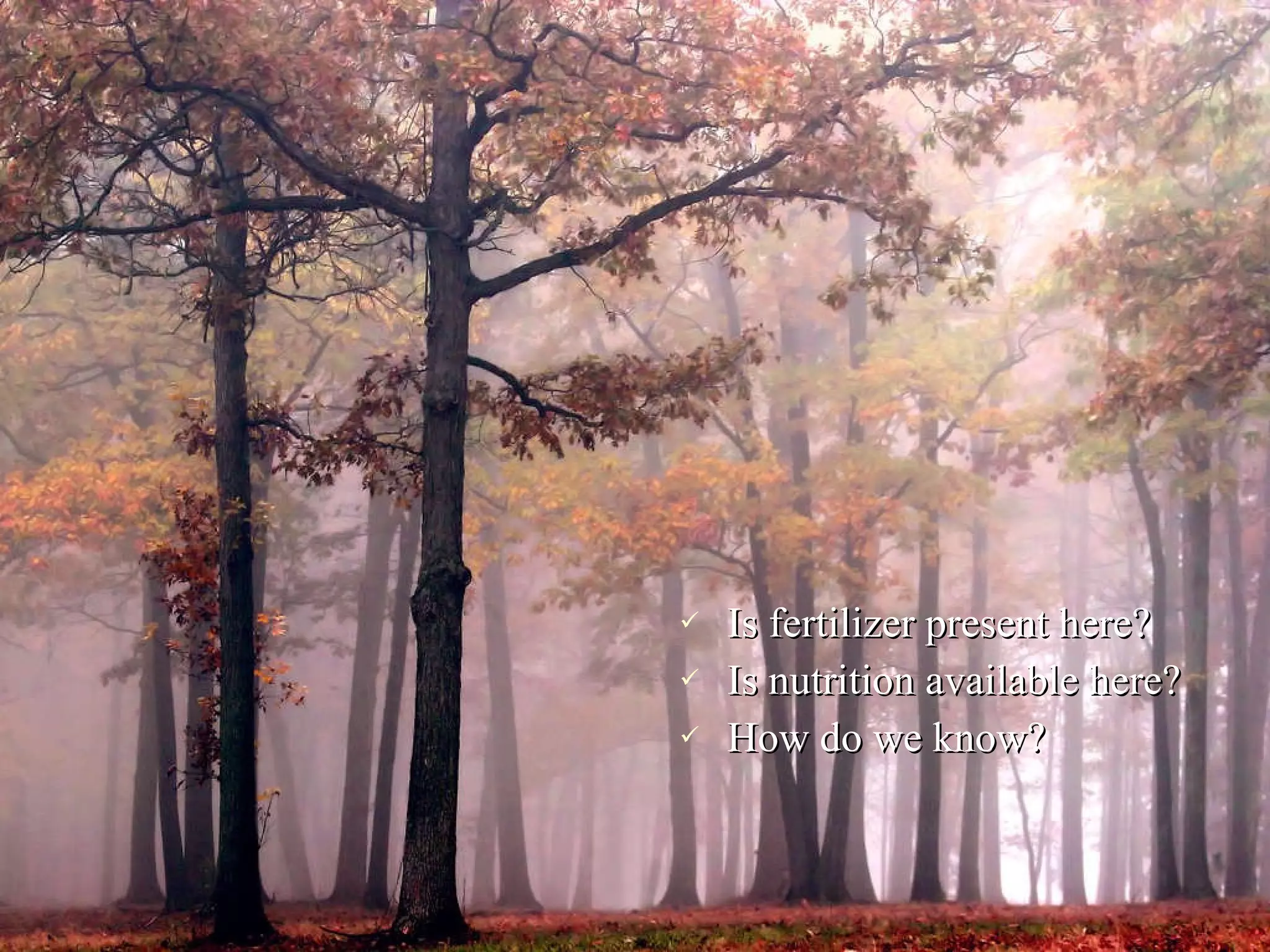
Is fertilizer present here? Is nutrition available here? How do we know?
 
Why fertilize? To overcome a visible nutrient deficiency To increase vegetative growth, flower or fruit set To increase plant vitality To eliminate a deficiency detected through laboratory analysis
Why not to fertilize When sufficient levels of all essential elements are present When the potential for certain pest problems may be increased When herbicide damage is present in or on the plant
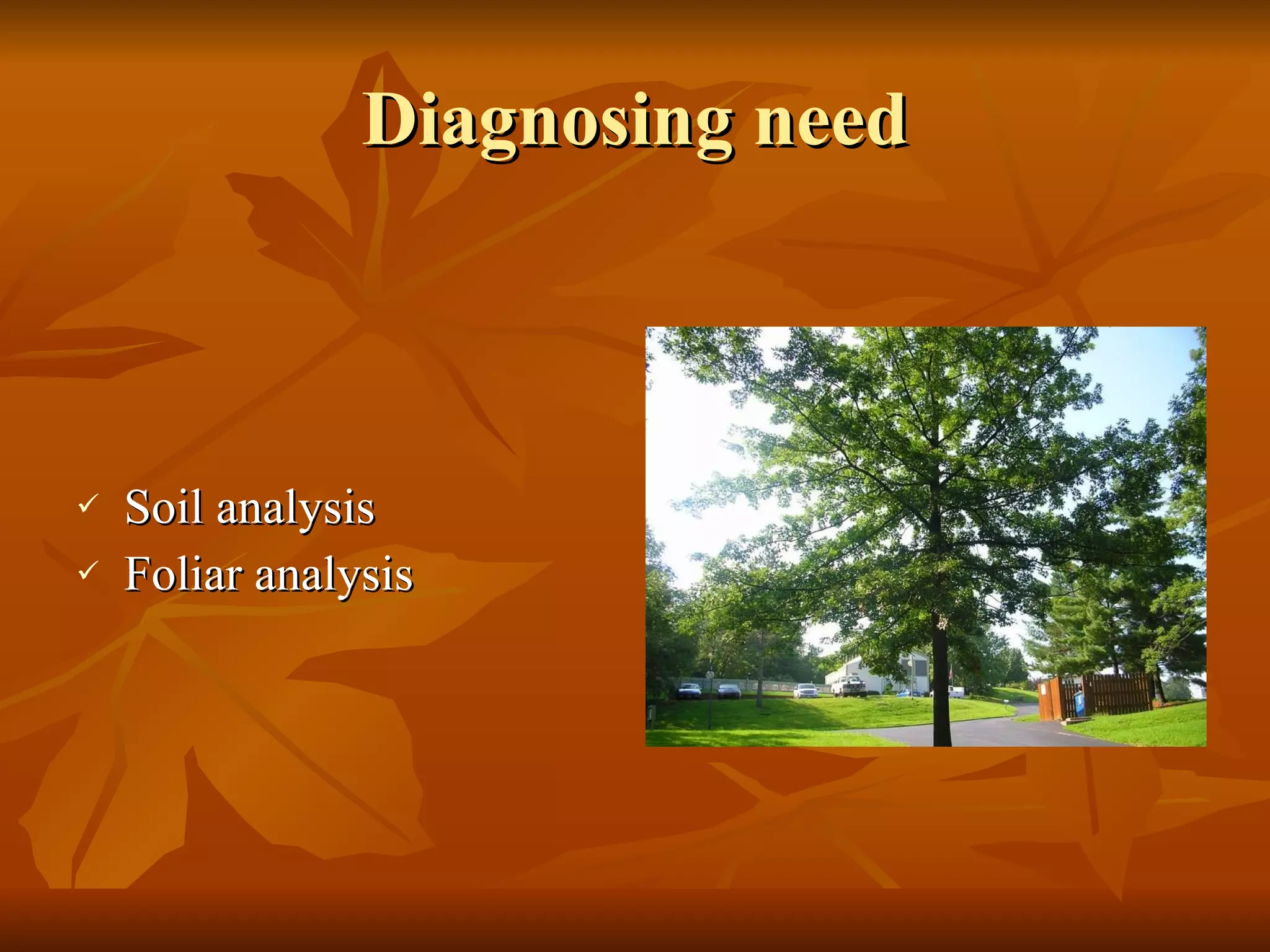
Diagnosing need Soil analysis Foliar analysis
Soil Analysis Less expensive than foliar analysis Provides data on soil pH, organic matter and cation exchange capacity Good snapshot or base Necessary first step
Foliar Analysis Provides a clear picture of the plants’ nutrient status Precise knowledge of adequate and deficient elements Expensive
We have need, now what? Injection Slow-release Foliar Surface Subsurface Ahhh-h-h-h-h-h-h-h-!!!!!!!!
A word on implants
Not those implants! Introduces chemical directly into xylem Timing is critical Technique is important Best suited for minor deficiencies
Macro-nutrients Nitrogen (N) Phosphorous (P) Potassium (K) Sulfur (S) Magnesium* (Mg) Calcium* (Ca)
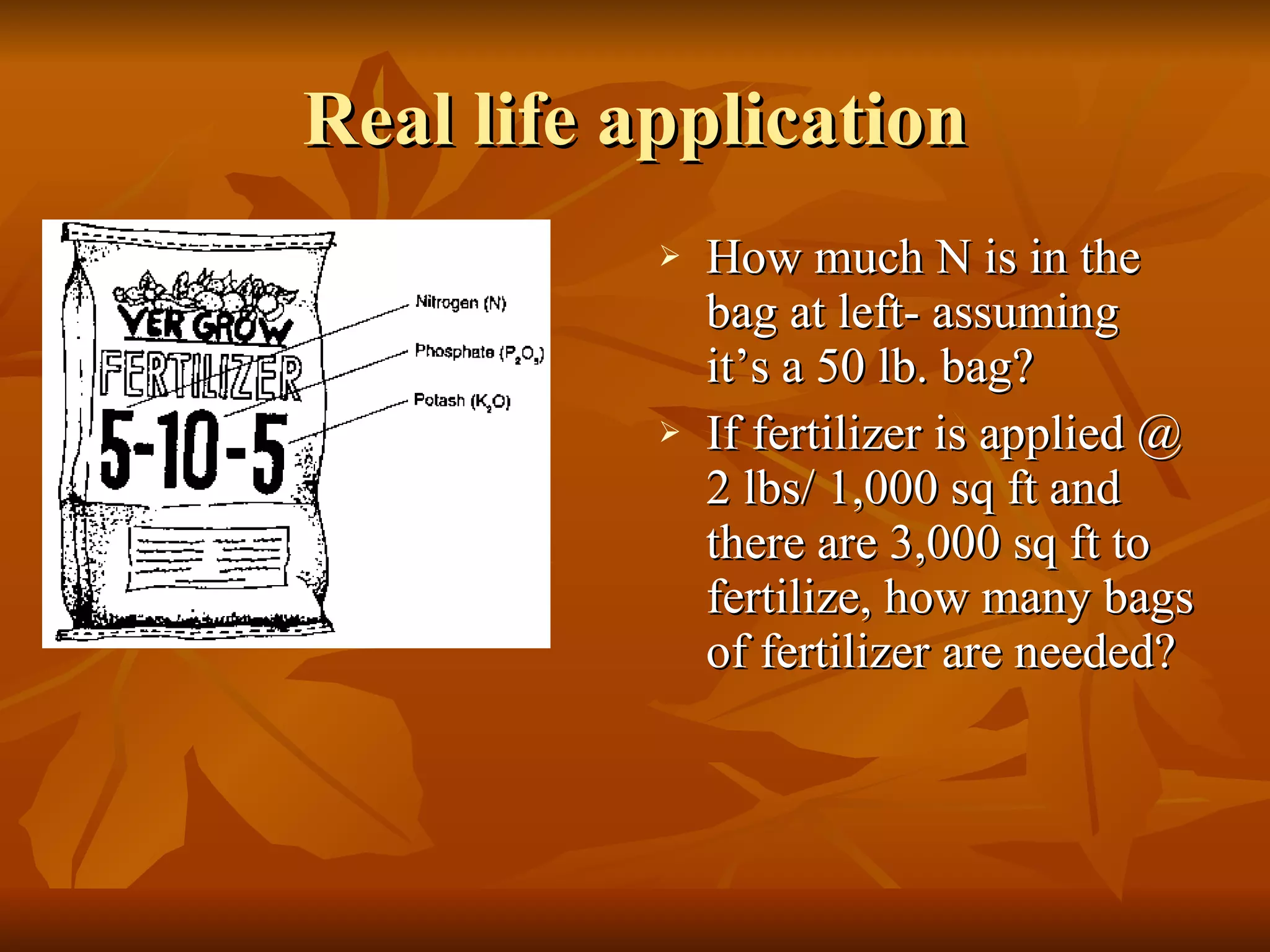
Real life application How much N is in the bag at left- assuming it’s a 50 lb. bag? If fertilizer is applied @ 2 lbs/ 1,000 sq ft and there are 3,000 sq ft to fertilize, how many bags of fertilizer are needed?
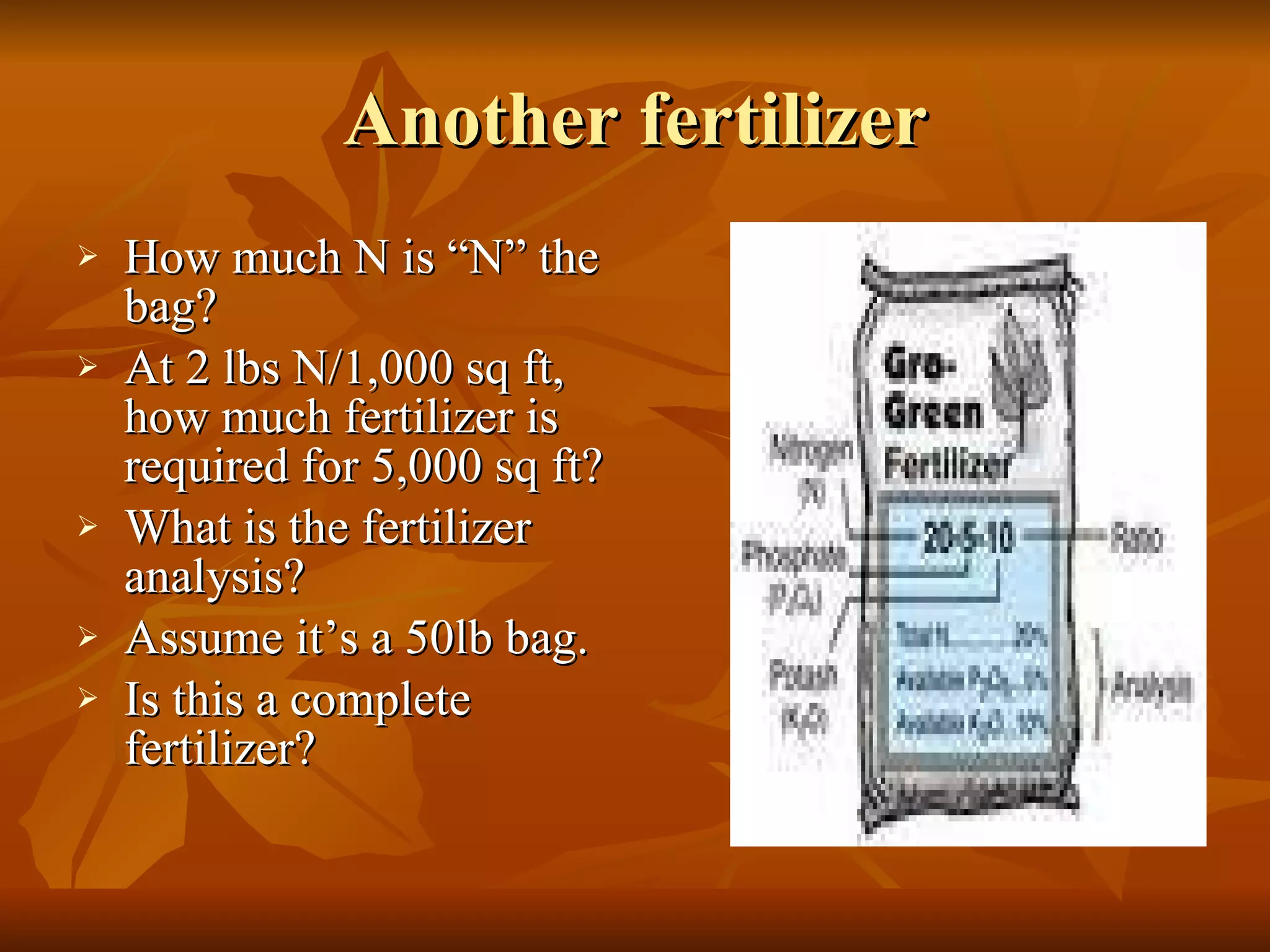
Another fertilizer How much N is “N” the bag? At 2 lbs N/1,000 sq ft, how much fertilizer is required for 5,000 sq ft? What is the fertilizer analysis? Assume it’s a 50lb bag. Is this a complete fertilizer?
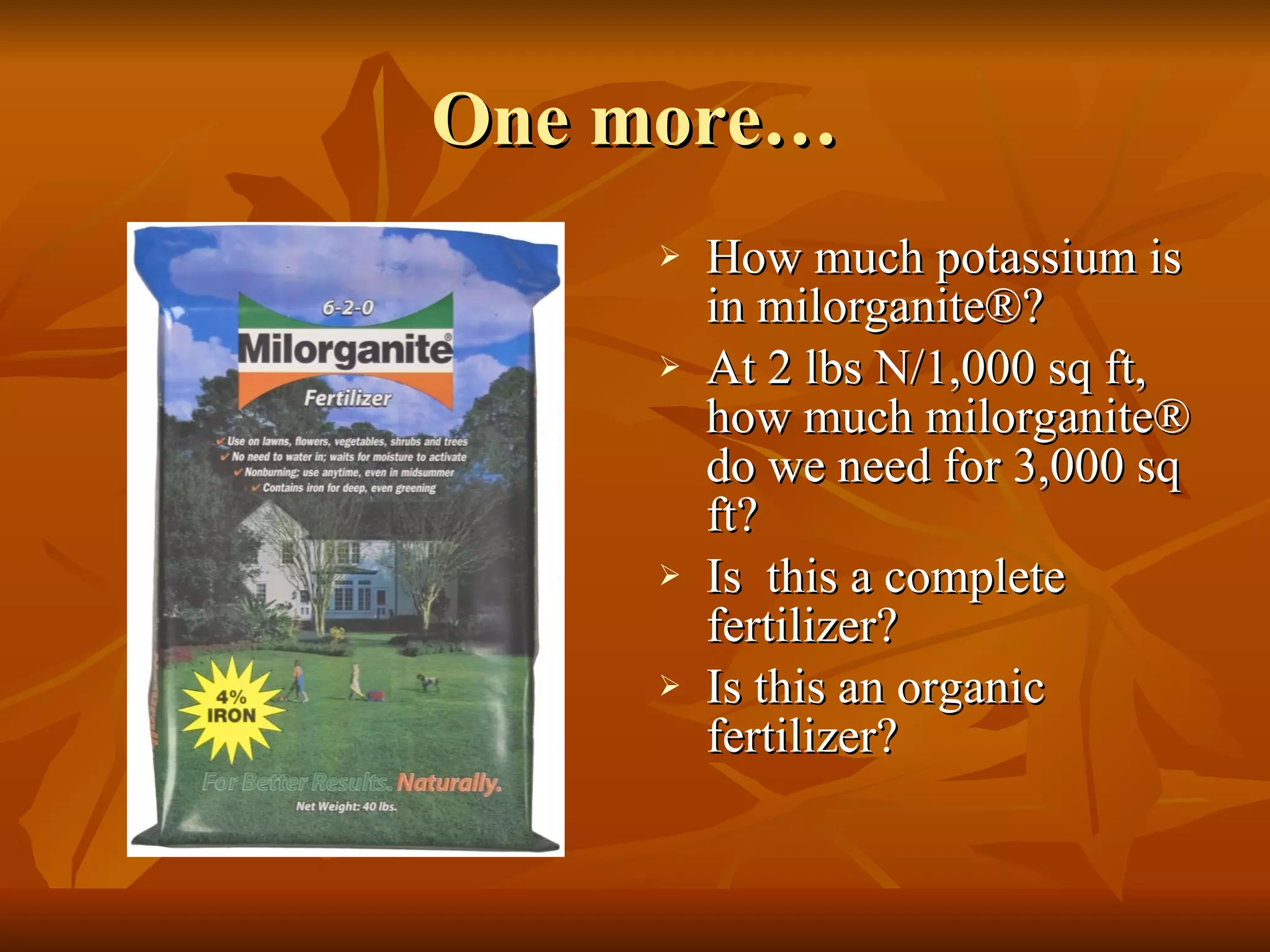
One more… How much potassium is in milorganite ® ? At 2 lbs N/1,000 sq ft, how much milorganite ®  do we need for 3,000 sq ft? Is  this a complete fertilizer? Is this an organic fertilizer?
Prescription without diagnosis is malpractice!
Apply only nutrients that have been found to be deficient!
Some workbook questions If fertilizer “burn” or leaching are potential problems, it may be desirable to use  a _____-_____ fertilizer. The most important factor for good uptake of fertilizer elements is adequate _____. Foliar application of fertilizer is sometimes used to correct _____ deficiencies.

Tree nutrition and fertilization 09

  • 1.
    Tree Nutrition &Fertilization
  • 2.
    Objectives Understand thereasons for fertilizing urban trees Explain why determining nutritional requirements and availability is the first step prior to fertilization recommendations. Recognize the problems that can be associated with excessive fertilization. Become familiar with the essential elements
  • 3.
    Three Things toTake We cannot “feed” trees – or any plant for that matter. Fertilizer is NOT the correct automatic answer. We are professionals because of our diagnostic work.
  • 4.
    The Differences Nutrition is, the provision to cells and organisms of the materials necessary (aka essential elements), in the form of food , to support life. The plant provides. Fertilization is, the application of various forms of nitrogen (N), phosphorous (P) and potassium (K) to cells and organisms. People can provide.
  • 5.
    Is fertilizer presenthere? Is nutrition available here? How do we know?
  • 6.
  • 7.
    Why fertilize? Toovercome a visible nutrient deficiency To increase vegetative growth, flower or fruit set To increase plant vitality To eliminate a deficiency detected through laboratory analysis
  • 8.
    Why not tofertilize When sufficient levels of all essential elements are present When the potential for certain pest problems may be increased When herbicide damage is present in or on the plant
  • 9.
    Diagnosing need Soilanalysis Foliar analysis
  • 10.
    Soil Analysis Lessexpensive than foliar analysis Provides data on soil pH, organic matter and cation exchange capacity Good snapshot or base Necessary first step
  • 11.
    Foliar Analysis Providesa clear picture of the plants’ nutrient status Precise knowledge of adequate and deficient elements Expensive
  • 12.
    We have need,now what? Injection Slow-release Foliar Surface Subsurface Ahhh-h-h-h-h-h-h-h-!!!!!!!!
  • 13.
    A word onimplants
  • 14.
    Not those implants!Introduces chemical directly into xylem Timing is critical Technique is important Best suited for minor deficiencies
  • 15.
    Macro-nutrients Nitrogen (N)Phosphorous (P) Potassium (K) Sulfur (S) Magnesium* (Mg) Calcium* (Ca)
  • 16.
    Real life applicationHow much N is in the bag at left- assuming it’s a 50 lb. bag? If fertilizer is applied @ 2 lbs/ 1,000 sq ft and there are 3,000 sq ft to fertilize, how many bags of fertilizer are needed?
  • 17.
    Another fertilizer Howmuch N is “N” the bag? At 2 lbs N/1,000 sq ft, how much fertilizer is required for 5,000 sq ft? What is the fertilizer analysis? Assume it’s a 50lb bag. Is this a complete fertilizer?
  • 18.
    One more… Howmuch potassium is in milorganite ® ? At 2 lbs N/1,000 sq ft, how much milorganite ® do we need for 3,000 sq ft? Is this a complete fertilizer? Is this an organic fertilizer?
  • 19.
  • 20.
    Apply only nutrientsthat have been found to be deficient!
  • 21.
    Some workbook questionsIf fertilizer “burn” or leaching are potential problems, it may be desirable to use a _____-_____ fertilizer. The most important factor for good uptake of fertilizer elements is adequate _____. Foliar application of fertilizer is sometimes used to correct _____ deficiencies.

Editor's Notes

  • #5 The essential elements must first go through a conversion process which we call photosynthesis whereby sugars are created from sunlight, carbon dioxide and water. On the exam you may be asked how many essential elements there are…some controversy there. Because the Study Guide says 17, go with 17.
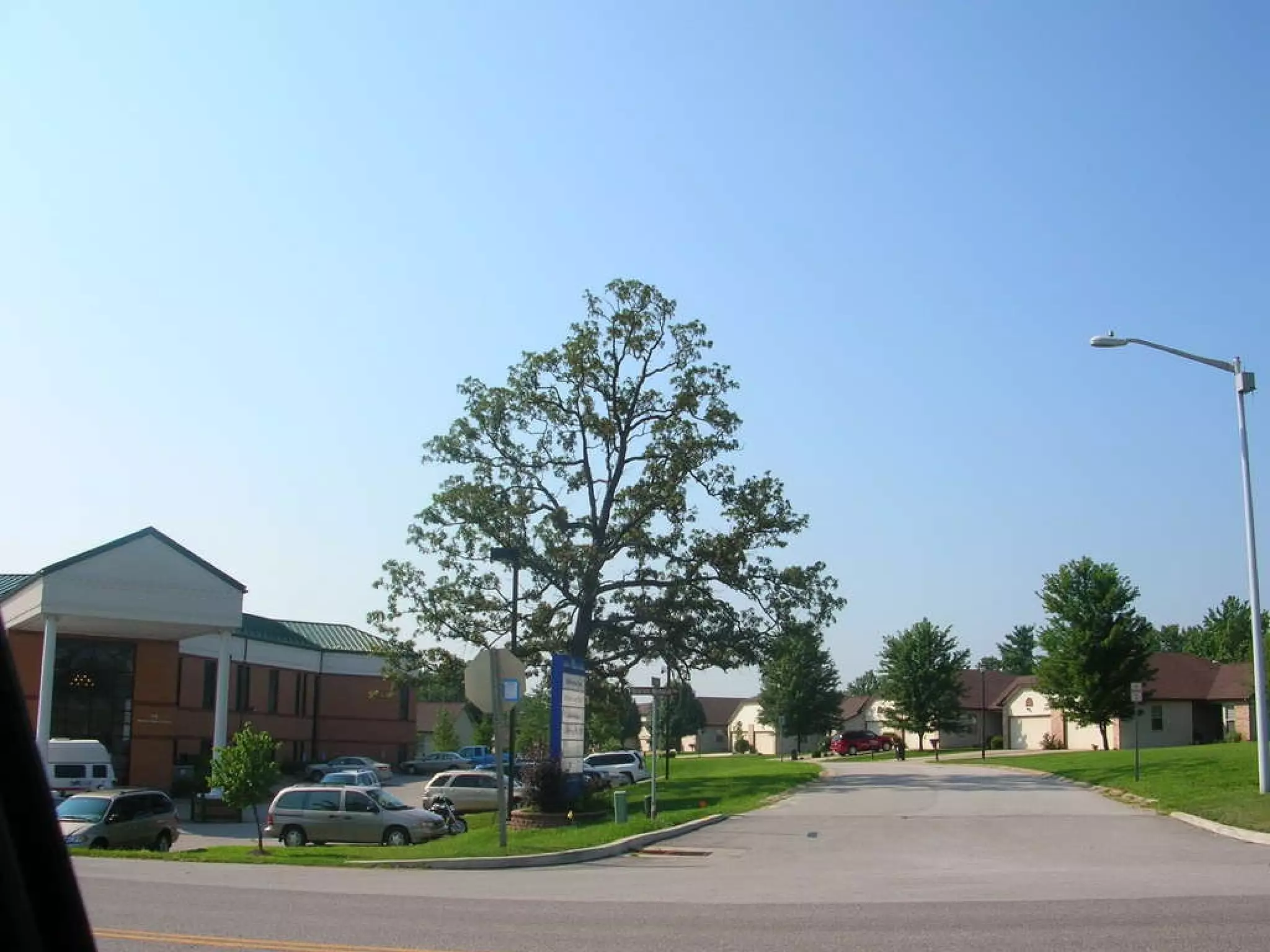
  • #7 Let’s ask the same questions for these trees and discuss the differences. Is fertilizer present? Is nutrition available? How do we know?
  • #9 Pests that will take advantage of over-fertilization: spider mites, aphids, adelgids, psyllids, scale, whiteflies, lacebug, pine pitch canker, fireblight.
  • #10 Trees and shrubs have certain elemental needs in relatively large quantities- macronutrients N-P-K. Most important of these is N. Under natural circumstances, forests or naturlally wooded areas, N comes largely from organic matter in the soil. “Loss of habitat” or the removal of leaf litter, top soil, soil compaction, drought, etc can lead to lack of available N. SOIL ANALYSIS- a laboratory process that determines the existence of certain elements in a given soil sample. FOLIAR ANALYSIS- a laboratory process that determines the presence of certain elements in the foliage of a given plant.
  • #11 As with insect & disease problems, you need to identify the exact cause of a problem before you can treat it. You would never treat diplodia tip blight with an insecticide, so why treat a manganese deficiency with nitrogen?
  • #12 Some information gleaned from a soil analysis will duplicate what is found in a foliar analysis but the actual soil data will not be included in the foliar analysis. The information available from a foliar analysis is excellent. The primary drawbacks are the cost and a lack of standard foliar nutrient values for healthy plants.
  • #13 There are many forms of the same essential elements. Choosing which form to use can again set you apart from the lesser educated folks in the industry. Use the form that best addresses the problem. Surface app is easiest and least expensive, more of an on-going maintenance approach & great for turf. Subsurface (also known as deep root) is designed to reach the tree roots and avoid turf roots. Foliar app, generally used for a temporary fix of minor element deficiencies, is ineffective for N..think of azaleas and Mir-Acid
  • #15 The plant should be actively transpiring. Never use on drought-stressed plant material. Small, clean holes should be drilled near the base of the plant, near the root flare. Do not treat trees less than 4”dbh with implants or injections.
  • #16 Mg and Ca are listed in figure 5.1 as a macroelement and in the text as a secondary nutrient. The remaining 5-11 essential elements are considered micronutrients.
  • #17 Fertilizer rates of application are debatable. The Study Guide recommends 2-4 lbs N/ 1000 sq ft. An article in the compendium recommends 1-6 lbs N/1000 sq ft and another recommends 1-3 lbs N/ 1000 sq ft. For the exam use information given in the Study Guide. The bag at left contains 2.5 lbs N 6 lbs N are needed for 3000 sq ft, 3 bags fertilizer- 2 full and approx ½ of the 3 rd . This is a complete fertilizer . The 5-10-5 is the fertilizer analysis .
  • #18 10 lbs N in this 50 lb bag. 10 lbs N required, so 1 of these bags.
  • #19 No potassium is in milorganite 6lbs needed, 2.4 lbs /40 lb bag = 2.5 bags. Milorganite is incomplete and organic.