SOIL MOISTURE
CONSERVATION
TECHNIQUES
Submitted by,
MANU MOHAN
BSc (Agri) I SEM.
INTRODUCTION
 To increase the moisture availability to the agricultural
crops, it is necessary to adopt in-situ moisture
conservation techniques in addition to the large scale
soil and moisture conservation and water harvesting
structures in the watershed.
 The principle behind the recommendation of different
practices is to increase the infiltration by reducing the
rate of runoff, temporarily
 Impounding the water on the surface of the soil to
increase the opportunity time for infiltration and
modifying the land configuration for inter plot water
harvesting.
 Earlier efforts for moisture conservation were
concentrated upon construction of various types of
bunds across the land slope to control erosion and
conserve soil.
 All the erosion control measures however, led to
accumulation of water against the structures rather
than its proper and uniform distribution in the
interterraced area and at times led to reduction in crop
yields.
 To overcome these problems the insitu moisture
conservation techniques are recommended.
 Generally, the sub soiling and deep digging decreases
the soil penetration resistance and increases profile
water use when compared with conventional tillage.
In-situ moisture conservation
methods
To increase the moisture availability to the agricultural
crops in the individual farmer’s field and to increase the
infiltration and percolation of rain water into the root
profile, the in-situ moisture conservation techniques are
recommended.
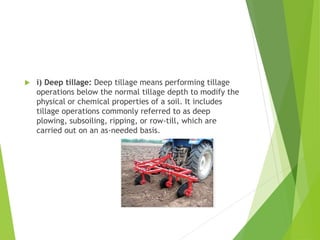
 i) Deep tillage: Deep tillage means performing tillage
operations below the normal tillage depth to modify the
physical or chemical properties of a soil. It includes
tillage operations commonly referred to as deep
plowing, subsoiling, ripping, or row-till, which are
carried out on an as-needed basis.
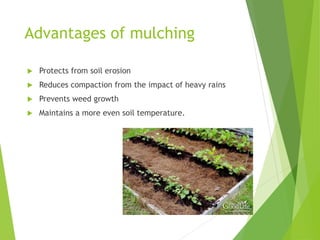
 ii) Mulching: Mulching is one of the simplest methods to
conserve soil moisture.A Mulch is simply a proyective
layer of a material that is spread on top of a
soil.Mulches can either be organic- such as straw bark
chips etc.or inorganic like stones brick chips plastic.
 The process is used both in commercial crop production
and in gardening, and when applied correctly can
dramatically improve soil productivity.
Advantages of mulching
 Protects from soil erosion
 Reduces compaction from the impact of heavy rains
 Prevents weed growth
 Maintains a more even soil temperature.
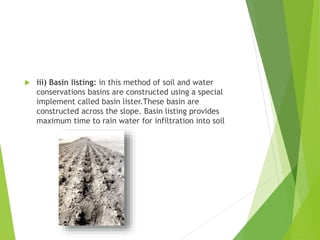
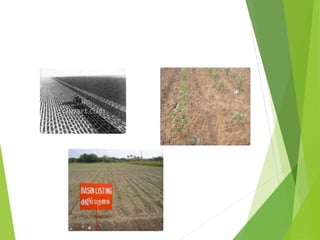
 iii) Basin listing: in this method of soil and water
conservations basins are constructed using a special
implement called basin lister.These basin are
constructed across the slope. Basin listing provides
maximum time to rain water for infiltration into soil
 iv) Broad based bed and furrows:
This system helps the soil to preserve the water level for a
longer period. Holding the moisture intact, the bed
stimulates crops growth. This system not only help in
water conservation but also help to adopt to changing
climate.
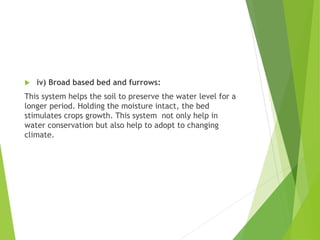
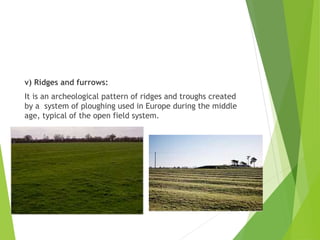
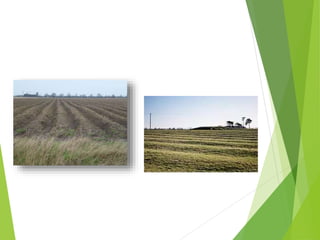
v) Ridges and furrows:
It is an archeological pattern of ridges and troughs created
by a system of ploughing used in Europe during the middle
age, typical of the open field system.
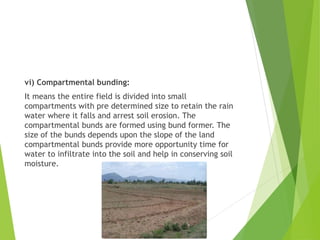
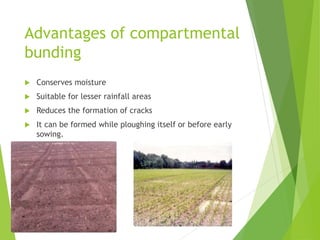
vi) Compartmental bunding:
It means the entire field is divided into small
compartments with pre determined size to retain the rain
water where it falls and arrest soil erosion. The
compartmental bunds are formed using bund former. The
size of the bunds depends upon the slope of the land
compartmental bunds provide more opportunity time for
water to infiltrate into the soil and help in conserving soil
moisture.
Advantages of compartmental
bunding
 Conserves moisture
 Suitable for lesser rainfall areas
 Reduces the formation of cracks
 It can be formed while ploughing itself or before early
sowing.
THANK YOU

Soil moisture conservation techniques

  • 1.
  • 2.
    INTRODUCTION  To increasethe moisture availability to the agricultural crops, it is necessary to adopt in-situ moisture conservation techniques in addition to the large scale soil and moisture conservation and water harvesting structures in the watershed.
  • 3.
     The principlebehind the recommendation of different practices is to increase the infiltration by reducing the rate of runoff, temporarily  Impounding the water on the surface of the soil to increase the opportunity time for infiltration and modifying the land configuration for inter plot water harvesting.
  • 4.
     Earlier effortsfor moisture conservation were concentrated upon construction of various types of bunds across the land slope to control erosion and conserve soil.  All the erosion control measures however, led to accumulation of water against the structures rather than its proper and uniform distribution in the interterraced area and at times led to reduction in crop yields.
  • 5.
     To overcomethese problems the insitu moisture conservation techniques are recommended.  Generally, the sub soiling and deep digging decreases the soil penetration resistance and increases profile water use when compared with conventional tillage.
  • 6.
    In-situ moisture conservation methods Toincrease the moisture availability to the agricultural crops in the individual farmer’s field and to increase the infiltration and percolation of rain water into the root profile, the in-situ moisture conservation techniques are recommended.
  • 7.
     i) Deeptillage: Deep tillage means performing tillage operations below the normal tillage depth to modify the physical or chemical properties of a soil. It includes tillage operations commonly referred to as deep plowing, subsoiling, ripping, or row-till, which are carried out on an as-needed basis.
  • 8.
     ii) Mulching:Mulching is one of the simplest methods to conserve soil moisture.A Mulch is simply a proyective layer of a material that is spread on top of a soil.Mulches can either be organic- such as straw bark chips etc.or inorganic like stones brick chips plastic.  The process is used both in commercial crop production and in gardening, and when applied correctly can dramatically improve soil productivity.
  • 9.
    Advantages of mulching Protects from soil erosion  Reduces compaction from the impact of heavy rains  Prevents weed growth  Maintains a more even soil temperature.
  • 10.
     iii) Basinlisting: in this method of soil and water conservations basins are constructed using a special implement called basin lister.These basin are constructed across the slope. Basin listing provides maximum time to rain water for infiltration into soil
  • 12.
     iv) Broadbased bed and furrows: This system helps the soil to preserve the water level for a longer period. Holding the moisture intact, the bed stimulates crops growth. This system not only help in water conservation but also help to adopt to changing climate.
  • 14.
    v) Ridges andfurrows: It is an archeological pattern of ridges and troughs created by a system of ploughing used in Europe during the middle age, typical of the open field system.
  • 16.
    vi) Compartmental bunding: Itmeans the entire field is divided into small compartments with pre determined size to retain the rain water where it falls and arrest soil erosion. The compartmental bunds are formed using bund former. The size of the bunds depends upon the slope of the land compartmental bunds provide more opportunity time for water to infiltrate into the soil and help in conserving soil moisture.
  • 17.
    Advantages of compartmental bunding Conserves moisture  Suitable for lesser rainfall areas  Reduces the formation of cracks  It can be formed while ploughing itself or before early sowing.
  • 18.