
SUSTAINABLE SOIL
MANAGEMENT THROUGH
PROPER SOIL GOVERNANCE
AND SOUND INVESTMENTS
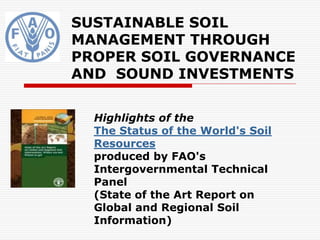
Highlights of the
The Status of the World's Soil
Resources
produced by FAO's
Intergovernmental Technical
Panel
(State of the Art Report on
Global and Regional Soil
Information)
World Soil Day celebration &
Closure of the International
Year of Soils 2015
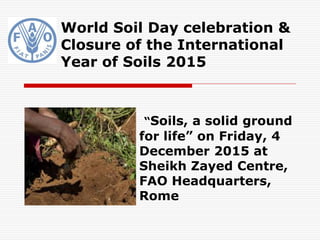
“Soils, a solid ground
for life” on Friday, 4
December 2015 at
Sheikh Zayed Centre,
FAO Headquarters,
Rome
"Let us promote sustainable soil
management rooted in proper
soil governance and sound
investments. Together, we can
promote the cause of soils, a
truly solid ground for life,"
UN Secretary-General Ban
Ki-moon message
"Further loss of productive soils
would severely damage food
production and food security,
amplify food-price volatility, and
potentially plunge millions of
people into hunger and poverty.
But the report also offers evidence
that this loss of soil resources and
functions can be avoided,"
FAO Director-General José
Graziano da Silva message
Basis for food, feed, fuel and fibre production and
for services to ecosystems and human well-being.
Reservoir for at least a quarter of global
biodiversity, and therefore requires the same
attention as above-ground biodiversity.
Play a key role in the supply of clean water and
resilience to floods and droughts.
The largest store of terrestrial carbon is in the soil
so that its preservation may contribute to climate
change adaptation and mitigation.
Therefore, maintenance or enhancement of global
soil resources is essential if humanity’s need for
food, water, and energy security is to be met.
Soils are highly important
Soils are vital for producing nutritious crops and
they filter and clean tens of thousands of cubic
kilometres of water each year. As a major
storehouse for carbon, soils also help regulate
emissions of carbon dioxide and other greenhouse
gases, thus are fundamental for regulating climate.
Yet the overwhelming conclusion of the report is
that the majority of the world's soil resources are
in only fair, poor or very poor condition and that
conditions are getting worse in far more cases than
they are improving. In particular, 33 percent of
land is moderately to highly degraded due to
erosion, salinization, compaction, acidification, and
chemical pollution of soils.
Soils status worldwide
The world's soils are rapidly deteriorating
due to
 soil erosion,
 nutrient depletion,
 loss of soil organic carbon,
 soil sealing and other threats
But this trend can be reversed provided
countries take the lead in promoting
sustainable management practices and the
use of appropriate technologies
Soils are endangered, but
the degradation can be
rolled back
Erosion carries away 25 to 40 billion tonnes of
topsoil every year, significantly reducing crop
yields and the soil’s ability to store and cycle
carbon, nutrients, and water. Annual cereal
production losses due to erosion have been
estimated at 7.6 million tonnes each year. If
action is not taken to reduce erosion, a total
reduction of over 253 million tonnes of cereals
could be projected by 2050. This yield loss
would be equivalent to removing 1.5 million
square kilometres of land from crop production
– or roughly all the arable land in India
Some of the report’s key
findings
 Lack of soil nutrients is the greatest obstacle
to improving food production and soil
function in many degraded landscapes. In
Africa, all but three countries extract more
nutrients from the soil each year than are
returned through use of fertilizer, crop
residues, manure, and other organic matter.
Some of the report’s key
findings (contd.)
 Accumulation of salts in the soil reduces crop
yields and can completely eliminate crop
production. Human-induced salinity affects
an estimated 760,000 square kilometres of
land worldwide – an area larger than all the
arable land in Brazil.
 Soil acidity is a serious constraint to food
production worldwide. The most acidic top
soils in the world are located in areas of
South America that have experienced
deforestation and intensive agriculture.
Some of the report’s key
findings (contd.)
The report focuses on the 10 main
threats to soil functions:
 soil erosion,
 soil organic carbon loss,
 nutrient imbalance,
 soil acidification,
 soil contamination,
Achieving healthy soils
 waterlogging,
 soil compaction,
 soil sealing,
 salinization and
 loss of soil biodiversity.
Achieving healthy soils
(contd.)
The report notes a general
consensus on soil-related
strategies that can, on the one
hand, increase the supply of food,
while on the other, minimize
harmful environmental impacts.
General consensus on
soil-related strategies
The solution proposed is one that
centres on sustainable soil
management and which requires
the participation of a broad level
of stakeholders ranging from
governments to small-holder
farmers.
The solution proposed
 Erosion, for example, can be
curbed by reducing or
eliminating tillage - digging,
stirring, and overturning of soil -
and using crop residues to
protect the soil surface from the
effects of rain and winds.
Examples
 Similarly, soils suffering from
nutrient deficits can be restored
and yields increased by returning
crop residues and other organic
material to the soil, employing
crop rotation with nitrogen-fixing
crops, and making judicious use
of organic and mineral fertilizers.
Examples
(contd.)
 Minimize further degradation of
soils and restore the productivity
of soils that are already degraded
in regions where people are most
vulnerable;
 Stabilize global stores of soil
organic matter, including both soil
organic carbon and soil organisms;
Report identifies four
priorities for action:
 Stabilize or reduce global use of
nitrogen and phosphorus
fertilizer, while increasing
fertilizer use in regions of
nutrient deficiency; and,
 Improve our knowledge about
the state and trend of soil
conditions.
Report identifies four
priorities for action (contd.)
 support for the development of soil
information systems to monitor and forecast
soil change;
 increasing education and awareness on soil
issues, by integrating these into formal
education and across the curriculum - from
geology to geography, from biology to
economics.
 investing in research development and
extension, to develop test, disseminate
sustainable soil management technologies
and practices.
Need to be supported by
targeted policies, including
 introducing appropriate and effective
regulation and incentives. This could include
taxes that discourage harmful practices such
as excessive use of fertilizer, herbicides and
pesticides. Zoning systems can be used to
protect the best agricultural soil from urban
sprawl. Subsidies could be used to encourage
people to purchase tools and other inputs
that have a less harmful impact on soils,
while certification of sustainable crop and
livestock practices can make produce more
commercially attractive at higher prices
Need to be supported by
targeted policies, including
 supporting achievement of local,
regional and international food
security by considering countries'
soil resources and their capacities
to manage them sustainably.
Need to be supported by
targeted policies, including
Maintaining healthy soils required for
feeding the growing population of the
world and meeting their needs for
biomass (energy), fibre, fodder, and
other products can only be ensured
through a strong partnership. This is
one of the key guiding principles for the
establishment of the Global Soil
Partnership (GSP)
GLOBAL SOIL PARTNERSHIP
Maintaining healthy soils required for
feeding the growing population of the
world and meeting their needs for
biomass (energy), fiber, fodder, and
other products can only be ensured
through a strong partnership. This is
one of the key guiding principles for the
establishment of the Global Soil
Partnership (GSP)
GLOBAL SOIL PARTNERSHIP
(contd.)
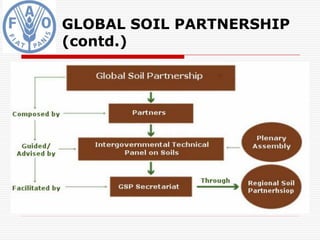
GLOBAL SOIL PARTNERSHIP
(contd.)
5 pillars of action
The Global Soil Partnership will support the process
leading to the adoption of sustainable development goals
for soils. It will contribute to environmental wellbeing
through, for example, preventing soil erosion and
degradation, reducing greenhouse gas emissions,
promoting carbon sequestration and promoting
sustainable use of agricultural inputs for soil health and
ecosystems management. It will equally contribute to
human wellbeing and social equity through improved use
and governance of soil resources, finding alternatives to
soil degrading practices through participatory
experiential processes, and being sensitive to issues of
gender and rights of indigenous peoples.
GLOBAL SOIL PARTNERSHIP
(contd.)
5 pillars of action
Promote sustainable management of soil
resources for soil protection, conservation and
sustainable productivity
Encourage investment, technical cooperation,
policy, education awareness and extension in soil
Promote targeted soil research and development
focusing on identified gaps and priorities and
synergies with related productive, environmental
and social development actions
GLOBAL SOIL PARTNERSHIP
(contd.)
5 pillars of action
Enhance the quantity and quality of soil data
and information: data collection (generation),
analysis, validation, reporting, monitoring and
integration with other disciplines
Harmonization of methods, measurements and
indicators for the sustainable management and
protection of soil resources
Healthy Soils Facility
The Healthy Soils Facility has been formulated
in response to a specific request from the
Plenary Assembly of the Global Soil Partnership
(GSP) at its first meeting of June 2013.
This Facility is meant to constitute a major
“operational arm” of the GSP, and needs to
operate in a context of major threats against
limited soil resources in all regions and
consequent urgent need for countries to take
collective and individual action to reverse
worrisome trends.
Healthy Soils Facility
(contd.)
The Facility is designed to align resource
partners (constituting an effective multi-
partner platform) willing to join forces in
support of the GSP, as it allows both for a
cogent approach and full consistency with the
GSP objectives.
Resource partners should be able to support
those components and activities which
correspond most closely to their own strategic
and geographical preferences, while having the
assurance that their contributions would be
part of a global, coherent set of interventions.
Healthy Soils Facility
(contd.)
The indicative lifetime of the Facility is
to be about five years (at least
initially) with a resource envelope
envisaged at this stage at USD 64
million (for voluntary contributions
from resource partners) to be
completed by eventual “in-kind”
contributions from GSP partners.
FAO through the Global Soil
Partnership in collaboration with its
member states and partner
organizations is trying to create
awareness and mobilize technical
and financial resources for
sustainable soil management
through proper soil governance and
sound investments.
Summary
THANK YOU FOR YOUR ATTENTION