The 15th International Conference
   for Women Engineers and
      Scientists (ICWES15)
       Adelaide, Australia
         15—22 July 2011


                                    1
UNDERGRADUATE RESEARCH
PROGRAM AT A COMMUNITY
       COLLEGE


Margaret E. McCarthy1*, Beth C. McGinnis-
    Cavanaugh1*, Barbara S. Wurtzel1*
     1 Springfield Technical Community

College, One Armory Square, Springfield MA
                    01105


                                             2
Abstract
• National Research Council [USA] has charged Community Colleges
  to consider instituting a foundation program to introduce students
  to science research.
• Initial focus will be a community of faculty "Research in
  Community" [RICE] to promote test-bed implementation and
  assessment as well as foster faculty buy-in across the campus.
• The plan will be coordinated with the existing Honors Program and
  current independent faculty / student research projects.
• The major goals:
   –   enhance overall student experience
   –   improving student performance and preparation
   –   supporting student transfer opportunities
   –   outreach to academic and community partners.
• This format is modeled on “Teaching in Community” specifically to
  provide better access for women in science to all aspects of the
  undergraduate experience.

                                                                       3
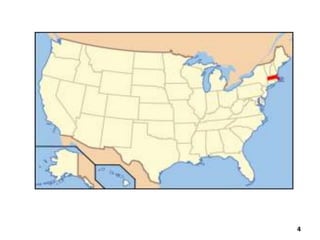
http://www.mapsofworld.com/usa/states/mas
sachusetts/maps/massachusetts-map.jpg


                                            4
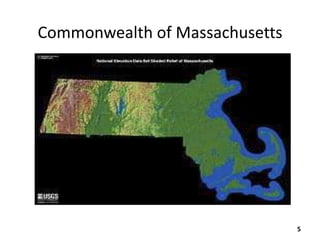
Commonwealth of Massachusetts


                                5
Western Massachusetts


                        6
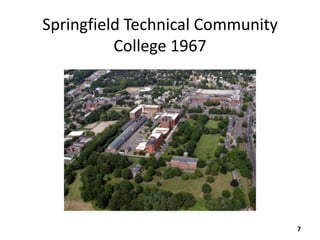
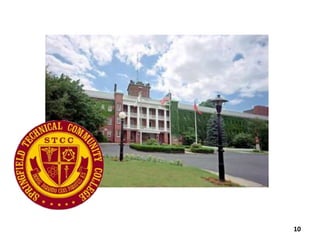
Springfield Technical Community
          College 1967


                                  7
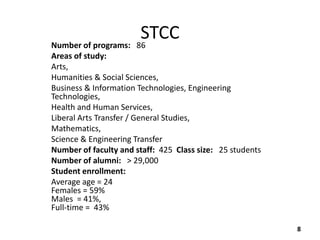
Number of programs:
                                              STCC
                                             86
Areas of study:
Arts,
Humanities & Social Sciences,
Business & Information Technologies, Engineering
Technologies,
Health and Human Services,
Liberal Arts Transfer / General Studies,
Mathematics,
Science & Engineering Transfer
Number of faculty and staff: 425 Class size: 25 students
Number of alumni: > 29,000
Student enrollment:
Average age = 24
Females = 59%
Males = 41%,
Full-time = 43%
Technical Community College is a major resource for the economic vitality of
Western Massachusetts. As the only technical community college in Massachusetts, STCC offers a
variety of career programs unequalled in the state. Biotechnology, IT Security, Laser Electro-                    8
Optics, Nursing, Robotics, Sonography, Telecommunications and dozens of other career programs produce potential
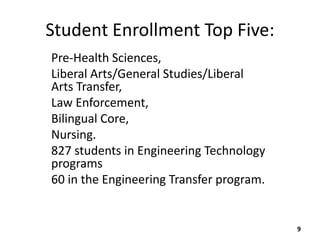
Student Enrollment Top Five:
Pre-Health Sciences,
Liberal Arts/General Studies/Liberal
Arts Transfer,
Law Enforcement,
Bilingual Core,
Nursing.
827 students in Engineering Technology
programs
60 in the Engineering Transfer program.


                                          9
10
Degrees & Programs
      Associate Degree Programs
            Fine Arts Option
          Liberal Arts Transfer
   Teacher Education Transfer Option
 Commonwealth Transfer Compact Option
    University Without Walls Option

          Certificate Program
          Health Aide Option

      Degree Preparation Programs
 Pre-Engineering Science Transfer Option
            Pre-Health Option
        Bilingual Program Option
       Non-Matriculating Option


                                           11
Studies Options
LTGS.AA -Transfer Option: for the student electing one of the degree or transfer
programs
    Commonwealth Transfer Compact Option
    University Without Walls Option

HTHC.GS -Pre-Health Option: for the student contemplating application to a program in
the fields of Health Sciences or Nursing

ENGC.GS - Pre-Engineering/Science Transfer Option: for the student planning to major
in the Science Transfer Option or to prepare for the Engineering Transfer program of the
College

BLNG.GS - Bilingual Program: for students who need to develop English language
skills, an intensive and accelerated curriculum in English As a Second Language, as well
as transitional courses in mathematics and biology, with related counseling and support
services

UNDC.NM - Non-Matriculating Option: for students not currently seeking acceptance
into a STCC program

                                                                                      12
http://health.stcc.edu/
                          School of Nursing
                              Nursing

              School of Health & Patient Simulation

Clinical Lab                        Physical Therapy Assistant
Cosmetology                         Respiratory Care
Dental Assistant                    Nuclear Medicine
Dental Hygiene                      Patient Care Technician
Paramedic Program                   Sonography
Interdisciplinary Health Studies    Radiography
Medical Assistant                   Surgical Technology
Massage Therapy                     General Studies Health Core
Occupational Therapy Assisting


                                                                  13
Action Plan Phase I: 2010 – 2011 Academic Year
Phase I begins the formalization of the program with informational
sessions for faculty and initial reporting to administration.
Goal: To introduce and infuse a culture of undergraduate research at
STCC
Objectives
     Determine characteristics of successful undergraduate research
     program at STCC
     Determine how undergraduate research is compatible with a
     teaching institution and consistent with the teaching mission of the
     College
     Promote “buy-in” of faculty
     Identify methods to elevate participating faculty and students in
     the culture of the institution
     Assess existing and required resources and support
Strategies
Outcomes

                                                                            14
Action Plan Phase I: 2010 – 2011 Academic Year
Phase I begins the formalization of the program with informational
sessions for faculty and initial reporting to administration.
Goal: To introduce and infuse a culture of undergraduate research at
STCC
Objectives
Strategies
     Formulation of RICE group
     RICE meetings with STCC faculty
     Compilation of faculty feedback from RICE sessions
     Report to College President and Dean of Academic Affairs
     Research funding sources and begin funding process
Outcomes


                                                                       15
Action Plan Phase I: 2010 – 2011 Academic Year
Phase I begins the formalization of the program with informational
sessions for faculty and initial reporting to administration.
Goal: To introduce and infuse a culture of undergraduate research at
STCC
Objectives
Strategies
Outcomes
     Preliminary working definition of undergraduate research at STCC
     Preliminary formal articulation of program’s philosophy
     Preliminary draft of overall program characteristics and structure
     RICE approved by College President and Academic Dean
     Formalization of first full RICE faculty cohort


                                                                           16
Phase II: 2011 – 2012 Academic Year
Phase II represents the specific formalization of the program. The program
will eventually fit within the Shared Governance structure as a standing
committee, which also serves as a free standing authority for future funding
requests.
Goal: To design a sustainable undergraduate research program
Objectives
      Compile and analyze faculty feedback from RICE meetings
      Evaluate existing library services and identify gaps
      Inventory existing Honors projects and independent faculty research
      projects
      Identify “test-bed” faculty and courses for pilot projects and faculty
      mentors
      Set thresholds, pre-requisites, and criteria for participation
      Identify realistic, sustainable incentives for faculty
      Develop effective support structure for program
      Determine satisfactory faculty incentives and adequate support
Strategies
Outcomes
                                                                                17
Phase II: 2011 – 2012 Academic Year
Phase II represents the specific formalization of the program. The program
will eventually fit within the Shared Governance structure as a standing
committee, which also serves as a free standing authority for future funding
requests.
Goal: To design a sustainable undergraduate research program
Objectives
Strategies
      Exploration of existing and planned learning communities to further
      program
      Present definition of undergraduate research to Shared Governance
      Outreach to Grants/Development and other sources for funding;
      initialization of contacts in academic/business/civic communities
      Review, compilation, and presentation to College President and Dean of
      Academic Affairs
Outcomes


                                                                                18
Phase II: 2011 – 2012 Academic Year
Phase II represents the specific formalization of the program. The program
will eventually fit within the Shared Governance structure as a standing
committee, which also serves as a free standing authority for future funding
requests.
Goal: To design a sustainable undergraduate research program
Objectives
Strategies
Outcomes
      Formal definition of undergraduate research as approved by Shared
      Governance
      Clarification of connection between undergraduate research and
      Honors Program
      RICE becomes standing committee under Shared Governance
      Fully-designed undergraduate research program at STCC approved by
      College President and Dean of Academic Affairs
      Approval by Academic Curriculum Committee


                                                                               19
Action Plan Phase III: 2012 – 2013 Academic Year
The STCC definition for undergraduate research will be finalized and a
working program design will be fully implemented.
Goal: To implement fully-designed undergraduate research program

Objectives
    Recruit and enroll qualified students
    Pursue funding sources and outside resources
    Comply with union contractual obligations and limitations

Strategies

Outcomes


                                                                         20
Action Plan Phase III: 2012 – 2013 Academic Year
The STCC definition for undergraduate research will be finalized and a
working program design will be fully implemented.
Goal: To implement fully-designed undergraduate research program
Objectives
Strategies
    Establish faculty mentors
    Develop assessment and evaluation instruments to align with
    academic/industry standards (examples: ABET, Essential of
    Medical Technologies, Nursing)
    Conduct outreach to other community colleges via reciprocal
    site visits
    Conduct outreach to other campus and national organizations
    Conduct outreach to local/state/national civic and business
    communities
Outcomes


                                                                         21
Action Plan Phase III: 2012 – 2013 Academic Year
The STCC definition for undergraduate research will be finalized and a
working program design will be fully implemented.
Goal: To implement fully-designed undergraduate research program

Objectives
Strategies
Outcomes
    Sufficient numbers of qualified and interested students and
    faculty; satisfactory projected enrollment
    Formal assessment and evaluation underway
    Collaboration with other academic, business, and community
    organizations with appropriate facilities, research programs, and
    opportunities for students
    Recognition by STCC Board of Trustees


                                                                         22
Assessment
            Students                         Faculty                        Institution
# participants                   # participants                   Increased collaboration with
                                                                  local and peer institutions
Diversity of participants        Diversity of programs offered    Increased visibility in
                                                                  community
Retention                        Retention                        Increased appeal to potential
                                                                  students
Increased scores on faculty-     Increased grant activity         Increased grant funding
designed content/skill rubrics
Number and quality of            Increased collaboration with     Enhanced collegiality among
presentations and publications   faculty                          faculty and administration
Scholarship and transfer         New faculty researchers and
success                          increased research publication
Better preparedness for four-    Faculty feedback
year institutions
Job and internship placement
Increased interest in STEM
Student feedback


                                                                                                  23
Conclusion
Directed by a clearly outlined three-year, three-phase process, the
major goals of the initiative will be directed by the STCC definition of
undergraduate research.
Characteristics of the successful program will be identified and tailored
by input across the campus and the curriculum for the academic year
2012-2013.

The major goals:
    enhance the overall student experience
    improve student engagement, performance, and preparation
    support student transfer opportunities; recruit
    retain traditionally underrepresented groups in areas of study
    foster outreach to academic, community, and industry partners.


                                                                            24
References (Alphabetical)
Boyd, MK, Wesemann, JL, & Frederick, KA 2009, Broadening
participation in undergraduate research: fostering excellence and
enhancing the impact. Council for Undergraduate
Research, Washington, D. C.
Bransford, J 2000, How people learn: brain, mind experience and school.
National Academy Press, Washington, D. C.
Council on Undergraduate Research & National Council for Institutional
Administrators. 2010. Developing undergraduate research at community
colleges: tapping the potential of all students, viewed 8 August, 2010.
<http://www.cur.org/cclicommcoll.html >.
Council on Undergraduate Research. Learning for research: frequently
asked questions. Viewed 22 January, 2011 <
http://www.cur.org/faq.html >
Dolan, E 2010, ‘The last five years.’ CBE: Life Sciences
Education, vol.9, no. 4, pp. 379-380, CBE: Life Sciences
Education, American Society for Cell Biology, viewed 12 February 2010.
Economic Development Council of Western Massachusetts. 2010.
Knowledge corridor. Viewed 25 January 2011.
<http://www.westernmassedc.com/Data__Demographics/knowledgecor
ridor/ >
                                                                          25
References (continued)
Engestrom Y, 2001, Expansive learning at work: toward an activity-
theoretical reconceptualisation. University of London, Institute of Education.
Ishiyama, J 2007, ‘Expectations and perceptions of undergraduate research
expectations and perceptions of undergraduate mentoring comparing first
generation, low income white/caucasian and African American students.’
College Student Journal, vol 41, no 3, pp. 540-549.
Hunt, EB & Minstrell, J 1994 ‘A cognitive approach to the teaching of
physics.’ In K McGilly (ed.) Classroom Lessons: Integrating Cognitive Theory
and Classroom Practice. MIT Press, Cambridge (Massachusetts)
Karukstis, K 2007, 'Alliances to promote undergraduate research.’ Journal of
Chemical Education , vol 84, no 3, pp. 384-386, Journal of Chemical
Education Online, viewed 10 February 2011.
Karukstis, K 2006, ‘A Council on Undergraduate Research Council initiative to
establish, enhance and institutionalize undergraduate research.’ Journal of
Chemical Education, vol. 83, no. 3, pp.1744-1745, Journal of Chemical
Education Online, viewed 10 February 2011.
Karukstis, K 2007, The impact of undergraduate research on America's
global competitiveness.’ Journal of Chemical Education, vol. 84, no.6,
pp.912-915. Journal of Chemical Education Online, viewed 11 February
2011.
                                                                            26
References (continued)
Karukstis, K 2007, The impact of undergraduate research on America's global competitiveness.’
Journal of Chemical Education, vol. 84, no.6, pp.912-915. Journal of Chemical Education
Online, viewed 11 February 2011.
Marx, RW, Blumenfeld, PC, Krajcik, JS & Soloway, E 1997, ‘Enacting project-based science.’ The
Elementary School Journal, vol.97, no.4 pp.341-358.
Mojock, C, Keefer, R & Summer, D 2008, ‘Stop and smell the fries: collaborative bio-fuel
research in the community college." Community College Journal of Research & Practice, vol.
32, no.11, pp. 892-894, Professional Development Collection. EBSCOhost,Viewed 12 February
2011.
Nagda BA.Gregerman, SR, Jonides, J. von Hippel, W & Lerner, JS. 1998,‘Undergraduate student-
faculty research partnerships affect student retention.’ The Review of Higher Education.Vol.
22, no. 1, pp. 55-72. Viewed 21 May 2011 http://www-
personal.umich.edu/~jjonides/pdf/1998_6.pdf
Nonaka, I & Takeuchi, H 1995, The knowledge creating company: how Japanese companies
create the dynamics of innovation. Oxford University Press, New York.
Sadler, TD & McKinney, L 2010, ‘Scientific research for undergraduate students: a review of the
literature.’ Journal of College Science Teaching vol.39, no. 5, pp. 43-49, Educator's Reference
Complete, Ebscohost. viewed 12 February 2011.
Taraban, R & Blanton, RL 2007, Creating effective undergraduate research programs in science:
the transformation from student to scientist. Teachers College Press, New York.
                                                                                             27
Contact Information
www.stcc.edu

Speaker: Margaret E McCarthy: mmccarthy@stcc.edu
Chairman Physics Department

Beth C. McGinnis-Cavanaugh:
bmcginnis-cavanaugh@stcc.edu
Civil Engineer

Barbara S. Wurtzel: bwurtzel@stcc.edu
Reference Librarian


                                                   28
29

ICWES15 - Undergraduate Research Initiative at a Community College. Presented by Margaret E McCarthy, Springfield Technical Community College, United States

  • 1.
    The 15th InternationalConference for Women Engineers and Scientists (ICWES15) Adelaide, Australia 15—22 July 2011 1
  • 2.
    UNDERGRADUATE RESEARCH PROGRAM ATA COMMUNITY COLLEGE Margaret E. McCarthy1*, Beth C. McGinnis- Cavanaugh1*, Barbara S. Wurtzel1* 1 Springfield Technical Community College, One Armory Square, Springfield MA 01105 2
  • 3.
    Abstract • National ResearchCouncil [USA] has charged Community Colleges to consider instituting a foundation program to introduce students to science research. • Initial focus will be a community of faculty "Research in Community" [RICE] to promote test-bed implementation and assessment as well as foster faculty buy-in across the campus. • The plan will be coordinated with the existing Honors Program and current independent faculty / student research projects. • The major goals: – enhance overall student experience – improving student performance and preparation – supporting student transfer opportunities – outreach to academic and community partners. • This format is modeled on “Teaching in Community” specifically to provide better access for women in science to all aspects of the undergraduate experience. 3
  • 4.
  • 5.
  • 6.
  • 7.
  • 8.
    Number of programs: STCC 86 Areas of study: Arts, Humanities & Social Sciences, Business & Information Technologies, Engineering Technologies, Health and Human Services, Liberal Arts Transfer / General Studies, Mathematics, Science & Engineering Transfer Number of faculty and staff: 425 Class size: 25 students Number of alumni: > 29,000 Student enrollment: Average age = 24 Females = 59% Males = 41%, Full-time = 43% Technical Community College is a major resource for the economic vitality of Western Massachusetts. As the only technical community college in Massachusetts, STCC offers a variety of career programs unequalled in the state. Biotechnology, IT Security, Laser Electro- 8 Optics, Nursing, Robotics, Sonography, Telecommunications and dozens of other career programs produce potential
  • 9.
    Student Enrollment TopFive: Pre-Health Sciences, Liberal Arts/General Studies/Liberal Arts Transfer, Law Enforcement, Bilingual Core, Nursing. 827 students in Engineering Technology programs 60 in the Engineering Transfer program. 9
  • 10.
  • 11.
    Degrees & Programs Associate Degree Programs Fine Arts Option Liberal Arts Transfer Teacher Education Transfer Option Commonwealth Transfer Compact Option University Without Walls Option Certificate Program Health Aide Option Degree Preparation Programs Pre-Engineering Science Transfer Option Pre-Health Option Bilingual Program Option Non-Matriculating Option 11
  • 12.
    Studies Options LTGS.AA -TransferOption: for the student electing one of the degree or transfer programs Commonwealth Transfer Compact Option University Without Walls Option HTHC.GS -Pre-Health Option: for the student contemplating application to a program in the fields of Health Sciences or Nursing ENGC.GS - Pre-Engineering/Science Transfer Option: for the student planning to major in the Science Transfer Option or to prepare for the Engineering Transfer program of the College BLNG.GS - Bilingual Program: for students who need to develop English language skills, an intensive and accelerated curriculum in English As a Second Language, as well as transitional courses in mathematics and biology, with related counseling and support services UNDC.NM - Non-Matriculating Option: for students not currently seeking acceptance into a STCC program 12
  • 13.
    http://health.stcc.edu/ School of Nursing Nursing School of Health & Patient Simulation Clinical Lab Physical Therapy Assistant Cosmetology Respiratory Care Dental Assistant Nuclear Medicine Dental Hygiene Patient Care Technician Paramedic Program Sonography Interdisciplinary Health Studies Radiography Medical Assistant Surgical Technology Massage Therapy General Studies Health Core Occupational Therapy Assisting 13
  • 14.
    Action Plan PhaseI: 2010 – 2011 Academic Year Phase I begins the formalization of the program with informational sessions for faculty and initial reporting to administration. Goal: To introduce and infuse a culture of undergraduate research at STCC Objectives Determine characteristics of successful undergraduate research program at STCC Determine how undergraduate research is compatible with a teaching institution and consistent with the teaching mission of the College Promote “buy-in” of faculty Identify methods to elevate participating faculty and students in the culture of the institution Assess existing and required resources and support Strategies Outcomes 14
  • 15.
    Action Plan PhaseI: 2010 – 2011 Academic Year Phase I begins the formalization of the program with informational sessions for faculty and initial reporting to administration. Goal: To introduce and infuse a culture of undergraduate research at STCC Objectives Strategies Formulation of RICE group RICE meetings with STCC faculty Compilation of faculty feedback from RICE sessions Report to College President and Dean of Academic Affairs Research funding sources and begin funding process Outcomes 15
  • 16.
    Action Plan PhaseI: 2010 – 2011 Academic Year Phase I begins the formalization of the program with informational sessions for faculty and initial reporting to administration. Goal: To introduce and infuse a culture of undergraduate research at STCC Objectives Strategies Outcomes Preliminary working definition of undergraduate research at STCC Preliminary formal articulation of program’s philosophy Preliminary draft of overall program characteristics and structure RICE approved by College President and Academic Dean Formalization of first full RICE faculty cohort 16
  • 17.
    Phase II: 2011– 2012 Academic Year Phase II represents the specific formalization of the program. The program will eventually fit within the Shared Governance structure as a standing committee, which also serves as a free standing authority for future funding requests. Goal: To design a sustainable undergraduate research program Objectives Compile and analyze faculty feedback from RICE meetings Evaluate existing library services and identify gaps Inventory existing Honors projects and independent faculty research projects Identify “test-bed” faculty and courses for pilot projects and faculty mentors Set thresholds, pre-requisites, and criteria for participation Identify realistic, sustainable incentives for faculty Develop effective support structure for program Determine satisfactory faculty incentives and adequate support Strategies Outcomes 17
  • 18.
    Phase II: 2011– 2012 Academic Year Phase II represents the specific formalization of the program. The program will eventually fit within the Shared Governance structure as a standing committee, which also serves as a free standing authority for future funding requests. Goal: To design a sustainable undergraduate research program Objectives Strategies Exploration of existing and planned learning communities to further program Present definition of undergraduate research to Shared Governance Outreach to Grants/Development and other sources for funding; initialization of contacts in academic/business/civic communities Review, compilation, and presentation to College President and Dean of Academic Affairs Outcomes 18
  • 19.
    Phase II: 2011– 2012 Academic Year Phase II represents the specific formalization of the program. The program will eventually fit within the Shared Governance structure as a standing committee, which also serves as a free standing authority for future funding requests. Goal: To design a sustainable undergraduate research program Objectives Strategies Outcomes Formal definition of undergraduate research as approved by Shared Governance Clarification of connection between undergraduate research and Honors Program RICE becomes standing committee under Shared Governance Fully-designed undergraduate research program at STCC approved by College President and Dean of Academic Affairs Approval by Academic Curriculum Committee 19
  • 20.
    Action Plan PhaseIII: 2012 – 2013 Academic Year The STCC definition for undergraduate research will be finalized and a working program design will be fully implemented. Goal: To implement fully-designed undergraduate research program Objectives Recruit and enroll qualified students Pursue funding sources and outside resources Comply with union contractual obligations and limitations Strategies Outcomes 20
  • 21.
    Action Plan PhaseIII: 2012 – 2013 Academic Year The STCC definition for undergraduate research will be finalized and a working program design will be fully implemented. Goal: To implement fully-designed undergraduate research program Objectives Strategies Establish faculty mentors Develop assessment and evaluation instruments to align with academic/industry standards (examples: ABET, Essential of Medical Technologies, Nursing) Conduct outreach to other community colleges via reciprocal site visits Conduct outreach to other campus and national organizations Conduct outreach to local/state/national civic and business communities Outcomes 21
  • 22.
    Action Plan PhaseIII: 2012 – 2013 Academic Year The STCC definition for undergraduate research will be finalized and a working program design will be fully implemented. Goal: To implement fully-designed undergraduate research program Objectives Strategies Outcomes Sufficient numbers of qualified and interested students and faculty; satisfactory projected enrollment Formal assessment and evaluation underway Collaboration with other academic, business, and community organizations with appropriate facilities, research programs, and opportunities for students Recognition by STCC Board of Trustees 22
  • 23.
    Assessment Students Faculty Institution # participants # participants Increased collaboration with local and peer institutions Diversity of participants Diversity of programs offered Increased visibility in community Retention Retention Increased appeal to potential students Increased scores on faculty- Increased grant activity Increased grant funding designed content/skill rubrics Number and quality of Increased collaboration with Enhanced collegiality among presentations and publications faculty faculty and administration Scholarship and transfer New faculty researchers and success increased research publication Better preparedness for four- Faculty feedback year institutions Job and internship placement Increased interest in STEM Student feedback 23
  • 24.
    Conclusion Directed by aclearly outlined three-year, three-phase process, the major goals of the initiative will be directed by the STCC definition of undergraduate research. Characteristics of the successful program will be identified and tailored by input across the campus and the curriculum for the academic year 2012-2013. The major goals: enhance the overall student experience improve student engagement, performance, and preparation support student transfer opportunities; recruit retain traditionally underrepresented groups in areas of study foster outreach to academic, community, and industry partners. 24
  • 25.
    References (Alphabetical) Boyd, MK,Wesemann, JL, & Frederick, KA 2009, Broadening participation in undergraduate research: fostering excellence and enhancing the impact. Council for Undergraduate Research, Washington, D. C. Bransford, J 2000, How people learn: brain, mind experience and school. National Academy Press, Washington, D. C. Council on Undergraduate Research & National Council for Institutional Administrators. 2010. Developing undergraduate research at community colleges: tapping the potential of all students, viewed 8 August, 2010. <http://www.cur.org/cclicommcoll.html >. Council on Undergraduate Research. Learning for research: frequently asked questions. Viewed 22 January, 2011 < http://www.cur.org/faq.html > Dolan, E 2010, ‘The last five years.’ CBE: Life Sciences Education, vol.9, no. 4, pp. 379-380, CBE: Life Sciences Education, American Society for Cell Biology, viewed 12 February 2010. Economic Development Council of Western Massachusetts. 2010. Knowledge corridor. Viewed 25 January 2011. <http://www.westernmassedc.com/Data__Demographics/knowledgecor ridor/ > 25
  • 26.
    References (continued) Engestrom Y,2001, Expansive learning at work: toward an activity- theoretical reconceptualisation. University of London, Institute of Education. Ishiyama, J 2007, ‘Expectations and perceptions of undergraduate research expectations and perceptions of undergraduate mentoring comparing first generation, low income white/caucasian and African American students.’ College Student Journal, vol 41, no 3, pp. 540-549. Hunt, EB & Minstrell, J 1994 ‘A cognitive approach to the teaching of physics.’ In K McGilly (ed.) Classroom Lessons: Integrating Cognitive Theory and Classroom Practice. MIT Press, Cambridge (Massachusetts) Karukstis, K 2007, 'Alliances to promote undergraduate research.’ Journal of Chemical Education , vol 84, no 3, pp. 384-386, Journal of Chemical Education Online, viewed 10 February 2011. Karukstis, K 2006, ‘A Council on Undergraduate Research Council initiative to establish, enhance and institutionalize undergraduate research.’ Journal of Chemical Education, vol. 83, no. 3, pp.1744-1745, Journal of Chemical Education Online, viewed 10 February 2011. Karukstis, K 2007, The impact of undergraduate research on America's global competitiveness.’ Journal of Chemical Education, vol. 84, no.6, pp.912-915. Journal of Chemical Education Online, viewed 11 February 2011. 26
  • 27.
    References (continued) Karukstis, K2007, The impact of undergraduate research on America's global competitiveness.’ Journal of Chemical Education, vol. 84, no.6, pp.912-915. Journal of Chemical Education Online, viewed 11 February 2011. Marx, RW, Blumenfeld, PC, Krajcik, JS & Soloway, E 1997, ‘Enacting project-based science.’ The Elementary School Journal, vol.97, no.4 pp.341-358. Mojock, C, Keefer, R & Summer, D 2008, ‘Stop and smell the fries: collaborative bio-fuel research in the community college." Community College Journal of Research & Practice, vol. 32, no.11, pp. 892-894, Professional Development Collection. EBSCOhost,Viewed 12 February 2011. Nagda BA.Gregerman, SR, Jonides, J. von Hippel, W & Lerner, JS. 1998,‘Undergraduate student- faculty research partnerships affect student retention.’ The Review of Higher Education.Vol. 22, no. 1, pp. 55-72. Viewed 21 May 2011 http://www- personal.umich.edu/~jjonides/pdf/1998_6.pdf Nonaka, I & Takeuchi, H 1995, The knowledge creating company: how Japanese companies create the dynamics of innovation. Oxford University Press, New York. Sadler, TD & McKinney, L 2010, ‘Scientific research for undergraduate students: a review of the literature.’ Journal of College Science Teaching vol.39, no. 5, pp. 43-49, Educator's Reference Complete, Ebscohost. viewed 12 February 2011. Taraban, R & Blanton, RL 2007, Creating effective undergraduate research programs in science: the transformation from student to scientist. Teachers College Press, New York. 27
  • 28.
    Contact Information www.stcc.edu Speaker: MargaretE McCarthy: mmccarthy@stcc.edu Chairman Physics Department Beth C. McGinnis-Cavanaugh: bmcginnis-cavanaugh@stcc.edu Civil Engineer Barbara S. Wurtzel: bwurtzel@stcc.edu Reference Librarian 28
  • 29.