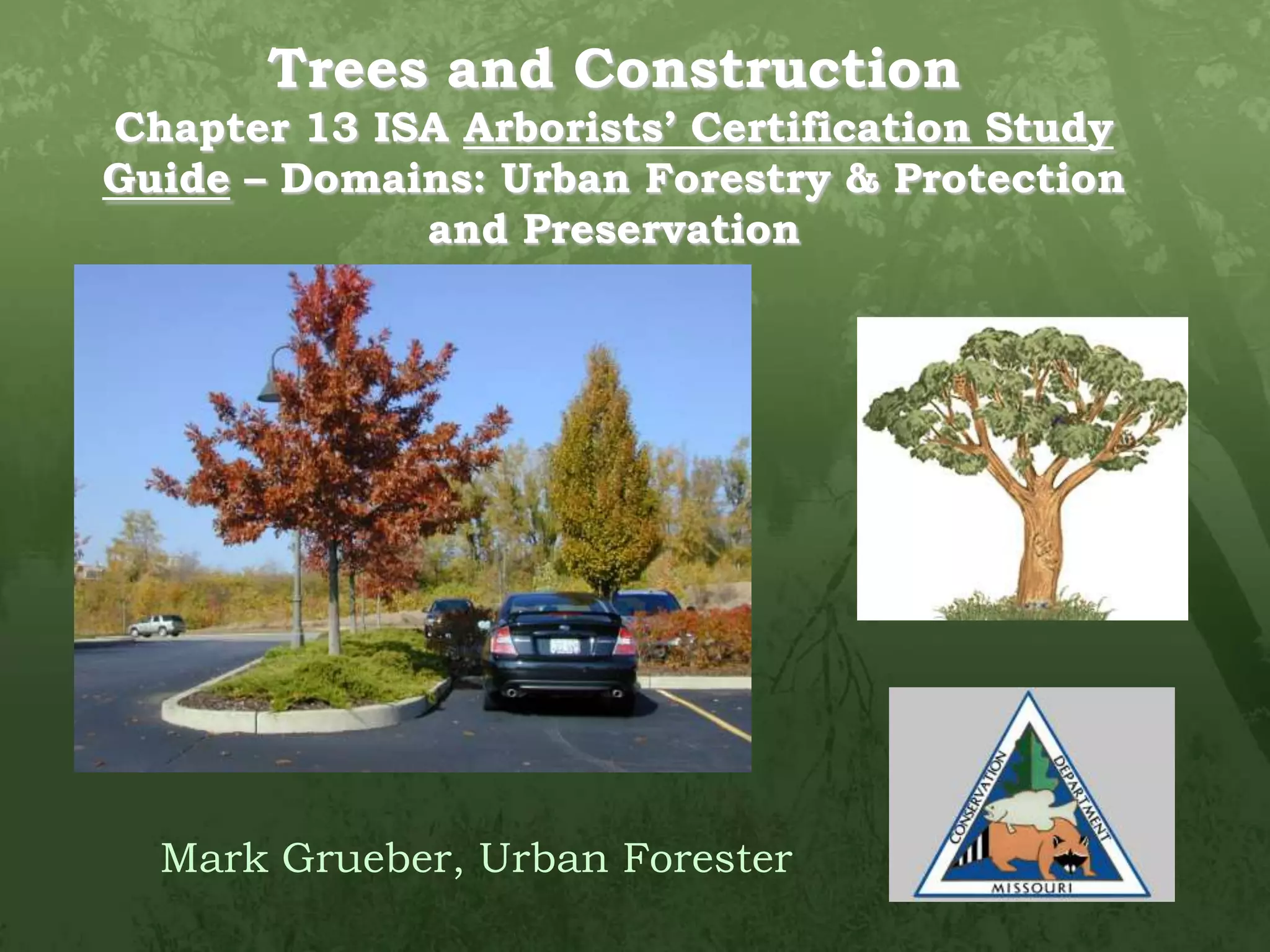
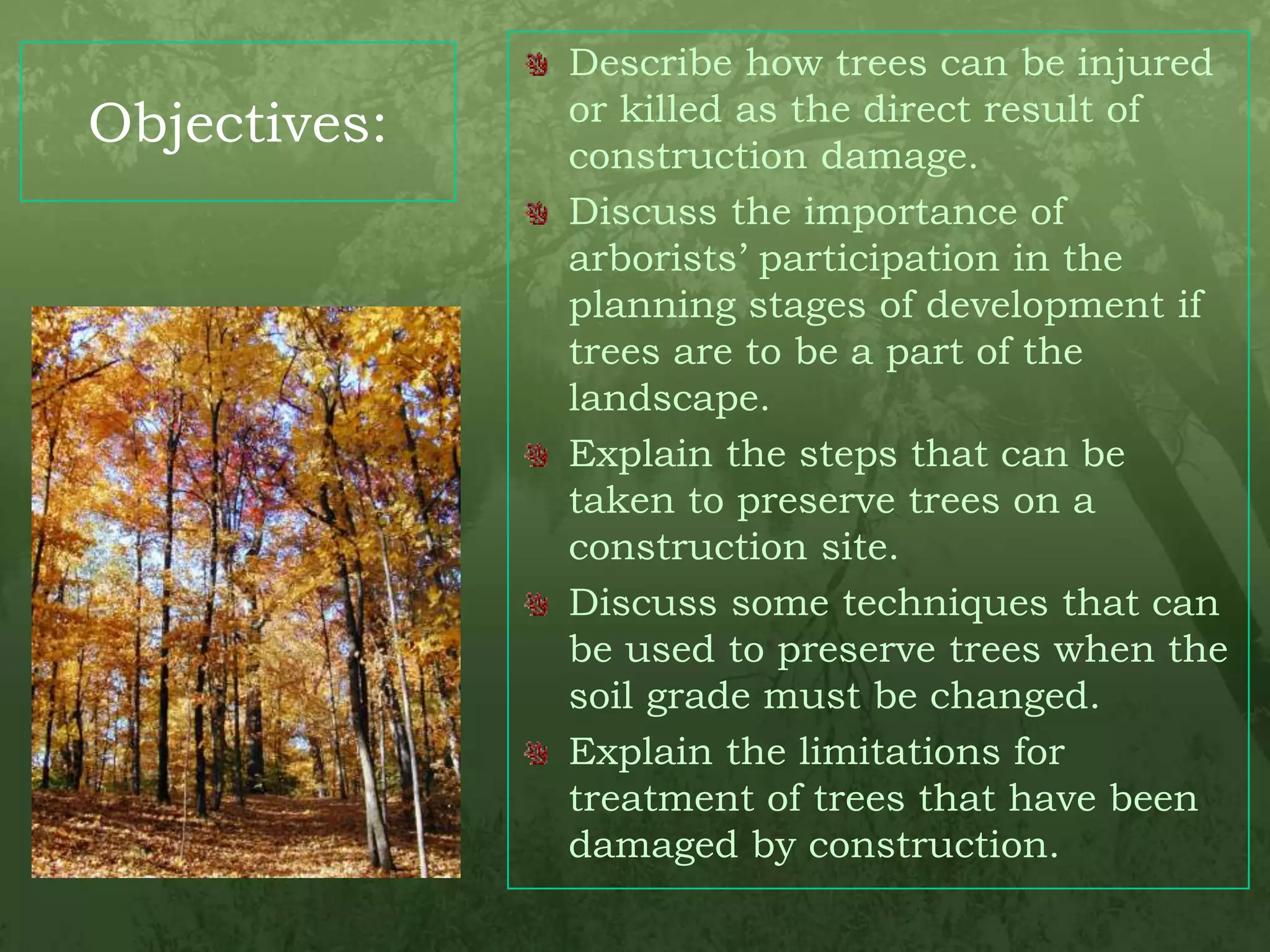
Trees and Construction Chapter 13 ISA Arborists’ Certification Study Guide – Domains: Urban Forestry & Protection and PreservationMark Grueber, Urban Forester
Describe how trees can be injured or killed as the direct result of construction damage.Discuss the importance of arborists’ participation in the planning stages of development if trees are to be a part of the landscape.Explain the steps that can be taken to preserve trees on a construction site.Discuss some techniques that can be used to preserve trees when the soil grade must be changed.Explain the limitations for treatment of trees that have been damaged by construction.Objectives:
Key TermsThe Key Terms as listed in the Arborist’s Certification Study Guide will be defined and highlightedthroughout the presentation.
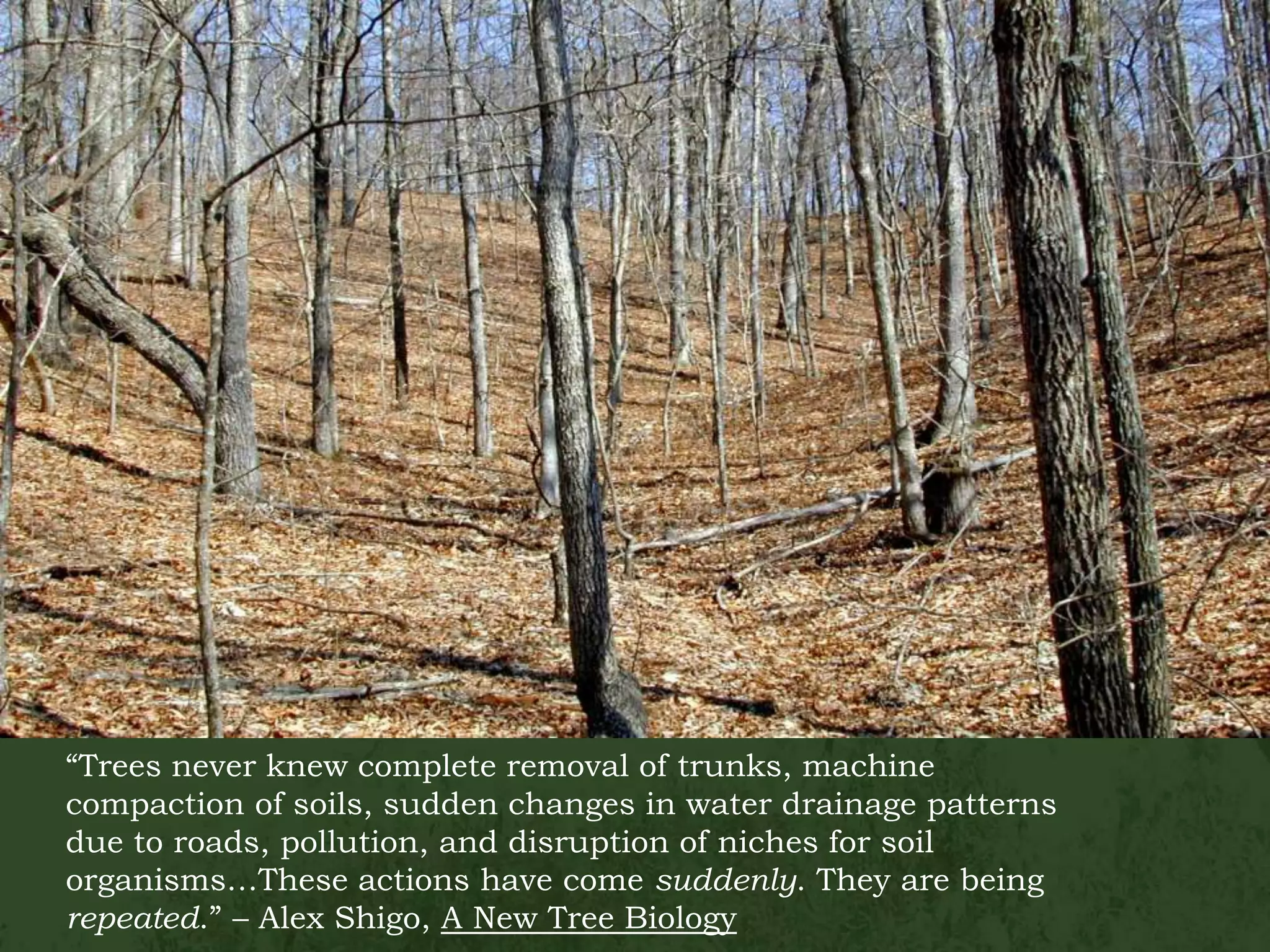
“Trees never knew complete removal of trunks, machine compaction of soils, sudden changes in water drainage patterns due to roads, pollution, and disruption of niches for soil organisms…These actions have come suddenly. They are being repeated.” – Alex Shigo, A New Tree Biology
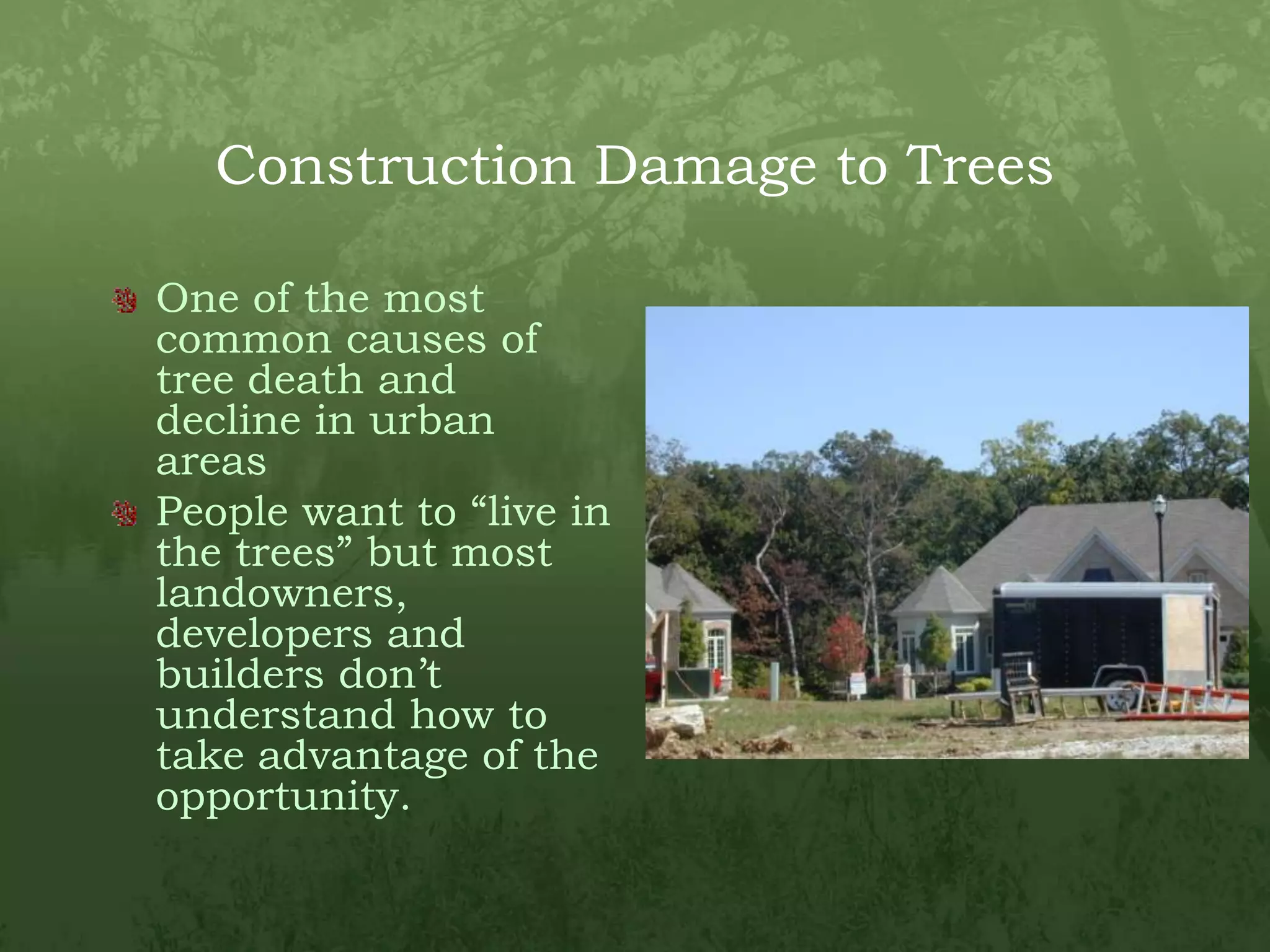
Construction Damage to TreesOne of the most common causes of tree death and decline in urban areasPeople want to “live in the trees” but most landowners, developers and builders don’t understand how to take advantage of the opportunity.
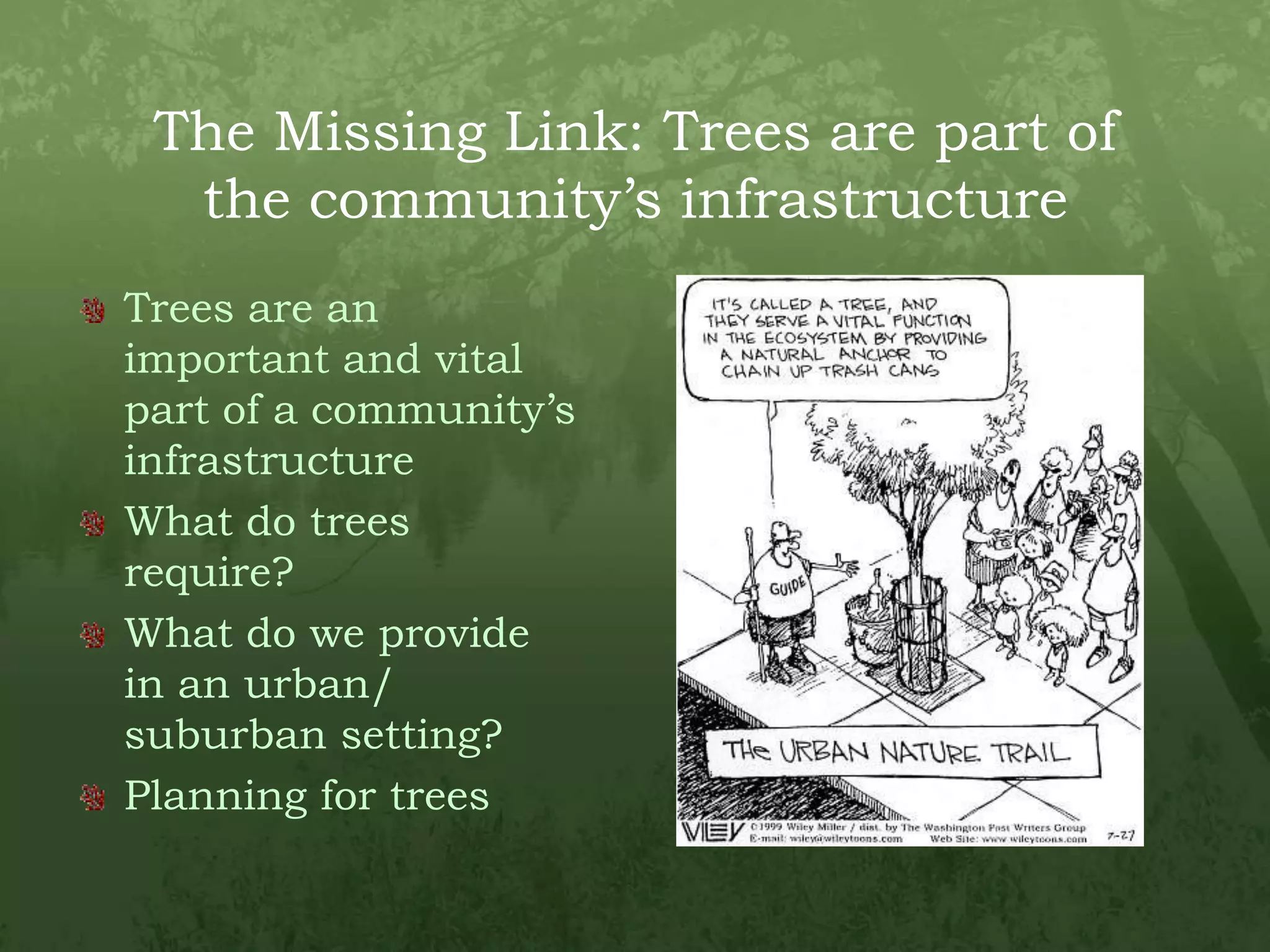
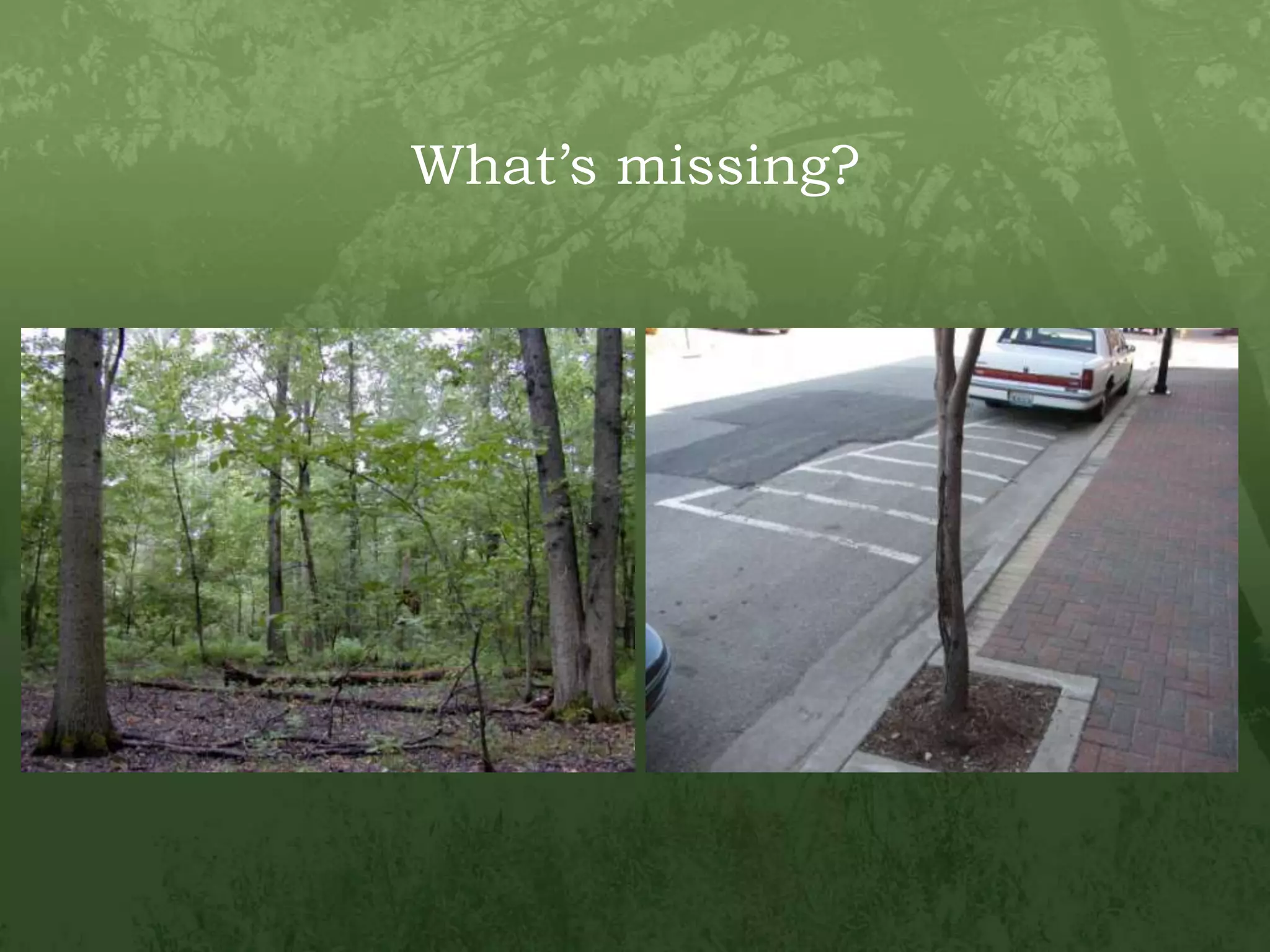
The Missing Link: Trees are part of the community’s infrastructureTrees are an important and vital part of a community’s infrastructureWhat do trees require?What do we provide in an urban/ suburban setting?Planning for trees
What’s missing?
Elements that affect plant growthWhat we can’t impactSunlightOxygenCarbon DioxideSoil texture (sand, silt or clay)TemperatureWhat we can impactAvailable WaterAvailable NutrientsSoil structure (how a soil hangs together)Available space
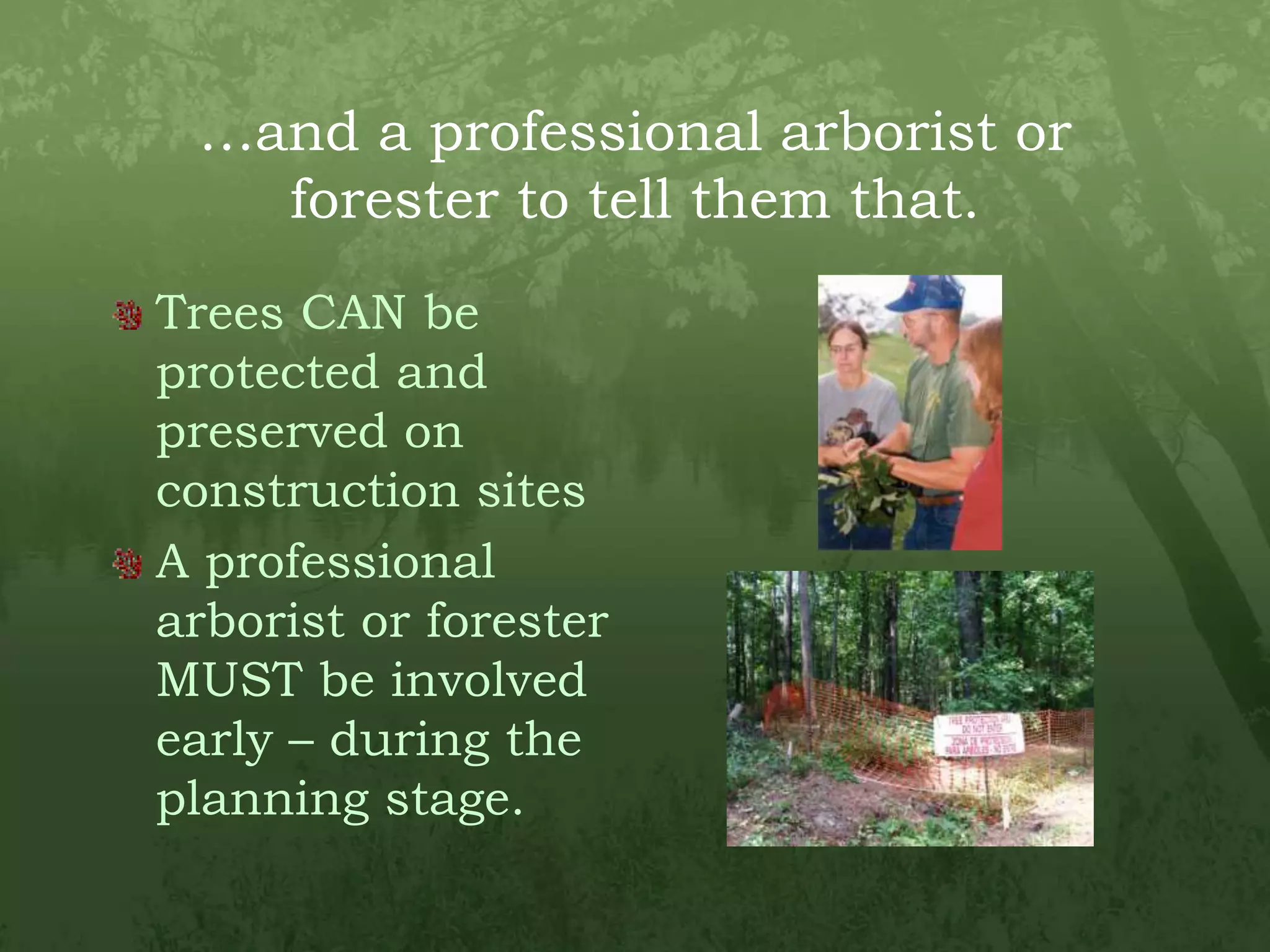
…and a professional arborist or forester to tell them that.Trees CAN be protected and preserved on construction sitesA professional arborist or forester MUST be involved early – during the planning stage.
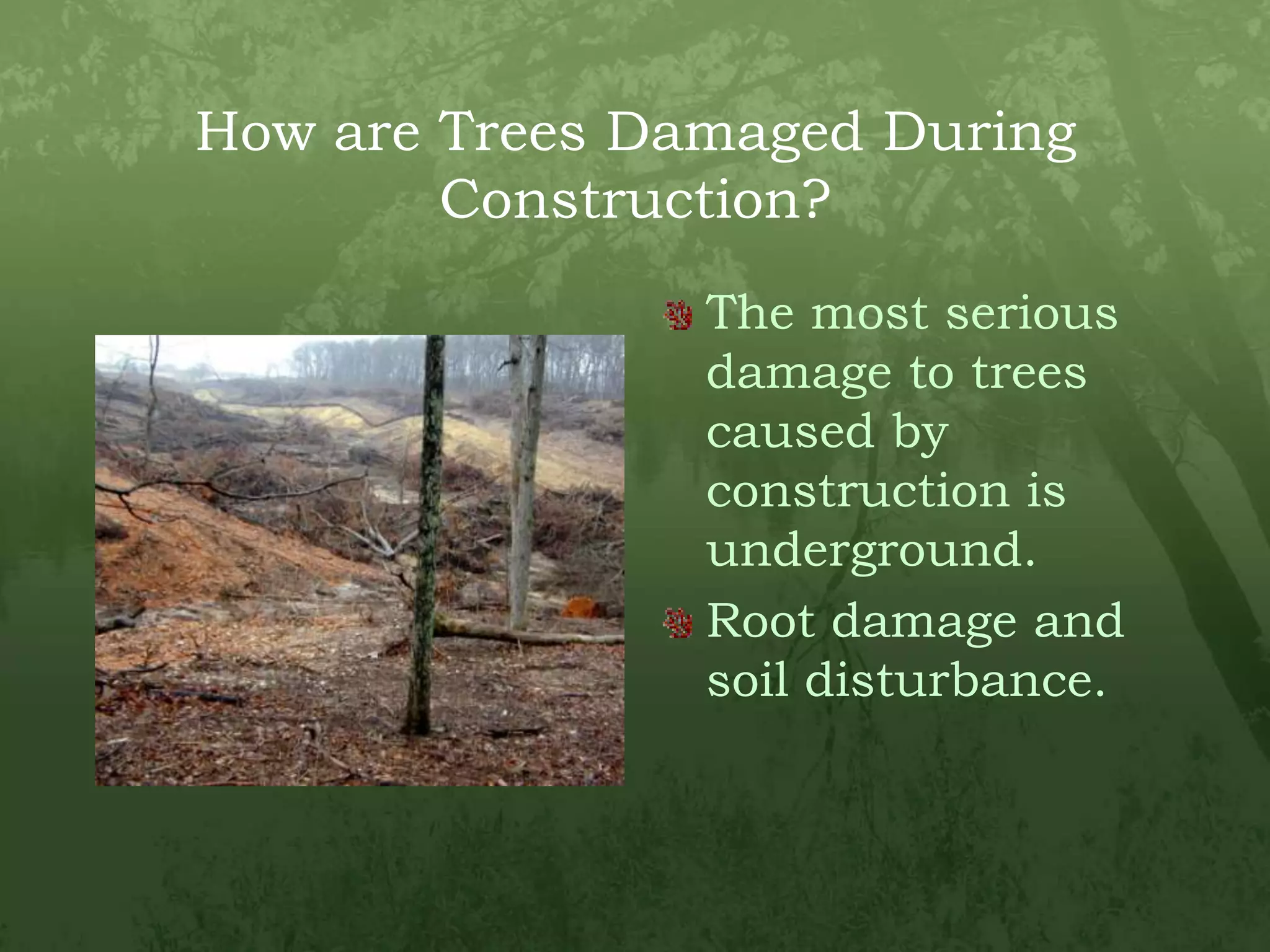
How are Trees Damaged During Construction?The most serious damage to trees caused by construction is underground.Root damage and soil disturbance.
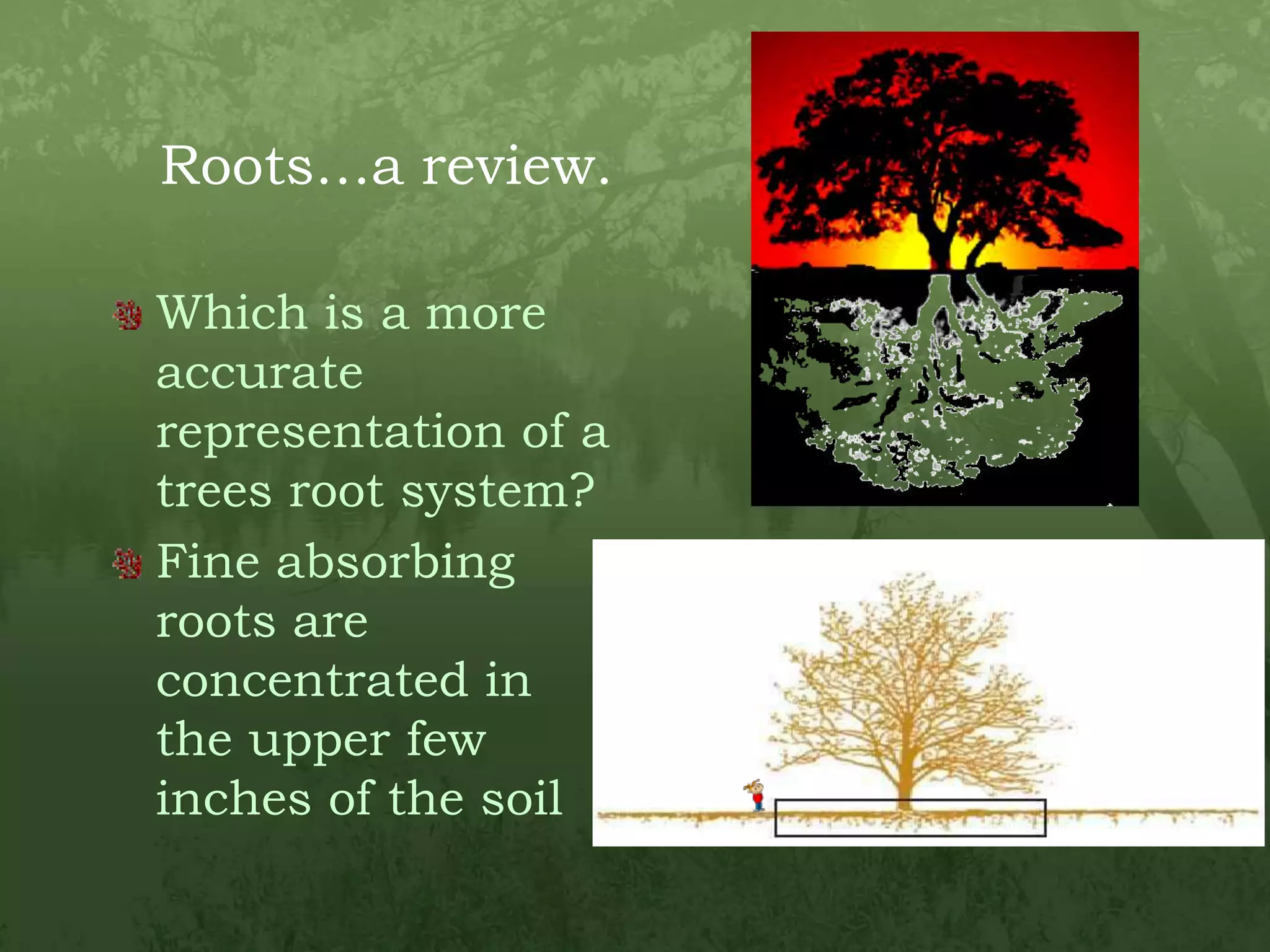
Roots…a review.Which is a more accurate representation of a trees root system?Fine absorbing roots are concentrated in the upper few inches of the soil
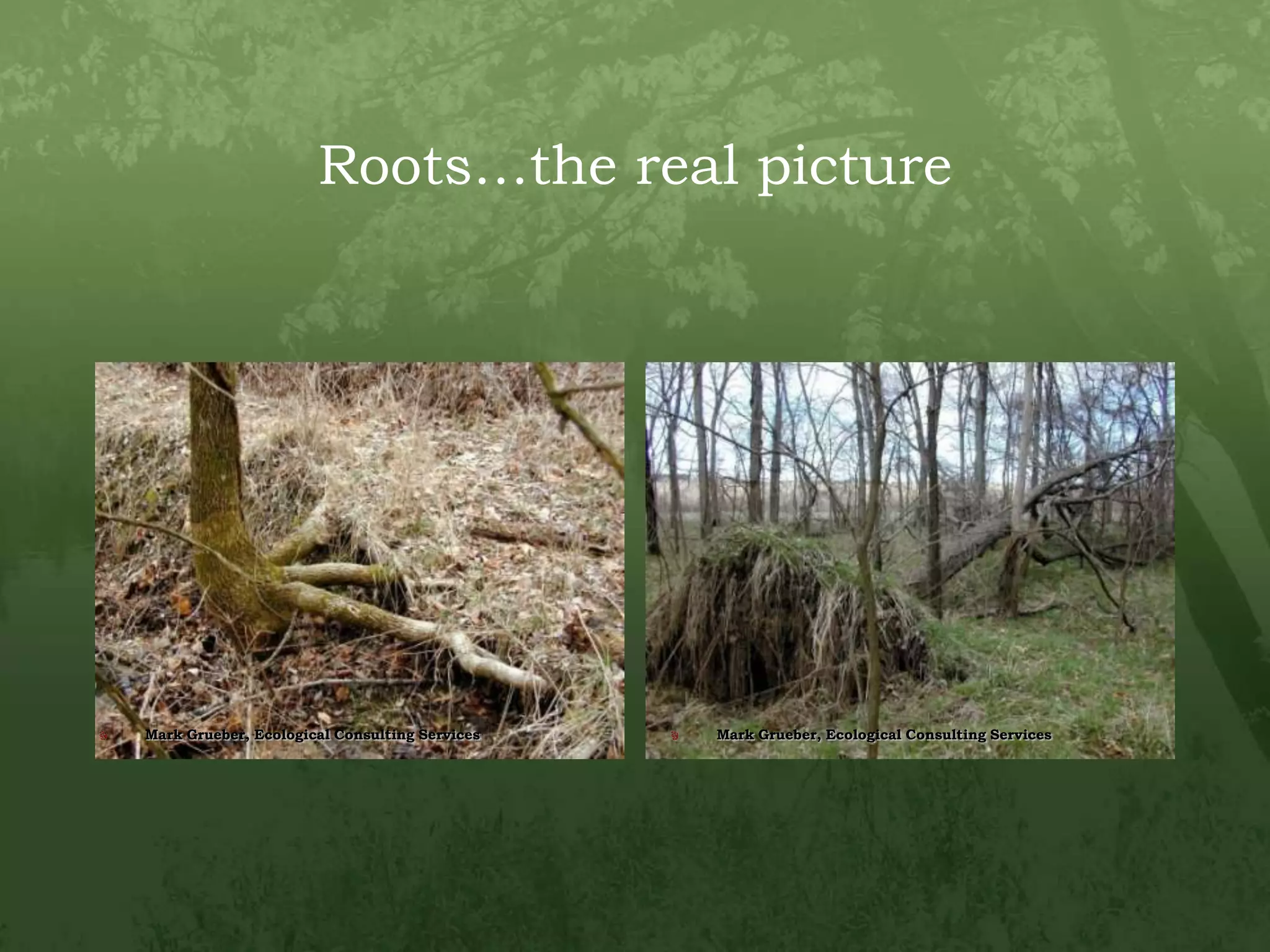
Roots…the real pictureMark Grueber, Ecological Consulting ServicesMark Grueber, Ecological Consulting ServicesMark Grueber, Ecological Consulting Services
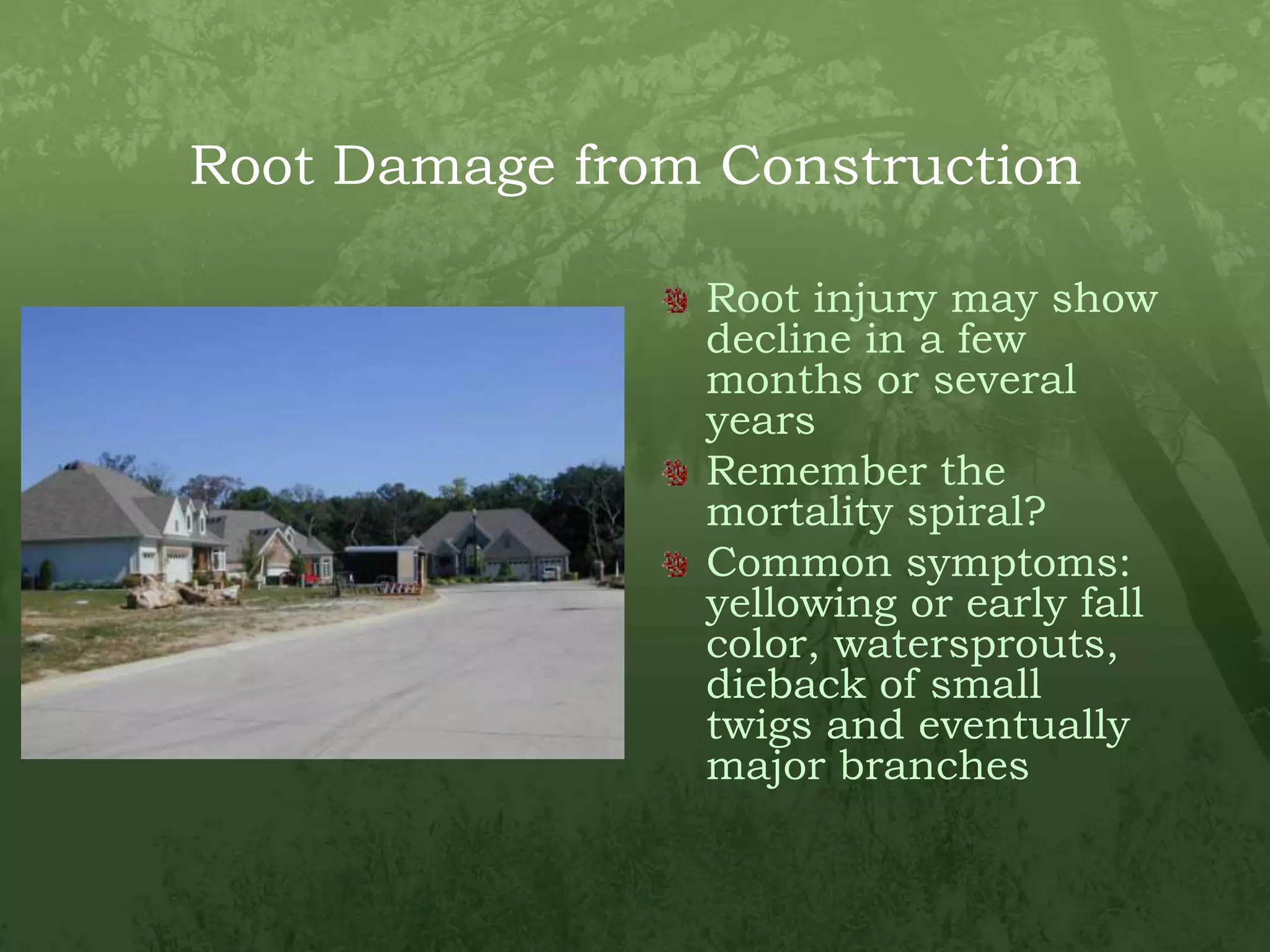
Root Damage from ConstructionRoot injury may show decline in a few months or several yearsRemember the mortality spiral?Common symptoms: yellowing or early fall color, watersprouts, dieback of small twigs and eventually major branches
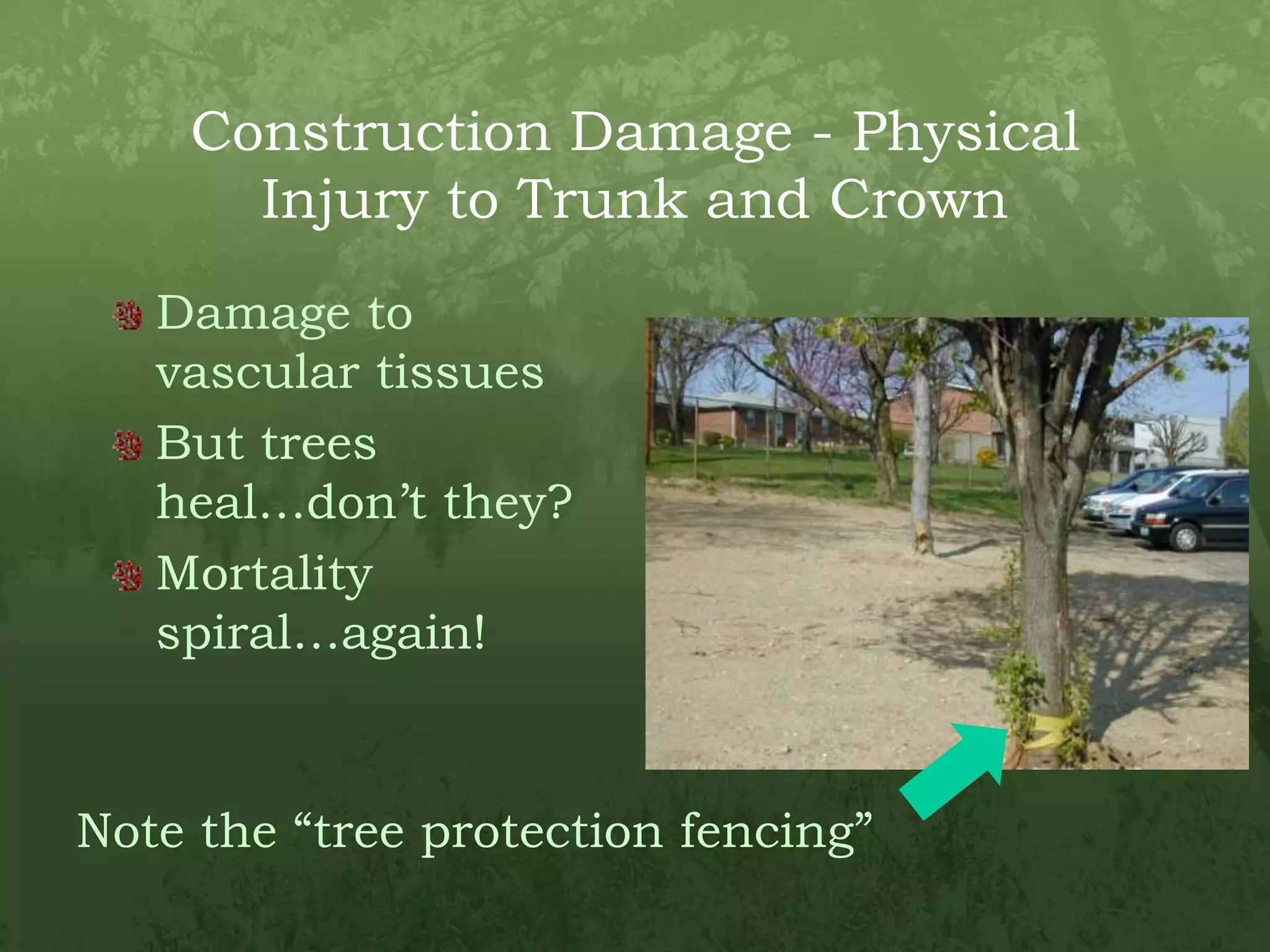
Construction Damage - Physical Injury to Trunk and CrownDamage to vascular tissuesBut trees heal…don’t they?Mortality spiral…again!Note the “tree protection fencing”
Construction Damage - Cutting of RootsDigging and trenching[digging to install utilities; of concern due to root damage] will likely sever rootsUsually due to misunderstanding of root growth habit (1-3x branch spread)Amount of damage depends on proximity to trunk and area of root development
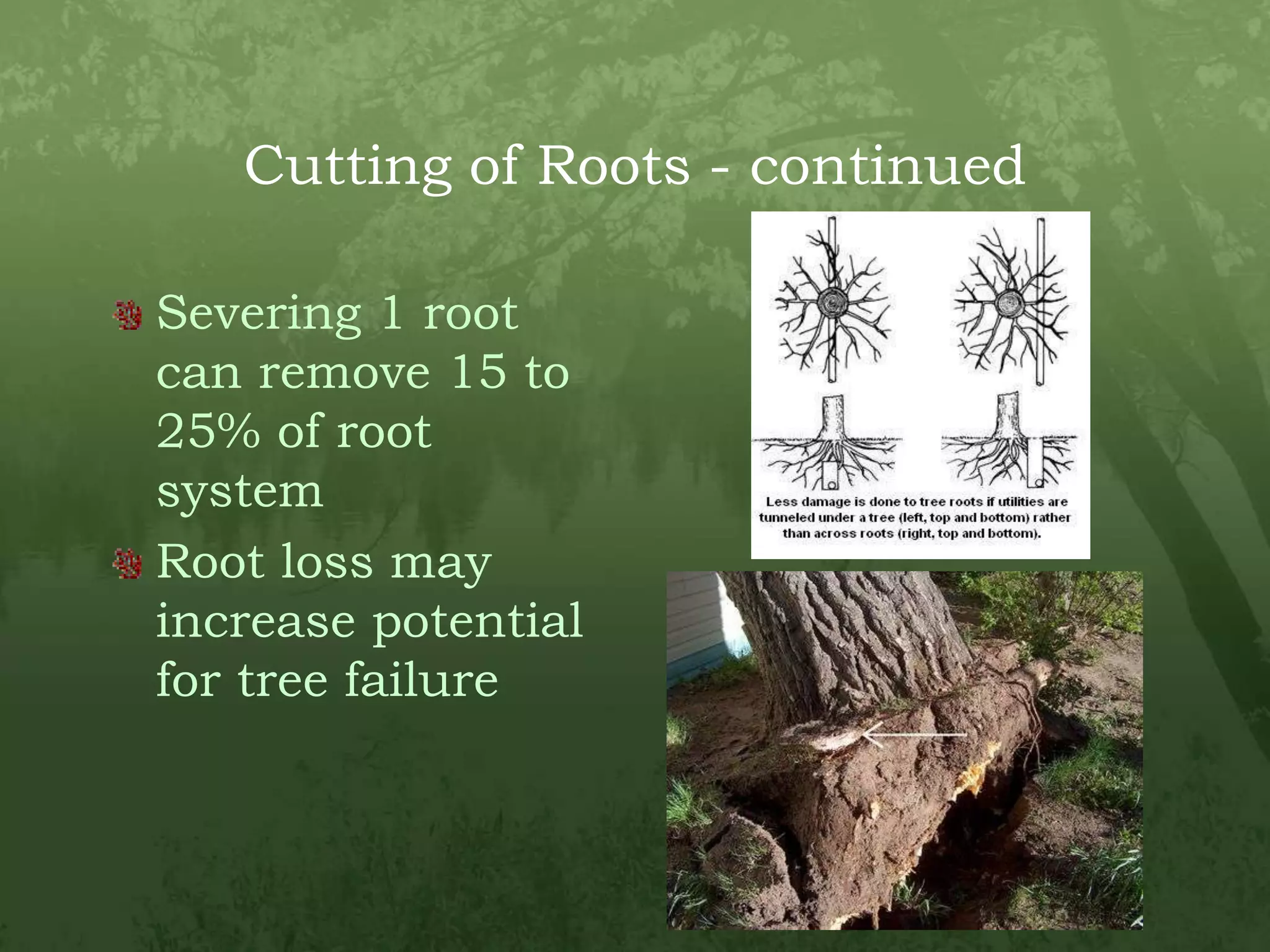
Cutting of Roots - continuedSevering 1 root can remove 15 to 25% of root systemRoot loss may increase potential for tree failure
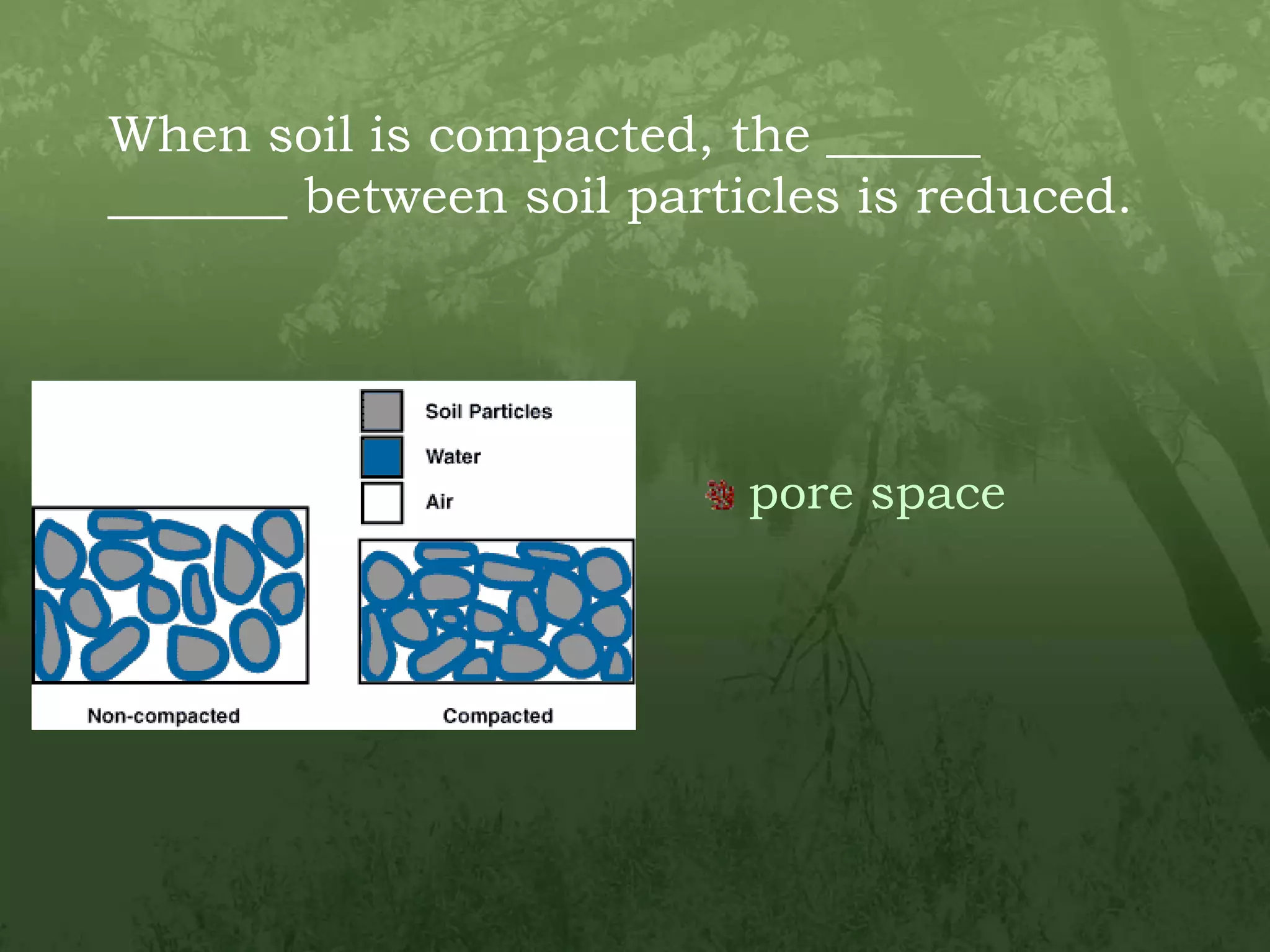
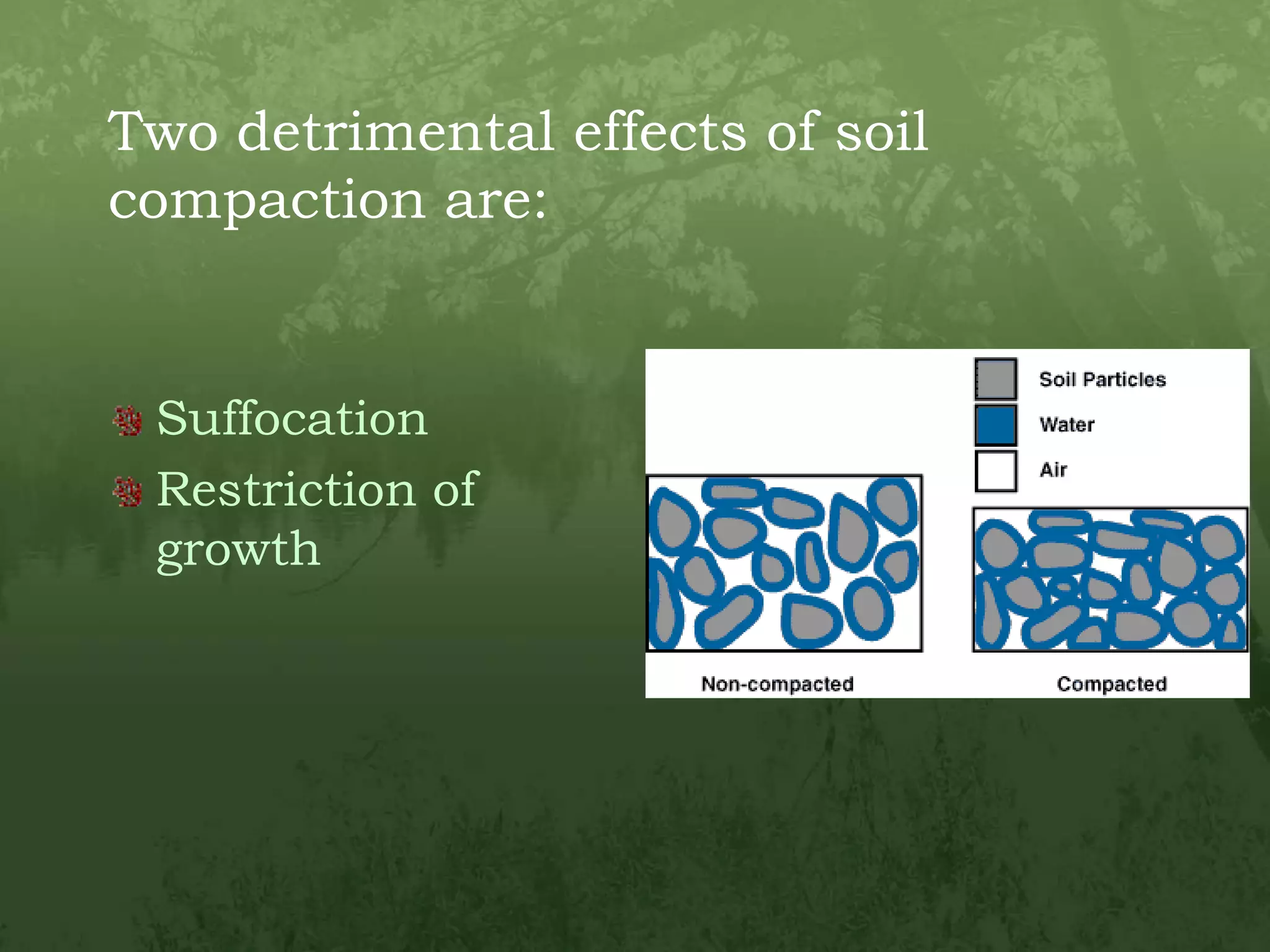
Construction Damage – Soil Compaction[Compression of the soil resulting in a reduction of the total pore space, especially the macropores]Ideal soil has 50% pore space – filled with H20 and airO2 is reduced; CO2 and other gases increaseRoot growth is diminished; absorption reduced
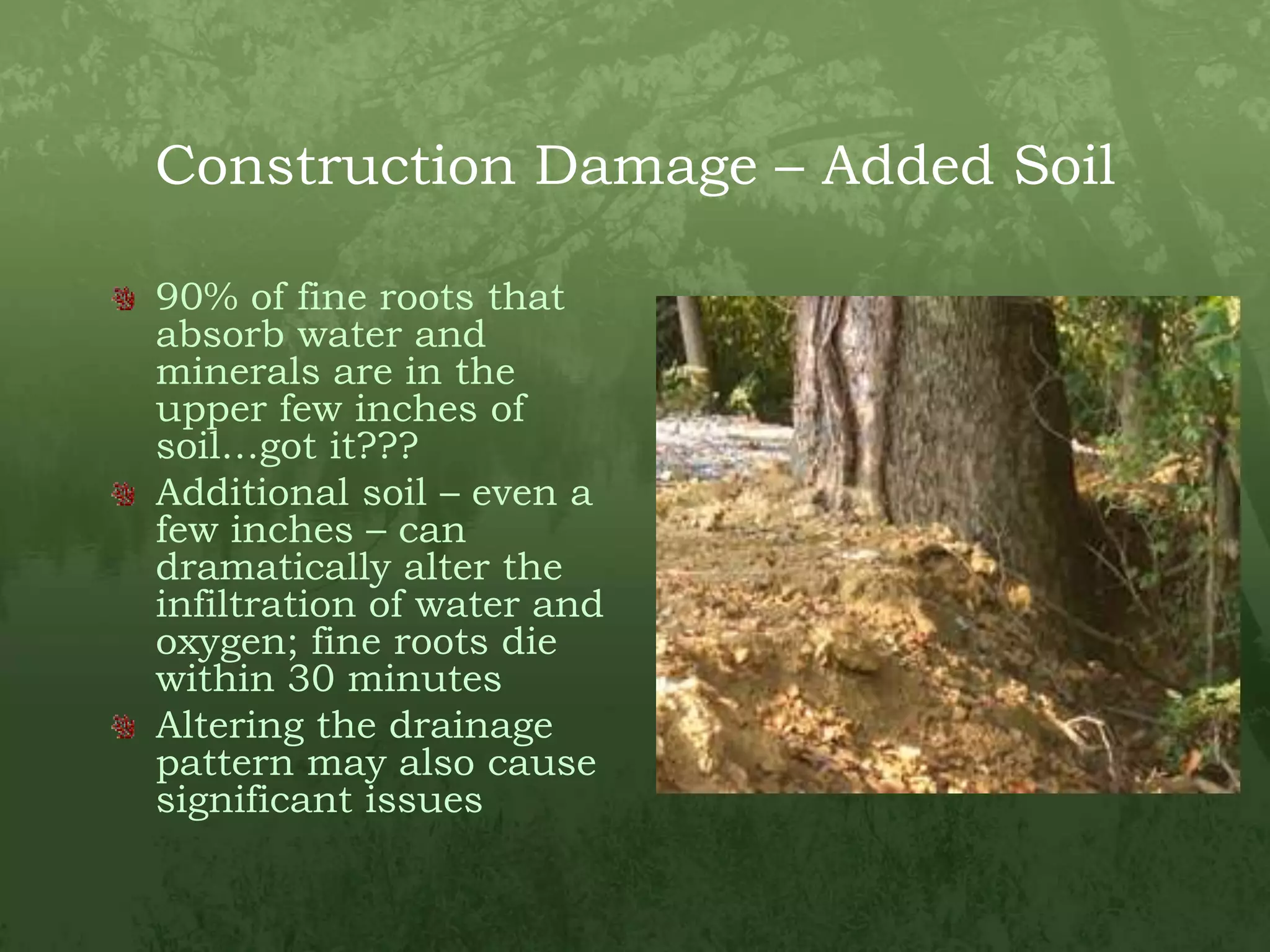
Construction Damage – Added Soil90% of fine roots that absorb water and minerals are in the upper few inches of soil…got it???Additional soil – even a few inches – can dramatically alter the infiltration of water and oxygen; fine roots die within 30 minutesAltering the drainage pattern may also cause significant issues
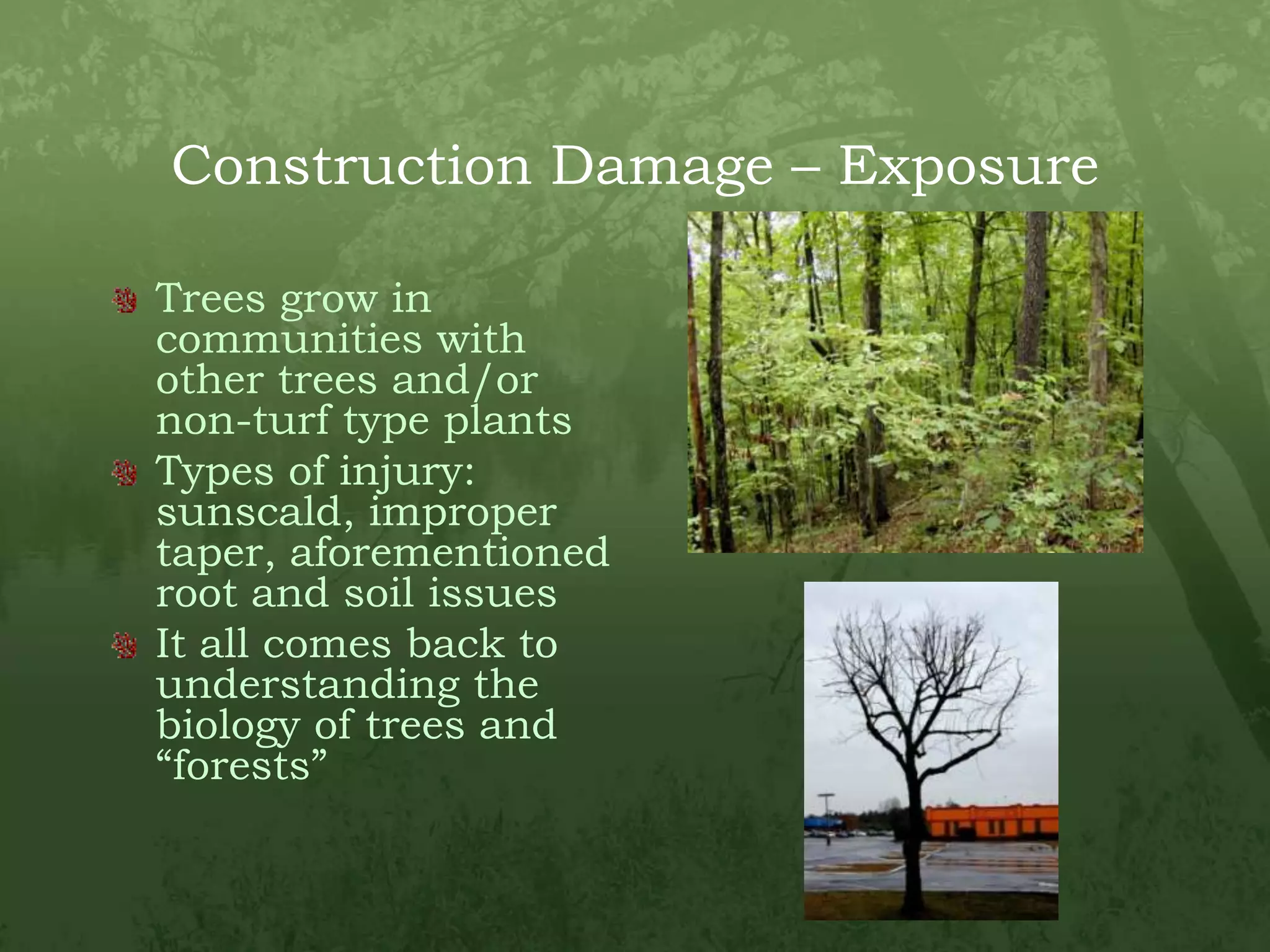
Construction Damage – Exposure Trees grow in communities with other trees and/or non-turf type plantsTypes of injury: sunscald, improper taper, aforementioned root and soil issuesIt all comes back to understanding the biology of trees and “forests”
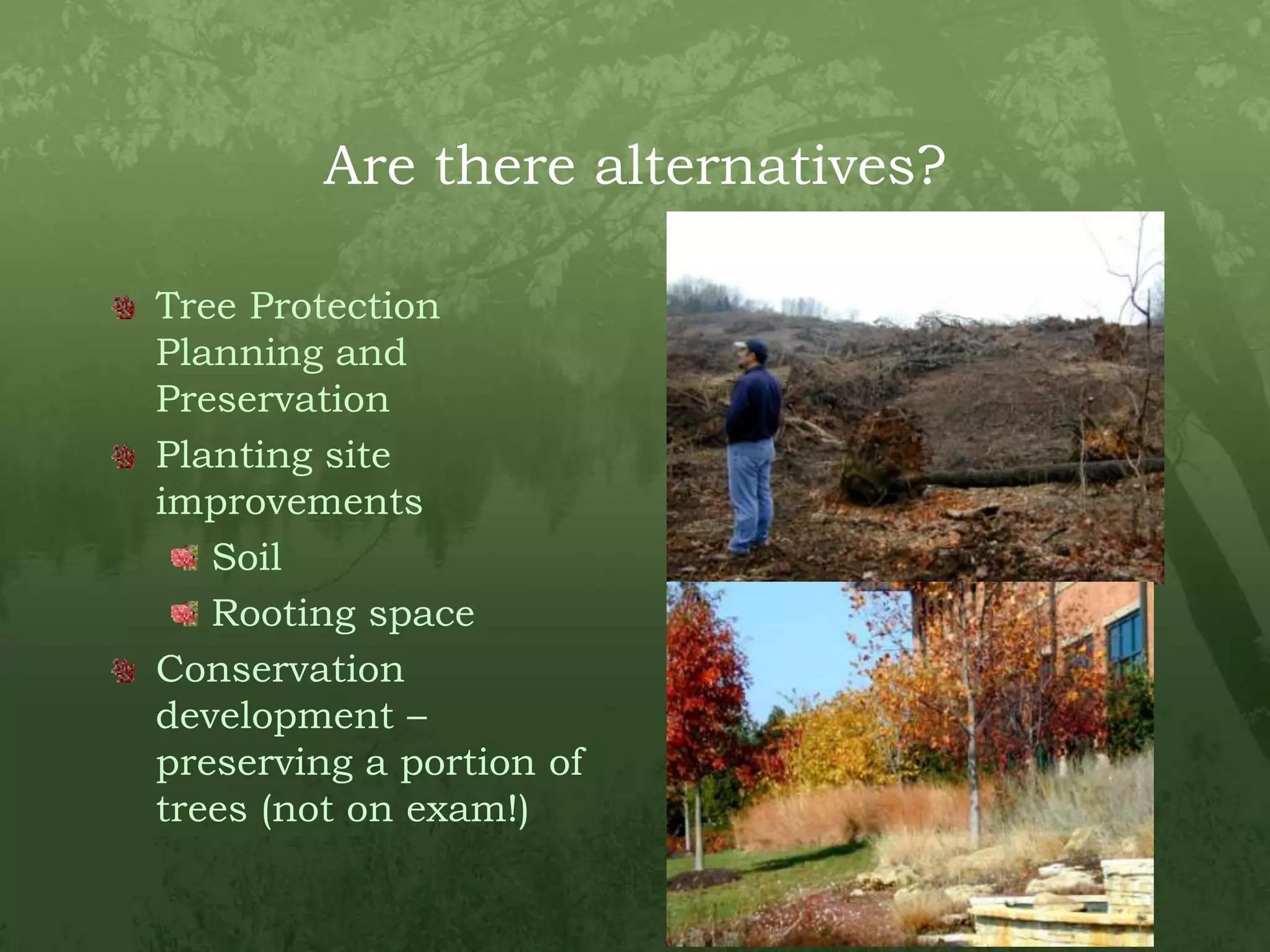
Are there alternatives?Tree Protection Planning and PreservationPlanting site improvementsSoilRooting spaceConservation development – preserving a portion of trees (not on exam!)
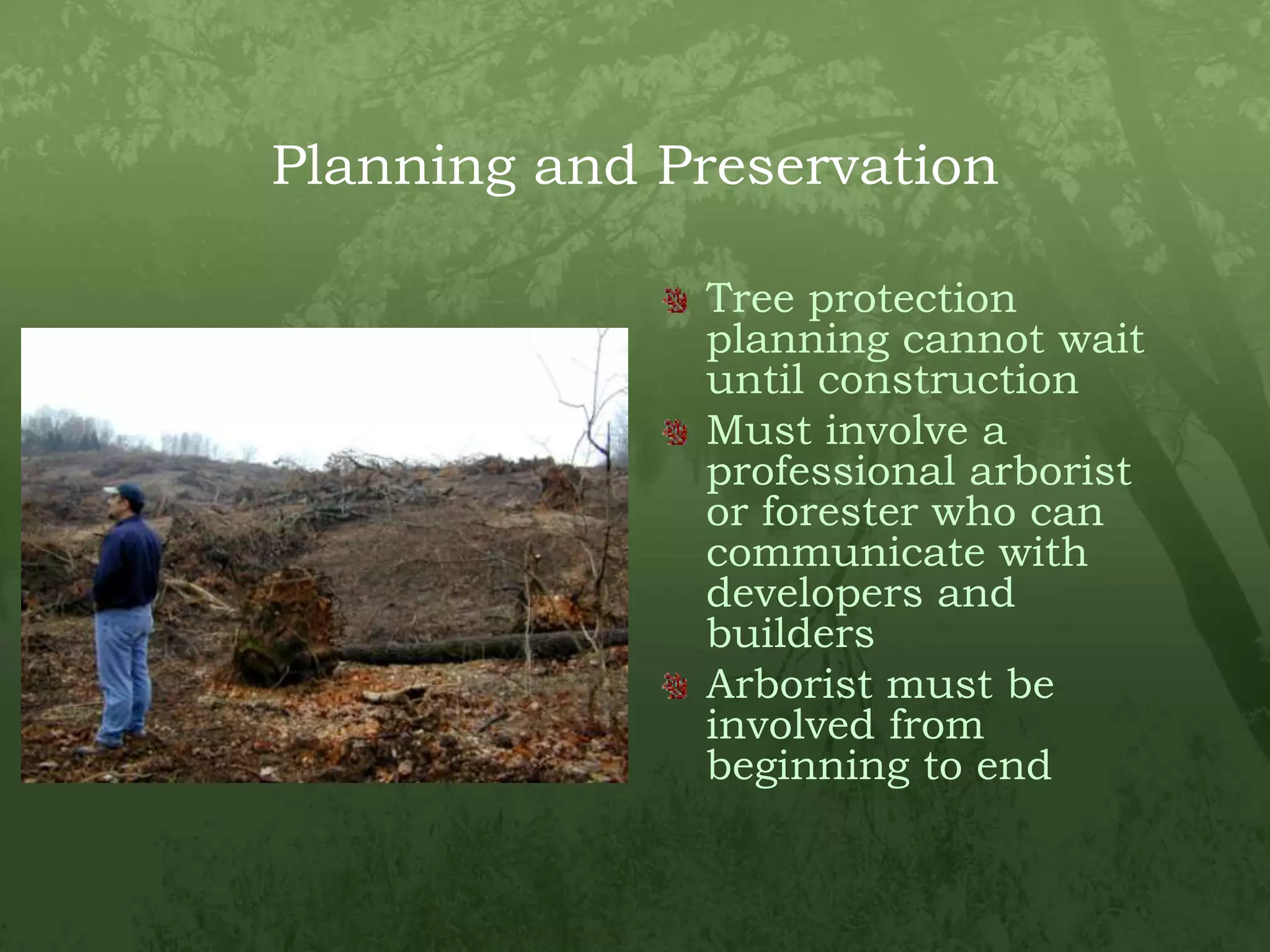
Planning and PreservationTree protection planning cannot wait until constructionMust involve a professional arborist or forester who can communicate with developers and buildersArborist must be involved from beginning to end
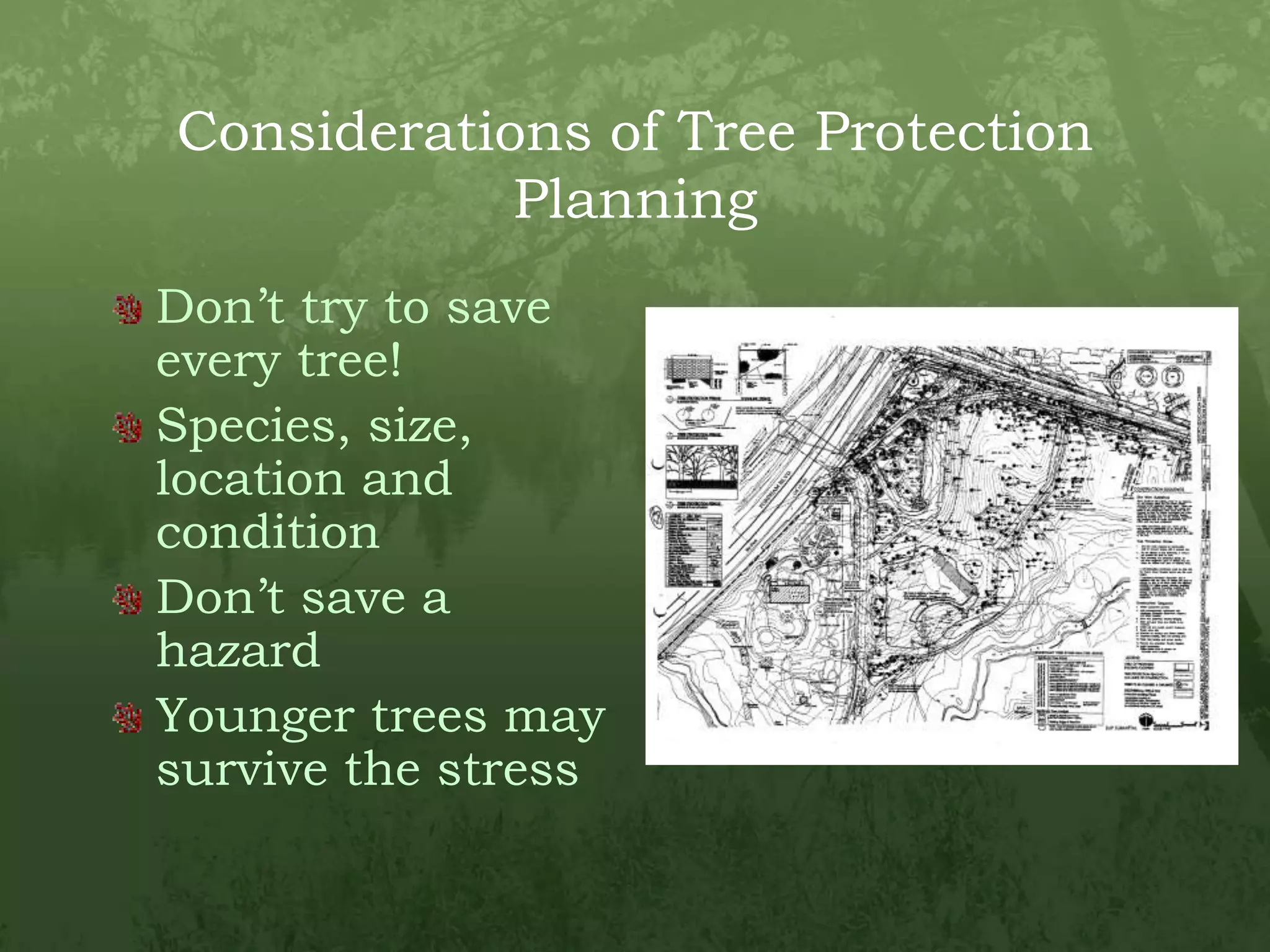
Considerations of Tree Protection PlanningDon’t try to save every tree!Species, size, location and conditionDon’t save a hazardYounger trees may survive the stress
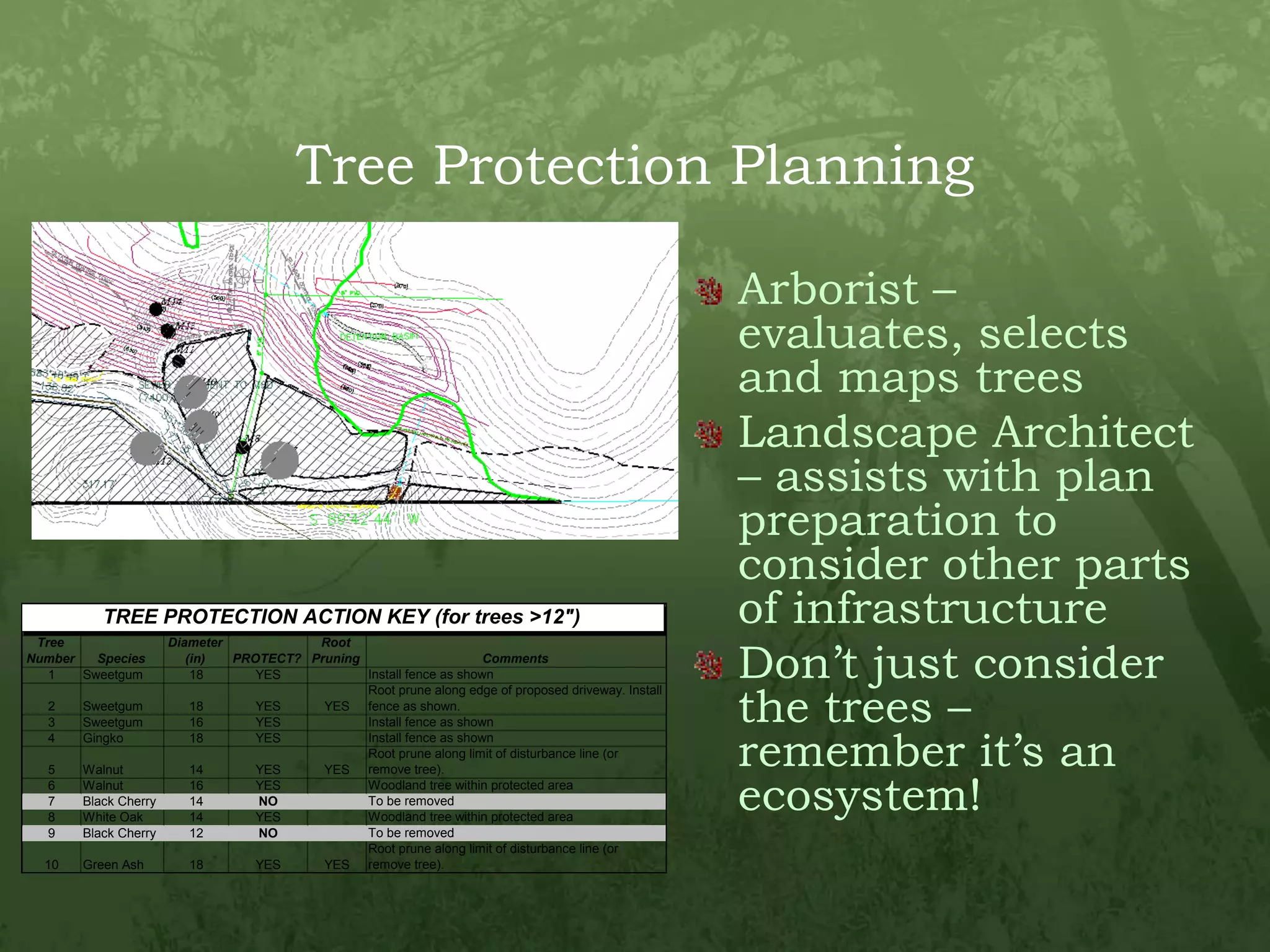
Tree Protection PlanningArborist – evaluates, selects and maps treesLandscape Architect – assists with plan preparation to consider other parts of infrastructureDon’t just consider the trees – remember it’s an ecosystem!
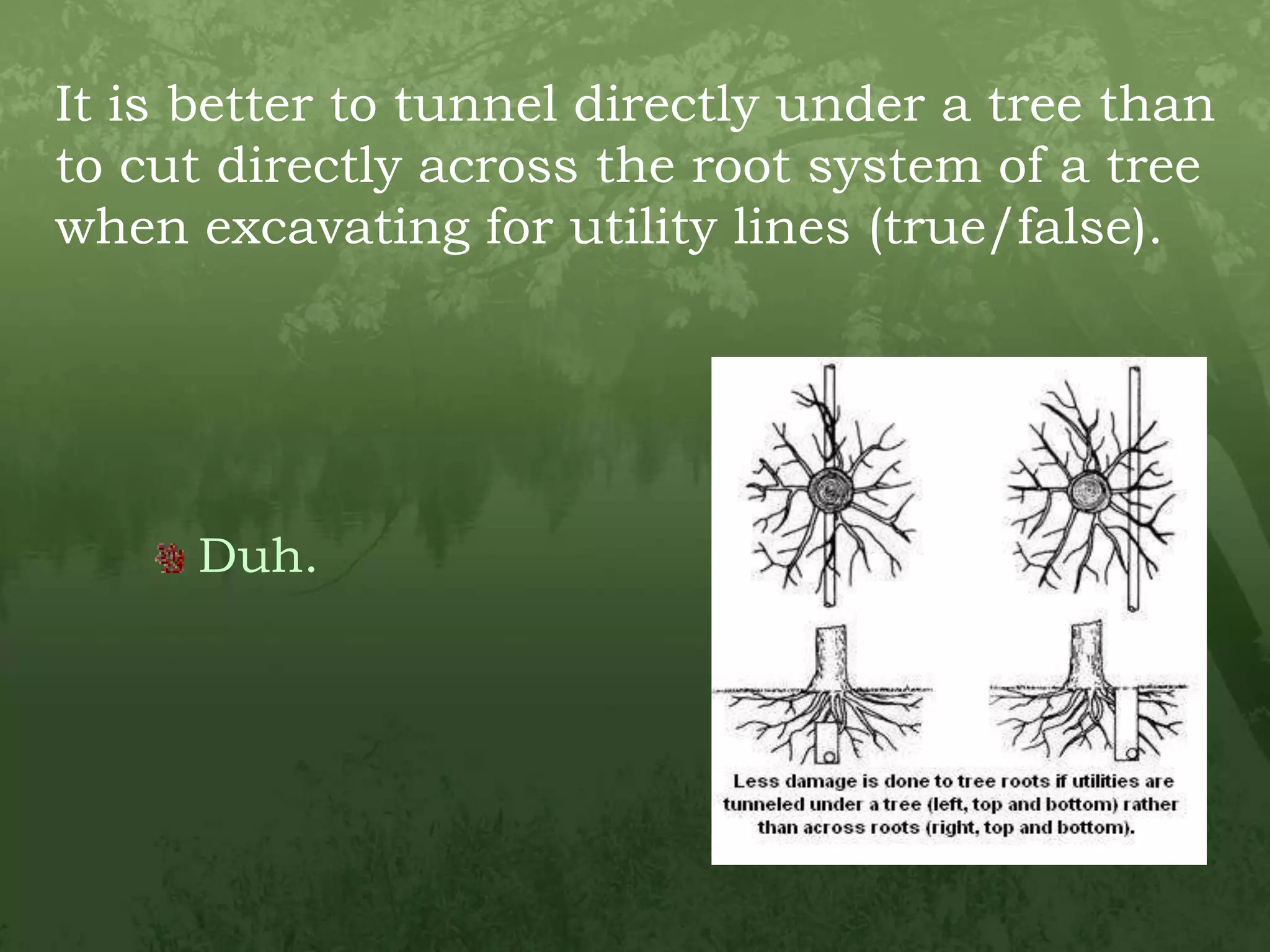
Tree Protection PlanningConsider design changes or construction procedure modifications to accommodate treesTunneling [alternative means to trenching for installation of underground utilities] instead of trenching is one of the most common
Specifications[detailed plans and statements of particular procedures and standards]All tree protection MUST be written into construction specificationsAll contractors (and subs!) must be made aware of these specsConsider fines (or incentives) using tree and landscape valuation methodology
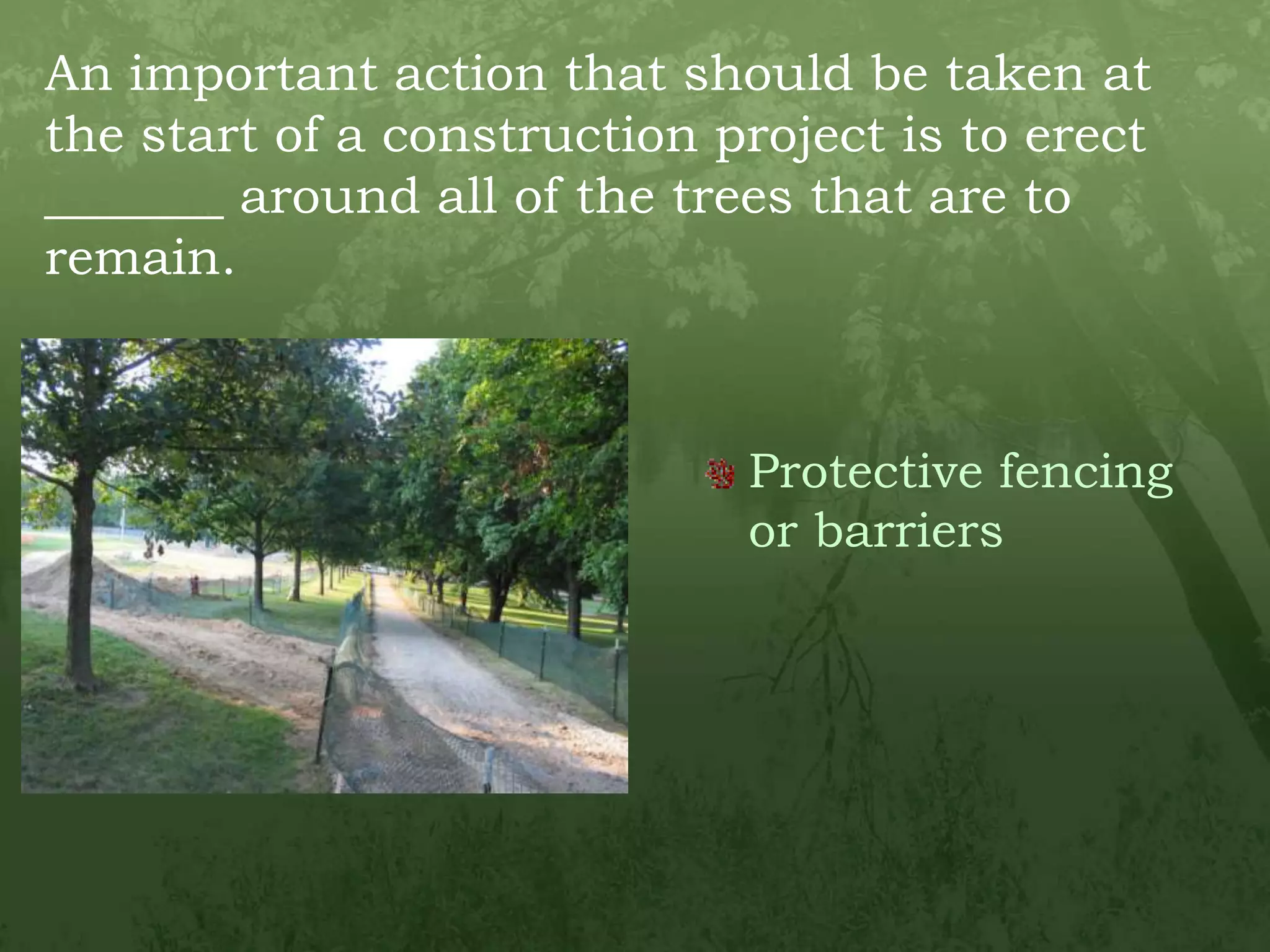
Construction Damage AvoidanceBarriers [fences or other means to establish a protection zone around trees on construction sites]Place as far away from tree as possible…or a minimum of 1’/1” dbhNo traffic or storage of building materials, waste or excess soilNO DISTURBANCE!
Avoidance - Limit AccessLimit access to one route [means of entering and leaving a property during a construction operation] on and off property – but be realistic! Remember parking.Specify areas for storage of equipment, soil, building materials; as well as areas for burning, washout, etc.
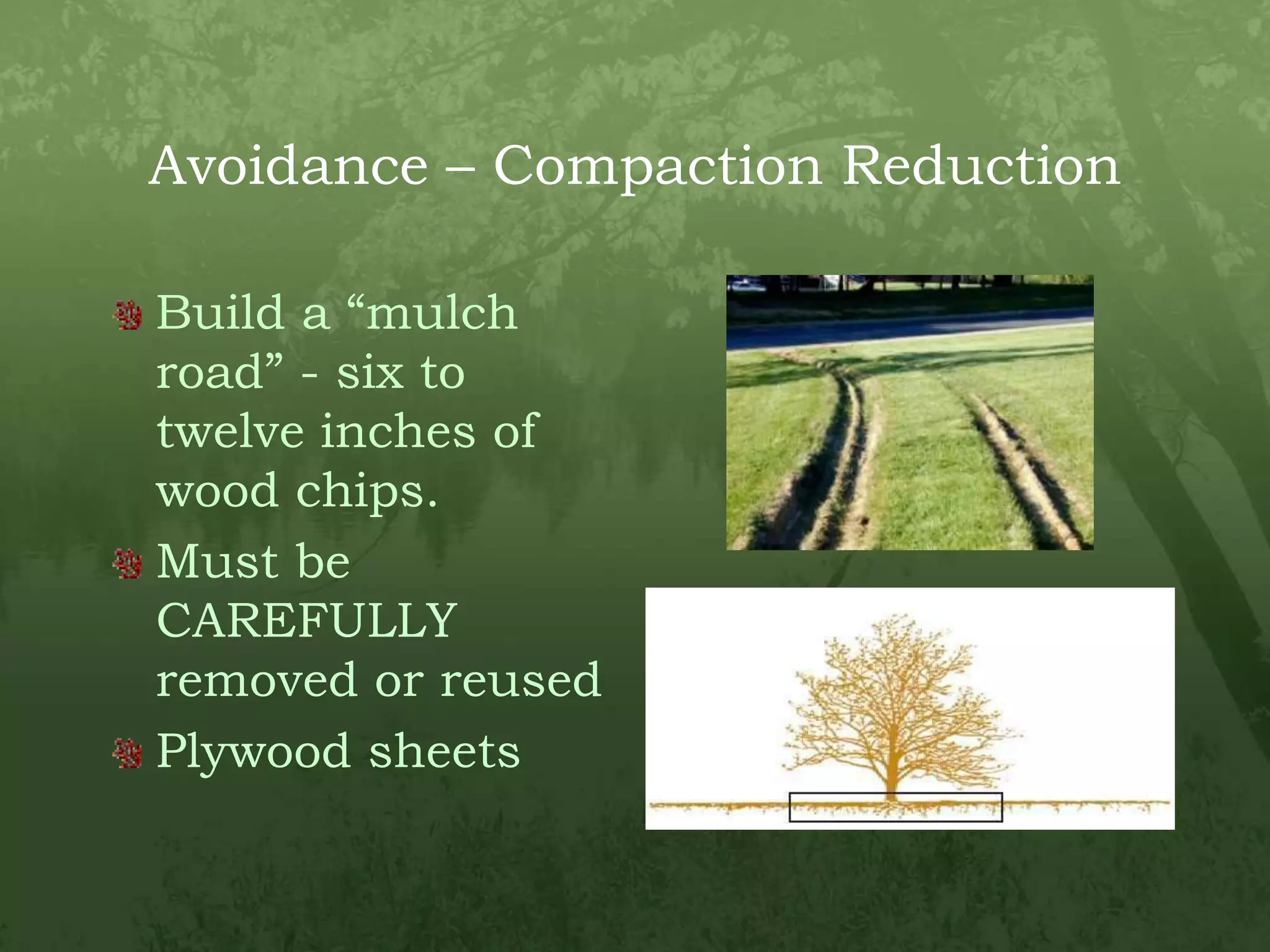
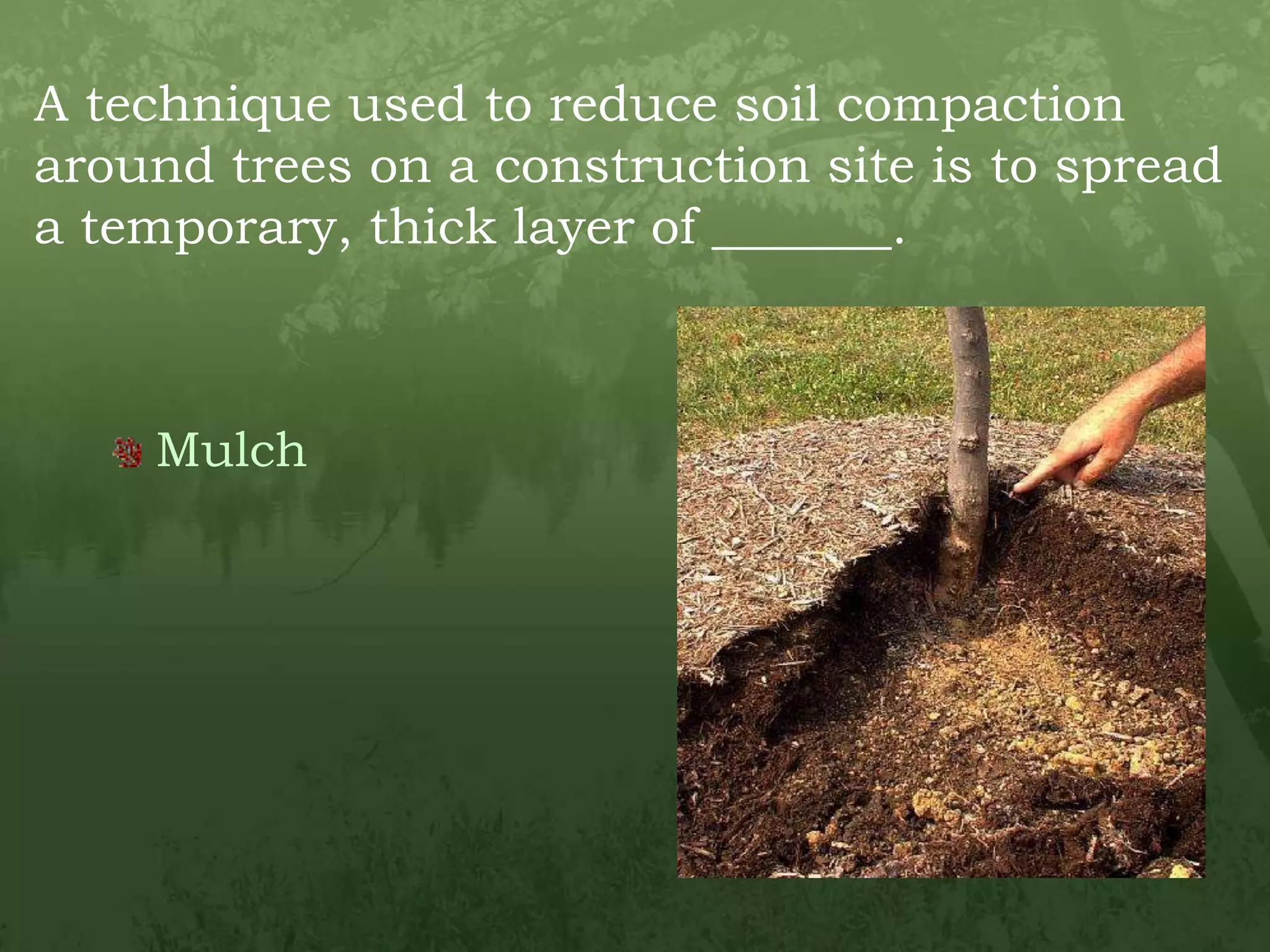
Avoidance – Compaction ReductionBuild a “mulch road” - six to twelve inches of wood chips.Must be CAREFULLY removed or reusedPlywood sheets
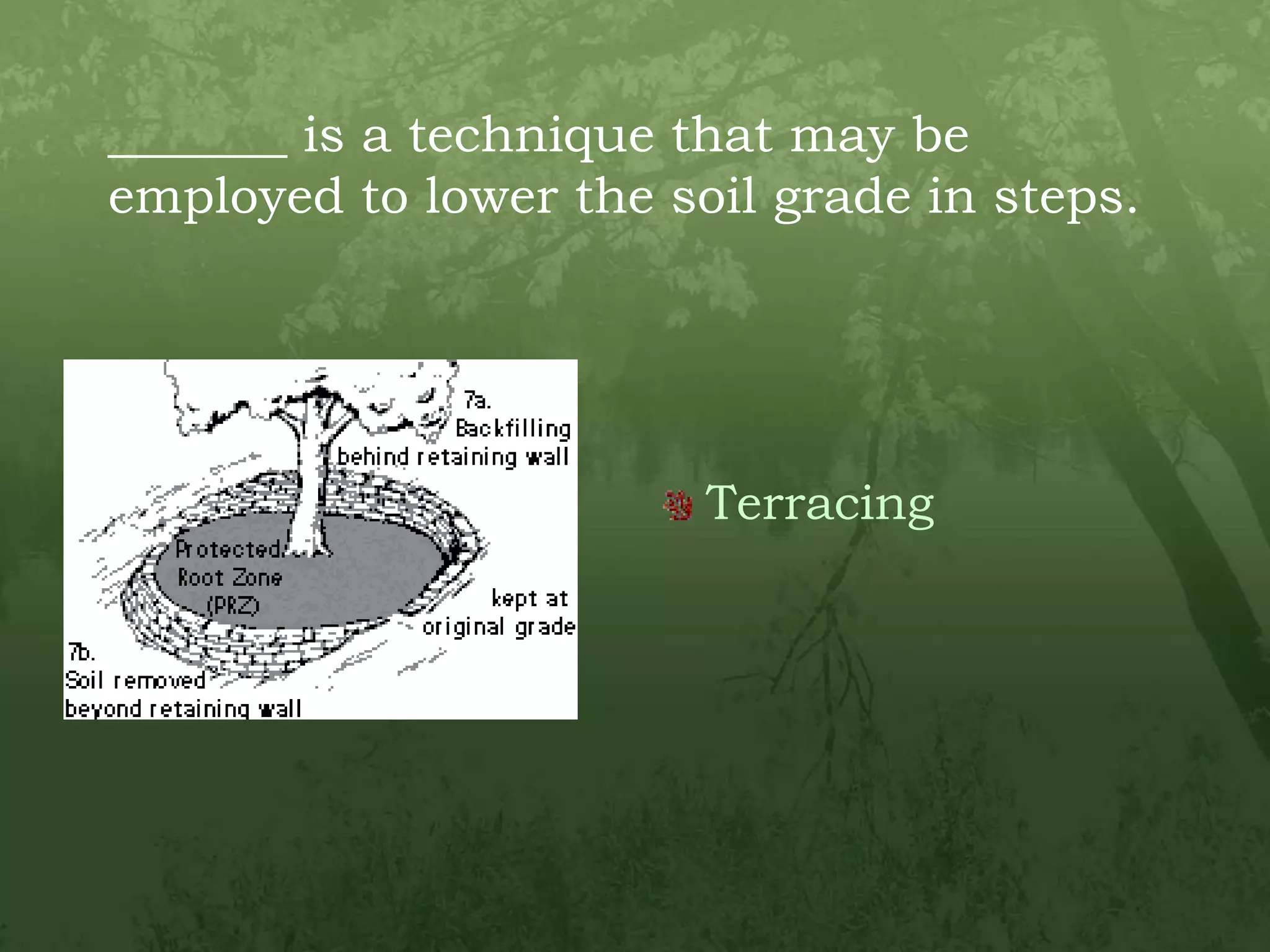
Avoidance – Grade ChangesTerracing[method used to lower the soil grade in stages]Maintain original grade as far from tree as possibleMust be accompanied by root pruning and care where roots are exposed
Avoidance – Grade Changes continuedTree Island[soil or landscape surrounding a tree, such as within a paved area]Similar to terracingExcellent for retaining small groves
Avoidance – Grade Changes continuedAeration systems[the set of holes or trenches created in a tree’s root area to improve oxygen availability to the roots]Tree wells[wall constructed around a tree when the soil grade is raised to maintain the original soil level and provide oxygen to the root zone]Lack of supporting researchGravel or stone below fill does NOT improve water or oxygen flowConsider tree size, species, drainage patterns, soil conditions, fill depth, irrigation and future maintenance
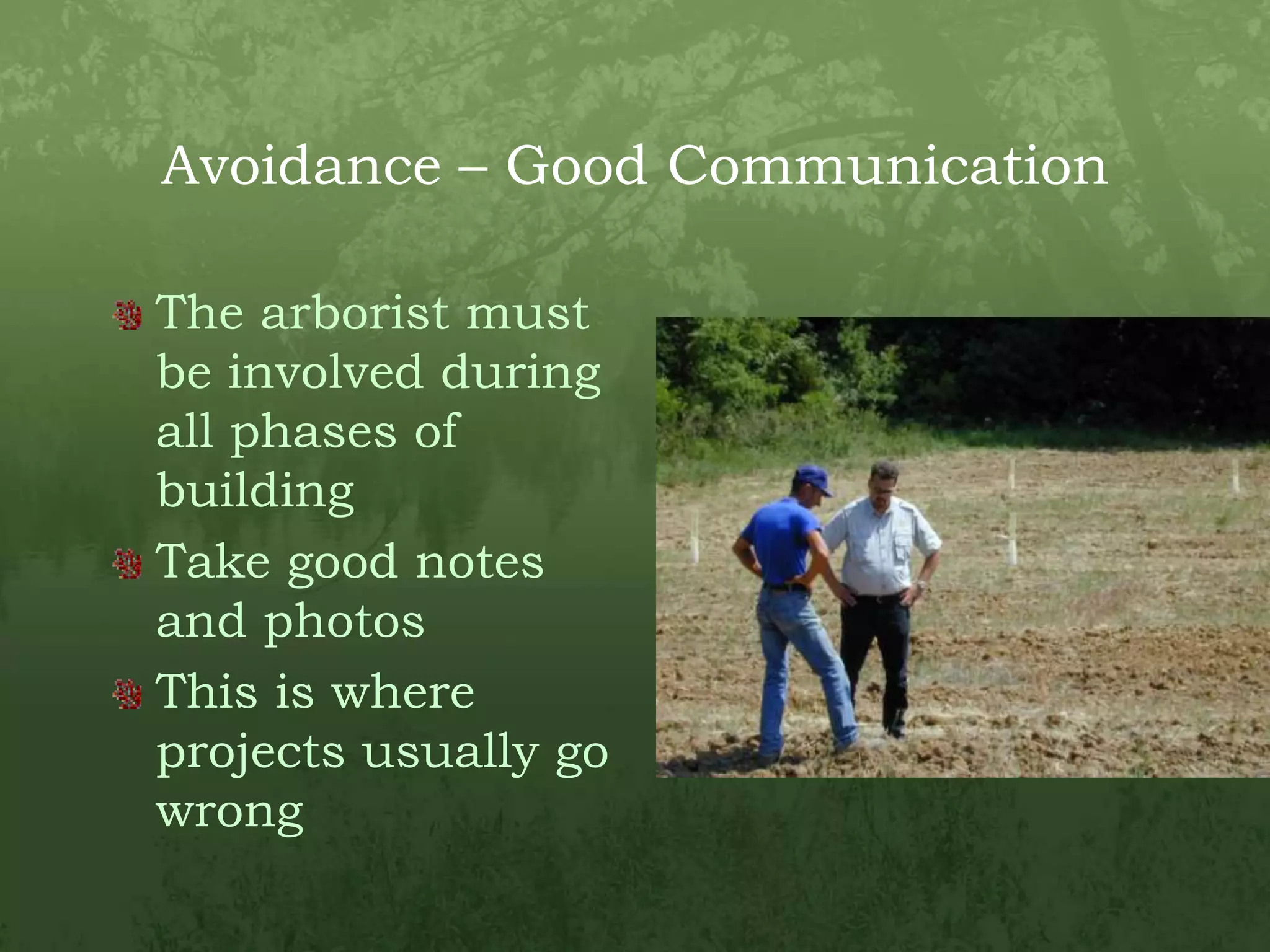
Avoidance – Good CommunicationThe arborist must be involved during all phases of buildingTake good notes and photosThis is where projects usually go wrong
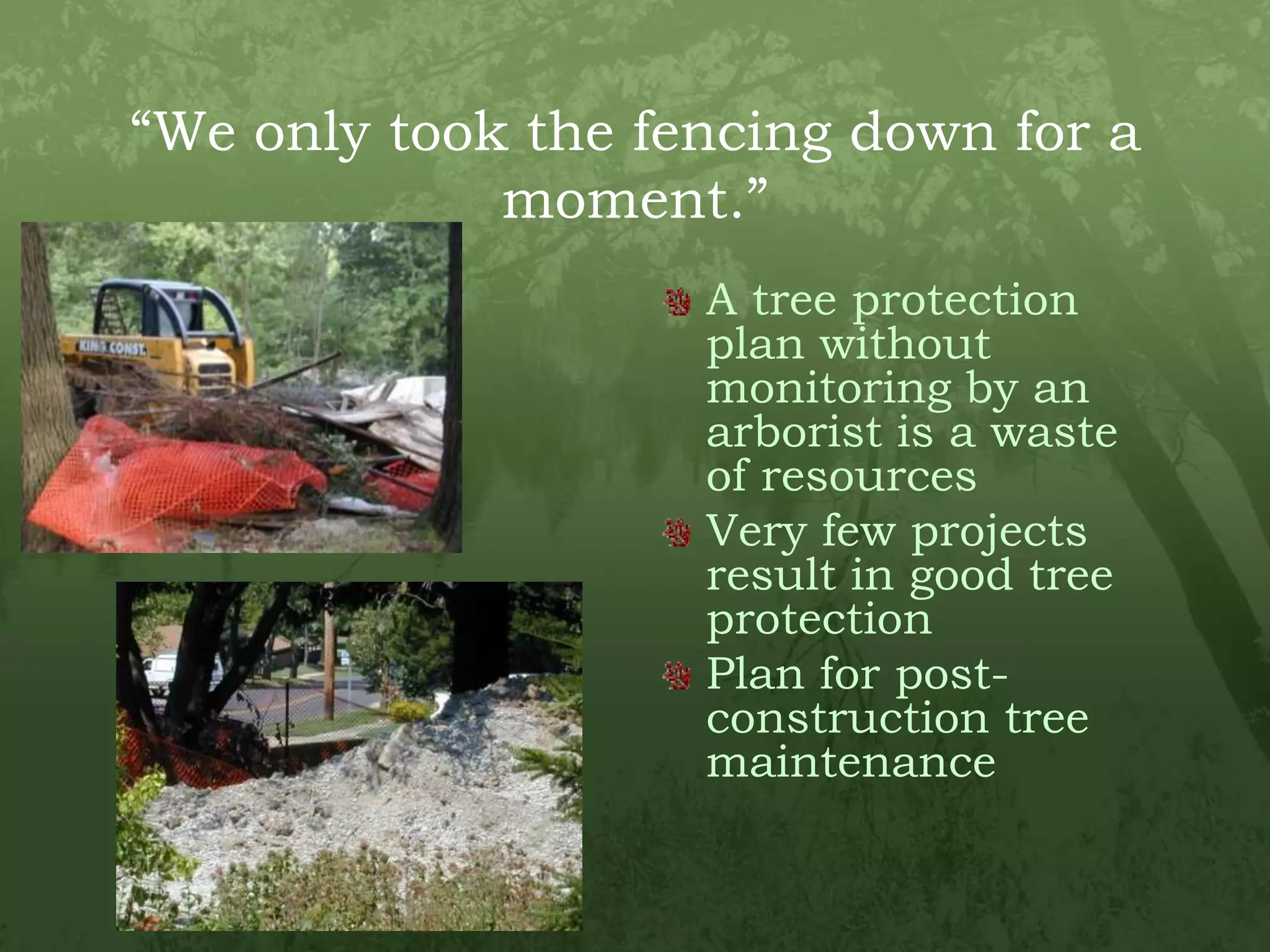
“We only took the fencing down for a moment.”A tree protection plan without monitoring by an arborist is a waste of resourcesVery few projects result in good tree protectionPlan for post-construction tree maintenance
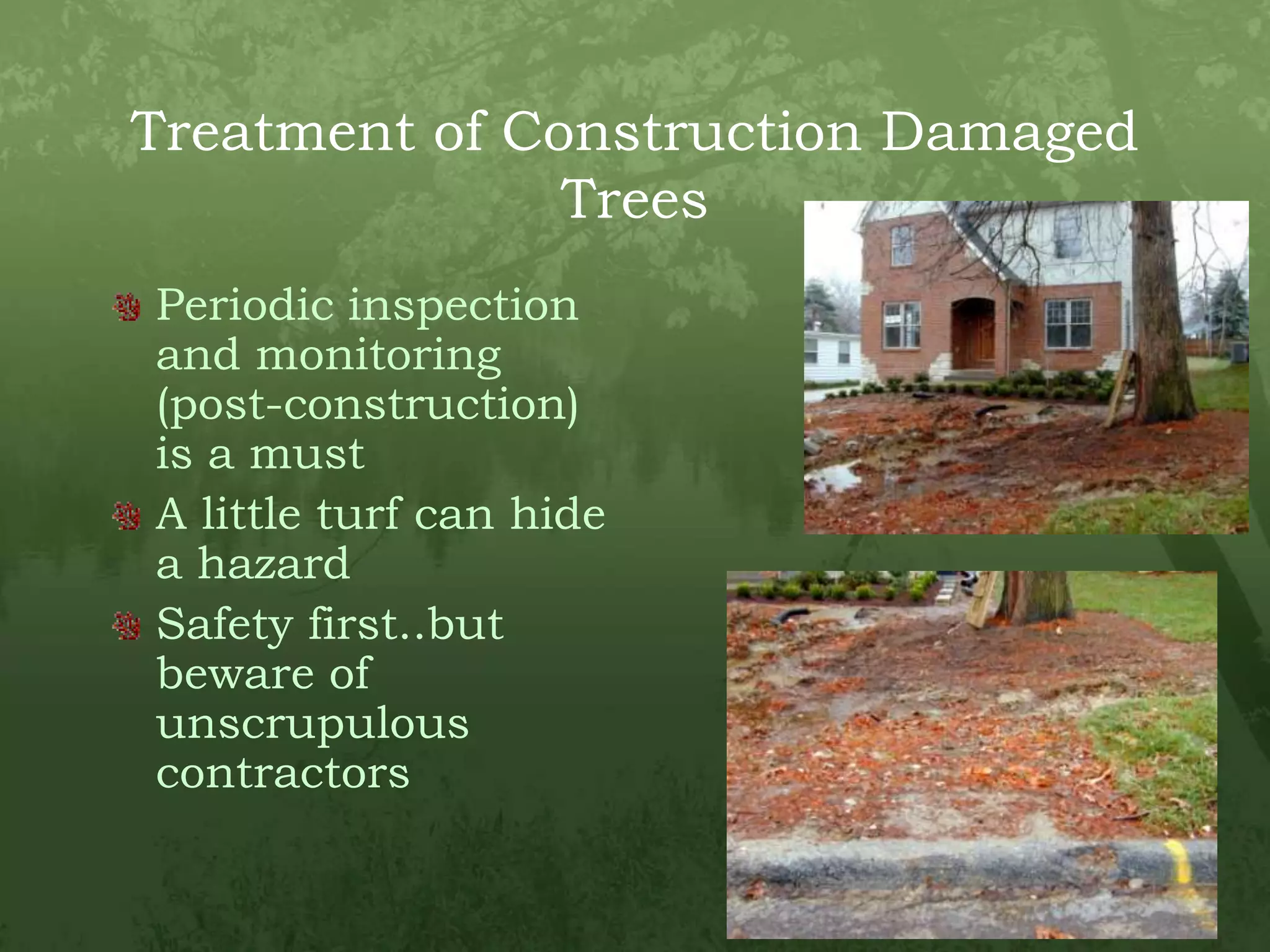
Treatment of Construction Damaged TreesPeriodic inspection and monitoring (post-construction) is a mustA little turf can hide a hazardSafety first..but beware of unscrupulous contractors
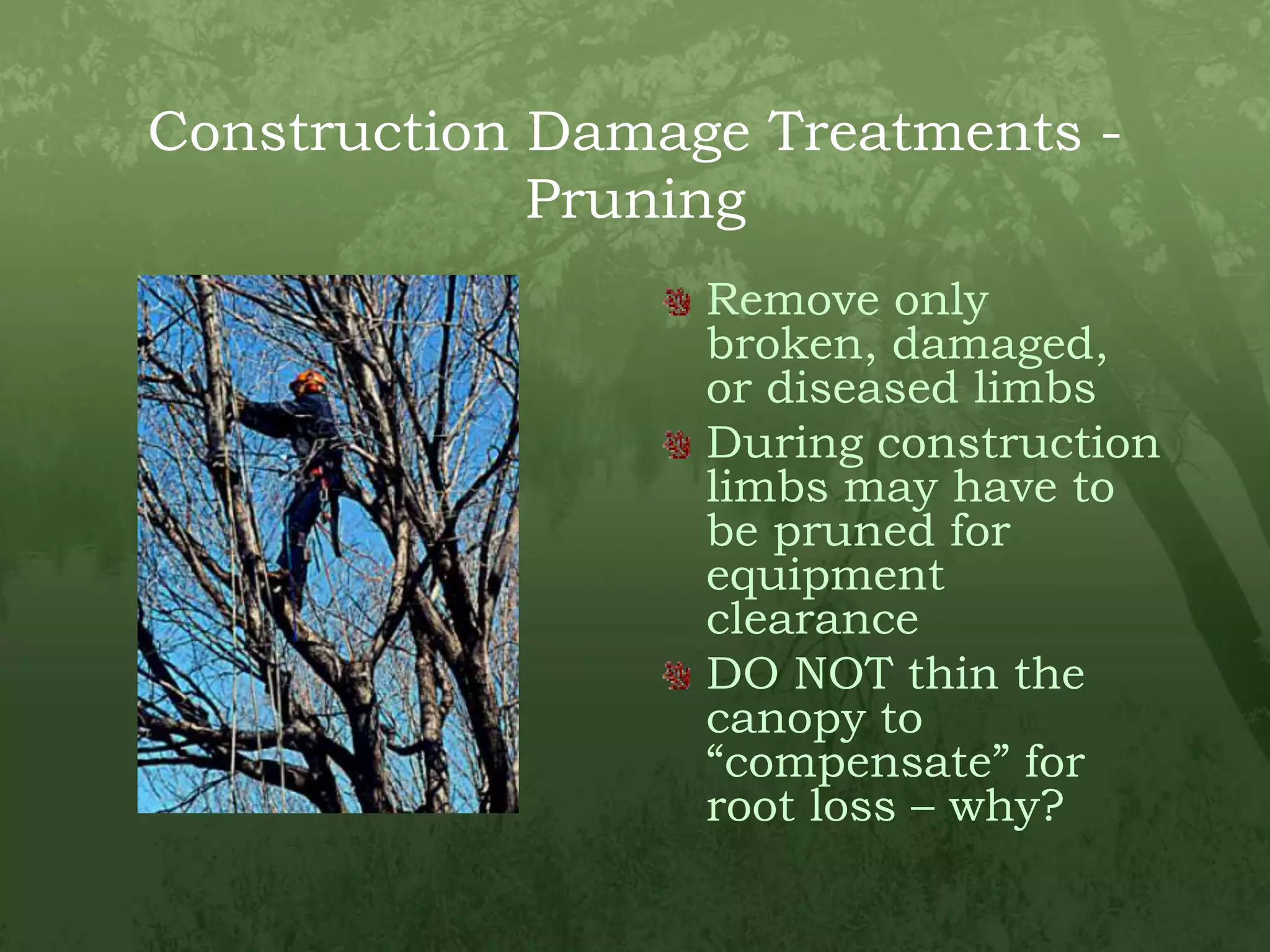
Construction Damage Treatments - PruningRemove only broken, damaged, or diseased limbsDuring construction limbs may have to be pruned for equipment clearanceDO NOT thin the canopy to “compensate” for root loss – why?
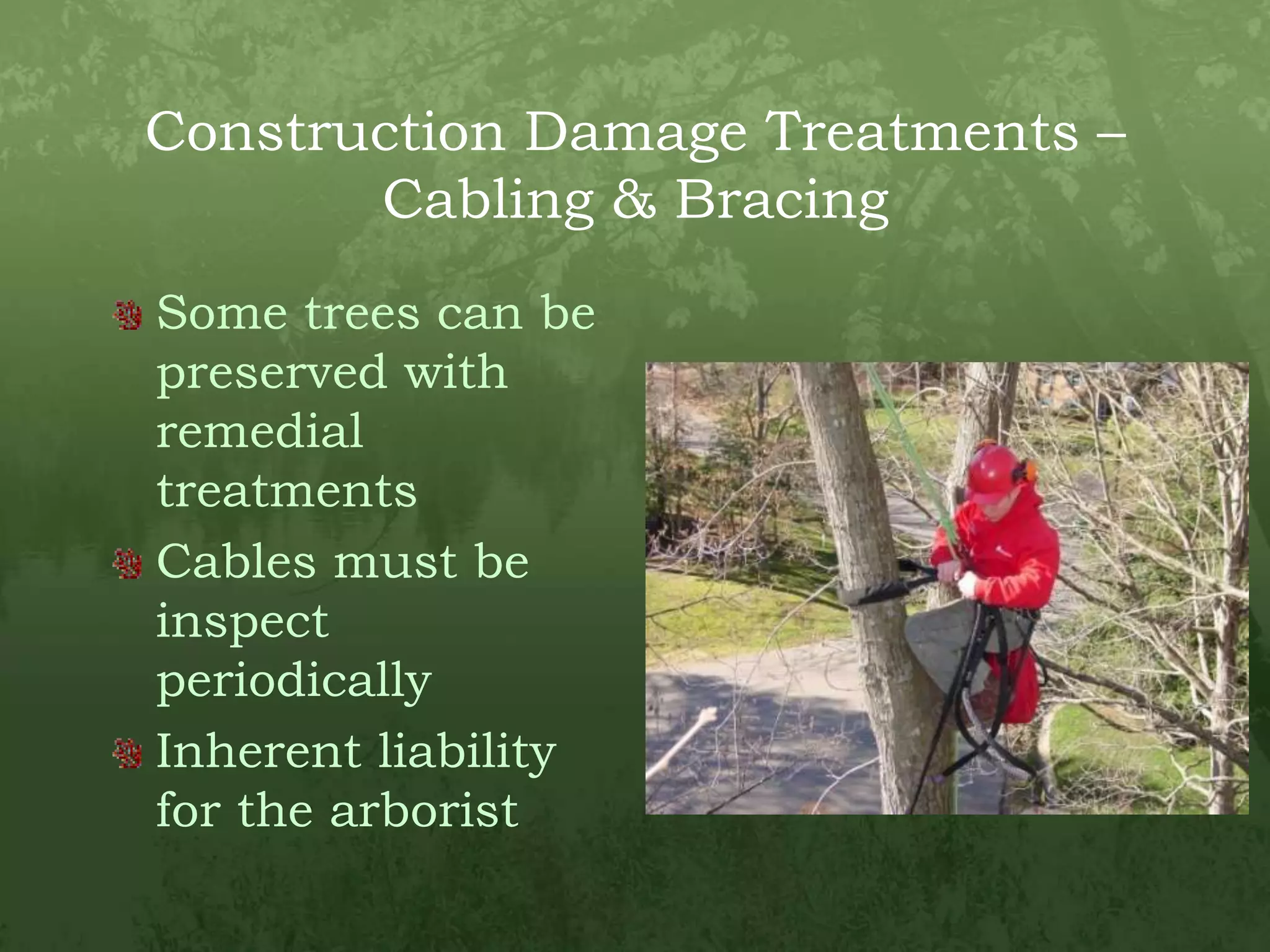
Construction Damage Treatments – Cabling & BracingSome trees can be preserved with remedial treatmentsCables must be inspect periodicallyInherent liability for the arborist
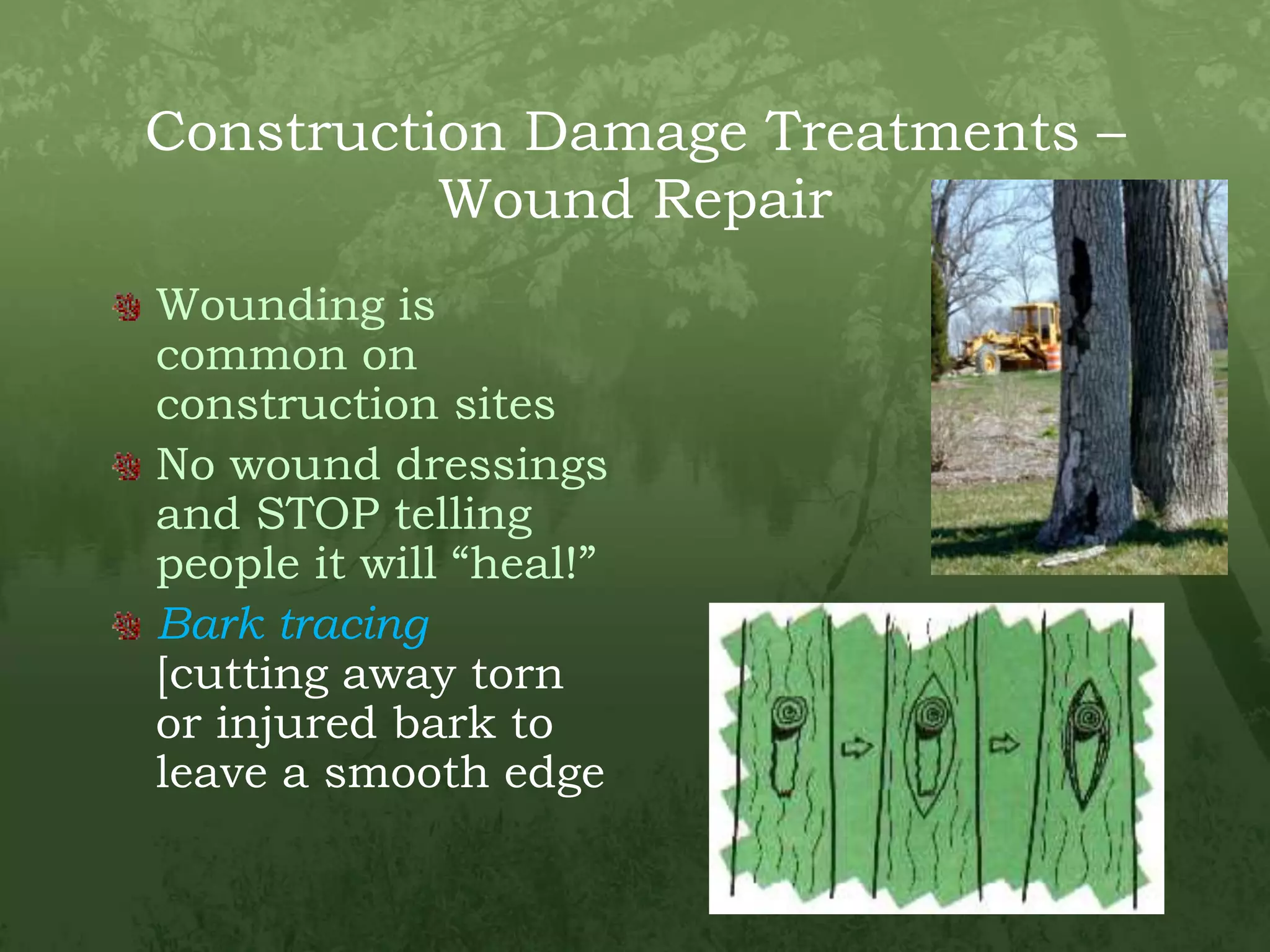
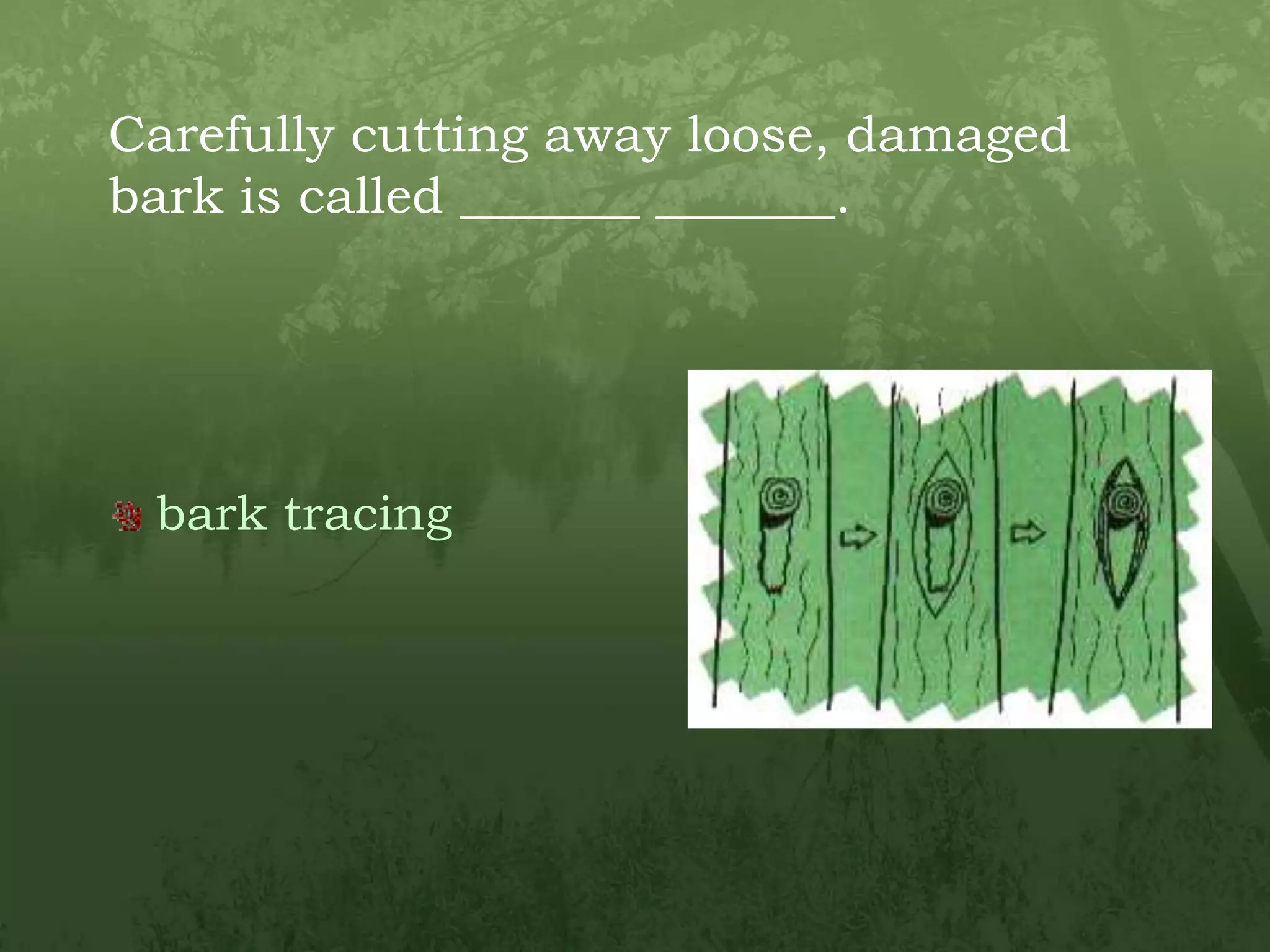
Construction Damage Treatments – Wound RepairWounding is common on construction sitesNo wound dressings and STOP telling people it will “heal!”Bark tracing[cutting away torn or injured bark to leave a smooth edge
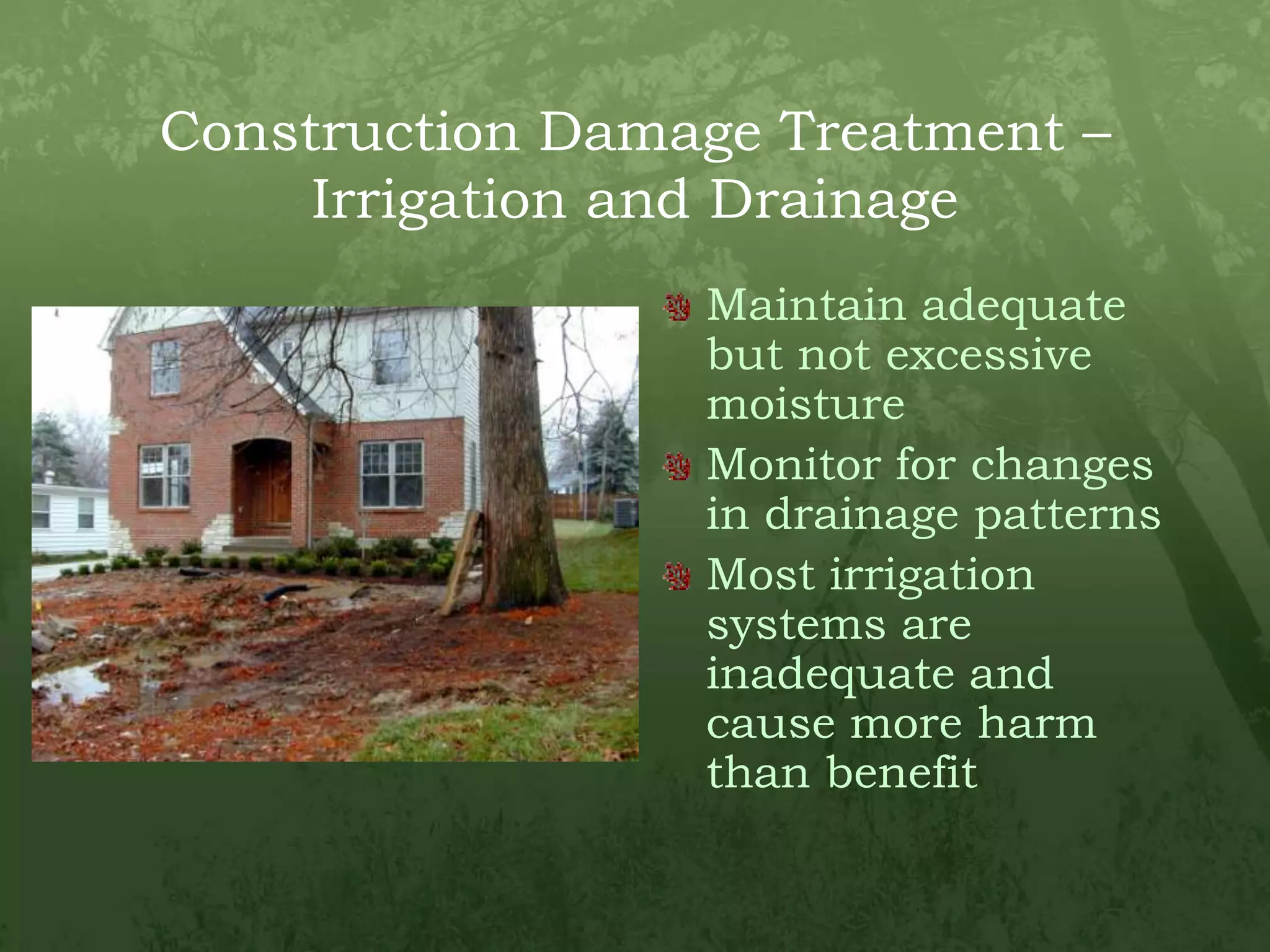
Construction Damage Treatment – Irrigation and DrainageMaintain adequate but not excessive moistureMonitor for changes in drainage patternsMost irrigation systems are inadequate and cause more harm than benefit
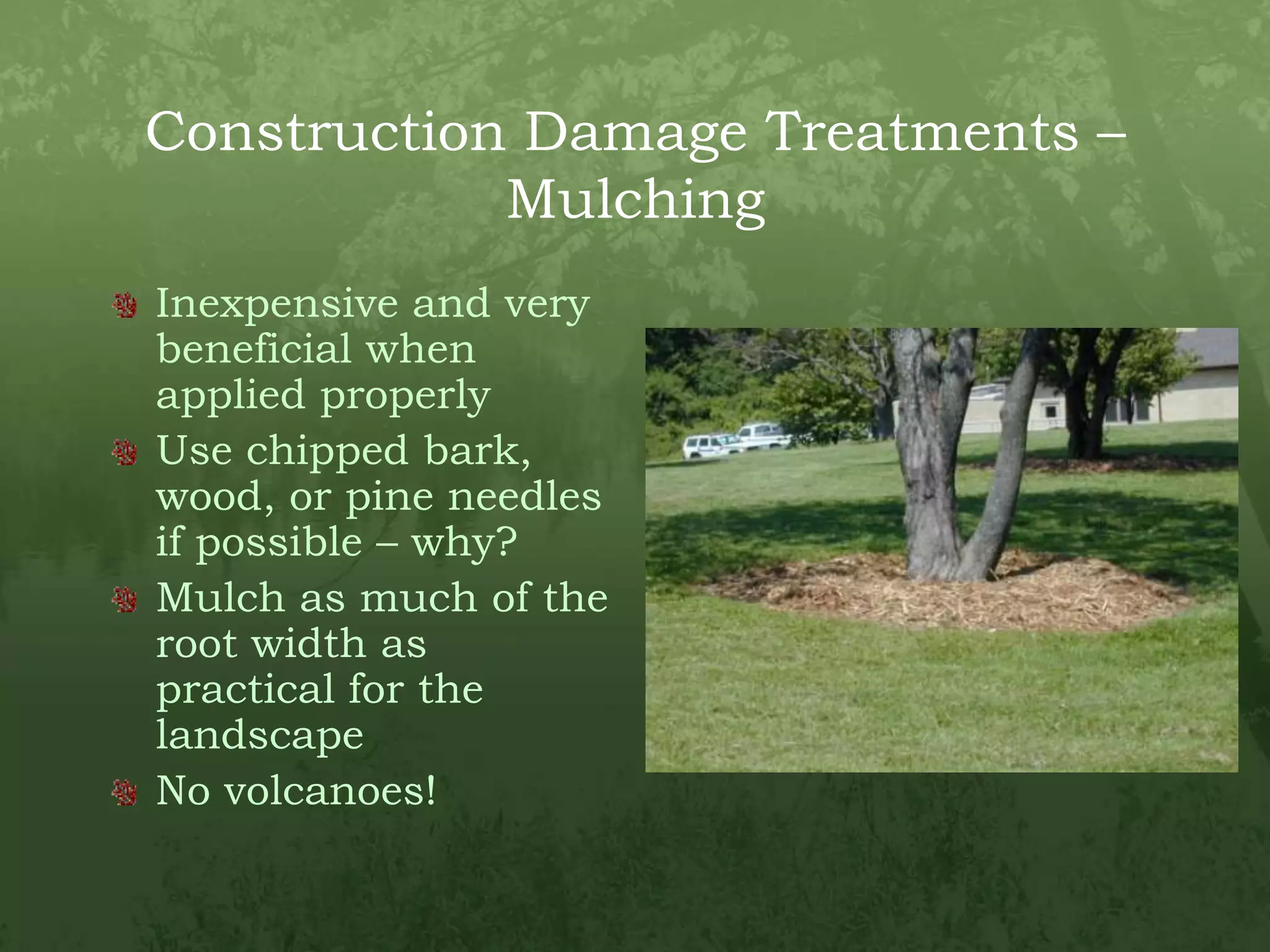
Construction Damage Treatments – Mulching Inexpensive and very beneficial when applied properlyUse chipped bark, wood, or pine needles if possible – why?Mulch as much of the root width as practical for the landscapeNo volcanoes!
Construction Damage Treatments – Aeration (Vertical Mulching)[filling vertical drilled holes in the soil with materials such as gravel, perlite, peat or sand]Drill holes 2-4” in diameter; 1-3’ on centerDrill holes to a 12” depth unless fill has been placed over the root system
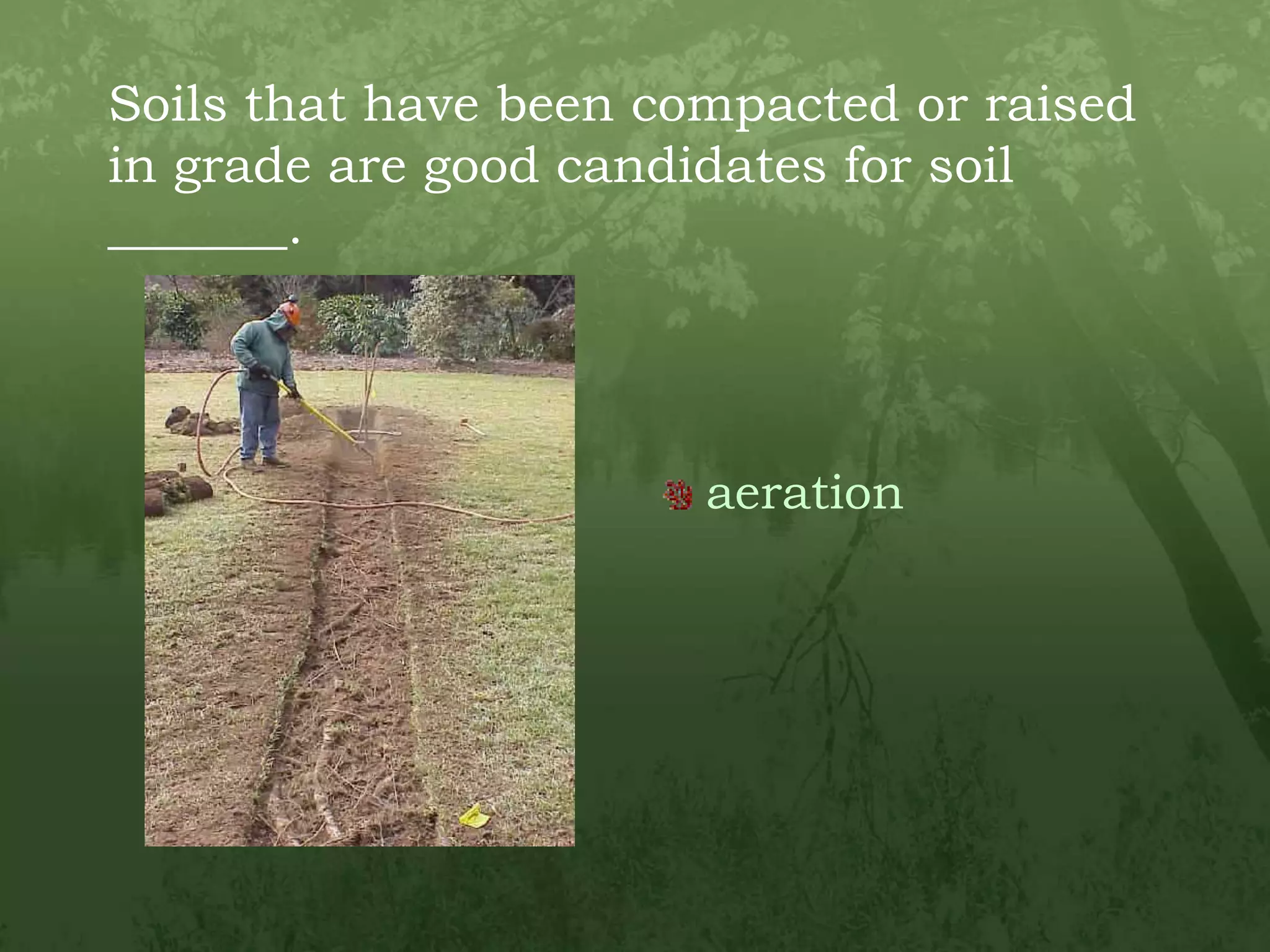
Construction Damage Treatments – Aeration (radial trenching)[means of aerating the soil in the root zone of a tree by removing and replacing soil in a spoke-like pattern]Air excavator [device that blows air at high force; used to remove soil from the root zone of trees]Mechanical trenchers should not operate within 4-8’ of trunkTrench at least to dripline; 1’ depth
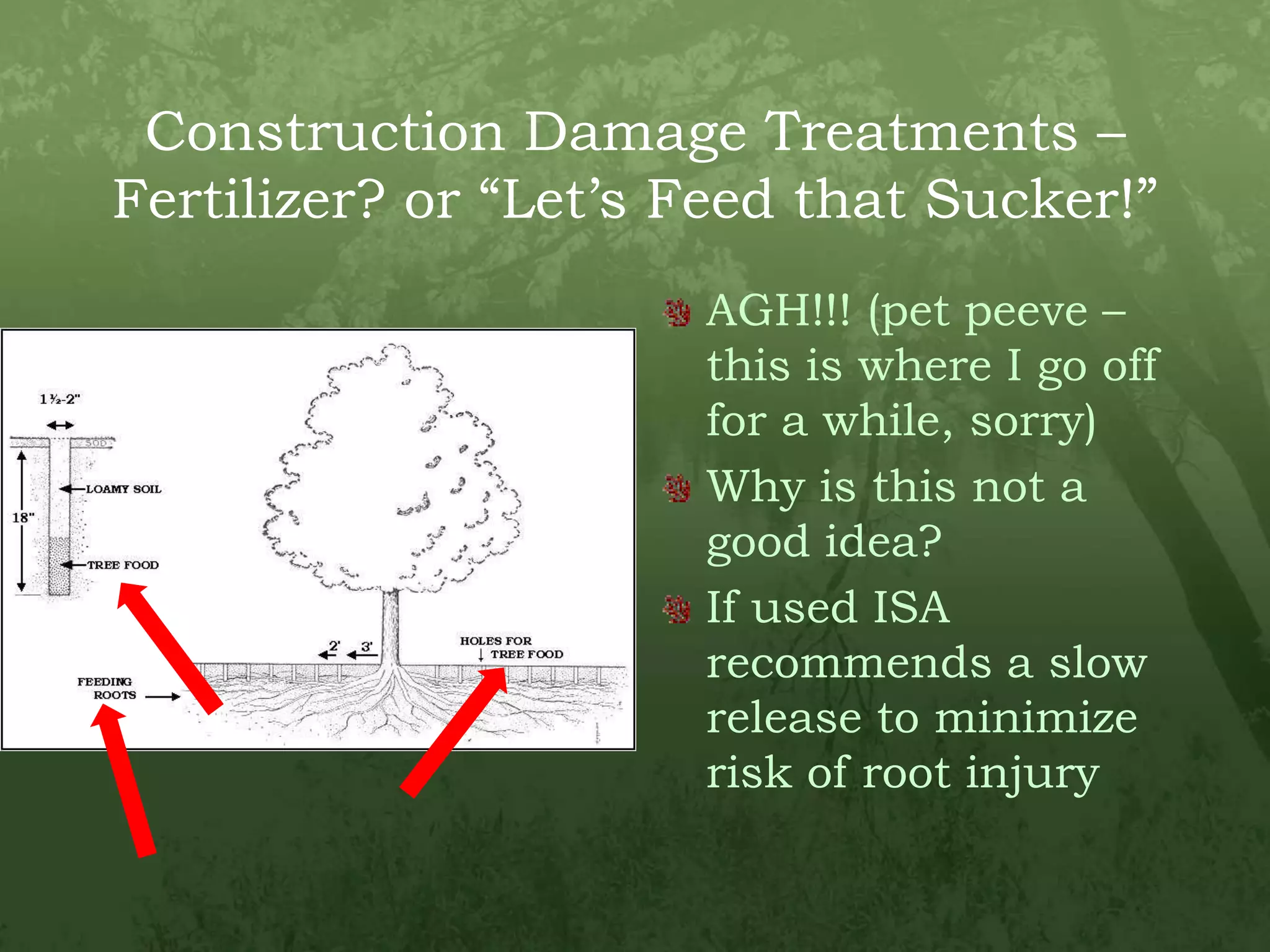
Construction Damage Treatments – Fertilizer? or “Let’s Feed that Sucker!”AGH!!! (pet peeve – this is where I go off for a while, sorry)Why is this not a good idea?If used ISA recommends a slow release to minimize risk of root injury
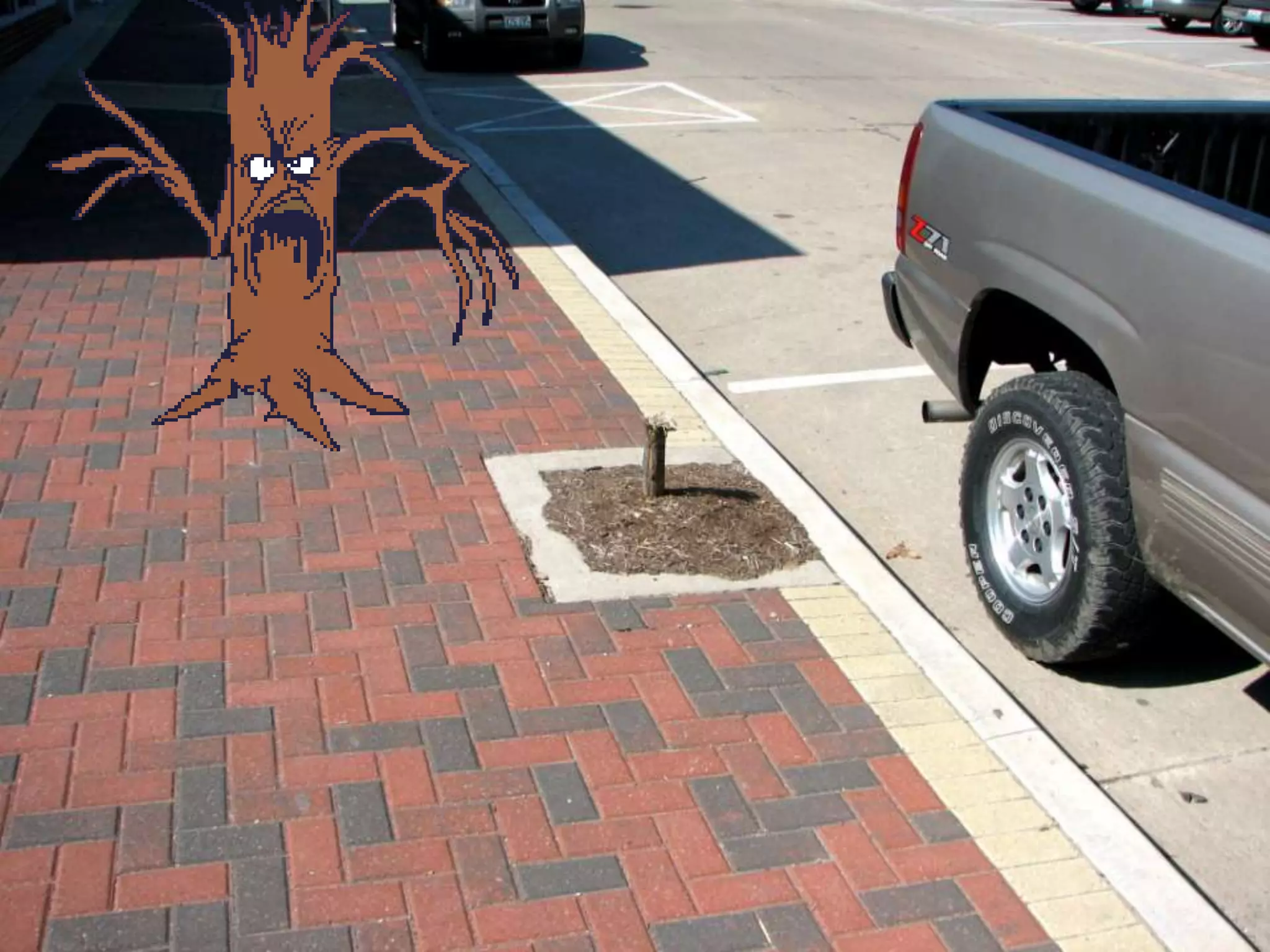
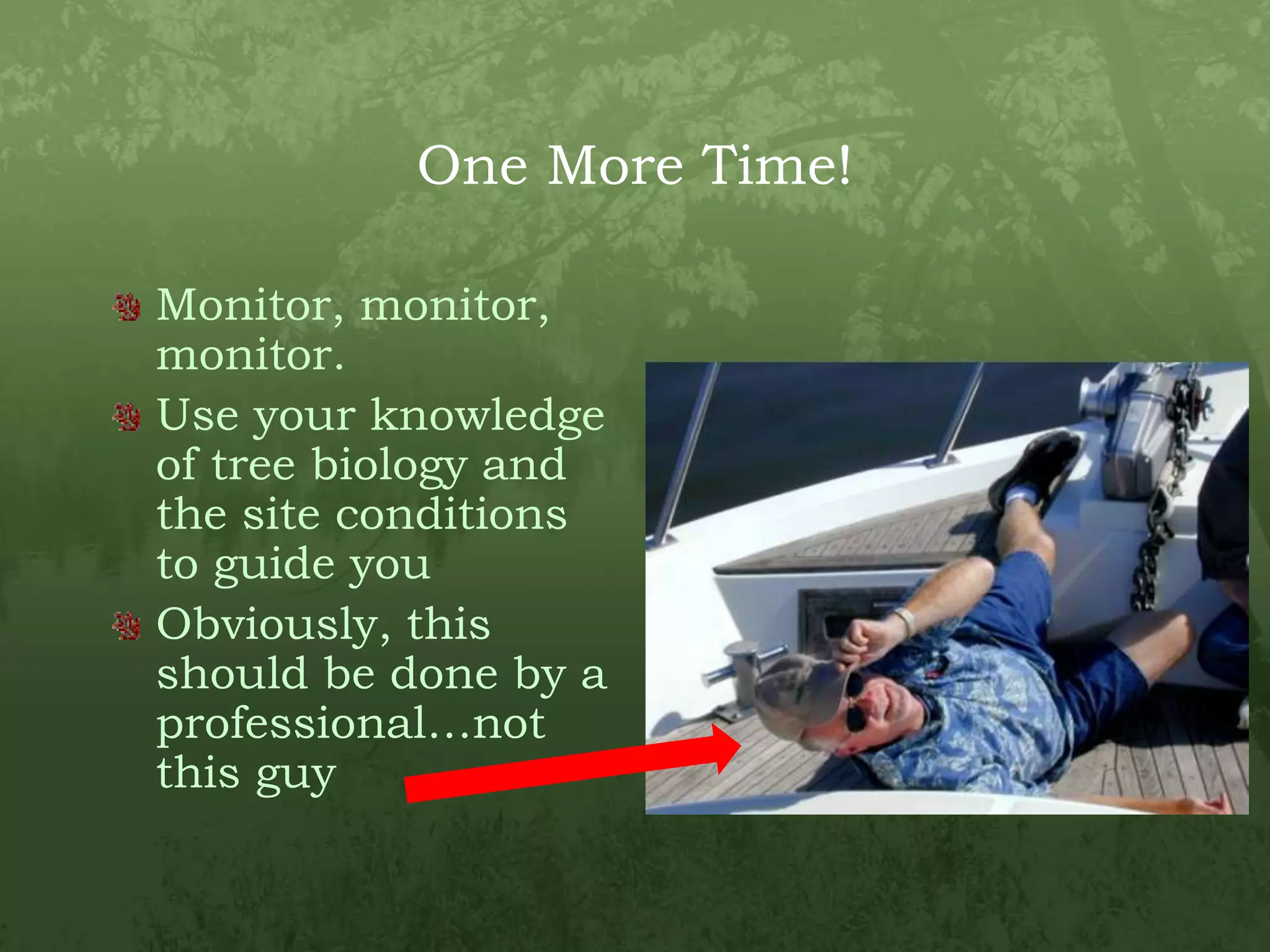
One More Time!Monitor, monitor, monitor.Use your knowledge of tree biology and the site conditions to guide youObviously, this should be done by a professional…not this guy
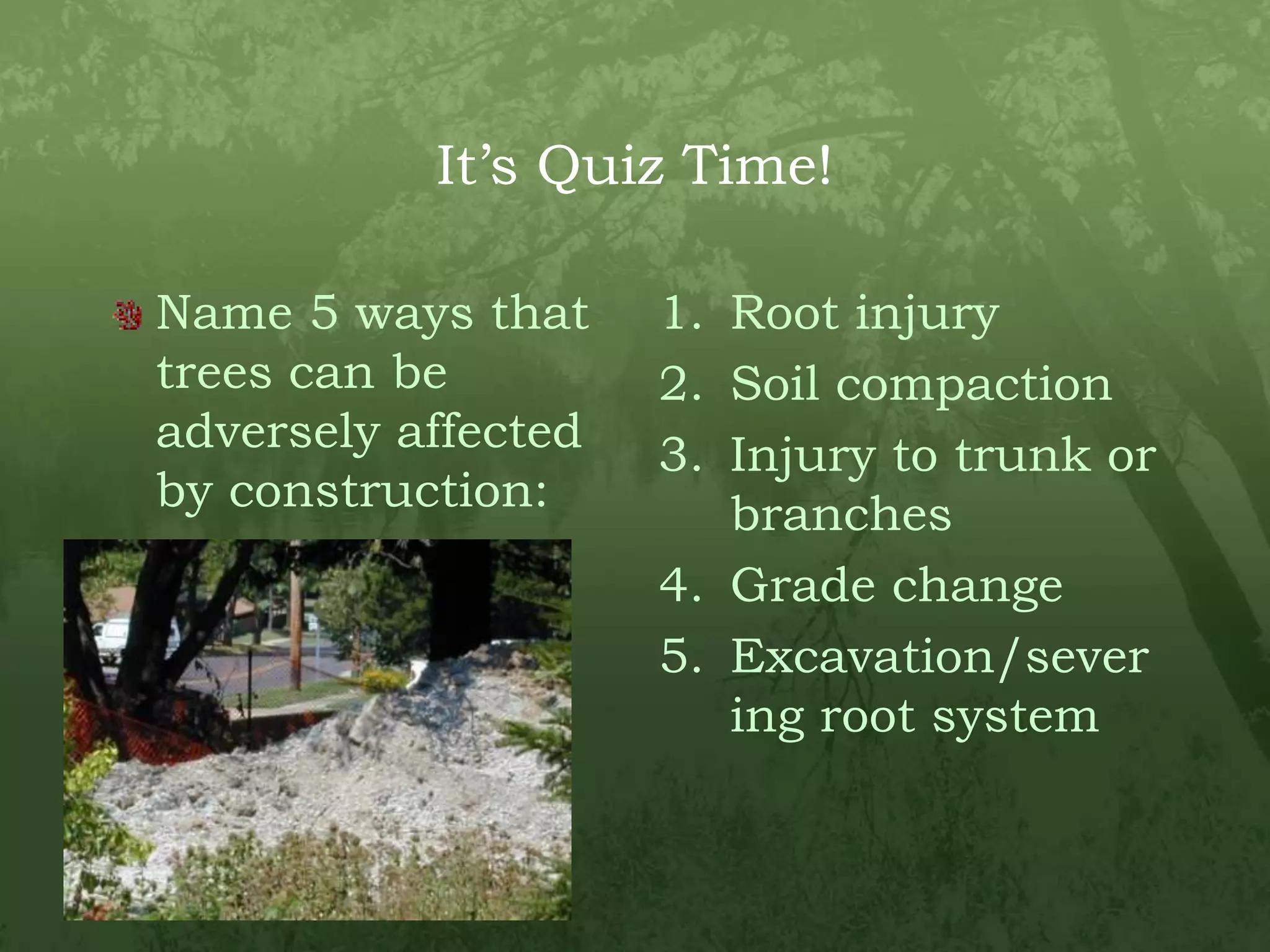
It’s Quiz Time!Name 5 ways that trees can be adversely affected by construction:Root injurySoil compactionInjury to trunk or branchesGrade changeExcavation/severing root system
When soil is compacted, the ______ _______ between soil particles is reduced.pore space
Two detrimental effects of soil compaction are:SuffocationRestriction of growth
A technique used to reduce soil compaction around trees on a construction site is to spread a temporary, thick layer of _______.Mulch
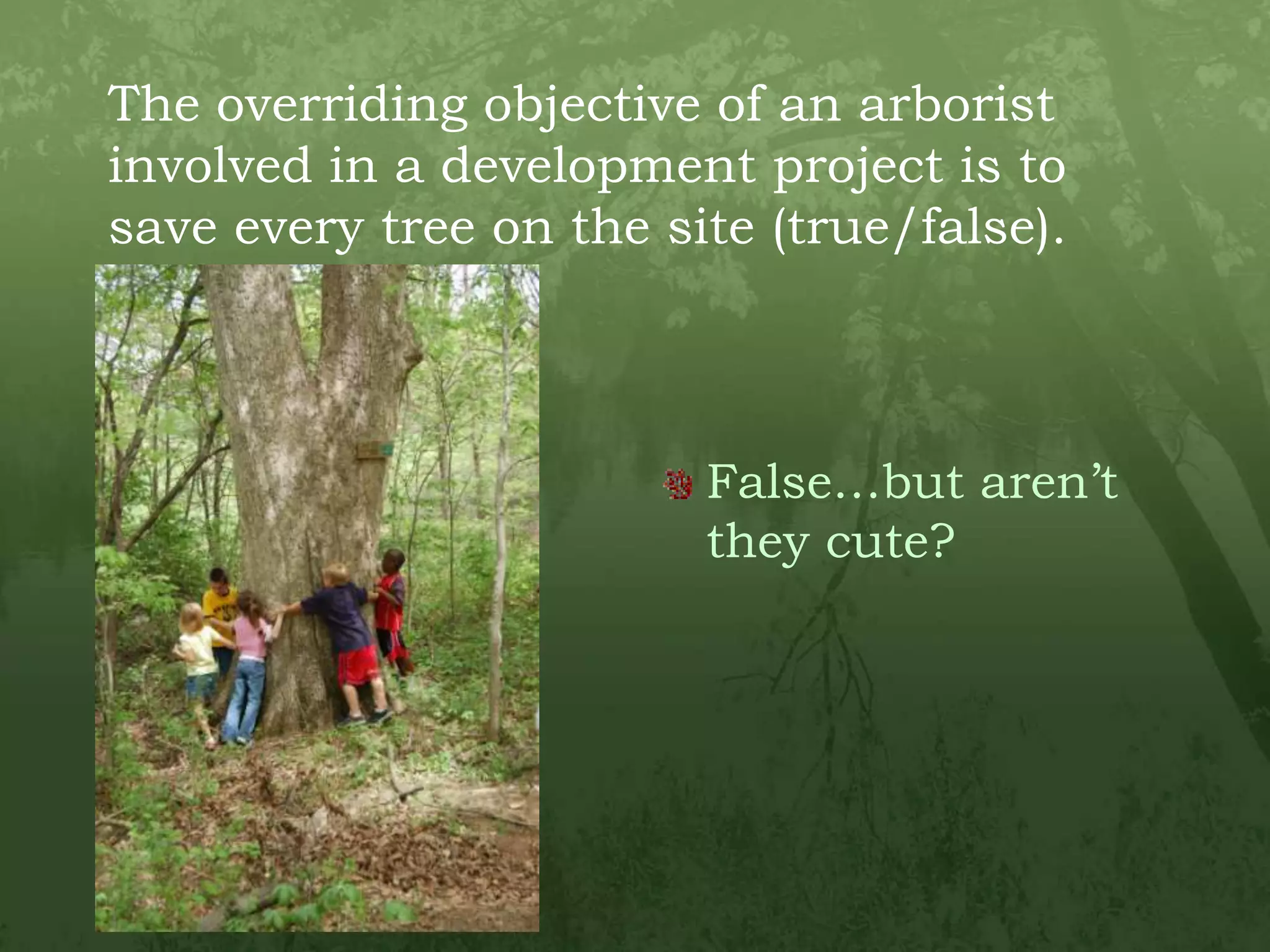
The overriding objective of an arborist involved in a development project is to save every tree on the site (true/false).False…but aren’t they cute?
It is better to tunnel directly under a tree than to cut directly across the root system of a tree when excavating for utility lines (true/false).Duh.
An important action that should be taken at the start of a construction project is to erect _______ around all of the trees that are to remain.Protective fencing or barriers
Carefully cutting away loose, damaged bark is called _______ _______.bark tracing
Soils that have been compacted or raised in grade are good candidates for soil _______.aeration
There is far more than an arborist can do to treat trees that have been damaged by construction than to prevent the damage (true/false).What a dork!
_______ is a technique that may be employed to lower the soil grade in steps.Terracing
(Easy) Sample Test QuestionsWhen soils are compacted by construction equipment, trees usually decline because:oxygen availability is reducedthe ability of the roots to absorb water and minerals decreasesroot growth and expansion may be diminishedall of the above
(Easy) Sample Test QuestionsArborists should be involved early in the construction planning process because:tree preservation measures should be in the specificationsonce construction has begun, it may be too late to save the treesthere is often little arborists can do to treat construction damageall of the above
(Easy) Sample Test QuestionsA measure that can be taken to minimize compaction on a construction site is:water the site thoroughly before equipment is brought inpermanently raise the soil grade to protect tree rotsspread a temporary, thick layer of mulch over the siteroot prune the trees in advance
(Easy) Sample Test QuestionsIf a significant portion of a tree’s root system has been removed during building construction, a step that will help preserve the tree is:pruning one-third of the crown to compensate for root lossa surface application of 10 pounds of soluble nitrogen per 1,000 square feetconstruction of a tree wellnone of the above
(Easy) Sample Test QuestionsDigging trenches in a wheel-spoke pattern and backfilling with organic matter or a more porous soil is called:radial aerationtunnel aerationsoil fracturingvertical radiation
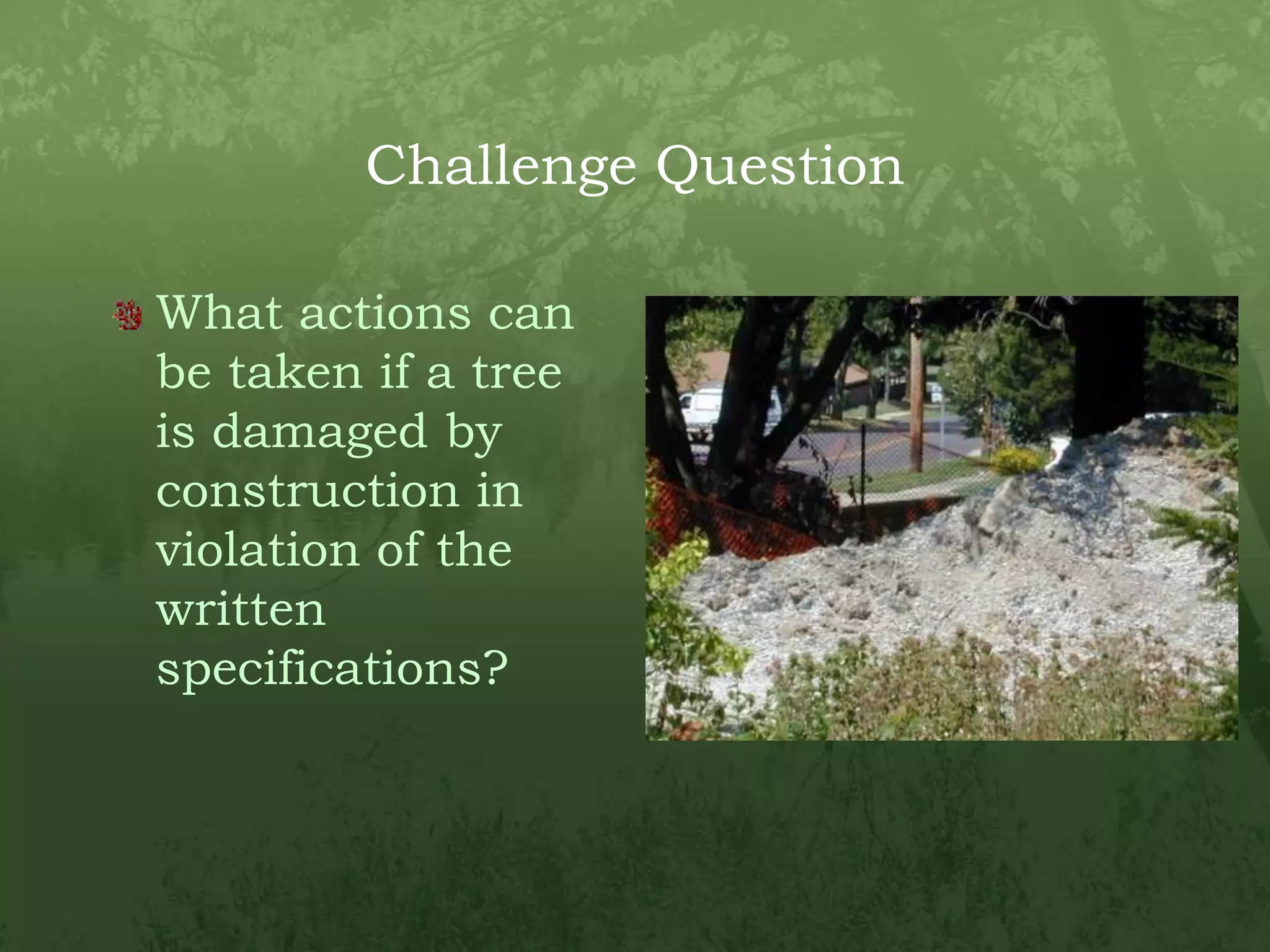
Challenge QuestionWhat actions can be taken if a tree is damaged by construction in violation of the written specifications?
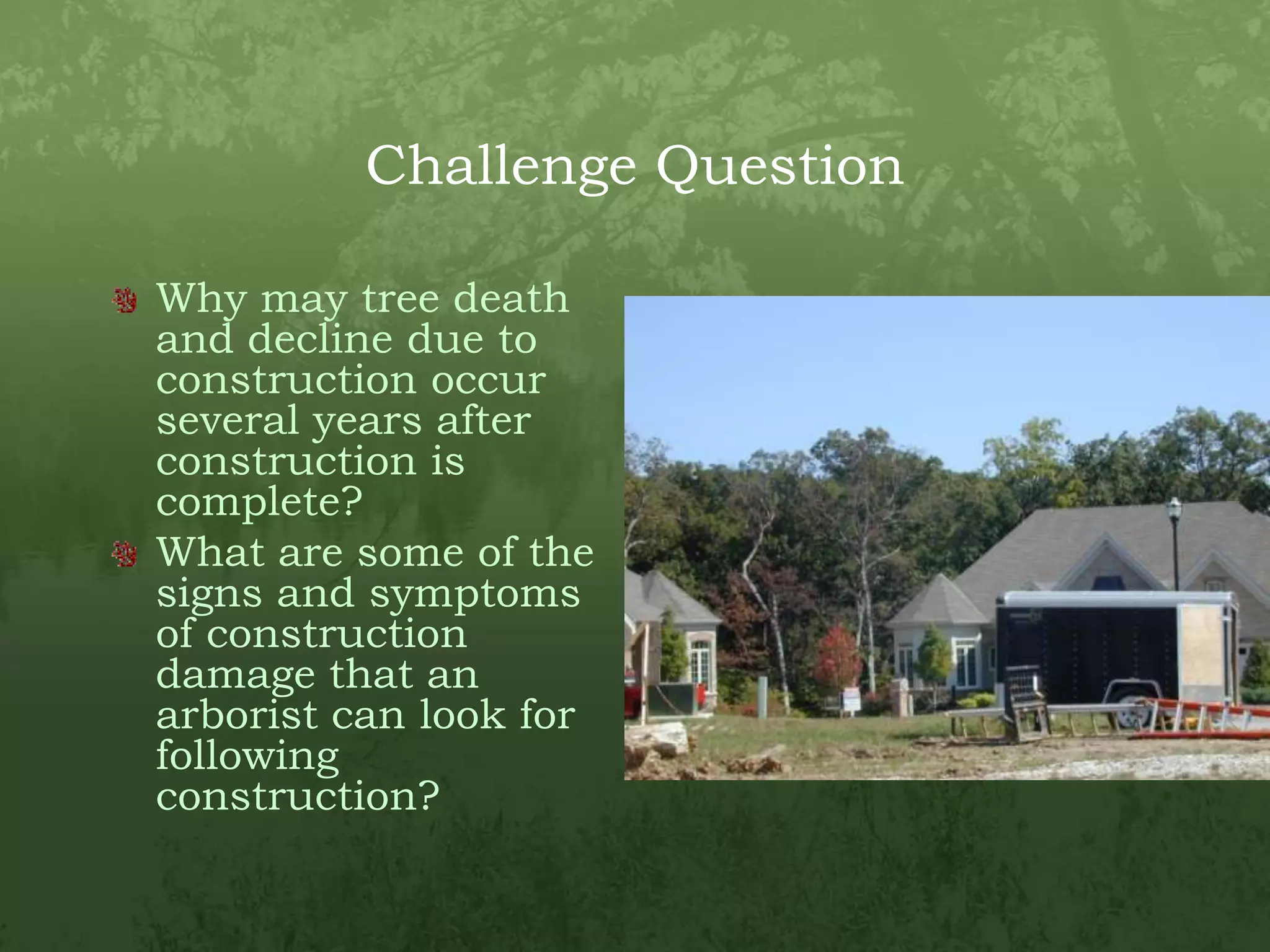
Challenge QuestionWhy may tree death and decline due to construction occur several years after construction is complete? What are some of the signs and symptoms of construction damage that an arborist can look for following construction?
ResourcesTrees and Development: A Technical Guide to Preservation of Trees During Land Development; Matheny and Clark, 1998.Root Injury and Tree Health; WatsonMissouri Department of Conservation Urban Forester: Mark.Grueber@mdc.mo.gov and www.missouriconservation.orgInternational Society of Arboriculture: www.treesaregood.comTreelink: www.treelink.orgBuilding with Trees Workshops – The Arbor Day Foundation: www.arborday.org

Isa trees and construction mark

  • 1.
    Trees and ConstructionChapter 13 ISA Arborists’ Certification Study Guide – Domains: Urban Forestry & Protection and PreservationMark Grueber, Urban Forester
  • 2.
    Describe how treescan be injured or killed as the direct result of construction damage.Discuss the importance of arborists’ participation in the planning stages of development if trees are to be a part of the landscape.Explain the steps that can be taken to preserve trees on a construction site.Discuss some techniques that can be used to preserve trees when the soil grade must be changed.Explain the limitations for treatment of trees that have been damaged by construction.Objectives:
  • 3.
    Key TermsThe KeyTerms as listed in the Arborist’s Certification Study Guide will be defined and highlightedthroughout the presentation.
  • 4.
    “Trees never knewcomplete removal of trunks, machine compaction of soils, sudden changes in water drainage patterns due to roads, pollution, and disruption of niches for soil organisms…These actions have come suddenly. They are being repeated.” – Alex Shigo, A New Tree Biology
  • 5.
    Construction Damage toTreesOne of the most common causes of tree death and decline in urban areasPeople want to “live in the trees” but most landowners, developers and builders don’t understand how to take advantage of the opportunity.
  • 6.
    The Missing Link:Trees are part of the community’s infrastructureTrees are an important and vital part of a community’s infrastructureWhat do trees require?What do we provide in an urban/ suburban setting?Planning for trees
  • 7.
  • 8.
    Elements that affectplant growthWhat we can’t impactSunlightOxygenCarbon DioxideSoil texture (sand, silt or clay)TemperatureWhat we can impactAvailable WaterAvailable NutrientsSoil structure (how a soil hangs together)Available space
  • 9.
    …and a professionalarborist or forester to tell them that.Trees CAN be protected and preserved on construction sitesA professional arborist or forester MUST be involved early – during the planning stage.
  • 10.
    How are TreesDamaged During Construction?The most serious damage to trees caused by construction is underground.Root damage and soil disturbance.
  • 11.
    Roots…a review.Which isa more accurate representation of a trees root system?Fine absorbing roots are concentrated in the upper few inches of the soil
  • 12.
    Roots…the real pictureMarkGrueber, Ecological Consulting ServicesMark Grueber, Ecological Consulting ServicesMark Grueber, Ecological Consulting Services
  • 14.
    Root Damage fromConstructionRoot injury may show decline in a few months or several yearsRemember the mortality spiral?Common symptoms: yellowing or early fall color, watersprouts, dieback of small twigs and eventually major branches
  • 15.
    Construction Damage -Physical Injury to Trunk and CrownDamage to vascular tissuesBut trees heal…don’t they?Mortality spiral…again!Note the “tree protection fencing”
  • 16.
    Construction Damage -Cutting of RootsDigging and trenching[digging to install utilities; of concern due to root damage] will likely sever rootsUsually due to misunderstanding of root growth habit (1-3x branch spread)Amount of damage depends on proximity to trunk and area of root development
  • 17.
    Cutting of Roots- continuedSevering 1 root can remove 15 to 25% of root systemRoot loss may increase potential for tree failure
  • 18.
    Construction Damage –Soil Compaction[Compression of the soil resulting in a reduction of the total pore space, especially the macropores]Ideal soil has 50% pore space – filled with H20 and airO2 is reduced; CO2 and other gases increaseRoot growth is diminished; absorption reduced
  • 19.
    Construction Damage –Added Soil90% of fine roots that absorb water and minerals are in the upper few inches of soil…got it???Additional soil – even a few inches – can dramatically alter the infiltration of water and oxygen; fine roots die within 30 minutesAltering the drainage pattern may also cause significant issues
  • 20.
    Construction Damage –Exposure Trees grow in communities with other trees and/or non-turf type plantsTypes of injury: sunscald, improper taper, aforementioned root and soil issuesIt all comes back to understanding the biology of trees and “forests”
  • 21.
    Are there alternatives?TreeProtection Planning and PreservationPlanting site improvementsSoilRooting spaceConservation development – preserving a portion of trees (not on exam!)
  • 22.
    Planning and PreservationTreeprotection planning cannot wait until constructionMust involve a professional arborist or forester who can communicate with developers and buildersArborist must be involved from beginning to end
  • 23.
    Considerations of TreeProtection PlanningDon’t try to save every tree!Species, size, location and conditionDon’t save a hazardYounger trees may survive the stress
  • 24.
    Tree Protection PlanningArborist– evaluates, selects and maps treesLandscape Architect – assists with plan preparation to consider other parts of infrastructureDon’t just consider the trees – remember it’s an ecosystem!
  • 25.
    Tree Protection PlanningConsiderdesign changes or construction procedure modifications to accommodate treesTunneling [alternative means to trenching for installation of underground utilities] instead of trenching is one of the most common
  • 26.
    Specifications[detailed plans andstatements of particular procedures and standards]All tree protection MUST be written into construction specificationsAll contractors (and subs!) must be made aware of these specsConsider fines (or incentives) using tree and landscape valuation methodology
  • 27.
    Construction Damage AvoidanceBarriers[fences or other means to establish a protection zone around trees on construction sites]Place as far away from tree as possible…or a minimum of 1’/1” dbhNo traffic or storage of building materials, waste or excess soilNO DISTURBANCE!
  • 28.
    Avoidance - LimitAccessLimit access to one route [means of entering and leaving a property during a construction operation] on and off property – but be realistic! Remember parking.Specify areas for storage of equipment, soil, building materials; as well as areas for burning, washout, etc.
  • 29.
    Avoidance – CompactionReductionBuild a “mulch road” - six to twelve inches of wood chips.Must be CAREFULLY removed or reusedPlywood sheets
  • 30.
    Avoidance – GradeChangesTerracing[method used to lower the soil grade in stages]Maintain original grade as far from tree as possibleMust be accompanied by root pruning and care where roots are exposed
  • 31.
    Avoidance – GradeChanges continuedTree Island[soil or landscape surrounding a tree, such as within a paved area]Similar to terracingExcellent for retaining small groves
  • 32.
    Avoidance – GradeChanges continuedAeration systems[the set of holes or trenches created in a tree’s root area to improve oxygen availability to the roots]Tree wells[wall constructed around a tree when the soil grade is raised to maintain the original soil level and provide oxygen to the root zone]Lack of supporting researchGravel or stone below fill does NOT improve water or oxygen flowConsider tree size, species, drainage patterns, soil conditions, fill depth, irrigation and future maintenance
  • 33.
    Avoidance – GoodCommunicationThe arborist must be involved during all phases of buildingTake good notes and photosThis is where projects usually go wrong
  • 34.
    “We only tookthe fencing down for a moment.”A tree protection plan without monitoring by an arborist is a waste of resourcesVery few projects result in good tree protectionPlan for post-construction tree maintenance
  • 35.
    Treatment of ConstructionDamaged TreesPeriodic inspection and monitoring (post-construction) is a mustA little turf can hide a hazardSafety first..but beware of unscrupulous contractors
  • 36.
    Construction Damage Treatments- PruningRemove only broken, damaged, or diseased limbsDuring construction limbs may have to be pruned for equipment clearanceDO NOT thin the canopy to “compensate” for root loss – why?
  • 37.
    Construction Damage Treatments– Cabling & BracingSome trees can be preserved with remedial treatmentsCables must be inspect periodicallyInherent liability for the arborist
  • 38.
    Construction Damage Treatments– Wound RepairWounding is common on construction sitesNo wound dressings and STOP telling people it will “heal!”Bark tracing[cutting away torn or injured bark to leave a smooth edge
  • 39.
    Construction Damage Treatment– Irrigation and DrainageMaintain adequate but not excessive moistureMonitor for changes in drainage patternsMost irrigation systems are inadequate and cause more harm than benefit
  • 40.
    Construction Damage Treatments– Mulching Inexpensive and very beneficial when applied properlyUse chipped bark, wood, or pine needles if possible – why?Mulch as much of the root width as practical for the landscapeNo volcanoes!
  • 41.
    Construction Damage Treatments– Aeration (Vertical Mulching)[filling vertical drilled holes in the soil with materials such as gravel, perlite, peat or sand]Drill holes 2-4” in diameter; 1-3’ on centerDrill holes to a 12” depth unless fill has been placed over the root system
  • 42.
    Construction Damage Treatments– Aeration (radial trenching)[means of aerating the soil in the root zone of a tree by removing and replacing soil in a spoke-like pattern]Air excavator [device that blows air at high force; used to remove soil from the root zone of trees]Mechanical trenchers should not operate within 4-8’ of trunkTrench at least to dripline; 1’ depth
  • 43.
    Construction Damage Treatments– Fertilizer? or “Let’s Feed that Sucker!”AGH!!! (pet peeve – this is where I go off for a while, sorry)Why is this not a good idea?If used ISA recommends a slow release to minimize risk of root injury
  • 44.
    One More Time!Monitor,monitor, monitor.Use your knowledge of tree biology and the site conditions to guide youObviously, this should be done by a professional…not this guy
  • 45.
    It’s Quiz Time!Name5 ways that trees can be adversely affected by construction:Root injurySoil compactionInjury to trunk or branchesGrade changeExcavation/severing root system
  • 46.
    When soil iscompacted, the ______ _______ between soil particles is reduced.pore space
  • 47.
    Two detrimental effectsof soil compaction are:SuffocationRestriction of growth
  • 48.
    A technique usedto reduce soil compaction around trees on a construction site is to spread a temporary, thick layer of _______.Mulch
  • 49.
    The overriding objectiveof an arborist involved in a development project is to save every tree on the site (true/false).False…but aren’t they cute?
  • 50.
    It is betterto tunnel directly under a tree than to cut directly across the root system of a tree when excavating for utility lines (true/false).Duh.
  • 51.
    An important actionthat should be taken at the start of a construction project is to erect _______ around all of the trees that are to remain.Protective fencing or barriers
  • 52.
    Carefully cutting awayloose, damaged bark is called _______ _______.bark tracing
  • 53.
    Soils that havebeen compacted or raised in grade are good candidates for soil _______.aeration
  • 54.
    There is farmore than an arborist can do to treat trees that have been damaged by construction than to prevent the damage (true/false).What a dork!
  • 55.
    _______ is atechnique that may be employed to lower the soil grade in steps.Terracing
  • 56.
    (Easy) Sample TestQuestionsWhen soils are compacted by construction equipment, trees usually decline because:oxygen availability is reducedthe ability of the roots to absorb water and minerals decreasesroot growth and expansion may be diminishedall of the above
  • 57.
    (Easy) Sample TestQuestionsArborists should be involved early in the construction planning process because:tree preservation measures should be in the specificationsonce construction has begun, it may be too late to save the treesthere is often little arborists can do to treat construction damageall of the above
  • 58.
    (Easy) Sample TestQuestionsA measure that can be taken to minimize compaction on a construction site is:water the site thoroughly before equipment is brought inpermanently raise the soil grade to protect tree rotsspread a temporary, thick layer of mulch over the siteroot prune the trees in advance
  • 59.
    (Easy) Sample TestQuestionsIf a significant portion of a tree’s root system has been removed during building construction, a step that will help preserve the tree is:pruning one-third of the crown to compensate for root lossa surface application of 10 pounds of soluble nitrogen per 1,000 square feetconstruction of a tree wellnone of the above
  • 60.
    (Easy) Sample TestQuestionsDigging trenches in a wheel-spoke pattern and backfilling with organic matter or a more porous soil is called:radial aerationtunnel aerationsoil fracturingvertical radiation
  • 61.
    Challenge QuestionWhat actionscan be taken if a tree is damaged by construction in violation of the written specifications?
  • 62.
    Challenge QuestionWhy maytree death and decline due to construction occur several years after construction is complete? What are some of the signs and symptoms of construction damage that an arborist can look for following construction?
  • 63.
    ResourcesTrees and Development:A Technical Guide to Preservation of Trees During Land Development; Matheny and Clark, 1998.Root Injury and Tree Health; WatsonMissouri Department of Conservation Urban Forester: Mark.Grueber@mdc.mo.gov and www.missouriconservation.orgInternational Society of Arboriculture: www.treesaregood.comTreelink: www.treelink.orgBuilding with Trees Workshops – The Arbor Day Foundation: www.arborday.org