PRODUCTION POTENTIAL UNDER
MONOCULTURE AND MULTIPLE CROPPING
P. DHAMODHARAN
2019502205
DEPARTMENT OF AGRONOMY
Mono-cropping or Single Cropping:
• Mono-cropping refers to growing only one crop on a particular land
year after year.
• Practice of growing only one crop in a piece of land year after year
e.g. growing only rabi crops in dry lands or only zaid crops in diary
lands
• This is due to climatologically and socio economic conditions or due
to specialization of a farmer in growing a particular crop.
Monoculture:
• Practice of repetitive growing only crop irrespective of its intensity as
rice-rice-rice in Kerala, West Bengal and Orissa.
Sole Cropping:
• One crop variety grown alone in pure stand at normal density.
Monoculture
• Monoculture crop production is the system in which a single crop is grown on the same
piece of land year after year.
• This system is mostly practiced in large- scale crop productions and includes growing both
annual crops and trees (permanent crops).
• Monoculture is often related to the farming of important industrial crops such as:
• Field crops – wheat, corn, rice, rapeseed, sugar cane, cotton
• Animal feed – soybean, corn, alfalfa
• Agrofuel – rapeseed, soybean, palm oil, jatropha, sugar cane
• Tree plantation – pine, eucalyptus, coffee, citrus, fruiting trees.
Beneficial Is a Monoculture System
• Higher crop yields – by continuously growing only one crop, a farmer can
develop the best farm practice to achieve high yields
• Yield optimization – growing crops adopted on certain environmental
conditions, such as drought, saline soils, or high temperatures, helps
maintain a sustainable yield
• Lower cost input – monoculture relies on machinery use instead of
human labor, which is more expensive
• Growing only one crop allows farmers to save money by only having to
employ one set of farm machinery. In being able to afford all needed
machinery, he will become more likely to have a successful crop
production.
Monoculture Threatens Plant Biodiversity
• Rural depopulation - in rural areas where large monoculture crop
productions take available water resources and land
• Increased input of artificial fertilizers to boost the crop yield
• Increased input of chemical pesticides due to increased insect pest
and disease occurrence
• Threaten plant and animal biodiversity
• Soil degradation – after years of monoculture farming, the soil
becomes exhausted and contains less nutrients
• Crop production stability - plants that have adapted to growing under
specific environment conditions are more vulnerable to changes,
putting the yield at risk
•
Multiple Cropping or Polycropping:
• It is a cropping system where two or three crops are gown annually on
the same piece of land using high input without affecting basic fertility
of the soil.
• It is the intensification of cropping in time and space dimensions i.e.
more number of crops within a year and more number of crops on the
same piece of land at any given period.
• It includes inter-cropping, mixed cropping and sequence cropping.
• Multiple Cropping Index (MCI) is determined by the number of crops
and total area planted divided by the total arable area.
• When the value is three or more, it is said to be most promising farm.
• This is also called as intensive cropping.
• Molested (1954) has mentioned that multiple cropping is a
philosophy of maximum crop production per acre of land with
minimum of soil deterioration.
• Polyculture: Cultivation of more than two types of crops grown together
on a piece of land in a crop season.
e.g.
• 1) Subabul + Papaya + Pigeon pea + Dinanath grass.
• 2) Mango + Pine apple + Turmeric
• 3) Banana + Marigold + berseem.
Relay Cropping:
• Growing the succeeding crop when previous crop is at its maturity stage-
or-sowing of the next crop immediately after the harvest of the standing
crops.

• Or it is a system of cropping where one crop stands over land to the crop
in quick succession.
e.g.
• 1) Paddy - lathyrus
• 2) Paddy - Lucerne.
• 3) Cotton - Berseem.
• 4) Rice – Cauliflower – Onion - summer gourds.
Overlapping Cropping:
• In this system, the succeeding crop is sown in the standing crop before
harvesting.
• Thus, in this system, one crop is sown before the harvesting of
preceding crops.
• Here the lucerne and berseem are broadcasted in standing paddy crop
just before they are ready for harvesting.
Inter Cropping:
• Growing of two or more crops simultaneously on the same piece of
land with a definite row pattern e.g. growing setaria + red gram in 5:1
ratio i.e. after every 5 rows of setaria one row of red gram is sown.
• Multiple cropping in the form of intercropping is predominant in the
regions of dry, humid and semi-arid tropics.
• Thus, cropping intensity in space dimension is achieved.
Objectives of Intercropping Systems
• Insurance against main crop failure under aberrant weather conditions or pest
epidemics.
• Increase in total productivity per unit land area.
• Judicious utilization of resources such as land, labour and inputs.
• Intercropping systems utilizes resources sufficiently and their productivity is
increased.
Additive Series:
• Which is mostly adopted in India, one crop is sown with 100% of its
recommended population in pure stand, which is known as the base
crops.
• Another crop known as intercrop is introduced into the base crop by
adjusting or changing geometry.
• The population of intercrop is less than its recommended population in
pure stand.
• LER of additive series is greater than replacement series.
• Additive series is more efficient than replacement series in
intercropping system.
In replacement series both the crops are called component crops.
• By scarifying certain proportion of population of none component,
another component is introduced.
• This type of intercropping is practiced in western countries.
Component Crop:
• It is used to refer to either individual crops making up the
intercropping situation.
• Intercrop yield is the yield of a component crop when grown in
intercropping and expressed over the total intercropped area. (i.e.
area occupied by both the crops).
• A simple addition of both the intercrop yields a combined intercrop
yield.
Base Crop:
• It is the one which is planted as its optimum sole crop population in
an intercropping situation and second crop is planted in between
rows of base crop for obtaining bonus yield from intercrop without
affecting base crop yield.
Inter Cropping in Cereals:
• Inter-cropping with cereal is an excellent way of improving the
resource utilization because the cereals utilize the rainy season
resources while late maturing crops exploits the post-rainy season
resources such as residual moisture.
• Sorghum is most commonly inter-cropped with pigeon pea on a
variety of soils.
• Sorghum is harvested after 3 ½ to 4 ½ months and pigeon pea
matures in about 6-9 months depending on the genotype.
• In monocropping of groundnut climate resources like rainfall,
temperature and solar radiation are utilized only during rainy season,
however when red gram is introduced as an inter-crop, these resources
are used up to the start of winter season and also benefit of late
shower rains.
• Soybean is also good compatible companion crop with maize. Pearl
millet is a quick tillering and fast growing crop that attains full canopy
development within 20-30 days of seedling establishment. It can be
inter-cropped with groundnut, black-gram or castor.
Inter Cropping in Pulses:
• For pigeon pea, short duration grain legumes such as black-gram and
soybean are the best companion crops in Peninsular India. Groundnut
is also a suitable inter-crop.
• Inter-cropping in cotton: It is initially a slow growing crop. Any short
duration and fast growing crops such as groundnut, black-gram,
green-gram or cluster bean are the compatible companion crops.
Inter Cropping in Sugarcane:
• Sugarcane is slow growing up to 80-90 days. Since the crop is planted
in rows 0.8-1.0 m apart, considerable space is available for inter-
cropping.
• Short duration crops maturing in 80-90 days can be advocated as
inter-crops.
• Black-gram and soybean are found suitable. The green manure,
Dhaincha can be sown in the inter-space and incorporated at about 2
months.
Important requirements:
1. The time of peak nutrient demands of component crops should not
overleap in maize + green gram intercropping system, the peak nutrient
demand period for green gram is around 35 DAS while it is 50 days for
maize.
2. Competition for light should be minimum among the component crops.
3. Complementary should exist between the component crops.
4. The differences in maturity of component crops should be at least 30
days.
Advantage of Intercropping:
• Intercropping gives additional yield and income/unit area than sole
cropping.
• It acts as an insurance against failure of crops in abnormal year.
• Inter-crops maintain the soil fertility as the nutrient uptake is made from
both layers of soil.
• Reduction in soil runoff and controls weeds.
• Intercrops provide shade and support to the other crop.
• Inter cropping system utilizes resources efficiently and their productivity is
increased (Reddy and Reddi, 1992).
• Intercropping with cash crops is highly profitable.
• It helps to avoid inter-crop competition and thus a higher number of crop
plants are grown per unit area
Disadvantages of intercropping:
• Yield decreases as the crops differ in their competitive abilities.
• Management of intercrops having different cultural practices seems
to be difficult task.
• Improved implements cannot be used efficiently.
• Higher amount of fertilizer or irrigation water cannot be utilized
properly as the component crops vary in their response of these
resources.
• Harvesting is difficult.
Types of Inter-Cropping:
a. Mixed intercropping: Growing two or more crops simultaneously
with no distinct row arrangement.
b. Row intercropping: Growing two or more crops simultaneously
where one or more crops are planted in rows.
c. Strip Inter-cropping: Growing two or more crops simultaneously in
different strips wide enough to permit independent cultivation but
narrow enough for the crops to interact ergonomically.
d. Relay inter-cropping: Growing two or more crops simultaneously
during part of the life cycle of each. A second crop is planted after the
first crop has reached its reproductive stage but before it is ready for
harvest.
Multi-tire Cropping:
• Inter-cropping is mostly prevalent in plantation crops like coconut and
areca nut.
• The practice different crops of varying heights, rooting pattern and
duration are called multi-tire cropping.
• The objective of this system of cropping is to utilize the vertical space
more effectively.
• In this system,the tallest components have foliage tolerant of strong
light and high evaporative demand and the shorter component(s)
with foliage requiring shade and or relatively high humidity.
e.g. Coconut + black pepper + cocoa + pineapple.
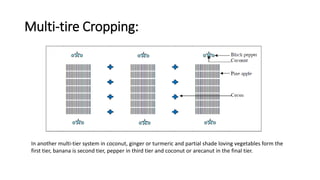
Multi-tire Cropping:
In another multi-tier system in coconut, ginger or turmeric and partial shade loving vegetables form the
first tier, banana is second tier, pepper in third tier and coconut or arecanut in the final tier.
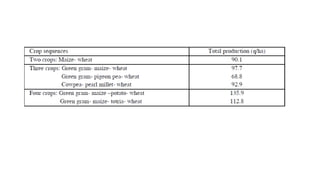
Sequence Cropping:
• Sequence cropping is defined as growing of two or more crops in
sequence on the same piece of land in a farming year.
• Crop intensification is only in time dimension and there is no
intercrop competition.
• Depending on the number of crops grown in a year, it is called as
double, triple and quadruple cropping involving two, three, and four
crops, respectively.
Double cropping:
• 1.Rice – potato/ mustard
• 2.Sorghum- gram;
Triple Cropping:
1. Rice- potato-groundnut
2. Cowpea- mustard- jute;
Quadruplecropping:
• Kharif groundnut- leafy vegetables- wheat- summer green gram.
• In India, food crop is predominantly grown in most suitable season and thus particular
food crop is basic to the cropping system followed by the farmers.
• Accordingly the cropping systems are usually referred to as:
1. Rice based cropping system;
2. Sorghum based cropping system;
3. Pearl millet based cropping system and
4. Wheat and gram based cropping system.
Some of the cropping systems based on commercial crops are:
i) cotton- based, ii) Groundnut based, iii) Sugarcane based, iv) Plantation crop based and v)
vegetable- based cropping systems.
THANK YOU

Production potential under monoculture and multiple cropping

  • 1.
    PRODUCTION POTENTIAL UNDER MONOCULTUREAND MULTIPLE CROPPING P. DHAMODHARAN 2019502205 DEPARTMENT OF AGRONOMY
  • 2.
    Mono-cropping or SingleCropping: • Mono-cropping refers to growing only one crop on a particular land year after year. • Practice of growing only one crop in a piece of land year after year e.g. growing only rabi crops in dry lands or only zaid crops in diary lands • This is due to climatologically and socio economic conditions or due to specialization of a farmer in growing a particular crop.
  • 3.
    Monoculture: • Practice ofrepetitive growing only crop irrespective of its intensity as rice-rice-rice in Kerala, West Bengal and Orissa. Sole Cropping: • One crop variety grown alone in pure stand at normal density.
  • 4.
    Monoculture • Monoculture cropproduction is the system in which a single crop is grown on the same piece of land year after year. • This system is mostly practiced in large- scale crop productions and includes growing both annual crops and trees (permanent crops). • Monoculture is often related to the farming of important industrial crops such as: • Field crops – wheat, corn, rice, rapeseed, sugar cane, cotton • Animal feed – soybean, corn, alfalfa • Agrofuel – rapeseed, soybean, palm oil, jatropha, sugar cane • Tree plantation – pine, eucalyptus, coffee, citrus, fruiting trees.
  • 5.
    Beneficial Is aMonoculture System • Higher crop yields – by continuously growing only one crop, a farmer can develop the best farm practice to achieve high yields • Yield optimization – growing crops adopted on certain environmental conditions, such as drought, saline soils, or high temperatures, helps maintain a sustainable yield • Lower cost input – monoculture relies on machinery use instead of human labor, which is more expensive • Growing only one crop allows farmers to save money by only having to employ one set of farm machinery. In being able to afford all needed machinery, he will become more likely to have a successful crop production.
  • 6.
    Monoculture Threatens PlantBiodiversity • Rural depopulation - in rural areas where large monoculture crop productions take available water resources and land • Increased input of artificial fertilizers to boost the crop yield • Increased input of chemical pesticides due to increased insect pest and disease occurrence • Threaten plant and animal biodiversity • Soil degradation – after years of monoculture farming, the soil becomes exhausted and contains less nutrients • Crop production stability - plants that have adapted to growing under specific environment conditions are more vulnerable to changes, putting the yield at risk •
  • 7.
    Multiple Cropping orPolycropping: • It is a cropping system where two or three crops are gown annually on the same piece of land using high input without affecting basic fertility of the soil. • It is the intensification of cropping in time and space dimensions i.e. more number of crops within a year and more number of crops on the same piece of land at any given period. • It includes inter-cropping, mixed cropping and sequence cropping.
  • 8.
    • Multiple CroppingIndex (MCI) is determined by the number of crops and total area planted divided by the total arable area. • When the value is three or more, it is said to be most promising farm. • This is also called as intensive cropping. • Molested (1954) has mentioned that multiple cropping is a philosophy of maximum crop production per acre of land with minimum of soil deterioration.
  • 9.
    • Polyculture: Cultivationof more than two types of crops grown together on a piece of land in a crop season. e.g. • 1) Subabul + Papaya + Pigeon pea + Dinanath grass. • 2) Mango + Pine apple + Turmeric • 3) Banana + Marigold + berseem.
  • 10.
    Relay Cropping: • Growingthe succeeding crop when previous crop is at its maturity stage- or-sowing of the next crop immediately after the harvest of the standing crops. • Or it is a system of cropping where one crop stands over land to the crop in quick succession. e.g. • 1) Paddy - lathyrus • 2) Paddy - Lucerne. • 3) Cotton - Berseem. • 4) Rice – Cauliflower – Onion - summer gourds.
  • 11.
    Overlapping Cropping: • Inthis system, the succeeding crop is sown in the standing crop before harvesting. • Thus, in this system, one crop is sown before the harvesting of preceding crops. • Here the lucerne and berseem are broadcasted in standing paddy crop just before they are ready for harvesting.
  • 12.
    Inter Cropping: • Growingof two or more crops simultaneously on the same piece of land with a definite row pattern e.g. growing setaria + red gram in 5:1 ratio i.e. after every 5 rows of setaria one row of red gram is sown. • Multiple cropping in the form of intercropping is predominant in the regions of dry, humid and semi-arid tropics. • Thus, cropping intensity in space dimension is achieved.
  • 13.
    Objectives of IntercroppingSystems • Insurance against main crop failure under aberrant weather conditions or pest epidemics. • Increase in total productivity per unit land area. • Judicious utilization of resources such as land, labour and inputs. • Intercropping systems utilizes resources sufficiently and their productivity is increased.
  • 14.
    Additive Series: • Whichis mostly adopted in India, one crop is sown with 100% of its recommended population in pure stand, which is known as the base crops. • Another crop known as intercrop is introduced into the base crop by adjusting or changing geometry. • The population of intercrop is less than its recommended population in pure stand. • LER of additive series is greater than replacement series. • Additive series is more efficient than replacement series in intercropping system.
  • 15.
    In replacement seriesboth the crops are called component crops. • By scarifying certain proportion of population of none component, another component is introduced. • This type of intercropping is practiced in western countries.
  • 16.
    Component Crop: • Itis used to refer to either individual crops making up the intercropping situation. • Intercrop yield is the yield of a component crop when grown in intercropping and expressed over the total intercropped area. (i.e. area occupied by both the crops). • A simple addition of both the intercrop yields a combined intercrop yield.
  • 17.
    Base Crop: • Itis the one which is planted as its optimum sole crop population in an intercropping situation and second crop is planted in between rows of base crop for obtaining bonus yield from intercrop without affecting base crop yield.
  • 18.
    Inter Cropping inCereals: • Inter-cropping with cereal is an excellent way of improving the resource utilization because the cereals utilize the rainy season resources while late maturing crops exploits the post-rainy season resources such as residual moisture. • Sorghum is most commonly inter-cropped with pigeon pea on a variety of soils. • Sorghum is harvested after 3 ½ to 4 ½ months and pigeon pea matures in about 6-9 months depending on the genotype.
  • 19.
    • In monocroppingof groundnut climate resources like rainfall, temperature and solar radiation are utilized only during rainy season, however when red gram is introduced as an inter-crop, these resources are used up to the start of winter season and also benefit of late shower rains. • Soybean is also good compatible companion crop with maize. Pearl millet is a quick tillering and fast growing crop that attains full canopy development within 20-30 days of seedling establishment. It can be inter-cropped with groundnut, black-gram or castor.
  • 20.
    Inter Cropping inPulses: • For pigeon pea, short duration grain legumes such as black-gram and soybean are the best companion crops in Peninsular India. Groundnut is also a suitable inter-crop. • Inter-cropping in cotton: It is initially a slow growing crop. Any short duration and fast growing crops such as groundnut, black-gram, green-gram or cluster bean are the compatible companion crops.
  • 21.
    Inter Cropping inSugarcane: • Sugarcane is slow growing up to 80-90 days. Since the crop is planted in rows 0.8-1.0 m apart, considerable space is available for inter- cropping. • Short duration crops maturing in 80-90 days can be advocated as inter-crops. • Black-gram and soybean are found suitable. The green manure, Dhaincha can be sown in the inter-space and incorporated at about 2 months.
  • 22.
    Important requirements: 1. Thetime of peak nutrient demands of component crops should not overleap in maize + green gram intercropping system, the peak nutrient demand period for green gram is around 35 DAS while it is 50 days for maize. 2. Competition for light should be minimum among the component crops. 3. Complementary should exist between the component crops. 4. The differences in maturity of component crops should be at least 30 days.
  • 23.
    Advantage of Intercropping: •Intercropping gives additional yield and income/unit area than sole cropping. • It acts as an insurance against failure of crops in abnormal year. • Inter-crops maintain the soil fertility as the nutrient uptake is made from both layers of soil. • Reduction in soil runoff and controls weeds. • Intercrops provide shade and support to the other crop. • Inter cropping system utilizes resources efficiently and their productivity is increased (Reddy and Reddi, 1992). • Intercropping with cash crops is highly profitable. • It helps to avoid inter-crop competition and thus a higher number of crop plants are grown per unit area
  • 24.
    Disadvantages of intercropping: •Yield decreases as the crops differ in their competitive abilities. • Management of intercrops having different cultural practices seems to be difficult task. • Improved implements cannot be used efficiently. • Higher amount of fertilizer or irrigation water cannot be utilized properly as the component crops vary in their response of these resources. • Harvesting is difficult.
  • 25.
    Types of Inter-Cropping: a.Mixed intercropping: Growing two or more crops simultaneously with no distinct row arrangement. b. Row intercropping: Growing two or more crops simultaneously where one or more crops are planted in rows. c. Strip Inter-cropping: Growing two or more crops simultaneously in different strips wide enough to permit independent cultivation but narrow enough for the crops to interact ergonomically. d. Relay inter-cropping: Growing two or more crops simultaneously during part of the life cycle of each. A second crop is planted after the first crop has reached its reproductive stage but before it is ready for harvest.
  • 26.
    Multi-tire Cropping: • Inter-croppingis mostly prevalent in plantation crops like coconut and areca nut. • The practice different crops of varying heights, rooting pattern and duration are called multi-tire cropping. • The objective of this system of cropping is to utilize the vertical space more effectively. • In this system,the tallest components have foliage tolerant of strong light and high evaporative demand and the shorter component(s) with foliage requiring shade and or relatively high humidity. e.g. Coconut + black pepper + cocoa + pineapple.
  • 27.
    Multi-tire Cropping: In anothermulti-tier system in coconut, ginger or turmeric and partial shade loving vegetables form the first tier, banana is second tier, pepper in third tier and coconut or arecanut in the final tier.
  • 28.
    Sequence Cropping: • Sequencecropping is defined as growing of two or more crops in sequence on the same piece of land in a farming year. • Crop intensification is only in time dimension and there is no intercrop competition. • Depending on the number of crops grown in a year, it is called as double, triple and quadruple cropping involving two, three, and four crops, respectively.
  • 29.
    Double cropping: • 1.Rice– potato/ mustard • 2.Sorghum- gram; Triple Cropping: 1. Rice- potato-groundnut 2. Cowpea- mustard- jute; Quadruplecropping: • Kharif groundnut- leafy vegetables- wheat- summer green gram.
  • 30.
    • In India,food crop is predominantly grown in most suitable season and thus particular food crop is basic to the cropping system followed by the farmers. • Accordingly the cropping systems are usually referred to as: 1. Rice based cropping system; 2. Sorghum based cropping system; 3. Pearl millet based cropping system and 4. Wheat and gram based cropping system. Some of the cropping systems based on commercial crops are: i) cotton- based, ii) Groundnut based, iii) Sugarcane based, iv) Plantation crop based and v) vegetable- based cropping systems.
  • 32.