Ann Koenig, Urban Forester
Missouri Department of Conservation
     Ann.Koenig@mdc.mo.gov
         573-882-8388 x 227
 Distinguish between plant problems
  caused by living and nonliving disorders.
 Understand the principles of a
  systematic approach to the plant
  diagnostic process.
 Learn to recognize the signs and
  symptoms of tree disorders.
 Become familiar with various types of
  insect and disease problems and their
  impact on trees.
The Key Terms as listed in
  the Arborist’s
  Certification Study
  Guide will be defined
  and highlighted
  throughout the
  presentation.
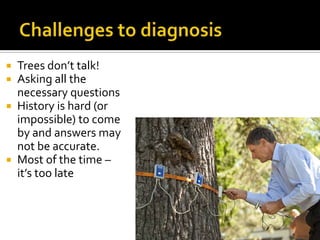
 Trees don’t talk!
 Asking all the
  necessary questions
 History is hard (or
  impossible) to come
  by and answers may
  not be accurate.
 Most of the time –
  it’s too late
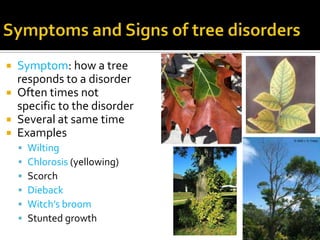
 Symptom: how a tree
  responds to a disorder
 Often times not
  specific to the disorder
 Several at same time
 Examples
       Wilting
       Chlorosis (yellowing)
       Scorch
       Dieback
       Witch’s broom
       Stunted growth
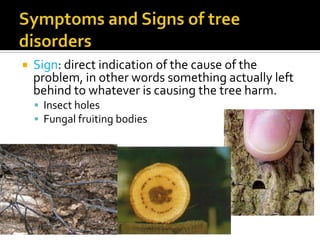
   Sign: direct indication of the cause of the
    problem, in other words something actually left
    behind to whatever is causing the tree harm.
     Insect holes
     Fungal fruiting bodies
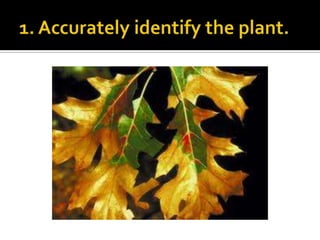
1.       Accurately identify the plant.
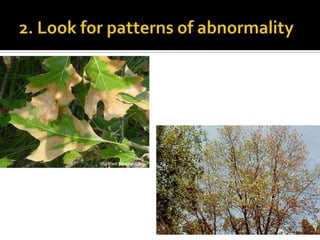
2.       Look for a pattern of abnormality.
         Multiple kinds of trees-abiotic
3.       Carefully examine the site.
         Drainage, construction, herbicide use,
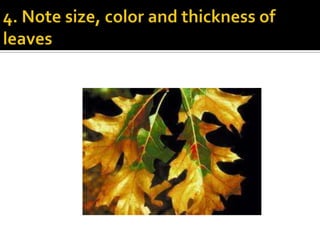
4.       Note the color, size and thickness of the
         foliage.
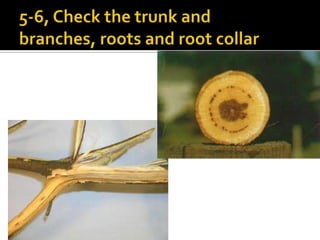
5.       Check the trunk and branches.
6.       Examine the roots and root color.
   Time of year can help:
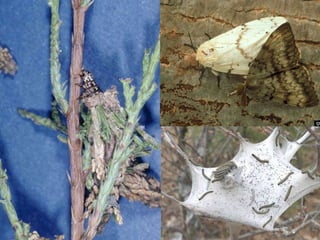
     Fall webworm
     Wilting oaks in summer
   Certain species are vulnerable to specific problems
     Oaks: oak wilt
     Maples: girdling roots
     Redbuds: herbicide sensitivity
   80 % of tree problems come from adverse conditions
    such as:
     Soil compaction
     Mechanical injury
     Poor species selection
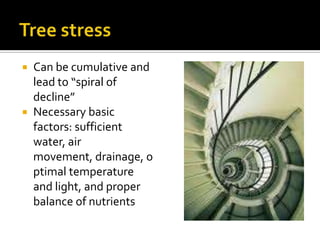
 Can be cumulative and
  lead to “spiral of
  decline”
 Necessary basic
  factors: sufficient
  water, air
  movement, drainage, o
  ptimal temperature
  and light, and proper
  balance of nutrients
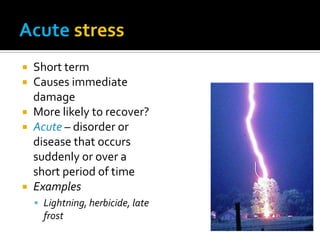
 Short term
 Causes immediate
  damage
 More likely to recover?
 Acute – disorder or
  disease that occurs
  suddenly or over a
  short period of time
 Examples
     Lightning, herbicide, late
      frost
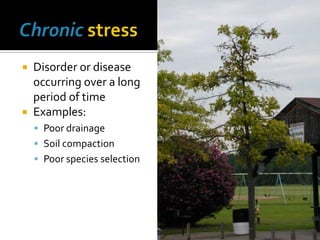
 Disorder or disease
  occurring over a long
  period of time
 Examples:
     Poor drainage
     Soil compaction
     Poor species selection
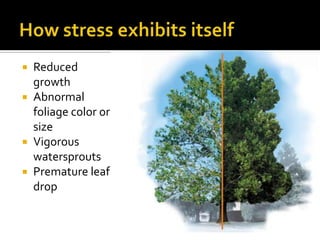
 Reduced
  growth
 Abnormal
  foliage color or
  size
 Vigorous
  watersprouts
 Premature leaf
  drop
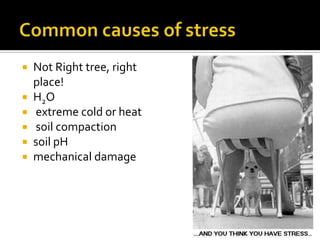
   Not Right tree, right
    place!
   H 2O
   extreme cold or heat
   soil compaction
   soil pH
   mechanical damage
 Biotic – pertaining to a living organism; pathogens
  (microscopic disease organisms) e.g.
  fungi, bacteria, viruses and nematodes [microscopic
  roundworm] as well as insect pests, mites, and other
  animals; a.k.a. infectious as they can spread from
  one plant to the next.
 Abiotic – non living; a.k.a. non-infectious and
  include environmental problems such temperature
  and moisture extremes, mechanical and chemical
  injuries, mineral deficiencies and many others
   Often the primary stress factor(s) that cause
    the spiral of decline
   Can be difficult to recognize – often mimic
    biotic disorders and are part of a complex
   Tree and site history often give the best clues
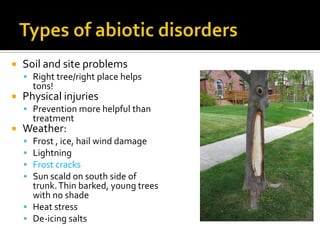
   Soil and site problems
     Right tree/right place helps
        tons!
   Physical injuries
     Prevention more helpful than
        treatment
   Weather:
     Frost , ice, hail wind damage
     Lightning
     Frost cracks
     Sun scald on south side of
      trunk. Thin barked, young trees
      with no shade
     Heat stress
     De-icing salts
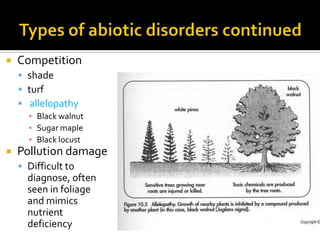
   Competition
     shade
     turf
     allelopathy
      ▪ Black walnut
      ▪ Sugar maple
      ▪ Black locust
   Pollution damage
     Difficult to
      diagnose, often
      seen in foliage
      and mimics
      nutrient
      deficiency
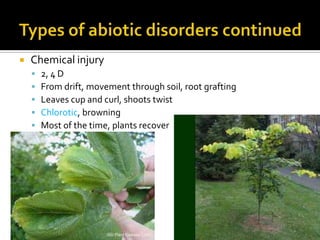
   Chemical injury
       2, 4 D
       From drift, movement through soil, root grafting
       Leaves cup and curl, shoots twist
       Chlorotic, browning
       Most of the time, plants recover
   Water availability
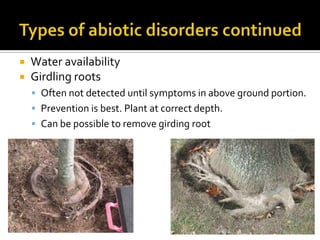
   Girdling roots
     Often not detected until symptoms in above ground portion.
     Prevention is best. Plant at correct depth.
     Can be possible to remove girding root
   Insects and Other Pests
   Disease
     Fungus
     bacteria
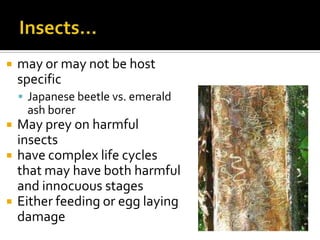
   may or may not be host
    specific
     Japanese beetle vs. emerald
     ash borer
   May prey on harmful
    insects
   have complex life cycles
    that may have both harmful
    and innocuous stages
   Either feeding or egg laying
    damage
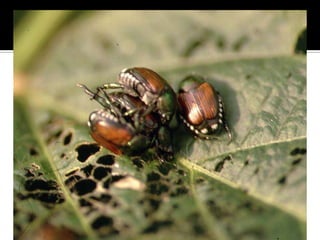
 May feed on entire leaf
 May feed on leaf margins
 May skeletonize [leaves that have had the tissue
  removed from between the veins by inects] Japanese
  beetle
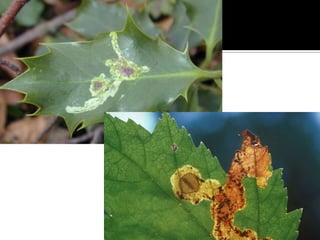
 Leaf mining inside leaf
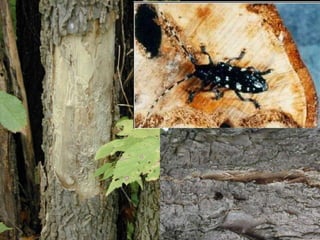
 May bore through wood
     EAB in inner bark
     Asian Longhorn Beetle in wood itself
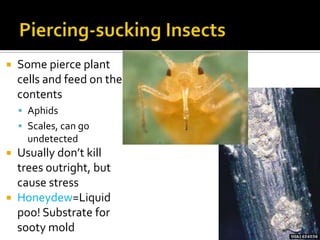
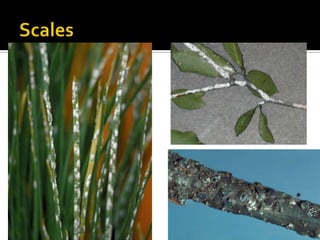
   Some pierce plant
    cells and feed on the
    contents
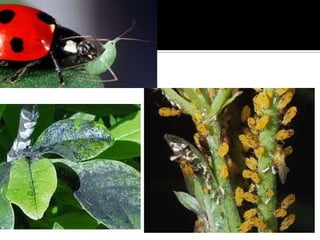
     Aphids
     Scales, can go
      undetected
 Usually don’t kill
  trees outright, but
  cause stress
 Honeydew=Liquid
  poo! Substrate for
  sooty mold
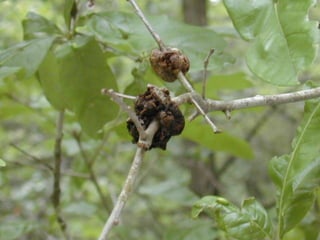
   Galls are a plant
    response – not a
    cocoon
Can also be vectors, organism that transmits a
 pathogen [causal agent of a disease]
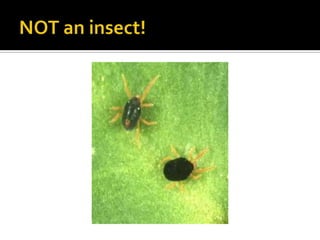
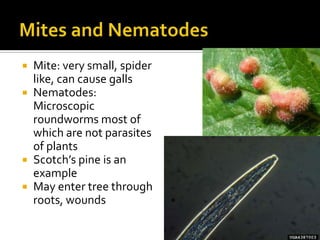
 Mite: very small, spider
  like, can cause galls
 Nematodes:
  Microscopic
  roundworms most of
  which are not parasites
  of plants
 Scotch’s pine is an
  example
 May enter tree through
  roots, wounds
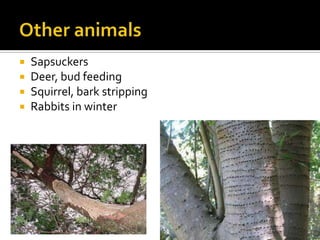
   Sapsuckers
   Deer, bud feeding
   Squirrel, bark stripping
   Rabbits in winter
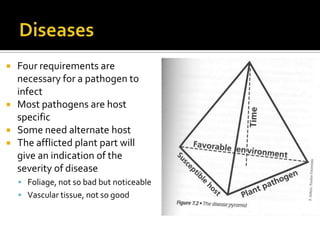
   Four requirements are
    necessary for a pathogen to
    infect
   Most pathogens are host
    specific
   Some need alternate host
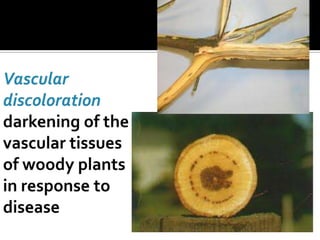
   The afflicted plant part will
    give an indication of the
    severity of disease
     Foliage, not so bad but noticeable
     Vascular tissue, not so good
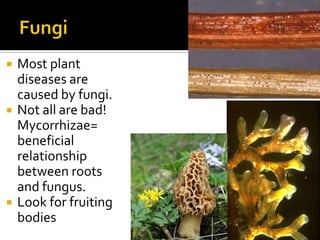
   Most plant
    diseases are
    caused by fungi.
   Not all are bad!
    Mycorrhizae=
    beneficial
    relationship
    between roots
    and fungus.
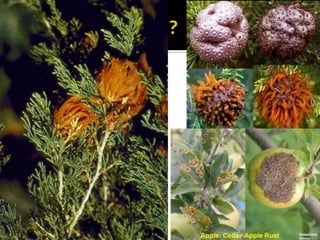
   Look for fruiting
    bodies
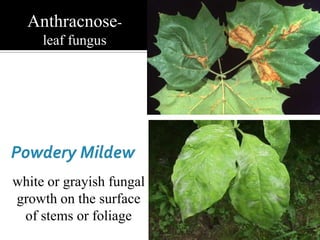
Anthracnose-
     leaf fungus


white or grayish fungal
growth on the surface
 of stems or foliage
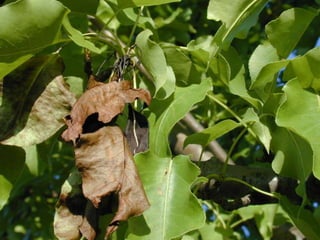
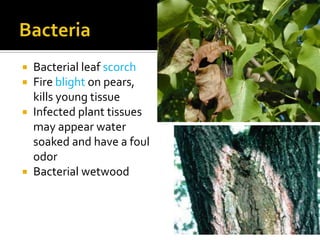
 Bacterial leaf scorch
 Fire blight on pears,
  kills young tissue
 Infected plant tissues
  may appear water
  soaked and have a foul
  odor
 Bacterial wetwood
   Extension
   MDC
   Missouri Community Forestry Council
   Sample:
       fresh,
       cool,
       interface between diseased and healthy tissue,
        early in week,
        good written description of problem and site

Diagnosis and plant disorders

  • 1.
    Ann Koenig, UrbanForester Missouri Department of Conservation Ann.Koenig@mdc.mo.gov 573-882-8388 x 227
  • 2.
     Distinguish betweenplant problems caused by living and nonliving disorders.  Understand the principles of a systematic approach to the plant diagnostic process.  Learn to recognize the signs and symptoms of tree disorders.  Become familiar with various types of insect and disease problems and their impact on trees.
  • 3.
    The Key Termsas listed in the Arborist’s Certification Study Guide will be defined and highlighted throughout the presentation.
  • 4.
     Trees don’ttalk!  Asking all the necessary questions  History is hard (or impossible) to come by and answers may not be accurate.  Most of the time – it’s too late
  • 5.
     Symptom: howa tree responds to a disorder  Often times not specific to the disorder  Several at same time  Examples  Wilting  Chlorosis (yellowing)  Scorch  Dieback  Witch’s broom  Stunted growth
  • 6.
    Sign: direct indication of the cause of the problem, in other words something actually left behind to whatever is causing the tree harm.  Insect holes  Fungal fruiting bodies
  • 7.
    1. Accurately identify the plant. 2. Look for a pattern of abnormality.  Multiple kinds of trees-abiotic 3. Carefully examine the site.  Drainage, construction, herbicide use, 4. Note the color, size and thickness of the foliage. 5. Check the trunk and branches. 6. Examine the roots and root color.
  • 13.
    Time of year can help:  Fall webworm  Wilting oaks in summer  Certain species are vulnerable to specific problems  Oaks: oak wilt  Maples: girdling roots  Redbuds: herbicide sensitivity  80 % of tree problems come from adverse conditions such as:  Soil compaction  Mechanical injury  Poor species selection
  • 14.
     Can becumulative and lead to “spiral of decline”  Necessary basic factors: sufficient water, air movement, drainage, o ptimal temperature and light, and proper balance of nutrients
  • 15.
     Short term Causes immediate damage  More likely to recover?  Acute – disorder or disease that occurs suddenly or over a short period of time  Examples  Lightning, herbicide, late frost
  • 16.
     Disorder ordisease occurring over a long period of time  Examples:  Poor drainage  Soil compaction  Poor species selection
  • 17.
     Reduced growth  Abnormal foliage color or size  Vigorous watersprouts  Premature leaf drop
  • 18.
    Not Right tree, right place!  H 2O  extreme cold or heat  soil compaction  soil pH  mechanical damage
  • 19.
     Biotic –pertaining to a living organism; pathogens (microscopic disease organisms) e.g. fungi, bacteria, viruses and nematodes [microscopic roundworm] as well as insect pests, mites, and other animals; a.k.a. infectious as they can spread from one plant to the next.  Abiotic – non living; a.k.a. non-infectious and include environmental problems such temperature and moisture extremes, mechanical and chemical injuries, mineral deficiencies and many others
  • 20.
    Often the primary stress factor(s) that cause the spiral of decline  Can be difficult to recognize – often mimic biotic disorders and are part of a complex  Tree and site history often give the best clues
  • 21.
    Soil and site problems  Right tree/right place helps tons!  Physical injuries  Prevention more helpful than treatment  Weather:  Frost , ice, hail wind damage  Lightning  Frost cracks  Sun scald on south side of trunk. Thin barked, young trees with no shade  Heat stress  De-icing salts
  • 22.
    Competition  shade  turf  allelopathy ▪ Black walnut ▪ Sugar maple ▪ Black locust  Pollution damage  Difficult to diagnose, often seen in foliage and mimics nutrient deficiency
  • 23.
    Chemical injury  2, 4 D  From drift, movement through soil, root grafting  Leaves cup and curl, shoots twist  Chlorotic, browning  Most of the time, plants recover
  • 24.
    Water availability  Girdling roots  Often not detected until symptoms in above ground portion.  Prevention is best. Plant at correct depth.  Can be possible to remove girding root
  • 25.
    Insects and Other Pests  Disease  Fungus  bacteria
  • 28.
    may or may not be host specific  Japanese beetle vs. emerald ash borer  May prey on harmful insects  have complex life cycles that may have both harmful and innocuous stages  Either feeding or egg laying damage
  • 29.
     May feedon entire leaf  May feed on leaf margins  May skeletonize [leaves that have had the tissue removed from between the veins by inects] Japanese beetle  Leaf mining inside leaf  May bore through wood  EAB in inner bark  Asian Longhorn Beetle in wood itself
  • 34.
    Some pierce plant cells and feed on the contents  Aphids  Scales, can go undetected  Usually don’t kill trees outright, but cause stress  Honeydew=Liquid poo! Substrate for sooty mold
  • 37.
    Galls are a plant response – not a cocoon
  • 38.
    Can also bevectors, organism that transmits a pathogen [causal agent of a disease]
  • 39.
     Mite: verysmall, spider like, can cause galls  Nematodes: Microscopic roundworms most of which are not parasites of plants  Scotch’s pine is an example  May enter tree through roots, wounds
  • 40.
    Sapsuckers  Deer, bud feeding  Squirrel, bark stripping  Rabbits in winter
  • 41.
    Four requirements are necessary for a pathogen to infect  Most pathogens are host specific  Some need alternate host  The afflicted plant part will give an indication of the severity of disease  Foliage, not so bad but noticeable  Vascular tissue, not so good
  • 44.
    Most plant diseases are caused by fungi.  Not all are bad! Mycorrhizae= beneficial relationship between roots and fungus.  Look for fruiting bodies
  • 46.
    Anthracnose- leaf fungus white or grayish fungal growth on the surface of stems or foliage
  • 47.
     Bacterial leafscorch  Fire blight on pears, kills young tissue  Infected plant tissues may appear water soaked and have a foul odor  Bacterial wetwood
  • 48.
    Extension  MDC  Missouri Community Forestry Council  Sample:  fresh,  cool,  interface between diseased and healthy tissue,  early in week,  good written description of problem and site