SOIL EROSION
&
CONSERVATION
Binanda Saikia
Department of Geological
Sciences
Gauhati Univeristy,
Guwahati, Assam
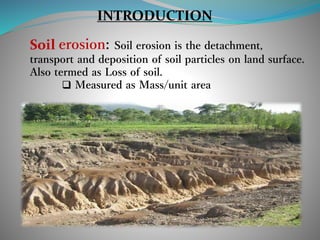
Soil erosion: Soil erosion is the detachment,
transport and deposition of soil particles on land surface.
Also termed as Loss of soil.
 Measured as Mass/unit area
INTRODUCTION
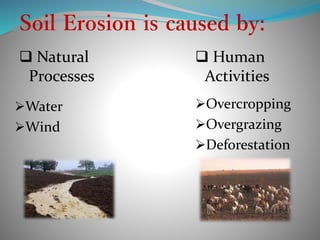
Soil Erosion is caused by:
 Natural
Processes
Water
Wind
 Human
Activities
Overcropping
Overgrazing
Deforestation
(1) Sheet erosion- Sheet erosion is the
removal of the thin layer of topsoil by
raindrop splash or water run-off.
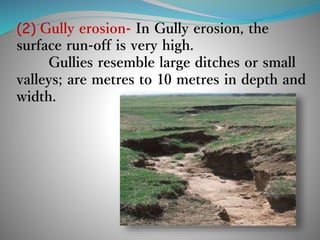
(2) Gully erosion- In Gully erosion, the
surface run-off is very high.
Gullies resemble large ditches or small
valleys; are metres to 10 metres in depth and
width.
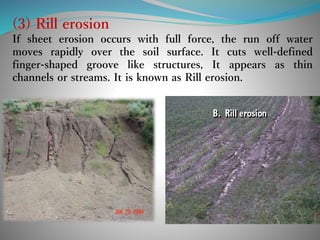
(3) Rill erosion
If sheet erosion occurs with full force, the run off water
moves rapidly over the soil surface. It cuts well-defined
finger-shaped groove like structures, It appears as thin
channels or streams. It is known as Rill erosion.
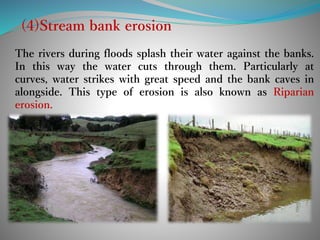
(4)Stream bank erosion
The rivers during floods splash their water against the banks.
In this way the water cuts through them. Particularly at
curves, water strikes with great speed and the bank caves in
alongside. This type of erosion is also known as Riparian
erosion.
 Other Types-
 Wind Erosion-Soil erosion by wind is common in dry
(arid) regions. Two characteristics of such region are:
(a) The soil is mainly sandy
(b) The vegetation is very poor or even absent
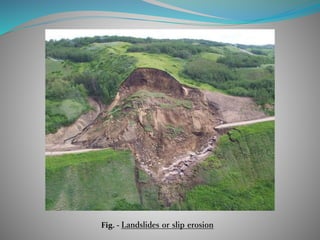
 Landslides or slip erosion-The hydraulic pressure which
is caused by heavy rains increases the weight of the rocks at
cliffs. As a result they come under the gravitational force and
finally slip or fall off.
Fig. - Landslides or slip erosion
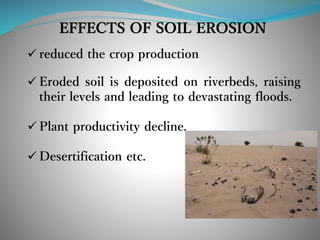
 reduced the crop production
 Eroded soil is deposited on riverbeds, raising
their levels and leading to devastating floods.
 Plant productivity decline.
 Desertification etc.
Various methods of soil conservation may be
broadly categorized into two types:
(1) Agronomic Practices
(2) Engineering practices
METHODS OF CONSERVATION
This method involves protection of the top soil by special
methods and schemes of crop cultivation. These are-
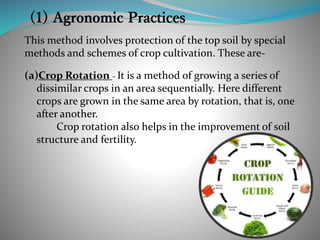
(a)Crop Rotation - It is a method of growing a series of
dissimilar crops in an area sequentially. Here different
crops are grown in the same area by rotation, that is, one
after another.
Crop rotation also helps in the improvement of soil
structure and fertility.
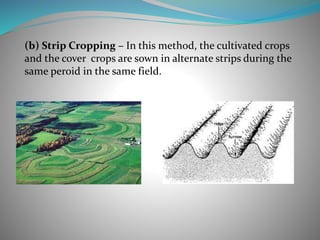
(b) Strip Cropping – In this method, the cultivated crops
and the cover crops are sown in alternate strips during the
same peroid in the same field.
(2) Engineering Practices
(a) Excavation of ditches – These are artificially created channels
to divert the excess water . Two types of ditches are commonly
made-
(i) Diversion ditches : diverting the run-off away from the field
(ii) Interception ditches : made at regular and suitable
intervals across the cultivated field. These ditches do not allow
formation of thick sheets of water .
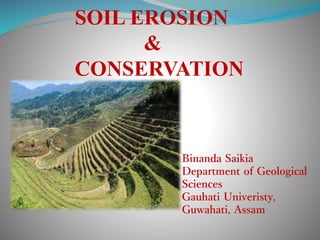
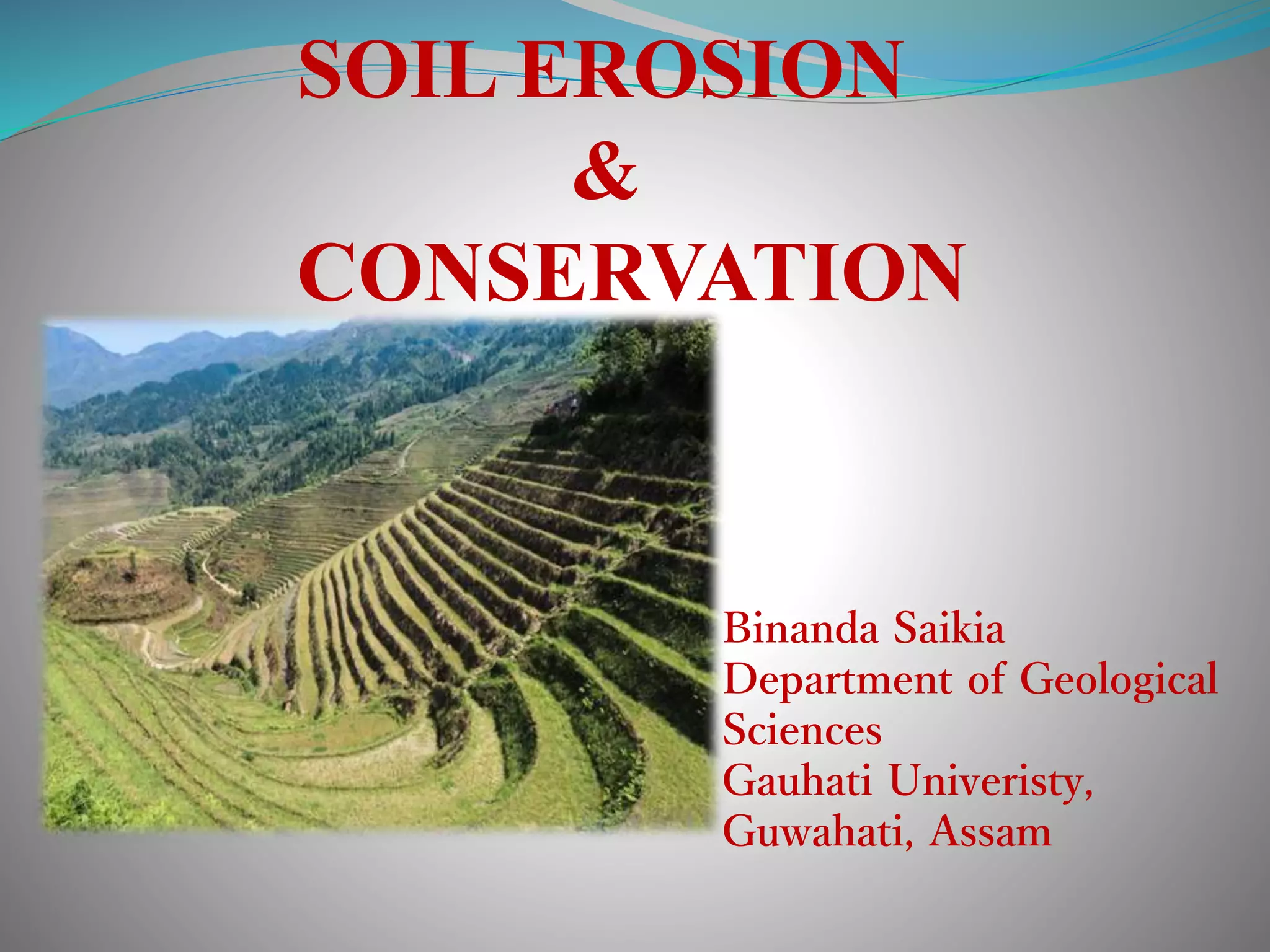
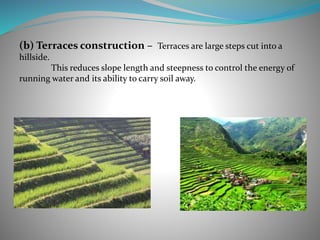
(b) Terraces construction – Terraces are large steps cut into a
hillside.
This reduces slope length and steepness to control the energy of
running water and its ability to carry soil away.
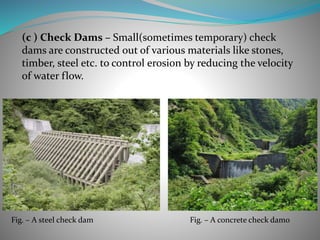
(c ) Check Dams – Small(sometimes temporary) check
dams are constructed out of various materials like stones,
timber, steel etc. to control erosion by reducing the velocity
of water flow.
Fig. – A steel check dam Fig. – A concrete check dam0
(d) Windbreaks / Shelter Belts - Barriers formed by trees and
plants with many leaves to control the wind velocity.
BIBLIOGRAPHY
(1)Engineering and general Geology- Parbin Singh
(2) www.wikipedia.com ( 28/10/2015, 6:50 pm )
(3) www.slideshare.com
(4) Soil erosion & Conservation- Dr. T. I. Eldho,
Professor, IIT, Bombay
(5) Google .
soil erosion and conservation

soil erosion and conservation

  • 1.
    SOIL EROSION & CONSERVATION Binanda Saikia Departmentof Geological Sciences Gauhati Univeristy, Guwahati, Assam
  • 2.
    Soil erosion: Soilerosion is the detachment, transport and deposition of soil particles on land surface. Also termed as Loss of soil.  Measured as Mass/unit area INTRODUCTION
  • 3.
    Soil Erosion iscaused by:  Natural Processes Water Wind  Human Activities Overcropping Overgrazing Deforestation
  • 4.
    (1) Sheet erosion-Sheet erosion is the removal of the thin layer of topsoil by raindrop splash or water run-off.
  • 5.
    (2) Gully erosion-In Gully erosion, the surface run-off is very high. Gullies resemble large ditches or small valleys; are metres to 10 metres in depth and width.
  • 6.
    (3) Rill erosion Ifsheet erosion occurs with full force, the run off water moves rapidly over the soil surface. It cuts well-defined finger-shaped groove like structures, It appears as thin channels or streams. It is known as Rill erosion.
  • 7.
    (4)Stream bank erosion Therivers during floods splash their water against the banks. In this way the water cuts through them. Particularly at curves, water strikes with great speed and the bank caves in alongside. This type of erosion is also known as Riparian erosion.
  • 8.
     Other Types- Wind Erosion-Soil erosion by wind is common in dry (arid) regions. Two characteristics of such region are: (a) The soil is mainly sandy (b) The vegetation is very poor or even absent  Landslides or slip erosion-The hydraulic pressure which is caused by heavy rains increases the weight of the rocks at cliffs. As a result they come under the gravitational force and finally slip or fall off.
  • 9.
    Fig. - Landslidesor slip erosion
  • 10.
     reduced thecrop production  Eroded soil is deposited on riverbeds, raising their levels and leading to devastating floods.  Plant productivity decline.  Desertification etc.
  • 11.
    Various methods ofsoil conservation may be broadly categorized into two types: (1) Agronomic Practices (2) Engineering practices METHODS OF CONSERVATION
  • 12.
    This method involvesprotection of the top soil by special methods and schemes of crop cultivation. These are- (a)Crop Rotation - It is a method of growing a series of dissimilar crops in an area sequentially. Here different crops are grown in the same area by rotation, that is, one after another. Crop rotation also helps in the improvement of soil structure and fertility.
  • 13.
    (b) Strip Cropping– In this method, the cultivated crops and the cover crops are sown in alternate strips during the same peroid in the same field.
  • 14.
    (2) Engineering Practices (a)Excavation of ditches – These are artificially created channels to divert the excess water . Two types of ditches are commonly made- (i) Diversion ditches : diverting the run-off away from the field (ii) Interception ditches : made at regular and suitable intervals across the cultivated field. These ditches do not allow formation of thick sheets of water .
  • 15.
    (b) Terraces construction– Terraces are large steps cut into a hillside. This reduces slope length and steepness to control the energy of running water and its ability to carry soil away.
  • 16.
    (c ) CheckDams – Small(sometimes temporary) check dams are constructed out of various materials like stones, timber, steel etc. to control erosion by reducing the velocity of water flow. Fig. – A steel check dam Fig. – A concrete check dam0
  • 17.
    (d) Windbreaks /Shelter Belts - Barriers formed by trees and plants with many leaves to control the wind velocity.
  • 19.
    BIBLIOGRAPHY (1)Engineering and generalGeology- Parbin Singh (2) www.wikipedia.com ( 28/10/2015, 6:50 pm ) (3) www.slideshare.com (4) Soil erosion & Conservation- Dr. T. I. Eldho, Professor, IIT, Bombay (5) Google .