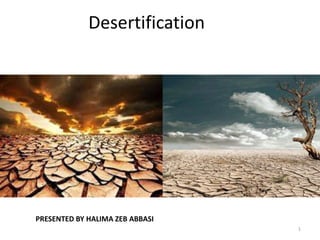
Desertification
PRESENTED BY HALIMA ZEB ABBASI
1
What is desertification
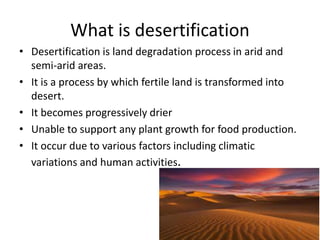
• Desertification is land degradation process in arid and
semi-arid areas.
• It is a process by which fertile land is transformed into
desert.
• It becomes progressively drier
• Unable to support any plant growth for food production.
• It occur due to various factors including climatic
variations and human activities.
2
• According to UNESCO,(United Nations
Educational, Scientific and Cultural Organization )
one third of world’s land surface is threatened by
desertification.
• Across the world it affects livelihood of millions
of people
• Desertification is a major barrier to meeting
human basic needs in dry lands
• Desertification affects topsoil, groundwater
reserves, surface runoff, human, animal and plant
populations.
3
Main Causes of desertification
• Overgrazing
• Drought
• Urbanization
• Climate change
• Over cultivation
• Deforestation
• Natural disasters.
4
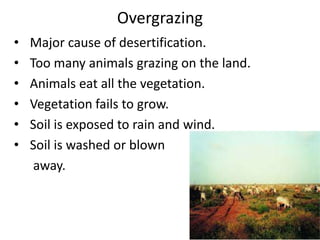
Overgrazing
• Major cause of desertification.
• Too many animals grazing on the land.
• Animals eat all the vegetation.
• Vegetation fails to grow.
• Soil is exposed to rain and wind.
• Soil is washed or blown
away.
5
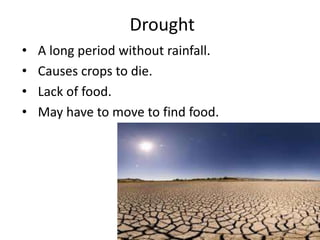
Drought
• A long period without rainfall.
• Causes crops to die.
• Lack of food.
• May have to move to find food.
6
Deforestation
• It is cutting down or clearing of trees from
a wooded area.
• If trees are removed, the area can become
much warmer and drier,
• which may result in desertification,
• which is a transform fertile land into
desert.
7
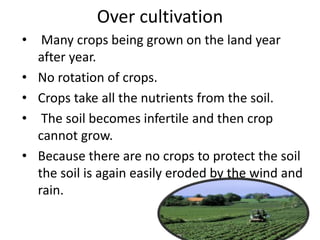
Over cultivation
• Many crops being grown on the land year
after year.
• No rotation of crops.
• Crops take all the nutrients from the soil.
• The soil becomes infertile and then crop
cannot grow.
• Because there are no crops to protect the soil
the soil is again easily eroded by the wind and
rain.
8
Urbanization
• It can also cause issues with the soil due to
chemicals and other things
• That may harm the ground.
• As areas become more urbanized,
there are less places for plants to grow,
• thus causing desertification.
9
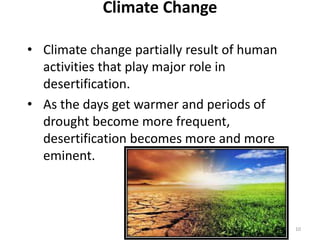
Climate Change
• Climate change partially result of human
activities that play major role in
desertification.
• As the days get warmer and periods of
drought become more frequent,
desertification becomes more and more
eminent.
10
CONSEQUENCES OF DESERTIFICATION
Desertification has:
• Environmental effects
• Economic effects
• Social effects
11
Effects of Desertification
• Loss of biodiversity.
• More chance of Floods, drought and related
losses.
• Soil erosion.
• Desertification and Drought.
• Changes in hydrological regime.
• Loss of nutrients
• Poor Water Quality
• Hunger problems
• Increase in sand storms
12
Soil becomes less usable
The soil can be blown away by wind or washed away rain. Nutrients in the soil
can be removed by wind or water. Salt can build up in the soil which makes it
harder for plant growth.
Vegetation is Lacked or Damaged
Desertification reduces the ability of land to support plant life.
Also, when overgrazing occurs, plant species may be lost.
Causes Famine
Drought and poor land management contribute to famine.
Food Loss
The soil is not suited for growing food; therefore the amount of food being
made will decline.
People near Affected Areas
Desertification can cause flooding, poor water quality, dust storms, and
pollution. All of these effects can hurt people living near an affected region.
Farming practice
Water scarcity in dry lands limits the production of wood, crops, forage and
other services that ecosystems provide to our community.
13
Solutions for Desertification
• Rising awareness of the problem
• Planting indigenous trees and shrubs
• Developing sustainable agricultural practices
• Controlled grazing
• Crop rotation (increase fertility & reduce soil
erosion)
• Proper land management
• Soil and water management
• Introduce proper technologies
• Manage dry land resources
• Tree planting schemes to reduce soil erosion.
14
15

desertification

  • 1.
  • 2.
    What is desertification •Desertification is land degradation process in arid and semi-arid areas. • It is a process by which fertile land is transformed into desert. • It becomes progressively drier • Unable to support any plant growth for food production. • It occur due to various factors including climatic variations and human activities. 2
  • 3.
    • According toUNESCO,(United Nations Educational, Scientific and Cultural Organization ) one third of world’s land surface is threatened by desertification. • Across the world it affects livelihood of millions of people • Desertification is a major barrier to meeting human basic needs in dry lands • Desertification affects topsoil, groundwater reserves, surface runoff, human, animal and plant populations. 3
  • 4.
    Main Causes ofdesertification • Overgrazing • Drought • Urbanization • Climate change • Over cultivation • Deforestation • Natural disasters. 4
  • 5.
    Overgrazing • Major causeof desertification. • Too many animals grazing on the land. • Animals eat all the vegetation. • Vegetation fails to grow. • Soil is exposed to rain and wind. • Soil is washed or blown away. 5
  • 6.
    Drought • A longperiod without rainfall. • Causes crops to die. • Lack of food. • May have to move to find food. 6
  • 7.
    Deforestation • It iscutting down or clearing of trees from a wooded area. • If trees are removed, the area can become much warmer and drier, • which may result in desertification, • which is a transform fertile land into desert. 7
  • 8.
    Over cultivation • Manycrops being grown on the land year after year. • No rotation of crops. • Crops take all the nutrients from the soil. • The soil becomes infertile and then crop cannot grow. • Because there are no crops to protect the soil the soil is again easily eroded by the wind and rain. 8
  • 9.
    Urbanization • It canalso cause issues with the soil due to chemicals and other things • That may harm the ground. • As areas become more urbanized, there are less places for plants to grow, • thus causing desertification. 9
  • 10.
    Climate Change • Climatechange partially result of human activities that play major role in desertification. • As the days get warmer and periods of drought become more frequent, desertification becomes more and more eminent. 10
  • 11.
    CONSEQUENCES OF DESERTIFICATION Desertificationhas: • Environmental effects • Economic effects • Social effects 11
  • 12.
    Effects of Desertification •Loss of biodiversity. • More chance of Floods, drought and related losses. • Soil erosion. • Desertification and Drought. • Changes in hydrological regime. • Loss of nutrients • Poor Water Quality • Hunger problems • Increase in sand storms 12
  • 13.
    Soil becomes lessusable The soil can be blown away by wind or washed away rain. Nutrients in the soil can be removed by wind or water. Salt can build up in the soil which makes it harder for plant growth. Vegetation is Lacked or Damaged Desertification reduces the ability of land to support plant life. Also, when overgrazing occurs, plant species may be lost. Causes Famine Drought and poor land management contribute to famine. Food Loss The soil is not suited for growing food; therefore the amount of food being made will decline. People near Affected Areas Desertification can cause flooding, poor water quality, dust storms, and pollution. All of these effects can hurt people living near an affected region. Farming practice Water scarcity in dry lands limits the production of wood, crops, forage and other services that ecosystems provide to our community. 13
  • 14.
    Solutions for Desertification •Rising awareness of the problem • Planting indigenous trees and shrubs • Developing sustainable agricultural practices • Controlled grazing • Crop rotation (increase fertility & reduce soil erosion) • Proper land management • Soil and water management • Introduce proper technologies • Manage dry land resources • Tree planting schemes to reduce soil erosion. 14
  • 15.