SOIL EROSION
PRESENTED BY
Taseer Raza
17-CE-93
Civil Engineering
SOIL EROSION
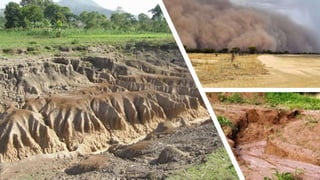
The process of eroding or being eroded by wind,
water, or other natural agents.
In earth science, erosion is the action of surface
processes that removes soil, rock, or dissolved
material from one location on the Earth's crust,
and then transports it to another location
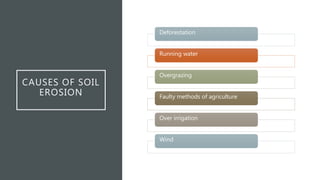
CAUSES OF SOIL
EROSION
Deforestation
Running water
Overgrazing
Faulty methods of agriculture
Over irrigation
Wind
CAUSES OF SOIL
EROSION
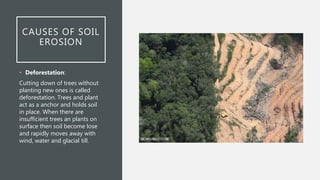
• Deforestation:
Cutting down of trees without
planting new ones is called
deforestation. Trees and plant
act as a anchor and holds soil
in place. When there are
insufficient trees an plants on
surface then soil become lose
and rapidly moves away with
wind, water and glacial till.
CAUSES OF SOIL
EROSION
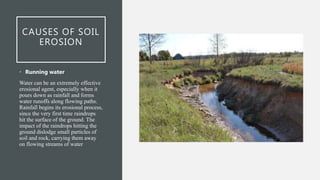
• Running water
Water can be an extremely effective
erosional agent, especially when it
pours down as rainfall and forms
water runoffs along flowing paths.
Rainfall begins its erosional process,
since the very first time raindrops
hit the surface of the ground. The
impact of the raindrops hitting the
ground dislodge small particles of
soil and rock, carrying them away
on flowing streams of water
CAUSES OF SOIL
EROSION
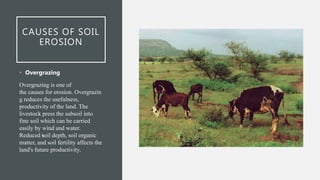
• Overgrazing
Overgrazing is one of
the causes for erosion. Overgrazin
g reduces the usefulness,
productivity of the land. The
livestock press the subsoil into
fine soil which can be carried
easily by wind and water.
Reduced soil depth, soil organic
matter, and soil fertility affects the
land's future productivity.
CAUSES OF SOIL
EROSION
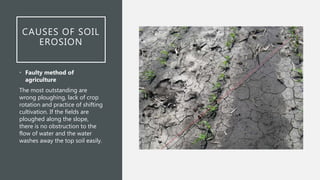
• Faulty method of
agriculture
The most outstanding are
wrong ploughing, lack of crop
rotation and practice of shifting
cultivation. If the fields are
ploughed along the slope,
there is no obstruction to the
flow of water and the water
washes away the top soil easily.
CAUSES OF SOIL
EROSION
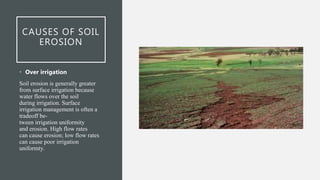
• Over irrigation
Soil erosion is generally greater
from surface irrigation because
water flows over the soil
during irrigation. Surface
irrigation management is often a
tradeoff be-
tween irrigation uniformity
and erosion. High flow rates
can cause erosion; low flow rates
can cause poor irrigation
uniformty.
CAUSES OF SOIL
EROSION
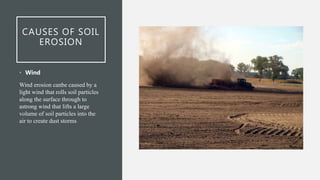
• Wind
Wind erosion canbe caused by a
light wind that rolls soil particles
along the surface through to
astrong wind that lifts a large
volume of soil particles into the
air to create dust storms
EFFECTS OF
SOIL EROSION
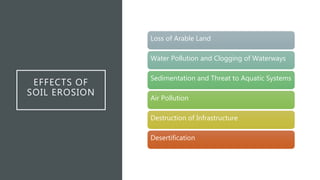
Loss of Arable Land
Water Pollution and Clogging of Waterways
Sedimentation and Threat to Aquatic Systems
Air Pollution
Destruction of Infrastructure
Desertification
EFFECTS OF
SOIL
EROSION
• Loss o Arable land
Lands used for crop production have been
substantially affected by soil erosion. Soil erosion
eats away the top soil which is the fertile layer of
the land and also the component that supports the
soil’s essential microorganisms and organic matter.
• Water Pollution and Clogging of Waterways
Soils eroded from agricultural lands carry
pesticides, heavy metals, and fertilizers which are
washed into streams and major water ways. This
leads to water pollution and damage to marine
and freshwater habitats.
EFFECTS OF
SOIL
EROSION
• Sedimentation and Threat to Aquatic
Systems
High soil sedimentation can be catastrophic to the
survival of aquatic life forms. Silt can smother the
breeding grounds of fish and equally lessens their
food supply since the siltation reduces the
biodiversity of algal life and beneficial aquatic
plants. Sediments may also enter the fish gills,
affecting their respiratory functions.
• Air Pollution
Wind erosion picks up dust particles of the soil
and throws them into the air, causing air pollution.
Some of the dust particles may contain harmful
and toxic particles such as petroleum and
pesticides that can pose a severe health hazard
when inhaled or ingested
EFFECTS OF
SOIL
EROSION
• Destruction of Infrastructure
Soil erosion can affect infrastructural projects such as dams,
drainages, and embankments. The accumulation of soil
sediments in dams/drainages and along embankments can
reduce their operational lifetime and efficiency. Also, the silt
up can support plant life that can, in turn, cause cracks and
weaken the structures. Soil erosion from surface water runoff
often causes serious damage to roads and tracks, especially
if stabilizing techniques are not used.
• Desertification
Soil erosion is a major driver of desertification. It gradually
transforms a habitable land and the ASAL regions into
deserts. The transformations are worsened by the destructive
use of the land and deforestation that leaves the soil naked
and open to erosion. This usually leads to loss of
biodiversity, alteration of ecosystems, land degradation, and
huge economic losses.
TYPES OF SOIL
EROSION
Wind Erosion
Water Erosion
TYPES OF SOIL
EROSION
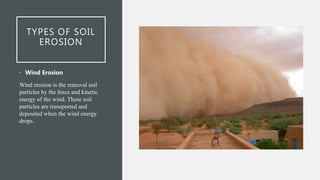
• Wind Erosion
Wind erosion is the removal soil
particles by the force and kinetic
energy of the wind. These soil
particles are transported and
deposited when the wind energy
drops.
TYPES OF
SOIL
EROSION
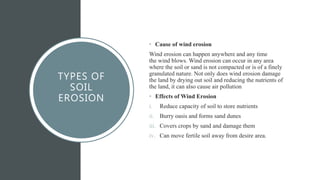
• Cause of wind erosion
Wind erosion can happen anywhere and any time
the wind blows. Wind erosion can occur in any area
where the soil or sand is not compacted or is of a finely
granulated nature. Not only does wind erosion damage
the land by drying out soil and reducing the nutrients of
the land, it can also cause air pollution
• Effects of Wind Erosion
i. Reduce capacity of soil to store nutrients
ii. Burry oasis and forms sand dunes
iii. Covers crops by sand and damage them
iv. Can move fertile soil away from desire area.
TYPES OF SOIL
EROSION
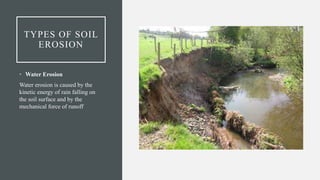
• Water Erosion
Water erosion is caused by the
kinetic energy of rain falling on
the soil surface and by the
mechanical force of runoff
TYPES OF
SOIL
EROSION
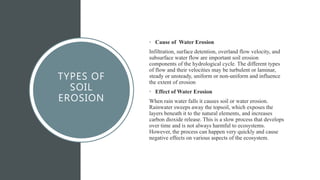
• Cause of Water Erosion
Infiltration, surface detention, overland flow velocity, and
subsurface water flow are important soil erosion
components of the hydrological cycle. The different types
of flow and their velocities may be turbulent or laminar,
steady or unsteady, uniform or non-uniform and influence
the extent of erosion
• Effect of Water Erosion
When rain water falls it causes soil or water erosion.
Rainwater sweeps away the topsoil, which exposes the
layers beneath it to the natural elements, and increases
carbon dioxide release. This is a slow process that develops
over time and is not always harmful to ecosystems.
However, the process can happen very quickly and cause
negative effects on various aspects of the ecosystem.
THANK YOU

Soil erosion

  • 1.
  • 2.
  • 3.
    SOIL EROSION The processof eroding or being eroded by wind, water, or other natural agents. In earth science, erosion is the action of surface processes that removes soil, rock, or dissolved material from one location on the Earth's crust, and then transports it to another location
  • 5.
    CAUSES OF SOIL EROSION Deforestation Runningwater Overgrazing Faulty methods of agriculture Over irrigation Wind
  • 6.
    CAUSES OF SOIL EROSION •Deforestation: Cutting down of trees without planting new ones is called deforestation. Trees and plant act as a anchor and holds soil in place. When there are insufficient trees an plants on surface then soil become lose and rapidly moves away with wind, water and glacial till.
  • 7.
    CAUSES OF SOIL EROSION •Running water Water can be an extremely effective erosional agent, especially when it pours down as rainfall and forms water runoffs along flowing paths. Rainfall begins its erosional process, since the very first time raindrops hit the surface of the ground. The impact of the raindrops hitting the ground dislodge small particles of soil and rock, carrying them away on flowing streams of water
  • 8.
    CAUSES OF SOIL EROSION •Overgrazing Overgrazing is one of the causes for erosion. Overgrazin g reduces the usefulness, productivity of the land. The livestock press the subsoil into fine soil which can be carried easily by wind and water. Reduced soil depth, soil organic matter, and soil fertility affects the land's future productivity.
  • 9.
    CAUSES OF SOIL EROSION •Faulty method of agriculture The most outstanding are wrong ploughing, lack of crop rotation and practice of shifting cultivation. If the fields are ploughed along the slope, there is no obstruction to the flow of water and the water washes away the top soil easily.
  • 10.
    CAUSES OF SOIL EROSION •Over irrigation Soil erosion is generally greater from surface irrigation because water flows over the soil during irrigation. Surface irrigation management is often a tradeoff be- tween irrigation uniformity and erosion. High flow rates can cause erosion; low flow rates can cause poor irrigation uniformty.
  • 11.
    CAUSES OF SOIL EROSION •Wind Wind erosion canbe caused by a light wind that rolls soil particles along the surface through to astrong wind that lifts a large volume of soil particles into the air to create dust storms
  • 12.
    EFFECTS OF SOIL EROSION Lossof Arable Land Water Pollution and Clogging of Waterways Sedimentation and Threat to Aquatic Systems Air Pollution Destruction of Infrastructure Desertification
  • 13.
    EFFECTS OF SOIL EROSION • Losso Arable land Lands used for crop production have been substantially affected by soil erosion. Soil erosion eats away the top soil which is the fertile layer of the land and also the component that supports the soil’s essential microorganisms and organic matter. • Water Pollution and Clogging of Waterways Soils eroded from agricultural lands carry pesticides, heavy metals, and fertilizers which are washed into streams and major water ways. This leads to water pollution and damage to marine and freshwater habitats.
  • 14.
    EFFECTS OF SOIL EROSION • Sedimentationand Threat to Aquatic Systems High soil sedimentation can be catastrophic to the survival of aquatic life forms. Silt can smother the breeding grounds of fish and equally lessens their food supply since the siltation reduces the biodiversity of algal life and beneficial aquatic plants. Sediments may also enter the fish gills, affecting their respiratory functions. • Air Pollution Wind erosion picks up dust particles of the soil and throws them into the air, causing air pollution. Some of the dust particles may contain harmful and toxic particles such as petroleum and pesticides that can pose a severe health hazard when inhaled or ingested
  • 15.
    EFFECTS OF SOIL EROSION • Destructionof Infrastructure Soil erosion can affect infrastructural projects such as dams, drainages, and embankments. The accumulation of soil sediments in dams/drainages and along embankments can reduce their operational lifetime and efficiency. Also, the silt up can support plant life that can, in turn, cause cracks and weaken the structures. Soil erosion from surface water runoff often causes serious damage to roads and tracks, especially if stabilizing techniques are not used. • Desertification Soil erosion is a major driver of desertification. It gradually transforms a habitable land and the ASAL regions into deserts. The transformations are worsened by the destructive use of the land and deforestation that leaves the soil naked and open to erosion. This usually leads to loss of biodiversity, alteration of ecosystems, land degradation, and huge economic losses.
  • 16.
    TYPES OF SOIL EROSION WindErosion Water Erosion
  • 17.
    TYPES OF SOIL EROSION •Wind Erosion Wind erosion is the removal soil particles by the force and kinetic energy of the wind. These soil particles are transported and deposited when the wind energy drops.
  • 18.
    TYPES OF SOIL EROSION • Causeof wind erosion Wind erosion can happen anywhere and any time the wind blows. Wind erosion can occur in any area where the soil or sand is not compacted or is of a finely granulated nature. Not only does wind erosion damage the land by drying out soil and reducing the nutrients of the land, it can also cause air pollution • Effects of Wind Erosion i. Reduce capacity of soil to store nutrients ii. Burry oasis and forms sand dunes iii. Covers crops by sand and damage them iv. Can move fertile soil away from desire area.
  • 19.
    TYPES OF SOIL EROSION •Water Erosion Water erosion is caused by the kinetic energy of rain falling on the soil surface and by the mechanical force of runoff
  • 20.
    TYPES OF SOIL EROSION • Causeof Water Erosion Infiltration, surface detention, overland flow velocity, and subsurface water flow are important soil erosion components of the hydrological cycle. The different types of flow and their velocities may be turbulent or laminar, steady or unsteady, uniform or non-uniform and influence the extent of erosion • Effect of Water Erosion When rain water falls it causes soil or water erosion. Rainwater sweeps away the topsoil, which exposes the layers beneath it to the natural elements, and increases carbon dioxide release. This is a slow process that develops over time and is not always harmful to ecosystems. However, the process can happen very quickly and cause negative effects on various aspects of the ecosystem.
  • 21.