Presented By
ANIL THAPA
Department of Horticulture
AFU, Rampur Campus
ngineering and Bio-engineerin
Soil Conservation measures
AGRICULTURE AND FORESTRY UNIVERSITY
Rampur Chitwan
Soil Conservation
Content
 Concept of Soil erosion and Soil Conservation
 Causes of soil erosion
 Types of soil erosion by water
 Consequences of soil erosion
 Fertility loss and land degradation
 Flood, Landslides and natural hazards
 On-site and off-site effects
 Socio-economic effects
 Soil erosion control measures
 Agriculture land
 Forest and Rangeland
 Engineering
 Bio-engineering
 Use of different equipments
Soil erosion is the process of washing away the top
layer of soil due to water on wind. There are mainly
three types of erosion.
i.e wind erosion ,
water erosion and
landslide erosion.
Soil erosion mainly involves three main processes:
 Detachment from the ground
 Transportation via water or wind
 Deposition
Causes of soil erosion
 Frequently blowing strong winds.
Heavy raining and flooding in hilly and slopy areas.
Overgrazing of cattle in the same rangeland frequently.
Deforestation in large scale.
Unplanned urbanization in hilly areas.
Development activities like road construction in slopy areas.
Bare and naked field are highly susceptible to soil erosion.
Types of soil erosion by water
 Sheet erosion: The type of erosion in which the top
alluvial soil is washed away over the surface and
deposited in any area is called sheet erosion
Types of soil erosion by water
 Rill erosion: The type of erosion in which water flows
over the soil surface forming a small stream or a channel,
washing away the soil particles is called rill erosion.
Types of soil erosion by water
 Gully erosion: If the rill erosion is not controlled, it
creates deeper and wider gullies washing away all the
soil particles on its way is called gully erosion.
Consequences of Soil erosion in Nepal
 Fertility loss and land degradation
 Flood, landslides and natural hazards
 On-site and off-site effects
 socio-economic effects
Soil erosion control measures
 Agriculture land:
Conservational tillage: The type of tillage practice in
which the intensity of tillage is reduced and crop residues
are left over the soil surface in order to conserve the
moisture and prevent soil loss.
It is also called as minimum tillage.
 Mulching: Mulching is the act of covering the soil
surface by a layer of old leaves, manure, straw, green
manure or plastic sheets so as to conserve the soil moisture
and prevent weed infestation.
Soil erosion control measures
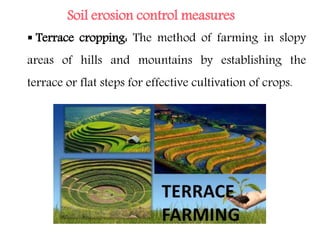
 Terrace cropping: The method of farming in slopy
areas of hills and mountains by establishing the
terrace or flat steps for effective cultivation of crops.
Soil erosion control measures
 Contour farming: The method of farming or growing
crops in slopy areas in equal elevation without
forming any steps or terrace is called contour farming.
Contour lines are built with the help of A -frame
Soil erosion control measures
 Strip or cover cropping: The method of growing
crops that are planted to cover the soil surface rather
than for the purpose of consumption is called cover
cropping.
 Forest and Rangeland
 Afforestation: Afforestation means planting trees or growing
forest at any place. Whereas reforestation means planting trees
in any place where they have been initially destroyed.
Afforestation acts as a wind breaker and shelter belts, thus
helps to prevent soil erosion.
 Controlled grazing: It is the practice of forage management by
limiting grazing of the cattle by subdividing the pastures with
permanent or temporary fences.
It is most commonly known as rotational grazing, intensive
grazing or strip grazing.
Animals are allowed to graze in small pastures (paddocks) for
a certain period and transferred into next paddock until the
pastures recover into normal condition. This period is called ‘rest
period’.
 Engineering: Engineering method of soil conservation are the
physical structures that stops or try to prevent the occurrence of
soil erosion.
The different methods of engineering for soil erosion
control are as follows:
• Check dams
• Retaining walls
• Water ways
• Embankment
• Spurs and soilways
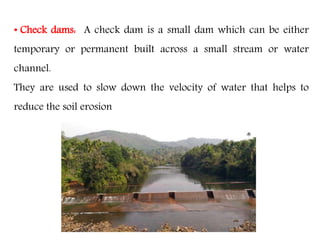
• Check dams: A check dam is a small dam which can be either
temporary or permanent built across a small stream or water
channel.
They are used to slow down the velocity of water that helps to
reduce the soil erosion
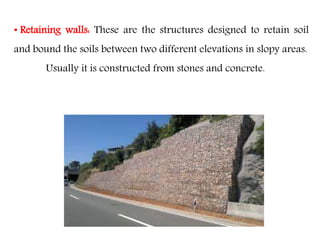
• Retaining walls: These are the structures designed to retain soil
and bound the soils between two different elevations in slopy areas.
Usually it is constructed from stones and concrete.
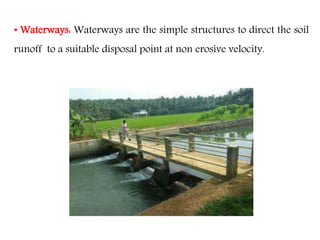
• Waterways: Waterways are the simple structures to direct the soil
runoff to a suitable disposal point at non erosive velocity.
• Embankment: Embankment are the bund like structure,
constructed across the land slope used for retaining the water and
thus controlling the soil erosion.
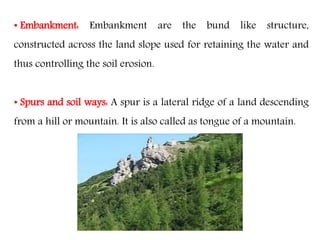
• Spurs and soil ways: A spur is a lateral ridge of a land descending
from a hill or mountain. It is also called as tongue of a mountain.
 Bio-engineering method: The integrated technique of soil
conservation that uses sound engineering practices following the
biological principles is called bio-engineering method.
For eg: Many landslide affected areas in Krishna Bhir was
controlled by bio-engineering technique.
Advantages
• Lower and long term maintenance cost
• environmentally sound
• Act as wildlife habitat
• Water quality improvement
• use of locally available materials
Bio-Engineering measures to control soil erosion
• Bamboo fencing: bamboo fencing is used to prevent soil creep in
slopy areas. It holds the soil particles firmly when shrubs and
grasses are grown along with it.
• Brush Layering: Fresh green cuttings of shrubs and herbs are
planted in the soil in lines across the slope. As the roots grow, it
holds the soil particles.
Bio-Engineering measures to control soil erosion
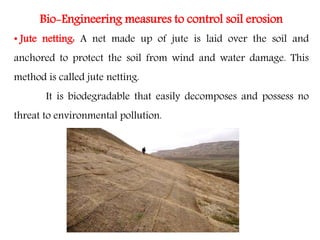
• Jute netting: A net made up of jute is laid over the soil and
anchored to protect the soil from wind and water damage. This
method is called jute netting.
It is biodegradable that easily decomposes and possess no
threat to environmental pollution.
Bio-Engineering measures to control soil erosion
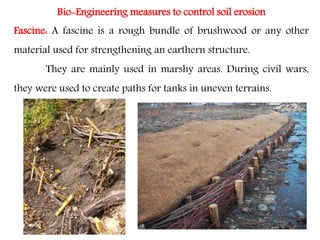
Fascine: A fascine is a rough bundle of brushwood or any other
material used for strengthening an earthern structure.
They are mainly used in marshy areas. During civil wars,
they were used to create paths for tanks in uneven terrains.
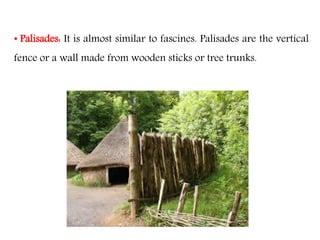
• Palisades: It is almost similar to fascines. Palisades are the vertical
fence or a wall made from wooden sticks or tree trunks.
 Use of different equipments and machineries
 Power tiller
 Cultivator

Engineering and Bio-engineering soil conservation measures

  • 1.
    Presented By ANIL THAPA Departmentof Horticulture AFU, Rampur Campus ngineering and Bio-engineerin Soil Conservation measures AGRICULTURE AND FORESTRY UNIVERSITY Rampur Chitwan
  • 2.
  • 3.
    Content  Concept ofSoil erosion and Soil Conservation  Causes of soil erosion  Types of soil erosion by water  Consequences of soil erosion  Fertility loss and land degradation  Flood, Landslides and natural hazards  On-site and off-site effects  Socio-economic effects  Soil erosion control measures  Agriculture land  Forest and Rangeland  Engineering  Bio-engineering  Use of different equipments
  • 4.
    Soil erosion isthe process of washing away the top layer of soil due to water on wind. There are mainly three types of erosion. i.e wind erosion , water erosion and landslide erosion. Soil erosion mainly involves three main processes:  Detachment from the ground  Transportation via water or wind  Deposition
  • 5.
    Causes of soilerosion  Frequently blowing strong winds. Heavy raining and flooding in hilly and slopy areas. Overgrazing of cattle in the same rangeland frequently. Deforestation in large scale. Unplanned urbanization in hilly areas. Development activities like road construction in slopy areas. Bare and naked field are highly susceptible to soil erosion.
  • 6.
    Types of soilerosion by water  Sheet erosion: The type of erosion in which the top alluvial soil is washed away over the surface and deposited in any area is called sheet erosion
  • 7.
    Types of soilerosion by water  Rill erosion: The type of erosion in which water flows over the soil surface forming a small stream or a channel, washing away the soil particles is called rill erosion.
  • 8.
    Types of soilerosion by water  Gully erosion: If the rill erosion is not controlled, it creates deeper and wider gullies washing away all the soil particles on its way is called gully erosion.
  • 9.
    Consequences of Soilerosion in Nepal  Fertility loss and land degradation  Flood, landslides and natural hazards  On-site and off-site effects  socio-economic effects
  • 10.
    Soil erosion controlmeasures  Agriculture land: Conservational tillage: The type of tillage practice in which the intensity of tillage is reduced and crop residues are left over the soil surface in order to conserve the moisture and prevent soil loss. It is also called as minimum tillage.  Mulching: Mulching is the act of covering the soil surface by a layer of old leaves, manure, straw, green manure or plastic sheets so as to conserve the soil moisture and prevent weed infestation.
  • 11.
    Soil erosion controlmeasures  Terrace cropping: The method of farming in slopy areas of hills and mountains by establishing the terrace or flat steps for effective cultivation of crops.
  • 12.
    Soil erosion controlmeasures  Contour farming: The method of farming or growing crops in slopy areas in equal elevation without forming any steps or terrace is called contour farming. Contour lines are built with the help of A -frame
  • 13.
    Soil erosion controlmeasures  Strip or cover cropping: The method of growing crops that are planted to cover the soil surface rather than for the purpose of consumption is called cover cropping.
  • 14.
     Forest andRangeland  Afforestation: Afforestation means planting trees or growing forest at any place. Whereas reforestation means planting trees in any place where they have been initially destroyed. Afforestation acts as a wind breaker and shelter belts, thus helps to prevent soil erosion.
  • 15.
     Controlled grazing:It is the practice of forage management by limiting grazing of the cattle by subdividing the pastures with permanent or temporary fences. It is most commonly known as rotational grazing, intensive grazing or strip grazing. Animals are allowed to graze in small pastures (paddocks) for a certain period and transferred into next paddock until the pastures recover into normal condition. This period is called ‘rest period’.
  • 16.
     Engineering: Engineeringmethod of soil conservation are the physical structures that stops or try to prevent the occurrence of soil erosion. The different methods of engineering for soil erosion control are as follows: • Check dams • Retaining walls • Water ways • Embankment • Spurs and soilways
  • 17.
    • Check dams:A check dam is a small dam which can be either temporary or permanent built across a small stream or water channel. They are used to slow down the velocity of water that helps to reduce the soil erosion
  • 18.
    • Retaining walls:These are the structures designed to retain soil and bound the soils between two different elevations in slopy areas. Usually it is constructed from stones and concrete.
  • 19.
    • Waterways: Waterwaysare the simple structures to direct the soil runoff to a suitable disposal point at non erosive velocity.
  • 20.
    • Embankment: Embankmentare the bund like structure, constructed across the land slope used for retaining the water and thus controlling the soil erosion. • Spurs and soil ways: A spur is a lateral ridge of a land descending from a hill or mountain. It is also called as tongue of a mountain.
  • 21.
     Bio-engineering method:The integrated technique of soil conservation that uses sound engineering practices following the biological principles is called bio-engineering method. For eg: Many landslide affected areas in Krishna Bhir was controlled by bio-engineering technique. Advantages • Lower and long term maintenance cost • environmentally sound • Act as wildlife habitat • Water quality improvement • use of locally available materials
  • 22.
    Bio-Engineering measures tocontrol soil erosion • Bamboo fencing: bamboo fencing is used to prevent soil creep in slopy areas. It holds the soil particles firmly when shrubs and grasses are grown along with it. • Brush Layering: Fresh green cuttings of shrubs and herbs are planted in the soil in lines across the slope. As the roots grow, it holds the soil particles.
  • 23.
    Bio-Engineering measures tocontrol soil erosion • Jute netting: A net made up of jute is laid over the soil and anchored to protect the soil from wind and water damage. This method is called jute netting. It is biodegradable that easily decomposes and possess no threat to environmental pollution.
  • 24.
    Bio-Engineering measures tocontrol soil erosion Fascine: A fascine is a rough bundle of brushwood or any other material used for strengthening an earthern structure. They are mainly used in marshy areas. During civil wars, they were used to create paths for tanks in uneven terrains.
  • 25.
    • Palisades: Itis almost similar to fascines. Palisades are the vertical fence or a wall made from wooden sticks or tree trunks.
  • 26.
     Use ofdifferent equipments and machineries  Power tiller  Cultivator