Software Project
Management
Walker Royce
Ms. Munazza mah Jabeen
Assistant professor – computer science
Workflows of the Process:
The term workflow is used to mean a thread of cohesive and most sequential activities:
There are seven top-level workflows:
 Management workflow: controlling the process and ensuring win conditions for all
stakeholders
 Environment workflow: automating the process and evolving the maintenance environment
 Requirements workflow: analysing the problem space and evolving the requirements
artefacts
 Design workflow: modelling the solution and evolving the architecture and design artefacts
 Implementation workflow: programming the components and evolving the implementation
and deployment artefacts
 Assessment workflow: assessing the trends in process and product quality
 Deployment workflow: transitioning the end products to the user
Software Process Workflows (Contd.)
Four basic key principles:
 Architecture-first approach: implementing and testing the architecture
must precede full-scale development and testing and must precede the
downstream focus on completeness and quality of the product features.
 Iterative life-cycle process: the activities and artefacts of any given
workflow may require more than one pass to achieve adequate results.
 Roundtrip engineering: Raising the environment activities to a first-class
workflow is critical; the environment is the tangible embodiment of the
project’s process and notations for producing the artefacts.
 Demonstration-based approach: Implementation and assessment
activities are initiated nearly in the life-cycle, reflecting the emphasis on
constructing executable subsets of the involving architecture.
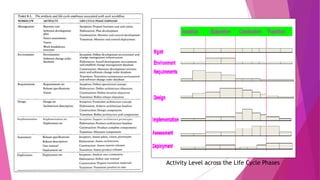
Activity Level across the Life Cycle Phases
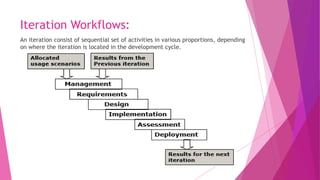
Iteration Workflows:
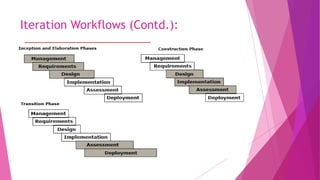
An iteration consist of sequential set of activities in various proportions, depending
on where the iteration is located in the development cycle.
Iteration Workflows (Contd.):

Workflows of the Process

  • 1.
    Software Project Management Walker Royce Ms.Munazza mah Jabeen Assistant professor – computer science
  • 2.
    Workflows of theProcess: The term workflow is used to mean a thread of cohesive and most sequential activities: There are seven top-level workflows:  Management workflow: controlling the process and ensuring win conditions for all stakeholders  Environment workflow: automating the process and evolving the maintenance environment  Requirements workflow: analysing the problem space and evolving the requirements artefacts  Design workflow: modelling the solution and evolving the architecture and design artefacts  Implementation workflow: programming the components and evolving the implementation and deployment artefacts  Assessment workflow: assessing the trends in process and product quality  Deployment workflow: transitioning the end products to the user
  • 3.
    Software Process Workflows(Contd.) Four basic key principles:  Architecture-first approach: implementing and testing the architecture must precede full-scale development and testing and must precede the downstream focus on completeness and quality of the product features.  Iterative life-cycle process: the activities and artefacts of any given workflow may require more than one pass to achieve adequate results.  Roundtrip engineering: Raising the environment activities to a first-class workflow is critical; the environment is the tangible embodiment of the project’s process and notations for producing the artefacts.  Demonstration-based approach: Implementation and assessment activities are initiated nearly in the life-cycle, reflecting the emphasis on constructing executable subsets of the involving architecture.
  • 4.
    Activity Level acrossthe Life Cycle Phases
  • 5.
    Iteration Workflows: An iterationconsist of sequential set of activities in various proportions, depending on where the iteration is located in the development cycle.
  • 6.