PRESENTED BY
SIDDHESH PALKAR
Software Quality Assurance
1
Software Quality Assurance
Software Quality Assurance ( SQA ) should be
utilized to the full extend with traceability of errors, cost
efficient. Every Business should use SQA and use it to the
best as they can.
They can easily guide the application to be the best
procedure. Everything should be “Spick & Span” when
SQA has been executed.
2
Need of SQA
It is all about business survival and SQA is just one
of the many tools the company should effectively use.
Following are the reasons why SQA should be used
by any company before releasing their application to their
intended user:
3
Need of SQA
Traceability of Errors
SQA looks for the reason why the error occurred.
Looking for errors is really easy but tracing the roots of the
problem is another thing. The SQA team should be able to
tell which practice has started the problem.
4
Need of SQA
Cost Efficient
This idea is saving money is very debatable is SQA.
Using SQA means you will have to hire another set of
people to work with you. Unfortunately most of the SQA
tools are expensive especially efficient tools.
5
Need of SQA
Flexible Solutions
SQA could easily provide solutions to the problem
since they look for the root of the problem instead of just
answering them. By providing the root of the problem,
they have the ability to provide solution to these problems
fast. But instead of one solution only, the SQA team
should be able to provide more than one solution.
6
Need of SQA
Better Customer Services
One of the ultimate goals of any businesses is to
best customer service possible. SQA could help these
companies realize that goal. The recommended documents
are carefully planned out to ensure that feedback is
working as planned.
7
Need of SQA
Innovation & Creativity
The SQA team is here to standardize how their
work is done, it still foster innovation and creativity for
developing the product. Everyone is given a free hand in
developing the application and the SQA team is there to
help them standardize the ideas.
8
Software Principles
Feedback
An SQA principle that uses rapid feedback is
assured of success. If they have the ability to get the
feedback of their application as soon as possible, then the
chance of developing a better application faster is possible.
9
Software Principles
Evolution
Reaching the objective is really easy but every time
something new happens, it should be always noted.
Evolution is setting the benchmark in each development.
Since the SQA team is able to mark every time something
new is done, evolution is monitored.
10
Software Principles
Quality Control
Quality Control is the pillar for Software Quality
Assurance ( SQA ). Everything needs to have quality
control – from the start to the finish. The biggest and
tightest quality control should be executed as early as
possible.
11
Software Principles
Motivation
There is not substitute than to have the right people
who has the will to do their jobs at all times. When they
have right mindset the willingness to do it, everything will
just go through.
12
Software Principles
Process Improvement
Process improvement fosters the development of
the actual treatment of the project. Every project has
unique situation that will give the SQA team a chance to
experience something new. This new will never be
translated to something good if they are not documented
for future references.
13
Software Principles
Persistence
There is no perfect application. The bigger they get,
the more error there could be. The SQA team should be
very tenacious in looking for concerns in every aspect of
the software development process.
14
SQA Activities
SQA group that has responsibility for quality
assurance planning, record keeping, oversight, analysis
and reporting and the other are software engineers, who do
technical work.
 SQA group prepares a SQA plan that identifies:
 Assessments to be carried out
 Reviews and audits to be executed
 Standards those are relevant to the project
 Measures for error reporting and tracking
 Credentials to be produced by the SQA group
 Amount of feedback provided to the software project team
15
Building Blocks of SQA
SQA Project Metrics
The application is only as good as its numbers. It is
a harsh reality but everything has to come down to the
numbers. Although we can enumerate tens or hundreds of
features in a single application, it will all be for nothing if
the metrics do not live up according to expectation. The
SQA team should ensure that the expected metrics will be
posted. At the same time, the SQA team should also select
the right tool to gauge the application.
16
Building Blocks of SQA
SQA Software and tools
In quality assurance, it is always important to get
all the help we could get. In other industries, developers
could easily check the products manually and discard
those that do not meet the standard. With tools and
machines, they can easily set a standard with their
products.
SQA team has their preferred tools for application
testing. Based on their belief and expertise, the SQA team
will usually give the owners or business managers a free
hand on what type of testing tool to use.
17
Building Blocks of SQA
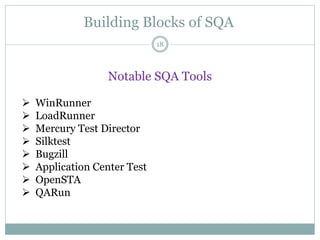
Notable SQA Tools
 WinRunner
 LoadRunner
 Mercury Test Director
 Silktest
 Bugzill
 Application Center Test
 OpenSTA
 QARun
18
Building Blocks of SQA
Selecting the Right Quality Model
There are so many quality models to choose from.
Each of them has their own advantage and disadvantages.
It is up to the SQA team to select which application that
will give the clients a good idea how the application works.
19
Building Blocks of SQA
Selecting Right SQA Tool
In selecting the right tool, testers and SQA
managers should always start with their objective.
Although usually the testers’ objective is to know every
bug and error related to the application, testers and
developers should also consider writing benchmarks.
Through this benchmark, they can assure the application
works as expected.
20
Building Blocks of SQA
SQA Planning & Requirements
In a regular SQA plan, the team will have
enumerated all the possible functions, tools and metrics
that will be expected from the application. SQA planning
will be the basis of everything once the actual SQA starts.
In business or in any intended application,
software requirements are very important since these
requirements will tell how an application would work.
From these requirements they will know what language,
SDLC program and other protocols that will be used to
build the applications.
21
Building Blocks of SQA
Technical Activities
One of the responsibilities of the SQA team from
the developers is the required user requirements
document. The UR document is produced by the intended
users who are tapped for this project. This document will
inform the developers what the users are expecting from
the application. The SQA team will ensure that the
document exists before they actually work on the software
requirements.
22
Building Blocks of SQA
SQA Management Plans
In the planning and requirements phase, there will
be four plans that will be created. These plans will be used
in the next stage of software development which is the
architectural phase.
 Software Quality Assurance Plan (SQAP)
 Software Project Management Plans (SPMP)
 Software Configuration Management Plans (SCMP)
 Software Verification Management Plan (SVMP)
23
SQA Planning & Standards
Planning is one of the most important aspects of
Software Quality Assurance. The entire operation of the
SQA team depends on how well their planning is done. In
smaller businesses, planning might not really dictate the
flow of SQA but in larger businesses, SQA Planning takes
on center stage.
24
SQA Lifecycle Standards
Software Quality Assurance procedures have
finally been standardized and have been virtually
perfected after years of planning on how to perfect the
application standardization. Through experience, the
company was able to place in writing how to develop a
plan for software development. Along with the standards,
the metrics are also standardized.
25
26

Software Quality Assurance

  • 1.
  • 2.
    Software Quality Assurance SoftwareQuality Assurance ( SQA ) should be utilized to the full extend with traceability of errors, cost efficient. Every Business should use SQA and use it to the best as they can. They can easily guide the application to be the best procedure. Everything should be “Spick & Span” when SQA has been executed. 2
  • 3.
    Need of SQA Itis all about business survival and SQA is just one of the many tools the company should effectively use. Following are the reasons why SQA should be used by any company before releasing their application to their intended user: 3
  • 4.
    Need of SQA Traceabilityof Errors SQA looks for the reason why the error occurred. Looking for errors is really easy but tracing the roots of the problem is another thing. The SQA team should be able to tell which practice has started the problem. 4
  • 5.
    Need of SQA CostEfficient This idea is saving money is very debatable is SQA. Using SQA means you will have to hire another set of people to work with you. Unfortunately most of the SQA tools are expensive especially efficient tools. 5
  • 6.
    Need of SQA FlexibleSolutions SQA could easily provide solutions to the problem since they look for the root of the problem instead of just answering them. By providing the root of the problem, they have the ability to provide solution to these problems fast. But instead of one solution only, the SQA team should be able to provide more than one solution. 6
  • 7.
    Need of SQA BetterCustomer Services One of the ultimate goals of any businesses is to best customer service possible. SQA could help these companies realize that goal. The recommended documents are carefully planned out to ensure that feedback is working as planned. 7
  • 8.
    Need of SQA Innovation& Creativity The SQA team is here to standardize how their work is done, it still foster innovation and creativity for developing the product. Everyone is given a free hand in developing the application and the SQA team is there to help them standardize the ideas. 8
  • 9.
    Software Principles Feedback An SQAprinciple that uses rapid feedback is assured of success. If they have the ability to get the feedback of their application as soon as possible, then the chance of developing a better application faster is possible. 9
  • 10.
    Software Principles Evolution Reaching theobjective is really easy but every time something new happens, it should be always noted. Evolution is setting the benchmark in each development. Since the SQA team is able to mark every time something new is done, evolution is monitored. 10
  • 11.
    Software Principles Quality Control QualityControl is the pillar for Software Quality Assurance ( SQA ). Everything needs to have quality control – from the start to the finish. The biggest and tightest quality control should be executed as early as possible. 11
  • 12.
    Software Principles Motivation There isnot substitute than to have the right people who has the will to do their jobs at all times. When they have right mindset the willingness to do it, everything will just go through. 12
  • 13.
    Software Principles Process Improvement Processimprovement fosters the development of the actual treatment of the project. Every project has unique situation that will give the SQA team a chance to experience something new. This new will never be translated to something good if they are not documented for future references. 13
  • 14.
    Software Principles Persistence There isno perfect application. The bigger they get, the more error there could be. The SQA team should be very tenacious in looking for concerns in every aspect of the software development process. 14
  • 15.
    SQA Activities SQA groupthat has responsibility for quality assurance planning, record keeping, oversight, analysis and reporting and the other are software engineers, who do technical work.  SQA group prepares a SQA plan that identifies:  Assessments to be carried out  Reviews and audits to be executed  Standards those are relevant to the project  Measures for error reporting and tracking  Credentials to be produced by the SQA group  Amount of feedback provided to the software project team 15
  • 16.
    Building Blocks ofSQA SQA Project Metrics The application is only as good as its numbers. It is a harsh reality but everything has to come down to the numbers. Although we can enumerate tens or hundreds of features in a single application, it will all be for nothing if the metrics do not live up according to expectation. The SQA team should ensure that the expected metrics will be posted. At the same time, the SQA team should also select the right tool to gauge the application. 16
  • 17.
    Building Blocks ofSQA SQA Software and tools In quality assurance, it is always important to get all the help we could get. In other industries, developers could easily check the products manually and discard those that do not meet the standard. With tools and machines, they can easily set a standard with their products. SQA team has their preferred tools for application testing. Based on their belief and expertise, the SQA team will usually give the owners or business managers a free hand on what type of testing tool to use. 17
  • 18.
    Building Blocks ofSQA Notable SQA Tools  WinRunner  LoadRunner  Mercury Test Director  Silktest  Bugzill  Application Center Test  OpenSTA  QARun 18
  • 19.
    Building Blocks ofSQA Selecting the Right Quality Model There are so many quality models to choose from. Each of them has their own advantage and disadvantages. It is up to the SQA team to select which application that will give the clients a good idea how the application works. 19
  • 20.
    Building Blocks ofSQA Selecting Right SQA Tool In selecting the right tool, testers and SQA managers should always start with their objective. Although usually the testers’ objective is to know every bug and error related to the application, testers and developers should also consider writing benchmarks. Through this benchmark, they can assure the application works as expected. 20
  • 21.
    Building Blocks ofSQA SQA Planning & Requirements In a regular SQA plan, the team will have enumerated all the possible functions, tools and metrics that will be expected from the application. SQA planning will be the basis of everything once the actual SQA starts. In business or in any intended application, software requirements are very important since these requirements will tell how an application would work. From these requirements they will know what language, SDLC program and other protocols that will be used to build the applications. 21
  • 22.
    Building Blocks ofSQA Technical Activities One of the responsibilities of the SQA team from the developers is the required user requirements document. The UR document is produced by the intended users who are tapped for this project. This document will inform the developers what the users are expecting from the application. The SQA team will ensure that the document exists before they actually work on the software requirements. 22
  • 23.
    Building Blocks ofSQA SQA Management Plans In the planning and requirements phase, there will be four plans that will be created. These plans will be used in the next stage of software development which is the architectural phase.  Software Quality Assurance Plan (SQAP)  Software Project Management Plans (SPMP)  Software Configuration Management Plans (SCMP)  Software Verification Management Plan (SVMP) 23
  • 24.
    SQA Planning &Standards Planning is one of the most important aspects of Software Quality Assurance. The entire operation of the SQA team depends on how well their planning is done. In smaller businesses, planning might not really dictate the flow of SQA but in larger businesses, SQA Planning takes on center stage. 24
  • 25.
    SQA Lifecycle Standards SoftwareQuality Assurance procedures have finally been standardized and have been virtually perfected after years of planning on how to perfect the application standardization. Through experience, the company was able to place in writing how to develop a plan for software development. Along with the standards, the metrics are also standardized. 25
  • 26.