This document provides an overview of a requirements specification (SRS) for a software engineering project. It defines what an SRS is, its purpose, types of requirements it should include, its typical structure, characteristics of a good SRS, and benefits of developing an SRS. The SRS is intended to clearly define the requirements for a software product to guide its design and development.
What is anSRS?
• SRS is the official statement of what the system developers should
implement.
• SRS is a complete description of the behavior of the system to be
developed.
• SRS should include both a definition of user requirements and a
specification of the system requirements.
• The SRS fully describes what the software will do and how it will be
expected to perform.
3.
What is thepurpose of an SRS?
• The SRS precisely defines the software product that will be built.
• SRS used to know all the requirements for the software development and thus
that will help in designing the software.
• It provides feedback to the customer. For example :
communication between the Customer, Analyst, system developers,
maintainers, ...
contract between Purchaser and Supplier
firm foundation for the design phase
support system testing activities
support project management and control
controlling the evolution of the system
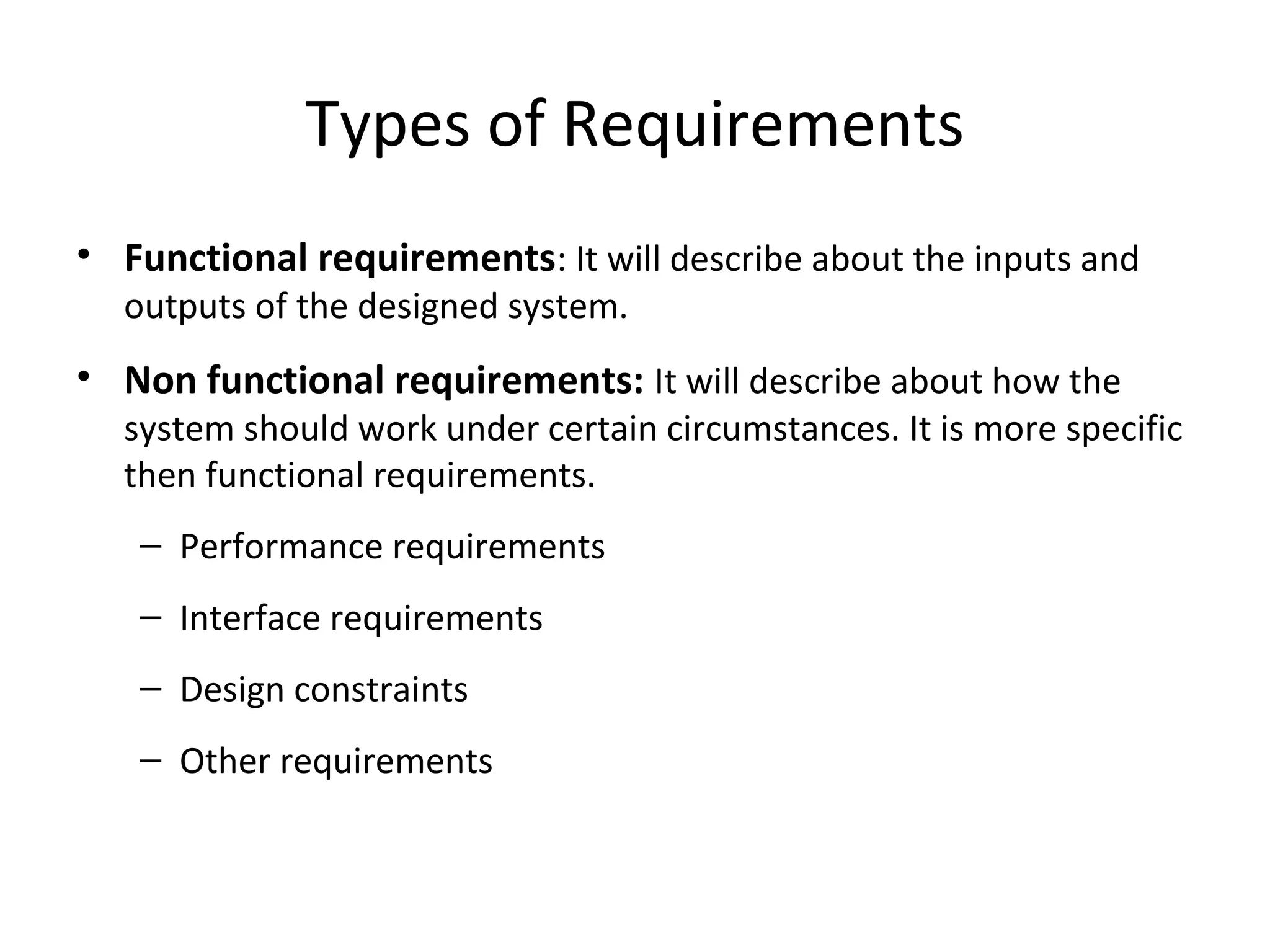
Types of Requirements
•Functional requirements: It will describe about the inputs and
outputs of the designed system.
• Non functional requirements: It will describe about how the
system should work under certain circumstances. It is more specific
then functional requirements.
– Performance requirements
– Interface requirements
– Design constraints
– Other requirements
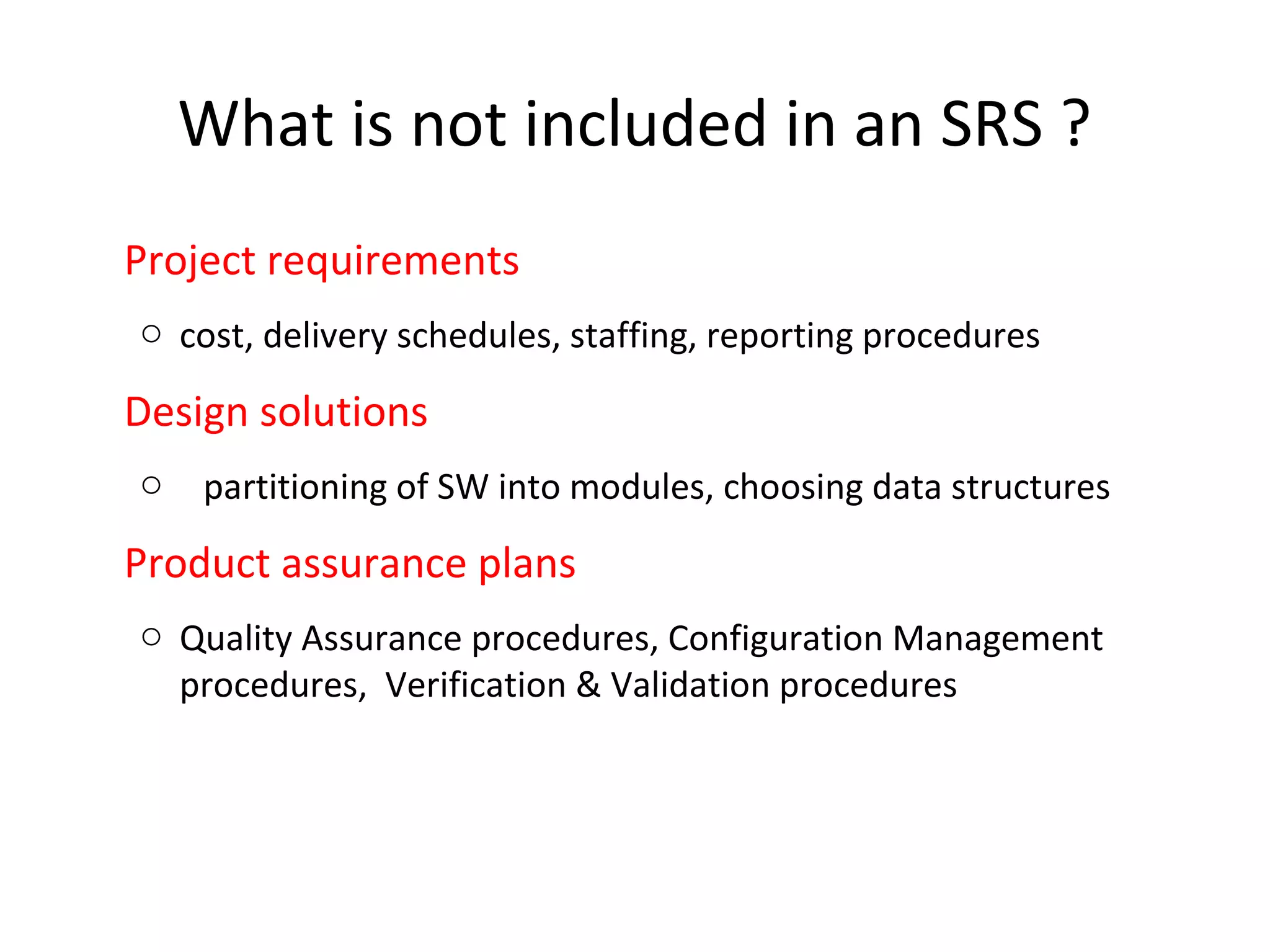
What is notincluded in an SRS ?
Project requirements
o cost, delivery schedules, staffing, reporting procedures
Design solutions
o partitioning of SW into modules, choosing data structures
Product assurance plans
o Quality Assurance procedures, Configuration Management
procedures, Verification & Validation procedures
8.
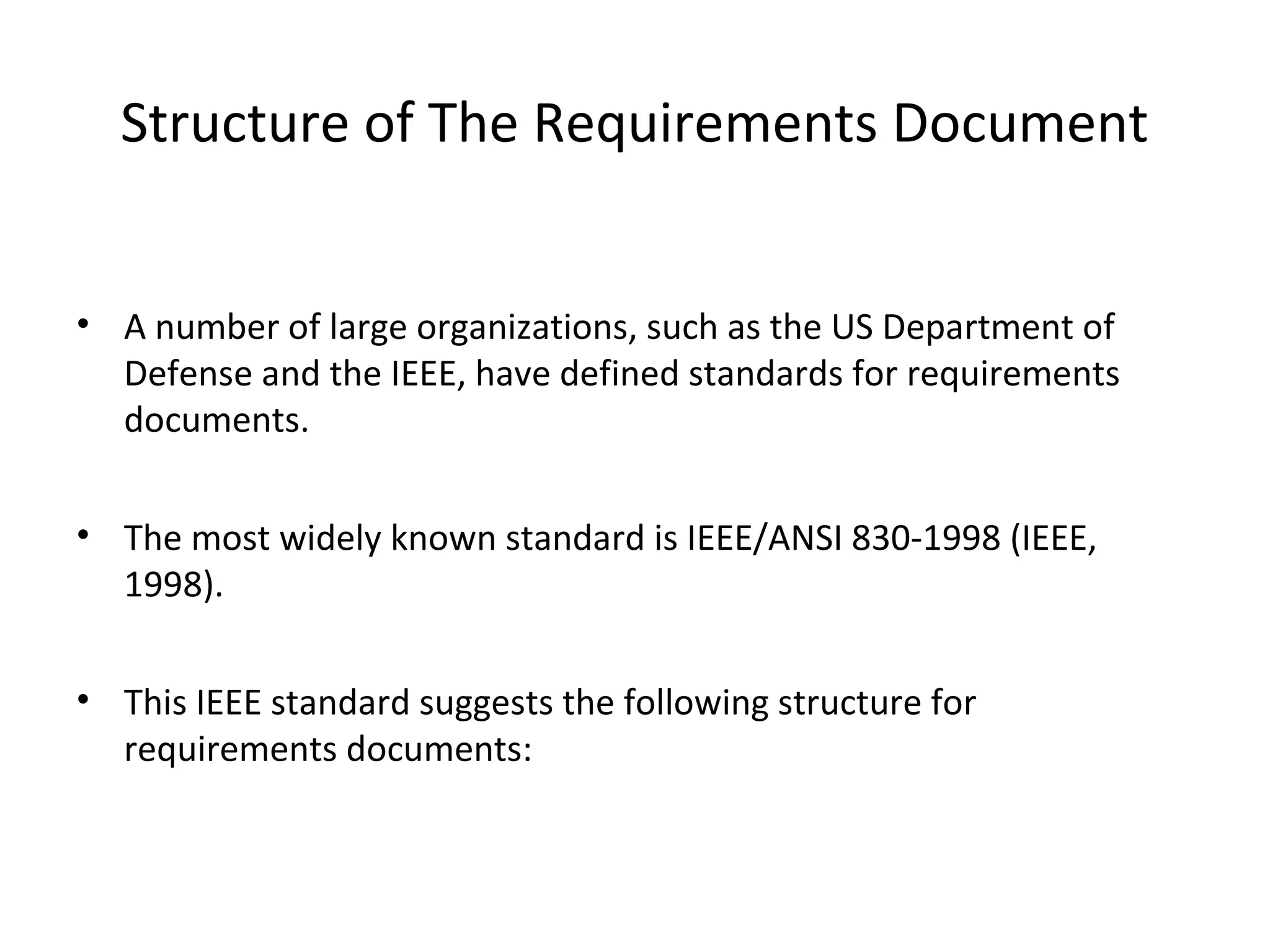
Structure of TheRequirements Document
• A number of large organizations, such as the US Department of
Defense and the IEEE, have defined standards for requirements
documents.
• The most widely known standard is IEEE/ANSI 830-1998 (IEEE,
1998).
• This IEEE standard suggests the following structure for
requirements documents:
10.
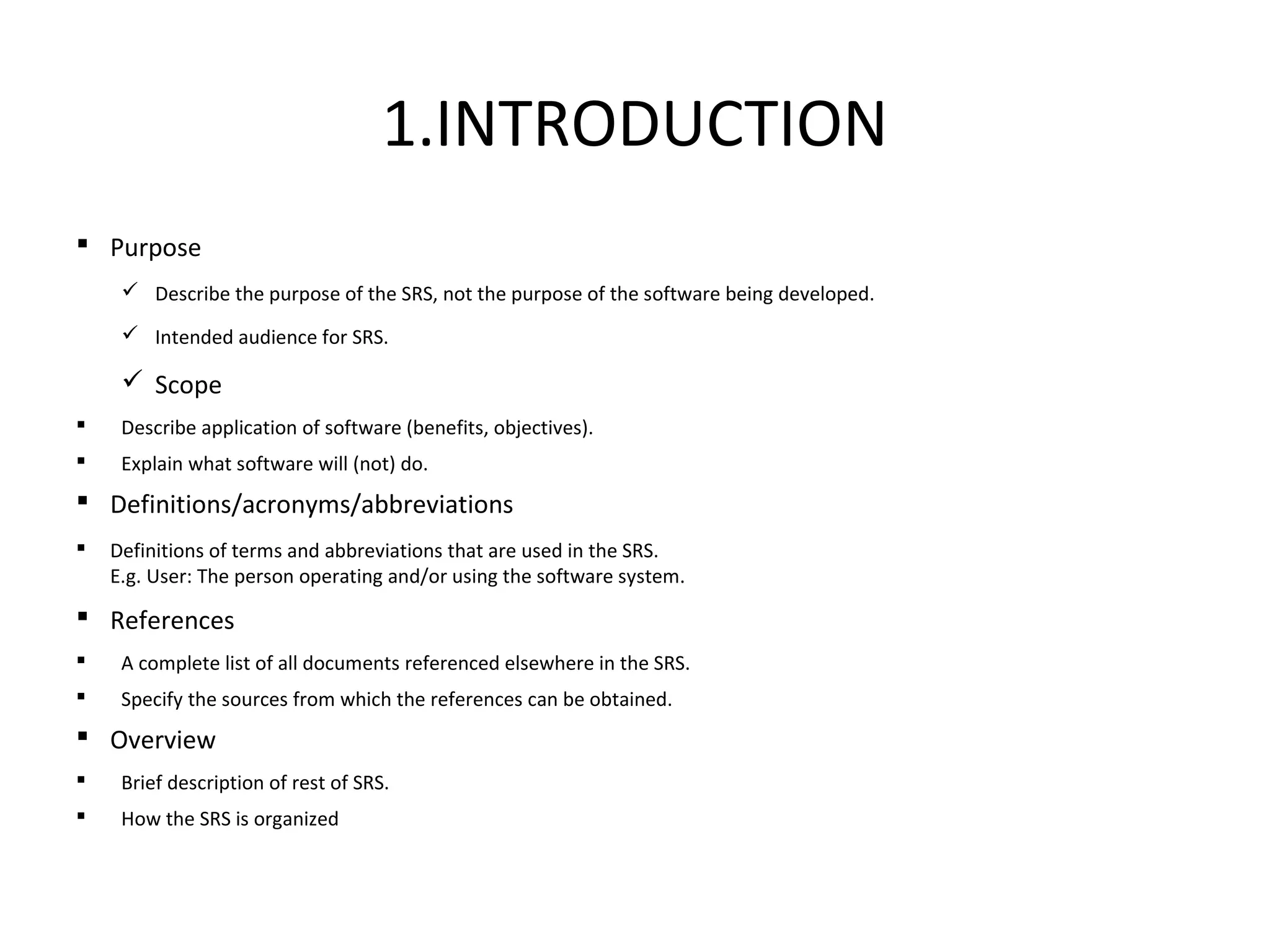
1.INTRODUCTION
Purpose
Describethe purpose of the SRS, not the purpose of the software being developed.
Intended audience for SRS.
Scope
Describe application of software (benefits, objectives).
Explain what software will (not) do.
Definitions/acronyms/abbreviations
Definitions of terms and abbreviations that are used in the SRS.
E.g. User: The person operating and/or using the software system.
References
A complete list of all documents referenced elsewhere in the SRS.
Specify the sources from which the references can be obtained.
Overview
Brief description of rest of SRS.
How the SRS is organized
11.
2.OVERALL DESCRIPTION
ProductPerspective
If the product is independent and totally self-contained, it should be stated here.
Describe the functions of each component of the larger system or project, and identify interfaces.
Product Functions
Provide a summary of the functions that the software will perform.
Block diagrams showing the different functions and their relationships can be helpful.
User Characteristics
Describe those general characteristics of the eventual users of the product that will affect the specific requirements.
Constraints
Provide a general description of any other items that will limit the developer's options for designing the system.
E.g.
1. The software system will run under Windows.
2. All code shall be written in Java.
12.
2.OVERALL DESCRIPTION
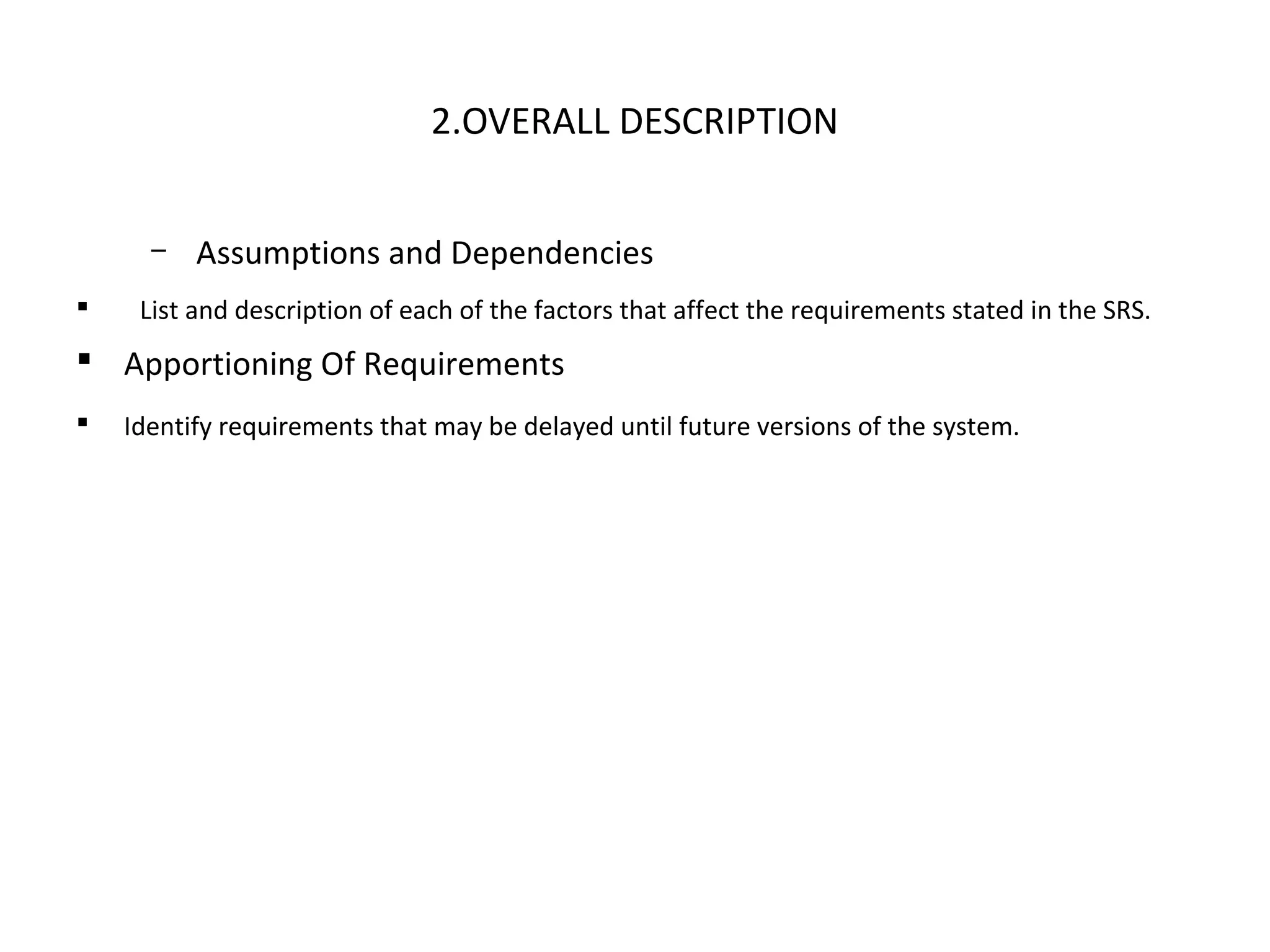
– Assumptionsand Dependencies
List and description of each of the factors that affect the requirements stated in the SRS.
Apportioning Of Requirements
Identify requirements that may be delayed until future versions of the system.
13.
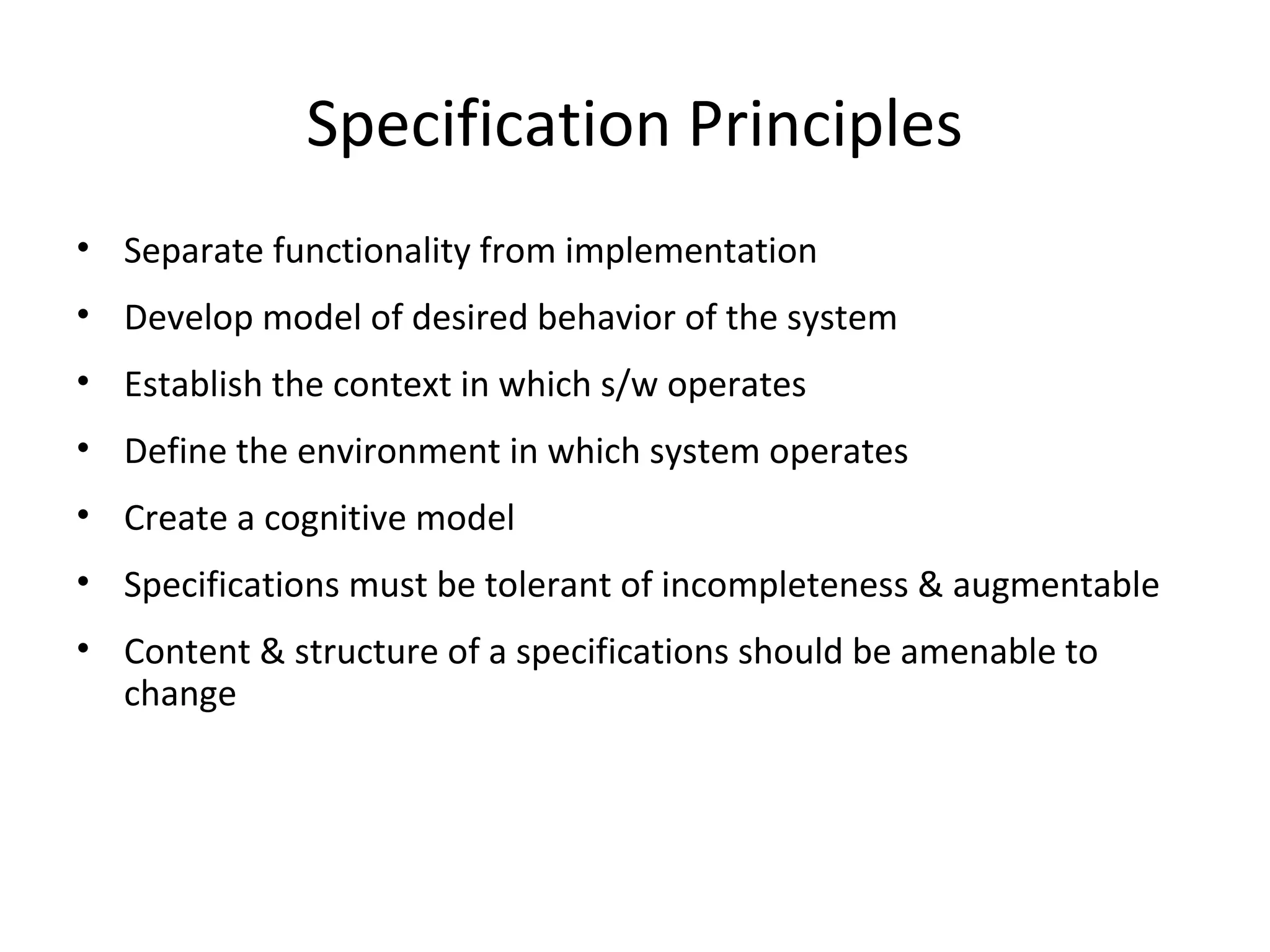
Specification Principles
• Separatefunctionality from implementation
• Develop model of desired behavior of the system
• Establish the context in which s/w operates
• Define the environment in which system operates
• Create a cognitive model
• Specifications must be tolerant of incompleteness & augmentable
• Content & structure of a specifications should be amenable to
change
14.
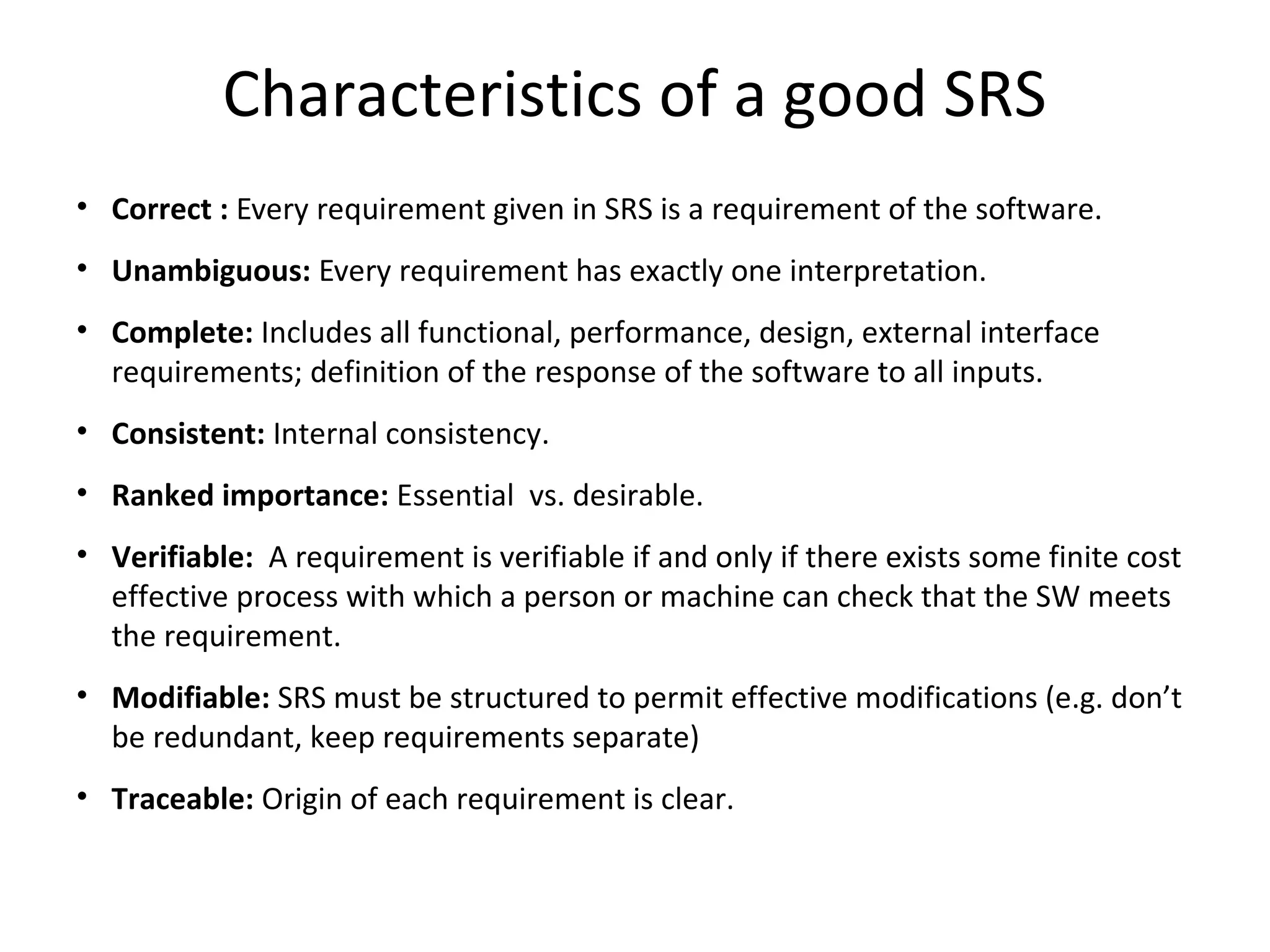
Characteristics of agood SRS
• Correct : Every requirement given in SRS is a requirement of the software.
• Unambiguous: Every requirement has exactly one interpretation.
• Complete: Includes all functional, performance, design, external interface
requirements; definition of the response of the software to all inputs.
• Consistent: Internal consistency.
• Ranked importance: Essential vs. desirable.
• Verifiable: A requirement is verifiable if and only if there exists some finite cost
effective process with which a person or machine can check that the SW meets
the requirement.
• Modifiable: SRS must be structured to permit effective modifications (e.g. don’t
be redundant, keep requirements separate)
• Traceable: Origin of each requirement is clear.
15.
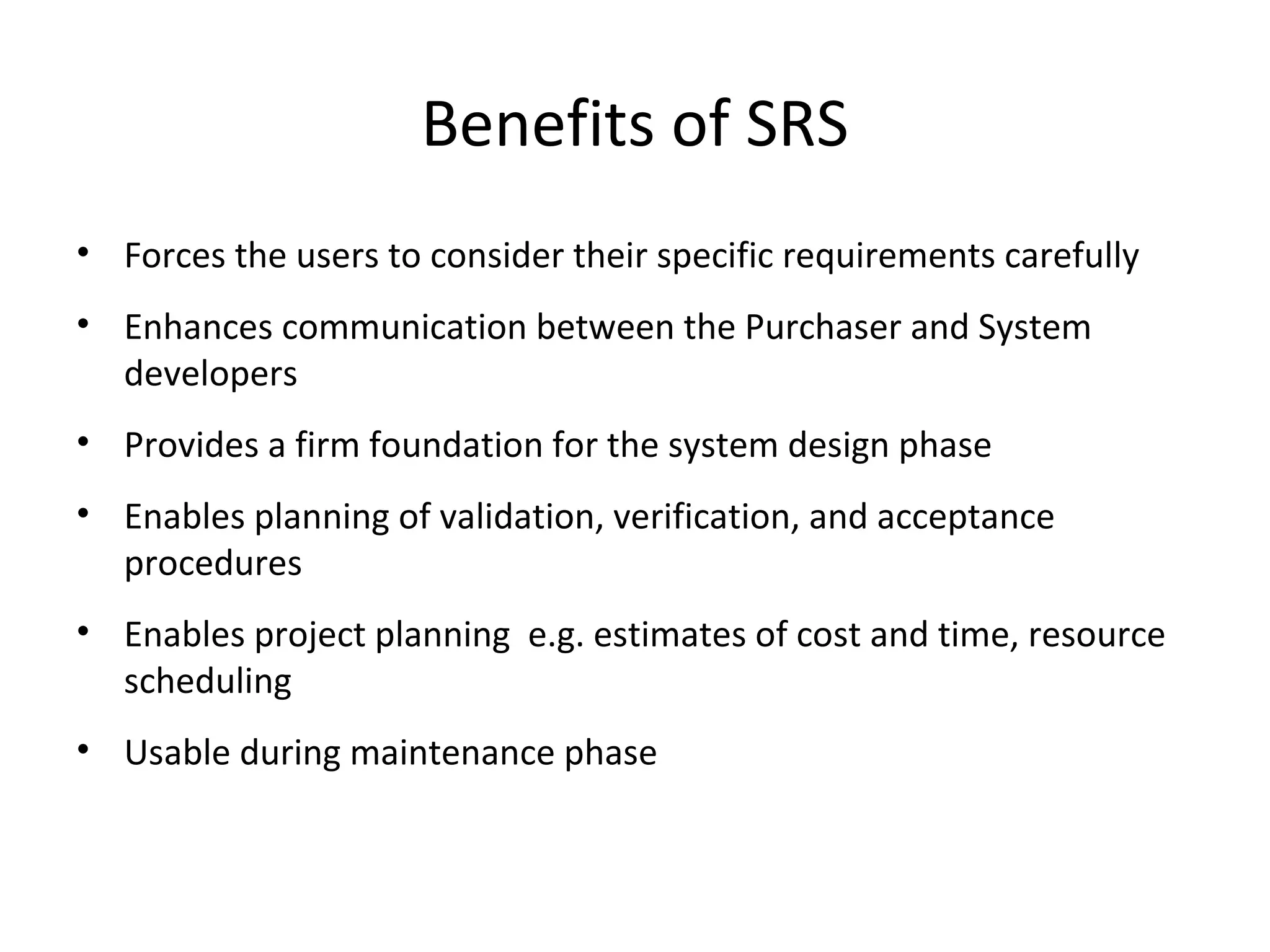
Benefits of SRS
•Forces the users to consider their specific requirements carefully
• Enhances communication between the Purchaser and System
developers
• Provides a firm foundation for the system design phase
• Enables planning of validation, verification, and acceptance
procedures
• Enables project planning e.g. estimates of cost and time, resource
scheduling
• Usable during maintenance phase
16.
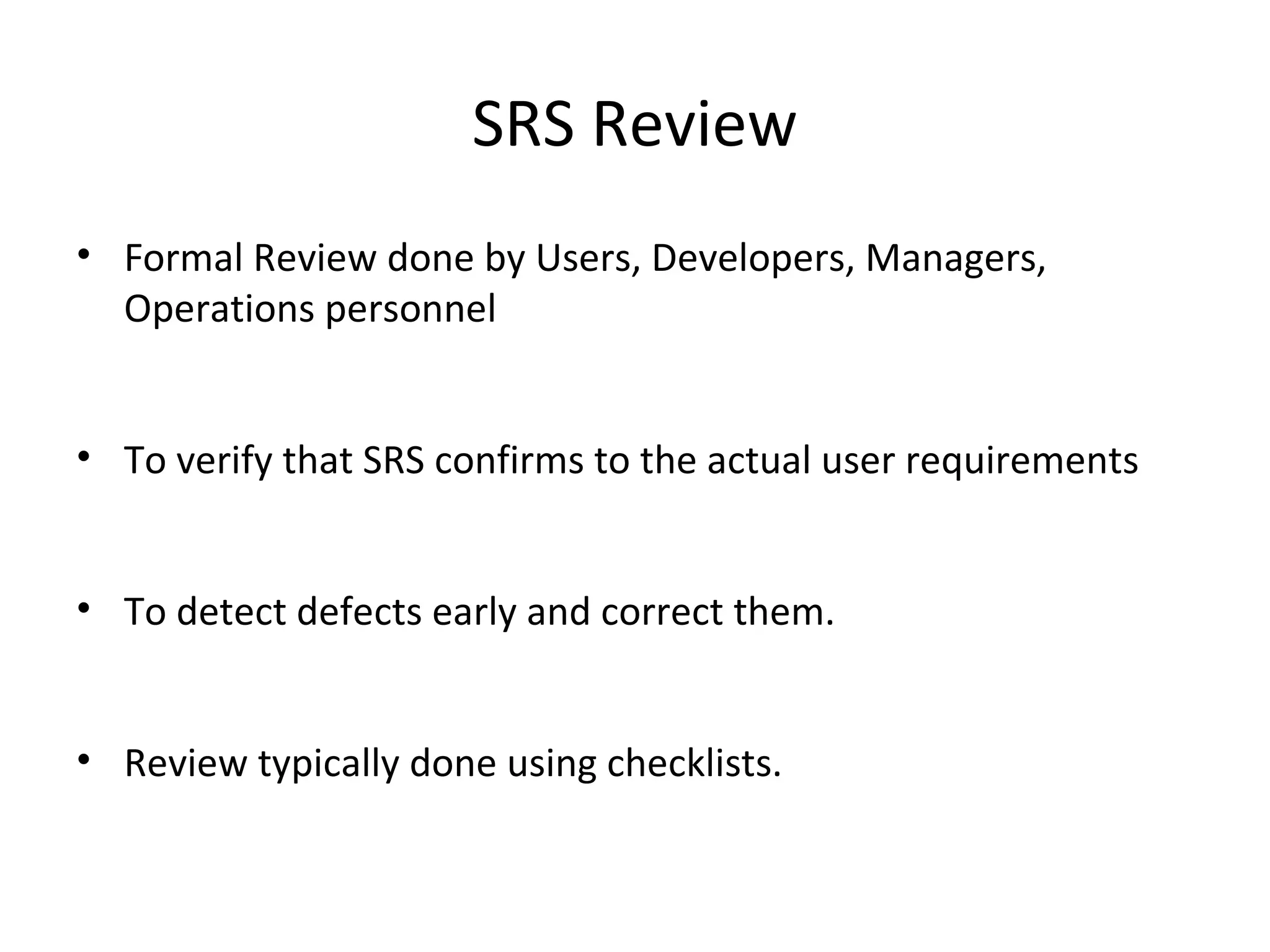
SRS Review
• FormalReview done by Users, Developers, Managers,
Operations personnel
• To verify that SRS confirms to the actual user requirements
• To detect defects early and correct them.
• Review typically done using checklists.