Software Quality Assurance
By Mr. Fazal Wahab
What is Software?
According to the IEEE
Software is:
“Computer programs, procedures, and possibly
associated documentation and data pertaining to
the operation of a computer system”.
What is Software Quality ?
According to the IEEE
 Software quality is:
1. The degree to which a system, component, or process
meets specified requirements.
2. The degree to which a system, component, or process
meets customer or user needs or expectations.
According to Pressman
“Conformance to explicitly stated functional and performance
requirements, explicitly documented development standards, and
implicit characteristics that are expected of all professionally
developed software”.
What is Software Quality?
 “Achieving high levels of user satisfaction, portability,
maintainability, robustness, and fitness for use” by
Dr. Barry Boehm.
 Quality means “conformance to user requirements”
by Phil Crosby.
 Edwards Deming considers quality to be “striving for
excellence” in reliability and functions by continuous
improvement in the process of development, support
by statistical analysis of the causes of failure.
What is Software Quality?
 Watts Humphrey, of the SEI, tends to speak of
quality as “achieving excellent levels of fitness for
use, conformance to requirements, reliability and
maintainability.”
 James Martin said that software quality means being
on time, within budget and meeting user needs
 Tom McCabe, the software complexity specialist,
defines quality as “high level of user satisfaction and
low defect levels, often associated with low
complexity
What is Software Quality?
 John Musa of Bell Laboratories states that
quality means combination of “low defect
levels, adherence of software functions to
users needs, and high reliability”
 Bill Perry, head of Quality Assurance Institute
has defined quality as “high levels of user
satisfaction and adherence to requirements”.
Why Quality is Important?
 Quality is critical for survival and success.
 Customers demand quality.
 Everybody seems to understand quality.
 Everybody wants quality
 Everybody has a different perception of
quality.
 Essentially quality means satisfying
customer.
Why Quality is Important?
 Why business should be concerned with
quality:
– Quality is competitive issue now
– Quality is a must for survival
– Quality gives you the global reach
– Quality is cost effective
– Quality helps retain customers and increase
profits
– Quality is the hallmarks of world-class business
Importance of Software Quality
 Software is a major component of computer systems
 (about 80% of the cost) – used for
– communication (e.g. phone system, email system)
– health monitoring,
– transportation (e.g. automobile, aeronautics),
– economic exchanges (e.g. ecommerce),
– entertainment,
– etc.
 Software defects are extremely costly in term of
– money
– reputation
– loss of life
Importance of Software Quality
 Several historic disasters attributed to software
– 1988 shooting down of Airbus 320 by the USS Vincennes cryptic and
misleading output displayed by tracking software
– 1991 patriot missile failure inaccurate calculation of time due to computer
arithmetic errors.
– London Ambulance Service Computer Aided Dispatch System – several
deaths
– On June 3, 1980, the North American Aerospace Defense Command
(NORAD) reported that the U.S. was under missile attack.
– First operational launch attempt of the space shuttle, whose real-time
operating software consists of about 500,000 lines of code, failed
synchronization problem among its flight control computers.
– 9 hour breakdown of AT&T's long distance telephone network caused by
an untested code patch
Software Quality Factors
 Correctness
– accuracy, completeness of required output
– upto-dateness, availability of the information
 Reliability
– Minimum failure rate
 Efficiency
resources needed to perform software function
 Integrity
– software system security, access rights
 Usability
– ability to learn, perform required task
Software Quality Factors
 Maintainability
– effort to identify and fix software failures (modularity, documentation, etc)
 Flexibility
– degree of adaptability (to new customers, tasks, etc)
 Testability
– support for testing (e.g. log files, automatic diagnostics, etc)
 Portability
– adaptation to other environments (hardware, software)
 Reusability
– use of software components for other projects
 Interoperability
– ability to interface with other components/systems
Elements of Quality Definition
Quality factors Predictable Measurable
Defect Level Yes Yes
Defect Origins Yes Yes
Defect Severity Yes Yes
Defect Removal Efficiency Yes Yes
Product Complexity Yes Yes
Project Reliability Yes Yes
Project Maintainability Yes Yes
Project schedules Yes Yes
Project budgets Yes Yes
Portability Yes Yes
Conformance to requirements No Yes
User Satisfaction No Yes
Fitness for Use No Yes
Robustness No No
Software Quality Challenges
 The measures for quality differ from project to project
and organization to organization
– Quality measures used for small systems may not be
appropriate for the large ones.
 Criteria for quality vary as a function of the specific
characteristics of the project, the needs of the users
and stakeholders, and the application requirements
of the system and software.
– Criteria for quality applied to real-time applications are not
always relevant when dealing with systems that are not
real-time.
What is Software Quality
Assurance?
According to the IEEE
Software quality assurance is:
1. A planned and systematic pattern of all actions
necessary to provide adequate confidence that an
item or product conforms to established technical
requirements.
2. A set of activities designed to evaluate the process
by which the products are developed or
manufactured. Contrast with: quality control.
What is Software Quality
Assurance?
According to D. Galin
Software quality assurance is:
“A systematic, planned set of actions necessary to provide
adequate confidence that the software development process
or the maintenance process of a software system product
conforms to established functional technical requirements
as well as with the managerial requirements of keeping the
schedule and operating within the budgetary confines.”
Objectives of SQA
Development:
 Assuring an acceptable level of confidence that the software will conform to
functional technical requirements.
 Assuring an acceptable level of confidence that the software will conform to
managerial scheduling and budgetary requirements.
 Initiation and management of activities for the improvement and greater
efficiency of software development and SQA activities.
Maintenance:
 Assuring an acceptable level of confidence that the software maintenance
activities will conform to the functional technical requirements.
 Assuring an acceptable level of confidence that the software maintenance
activities will conform to managerial scheduling and budgetary requirements.
 Initiate and manage activities to improve and increase the efficiency of software
maintenance and SQA activities.
Three General Principles of QA
Know what you are doing
Know what you should be doing
Know how to measure the difference
Three General Principles of QA
Know what you are doing
 understand what is being built, how it is being built
and what it currently does.
 suppose a software development process with
– management structure (milestones, scheduling)
– reporting policies
– tracking
Three General Principles of QA
 Know what you should be doing
– having explicit requirements and specifications
– suppose a software development process with
 requirements analysis,
 acceptance tests,
 frequent user feedback
Three General Principles of QA
 Know how to measure the difference
– having explicit measures comparing what is being
done from what should be done
– four complementary methods:
 formal methods – verify mathematically specified properties
 testing – explicit input to exercise software and check for
expected output
 inspections – human examination of requirements, design,
code, ... based on checklists
 metrics – measures a known set of properties related to
quality.
Software Quality Challenges
 Complex Software requires different monitoring
procedures than trivial applications.
 Quality criteria vary dramatically depending on the
phase of the project at which the evaluation takes
place
 The measures of the quality must be specific to the
project being evaluated and must assess the
effectiveness of the entire development process, not
just individual segments.
Software Quality Challenges
 Quality cannot be directly checked in the product; it
must planned right from the beginning.
 Quality goals must be clearly defined, effectively
monitored, and rigorously enforced.
 The project must focus on the quality issues of the
project from the beginning, ensuring that quality
criteria are consistent with defined requirements.
 Quality must be planed into the project structure,
constantly evaluated, and corrections applied when
deficiencies are identified.
Changing View of Quality
Past Present
Quality is the responsibility of blue
collar workers and direct labor
employees working on the product
Quality is everyone’s responsibility,
including, white-collar workers, the
indirect labor force and the
overhead staff
Quality defects should be hidden
from the customers and
management
Defects should be highlighted and
brought to the surface for corrective
actions
Quality problems lead to blame,
faulty justification and excuses
Quality problems lead to
cooperative solutions
Corrections-to-quality problems
should be accompanied with
minimum documentation
Documentation is essential for
“lessons learnt” so the mistakes are
not repeated.
Changing View of Quality
Past Present
Increased quality will increase
project costs
Improved quality saves money and
increase business
Quality is internally focused Quality is customer focused
Quality will not occur without close
supervision of people
People want to produce quality
products
Quality occurs during project
execution
Quality occurs at project initiation
and must be planned for within the
project
Quality Control v/s Quality Assurance
 Quality means meeting requirements and meeting
customer needs, which means a defect-free product
from both the producer’s and the customer’s
viewpoint.
 Both quality control and quality assurance are used
to make quality happen.
 Quality is an attribute of a product. A product is
something produced, such as a requirement
document, test data, source code etc.
Quality Control v/s Quality Assurance
Quality Assurance Quality Control
Quality Assurance (QA) is
the set of activities (including
facilitation, training,
measurement and analysis)
needed to provide adequate
confidence that processes
are established and
continuously improved in
order to produce products or
services that conform to
requirements and are fit for
use.
Quality Control (QC) is
defined as the processes and
methods used to compare
product quality to
requirements and applicable
standards, and the action
taken when a
nonconformance is detected.
Quality Control v/s Quality Assurance
Quality Assurance Quality Control
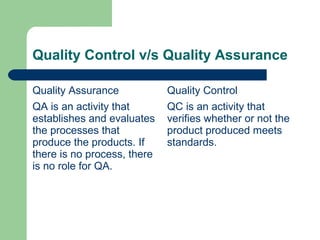
QA is an activity that
establishes and evaluates
the processes that
produce the products. If
there is no process, there
is no role for QA.
QC is an activity that
verifies whether or not the
product produced meets
standards.
Quality Control v/s Quality Assurance
Quality Assurance Quality Control
QA helps establish
processes
QC relates to a specific
product or service
QA sets up measurement
programs to evaluate
processes
QC verified whether
particular attributes exist,
or do not exist, in a
specific product or service
QA identifies weakness in
processes and improves
them
QC identifies defect for the
primary purpose of
correcting defects.
Quality Control v/s Quality Assurance
Quality Assurance Quality Control
QA is a management
responsibility, frequently
performed by a staff
function
QC is the responsibility of
the worker
QA evaluates whether or
not quality control is working
for the primary purpose of
determining whether or not
there is weakness in the
process
Quality Control v/s Quality Assurance
Quality Assurance Quality Control
Defining Processes Walkthrough
Quality Audit Testing
Selection of Tools Inspection
Training Checkpoint review
Impediments to Software Quality
Control
 Quality control is often viewed as a police
action
 IT is often considered an art
 Unclear or ineffective standards and
processes
 Lack of process training
Impediments to Software Quality
Assurance
 Management does not insist on compliance to processes
 Workers are not convinced of the value of processes
 Processes become obsolete
 Processes are difficult to use
 Workers lack training in processes
 Processes are not measurable
 Measurement can threaten employees
 Processes do not focus on critical aspects of products
Quality Assurance at each phase of
SDLC
 Requirements Analysis Phase:
 Three major activities that foster quality
– Measurement of process attributes
– Verification and Validation
– Management
 Managing quality in the analysis stage is a
challenge.
Quality Assurance at each phase of
SDLC
 Good Quality Requirements
– They are precise, with no room for
misinterpretation by users or implementers
– They specify just what the system must do, not
how to do it. They avoid specifying
implementation details
– They show conceptual integrity, building on a
simple set of facilities that interact well with each
other
Quality Assurance at each phase of
SDLC
 Major management deficiencies in most
software development projects:
– Incorrect schedules
– Incorrect cost estimates
– Inadequate project accountability procedures
– Inadequate quality assurance procedures
– Imprecise goals and success criteria
Quality Assurance at each phase of
SDLC
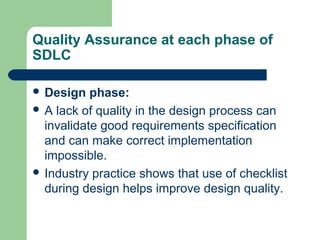
 Design phase:
 A lack of quality in the design process can
invalidate good requirements specification
and can make correct implementation
impossible.
 Industry practice shows that use of checklist
during design helps improve design quality.

Software quality assurance lecture 1

  • 1.
  • 2.
    What is Software? Accordingto the IEEE Software is: “Computer programs, procedures, and possibly associated documentation and data pertaining to the operation of a computer system”.
  • 3.
    What is SoftwareQuality ? According to the IEEE  Software quality is: 1. The degree to which a system, component, or process meets specified requirements. 2. The degree to which a system, component, or process meets customer or user needs or expectations. According to Pressman “Conformance to explicitly stated functional and performance requirements, explicitly documented development standards, and implicit characteristics that are expected of all professionally developed software”.
  • 4.
    What is SoftwareQuality?  “Achieving high levels of user satisfaction, portability, maintainability, robustness, and fitness for use” by Dr. Barry Boehm.  Quality means “conformance to user requirements” by Phil Crosby.  Edwards Deming considers quality to be “striving for excellence” in reliability and functions by continuous improvement in the process of development, support by statistical analysis of the causes of failure.
  • 5.
    What is SoftwareQuality?  Watts Humphrey, of the SEI, tends to speak of quality as “achieving excellent levels of fitness for use, conformance to requirements, reliability and maintainability.”  James Martin said that software quality means being on time, within budget and meeting user needs  Tom McCabe, the software complexity specialist, defines quality as “high level of user satisfaction and low defect levels, often associated with low complexity
  • 6.
    What is SoftwareQuality?  John Musa of Bell Laboratories states that quality means combination of “low defect levels, adherence of software functions to users needs, and high reliability”  Bill Perry, head of Quality Assurance Institute has defined quality as “high levels of user satisfaction and adherence to requirements”.
  • 7.
    Why Quality isImportant?  Quality is critical for survival and success.  Customers demand quality.  Everybody seems to understand quality.  Everybody wants quality  Everybody has a different perception of quality.  Essentially quality means satisfying customer.
  • 8.
    Why Quality isImportant?  Why business should be concerned with quality: – Quality is competitive issue now – Quality is a must for survival – Quality gives you the global reach – Quality is cost effective – Quality helps retain customers and increase profits – Quality is the hallmarks of world-class business
  • 9.
    Importance of SoftwareQuality  Software is a major component of computer systems  (about 80% of the cost) – used for – communication (e.g. phone system, email system) – health monitoring, – transportation (e.g. automobile, aeronautics), – economic exchanges (e.g. ecommerce), – entertainment, – etc.  Software defects are extremely costly in term of – money – reputation – loss of life
  • 10.
    Importance of SoftwareQuality  Several historic disasters attributed to software – 1988 shooting down of Airbus 320 by the USS Vincennes cryptic and misleading output displayed by tracking software – 1991 patriot missile failure inaccurate calculation of time due to computer arithmetic errors. – London Ambulance Service Computer Aided Dispatch System – several deaths – On June 3, 1980, the North American Aerospace Defense Command (NORAD) reported that the U.S. was under missile attack. – First operational launch attempt of the space shuttle, whose real-time operating software consists of about 500,000 lines of code, failed synchronization problem among its flight control computers. – 9 hour breakdown of AT&T's long distance telephone network caused by an untested code patch
  • 11.
    Software Quality Factors Correctness – accuracy, completeness of required output – upto-dateness, availability of the information  Reliability – Minimum failure rate  Efficiency resources needed to perform software function  Integrity – software system security, access rights  Usability – ability to learn, perform required task
  • 12.
    Software Quality Factors Maintainability – effort to identify and fix software failures (modularity, documentation, etc)  Flexibility – degree of adaptability (to new customers, tasks, etc)  Testability – support for testing (e.g. log files, automatic diagnostics, etc)  Portability – adaptation to other environments (hardware, software)  Reusability – use of software components for other projects  Interoperability – ability to interface with other components/systems
  • 13.
    Elements of QualityDefinition Quality factors Predictable Measurable Defect Level Yes Yes Defect Origins Yes Yes Defect Severity Yes Yes Defect Removal Efficiency Yes Yes Product Complexity Yes Yes Project Reliability Yes Yes Project Maintainability Yes Yes Project schedules Yes Yes Project budgets Yes Yes Portability Yes Yes Conformance to requirements No Yes User Satisfaction No Yes Fitness for Use No Yes Robustness No No
  • 14.
    Software Quality Challenges The measures for quality differ from project to project and organization to organization – Quality measures used for small systems may not be appropriate for the large ones.  Criteria for quality vary as a function of the specific characteristics of the project, the needs of the users and stakeholders, and the application requirements of the system and software. – Criteria for quality applied to real-time applications are not always relevant when dealing with systems that are not real-time.
  • 15.
    What is SoftwareQuality Assurance? According to the IEEE Software quality assurance is: 1. A planned and systematic pattern of all actions necessary to provide adequate confidence that an item or product conforms to established technical requirements. 2. A set of activities designed to evaluate the process by which the products are developed or manufactured. Contrast with: quality control.
  • 16.
    What is SoftwareQuality Assurance? According to D. Galin Software quality assurance is: “A systematic, planned set of actions necessary to provide adequate confidence that the software development process or the maintenance process of a software system product conforms to established functional technical requirements as well as with the managerial requirements of keeping the schedule and operating within the budgetary confines.”
  • 17.
    Objectives of SQA Development: Assuring an acceptable level of confidence that the software will conform to functional technical requirements.  Assuring an acceptable level of confidence that the software will conform to managerial scheduling and budgetary requirements.  Initiation and management of activities for the improvement and greater efficiency of software development and SQA activities. Maintenance:  Assuring an acceptable level of confidence that the software maintenance activities will conform to the functional technical requirements.  Assuring an acceptable level of confidence that the software maintenance activities will conform to managerial scheduling and budgetary requirements.  Initiate and manage activities to improve and increase the efficiency of software maintenance and SQA activities.
  • 18.
    Three General Principlesof QA Know what you are doing Know what you should be doing Know how to measure the difference
  • 19.
    Three General Principlesof QA Know what you are doing  understand what is being built, how it is being built and what it currently does.  suppose a software development process with – management structure (milestones, scheduling) – reporting policies – tracking
  • 20.
    Three General Principlesof QA  Know what you should be doing – having explicit requirements and specifications – suppose a software development process with  requirements analysis,  acceptance tests,  frequent user feedback
  • 21.
    Three General Principlesof QA  Know how to measure the difference – having explicit measures comparing what is being done from what should be done – four complementary methods:  formal methods – verify mathematically specified properties  testing – explicit input to exercise software and check for expected output  inspections – human examination of requirements, design, code, ... based on checklists  metrics – measures a known set of properties related to quality.
  • 22.
    Software Quality Challenges Complex Software requires different monitoring procedures than trivial applications.  Quality criteria vary dramatically depending on the phase of the project at which the evaluation takes place  The measures of the quality must be specific to the project being evaluated and must assess the effectiveness of the entire development process, not just individual segments.
  • 23.
    Software Quality Challenges Quality cannot be directly checked in the product; it must planned right from the beginning.  Quality goals must be clearly defined, effectively monitored, and rigorously enforced.  The project must focus on the quality issues of the project from the beginning, ensuring that quality criteria are consistent with defined requirements.  Quality must be planed into the project structure, constantly evaluated, and corrections applied when deficiencies are identified.
  • 24.
    Changing View ofQuality Past Present Quality is the responsibility of blue collar workers and direct labor employees working on the product Quality is everyone’s responsibility, including, white-collar workers, the indirect labor force and the overhead staff Quality defects should be hidden from the customers and management Defects should be highlighted and brought to the surface for corrective actions Quality problems lead to blame, faulty justification and excuses Quality problems lead to cooperative solutions Corrections-to-quality problems should be accompanied with minimum documentation Documentation is essential for “lessons learnt” so the mistakes are not repeated.
  • 25.
    Changing View ofQuality Past Present Increased quality will increase project costs Improved quality saves money and increase business Quality is internally focused Quality is customer focused Quality will not occur without close supervision of people People want to produce quality products Quality occurs during project execution Quality occurs at project initiation and must be planned for within the project
  • 26.
    Quality Control v/sQuality Assurance  Quality means meeting requirements and meeting customer needs, which means a defect-free product from both the producer’s and the customer’s viewpoint.  Both quality control and quality assurance are used to make quality happen.  Quality is an attribute of a product. A product is something produced, such as a requirement document, test data, source code etc.
  • 27.
    Quality Control v/sQuality Assurance Quality Assurance Quality Control Quality Assurance (QA) is the set of activities (including facilitation, training, measurement and analysis) needed to provide adequate confidence that processes are established and continuously improved in order to produce products or services that conform to requirements and are fit for use. Quality Control (QC) is defined as the processes and methods used to compare product quality to requirements and applicable standards, and the action taken when a nonconformance is detected.
  • 28.
    Quality Control v/sQuality Assurance Quality Assurance Quality Control QA is an activity that establishes and evaluates the processes that produce the products. If there is no process, there is no role for QA. QC is an activity that verifies whether or not the product produced meets standards.
  • 29.
    Quality Control v/sQuality Assurance Quality Assurance Quality Control QA helps establish processes QC relates to a specific product or service QA sets up measurement programs to evaluate processes QC verified whether particular attributes exist, or do not exist, in a specific product or service QA identifies weakness in processes and improves them QC identifies defect for the primary purpose of correcting defects.
  • 30.
    Quality Control v/sQuality Assurance Quality Assurance Quality Control QA is a management responsibility, frequently performed by a staff function QC is the responsibility of the worker QA evaluates whether or not quality control is working for the primary purpose of determining whether or not there is weakness in the process
  • 31.
    Quality Control v/sQuality Assurance Quality Assurance Quality Control Defining Processes Walkthrough Quality Audit Testing Selection of Tools Inspection Training Checkpoint review
  • 32.
    Impediments to SoftwareQuality Control  Quality control is often viewed as a police action  IT is often considered an art  Unclear or ineffective standards and processes  Lack of process training
  • 33.
    Impediments to SoftwareQuality Assurance  Management does not insist on compliance to processes  Workers are not convinced of the value of processes  Processes become obsolete  Processes are difficult to use  Workers lack training in processes  Processes are not measurable  Measurement can threaten employees  Processes do not focus on critical aspects of products
  • 34.
    Quality Assurance ateach phase of SDLC  Requirements Analysis Phase:  Three major activities that foster quality – Measurement of process attributes – Verification and Validation – Management  Managing quality in the analysis stage is a challenge.
  • 35.
    Quality Assurance ateach phase of SDLC  Good Quality Requirements – They are precise, with no room for misinterpretation by users or implementers – They specify just what the system must do, not how to do it. They avoid specifying implementation details – They show conceptual integrity, building on a simple set of facilities that interact well with each other
  • 36.
    Quality Assurance ateach phase of SDLC  Major management deficiencies in most software development projects: – Incorrect schedules – Incorrect cost estimates – Inadequate project accountability procedures – Inadequate quality assurance procedures – Imprecise goals and success criteria
  • 37.
    Quality Assurance ateach phase of SDLC  Design phase:  A lack of quality in the design process can invalidate good requirements specification and can make correct implementation impossible.  Industry practice shows that use of checklist during design helps improve design quality.